TRILLIUM SOFTWARE 2013 CUSTOMER CONFERENCE
Both Sides Now
Cloud Computing & Data Governance
Presented By:
Nigel Turner
VP Information
Management Strategy
1
Confused? I was…
“I've looked at clouds
from both sides now
From up and down, and
still somehow
It's cloud illusions I
recall
I really don't know
clouds at all”
Both Sides Now
Joni Mitchell 1967
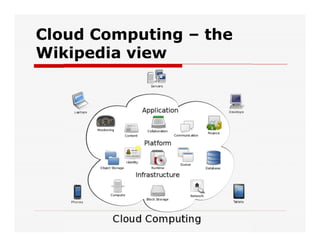
Cloud Computing – the
Wikipedia view
Cloud Computing – Some
alternative definitions
 “Cloud computing is the delivery of computing as a service
rather than a product, whereby shared resources, software, and
information are provided to computers and other devices as a
metered service over a network (typically the Internet).”
(Wikipedia)
 “Internet or network based subscription services for
applications, platforms or infrastructure” (IBM)
 “Marketing term for the technologies that provide computation,
software, data access, and storage services that do not require
end-user knowledge of the physical location or configuration of
the system that delivers the services.” (Trillium Software)
Cloud Computing –
core elements
 Provision of services via the Internet / network
 Virtual not physical allocation of resources
 Multi-tenanted hosting
 Pay as you use not outright purchase (cf
utilities)
 Cloud is a disruptive technology as it provides
a clear alternative model to outright purchase
of hardware, platforms & applications
Cloud Computing – how
it can be offered
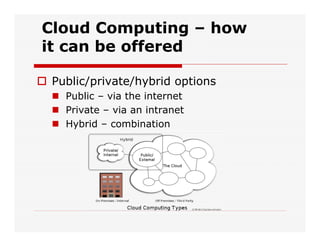
 Public/private/hybrid options
 Public – via the internet
 Private – via an intranet
 Hybrid – combination
Cloud Computing – what can
be offered
 Infrastructure as a service (IaaS)
 Hosted hardware, storage and servers
 Key providers include Amazon, Google
 Platform as a service (PaaS)
 Access to an externally managed platform for
application development & integration
 Key providers include AT&T, MS (Azure), Rackspace,
Jaspersoft
 Software as a service (SaaS)
 Access to software applications not managed in-house
 Thousands of examples…
Examples of SaaS
Cloud Computing: potential
benefits (1)
 Speed to deploy new applications &
services
 Greater standardisation
 Scalability & elasticity
 Lower initial implementation costs –
CAPEX to OPEX
 Better cost control and lower internal IT
costs (e.g. help desks)
Cloud Computing: potential
benefits (2)
 Benefits to SMEs who cannot afford to
purchase
 Try before you buy options – benefits
both customers & suppliers
 Self-service and self-configuration of
services
 Better and faster user adoption
 Potentially improved performance
 Automatic data back ups
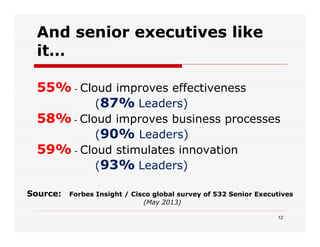
And senior executives like
it…
12
55% - Cloud improves effectiveness
(87% Leaders)
58% - Cloud improves business processes
(90% Leaders)
59% - Cloud stimulates innovation
(93% Leaders)
Source: Forbes Insight / Cisco global survey of 532 Senior Executives
(May 2013)
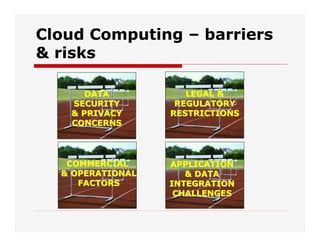
Cloud Computing – barriers
& risks
DATADATA
SECURITYSECURITY
& PRIVACY& PRIVACY
CONCERNSCONCERNS
COMMERCIALCOMMERCIAL
& OPERATIONAL& OPERATIONAL
FACTORSFACTORS
APPLICATIONAPPLICATION
& DATA& DATA
INTEGRATIONINTEGRATION
CHALLENGESCHALLENGES
LEGAL &LEGAL &
REGULATORYREGULATORY
RESTRICTIONSRESTRICTIONS
Barriers: Data Security &
Privacy Concerns
 Many organisations are reluctant to allow
their data & applications to be physically
held outside their immediate control
 Moving personal information into the
Cloud may increase the chances of
misuse and security breaches
 BUT… are hosted services less secure
than in-house?
Barriers: Legal &
Regulatory Restrictions
 Data protection laws (e.g. EU Data Protection
Acts) restricts where data can be held
physically – default is not outside EU unless
special provisions made
 Industry specific regulations (e.g. Finance) also
restrict where data can be held
 As Cloud hosting is virtual difficult to track and
verify where data is physically held
 If data is misused, who is responsible?
Barriers: Commercial &
operational factors
 Reduces CAPEX but some claim higher OPEX will
negate OPEX savings
 Creates a commercial & technical dependency on
the supplier
 Potential for supplier downtime and loss of
service
 Broadband speeds variable – e.g. rural areas
 Immature & volatile market so choosing reliable
and long term providers difficult
Barriers: Application &
Data Integration
 Public Cloud customers have to work out how
to integrate existing in house IT investments
with new Cloud services
 Many potential Cloud customers do not have
sufficiently virtualised in-house applications to
enable them to integrate
 Cloud might encourage greater fragmentation
of applications
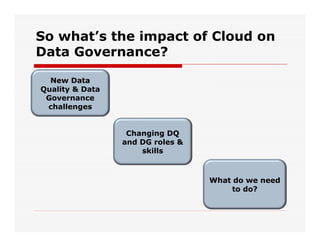
So what’s the impact of Cloud on
Data Governance?
New Data
Quality & Data
Governance
challenges
What do we need
to do?
Changing DQ
and DG roles &
skills
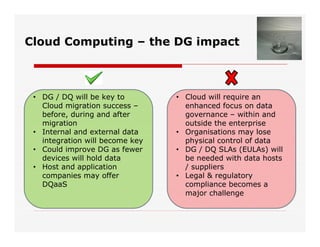
Cloud Computing – the DG impact
• DG / DQ will be key to
Cloud migration success –
before, during and after
migration
• Internal and external data
integration will become key
• Could improve DG as fewer
devices will hold data
• Host and application
companies may offer
DQaaS
• Cloud will require an
enhanced focus on data
governance – within and
outside the enterprise
• Organisations may lose
physical control of data
• DG / DQ SLAs (EULAs) will
be needed with data hosts
/ suppliers
• Legal & regulatory
compliance becomes a
major challenge
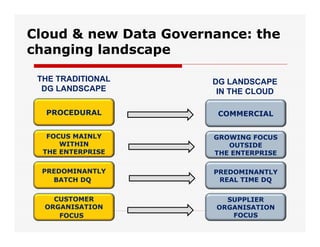
Cloud & new Data Governance: the
changing landscape
PREDOMINANTLY
BATCH DQ
CUSTOMER
ORGANISATION
FOCUS
PROCEDURAL
FOCUS MAINLY
WITHIN
THE ENTERPRISE
THE TRADITIONAL
DG LANDSCAPE
SUPPLIER
ORGANISATION
FOCUS
PREDOMINANTLY
REAL TIME DQ
GROWING FOCUS
OUTSIDE
THE ENTERPRISE
COMMERCIAL
DG LANDSCAPE
IN THE CLOUD
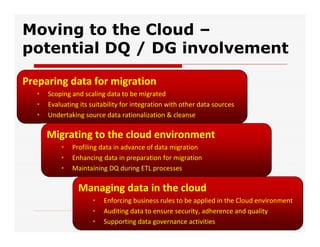
Moving to the Cloud –
potential DQ / DG involvement
Preparing data for migration
• Scoping and scaling data to be migrated
• Evaluating its suitability for integration with other data sources
• Undertaking source data rationalization & cleanse
Migrating to the cloud environment
• Profiling data in advance of data migration
• Enhancing data in preparation for migration
• Maintaining DQ during ETL processes
Managing data in the cloud
• Enforcing business rules to be applied in the Cloud environment
• Auditing data to ensure security, adherence and quality
• Supporting data governance activities
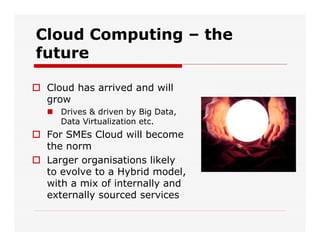
Cloud Computing – the
future
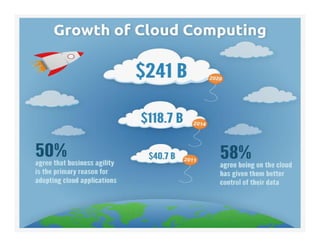
 Cloud has arrived and will
grow
 Drives & driven by Big Data,
Data Virtualization etc.
 For SMEs Cloud will become
the norm
 Larger organisations likely
to evolve to a Hybrid model,
with a mix of internally and
externally sourced services
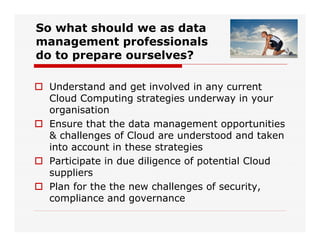
So what should we as data
management professionals
do to prepare ourselves?
 Understand and get involved in any current
Cloud Computing strategies underway in your
organisation
 Ensure that the data management opportunities
& challenges of Cloud are understood and taken
into account in these strategies
 Participate in due diligence of potential Cloud
suppliers
 Plan for the the new challenges of security,
compliance and governance
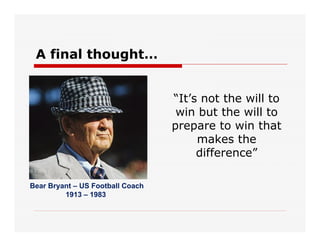
A final thought…
“It’s not the will to
win but the will to
prepare to win that
makes the
difference”
Bear Bryant – US Football Coach
1913 – 1983
Questions
Both Sides Now:
Cloud Computing & Data Governance
25

Cloud Computing and Data Governance

  • 1.
    TRILLIUM SOFTWARE 2013CUSTOMER CONFERENCE Both Sides Now Cloud Computing & Data Governance Presented By: Nigel Turner VP Information Management Strategy 1
  • 2.
    Confused? I was… “I'velooked at clouds from both sides now From up and down, and still somehow It's cloud illusions I recall I really don't know clouds at all” Both Sides Now Joni Mitchell 1967
  • 3.
    Cloud Computing –the Wikipedia view
  • 4.
    Cloud Computing –Some alternative definitions  “Cloud computing is the delivery of computing as a service rather than a product, whereby shared resources, software, and information are provided to computers and other devices as a metered service over a network (typically the Internet).” (Wikipedia)  “Internet or network based subscription services for applications, platforms or infrastructure” (IBM)  “Marketing term for the technologies that provide computation, software, data access, and storage services that do not require end-user knowledge of the physical location or configuration of the system that delivers the services.” (Trillium Software)
  • 5.
    Cloud Computing – coreelements  Provision of services via the Internet / network  Virtual not physical allocation of resources  Multi-tenanted hosting  Pay as you use not outright purchase (cf utilities)  Cloud is a disruptive technology as it provides a clear alternative model to outright purchase of hardware, platforms & applications
  • 6.
    Cloud Computing –how it can be offered  Public/private/hybrid options  Public – via the internet  Private – via an intranet  Hybrid – combination
  • 7.
    Cloud Computing –what can be offered  Infrastructure as a service (IaaS)  Hosted hardware, storage and servers  Key providers include Amazon, Google  Platform as a service (PaaS)  Access to an externally managed platform for application development & integration  Key providers include AT&T, MS (Azure), Rackspace, Jaspersoft  Software as a service (SaaS)  Access to software applications not managed in-house  Thousands of examples…
  • 8.
  • 10.
    Cloud Computing: potential benefits(1)  Speed to deploy new applications & services  Greater standardisation  Scalability & elasticity  Lower initial implementation costs – CAPEX to OPEX  Better cost control and lower internal IT costs (e.g. help desks)
  • 11.
    Cloud Computing: potential benefits(2)  Benefits to SMEs who cannot afford to purchase  Try before you buy options – benefits both customers & suppliers  Self-service and self-configuration of services  Better and faster user adoption  Potentially improved performance  Automatic data back ups
  • 12.
    And senior executiveslike it… 12 55% - Cloud improves effectiveness (87% Leaders) 58% - Cloud improves business processes (90% Leaders) 59% - Cloud stimulates innovation (93% Leaders) Source: Forbes Insight / Cisco global survey of 532 Senior Executives (May 2013)
  • 13.
    Cloud Computing –barriers & risks DATADATA SECURITYSECURITY & PRIVACY& PRIVACY CONCERNSCONCERNS COMMERCIALCOMMERCIAL & OPERATIONAL& OPERATIONAL FACTORSFACTORS APPLICATIONAPPLICATION & DATA& DATA INTEGRATIONINTEGRATION CHALLENGESCHALLENGES LEGAL &LEGAL & REGULATORYREGULATORY RESTRICTIONSRESTRICTIONS
  • 14.
    Barriers: Data Security& Privacy Concerns  Many organisations are reluctant to allow their data & applications to be physically held outside their immediate control  Moving personal information into the Cloud may increase the chances of misuse and security breaches  BUT… are hosted services less secure than in-house?
  • 15.
    Barriers: Legal & RegulatoryRestrictions  Data protection laws (e.g. EU Data Protection Acts) restricts where data can be held physically – default is not outside EU unless special provisions made  Industry specific regulations (e.g. Finance) also restrict where data can be held  As Cloud hosting is virtual difficult to track and verify where data is physically held  If data is misused, who is responsible?
  • 16.
    Barriers: Commercial & operationalfactors  Reduces CAPEX but some claim higher OPEX will negate OPEX savings  Creates a commercial & technical dependency on the supplier  Potential for supplier downtime and loss of service  Broadband speeds variable – e.g. rural areas  Immature & volatile market so choosing reliable and long term providers difficult
  • 17.
    Barriers: Application & DataIntegration  Public Cloud customers have to work out how to integrate existing in house IT investments with new Cloud services  Many potential Cloud customers do not have sufficiently virtualised in-house applications to enable them to integrate  Cloud might encourage greater fragmentation of applications
  • 18.
    So what’s theimpact of Cloud on Data Governance? New Data Quality & Data Governance challenges What do we need to do? Changing DQ and DG roles & skills
  • 19.
    Cloud Computing –the DG impact • DG / DQ will be key to Cloud migration success – before, during and after migration • Internal and external data integration will become key • Could improve DG as fewer devices will hold data • Host and application companies may offer DQaaS • Cloud will require an enhanced focus on data governance – within and outside the enterprise • Organisations may lose physical control of data • DG / DQ SLAs (EULAs) will be needed with data hosts / suppliers • Legal & regulatory compliance becomes a major challenge
  • 20.
    Cloud & newData Governance: the changing landscape PREDOMINANTLY BATCH DQ CUSTOMER ORGANISATION FOCUS PROCEDURAL FOCUS MAINLY WITHIN THE ENTERPRISE THE TRADITIONAL DG LANDSCAPE SUPPLIER ORGANISATION FOCUS PREDOMINANTLY REAL TIME DQ GROWING FOCUS OUTSIDE THE ENTERPRISE COMMERCIAL DG LANDSCAPE IN THE CLOUD
  • 21.
    Moving to theCloud – potential DQ / DG involvement Preparing data for migration • Scoping and scaling data to be migrated • Evaluating its suitability for integration with other data sources • Undertaking source data rationalization & cleanse Migrating to the cloud environment • Profiling data in advance of data migration • Enhancing data in preparation for migration • Maintaining DQ during ETL processes Managing data in the cloud • Enforcing business rules to be applied in the Cloud environment • Auditing data to ensure security, adherence and quality • Supporting data governance activities
  • 22.
    Cloud Computing –the future  Cloud has arrived and will grow  Drives & driven by Big Data, Data Virtualization etc.  For SMEs Cloud will become the norm  Larger organisations likely to evolve to a Hybrid model, with a mix of internally and externally sourced services
  • 23.
    So what shouldwe as data management professionals do to prepare ourselves?  Understand and get involved in any current Cloud Computing strategies underway in your organisation  Ensure that the data management opportunities & challenges of Cloud are understood and taken into account in these strategies  Participate in due diligence of potential Cloud suppliers  Plan for the the new challenges of security, compliance and governance
  • 24.
    A final thought… “It’snot the will to win but the will to prepare to win that makes the difference” Bear Bryant – US Football Coach 1913 – 1983
  • 25.
    Questions Both Sides Now: CloudComputing & Data Governance 25