




The Graduate  Mindset :  Get  more  out of postgraduate  education Focus:  Management  Education Sanjay Goel, JIIT Univ, 2007 Sanjay Goel, JIIT, 2007
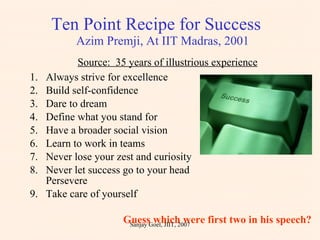
Ten Point Recipe for Success  Azim Premji, At IIT Madras, 2001 Always strive for excellence Build self-confidence  Dare to dream Define what you stand for  Have a broader social vision Learn to work in teams Never lose your zest and curiosity Never let success go to your head Persevere  Take care of yourself  Guess which were first two in his speech? Source:  35 years of illustrious experience Sanjay Goel, JIIT, 2007
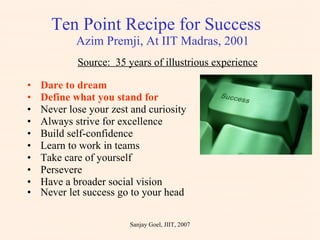
Ten Point Recipe for Success  Azim Premji, At IIT Madras, 2001 Dare to dream Define what you stand for  Never lose your zest and curiosity Always strive for excellence Build self-confidence  Learn to work in teams Take care of yourself  Persevere  Have a broader social vision Never let success go to your head Source:  35 years of illustrious experience Sanjay Goel, JIIT, 2007
Learning Objectives:  What constitutes effective management?     - Whetten  & Cameron,  1995   Building effective teams.  Communicating supportively;  Developing self-awareness;  Empowering and delegating Gaining power and influence;  Managing conflict;  Managing stress;  Motivating others;  Solving problems creatively;  Guess which were first two in this list? Source:  Decade long research Sanjay Goel, JIIT, 2007
Learning Objectives:  What constitutes effective management?     - Whetten  & Cameron,  1995   1.  Developing self-awareness;  2.  Managing stress;  3.  Solving problems creatively;  4.  Communicating supportively;  5.  Gaining power and influence;  6.  Motivating others;  7.  Managing conflict;  8.  Empowering and delegating; and  9.  Building effective teams.  Source:  Decade long research Sanjay Goel, JIIT, 2007
How MBAs view their job choices: Changing trends.     - Stanford & UC Santa Barbara study, 2004 800 MBAs from 11 leading North American and European schools Top 3 criteria for job choice  ? ? ?   Sanjay Goel, JIIT, 2007
How MBAs view their job choices: Changing trends.     - Stanford & UC Santa Barbara study, 2004 800 MBAs from 11 leading North American and European schools Top 3 criteria for job choice  Intellectual challenge (100). Financial package (80).  Reputation for ethics and caring about employees (77).   Sanjay Goel, JIIT, 2007
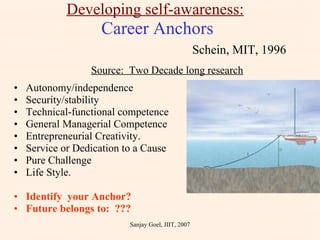
Developing self-awareness:   Career Anchors   Schein, MIT, 1996 Autonomy/independence  Security/stability  Technical-functional competence  General Managerial Competence  Entrepreneurial Creativity.  Service or Dedication to a Cause  Pure Challenge  Life Style.  Identify  your Anchor? Future belongs to:  ??? Source:  Two Decade long research Sanjay Goel, JIIT, 2007
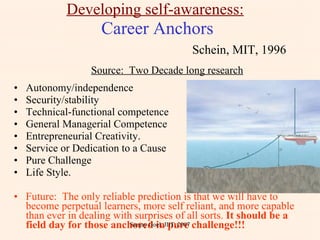
Developing self-awareness:   Career Anchors   Schein, MIT, 1996 Autonomy/independence  Security/stability  Technical-functional competence  General Managerial Competence  Entrepreneurial Creativity.  Service or Dedication to a Cause  Pure Challenge  Life Style.  Future:  The only reliable prediction is that we will have to become perpetual learners, more self reliant, and more capable than ever in dealing with surprises of all sorts.  It should be a field day for those anchored in pure challenge!!!   Source:  Two Decade long research Sanjay Goel, JIIT, 2007
Developing self-awareness: A Cross-Cultural Comparison of  Ethical Attitudes of Business Managers    -  Joseph Christie et al, 2003 Most business managers (99% Americans, 96% Indians and 84% Koreans) agree that they  need to be ethical in their business activities   in order to achieve long-term success and profitability. Sanjay Goel, JIIT, 2007
Honesty and Fairness Manipulating or misreporting financial figures; Over-Billing; Withholding or hiding information or not telling the whole truth;  Selling something the customer doesn’t need; Stealing via expense reports, loyalty,  bribes Discrimination ;  Taking advantage of customers ; Developing self-awareness: Addressing Workplace ethical issues     - Power & Lundsten,  2005 … Sanjay Goel, JIIT, 2007
Intrapersonal and Personal issues  Stealing time from employer; Lack of integrity; Courage; Not knowing what to do; Reporting another’s unethical or other behavior;  Self-interest;  Acting in conflict with corporate policy; All other instances of unhappiness with corporate policy Taking credit for other’s work; Favoritism; Stealing ideas or clients; Inappropriate relationships; Backstabbing; Other instances of problems with others; Not being respected as an individual; Being threatened with losing your job; Being asked to do something unethical; Being asked to do something you don’t agree with;  Others not taking ownership of the job Developing self-awareness: Addressing Workplace ethical issues     - Power & Lundsten,  2005 … Sanjay Goel, JIIT, 2007
Complex, business issues Conflicts of interest; Privacy or misuse of information;  excessive corporate profit ; Compliance;  Product or service quality ; Competitive practices or relationships;  Environmental issues;  Safety; International issues; Work-Life balance; Sexual harassment; Insider trading or other illegal acts; Executive compensation; Corporate social responsibility or citizenship Developing self-awareness: Addressing Workplace ethical issues     - Power & Lundsten,  2005 Sanjay Goel, JIIT, 2007
Your opportunity: Prepare yourself  to Redefine the Business Challenge the binary dichotomies Development  Vs  Sustainability Success  Vs  Happiness Abundance  Vs  Ethics Competition  Vs  Coexistence Profit  Vs  Mutual fulfillment Work  Vs  Pleasure Tradition  Vs  Modernity Sanjay Goel, JIIT, 2007
Your self assessment Sanjay Goel, JIIT, 2007
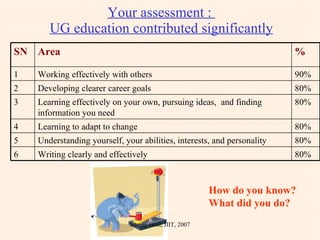
Your assessment :  UG education contributed significantly How do you know? What did you do? Sanjay Goel, JIIT, 2007 SN Area % 1 Working effectively with others 90% 2 Developing clearer career goals 80% 3 Learning effectively on your own, pursuing ideas,  and finding information you need  80% 4 Learning to adapt to change 80% 5 Understanding yourself, your abilities, interests, and personality 80% 6 Writing clearly and effectively 80%
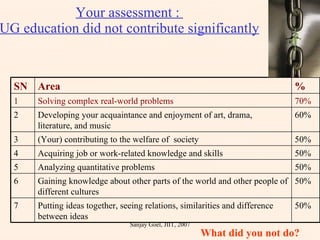
Your assessment :  UG education did not contribute significantly What did you not do? Sanjay Goel, JIIT, 2007 SN Area % 1 Solving complex real-world problems 70% 2 Developing your acquaintance and enjoyment of art, drama, literature, and music 60% 3 (Your) contributing to the welfare of  society 50% 4 Acquiring job or work-related knowledge and skills 50% 5 Analyzing quantitative problems 50% 6 Gaining knowledge about other parts of the world and other people of different cultures 50% 7 Putting ideas together, seeing relations, similarities and difference between ideas 50%
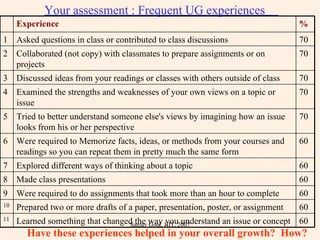
Your assessment : Frequent UG experiences  Have these experiences helped in your overall growth?  How? Sanjay Goel, JIIT, 2007 Experience % 1 Asked questions in class or contributed to class discussions 70  2 Collaborated (not copy) with classmates to prepare assignments or on  projects  70  3 Discussed ideas from your readings or classes with others outside of class  70  4 Examined the strengths and weaknesses of your own views on a topic or issue 70  5 Tried to better understand someone else's views by imagining how an issue looks from his or her perspective 70  6 Were required to Memorize facts, ideas, or methods from your courses and readings so you can repeat them in pretty much the same form 60 7 Explored different ways of thinking about a topic 60 8 Made class presentations 60 9 Were required to do assignments that took more than an hour to complete 60 10 Prepared two or more drafts of a paper, presentation, poster, or assignment  60 11 Learned something that changed the way you understand an issue or concept 60
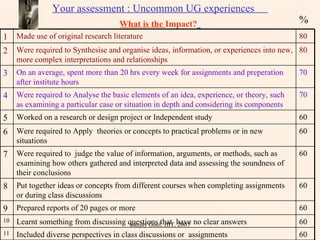
Your assessment : Uncommon UG experiences  What is the  Impact?   % Sanjay Goel, JIIT, 2007 1 Made use of original research literature 80  2 Were required to Synthesise and organise ideas, information, or experiences into new, more complex interpretations and relationships 80 3 On an average, spent more than 20 hrs every week for assignments and preperation after institute hours 70 4 Were required to Analyse the basic elements of an idea, experience, or theory, such as examining a particular case or situation in depth and considering its components 70  5 Worked on a research or design project or Independent study  60  6 Were required to Apply  theories or concepts to practical problems or in new situations 60 7 Were required to  judge the value of information, arguments, or methods, such as examining how others gathered and interpreted data and assessing the soundness of their conclusions 60 8 Put together ideas or concepts from different courses when completing assignments or during class discussions 60 9 Prepared reports of 20 pages or more 60 10 Learnt something from discussing questions that  have no clear answers  60 11 Included diverse perspectives in class discussions or  assignments 60
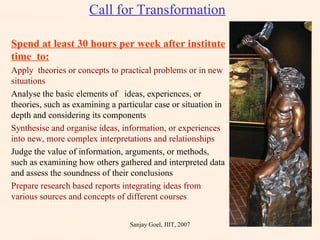
Call for Transformation Spend at least 30 hours per week after institute time  to: Apply  theories or concepts to practical problems or in new  situations Analyse the basic elements of  ideas, experiences, or theories, such as examining a particular case or situation in depth and considering its components Synthesise and organise ideas, information, or experiences into new, more complex interpretations and relationships Judge the value of information, arguments, or methods, such as examining how others gathered and interpreted data and assess the soundness of their conclusions Prepare research based reports integrating ideas from various sources and concepts of different courses Sanjay Goel, JIIT, 2007
May God Bless You  Sanjay Goel, JIIT, 2007

Preparing Graduate Mindset

  • 1.
    The Graduate Mindset : Get more out of postgraduate education Focus: Management Education Sanjay Goel, JIIT Univ, 2007 Sanjay Goel, JIIT, 2007
  • 2.
    The Graduate Mindset : Get more out of postgraduate education Focus: Management Education Sanjay Goel, JIIT Univ, 2007 Sanjay Goel, JIIT, 2007
  • 3.
    Ten Point Recipefor Success Azim Premji, At IIT Madras, 2001 Always strive for excellence Build self-confidence Dare to dream Define what you stand for Have a broader social vision Learn to work in teams Never lose your zest and curiosity Never let success go to your head Persevere Take care of yourself Guess which were first two in his speech? Source: 35 years of illustrious experience Sanjay Goel, JIIT, 2007
  • 4.
    Ten Point Recipefor Success Azim Premji, At IIT Madras, 2001 Dare to dream Define what you stand for Never lose your zest and curiosity Always strive for excellence Build self-confidence Learn to work in teams Take care of yourself Persevere Have a broader social vision Never let success go to your head Source: 35 years of illustrious experience Sanjay Goel, JIIT, 2007
  • 5.
    Learning Objectives: What constitutes effective management? - Whetten & Cameron, 1995 Building effective teams. Communicating supportively; Developing self-awareness; Empowering and delegating Gaining power and influence; Managing conflict; Managing stress; Motivating others; Solving problems creatively; Guess which were first two in this list? Source: Decade long research Sanjay Goel, JIIT, 2007
  • 6.
    Learning Objectives: What constitutes effective management? - Whetten & Cameron, 1995 1. Developing self-awareness; 2. Managing stress; 3. Solving problems creatively; 4. Communicating supportively; 5. Gaining power and influence; 6. Motivating others; 7. Managing conflict; 8. Empowering and delegating; and 9. Building effective teams. Source: Decade long research Sanjay Goel, JIIT, 2007
  • 7.
    How MBAs viewtheir job choices: Changing trends. - Stanford & UC Santa Barbara study, 2004 800 MBAs from 11 leading North American and European schools Top 3 criteria for job choice ? ? ? Sanjay Goel, JIIT, 2007
  • 8.
    How MBAs viewtheir job choices: Changing trends. - Stanford & UC Santa Barbara study, 2004 800 MBAs from 11 leading North American and European schools Top 3 criteria for job choice Intellectual challenge (100). Financial package (80). Reputation for ethics and caring about employees (77). Sanjay Goel, JIIT, 2007
  • 9.
    Developing self-awareness: Career Anchors Schein, MIT, 1996 Autonomy/independence Security/stability Technical-functional competence General Managerial Competence Entrepreneurial Creativity. Service or Dedication to a Cause Pure Challenge Life Style. Identify your Anchor? Future belongs to: ??? Source: Two Decade long research Sanjay Goel, JIIT, 2007
  • 10.
    Developing self-awareness: Career Anchors Schein, MIT, 1996 Autonomy/independence Security/stability Technical-functional competence General Managerial Competence Entrepreneurial Creativity. Service or Dedication to a Cause Pure Challenge Life Style. Future: The only reliable prediction is that we will have to become perpetual learners, more self reliant, and more capable than ever in dealing with surprises of all sorts. It should be a field day for those anchored in pure challenge!!! Source: Two Decade long research Sanjay Goel, JIIT, 2007
  • 11.
    Developing self-awareness: ACross-Cultural Comparison of Ethical Attitudes of Business Managers - Joseph Christie et al, 2003 Most business managers (99% Americans, 96% Indians and 84% Koreans) agree that they need to be ethical in their business activities in order to achieve long-term success and profitability. Sanjay Goel, JIIT, 2007
  • 12.
    Honesty and FairnessManipulating or misreporting financial figures; Over-Billing; Withholding or hiding information or not telling the whole truth; Selling something the customer doesn’t need; Stealing via expense reports, loyalty, bribes Discrimination ; Taking advantage of customers ; Developing self-awareness: Addressing Workplace ethical issues - Power & Lundsten, 2005 … Sanjay Goel, JIIT, 2007
  • 13.
    Intrapersonal and Personalissues Stealing time from employer; Lack of integrity; Courage; Not knowing what to do; Reporting another’s unethical or other behavior; Self-interest; Acting in conflict with corporate policy; All other instances of unhappiness with corporate policy Taking credit for other’s work; Favoritism; Stealing ideas or clients; Inappropriate relationships; Backstabbing; Other instances of problems with others; Not being respected as an individual; Being threatened with losing your job; Being asked to do something unethical; Being asked to do something you don’t agree with; Others not taking ownership of the job Developing self-awareness: Addressing Workplace ethical issues - Power & Lundsten, 2005 … Sanjay Goel, JIIT, 2007
  • 14.
    Complex, business issuesConflicts of interest; Privacy or misuse of information; excessive corporate profit ; Compliance; Product or service quality ; Competitive practices or relationships; Environmental issues; Safety; International issues; Work-Life balance; Sexual harassment; Insider trading or other illegal acts; Executive compensation; Corporate social responsibility or citizenship Developing self-awareness: Addressing Workplace ethical issues - Power & Lundsten, 2005 Sanjay Goel, JIIT, 2007
  • 15.
    Your opportunity: Prepareyourself to Redefine the Business Challenge the binary dichotomies Development Vs Sustainability Success Vs Happiness Abundance Vs Ethics Competition Vs Coexistence Profit Vs Mutual fulfillment Work Vs Pleasure Tradition Vs Modernity Sanjay Goel, JIIT, 2007
  • 16.
    Your self assessmentSanjay Goel, JIIT, 2007
  • 17.
    Your assessment : UG education contributed significantly How do you know? What did you do? Sanjay Goel, JIIT, 2007 SN Area % 1 Working effectively with others 90% 2 Developing clearer career goals 80% 3 Learning effectively on your own, pursuing ideas, and finding information you need 80% 4 Learning to adapt to change 80% 5 Understanding yourself, your abilities, interests, and personality 80% 6 Writing clearly and effectively 80%
  • 18.
    Your assessment : UG education did not contribute significantly What did you not do? Sanjay Goel, JIIT, 2007 SN Area % 1 Solving complex real-world problems 70% 2 Developing your acquaintance and enjoyment of art, drama, literature, and music 60% 3 (Your) contributing to the welfare of society 50% 4 Acquiring job or work-related knowledge and skills 50% 5 Analyzing quantitative problems 50% 6 Gaining knowledge about other parts of the world and other people of different cultures 50% 7 Putting ideas together, seeing relations, similarities and difference between ideas 50%
  • 19.
    Your assessment :Frequent UG experiences Have these experiences helped in your overall growth? How? Sanjay Goel, JIIT, 2007 Experience % 1 Asked questions in class or contributed to class discussions 70 2 Collaborated (not copy) with classmates to prepare assignments or on projects 70 3 Discussed ideas from your readings or classes with others outside of class 70 4 Examined the strengths and weaknesses of your own views on a topic or issue 70 5 Tried to better understand someone else's views by imagining how an issue looks from his or her perspective 70 6 Were required to Memorize facts, ideas, or methods from your courses and readings so you can repeat them in pretty much the same form 60 7 Explored different ways of thinking about a topic 60 8 Made class presentations 60 9 Were required to do assignments that took more than an hour to complete 60 10 Prepared two or more drafts of a paper, presentation, poster, or assignment 60 11 Learned something that changed the way you understand an issue or concept 60
  • 20.
    Your assessment :Uncommon UG experiences What is the Impact? % Sanjay Goel, JIIT, 2007 1 Made use of original research literature 80 2 Were required to Synthesise and organise ideas, information, or experiences into new, more complex interpretations and relationships 80 3 On an average, spent more than 20 hrs every week for assignments and preperation after institute hours 70 4 Were required to Analyse the basic elements of an idea, experience, or theory, such as examining a particular case or situation in depth and considering its components 70 5 Worked on a research or design project or Independent study 60 6 Were required to Apply theories or concepts to practical problems or in new situations 60 7 Were required to judge the value of information, arguments, or methods, such as examining how others gathered and interpreted data and assessing the soundness of their conclusions 60 8 Put together ideas or concepts from different courses when completing assignments or during class discussions 60 9 Prepared reports of 20 pages or more 60 10 Learnt something from discussing questions that have no clear answers 60 11 Included diverse perspectives in class discussions or assignments 60
  • 21.
    Call for TransformationSpend at least 30 hours per week after institute time to: Apply theories or concepts to practical problems or in new situations Analyse the basic elements of ideas, experiences, or theories, such as examining a particular case or situation in depth and considering its components Synthesise and organise ideas, information, or experiences into new, more complex interpretations and relationships Judge the value of information, arguments, or methods, such as examining how others gathered and interpreted data and assess the soundness of their conclusions Prepare research based reports integrating ideas from various sources and concepts of different courses Sanjay Goel, JIIT, 2007
  • 22.
    May God BlessYou Sanjay Goel, JIIT, 2007