Why Would Learning ‘ed’
and ‘ing’ Adjectives Help
With the IELTS Speaking
Test?
The Simple Answer
Whether its IELTS or any other test, the speaking
component will most likely ask you to speak
about yourself and the things around you.
Speaking About Yourself
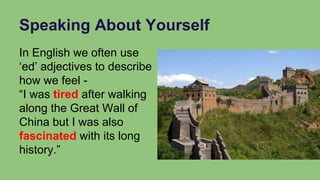
In English we often use
‘ed’ adjectives to describe
how we feel -
“I was tired after walking
along the Great Wall of
China but I was also
fascinated with its long
history.”
Speaking About The Things Around You
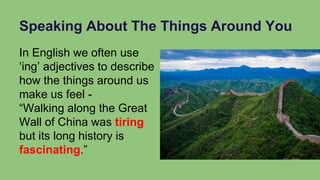
In English we often use
‘ing’ adjectives to describe
how the things around us
make us feel -
“Walking along the Great
Wall of China was tiring
but its long history is
fascinating.”
The Common Mistake
It is very common for non English speaker to use ‘ed’
and ‘ing’ in the wrong way and unfortunately native
speaker (such as testers) will hear these mistakes.
“I was tiring after walking along the Great Wall of
China but I was also fascinating with its long
history.”
“Walking along the Great Wall of China was tired
but its long history is fascinated.”
Sample Questions
Now you have seen some sentences structures
let’s take a look at some sample questions
which come from the come from the British
Council IELTS preparation page.
They should give you an indication of how
adjectives will help get you a great score.
Where You Live?
Let’s talk about your home town or village:
● what kind of place is it?
● what’s the most interesting part of your
town/village?
● what kind of jobs do the people in your
town/village do?
● would you say it’s a good place to live? (why?)
What Kind of Place Is It?
Non ‘ed’ and ‘ing’
adjectives:
small, big, pretty,
beautiful, peaceful,
noisy, quaint, vibrant,
colourful
‘ed’ and ‘ing’
adjectives:
charming, fascinating,
exciting, interesting,
surprising, relaxing
“I come from a charming little town.”
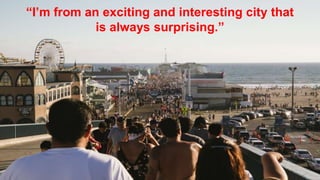
“I’m from an exciting and interesting city that
is always surprising.”
Would You Say it is a Good Place to Live?
Non ‘ed’ and ‘ing’
adjectives:
nice, great, fantastic,
brilliant, terrible,
horrible
‘ed’ and ‘ing’
adjectives:
alarming, annoying,
boring, depressing,
entertaining,
exhausting, relaxing
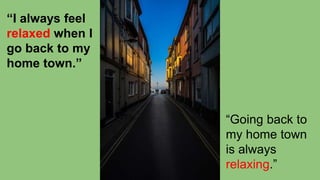
“I always feel
relaxed when I
go back to my
home town.”
“Going back to
my home town
is always
relaxing.”
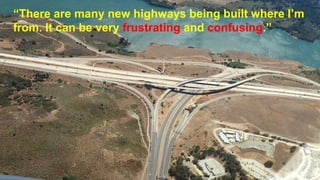
“There are many new highways being built where I’m
from. It can be very frustrating and confusing.”
“There are lots
of fascinating
little cafes in
my town
where you can
unwind when
you feel a little
bit tired.”
“There’s been
a distressing
increase in the
amount of air
pollution in
my city and I
am very
disturbed that
nothing is
being done to
improve it.”
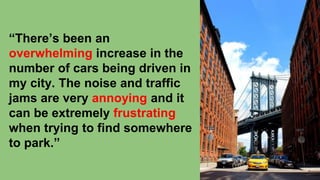
“There’s been an
overwhelming increase in the
number of cars being driven in
my city. The noise and traffic
jams are very annoying and it
can be extremely frustrating
when trying to find somewhere
to park.”
What Is Important To You?
Describe something you own which is very
important to you. You should say:
● where you got it from
● how long you have had it
● what you use it for; and
● explain why it is important to you.
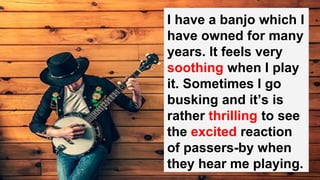
I have a banjo which I
have owned for many
years. It feels very
soothing when I play
it. Sometimes I go
busking and it’s is
rather thrilling to see
the excited reaction
of passers-by when
they hear me playing.
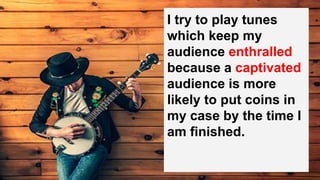
I try to play tunes
which keep my
audience enthralled
because a captivated
audience is more
likely to put coins in
my case by the time I
am finished.
I have an old VW which I have had for about 10
years. It breaks down sometimes and its problems
can be perplexing. However I always feel very
satisfied when I can fix it and get it back on the road.
What Is Important To You?
Rounding off questions
Tell me
● is it valuable in terms of money?
● would it be easy to replace?
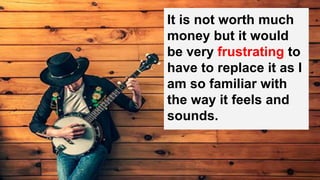
It is not worth much
money but it would
be very frustrating to
have to replace it as I
am so familiar with
the way it feels and
sounds.
It is not worth much money but it would be
devastating if I ever had to replace it. I would feel
very discouraged if I had to find a new car after I
have put in so much tiring work into this one.
Talking About Values
Let’s consider first of all how people’s values
have changed.
● What kind of things give status to people in your
country?
● Have things changed since your parents’ time?
People like to own the
latest exciting technology
but lose interest in it
whenever something new
is comes along. It is a
perplexing phenomena and
the fact that I behave this
way too makes me feel
somewhat embarrassed.
In conclusion
I hope this slideshow has given
you some ideas as to how your
speaking can be enhanced when
you use ‘ed’ and ‘ing’ adjectives.
If you are currently frustrated
and confused when you use
these adjectives can I suggest
that you take a look at my app.
In conclusion
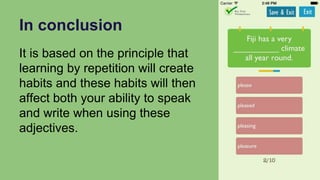
It is based on the principle that
learning by repetition will create
habits and these habits will then
affect both your ability to speak
and write when using these
adjectives.
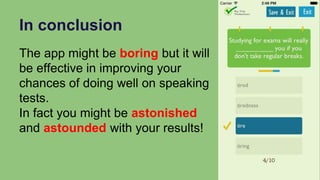
In conclusion
The app might be boring but it will
be effective in improving your
chances of doing well on speaking
tests.
In fact you might be astonished
and astounded with your results!
Big Tick is a small developer of iPhone
apps which make learning English a
little easier. Find us on:
iTunes
Facebook
Google+
Twitter
Sino Weibo
Photo Attributions
"Natural Earth projection SW" by Strebe - Own work. Licensed under CC BY-SA 3.0 via Wikimedia Commons -
http://commons.wikimedia.org/wiki/File:Natural_Earth_projection_SW.JPG#mediaviewer/File:Natural_Earth_projection_
SW.JPG
“Talking” http://englishschmooze.com/
"20090529 Great Wall 8185" by Jakub Hałun - Own work. Licensed under CC BY-SA 3.0 via Wikimedia Commons -
http://commons.wikimedia.org/wiki/File:20090529_Great_Wall_8185.jpg#mediaviewer/File:20090529_Great_Wall_8185
.jpg
"The Great Wall of China at Jinshanling" by Severin.stalder - Own work. Licensed under CC BY-SA 3.0 via Wikimedia
Commons -
http://commons.wikimedia.org/wiki/File:The_Great_Wall_of_China_at_Jinshanling.jpg#mediaviewer/File:The_Great_Wa
ll_of_China_at_Jinshanling.jpg
https://ununsplash.imgix.net/photo-1415302199888-384f752645d0?fit=crop&fm=jpg&h=700&q=75&w=1050
https://unsplash.imgix.net/photo-1415033523948-6c31d010530d?fit=crop&fm=jpg&h=700&q=75&w=1050
https://unsplash.imgix.net/photo-1417962798089-0c93ceaed88a?fit=crop&fm=jpg&h=1575&q=75&w=1050
https://unsplash.imgix.net/reserve/rHBf1lEaSc2nsbqYPQau_IMG_0177.jpg?fit=crop&fm=jpg&h=800&q=75&w=1050
Photo Attributions
https://unsplash.imgix.net/photo-1415226581130-91cb7f52f078?fit=crop&fm=jpg&h=800&q=75&w=1050
https://ununsplash.imgix.net/43/kIlSDateSiyn420ZmgjA_IMG_3768.JPG?fit=crop&fm=jpg&h=800&q=75&w=1050
https://unsplash.imgix.net/reserve/OlxPGKgRUaX0E1hg3b3X_Dumbo.JPG?fit=crop&fm=jpg&h=1575&q=75&w=1050
http://gratisography.com/pictures/63_1.jpg
http://gratisography.com/pictures/77_1.jpg
http://gratisography.com/pictures/177_1.jpg

Preparing for the IELTS Speaking Test

  • 1.
    Why Would Learning‘ed’ and ‘ing’ Adjectives Help With the IELTS Speaking Test?
  • 2.
    The Simple Answer Whetherits IELTS or any other test, the speaking component will most likely ask you to speak about yourself and the things around you.
  • 3.
    Speaking About Yourself InEnglish we often use ‘ed’ adjectives to describe how we feel - “I was tired after walking along the Great Wall of China but I was also fascinated with its long history.”
  • 4.
    Speaking About TheThings Around You In English we often use ‘ing’ adjectives to describe how the things around us make us feel - “Walking along the Great Wall of China was tiring but its long history is fascinating.”
  • 5.
    The Common Mistake Itis very common for non English speaker to use ‘ed’ and ‘ing’ in the wrong way and unfortunately native speaker (such as testers) will hear these mistakes. “I was tiring after walking along the Great Wall of China but I was also fascinating with its long history.” “Walking along the Great Wall of China was tired but its long history is fascinated.”
  • 6.
    Sample Questions Now youhave seen some sentences structures let’s take a look at some sample questions which come from the come from the British Council IELTS preparation page. They should give you an indication of how adjectives will help get you a great score.
  • 7.
    Where You Live? Let’stalk about your home town or village: ● what kind of place is it? ● what’s the most interesting part of your town/village? ● what kind of jobs do the people in your town/village do? ● would you say it’s a good place to live? (why?)
  • 8.
    What Kind ofPlace Is It? Non ‘ed’ and ‘ing’ adjectives: small, big, pretty, beautiful, peaceful, noisy, quaint, vibrant, colourful ‘ed’ and ‘ing’ adjectives: charming, fascinating, exciting, interesting, surprising, relaxing
  • 9.
    “I come froma charming little town.”
  • 10.
    “I’m from anexciting and interesting city that is always surprising.”
  • 11.
    Would You Sayit is a Good Place to Live? Non ‘ed’ and ‘ing’ adjectives: nice, great, fantastic, brilliant, terrible, horrible ‘ed’ and ‘ing’ adjectives: alarming, annoying, boring, depressing, entertaining, exhausting, relaxing
  • 12.
    “I always feel relaxedwhen I go back to my home town.” “Going back to my home town is always relaxing.”
  • 13.
    “There are manynew highways being built where I’m from. It can be very frustrating and confusing.”
  • 14.
    “There are lots offascinating little cafes in my town where you can unwind when you feel a little bit tired.”
  • 15.
    “There’s been a distressing increasein the amount of air pollution in my city and I am very disturbed that nothing is being done to improve it.”
  • 16.
    “There’s been an overwhelmingincrease in the number of cars being driven in my city. The noise and traffic jams are very annoying and it can be extremely frustrating when trying to find somewhere to park.”
  • 17.
    What Is ImportantTo You? Describe something you own which is very important to you. You should say: ● where you got it from ● how long you have had it ● what you use it for; and ● explain why it is important to you.
  • 18.
    I have abanjo which I have owned for many years. It feels very soothing when I play it. Sometimes I go busking and it’s is rather thrilling to see the excited reaction of passers-by when they hear me playing.
  • 19.
    I try toplay tunes which keep my audience enthralled because a captivated audience is more likely to put coins in my case by the time I am finished.
  • 20.
    I have anold VW which I have had for about 10 years. It breaks down sometimes and its problems can be perplexing. However I always feel very satisfied when I can fix it and get it back on the road.
  • 21.
    What Is ImportantTo You? Rounding off questions Tell me ● is it valuable in terms of money? ● would it be easy to replace?
  • 22.
    It is notworth much money but it would be very frustrating to have to replace it as I am so familiar with the way it feels and sounds.
  • 23.
    It is notworth much money but it would be devastating if I ever had to replace it. I would feel very discouraged if I had to find a new car after I have put in so much tiring work into this one.
  • 24.
    Talking About Values Let’sconsider first of all how people’s values have changed. ● What kind of things give status to people in your country? ● Have things changed since your parents’ time?
  • 25.
    People like toown the latest exciting technology but lose interest in it whenever something new is comes along. It is a perplexing phenomena and the fact that I behave this way too makes me feel somewhat embarrassed.
  • 26.
    In conclusion I hopethis slideshow has given you some ideas as to how your speaking can be enhanced when you use ‘ed’ and ‘ing’ adjectives. If you are currently frustrated and confused when you use these adjectives can I suggest that you take a look at my app.
  • 27.
    In conclusion It isbased on the principle that learning by repetition will create habits and these habits will then affect both your ability to speak and write when using these adjectives.
  • 28.
    In conclusion The appmight be boring but it will be effective in improving your chances of doing well on speaking tests. In fact you might be astonished and astounded with your results!
  • 29.
    Big Tick isa small developer of iPhone apps which make learning English a little easier. Find us on: iTunes Facebook Google+ Twitter Sino Weibo
  • 30.
    Photo Attributions "Natural Earthprojection SW" by Strebe - Own work. Licensed under CC BY-SA 3.0 via Wikimedia Commons - http://commons.wikimedia.org/wiki/File:Natural_Earth_projection_SW.JPG#mediaviewer/File:Natural_Earth_projection_ SW.JPG “Talking” http://englishschmooze.com/ "20090529 Great Wall 8185" by Jakub Hałun - Own work. Licensed under CC BY-SA 3.0 via Wikimedia Commons - http://commons.wikimedia.org/wiki/File:20090529_Great_Wall_8185.jpg#mediaviewer/File:20090529_Great_Wall_8185 .jpg "The Great Wall of China at Jinshanling" by Severin.stalder - Own work. Licensed under CC BY-SA 3.0 via Wikimedia Commons - http://commons.wikimedia.org/wiki/File:The_Great_Wall_of_China_at_Jinshanling.jpg#mediaviewer/File:The_Great_Wa ll_of_China_at_Jinshanling.jpg https://ununsplash.imgix.net/photo-1415302199888-384f752645d0?fit=crop&fm=jpg&h=700&q=75&w=1050 https://unsplash.imgix.net/photo-1415033523948-6c31d010530d?fit=crop&fm=jpg&h=700&q=75&w=1050 https://unsplash.imgix.net/photo-1417962798089-0c93ceaed88a?fit=crop&fm=jpg&h=1575&q=75&w=1050 https://unsplash.imgix.net/reserve/rHBf1lEaSc2nsbqYPQau_IMG_0177.jpg?fit=crop&fm=jpg&h=800&q=75&w=1050
  • 31.