International Journal of Trend in Scientific Research and Development (IJTSRD)
Volume 4 Issue 2, February 2020 Available Online: www.ijtsrd.com e-ISSN: 2456 – 6470
@ IJTSRD | Unique Paper ID – IJTSRD30203 | Volume – 4 | Issue – 2 | January-February 2020 Page 1134
Preparation and Control of Chemical Filling Station by using DCS
Mr. J. Asokan1 M. E. (Ph.D), S. Gobisha2, T. Haritha2, K. P. Thivyapriya2
1Assistant Professor, 2UG Student,
1,2Department of Electronics and Communication Engineering,
1,2Paavai Engineering College, Namakkal, Tamil Nadu, India
ABSTRACT
Here, we are monitoring, controlling and maintaining the chemical filling
station by using DCS automation. Distributed control system is an embedded
system which is a combination of hardware and software used for control
operations. Each chemical has different method of packing. Some chemicals
should be handled morecarefully.Eachandeverychemical undergoesnumber
of process one by one to obtain the resultant product. Here we are using
sodium soap as chemical solids. This sodium soap is usedinDe-inkingprocess
in paper industries for removing the ink from the recycling paper, where
sodium soap is used in large amount in liquid form. Sodium soap arenormally
obtained in solid form, we have to undergo number of manual operations to
convert it into liquid form which is quite complex and requires time and
continuous monitoring.Thismanual operationsareconvertedintoautomation
by introducing (DCS) Distributed Control System.
KEYWORDS: Distributed Control System (DCS), 800XA control software,
Temperature Transmitter, Level Transmitter and Magnetic Flow Transmitter
How to cite this paper: Mr. J. Asokan | S.
Gobisha | T. Haritha | K. P. Thivyapriya
"Preparation and Control of Chemical
Filling Station by using DCS" Published in
International Journal
of Trend in Scientific
Research and
Development(ijtsrd),
ISSN: 2456-6470,
Volume-4 | Issue-2,
February 2020,
pp.1134-1136, URL:
www.ijtsrd.com/papers/ijtsrd30203.pdf
Copyright © 2019 by author(s) and
International Journal ofTrendinScientific
Research and Development Journal. This
is an Open Access article distributed
under the terms of
the Creative
CommonsAttribution
License (CC BY 4.0)
(http://creativecommons.org/licenses/by
/4.0)
1. INRODUCTION
Sodium soap is a solid form of a fatty acid used in a varietyof
cleaning and lubrication products.Ina domesticusage,soaps
are usually used for washing, bathing and other types of
housekeeping. In industry, sodium soaps are used as
thickener, component of some lubricants, and precursor to
catalysts.
When used for cleaning, sodium solubilizes particles, which
can then be separated from the article being cleaned.
Sometimes sodium soapsactsassurfactants,emulsifying oils
to enable them to be carried away by water.
Sodium hydroxide is used to adjust pH. The role of the
surfactant used for de-inking to create hydrophilic,
dispersed ink particles. Sodium Hydrosulfite is also
commonly used to reduce the colors in recycled paper
industry.
For de-inking process, the required chemical should be in
liquid form. To convert the solid chemicals into liquid it has
some manual operations. The bags of solid chemicals is
dropped into the hopper, it carries the solid chemicals tothe
cooking unit through the conveyor belt. In the cooking unit
the water is added to the solid chemicals and it is steamed at
a particular temperature, this converts the solid chemical
into liquid which is cooled and brought to the packing unit
and packed at the particular amount into the containers as
per the requirements.
This overall process is a manual operation which is
converted into automatic process with the help of (DCS)
Distributed Control System which is a computerized control
system.
2. LITRATURE SURVEY
Chandima Gomes [1] “Characterizing Of Bentonite With
Chemical, Physical, and Electrical perspectives For
improvement Of Electrical Grounding Systems” the main
objective of the paper is use application of bentonite as
electrical grounding improvement material (GIM) has been
investigated.
R. Yesodha [2] “Effectiveness of Firefly Algorithm in solving
Bin Packing Problem” the main objective of the paper is to
solve the Bin Packing Problem (BPP) with the help of Bio-
inspired computing and FireFly Algorithm.
Dieter Schrenk [3] “Literature report on food packing
materials and their potential impact on human health”, the
main objective of this paper is to present and discuss the
major facts and perspectives related to assessment of health
risks of food packaging materials (FPMs) issue also
comparing the properties of a broad spectrum of FPM with
respect to food safety.
A. SYSTEM ARCHITECTURE:
The scope of this control system is to maintain the chemical
packing system of chemical solids at all loads. Each chemical
has different method of packing. Some chemicals should be
IJTSRD30203
International Journal of Trend in Scientific Research and Development (IJTSRD) @ www.ijtsrd.com eISSN: 2456-6470
@ IJTSRD | Unique Paper ID – IJTSRD30203 | Volume – 4 | Issue – 2 | January-February 2020 Page 1135
handled more carefully. Each andeverychemicalsundergoes
number of process one by one to obtain the resultant
product. Here in our project, we are replacing the
programmable logic controller (PLC) with the distributed
control system (DCS). DCS is a control system where each
individual controller communicating to a central computers
acting as workstations.Suchasystemshastheadvantagethat
failure of a single component will not cause system failure,
shutdown; Sometimes called graceful degradation.
B. PROPOSED SYSTEM:
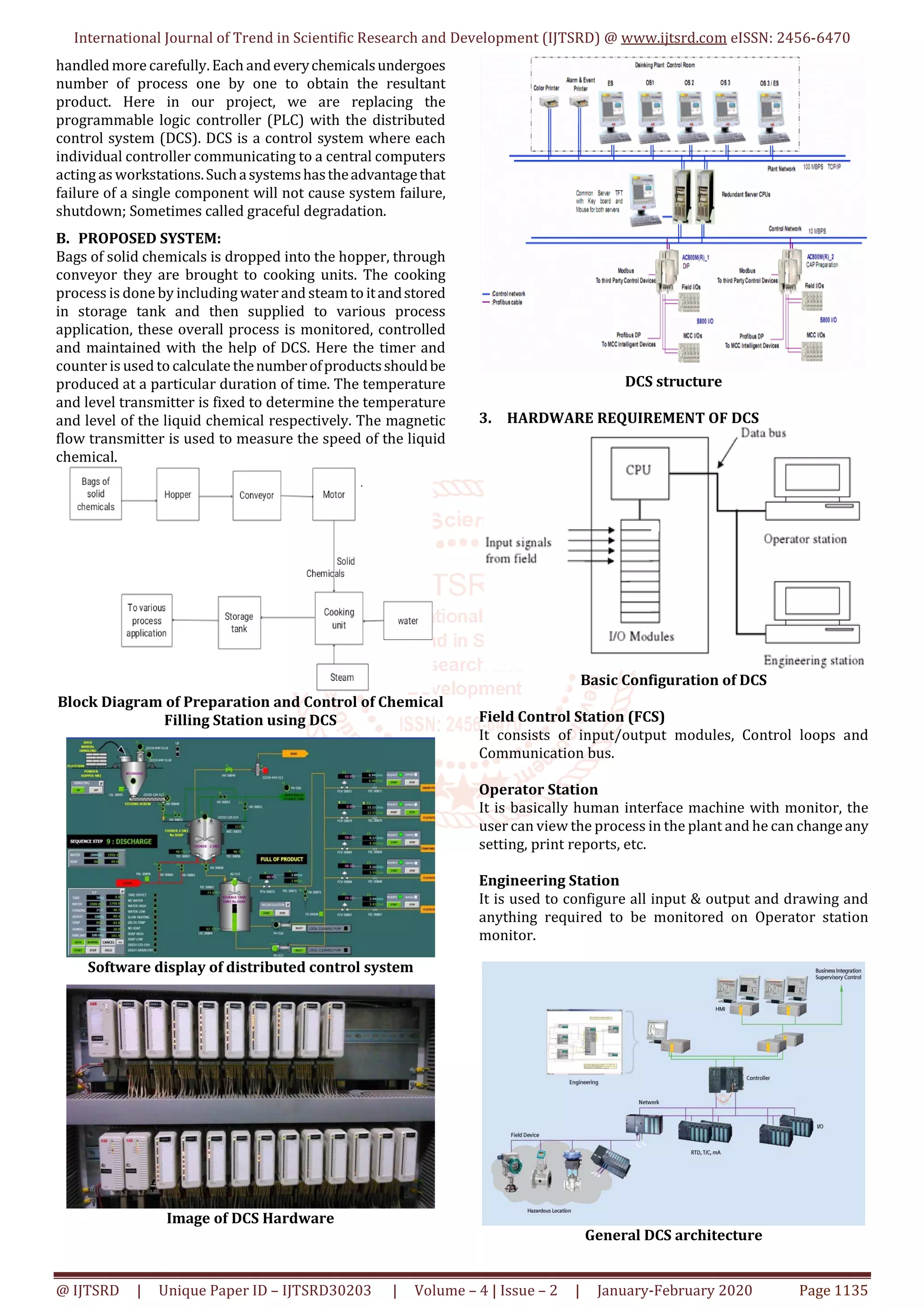
Bags of solid chemicals is dropped into the hopper, through
conveyor they are brought to cooking units. The cooking
process is done by including water and steam to itandstored
in storage tank and then supplied to various process
application, these overall process is monitored, controlled
and maintained with the help of DCS. Here the timer and
counter is used to calculate thenumberofproductsshouldbe
produced at a particular duration of time. The temperature
and level transmitter is fixed to determine the temperature
and level of the liquid chemical respectively. The magnetic
flow transmitter is used to measure the speed of the liquid
chemical.
Block Diagram of Preparation and Control of Chemical
Filling Station using DCS
Software display of distributed control system
Image of DCS Hardware
DCS structure
3. HARDWARE REQUIREMENT OF DCS
Basic Configuration of DCS
Field Control Station (FCS)
It consists of input/output modules, Control loops and
Communication bus.
Operator Station
It is basically human interface machine with monitor, the
user can view the process in the plant and he can changeany
setting, print reports, etc.
Engineering Station
It is used to configure all input & output and drawing and
anything required to be monitored on Operator station
monitor.
General DCS architecture
International Journal of Trend in Scientific Research and Development (IJTSRD) @ www.ijtsrd.com eISSN: 2456-6470
@ IJTSRD | Unique Paper ID – IJTSRD30203 | Volume – 4 | Issue – 2 | January-February 2020 Page 1136
The elements of a commercial DCS network
4. 800XA CONTROL SOFTWARE
AC 800M control applications can be created in any of the
five IEC 61131-3 dialects by using Engineering workstation,
and then be downloaded to controllers using the Control
Builder. Control applicationscanbedistributedand executed
on several controllers and communicate with each other on
Control Network using named variable communication.
Parts of the application can be downloaded to different
controllers. The functionality range for control applications
is wide, from binary control to closed loop control, with
advanced functions like auto tuning PIDs, fuzzy control, etc.
Pre-defined process objects likemotorobjects,valveobjects,
etc. are available. It is possible to build user-definedfunction
blocks, and also to hide its content in order to protect the
intellectual property. User-defined serial protocols can be
developed in structured text with the support of special
functions needed, e.g. for checksum calculation. Control
Modules extend the IEC 61131-3 language to an object-
oriented configuration method. The Control Moduleconcept
raises the abstraction level of engineering by hiding details
in pre-defined control blocks. This enables reuse to a higher
degree, making repetitive engineering very efficient.
5. THE PROGRAMMING LANGUAGES
Function Block Diagram: Function Block is a graphical
language for depicting signal and data flows with the
help of library-stored software elements.
Structured Text: Structured text (ST) is a high-level
programming language which contains comprehensive
range of constructs for assignments, function calls,
expressions, conditional statements, etc.
Ladder Diagram: Ladder diagram (LD) is a graphical
language based on relay ladder logic which define
interlocks and control actions in terms of relay contacts
and coils, and other functions as "black boxes".
Sequential Function Chart: Sequential function chart
(SFC) is a graphical language for describe the sequential
behavior of a control system.
Instruction List: Instruction list (IL) is a low-level,
execution-efficient PLC language it has a structure
similar to Assembler.
Configuration and Downloading: Applications can
either be loaded into the target controllers by non-
volatile Flash memory cards.
6. CONCLUSION AND RESULT
The demand for recycled fiber is globally increasing bymore
than 4% annually compared to around 2% for virgin fibers.
This means the recycling of is increased.Ahigherproportion
of deinked fiber will also be used in especially magazine
grade papers. Newsprint is already produced with 100%
deinked pulp. For deinking process sodium soap are highly
consumed that too in liquid form, Which isachievedwith the
help of DCS. DCS minimizes the manual operation by
atomizing it.
These trends signify that more deinking and other recycling
process to reach the same quality target, the requirement of
chemicals will be high.
REFERENCE:
[1] Jacob L. Johansen, ARC Centre of Excellence for Coral
Reef Studies, and School of Marine and Tropical
Biology, James Cook University, Townsville,
Queensland, Australia.
[2] Muller, R. M. de Brito and R. J. Bender "Instrumented
Sphere for Compression Analysis", Proc. IEEE IIMTC
2008.
[3] M. Niraimathi[1], S. Sivakumar [2], R.Vigneshwaran [3],
R.Vinothkumar [4], P.Babu[5] . 1,2,3,4 U G Students,
Department of ECE, K. S. Rangasamy College of
Technology, Tiruchengode, Tamilnadu, India.
5Associate Professor, Department of ECE, K. S.
Rangasamy College of Technology, Tiruchengode,
Tamil Nadu, India. Published in "International Journal
of Electronics and Computer Science Engineering".
[4] J. G. Rocha, C. Couto, J. H. Correia. Department of
Industrial Electronics, UniÍersity of Minho, Campus de
Azurem, 4800 Guimaraes, Portugal Received 14
September 1999; received in revised form 8 February
2000; accepted 9 February 2000.
[5] Tan, Y. M. Sch. of Electr. & Electron. Eng., Univ. of
Manchester, Manchester, UK. Yin, W.; Peyton, A.J.
Published in "Instrumentation and Measurement
Technology Conference (I2MTC), 2012 IEEE
International". Date of Conference13-16 May 2012.

Preparation and Control of Chemical Filling Station by using DCS

  • 1.
    International Journal ofTrend in Scientific Research and Development (IJTSRD) Volume 4 Issue 2, February 2020 Available Online: www.ijtsrd.com e-ISSN: 2456 – 6470 @ IJTSRD | Unique Paper ID – IJTSRD30203 | Volume – 4 | Issue – 2 | January-February 2020 Page 1134 Preparation and Control of Chemical Filling Station by using DCS Mr. J. Asokan1 M. E. (Ph.D), S. Gobisha2, T. Haritha2, K. P. Thivyapriya2 1Assistant Professor, 2UG Student, 1,2Department of Electronics and Communication Engineering, 1,2Paavai Engineering College, Namakkal, Tamil Nadu, India ABSTRACT Here, we are monitoring, controlling and maintaining the chemical filling station by using DCS automation. Distributed control system is an embedded system which is a combination of hardware and software used for control operations. Each chemical has different method of packing. Some chemicals should be handled morecarefully.Eachandeverychemical undergoesnumber of process one by one to obtain the resultant product. Here we are using sodium soap as chemical solids. This sodium soap is usedinDe-inkingprocess in paper industries for removing the ink from the recycling paper, where sodium soap is used in large amount in liquid form. Sodium soap arenormally obtained in solid form, we have to undergo number of manual operations to convert it into liquid form which is quite complex and requires time and continuous monitoring.Thismanual operationsareconvertedintoautomation by introducing (DCS) Distributed Control System. KEYWORDS: Distributed Control System (DCS), 800XA control software, Temperature Transmitter, Level Transmitter and Magnetic Flow Transmitter How to cite this paper: Mr. J. Asokan | S. Gobisha | T. Haritha | K. P. Thivyapriya "Preparation and Control of Chemical Filling Station by using DCS" Published in International Journal of Trend in Scientific Research and Development(ijtsrd), ISSN: 2456-6470, Volume-4 | Issue-2, February 2020, pp.1134-1136, URL: www.ijtsrd.com/papers/ijtsrd30203.pdf Copyright © 2019 by author(s) and International Journal ofTrendinScientific Research and Development Journal. This is an Open Access article distributed under the terms of the Creative CommonsAttribution License (CC BY 4.0) (http://creativecommons.org/licenses/by /4.0) 1. INRODUCTION Sodium soap is a solid form of a fatty acid used in a varietyof cleaning and lubrication products.Ina domesticusage,soaps are usually used for washing, bathing and other types of housekeeping. In industry, sodium soaps are used as thickener, component of some lubricants, and precursor to catalysts. When used for cleaning, sodium solubilizes particles, which can then be separated from the article being cleaned. Sometimes sodium soapsactsassurfactants,emulsifying oils to enable them to be carried away by water. Sodium hydroxide is used to adjust pH. The role of the surfactant used for de-inking to create hydrophilic, dispersed ink particles. Sodium Hydrosulfite is also commonly used to reduce the colors in recycled paper industry. For de-inking process, the required chemical should be in liquid form. To convert the solid chemicals into liquid it has some manual operations. The bags of solid chemicals is dropped into the hopper, it carries the solid chemicals tothe cooking unit through the conveyor belt. In the cooking unit the water is added to the solid chemicals and it is steamed at a particular temperature, this converts the solid chemical into liquid which is cooled and brought to the packing unit and packed at the particular amount into the containers as per the requirements. This overall process is a manual operation which is converted into automatic process with the help of (DCS) Distributed Control System which is a computerized control system. 2. LITRATURE SURVEY Chandima Gomes [1] “Characterizing Of Bentonite With Chemical, Physical, and Electrical perspectives For improvement Of Electrical Grounding Systems” the main objective of the paper is use application of bentonite as electrical grounding improvement material (GIM) has been investigated. R. Yesodha [2] “Effectiveness of Firefly Algorithm in solving Bin Packing Problem” the main objective of the paper is to solve the Bin Packing Problem (BPP) with the help of Bio- inspired computing and FireFly Algorithm. Dieter Schrenk [3] “Literature report on food packing materials and their potential impact on human health”, the main objective of this paper is to present and discuss the major facts and perspectives related to assessment of health risks of food packaging materials (FPMs) issue also comparing the properties of a broad spectrum of FPM with respect to food safety. A. SYSTEM ARCHITECTURE: The scope of this control system is to maintain the chemical packing system of chemical solids at all loads. Each chemical has different method of packing. Some chemicals should be IJTSRD30203
  • 2.
    International Journal ofTrend in Scientific Research and Development (IJTSRD) @ www.ijtsrd.com eISSN: 2456-6470 @ IJTSRD | Unique Paper ID – IJTSRD30203 | Volume – 4 | Issue – 2 | January-February 2020 Page 1135 handled more carefully. Each andeverychemicalsundergoes number of process one by one to obtain the resultant product. Here in our project, we are replacing the programmable logic controller (PLC) with the distributed control system (DCS). DCS is a control system where each individual controller communicating to a central computers acting as workstations.Suchasystemshastheadvantagethat failure of a single component will not cause system failure, shutdown; Sometimes called graceful degradation. B. PROPOSED SYSTEM: Bags of solid chemicals is dropped into the hopper, through conveyor they are brought to cooking units. The cooking process is done by including water and steam to itandstored in storage tank and then supplied to various process application, these overall process is monitored, controlled and maintained with the help of DCS. Here the timer and counter is used to calculate thenumberofproductsshouldbe produced at a particular duration of time. The temperature and level transmitter is fixed to determine the temperature and level of the liquid chemical respectively. The magnetic flow transmitter is used to measure the speed of the liquid chemical. Block Diagram of Preparation and Control of Chemical Filling Station using DCS Software display of distributed control system Image of DCS Hardware DCS structure 3. HARDWARE REQUIREMENT OF DCS Basic Configuration of DCS Field Control Station (FCS) It consists of input/output modules, Control loops and Communication bus. Operator Station It is basically human interface machine with monitor, the user can view the process in the plant and he can changeany setting, print reports, etc. Engineering Station It is used to configure all input & output and drawing and anything required to be monitored on Operator station monitor. General DCS architecture
  • 3.
    International Journal ofTrend in Scientific Research and Development (IJTSRD) @ www.ijtsrd.com eISSN: 2456-6470 @ IJTSRD | Unique Paper ID – IJTSRD30203 | Volume – 4 | Issue – 2 | January-February 2020 Page 1136 The elements of a commercial DCS network 4. 800XA CONTROL SOFTWARE AC 800M control applications can be created in any of the five IEC 61131-3 dialects by using Engineering workstation, and then be downloaded to controllers using the Control Builder. Control applicationscanbedistributedand executed on several controllers and communicate with each other on Control Network using named variable communication. Parts of the application can be downloaded to different controllers. The functionality range for control applications is wide, from binary control to closed loop control, with advanced functions like auto tuning PIDs, fuzzy control, etc. Pre-defined process objects likemotorobjects,valveobjects, etc. are available. It is possible to build user-definedfunction blocks, and also to hide its content in order to protect the intellectual property. User-defined serial protocols can be developed in structured text with the support of special functions needed, e.g. for checksum calculation. Control Modules extend the IEC 61131-3 language to an object- oriented configuration method. The Control Moduleconcept raises the abstraction level of engineering by hiding details in pre-defined control blocks. This enables reuse to a higher degree, making repetitive engineering very efficient. 5. THE PROGRAMMING LANGUAGES Function Block Diagram: Function Block is a graphical language for depicting signal and data flows with the help of library-stored software elements. Structured Text: Structured text (ST) is a high-level programming language which contains comprehensive range of constructs for assignments, function calls, expressions, conditional statements, etc. Ladder Diagram: Ladder diagram (LD) is a graphical language based on relay ladder logic which define interlocks and control actions in terms of relay contacts and coils, and other functions as "black boxes". Sequential Function Chart: Sequential function chart (SFC) is a graphical language for describe the sequential behavior of a control system. Instruction List: Instruction list (IL) is a low-level, execution-efficient PLC language it has a structure similar to Assembler. Configuration and Downloading: Applications can either be loaded into the target controllers by non- volatile Flash memory cards. 6. CONCLUSION AND RESULT The demand for recycled fiber is globally increasing bymore than 4% annually compared to around 2% for virgin fibers. This means the recycling of is increased.Ahigherproportion of deinked fiber will also be used in especially magazine grade papers. Newsprint is already produced with 100% deinked pulp. For deinking process sodium soap are highly consumed that too in liquid form, Which isachievedwith the help of DCS. DCS minimizes the manual operation by atomizing it. These trends signify that more deinking and other recycling process to reach the same quality target, the requirement of chemicals will be high. REFERENCE: [1] Jacob L. Johansen, ARC Centre of Excellence for Coral Reef Studies, and School of Marine and Tropical Biology, James Cook University, Townsville, Queensland, Australia. [2] Muller, R. M. de Brito and R. J. Bender "Instrumented Sphere for Compression Analysis", Proc. IEEE IIMTC 2008. [3] M. Niraimathi[1], S. Sivakumar [2], R.Vigneshwaran [3], R.Vinothkumar [4], P.Babu[5] . 1,2,3,4 U G Students, Department of ECE, K. S. Rangasamy College of Technology, Tiruchengode, Tamilnadu, India. 5Associate Professor, Department of ECE, K. S. Rangasamy College of Technology, Tiruchengode, Tamil Nadu, India. Published in "International Journal of Electronics and Computer Science Engineering". [4] J. G. Rocha, C. Couto, J. H. Correia. Department of Industrial Electronics, UniÍersity of Minho, Campus de Azurem, 4800 Guimaraes, Portugal Received 14 September 1999; received in revised form 8 February 2000; accepted 9 February 2000. [5] Tan, Y. M. Sch. of Electr. & Electron. Eng., Univ. of Manchester, Manchester, UK. Yin, W.; Peyton, A.J. Published in "Instrumentation and Measurement Technology Conference (I2MTC), 2012 IEEE International". Date of Conference13-16 May 2012.