Solution Manual for Critical Thinking The Art of Argument, 2nd Edition
Solution Manual for Critical Thinking The Art of Argument, 2nd Edition
Solution Manual for Critical Thinking The Art of Argument, 2nd Edition
Solution Manual for Critical Thinking The Art of Argument, 2nd Edition
Solution Manual for Critical Thinking The Art of Argument, 2nd Edition
1.
Solution Manual forCritical Thinking The Art of
Argument, 2nd Edition download
https://testbankmall.com/product/solution-manual-for-critical-
thinking-the-art-of-argument-2nd-edition/
Visit testbankmall.com today to download the complete set of
test bank or solution manual
2.
Here are somerecommended products for you. Click the link to
download, or explore more at testbankmall.com
Solution Manual for Art of Thinking, The: A Guide to
critical and Creative Thought, 11/E 11th Edition :
0321953312
https://testbankmall.com/product/solution-manual-for-art-of-thinking-
the-a-guide-to-critical-and-creative-thought-11-e-11th-
edition-0321953312/
Test Bank for The Art of Reasoning An Introduction to
Logic and Critical Thinking, Fourth Edition
https://testbankmall.com/product/test-bank-for-the-art-of-reasoning-
an-introduction-to-logic-and-critical-thinking-fourth-edition/
Solution Manual for Understanding the Essentials of
Critical Care Nursing 2nd Edition by Perrin
https://testbankmall.com/product/solution-manual-for-understanding-
the-essentials-of-critical-care-nursing-2nd-edition-by-perrin/
The Articulate Voice An Introduction to Voice and Diction
4th Edition Wells Test Bank
https://testbankmall.com/product/the-articulate-voice-an-introduction-
to-voice-and-diction-4th-edition-wells-test-bank/
3.
Economics 21st EditionMcConnell Test Bank
https://testbankmall.com/product/economics-21st-edition-mcconnell-
test-bank/
Test bank for Janson’s History of Art 8th Edition Davies
Denny Hofrichter Jacobs Roberts Simon
https://testbankmall.com/product/test-bank-for-jansons-history-of-
art-8th-edition-davies-denny-hofrichter-jacobs-roberts-simon/
Solution Manual for Advanced Financial Accounting, 12th
Edition, Theodore Christensen, David Cottrell, Cassy Budd,
ISBN-10: 1259916979, ISBN-13: 9781259916977
https://testbankmall.com/product/solution-manual-for-advanced-
financial-accounting-12th-edition-theodore-christensen-david-cottrell-
cassy-budd-isbn-10-1259916979-isbn-13-9781259916977/
Test Bank for Fundamentals of Human Resource Management
8th by Noe
https://testbankmall.com/product/test-bank-for-fundamentals-of-human-
resource-management-8th-by-noe/
Fundamentals of Anatomy and Physiology 10th Edition
Martini Solutions Manual
https://testbankmall.com/product/fundamentals-of-anatomy-and-
physiology-10th-edition-martini-solutions-manual/
4.
Engineering Mechanics Staticsin SI Units 14th Edition
Hibbeler Solutions Manual
https://testbankmall.com/product/engineering-mechanics-statics-in-si-
units-14th-edition-hibbeler-solutions-manual/
5.
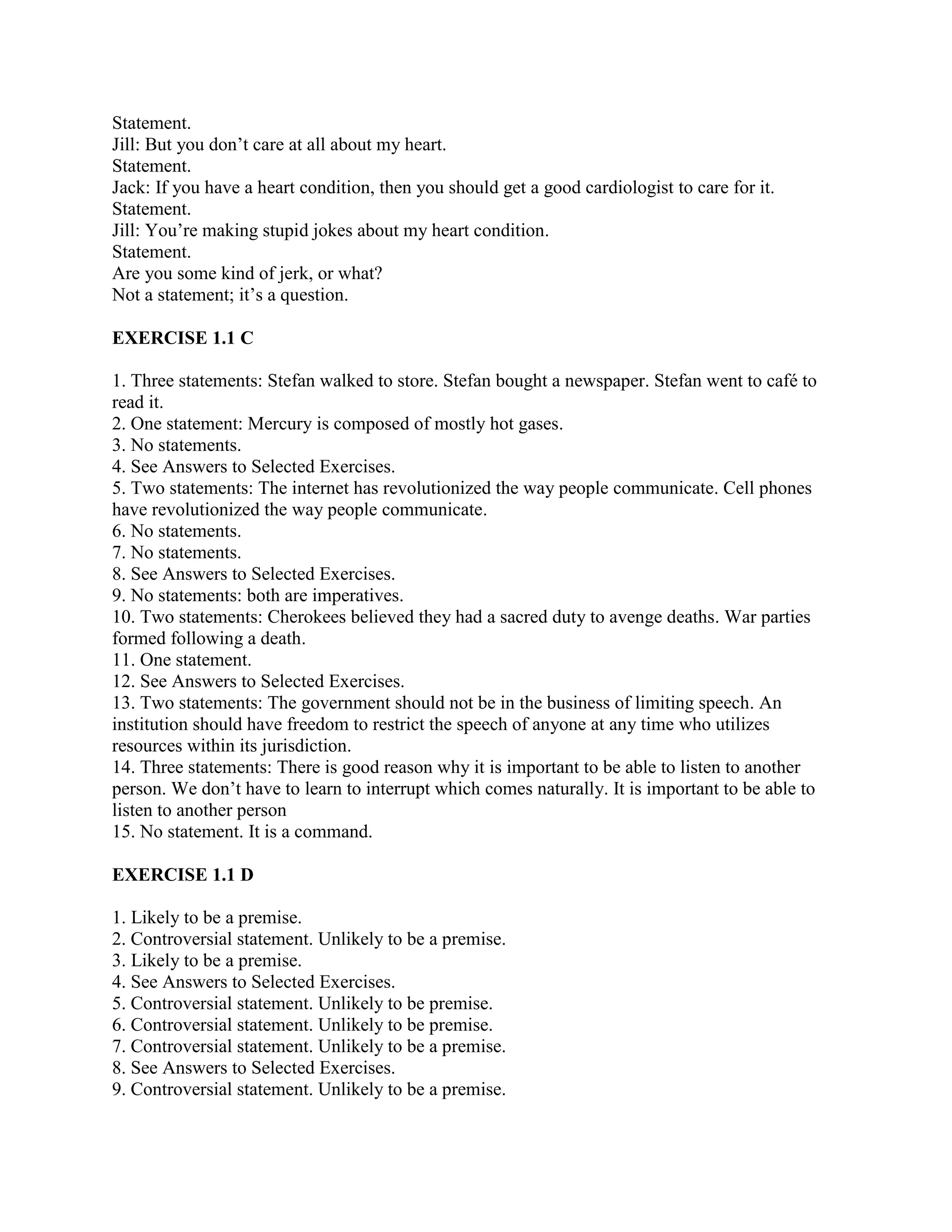
Statement.
Jill: But youdon’t care at all about my heart.
Statement.
Jack: If you have a heart condition, then you should get a good cardiologist to care for it.
Statement.
Jill: You’re making stupid jokes about my heart condition.
Statement.
Are you some kind of jerk, or what?
Not a statement; it’s a question.
EXERCISE 1.1 C
1. Three statements: Stefan walked to store. Stefan bought a newspaper. Stefan went to café to
read it.
2. One statement: Mercury is composed of mostly hot gases.
3. No statements.
4. See Answers to Selected Exercises.
5. Two statements: The internet has revolutionized the way people communicate. Cell phones
have revolutionized the way people communicate.
6. No statements.
7. No statements.
8. See Answers to Selected Exercises.
9. No statements: both are imperatives.
10. Two statements: Cherokees believed they had a sacred duty to avenge deaths. War parties
formed following a death.
11. One statement.
12. See Answers to Selected Exercises.
13. Two statements: The government should not be in the business of limiting speech. An
institution should have freedom to restrict the speech of anyone at any time who utilizes
resources within its jurisdiction.
14. Three statements: There is good reason why it is important to be able to listen to another
person. We don’t have to learn to interrupt which comes naturally. It is important to be able to
listen to another person
15. No statement. It is a command.
EXERCISE 1.1 D
1. Likely to be a premise.
2. Controversial statement. Unlikely to be a premise.
3. Likely to be a premise.
4. See Answers to Selected Exercises.
5. Controversial statement. Unlikely to be premise.
6. Controversial statement. Unlikely to be premise.
7. Controversial statement. Unlikely to be a premise.
8. See Answers to Selected Exercises.
9. Controversial statement. Unlikely to be a premise.
6.
10. Controversial statement.Unlikely to be a premise.
11. Not a statement
12. See Answers to Selected Exercises.
13. Likely to be a premise.
14. Controversial statement. Unlikely to be a premise.
15. Likely to be a premise.
EXERCISE 1.1 E
1. Conclusion.
2. Conclusion.
3. Conclusion.
4. See Answers to Selected Exercises.
5. Not a likely conclusion. It’s a request.
6. Not a likely conclusion. It’s not controversial.
7. Not a likely conclusion. It’s not controversial.
8. See Answers to Selected Exercises.
9. Conclusion.
10. Conclusion.
11. Conclusion.
12. See Answers to Selected Exercises.
13. Likely to be a premise, not a conclusion. It’s uncontroversial.
14. Conclusion.
15. Not likely to be conclusion. It’s not controversial.
EXERCISE 1.2 A
Note to Instructors: there are unstated premises in some of the following, although the section
on unstated premises comes subsequent to this exercise. We have added the unstated premises,
although, of course, the students would not be expected to do this at this point in the chapter.
(1) It is a steep hill.
(2) I have a heart condition.
Therefore,
(3) It is a bad idea to go up the hill.
(1) You don’t care about my heart.
[2] People should care about other people’s hearts.
Therefore,
(3) You are a heartless human being.
(1) You have a heart condition.
[2] A good cardiologist can help you with your heard condition.
Therefore,
(3) You should get a good cardiologist to care for it.
7.
EXERCISE 1.2 B
Noteto Instructors: there are unstated premises in some of the following, although the section
on unstated premises comes subsequent to this exercise. We have added the unstated premises,
although, of course, the students would not be expected to do this at this point in the chapter.
1. Not an argument. Two statements: I don’t like Facebook. I can’t stand Twitter either.
2. Argument.
(1) Every time you hang out with him, you feel miserable.
[2] You don’t want to feel miserable.
Therefore,
(3) You shouldn’t go out with him.
3. Argument.
(1) I have seen 1,000 swans.
(2) All of the swans I have seen are white.
Therefore,
(3) Most swans are white.
4. See Answers to Selected Exercises.
5. Argument.
(1) Carbon-dioxide emissions are higher.
(2) Atmospheric particulates are increased.
[3] If emissions and particulates increase, then global temperatures will increase.
Therefore,
(4) Global temperatures will rise over the coming century.
6. Not an argument.
7. Argument
(1) Mary Wollenstonecraft was a woman.
(2) Mary Wollenstonecraft was a famous philosopher.
Therefore,
(3) Some famous philosophers are women.
8. See Answers to Selected Exercises.
9. Not an argument.
10. Argument:
(1) Tai nam is my favorite kind of Vietnamese noodles.
[2] If it is my favorite kind of Vietnamese noodle, then you will like tai nam.
Therefore,
(3) You will like tai nam.
8.
11. Not anargument.
12. See Answers to Selected Exercises.
13. Not an argument.
14. Not an argument. It’s a description.
15. Two arguments:
(1) The table is the same color but appears differently in reflected light.
(2) If I move, the different parts are reflected.
Therefore,
(3) The distribution of colors will look different with my movement.
(1) The distribution of colors will look different with my movement.
(2) No two people can see the table from exact same point of view.
(3) Any change in point of view means some change in the reflected light.
Therefore,
(4) No two people looking at the table at the same time will see the same distribution of colors.
EXERCISE 1.2 C
Answered above.
EXERCISE 1.3
Note to Instructors: there are unstated premises in some of the following, although the section
on unstated premises comes subsequent to this exercise. We have added the unstated premises,
although of course, the students would not be expected to do this at this point in the chapter.
1. Argument
(1) Every time you hang out with him, you feel miserable.
[2] You don’t want to feel miserable.
Therefore,
[3] You shouldn’t go out with him.
2. Argument
[1] If you don’t buy guns, people who make them will lose their jobs.
[2] People don’t others to become unemployed.
Therefore,
(3) There are economic benefits to gun sales.
(1) There are economic benefits to gun sales.
(2) People’s lives are saved by guns.
[3] Saving people’s lives is good.
Therefore,
[4] You shouldn’t support gun control.
9.
3. Not anargument. It’s an explanation.
4. See Answers to Selected Exercises..
5. Not an argument. It’s an explanation of the fact that people do not save for retirement.
6. Argument
(1) Murata has more experience.
(2) Murata has better communication skills than Johnson.
[3] More experience and education make better employees.
Therefore,
(4) We should hire Murata.
7. Argument
(1) 87% of 1000 surveyed college students preferred instant messaging to email.
Therefore,
(2) The vast majority of college students prefer instant messaging to email.
8. See Answers to Selected Exercises.
9. Argument
(1) Young people on average are getting fatter.
(2) Adult diabetes is rising.
[3] Public school lunches are not currently selling healthy food.
Therefore,
(4) Public schools should stop selling unhealthy food.
10. Two arguments
(1) Most words are open to multiple interpretations.
Therefore,
(2) If laws are what their words mean, then the meaning of most laws would be unacceptably
ambiguous.
(1) If laws are what their words mean, then the meaning of most laws would be unacceptably
ambiguous.
Therefore,
(2). The idea that the law is what the words that constitute it mean is too simple.
11. Not an argument.
12. See Answers to Selected Exercises.
13. Argument
(1) The unemployment rate for recent four-year college graduates is 6.8%.
(2) The unemployment rate for recent high school graduates is nearly 24%.
(3) Nearly 200,000 jobs for workers with Bachelor’s degree were added during the recession.
10.
(4) Two millionjobs for college-educated workers have been added during the recovery.
(5) Nearly four out of five jobs destroyed by the recession where held by workers with a high
school diploma or less.
Therefore,
(6) A college degree is the best defense against unemployment.
14. There are two arguments in this passage.
(1) Nearly 90% of field-collected and laboratory-reared earwig males hold their penises in the
right-ready state.
Therefore,
(2) Earwig males have a strong preference for their right penises.
(1) Earwig males have a strong preference for their right penises.
(2) The two penises are morphologically indistinguishable and fully functional.
Therefore,
(1) Earwig males strong preference for their right penises is largely, if not entirely, behavioral.
15. Most of the passage is an explanation about why SAC still has investors in midst of ethical
scandals (Explanans = investors are only looking for performance when deciding where to
invest. Investors are not concerned about the ethics of the employees in the company).At the end
of the passage there are two arguments:
(1) Investing money on behalf of clients requires trust.
[2] Relationships based on trust require concern with ethics.
Therefore,
(3) Investors should have an interest in ensuring they do not invest in a company with
questionable ethical standards.
(1) Investors should have an interest in ensuring they do not invest in a company with
questionable ethical standards.
Therefore,
[2] Investors should not continue investing in SAC hedge fund.
EXERCISE 1.4
1. Unstated premise. Suicides are undesirable.
2. Unstated premise. People should do things that make them less likely to be victims of crime.
3. Unstated conclusion. A single-payer health care system would be bad.
4. See Answers to Selected Exercises.
5. Unstated conclusion. She did not take Bio 101.
11.
6. Unstated premise.In order to graduate, students must complete their academic residency
requirements.
7. All premises and conclusions are stated.
8. See Answers to Selected Exercises.
9. Unstated premise. If you do not wash your hands, you will make everyone sick.
10. Two unstated premises and an unstated conclusion.
Unstated premise. All investors want excess return.
Unstated premise. The risks can cause people to lose money.
Unstated conclusion. All investors must accept losing money
11. One unstated premise and unstated conclusion.
Unstated premise. Romeo and Juliet do not want to be killed.
Unstated conclusion. Romeo and Juliet should not elope.
12. See Answers to Selected Exercises.
13. Two unstated premises.
Unstated premise. Pluto cannot be smaller than other space objects and retain its planet status.
Unstated premise. The asteroid Ceres is of comparable size to Pluto and 2003 UB313.
14. All premises and conclusions are stated.
15. Unstated conclusion. High-street retailers should meet the demands for clothing styles from
the mature women market.
EXERCISE 1.5 A
1. See Answers to Selected Exercises.
2. Argument One
(1) The patient is having severe chest pain.
(2) There is a history of heart attacks in his family.
Therefore,
(3) The patient is having a heart attack and we must operate immediately.
Argument Two
(1) The patient has a receipt from Joe’s Greasy Fried Chicken Shack for five portions of Greasy
chicken wings.
(2) The patient’s hands have a lot of grease on them.
Therefore,
(3) The patient is more likely having indigestion than a heart attack.
12.
(1) The patientis more likely having indigestion than a heart attack.
Therefore,
(2) We should not immediately perform surgery.
EXERCISE 1.5 B
1. Argument
(1) I-75 is always a mess.
(2) They are repaving part of I-75 today.
Therefore,
(3) We should take I-285 instead of I-75.
2. Not an argument. Description.
3. Argument.
(1) Your car is pulling to the right.
(2) The tires look ok.
Therefore,
(3) One of your tie rods is bent.
4. See Answers to Selected Exercises.
5. Not an argument. Question.
6. Not an argument. Assertion.
7. Argument.
(1) Brown sugar is white sugar with molasses added.
(2) The molasses adds only minuscule amounts of minerals.
Therefore,
(3) Nutritionally, brown sugar and white sugar not much different.
(1) Nutritionally, brown sugar and white sugar not much different.
Therefore,
(2) Brown sugar is not a healthier option than white sugar.
8. See Answers to Selected Exercises.
9. Argument.
(1) The Spaniards appeared for the first time in 1517, whereas Quetzalcoatl was supposed
to have returned in a One-Reed year of the Aztec calendar in 1519.
Therefore,
(2) Montezuma may not have believed that Cortes was Quetzalcoatl.
10. Not an argument. Description.
13.
11. Not anargument. Joke.
12. See Answers to Selected Exercises.
13. Not an argument. Description (of what happened after Apple dropped its contract with
Google).
14. Argument.
(1) The fossils of amphibians have been found in Antarctica.
[2] Amphibians cannot live in extremely cold climates.
Therefore,
(3) The weather in Antarctica at that time must have been warmer than it is now.
15. Argument.
(1) Melanesians do not believe in physiological paternity.
(2) Melanesian men are as jealous as men in societies in which procreation is understood.
[3] Explanations are either genetic or cultural.
Therefore,
(4) Sexual jealousy has a genetic rather than purely cultural explanation.
EXERCISE 1.5 C
1. Argument.
(1) Students do better when classes are smaller.
Therefore,
(2) We should decrease class sizes.
2. Explanation.
Explanans: He does not exercise, eats donuts for breakfast, and eats hamburgers every night.
Explanandum: He is getting fat.
3. Argument against an explanation.
(1) His parents were divorced before he was two.
[2] He did not go to school until after he was two.
Therefore,
(3) The divorce could not have caused the drop in grades.
(1) The divorce could not have caused the drop in grades.
Therefore,
(2) There is some other cause for the drop in grades.
4. See Answers to Selected Exercises.
5. Neither an argument nor an explanation.
6. Neither an argument nor an explanation.
14.
7. Explanation.
Explanans: Theinside wheel’s track has a smaller radius, making a tighter turn.
Explanandum: The front wheels are not pointing in same direction when you turn the car.
8. See Answers to Selected Exercises.
9. Explanation.
Explanans: People are concerned the economy’s expansion will erode due to mortgage industry
troubles.
Explanandum: Stocks fell yesterday.
10.
(1) Peace and freedom result when one’s sexual desires relax.
[2] One desires to have peace and freedom.
Therefore,
(3) It is good to no longer desire to have sex.
11. Explanation
Explanans: Humans could build shelters, use fire and make clothes that would counter any
advantages of having fur like keeping warm
Explanandum: Humans do not have fur.
12. See Answers to Selected Exercises.
13. Explanation
Explanans: The U.S. would never invest in rehabilitating the poor as long as things like Vietnam
continued to drain off energy and resources.
Explanandum: The war was an enemy of the poor.
14. Argument.
(1) We do not have to learn to interrupt which comes naturally.
(2) Interrupting is considered impolite.
Therefore,
(3) We have to learn not to interrupt.
(1) We have to learn not to interrupt.
[2] We act either naturally or by learning.
Therefore,
(3) It is important that we learn to listen.
15. No argument and no explanation. Just an announcement.
EXERCISE 1.6 A AND 1.6 B
Answered above.
15.
EXERCISE 1.6 C
1.Argument.
(1) You were playing with your dinosaur in the kitchen less than an hour ago.
(2) You have not been out of the house in the last hour.
Therefore,
(3) Your dinosaur is in the house.
2. Not an argument.
3. Argument.
(1) If he goes to work, he’ll get sick.
(2) He won’t go to work.
Therefore,
(3) He will not get sick.
This is an imperfect standardization because it contains pronouns but the passage does not tell us
who “he” is.
4. See Answers to Selected Exercises.
5. Argument.
(1) Napoleon either lost at Waterloo or at Austerlitz.
(2) Napoleon did not lose at Austerlitz.
Therefore,
(3) Napoleon lost at Waterloo.
6. Argument.
(1) There is some red dirt on Watson’s shoe.
(2) There is red dirt on the ground in front of the Seymour Street Post Office that lies in such a
way that it is difficult to avoid treading in it in entering.
Therefore,
(3) Watson has been to the Seymour Street Post Office.
7. Argument.
(1) God has many earthly children but he does not tenderly care for them and he inflicts wanton
cruelty on them.
(2) People condemn those who have children and do not tenderly care for them and treat them
cruelly.
(3) People do not condemn God’s failure to tenderly care for his earthly children and God’s
infliction of wanton cruelty on them.
Therefore,
(4) People do not correctly use their reasoning abilities when they think about religious matters.
8. See Answers to Selected Exercises.
16.
9. This isa series of descriptions of claims made by Peter Singer. It is not an argument.
However, someone might be confused into thinking that the passage is making an argument
because the authors are describing an argument made by Singer. Here’s is a standardization of
Singer’s argument:
(1) The reflective, communicative, emotional, and social abilities of severely mentally impaired
humans are not any greater than that of a pig or a primate.
Therefore,
(2) There are no morally relevant differences between some non-human animals and some
severely mentally impaired human beings.
(1) There are no morally relevant differences between some non-human animals and some
severely mentally impaired human beings.
Therefore,
(2) We should treat all these beings in similar ways.
10. Not an argument. There is a set of descriptions.
11. Argument.
(1) 1964 is an election year.
Therefore,
(2) 1964 threatens to be the most explosive year America has ever witnessed.
12. See Answers to Selected Exercises.
13. Argument.
(1) After 45 days, the presence of sesame oil in the diets was observed to lower blood pressure.
(2) After 45 days, the withdrawal of sesame oil from the diets of the same patients brought back
their initial blood pressure (before the addition of the sesame oil).
Therefore,
(3) Sesame oil in the diet lowers blood pressure levels.
14. Explanation.
Explanans: Descartes has waited until such time as he has experience, background knowledge,
leisure, age and maturity sufficient to allow him to be able to successfully carry out such an
enterprise.
Explanandum: Why Descartes will begin his overthrow of all his opinions today.
15. Mr. Logan’s argument:
(1) None of the prior convictions were felonies that led to having his rights revoked
(2) Anyone whose rights are not revoked should be treated equally with those who have had their
rights restored
(3) Those convictions on which rights were restored are exempted from the three prior
convictions law
Therefore,
(4) Mr. Logan’s case should be exempted.
This ebook isfor the use of anyone anywhere in the United States
and most other parts of the world at no cost and with almost no
restrictions whatsoever. You may copy it, give it away or re-use it
under the terms of the Project Gutenberg License included with this
ebook or online at www.gutenberg.org. If you are not located in the
United States, you will have to check the laws of the country where
you are located before using this eBook.
Title: A Comedy of Elopement
Author: Christian Reid
Release date: August 9, 2020 [eBook #62890]
Most recently updated: October 18, 2024
Language: English
Credits: Produced by David Garcia, Susan Carr, Larry B. Harrison
and the Online Distributed Proofreading Team at
https://www.pgdp.net
*** START OF THE PROJECT GUTENBERG EBOOK A COMEDY OF
ELOPEMENT ***
23.
NOVELS BY CHRISTIANREID.
Valerie Aylmer. 8vo. Paper, 75 cents; cloth, $1.25.
Morton House. 8vo. Paper, 75 cents; cloth, $1.25.
Mabel Lee. 8vo. Paper, 75 cents; cloth, $1.25.
Ebb-Tide. 8vo. Paper, 75 cents; cloth, $1.25.
Nina’s Atonement, etc. 8vo. Paper, 75 cts.; cloth,
$1.25.
A Daughter of Bohemia. 8vo. Paper, 75 cts.; cloth,
$1.25.
Bonny Kate. 8vo. Paper, 75 cents; cloth, $1.25.
After Many Days. 8vo. Paper, 75 cents; cloth, $1.25.
The Land of the Sky. 8vo. Paper, 75 cts.; cloth, $1.25.
Hearts and Hands. 8vo. Paper, 50 cents.
A Gentle Belle. 8vo. Paper, 50 cents.
A Question of Honor. 12mo. Cloth, $1.25.
Heart of Steel. 12mo. Cloth, $1.25.
Roslyn’s Fortune. 12mo. Cloth, $1.25.
A Summer Idyl. 18mo. Paper, 30 cents; cloth, 60 cents.
Miss Churchill. 12mo. Paper, 50 cents; cloth, $1.00.
A Comedy of Elopement. 12mo. Paper, 50 cents; cloth,
$1.00.
The Land of the Sun. (In preparation.)
New York: D. APPLETON AND COMPANY, Publishers.
AUTHOR OF
MISS CHURCHILL,BONNY KATE, A SUMMER IDYL, MORTON HOUSE,
VALERIE AYLMER, NINA’S ATONEMENT, HEART OF STEEL, ETC.
NEW YORK
D. APPLETON AND COMPANY
1893
26.
Copyright, 1892,
By D.APPLETON AND COMPANY.
Electrotyped and Printed
at the Appleton Press, U. S. A.
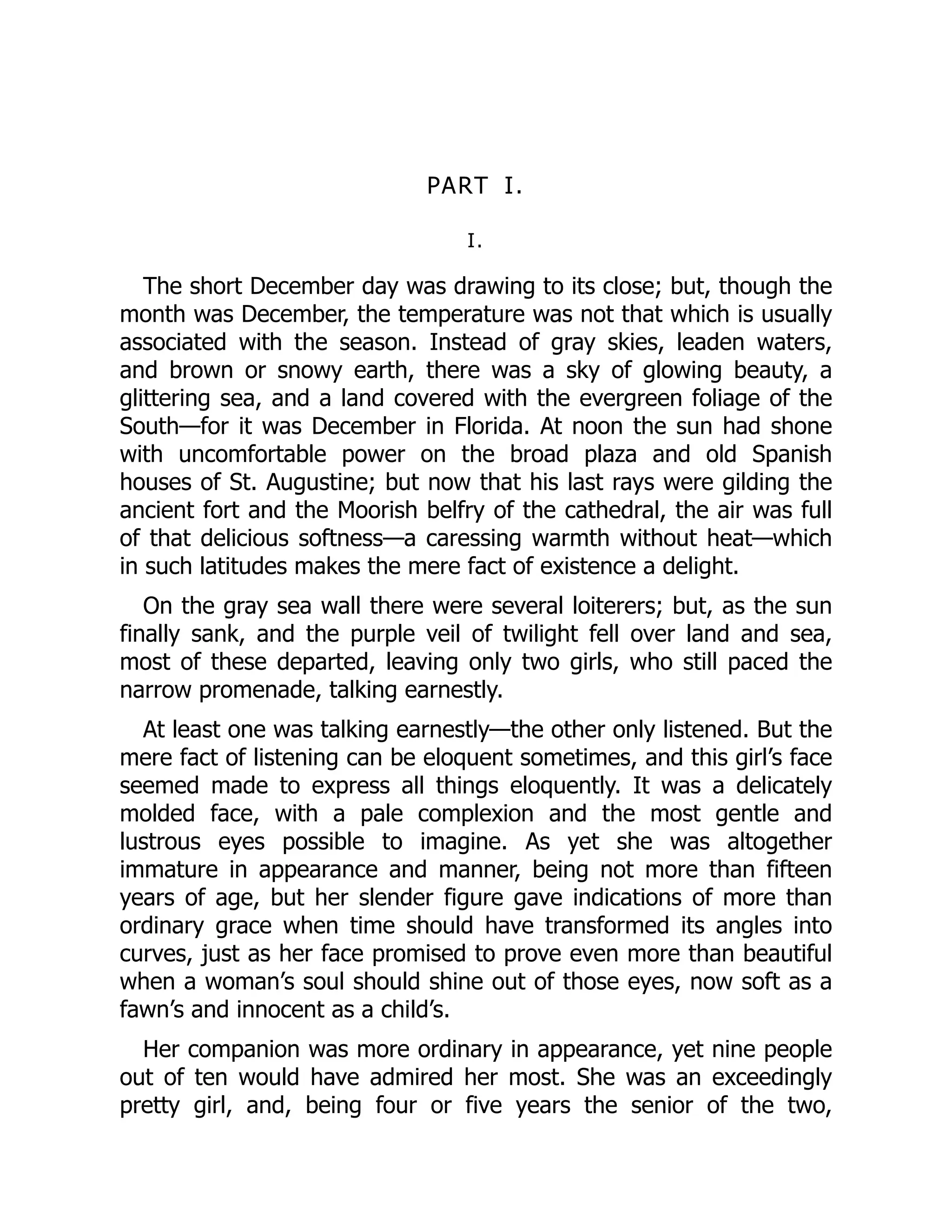
PART I.
I.
The shortDecember day was drawing to its close; but, though the
month was December, the temperature was not that which is usually
associated with the season. Instead of gray skies, leaden waters,
and brown or snowy earth, there was a sky of glowing beauty, a
glittering sea, and a land covered with the evergreen foliage of the
South—for it was December in Florida. At noon the sun had shone
with uncomfortable power on the broad plaza and old Spanish
houses of St. Augustine; but now that his last rays were gilding the
ancient fort and the Moorish belfry of the cathedral, the air was full
of that delicious softness—a caressing warmth without heat—which
in such latitudes makes the mere fact of existence a delight.
On the gray sea wall there were several loiterers; but, as the sun
finally sank, and the purple veil of twilight fell over land and sea,
most of these departed, leaving only two girls, who still paced the
narrow promenade, talking earnestly.
At least one was talking earnestly—the other only listened. But the
mere fact of listening can be eloquent sometimes, and this girl’s face
seemed made to express all things eloquently. It was a delicately
molded face, with a pale complexion and the most gentle and
lustrous eyes possible to imagine. As yet she was altogether
immature in appearance and manner, being not more than fifteen
years of age, but her slender figure gave indications of more than
ordinary grace when time should have transformed its angles into
curves, just as her face promised to prove even more than beautiful
when a woman’s soul should shine out of those eyes, now soft as a
fawn’s and innocent as a child’s.
Her companion was more ordinary in appearance, yet nine people
out of ten would have admired her most. She was an exceedingly
pretty girl, and, being four or five years the senior of the two,
30.
possessed all theadvantage of presence and of manner which such
a difference in age at this period of life bestows. Her face had none
of the delicate regularity of the face beside her, but her features
were charmingly piquant, her complexion brilliantly fair, and her
sunny, hazel eyes were full of mirth. At least they were usually full of
mirth, but this evening there was a shade in them that looked like
anxiety. It was she who had been talking for half an hour, while the
girl who clung to her arm listened with rapt attention. As they still
paced up and down in the twilight she went on:
“You understand now, Aimée, how it is, and how I am almost at
my wit’s end to know what to do. I declare it is almost enough to
make one wish one were ugly, to be tormented as I am!”
“I would not wish that,” said Aimée. “It is like a novel—only better
—to be as pretty as you are, and to know that two men love you to
distraction; that you are almost engaged to one, but that you love
the other and are going to elope with him—”
“Hush!” cried the other, with a pressure of the arm she held
almost as sharp as the tone of her voice. “Think, if somebody were
to hear you! I am not going to elope with him! That is just the point.
I have promised—but I can not, I can not! I like him—of course, I
like him—but I don’t like him well enough to ruin all my life for him,
to give up everything and break mamma’s heart. Aimée, I can’t do
it.”
“What are you going to do, then?” asked Aimée, while her eyes
seemed to grow momently larger and darker and more full of
interest.
To an impressionable girl of fifteen, with her head full of
romances, all this was thrilling beyond expression. A beautiful girl, a
worldly mother, two ardent suitors, and an elopement planned—
what could any romance furnish better? Yet it was here in her own
every-day world, and she was promoted to the dignity of receiving
the confidences of the heroine. What could life hold more exciting,
31.
save the joy,of which she as yet hardly dreamed, of being a heroine
herself?
“What are you going to do?” she repeated in a voice as sweet and
as full of dramatic expression as her eyes. “If you have promised to
go to-night, how can you break your promise?”
“Breaking my promise does not matter at all,” said Fanny Berrien,
impatiently; “but getting rid of Lennox Kyrle without trouble does
matter. And how it is to be done I do not know, unless you will help
me.”
“I will do anything—anything in the world!” said Aimée, fervently.
“But how can you make up your mind to give him up?”
“It does not exactly mean giving him up,” said Fanny, “though I
suppose it will come to that at last,” she added with a sigh. “But just
now I only want him to understand that it is quite impossible for me
to go with him. He is so impetuous and rash, he will not understand
at all how I am placed; and if I do not meet him at the time when
he expects me, he will be quite capable of coming for me—as he has
threatened to do—and then there would be a fearful state of affairs!”
“He must be like young Lochinvar,” said Aimée. “I should think you
would adore such a lover as that.”
“He has given me more trouble than any other man in the world,
so I suppose I ought to adore—or else hate him,” said Miss Berrien.
“Of course, you don’t understand about these things, Aimée, and I
ought not to be talking of them to a child like you, only I have
nobody else to talk to; but Lennox Kyrle is one of the men to whom
one can’t say no. He has more power over me than any one else in
the world, and yet I am not at all sure that I want to marry him.”
“Why not?” asked Aimée, who was drinking in these new ideas as
a plant absorbs water.
“Oh, for a great many reasons,” replied the other. “For one thing, I
am not sure that I want to be domineered over for the rest of my
life; and then he has nothing in the way of fortune—at least nothing
32.
to speak of.Now, Aimée, you know it is not at all pleasant to want
money and not have any.”
“No,” said Aimée decidedly—she evidently understood this—“it is
not at all pleasant.”
“And Mr. Meredith is rich, and will be richer; and he is devoted to
me, and mamma is anxious that I shall marry him, and I like him
very well—when I don’t see Lennox! So I have nearly made up my
mind not to see him any more.”
There was a pause. Aimée felt that this was a very unheroine-like
decision, a lame and impotent conclusion for a romance; but she did
not know what to say, being somewhat confused by the multiplicity
of new ideas presented to her consideration.
“At all events, I can not go to-night, though I was mad enough to
promise him that I would,” pursued the young lady desperately. “And
I can not see him; if I did, I should go. I am ashamed to think how
little will of my own I have when I am with him—in fact, I have none
at all. He simply makes me do whatever he likes. So I dare not go to
meet him, and this brings me to the point I have been trying to
reach all this time—will you go for me?”
If she had asked Aimée to spring from the wall into the waves
washing softly against it, the girl could hardly have been more
surprised. Her face showed this plainly, but after an instant’s
hesitation she said:
“I will do anything that I can for you—where do you want me to
go?”
“It will not be pleasant at all, and I feel as if it was very selfish to
ask it of you,” said Miss Berrien. “But then you are only a child, and
it can not compromise you as it would compromise me; and you are
as brave as a lion, so you won’t be afraid to come here after dark,
will you?”
“Here?” said Aimée, glancing around.
33.
“Yes, here,” answeredher companion. “A boat, with Lennox in it,
will be here at midnight. You must tell him that I can not come, that
I—But never mind, I will give the message at the time. Will you do it
for me?”
If Aimée’s courage failed at such a prospect, she felt that it would
never do to betray as much. She had pledged herself to do
“anything,” and she must not fail when something was demanded.
“Yes, I will do it,” she said, “if there is no other way; but why can
you not write and let him know?”
“Write!” repeated the other. “Why, you foolish child, have I not
told you where he is?”
“I don’t think you have,” said Aimée—conscious, however, that in
the multiplicity of statements which had been made to her, the
particular statement relative to Mr. Kyrle’s whereabouts might not
have received due attention.
“He is there,” said Fanny with a comprehensive wave of her hand
toward the Atlantic Ocean. “Did I not tell you that he is in a yacht?”
“Oh! has he a yacht?” cried Aimée; “and can you refuse to go with
him?”
“I might not refuse if it was his own yacht—for a man must be
very rich to afford a yacht—but it is not his own. It is borrowed from
a friend ‘for this occasion only,’” said Fanny, with a slight laugh. “His
plan is certainly very well arranged. He borrows the yacht, as I have
said, runs down here, lies off the inlet and brings a boat up to St.
Augustine for me—I step into it, we return to the yacht, run to Key
West or Pensacola and are married, then cruise for a month among
the West Indies. How would you like such a programme as that,
Aimée?”
“How would I like it?” repeated Aimée. Words were evidently too
weak to express her sentiments; but she clasped her hands and her
eyes shone like stars. “It would be glorious!” she cried, with a thrill
34.
in her voice.“I never read of anything more beautiful. I don’t
believe, I can’t believe, but that you mean to go.”
“You may believe it, then,” said Miss Berrien, shortly. “It is very
well to be romantic when you don’t have to pay a price for romance;
but when you do, and it is such a heavy one as a life of poverty—
sailing and love-making can’t last forever, and what is to come after?
I asked myself that question, and the answer made me stop.”
“I wonder if it was not Mr. Meredith who made you stop?” said
Aimée. “I saw the diamonds he brought you; but, though diamonds
are very pretty, they are not as good as a lover like young
Lochinvar.”
“You will change your mind when you are a little older, my dear.
Lovers are plenty, but diamonds—However, it is not certain that I will
take them. It is only certain that I can not throw away everything by
going with Lennox to-night. He must wait.”
“But perhaps he won’t wait,” said Aimée. “If he is so impetuous,
perhaps he will say that it must be this night or never.”
“There is no danger that he will say anything of the kind,” replied
Fanny, with a comfortable assurance of her own power. “He will
never give me up until I am married to somebody else. He makes
love like an angel,” she added, with a stifled sigh. “I have had a
great many lovers, of course, but nobody that I ever liked half as
well as Lennox. But I must not think of him; and as for seeing him—
well, if I did that, I should be on board the Ariel before day. I will
give my chance of a cruise over to you, Aimée.”
“I only wish I could take it,” said Aimée, with the most evident
sincerity.
“Now we must go home,” said the other, glancing out at the
darkening water. “But first come and let me show you exactly where
the boat will be to-night.”
35.
II.
Twilight had givenway to night, and the sky was thickset with
golden stars, when the two girls reached the door of their boarding
house. A stream of light from the dining room, and a clatter of
knives and forks and voices announced that supper was in progress,
so they turned at once into that apartment.
A party of about a dozen people—chiefly feminine—were gathered
round the table. One of these, a handsome middle-aged lady, looked
up when the two entered.
“Why are you so late, Fanny?” she asked. “You know that I do not
like you to be out after dark without an escort.”
“But it is so hard to get in before dark, mamma,” said Miss
Berrien, taking her place at the table. “It is lovely on the sea wall at
twilight, and the air—oh, what a feeling it gives one! Do you
suppose it can be ozone?—ozone in the air, I mean? Well”—as
nobody appeared able to answer this question—“whatever it is, it is
wonderful in its effect. My appetite is a most serious fact, and I am
quite ready to do justice to your good things, Mrs. Shreve.”
Mrs. Shreve—an elderly faded widow, who presided at the head of
the table—smiled faintly. The faintness of the smile was not owing to
any disapproval of her young boarder’s appetite, but was due to the
fact that, like a good many other estimable people, she lived
persistently in the shadow rather than in the sunshine of life.
“I like to see people with good appetites, Miss Fanny,” she said in
a tone which seemed to imply that appetites were perhaps a slight
mitigation of the sadness of existence. “Try the cup cakes; they are
nice to-night.—Why, Miss Aimée, you are not eating anything!”
“I am not hungry, Mrs. Shreve,” replied Aimée, who could not say
that she was incapacitated by excitement from eating, and who
looked with amazement at Fanny’s gastronomic performances. How
36.
a girl onthe eve of a promised elopement, with a lover on his way to
meet her, could exhibit such a keen appreciation of cup cakes and
other delicacies was quite beyond Aimée’s comprehension.
Her attention thus directed to the latter, Mrs. Berrien glanced at
her.
“What is the matter with you, Aimée?” she asked. “Your eyes are
shining as if you had been listening to a ghost story.”
“She has been listening to a moral lecture,” said Miss Fanny, giving
Aimée an admonitory touch under the table, “and she is reflecting
upon it.”
“Nothing is the matter with me, Aunt Alice,” said Aimée. “I have
no appetite—that is all.”
“Want of appetite is very far from being the trifling thing that most
people consider it,” said an elderly gentleman on the other side of
the table, who certainly himself had no ground for complaint on that
score. “There is no effect without a cause, and no physical
derangement which may not be attended with the most serious
results. If people would only be warned in time—”
“I suppose nobody would ever die,” interposed Fanny, a little
flippantly; and then, feeling that to talk of dying to a company
chiefly composed of invalids was not the extreme of tact, she went
on hastily: “O mamma! who do you suppose I met at the hotel to-
day? Your old friend Mr. Denham, who is here for his throat—that
same throat of which he has been talking ever since I can
remember. I also saw the English gentlemen who are going soon on
that hunting expedition which Mr. Meredith thinks of joining, and
which I should like to join, too.”
“I have no doubt the party would be glad to receive you as a
recruit, Miss Berrien,” said one of the ladies with a smile. “At least it
is easy to answer for one member of it.”
“Yes, I think I might count on his vote,” returned Miss Berrien,
composedly.
37.
After tea thisyoung lady retired for some additions to her toilet,
while Aimée—who felt as if she lived, moved, and had her being in a
dream—went into the parlor and sat down ostensibly to read. She
was usually a great bookworm, having been a devourer of all kinds
of literature from her earliest childhood, and to-night she had a
novel which at another time would have absorbed all her attention.
But for once the letters danced before her eyes and conveyed no
meaning to her mind. The romance of reality in which she was so
soon to play a part engrossed all her thoughts. How would she
acquit herself? What would she be called upon to do? How could
Fanny possibly be so composed when her fate was hanging in the
balance? These questions formed the burden of Aimée’s reflections,
while her head was bent and her dark eyes rested on the open page
of the book which she held.
Suddenly, however, she roused with a start, for some one said,
“How are you, this evening, Mr. Meredith?” and looking up she saw
Miss Berrien’s lover number two crossing the room.
A man with whom the world went well and easily was Mr.
Meredith, evidently. Rather short, rather stout, rather rubicund, but
not ill-looking, and apparently not cast by Nature for that villainous
part which is assigned in melodramas to the obnoxious suitor,
Aimée’s gaze followed him with a species of fascination. This man,
commonplace as he appeared, was, unconsciously to himself, one of
the dramatis personæ in the romance now proceeding. “If he could
know!” thought the girl, with a thrill.
Exemplifying the proverb that ignorance is sometimes bliss, Mr.
Meredith sank easily into a seat and began talking to one or two
people, without observing the solemn young eyes regarding him
from a shady corner. “If he could know!” Aimée thought again when
Fanny entered, bright, sparkling, coquettish, and gave him her hand
as he came eagerly forward to meet her. If there was a single weight
on Miss Berrien’s mind, a single cloud on her spirit, no one could
possibly have suspected it; and Aimée began to wonder somewhat if
the whole thing was not a jest, when, in the midst of the lively
38.
banter which withFanny generally did duty for conversation, she
sent a sudden, swift glance across the room, which made the
wondering girl understand that it was reality after all.
The glance conveyed a warning, and fearing lest she might
unguardedly betray to Mrs. Berrien’s quick observation that
something unusual was in the atmosphere, Aimée rose and with her
book in her hand went quietly from the room. As her slender young
figure passed, two ladies near the door looked up and nodded a
kindly good-night.
“What a sweet girl that is!” said one of them. “She seems the
embodiment of gentleness.”
“She is so pretty, too,” said the other. “At least, she promises to be
pretty—and there is so much mind and soul in her face!”
“Poor child! I fancy it is doubtful what will become of her,” said the
first speaker. “Her father is dead, and her mother has married again
—married a certain Major Joscelyn, who is very much gone to pieces
in all respects. I know the family well, and Mrs. Berrien was talking
to me about the Joscelyns—whom she dislikes exceedingly—the
other day. Aimée, you see, is her brother’s child, and for that reason
she has her with her at present. ‘I found that the Joscelyns were
simply making her a drudge,’ she said, ‘and her health was breaking
down under it, so I decided to take her for a time at least. Perhaps,
when Fanny is married, I may adopt her altogether.’”
“She can well afford to do so if Miss Fanny establishes herself in
life as well as that,” responded the other, glancing significantly
across the room.
Aimée meanwhile—altogether unconscious of being a subject of
discussion—went to the chamber which she shared with her cousin,
and, without striking a light, sat down by the open window through
which even at night the air came with balmy softness. She felt
strangely puzzled, and strongly averse to the service which she had
pledged herself to perform; yet the idea of retreating did not for a
moment occur to her. She had promised Fanny, and she must
39.
perform whatever wasexacted from her in fulfillment of that
promise. But how much she shrank from this fulfillment it is difficult
to say. This impetuous lover, whom Fanny herself was afraid to face,
what would he say, what would he do? Would he rage with passion,
or be overwhelmed by despair? Aimée decided that she would prefer
passion to despair, for she had a most tender heart, and the sight of
distress always unnerved her. She pictured to herself the Ariel lying
off the bar, with the eager lover pacing her deck, sure that
happiness was within his grasp, fancying no doubt that Fanny, like
himself, was counting the hours to their time of meeting; and then a
picture of the scene in the parlor below—of Fanny gay and
enchanting, of Mr. Meredith fascinated and amused—rose before her
mental vision. “How can she?” the girl thought. “How can she? To
bring a man here just to disappoint him! It is—yes, it is shameful!”
As she so sat and so thought, a clock tolled out ten strokes. Soon
thereafter the different inmates of the house—being chiefly of
middle age and quiet habits—were to be heard exchanging good-
night salutations on the staircase and in the hall, several doors
closed, and then Aimée heard her aunt’s footsteps approach her
chamber. There was no light, and the girl hoped it would pass on—
for she had the feeling of a conspirator, and dreaded to be
addressed by one whom she felt as if she was betraying—but Mrs.
Berrien paused, opened the door and looked in.
“Are you asleep, Aimée?” she asked.
“Oh, no, Aunt Alice,” replied Aimée’s voice from the window. “I am
sitting here.”
“What! in the dark, and by an open window! Are you trying to
take cold? What is the matter?”
“Nothing at all,” answered Aimée, conscious that guilt was in every
cadence of her voice. “It is so warm that I did not think I could take
cold, and I—I like to look at the stars.”
“Close the window at once and go to bed,” said Mrs. Berrien. “You
need not wait for Fanny. She will probably not be up for some time.
40.
Why are youso foolish and so peculiar, my dear? It is better for you
to stay down-stairs in the evening.”
“I will hereafter, if you desire it,” replied Aimée, lowering the
window as she spoke. She was always docile to the least suggestion,
but at that moment she would have promised obedience in anything,
to atone for the deception she was aiding to practice.
“Well, good-night,” said Mrs. Berrien. “Have you matches at
hand?”
“Oh, yes,” answered the girl, glad not to be obliged to show her
face.
As her aunt went away, she threw herself on the outside of her
bed, and lay there almost motionless, but wide awake for another
hour—the delightful hour for which Mr. Meredith invariably waited,
for in it he had the society of his pretty ladylove to himself. Fanny,
however, who always sent him away punctually on the stroke of
eleven, was to-night not remiss in doing so. Ten minutes after that
hour the door of the chamber opened, and that young lady
appeared, bearing a light which flashed full in Aimée’s face.
“Oh!” she cried, “how you startled me with your great, solemn
eyes! You foolish child, have you not been asleep? I hoped when you
went away so early you would take a good sleep, and be fresh and
ready for my little errand.”
“I am ready,” answered Aimée, “but as for having gone to sleep,
how could I? It is all too exciting!”
“One would think it was you who were going to elope,” said Fanny,
putting down her lamp. “As for me, I am so tired of men, that if it
were not for mamma I would go into a convent, where I would
never hear of them again. You can not fancy how Mr. Meredith has
been tormenting me, until I have half promised to marry him just to
get rid of him.”
“But you will not get rid of him if you marry him,” said Aimée, with
her eyes more great and more solemn than ever.
41.
“Simpleton!” returned Fanny.“Of course not; but between
promising and doing a thing there is a very great difference, as poor
Lennox will find out to-night. Dear me!”—sitting down meditatively
on the side of Aimée’s bed—“I wonder what made me such a fool as
to imagine for a moment that I would go with him? The mere
thought makes me shudder—to be running off wildly and being
seasick (the idea of my forgetting that I always am seasick!) instead
of going to bed comfortably and getting up to-morrow to torment
Mr. Meredith by flirting with one of those handsome Englishmen!”
“O Fanny, are you not ashamed!” said Aimée. “To think what Mr.
Kyrle must be feeling at this moment, while you—”
“Yes, really, I am ashamed!” said Fanny, hastily. “It is abominable
conduct, I know. But you see I am shallow—shallow as that”—
indicating about a quarter the depth of her little finger—“and I can’t
help it if one nail drives out another in my mind. I wonder if it is my
mind or my heart, by the by? Well, anyway, in me. It is not my fault
that I am shallow; and, on the whole, I think I rather like it. One has
a much easier life. Isn’t it a great deal wiser for me to make the best
of things as they are, for instance, than to be distracted about
Lennox Kyrle, who I really like better than anybody else in the world,
if I let myself think of him?”
“I—I don’t know,” said Aimée, who found this question too deep
for her solving. “You must decide, of course.”
“I have decided,” said Fanny. “Things are best as they are. But
now we must have done with talking and proceed to action. In the
first place, I will tell you exactly what you must say to Mr. Kyrle
when you meet him.”
“Yes,” answered Aimée, beginning to shiver at that anticipation.
“You are to say,” went on Fanny, “that I feel it is impossible for me
to take such a desperate step as to elope with him; that it would
break mamma’s heart; and—and that it would ruin his life, for I
should only tie him down to hopeless poverty. Say that I am sorry,
and blame myself dreadfully, that my feelings will not permit me to
42.
see him, andthat—be sure to make this point emphatic!—he must
not dream of attempting to see me. My resolution can not be
changed. I am sure I can trust you to put it all as well as possible,
Aimée—you have a great deal of tact and judgment.”
“But why not write it?” demanded Aimée, whose dismay was not
soothed by this compliment.
“My dear child, could he read a letter in the dark?” asked the
other, impatiently. “Besides, I never write; I have learned too much
of the mischief that lurks in ink. Tell him all this as quickly as you
can—and be sure to make it very positive about his not trying to see
me—and then run back to the house as fast as possible. How lucky it
is that we live so near the water, else I could not let you go!”
It is safe to say that, in this view of the case, such lucky proximity
was something for which Aimée did not feel very grateful as she rose
to prepare for the expedition. Her courage was sadly failing, not so
much on account of the lonely walk through the midnight streets, as
from the realization of the strange and awkward position in which
she would be placed. She was trembling like a leaf from nervousness
and excitement as Miss Berrien enveloped her in a large, dark cloak,
and drew the hood over her head.
“Now,” said Fanny, glancing at her watch, “it is time for you to go.
I hate—oh, I hate dreadfully to send you! If there were any other
way—”
“But there is none,” said Aimée, trying to smile. “And I am not
afraid.”
“It seems so cowardly to send you,” said Fanny, half under her
breath. “Yet I can not trust my own resolution if I met Lennox!—and
then if it should be discovered—”
Her pause said more than many words. At that moment the
Meredith diamonds, and all that the Meredith diamonds represented,
shone brightly before her eyes. To risk the loss of them by keeping
this midnight tryst, was more than she could dare. And the girl
43.
before her lookedup with brave, generous glance from under the
dark hood.
“Don’t think of it, Fanny,” she said. “If you were discovered, what
would everybody say? while if I am, it does not matter. Nobody
knows or cares about me! Come, now, and let me out. You’ll wait
downstairs to let me in, will you not?”
“Yes, indeed, I shall wait and count every instant. For Heaven’s
sake come back as quickly as you can! And be certain, very certain,
that it is Lennox Kyrle to whom you speak. It would be awful if you
gave the message to any one but him!”
44.
III.
Being a littleexcited, and not at all sleepy, it chanced that Mr.
Meredith, after parting with Miss Berrien, betook himself to the sea
wall, where he proceeded to pace to and fro, smoking a cigar and
wrapped in very agreeable thought. Despite her coquetry, Fanny had
yielded to his suit more than ever before, and he felt no doubt that
in the end she would yield altogether. He liked to be played with in
this manner. It was not enough to discourage—Fanny was too wise
for that—but just enough to give a zest of uncertainty, to sustain and
keep alive the interest which in similar affairs had more than once
failed him. In short, he was completely conscious of being in love,
and very much pleased with the same, finding in it none of the
“pang, the agony, the doubt,” which are poetically supposed to
accompany the tender passion, but only an agreeable stimulation.
He was even conscious of feeling distinctly sentimental, and
disposed to cast lingering glances at Mrs. Shreve’s house whenever
he came to the spot where it entered into his range of vision.
On one of these occasions he was surprised by a sudden and very
unexpected sight—the opening of the street door and the emerging
thence of a figure. For an instant he had a startled sensation; the
next he said to himself, “It is only a servant, of course.” But a
moment later he knew that it was not a servant. How he knew it, is
difficult to tell; but he felt instinctively sure from the walk, the
bearing, and the motions. He stood still, a prey to very odd
sensations, and watched the approach of the figure that had in
every line a familiar aspect. If it was not Fanny, who could it be? He
knew that all the other inmates of the house were elderly people,
except Aimée, of whom he did not think at all. But to conceive that it
could be Fanny, alone and disguised in the streets at midnight, was
impossible. He said to himself that it was impossible, yet his pulses
were beating in a most unaccountable manner, and there was a
sound in his ears like the rush of many waters. It was natural that at
45.
this moment hedid not pause to ask himself whether or not it would
be honorable to act the part of a spy: he only felt that he must know
who it was that came forth from Mrs. Shreve’s house at midnight,
with Fanny Berrien’s air and movement.
Meanwhile the shrouded figure walking so swiftly, with head bent
down, did not see him. Poor Aimée’s pulses were beating
tumultuously like his own, and she was thinking of nothing save her
desire to accomplish her errand and return to the shelter of the
house she had left. The night seemed to her invested with terror,
and the sound of her own light footsteps on the quiet street brought
her heart into her throat. It is doubtful if she would have noticed Mr.
Meredith had he stood immediately in her path; she certainly cast no
glance either to right or left, but hurried forward to the place Fanny
had designated, intent only upon one object, to deliver her message
and return.
As she mounted the sea wall she heard the sound of oars, and
when she paused, shrinking and trembling on the steps that led
down to the water, she saw in the starlight the dark outline of a boat
containing two or three figures. Her heart gave a wild bound and
then seemed to stand still—for was not this the moment of fate; was
not the impetuous lover, who would take no denial, before her?
Certainly one of the figures sprang from the boat as she appeared,
and reached her side with all the impetuosity conceivable in the
most desperate lover. Before she could speak she found her hands in
a close clasp, and a voice was saying, in a tone of eagerness and
delight:
“So you have come; you are really here!”
Even at this moment it struck Aimée that there was surprise as
well as delight in the voice. Evidently Mr. Kyrle had been by no
means sure that Miss Berrien would appear. But the rapture of his
greeting made it harder for Aimée to explain that she was not the
person so eagerly welcomed, and when she tried to speak her voice
failed. She could only gasp, after a moment:
46.
“I have cometo tell you—”
“Never mind what,” interrupted the young man eagerly, with
probably a prudent fear of what the communication might be. “You
are here; that is enough. There will be time to tell me anything and
everything when we are afloat. Come, here is the boat.”
He drew her toward him, and so compelling was his grasp that
Aimée felt that in another moment she might be in the boat and en
route for the West Indies. This gave her the courage of desperation.
She made a determined effort to release herself as she said more
clearly:
“You are mistaken. I am not the person you think. I have only
come to tell you that she can not come.”
“Not the person I think!” repeated the young man. He released
her hands and fell back a step in his amazement. The violent
revulsion of feeling which he underwent was evident in his voice,
and the sharpness of his disappointment so pierced Aimée’s heart
that she forgave the sharpness of his tone, as he went on:
“Then who are you—and why are you here?”
“I am Fanny’s cousin,” the girl replied, then suddenly checked
herself. “But you—who are you?” she said. “I was told to ask your
name before I gave any message.”
“There is no doubt who I am,” he replied, sternly. “My name is
Lennox Kyrle. What message have you for me?”
“Only that—that Fanny can not come,” answered Aimée,
tremulously. She paused and clasped her hands nervously together,
trying to recall all that Fanny had impressed on her mind to be
delivered, but only the principal points remained, and before she
could gather them into shape, as it were, Mr. Kyrle justified his
character for impetuosity by breaking in:
“That she can not come,” he repeated. “Is that all, after having
brought me here? Why can not she come?”
47.
The indignant emphasisof the last question was, under the
circumstances, natural enough; and, confronted with it, Aimée felt in
every fiber the shame of the answer which she was bound to give:
“Because she—has changed her mind,” she said desperately,
grasping the main fact and forgetting all the fluent words with which
Fanny had clothed it. “She bade me tell you that she is very sorry,
but that she can not elope with you and break her mother’s heart.”
“Her consideration for her mother is most admirable,” said the
young man with grim sarcasm. “It is only a pity that it did not
influence her a little sooner. And so she is ‘sorry’ that she can not
elope! She could say no more for the calamity of missing a ball.”
“Fanny has not very deep feelings,” said Aimée, in a voice of as
sincere compunction as if the feelings in question had been her own,
“but I think she is sorry.”
This simple statement, made in that sweet, pathetic voice, said a
great deal more than the speaker intended to Lennox Kyrle. He was
silent for an instant, then spoke in a softer tone:
“I know that she is easily influenced by those around her,” he said,
“and so this might have been anticipated. But if I were to see her—”
“Oh, that is impossible!” interrupted Aimée, hastily. “She charged
me to tell you above all things not to attempt to see her.”
“Ah!” said the young man. Keen disappointment and mortification
were in his tone, but also something of comprehension. “Then there
is another lover,” he said.
Aimée did not reply. It was no part of the message with which she
was charged to enlighten Mr. Kyrle with regard to the other string to
Miss Berrien’s bow; and since his assertion was fortunately an
assertion, not a question, she suffered it to pass unanswered,
forgetting that silence, in this case as in many others, was equivalent
to assent.
“That accounts for everything,” said the young man after a pause
—in which, perhaps, he had waited for contradiction—“and I only
48.
regret that Ishould have given Miss Berrien the pain which I am
sure she must feel acutely of treating me in this way. But it may
relieve her sorrow, perhaps, to know that it is the last opportunity
she will ever have to inflict a pang upon me. I have been the slave
of her caprice and my own folly long enough. As I came here I
resolved that this should be the decisive test. If she cared for me,
she would go with me; if not, it was well to know the truth and be
no longer the plaything of a coquette. Well, I am here, and she
refuses even to see me. She breaks her word and throws me over
without compunction. It is the end. Tell her that from me.”
It flashed across Aimée’s mind, as he spoke, that this was very
much the ultimatum which she had prophesied, but she had not
been prepared for the stern resolution of the voice which uttered it.
Plainly, Mr. Lennox Kyrle meant all that he said, and Miss Berrien’s
comfortable belief that he would remain her slave as much as ever
was a delusion of her own vanity.
“I will tell her,” the girl answered, in a subdued tone. “I wish I had
been able to—to give you her message better. She said a great deal
—”
“Which I can easily imagine,” interposed Mr. Kyrle. “It is not
necessary that you should make an effort to remember it.”
Thus discouraged, Aimée felt that she need no longer remain, that
she had done all that was required of her, and might now return with
speed to the shelter of the roof for which she longed.
“I must go now,” she said, yet still she hesitated. She longed to
say a word of sympathy, but it was not easy to do so. At length,
however, she summoned courage, and spoke quickly:
“I am sorry, very sorry for you,” she said. “It is dreadful to trust
and—be deceived. I would not have come on such an errand, only it
was necessary you should know, and Fanny could not come.”
It is not too much to say that these words brought her personal
individuality for the first time to the attention of the man before her.
Up to this time he had not given a thought to the consideration of
49.
who or whatshe was. To him she was simply the mouthpiece of and
means of communication with Fanny Berrien. Now it suddenly
occurred to him that here was a young, shrinking girl, who had come
alone at midnight to bring him the message of the woman who had
failed him.
“She could not come, but she could send you,” he said, suddenly
rousing to something like indignation, “though I hear from your
voice that you are young, and this is no fitting time or place for you.
Do not let me detain you longer—or, rather, let me take you at once
back to your home.”
“Oh, no, no!” cried Aimée, mindful of Fanny’s promise to watch
and wait for her, and fearing an encounter of the two at Mrs.
Shreve’s respectable door. “You must not think of it. I have only a
short way to go, and the streets are quiet.”
“Do you think I will force my way in to her?” said the young man,
scornfully. “I assure you that I have not the least desire to do so.
What have I to say to her? Nothing, except that I shall never trouble
her again, and that I can trust you to say for me.”
“I shall say it,” Aimée answered, feeling not altogether disinclined
to do so, “but I beg you not to come with me. I shall be at home in
a minute. Indeed, you must not come.”
“I will not insist, then,” he said, hearing in her tone how greatly
she was disturbed. “But you must go at once. This is a service that
only selfishness would have asked of you.”
“I came willingly,” said the girl. “It might have compromised Fanny,
but I am of no importance—it can not harm me. I am only sorry that
I had to bring you such a painful disappointment.”
“If a man is a fool, he must suffer, and deserves to suffer,” said Mr.
Kyrle, with a decision that did credit to his common sense. “But you
are as kind as you are brave, and I shall not forget you. Now, go.”
Aimée needed no second bidding. She turned and hastened back
in the direction of Mrs. Shreve’s house and Mr. Meredith, who had
50.
watched the meetingand conversation from afar, divided the while
between an overwhelming desire to break in upon it and the salutary
fear of making himself ridiculous, had the satisfaction of seeing the
door open and close upon her.
51.
IV.
“Oh, what atime you have been, Aimée!” cried Miss Berrien as
she opened the door. “I have been in an agony! What kept you so
long?”
“Have I been long?” said Aimée. She was almost breathless, and
as she sank down on the first seat at hand, pale and trembling now
that the need for exertion was past, Fanny’s heart smote her for her
words of reproach.
“Of course it has seemed long to me,” she said, “but I do not
suppose it really has been long; and what does it matter about me
in comparison to you—you poor, brave child! What a selfish wretch I
was to send you! You look perfectly overcome, and I have not even
a glass of wine to give you.”
“I don’t want any wine,” said Aimée. “After a while—when my
heart stops beating so dreadfully—I will tell you—all about it.”
“Yes,” said Fanny, eagerly, “but at least you can tell me this now—
did you see him?”
Aimée nodded, being for the moment past speech; and Miss
Berrien at once locked the door, as if she feared Mr. Kyrle might be
on the other side. Then she watched Aimée anxiously, and when the
latter presently opened her lips as if to speak, interposed with a
warning whisper:
“No, no—not here. We must go upstairs. Are you able to walk?”
“Oh, yes—why not?” answered Aimée. “I was out of breath when I
came in; that was all.”
“You looked as if you were about to faint,” said Fanny, taking up
her lamp. “How thankful I am that it is over, and that you are safely
back!”
52.
Aimée might haveassured the speaker that her thankfulness on
this point was trifling compared to her own, but the action of her
heart not being yet sufficiently regulated to make speech easy, she
silently followed Miss Berrien’s stealthy footsteps upstairs.
Once safely in their own room, Fanny was full of eager
questioning.
“You saw him!” she exclaimed. “Did you give him my message?
How did he take it? What did he say?”
“Yes, I saw him,” replied Aimée. “He was waiting, and at first
could scarcely believe that it was not you—”
“Poor fellow!” cried Fanny, in feeling parenthesis.
“But when he understood that it was not you, and that you meant
to throw him over,” proceeded Aimée, not without a sense of
pleasure in the recital, “he was very indignant, and he told me to tell
you that you would never have another opportunity to treat him in
such a manner, and that he came here meaning this to be the
decisive test: that if you cared for him you would come with him,
and that if you did not come he would never ask you again. It was
to-night or never.”
“‘To-night or never!’” repeated Miss Berrien. For a moment she
was too much amazed to say anything more. Then her customary
easy philosophy reasserted itself. “He must have been awfully
angry,” she observed, “and when a man is angry he will say
anything. But for his sake I am rather glad that he takes it in this
way; he will not feel the disappointment so much. I was afraid that
he would be desperate, and insist on seeing me. It is a great deal
better that he should be furious, and talk about ‘to-night or never’—
which, of course, is all nonsense. It may be never, indeed”—with a
slight sigh—“but, if so, it will not be his fault.”
“You would not think so if you had heard him,” said Aimée.
“Whether you marry Mr. Meredith or not, I am sure that Mr. Kyrle will
never ask you to marry him again.”
53.
Welcome to ourwebsite – the perfect destination for book lovers and
knowledge seekers. We believe that every book holds a new world,
offering opportunities for learning, discovery, and personal growth.
That’s why we are dedicated to bringing you a diverse collection of
books, ranging from classic literature and specialized publications to
self-development guides and children's books.
More than just a book-buying platform, we strive to be a bridge
connecting you with timeless cultural and intellectual values. With an
elegant, user-friendly interface and a smart search system, you can
quickly find the books that best suit your interests. Additionally,
our special promotions and home delivery services help you save time
and fully enjoy the joy of reading.
Join us on a journey of knowledge exploration, passion nurturing, and
personal growth every day!
testbankmall.com

![10. Controversial statement. Unlikely to be a premise.
11. Not a statement
12. See Answers to Selected Exercises.
13. Likely to be a premise.
14. Controversial statement. Unlikely to be a premise.
15. Likely to be a premise.
EXERCISE 1.1 E
1. Conclusion.
2. Conclusion.
3. Conclusion.
4. See Answers to Selected Exercises.
5. Not a likely conclusion. It’s a request.
6. Not a likely conclusion. It’s not controversial.
7. Not a likely conclusion. It’s not controversial.
8. See Answers to Selected Exercises.
9. Conclusion.
10. Conclusion.
11. Conclusion.
12. See Answers to Selected Exercises.
13. Likely to be a premise, not a conclusion. It’s uncontroversial.
14. Conclusion.
15. Not likely to be conclusion. It’s not controversial.
EXERCISE 1.2 A
Note to Instructors: there are unstated premises in some of the following, although the section
on unstated premises comes subsequent to this exercise. We have added the unstated premises,
although, of course, the students would not be expected to do this at this point in the chapter.
(1) It is a steep hill.
(2) I have a heart condition.
Therefore,
(3) It is a bad idea to go up the hill.
(1) You don’t care about my heart.
[2] People should care about other people’s hearts.
Therefore,
(3) You are a heartless human being.
(1) You have a heart condition.
[2] A good cardiologist can help you with your heard condition.
Therefore,
(3) You should get a good cardiologist to care for it.](https://image.slidesharecdn.com/18252-250701041958-8c9000e2/75/Solution-Manual-for-Critical-Thinking-The-Art-of-Argument-2nd-Edition-6-2048.jpg)
![EXERCISE 1.2 B
Note to Instructors: there are unstated premises in some of the following, although the section
on unstated premises comes subsequent to this exercise. We have added the unstated premises,
although, of course, the students would not be expected to do this at this point in the chapter.
1. Not an argument. Two statements: I don’t like Facebook. I can’t stand Twitter either.
2. Argument.
(1) Every time you hang out with him, you feel miserable.
[2] You don’t want to feel miserable.
Therefore,
(3) You shouldn’t go out with him.
3. Argument.
(1) I have seen 1,000 swans.
(2) All of the swans I have seen are white.
Therefore,
(3) Most swans are white.
4. See Answers to Selected Exercises.
5. Argument.
(1) Carbon-dioxide emissions are higher.
(2) Atmospheric particulates are increased.
[3] If emissions and particulates increase, then global temperatures will increase.
Therefore,
(4) Global temperatures will rise over the coming century.
6. Not an argument.
7. Argument
(1) Mary Wollenstonecraft was a woman.
(2) Mary Wollenstonecraft was a famous philosopher.
Therefore,
(3) Some famous philosophers are women.
8. See Answers to Selected Exercises.
9. Not an argument.
10. Argument:
(1) Tai nam is my favorite kind of Vietnamese noodles.
[2] If it is my favorite kind of Vietnamese noodle, then you will like tai nam.
Therefore,
(3) You will like tai nam.](https://image.slidesharecdn.com/18252-250701041958-8c9000e2/75/Solution-Manual-for-Critical-Thinking-The-Art-of-Argument-2nd-Edition-7-2048.jpg)
![11. Not an argument.
12. See Answers to Selected Exercises.
13. Not an argument.
14. Not an argument. It’s a description.
15. Two arguments:
(1) The table is the same color but appears differently in reflected light.
(2) If I move, the different parts are reflected.
Therefore,
(3) The distribution of colors will look different with my movement.
(1) The distribution of colors will look different with my movement.
(2) No two people can see the table from exact same point of view.
(3) Any change in point of view means some change in the reflected light.
Therefore,
(4) No two people looking at the table at the same time will see the same distribution of colors.
EXERCISE 1.2 C
Answered above.
EXERCISE 1.3
Note to Instructors: there are unstated premises in some of the following, although the section
on unstated premises comes subsequent to this exercise. We have added the unstated premises,
although of course, the students would not be expected to do this at this point in the chapter.
1. Argument
(1) Every time you hang out with him, you feel miserable.
[2] You don’t want to feel miserable.
Therefore,
[3] You shouldn’t go out with him.
2. Argument
[1] If you don’t buy guns, people who make them will lose their jobs.
[2] People don’t others to become unemployed.
Therefore,
(3) There are economic benefits to gun sales.
(1) There are economic benefits to gun sales.
(2) People’s lives are saved by guns.
[3] Saving people’s lives is good.
Therefore,
[4] You shouldn’t support gun control.](https://image.slidesharecdn.com/18252-250701041958-8c9000e2/75/Solution-Manual-for-Critical-Thinking-The-Art-of-Argument-2nd-Edition-8-2048.jpg)
![3. Not an argument. It’s an explanation.
4. See Answers to Selected Exercises..
5. Not an argument. It’s an explanation of the fact that people do not save for retirement.
6. Argument
(1) Murata has more experience.
(2) Murata has better communication skills than Johnson.
[3] More experience and education make better employees.
Therefore,
(4) We should hire Murata.
7. Argument
(1) 87% of 1000 surveyed college students preferred instant messaging to email.
Therefore,
(2) The vast majority of college students prefer instant messaging to email.
8. See Answers to Selected Exercises.
9. Argument
(1) Young people on average are getting fatter.
(2) Adult diabetes is rising.
[3] Public school lunches are not currently selling healthy food.
Therefore,
(4) Public schools should stop selling unhealthy food.
10. Two arguments
(1) Most words are open to multiple interpretations.
Therefore,
(2) If laws are what their words mean, then the meaning of most laws would be unacceptably
ambiguous.
(1) If laws are what their words mean, then the meaning of most laws would be unacceptably
ambiguous.
Therefore,
(2). The idea that the law is what the words that constitute it mean is too simple.
11. Not an argument.
12. See Answers to Selected Exercises.
13. Argument
(1) The unemployment rate for recent four-year college graduates is 6.8%.
(2) The unemployment rate for recent high school graduates is nearly 24%.
(3) Nearly 200,000 jobs for workers with Bachelor’s degree were added during the recession.](https://image.slidesharecdn.com/18252-250701041958-8c9000e2/75/Solution-Manual-for-Critical-Thinking-The-Art-of-Argument-2nd-Edition-9-2048.jpg)
![(4) Two million jobs for college-educated workers have been added during the recovery.
(5) Nearly four out of five jobs destroyed by the recession where held by workers with a high
school diploma or less.
Therefore,
(6) A college degree is the best defense against unemployment.
14. There are two arguments in this passage.
(1) Nearly 90% of field-collected and laboratory-reared earwig males hold their penises in the
right-ready state.
Therefore,
(2) Earwig males have a strong preference for their right penises.
(1) Earwig males have a strong preference for their right penises.
(2) The two penises are morphologically indistinguishable and fully functional.
Therefore,
(1) Earwig males strong preference for their right penises is largely, if not entirely, behavioral.
15. Most of the passage is an explanation about why SAC still has investors in midst of ethical
scandals (Explanans = investors are only looking for performance when deciding where to
invest. Investors are not concerned about the ethics of the employees in the company).At the end
of the passage there are two arguments:
(1) Investing money on behalf of clients requires trust.
[2] Relationships based on trust require concern with ethics.
Therefore,
(3) Investors should have an interest in ensuring they do not invest in a company with
questionable ethical standards.
(1) Investors should have an interest in ensuring they do not invest in a company with
questionable ethical standards.
Therefore,
[2] Investors should not continue investing in SAC hedge fund.
EXERCISE 1.4
1. Unstated premise. Suicides are undesirable.
2. Unstated premise. People should do things that make them less likely to be victims of crime.
3. Unstated conclusion. A single-payer health care system would be bad.
4. See Answers to Selected Exercises.
5. Unstated conclusion. She did not take Bio 101.](https://image.slidesharecdn.com/18252-250701041958-8c9000e2/75/Solution-Manual-for-Critical-Thinking-The-Art-of-Argument-2nd-Edition-10-2048.jpg)
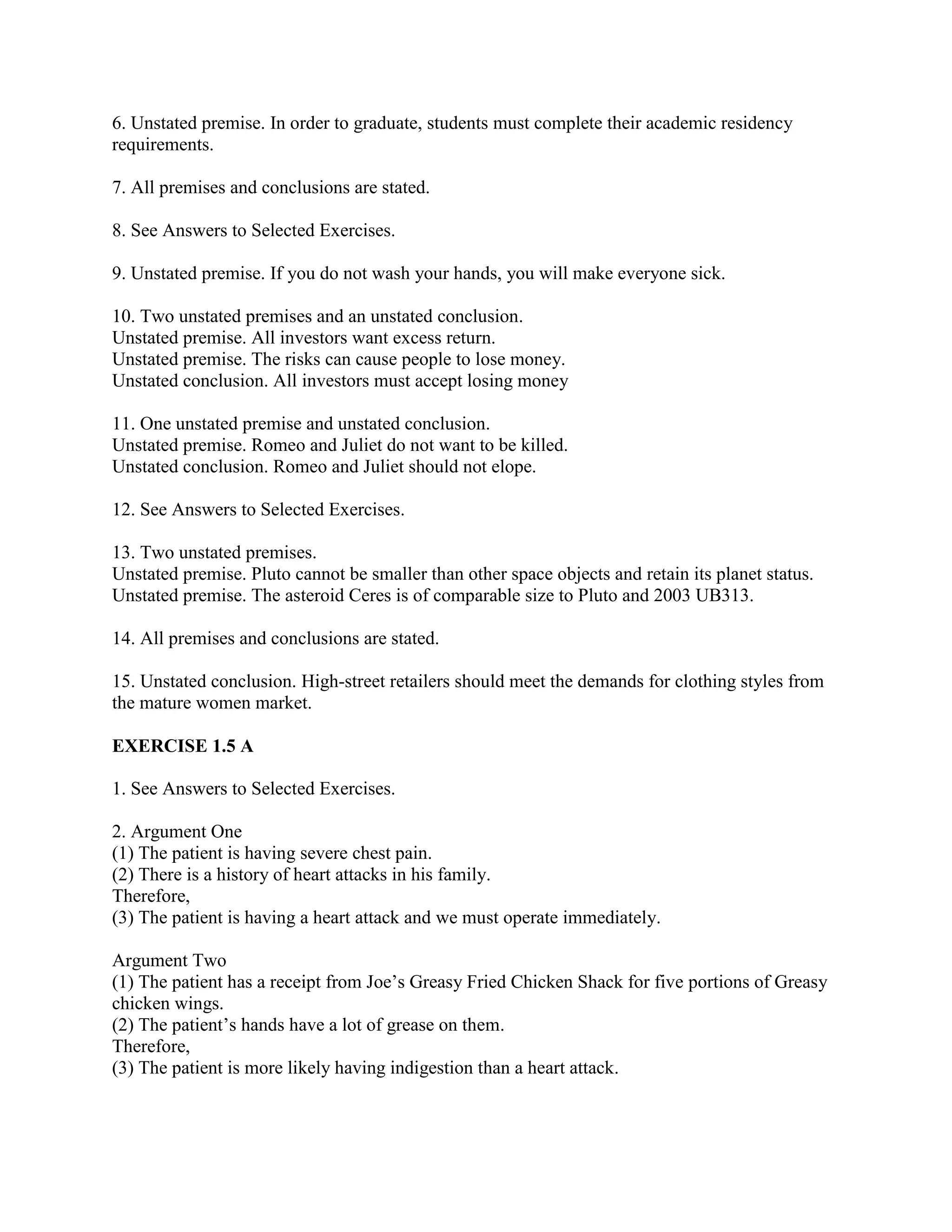
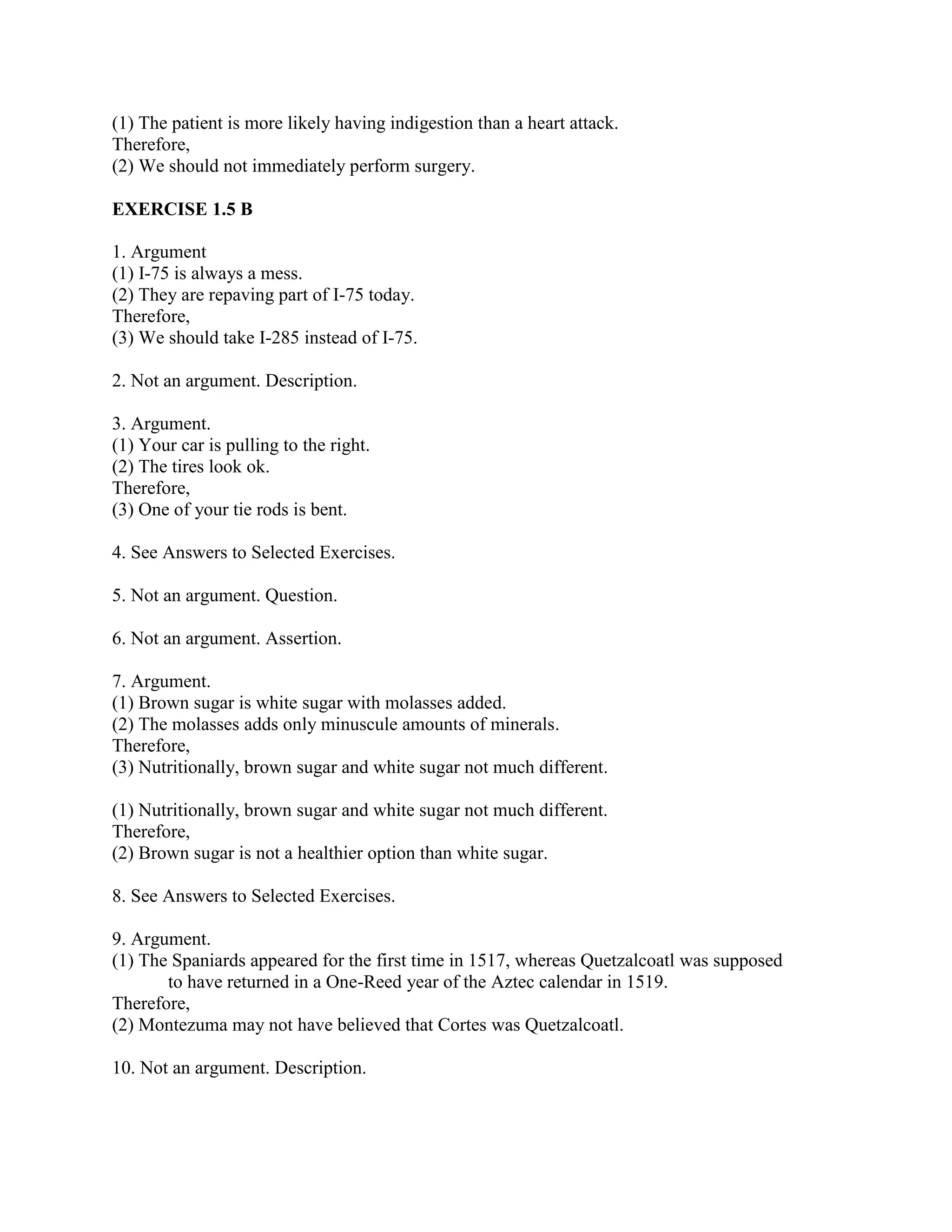
![11. Not an argument. Joke.
12. See Answers to Selected Exercises.
13. Not an argument. Description (of what happened after Apple dropped its contract with
Google).
14. Argument.
(1) The fossils of amphibians have been found in Antarctica.
[2] Amphibians cannot live in extremely cold climates.
Therefore,
(3) The weather in Antarctica at that time must have been warmer than it is now.
15. Argument.
(1) Melanesians do not believe in physiological paternity.
(2) Melanesian men are as jealous as men in societies in which procreation is understood.
[3] Explanations are either genetic or cultural.
Therefore,
(4) Sexual jealousy has a genetic rather than purely cultural explanation.
EXERCISE 1.5 C
1. Argument.
(1) Students do better when classes are smaller.
Therefore,
(2) We should decrease class sizes.
2. Explanation.
Explanans: He does not exercise, eats donuts for breakfast, and eats hamburgers every night.
Explanandum: He is getting fat.
3. Argument against an explanation.
(1) His parents were divorced before he was two.
[2] He did not go to school until after he was two.
Therefore,
(3) The divorce could not have caused the drop in grades.
(1) The divorce could not have caused the drop in grades.
Therefore,
(2) There is some other cause for the drop in grades.
4. See Answers to Selected Exercises.
5. Neither an argument nor an explanation.
6. Neither an argument nor an explanation.](https://image.slidesharecdn.com/18252-250701041958-8c9000e2/75/Solution-Manual-for-Critical-Thinking-The-Art-of-Argument-2nd-Edition-13-2048.jpg)
![7. Explanation.
Explanans: The inside wheel’s track has a smaller radius, making a tighter turn.
Explanandum: The front wheels are not pointing in same direction when you turn the car.
8. See Answers to Selected Exercises.
9. Explanation.
Explanans: People are concerned the economy’s expansion will erode due to mortgage industry
troubles.
Explanandum: Stocks fell yesterday.
10.
(1) Peace and freedom result when one’s sexual desires relax.
[2] One desires to have peace and freedom.
Therefore,
(3) It is good to no longer desire to have sex.
11. Explanation
Explanans: Humans could build shelters, use fire and make clothes that would counter any
advantages of having fur like keeping warm
Explanandum: Humans do not have fur.
12. See Answers to Selected Exercises.
13. Explanation
Explanans: The U.S. would never invest in rehabilitating the poor as long as things like Vietnam
continued to drain off energy and resources.
Explanandum: The war was an enemy of the poor.
14. Argument.
(1) We do not have to learn to interrupt which comes naturally.
(2) Interrupting is considered impolite.
Therefore,
(3) We have to learn not to interrupt.
(1) We have to learn not to interrupt.
[2] We act either naturally or by learning.
Therefore,
(3) It is important that we learn to listen.
15. No argument and no explanation. Just an announcement.
EXERCISE 1.6 A AND 1.6 B
Answered above.](https://image.slidesharecdn.com/18252-250701041958-8c9000e2/75/Solution-Manual-for-Critical-Thinking-The-Art-of-Argument-2nd-Edition-14-2048.jpg)


![This ebook is for the use of anyone anywhere in the United States
and most other parts of the world at no cost and with almost no
restrictions whatsoever. You may copy it, give it away or re-use it
under the terms of the Project Gutenberg License included with this
ebook or online at www.gutenberg.org. If you are not located in the
United States, you will have to check the laws of the country where
you are located before using this eBook.
Title: A Comedy of Elopement
Author: Christian Reid
Release date: August 9, 2020 [eBook #62890]
Most recently updated: October 18, 2024
Language: English
Credits: Produced by David Garcia, Susan Carr, Larry B. Harrison
and the Online Distributed Proofreading Team at
https://www.pgdp.net
*** START OF THE PROJECT GUTENBERG EBOOK A COMEDY OF
ELOPEMENT ***](https://image.slidesharecdn.com/18252-250701041958-8c9000e2/75/Solution-Manual-for-Critical-Thinking-The-Art-of-Argument-2nd-Edition-22-2048.jpg)