NAMES : DHUHA KHALID , 201110402
MEERA ALI , 201112824
 Introduction:
 Classification schemes for lesions of the oral cavity
typically have used the clinical appearance of lesions
to determine which are premalignant. (1) Leukoplakia
and erythroplakia are two clinical lesions widely
considered to be premalignant. However, using clinical
features to classify lesions is difficult because they vary
in appearance and are likely to be interpreted
subjectively by the clinician. A histopathology
diagnosis is generally more indicative of premalignant
change than clinically apparent alterations.
 A State of the Science
 Clinical Lesions Associated with Premalignancy
Leukoplakia
 The term leukoplakia is sometimes used
inappropriately to indicate a premalignant condition.
In fact, the term describes a white plaque that does not
rub off and cannot be clinically identified as another
entity. Most cases of leukoplakia are a hyperkeratotic
response to an irritant and are asymptomatic,
 Erythroplakia
 An erythroplakia is a red lesion that cannot be
classified as another entity. Far less common than
leukoplakia, erythroplakia has a much greater
probability (91%) of showing signs of dysplasia or
malignancy at the time of diagnosis
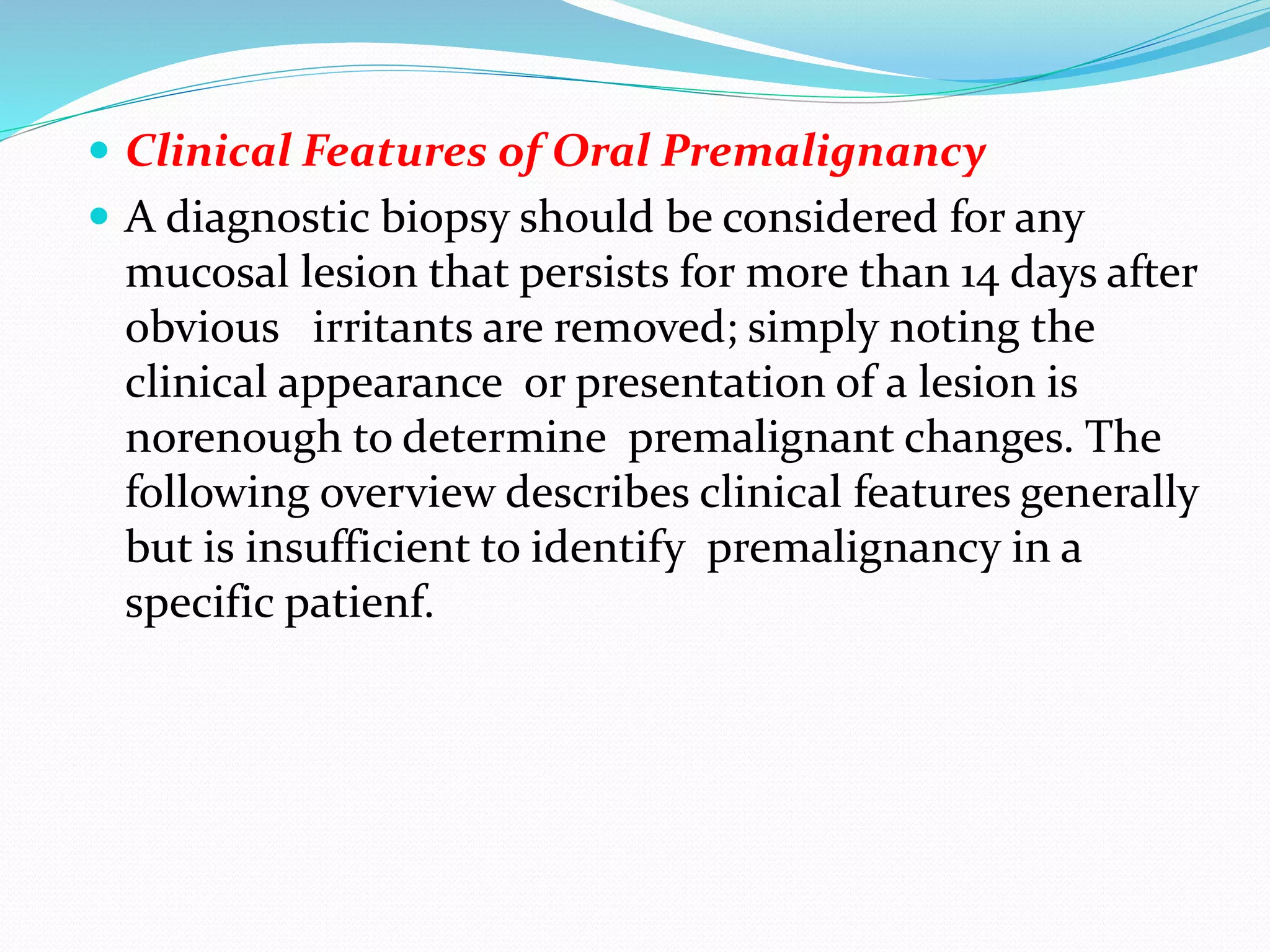
 Other Lesions
 Premalignant changes arising in other oral lesions are
uncommon. White lesions such as linea alba, leukoedema,
and frictional keratosis are common in the oral cavity but
have no propensity for malignant transformation. The
health
 professional can usually identify them by patient history
and clinical xamination.
 Clinical Features of Oral Premalignancy
 A diagnostic biopsy should be considered for any
mucosal lesion that persists for more than 14 days after
obvious irritants are removed; simply noting the
clinical appearance or presentation of a lesion is
norenough to determine premalignant changes. The
following overview describes clinical features generally
but is insufficient to identify premalignancy in a
specific patienf.
 Anatomic Location'
 21.8% Of oral epithelial dysplasias occurred on the buccal mucosa( 13.7°/d on
the palate, and 12.30/0 on the floor of the mouth. (7) A study of leukoplakia by
Shafer and Waldron8
 found that the mandibular mucosa and sulcus were involved
 in 25.2% of their cases and on the buccal mucosa in 21.9%.
 tongue, oropharynx, lip, and floor of mouth are the most
 common sites

 Age
 The mean age at diagnosis of oral premalignancy is 50-69;
 less than 50/0 of diagnoses are in patients under 30 years of
 age.7,10,11 Thus, the aging process itself is the greatest risk
 factor for premalignant and malignant changes.
 Sex
 Studies have shown that epithelial dysplasia has a
 predilection for males, but the decrease in the (7,10,11)
 male female ratio for oral squamous cell carcinoma suggests
 the picture may be changing. This may be due to increased
 use of tobacco and alcohol among women (see Chapter I). Clinical Appearanc
 Although most premalignant lesions are white (leukoplakia),
 they vary considerably in their initial presentation. These
 lesions are usually asymptomatic
 . A greater risk of malignant change in an epithelial dysplasia has been
associated with the following factors: (1) erythroplakia within a leukoplakia, (2)
a proliferative verrucous appearance, (3) location at a high-risk
 anatomic site such as the tongue or floor of mouth, (4) the presence of
multiple lesions, and, paradoxically, (5) a history of not smoking cigarettes. (2)
 Diagnosis

 They must still exercise clinical judgment, however,
 when evaluating the results of the toluidine blue stain. In
 almost all cases in
 ter an unexplained
 leukoplakic or erythroplakic lesion, they should perform a
 there is a noninvasive clinical test-the topical application of
toluidine blue to a sus icious area that helps identify the
presence of dysplastic or carcinomatous lesions.
 Clinicians can use toluidine blue to help identify lesions more
likely to have premalignant or Histopathologic Diagnosis
 Histopathologic Diagnosis
 The histomorphologic changes of epithelial dysplasia consist of the following:
(18)
 Loss of basal cell polarity
 Parabasilar hyperplasia
 Increased nuclear: cytoplasmic ratio
 Drop-shaped rete ridges
 Abnormal epithelial maturation
 Increased mitotic activity
 Mitoses in the superficial half of the surface epithelium
 Cellular pleomorohism
 Nuclear hyperchromaticity
 Enlarged nucleoli
 Loss of cellular cohesiveness
 individual cell keratinization in the spinous cell layer
 Treatment
 Surgical excision, which can be accomplished with a
scalpel or a C02 laser, is the treatment of choice for
epithelial dysplasia of the oral cavity


Premalignant lesion

  • 1.
    NAMES : DHUHAKHALID , 201110402 MEERA ALI , 201112824
  • 2.
     Introduction:  Classificationschemes for lesions of the oral cavity typically have used the clinical appearance of lesions to determine which are premalignant. (1) Leukoplakia and erythroplakia are two clinical lesions widely considered to be premalignant. However, using clinical features to classify lesions is difficult because they vary in appearance and are likely to be interpreted subjectively by the clinician. A histopathology diagnosis is generally more indicative of premalignant change than clinically apparent alterations.
  • 3.
     A Stateof the Science  Clinical Lesions Associated with Premalignancy Leukoplakia  The term leukoplakia is sometimes used inappropriately to indicate a premalignant condition. In fact, the term describes a white plaque that does not rub off and cannot be clinically identified as another entity. Most cases of leukoplakia are a hyperkeratotic response to an irritant and are asymptomatic,
  • 4.
     Erythroplakia  Anerythroplakia is a red lesion that cannot be classified as another entity. Far less common than leukoplakia, erythroplakia has a much greater probability (91%) of showing signs of dysplasia or malignancy at the time of diagnosis
  • 5.
     Other Lesions Premalignant changes arising in other oral lesions are uncommon. White lesions such as linea alba, leukoedema, and frictional keratosis are common in the oral cavity but have no propensity for malignant transformation. The health  professional can usually identify them by patient history and clinical xamination.
  • 6.
     Clinical Featuresof Oral Premalignancy  A diagnostic biopsy should be considered for any mucosal lesion that persists for more than 14 days after obvious irritants are removed; simply noting the clinical appearance or presentation of a lesion is norenough to determine premalignant changes. The following overview describes clinical features generally but is insufficient to identify premalignancy in a specific patienf.
  • 7.
     Anatomic Location' 21.8% Of oral epithelial dysplasias occurred on the buccal mucosa( 13.7°/d on the palate, and 12.30/0 on the floor of the mouth. (7) A study of leukoplakia by Shafer and Waldron8  found that the mandibular mucosa and sulcus were involved  in 25.2% of their cases and on the buccal mucosa in 21.9%.  tongue, oropharynx, lip, and floor of mouth are the most  common sites   Age  The mean age at diagnosis of oral premalignancy is 50-69;  less than 50/0 of diagnoses are in patients under 30 years of  age.7,10,11 Thus, the aging process itself is the greatest risk  factor for premalignant and malignant changes.
  • 8.
     Sex  Studieshave shown that epithelial dysplasia has a  predilection for males, but the decrease in the (7,10,11)  male female ratio for oral squamous cell carcinoma suggests  the picture may be changing. This may be due to increased  use of tobacco and alcohol among women (see Chapter I). Clinical Appearanc  Although most premalignant lesions are white (leukoplakia),  they vary considerably in their initial presentation. These  lesions are usually asymptomatic  . A greater risk of malignant change in an epithelial dysplasia has been associated with the following factors: (1) erythroplakia within a leukoplakia, (2) a proliferative verrucous appearance, (3) location at a high-risk  anatomic site such as the tongue or floor of mouth, (4) the presence of multiple lesions, and, paradoxically, (5) a history of not smoking cigarettes. (2)
  • 9.
     Diagnosis   Theymust still exercise clinical judgment, however,  when evaluating the results of the toluidine blue stain. In  almost all cases in  ter an unexplained  leukoplakic or erythroplakic lesion, they should perform a  there is a noninvasive clinical test-the topical application of toluidine blue to a sus icious area that helps identify the presence of dysplastic or carcinomatous lesions.  Clinicians can use toluidine blue to help identify lesions more likely to have premalignant or Histopathologic Diagnosis
  • 10.
     Histopathologic Diagnosis The histomorphologic changes of epithelial dysplasia consist of the following: (18)  Loss of basal cell polarity  Parabasilar hyperplasia  Increased nuclear: cytoplasmic ratio  Drop-shaped rete ridges  Abnormal epithelial maturation  Increased mitotic activity  Mitoses in the superficial half of the surface epithelium  Cellular pleomorohism  Nuclear hyperchromaticity  Enlarged nucleoli  Loss of cellular cohesiveness  individual cell keratinization in the spinous cell layer
  • 11.
     Treatment  Surgicalexcision, which can be accomplished with a scalpel or a C02 laser, is the treatment of choice for epithelial dysplasia of the oral cavity 