Predictive analytics (Webinar 1)
Customer retention May 19th 2015
we look at simple
‣ What are we trying to solve?
‣ How can we use predictive analytics?
‣ What data are we talking about?
‣ Demo
‣ Q&A
David Hitt
Director, Strategic Accounts
Qubit
Stephen Pavlovich
CEO & Founder
conversion.com
Agenda
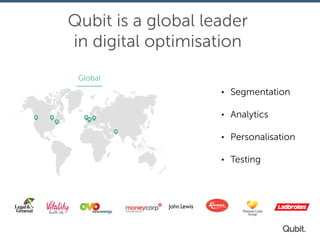
Qubit is a global leader
in digital optimisation
Global
• Segmentation
• Analytics
• Personalisation
• Testing
we look at simple
What is the
retention problem?
80% of future revenue
will come from as little as
20% of existing customer
(Gartner).
Yet most companies don’t
have effective retention
programs.
Consider conversion rates online which
can be as low as 3% for new visitors.
Existing customers on the other hand can
renew at volumes greater than 80%
depending upon the brand and industry.
If we look at a wireline provider who
tends to have a churn rate of between 2 -
2.5% per month even with a modest
customer base of 5 million, that means
an estimated 1.3m customers or $2b in
revenue is lost every year. Frightening
numbers. The revenue opportunities
associated with an increase in retention
can be massive.
EXAMPLE
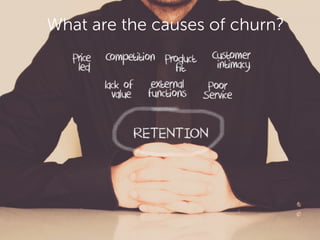
What are the causes of churn?
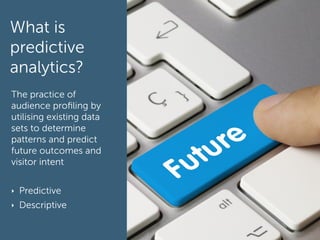
What is
predictive
analytics?
The practice of
audience profiling by
utilising existing data
sets to determine
patterns and predict
future outcomes and
visitor intent
‣ Predictive
‣ Descriptive
Purchase scenario
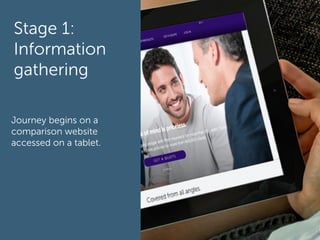
Stage 1:
Information
gathering
Journey begins on a
comparison website
accessed on a tablet.
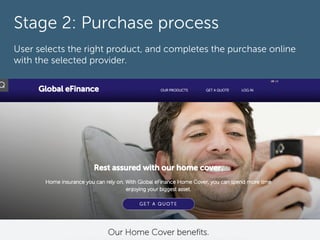
Stage 2: Purchase process
User selects the right product, and completes the purchase online
with the selected provider.
Stage 3:
In-life
customer
support
Customer will have a
number of experiences
during the period of service
that will impact their
propensity to churn or
renew.
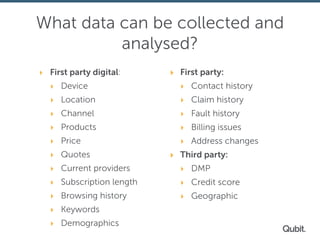
What data can be collected and
analysed?
‣ First party digital:
‣ Device
‣ Location
‣ Channel
‣ Products
‣ Price
‣ Quotes
‣ Current providers
‣ Subscription length
‣ Browsing history
‣ Keywords
‣ Demographics
‣ First party:
‣ Contact history
‣ Claim history
‣ Fault history
‣ Billing issues
‣ Address changes
‣ Third party:
‣ DMP
‣ Credit score
‣ Geographic
EXAMPLE
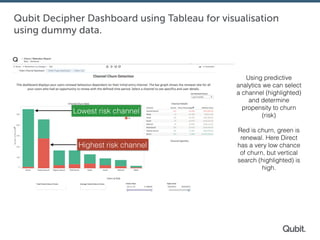
Qubit Decipher Dashboard using Tableau for visualisation
using dummy data.
Using predictive
analytics we can select
a channel (highlighted)
and determine
propensity to churn
(risk)
Red is churn, green is
renewal. Here Direct
has a very low chance
of churn, but vertical
search (highlighted) is
high.
Highest risk channel
Lowest risk channel
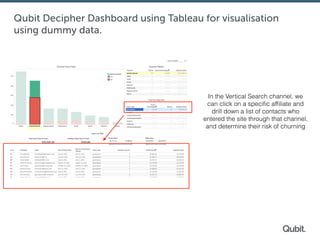
Qubit Decipher Dashboard using Tableau for visualisation
using dummy data.
In the Vertical Search channel, we
can click on a specific affiliate and
drill down a list of contacts who
entered the site through that channel,
and determine their risk of churning
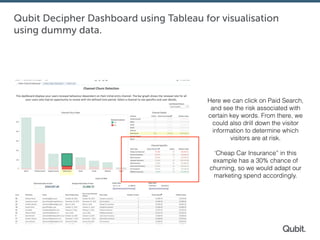
Qubit Decipher Dashboard using Tableau for visualisation
using dummy data.
Here we can click on Paid Search,
and see the risk associated with
certain key words. From there, we
could also drill down the visitor
information to determine which
visitors are at risk.
‘Cheap Car Insurance” in this
example has a 30% chance of
churning, so we would adapt our
marketing spend accordingly.
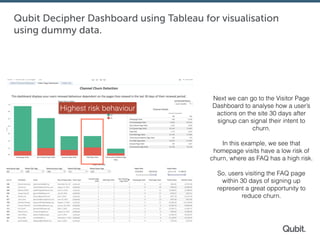
Qubit Decipher Dashboard using Tableau for visualisation
using dummy data.
Next we can go to the Visitor Page
Dashboard to analyse how a user’s
actions on the site 30 days after
signup can signal their intent to
churn.
In this example, we see that
homepage visits have a low risk of
churn, where as FAQ has a high risk.
So, users visiting the FAQ page
within 30 days of signing up
represent a great opportunity to
reduce churn.
Highest risk behaviour
Qubit Decipher Dashboard using Tableau for visualisation
using dummy data.
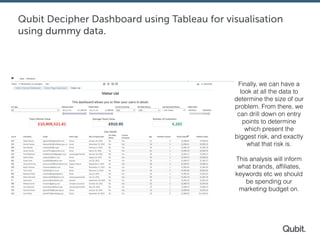
Finally, we can have a
look at all the data to
determine the size of our
problem. From there, we
can drill down on entry
points to determine
which present the
biggest risk, and exactly
what that risk is.
This analysis will inform
what brands, affiliates,
keywords etc we should
be spending our
marketing budget on.
we look at simple
Personalising
the experience
The next 2 slides we look at
how to personalise the
experience for at risk users.
1) Personalising by cross-selling
a product that reduces
propensity to churn
2) Targeting users on the FAQ
page with a rang of
personalised and relevant
discounts to lock them in and
reduce churn.
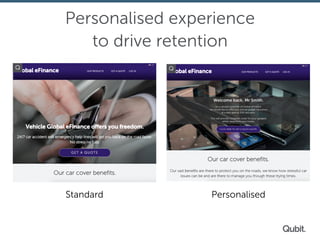
Personalised experience
to drive retention
Standard Personalised
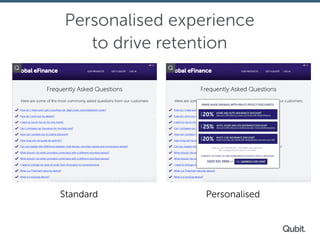
Personalised experience
to drive retention
Standard Personalised
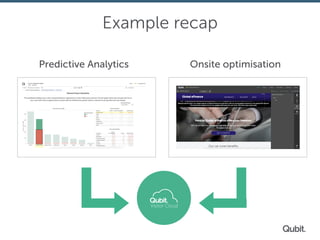
Example recap
Predictive Analytics Onsite optimisation
Visitor Cloud
The business value
‣ Customer retention
‣ Stop existing customers from moving to the competition
‣ Improved targeting of offers
‣ Know who to target with which offer based on their individual score
‣ Improved loyalty and willingness to recommend
‣ Positive word of mouth driving more conversions
‣ Increased customer lifetime value
‣ Increase average subscription period and value
‣ Optimise the partner/affiliate programme
‣ Manage partners based on true conversion value
For more information
contact
retention@qubit.com

Driving customer retention using predictive analytics

  • 1.
    Predictive analytics (Webinar1) Customer retention May 19th 2015
  • 2.
    we look atsimple ‣ What are we trying to solve? ‣ How can we use predictive analytics? ‣ What data are we talking about? ‣ Demo ‣ Q&A David Hitt Director, Strategic Accounts Qubit Stephen Pavlovich CEO & Founder conversion.com Agenda
  • 3.
    Qubit is aglobal leader in digital optimisation Global • Segmentation • Analytics • Personalisation • Testing
  • 4.
    we look atsimple What is the retention problem? 80% of future revenue will come from as little as 20% of existing customer (Gartner). Yet most companies don’t have effective retention programs. Consider conversion rates online which can be as low as 3% for new visitors. Existing customers on the other hand can renew at volumes greater than 80% depending upon the brand and industry. If we look at a wireline provider who tends to have a churn rate of between 2 - 2.5% per month even with a modest customer base of 5 million, that means an estimated 1.3m customers or $2b in revenue is lost every year. Frightening numbers. The revenue opportunities associated with an increase in retention can be massive. EXAMPLE
  • 5.
    What are thecauses of churn?
  • 6.
    What is predictive analytics? The practiceof audience profiling by utilising existing data sets to determine patterns and predict future outcomes and visitor intent ‣ Predictive ‣ Descriptive
  • 7.
  • 8.
    Stage 1: Information gathering Journey beginson a comparison website accessed on a tablet.
  • 9.
    Stage 2: Purchaseprocess User selects the right product, and completes the purchase online with the selected provider.
  • 10.
    Stage 3: In-life customer support Customer willhave a number of experiences during the period of service that will impact their propensity to churn or renew.
  • 11.
    What data canbe collected and analysed? ‣ First party digital: ‣ Device ‣ Location ‣ Channel ‣ Products ‣ Price ‣ Quotes ‣ Current providers ‣ Subscription length ‣ Browsing history ‣ Keywords ‣ Demographics ‣ First party: ‣ Contact history ‣ Claim history ‣ Fault history ‣ Billing issues ‣ Address changes ‣ Third party: ‣ DMP ‣ Credit score ‣ Geographic
  • 12.
  • 13.
    Qubit Decipher Dashboardusing Tableau for visualisation using dummy data. Using predictive analytics we can select a channel (highlighted) and determine propensity to churn (risk) Red is churn, green is renewal. Here Direct has a very low chance of churn, but vertical search (highlighted) is high. Highest risk channel Lowest risk channel
  • 14.
    Qubit Decipher Dashboardusing Tableau for visualisation using dummy data. In the Vertical Search channel, we can click on a specific affiliate and drill down a list of contacts who entered the site through that channel, and determine their risk of churning
  • 15.
    Qubit Decipher Dashboardusing Tableau for visualisation using dummy data. Here we can click on Paid Search, and see the risk associated with certain key words. From there, we could also drill down the visitor information to determine which visitors are at risk. ‘Cheap Car Insurance” in this example has a 30% chance of churning, so we would adapt our marketing spend accordingly.
  • 16.
    Qubit Decipher Dashboardusing Tableau for visualisation using dummy data. Next we can go to the Visitor Page Dashboard to analyse how a user’s actions on the site 30 days after signup can signal their intent to churn. In this example, we see that homepage visits have a low risk of churn, where as FAQ has a high risk. So, users visiting the FAQ page within 30 days of signing up represent a great opportunity to reduce churn. Highest risk behaviour
  • 17.
    Qubit Decipher Dashboardusing Tableau for visualisation using dummy data. Finally, we can have a look at all the data to determine the size of our problem. From there, we can drill down on entry points to determine which present the biggest risk, and exactly what that risk is. This analysis will inform what brands, affiliates, keywords etc we should be spending our marketing budget on.
  • 18.
    we look atsimple Personalising the experience The next 2 slides we look at how to personalise the experience for at risk users. 1) Personalising by cross-selling a product that reduces propensity to churn 2) Targeting users on the FAQ page with a rang of personalised and relevant discounts to lock them in and reduce churn.
  • 19.
    Personalised experience to driveretention Standard Personalised
  • 20.
    Personalised experience to driveretention Standard Personalised
  • 21.
    Example recap Predictive AnalyticsOnsite optimisation Visitor Cloud
  • 22.
    The business value ‣Customer retention ‣ Stop existing customers from moving to the competition ‣ Improved targeting of offers ‣ Know who to target with which offer based on their individual score ‣ Improved loyalty and willingness to recommend ‣ Positive word of mouth driving more conversions ‣ Increased customer lifetime value ‣ Increase average subscription period and value ‣ Optimise the partner/affiliate programme ‣ Manage partners based on true conversion value
  • 23.