Developing a  Marketing Analytics Platform
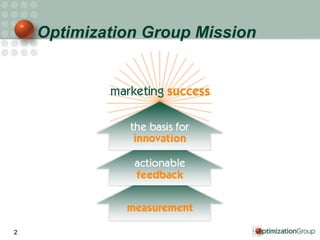
Optimization Group Mission
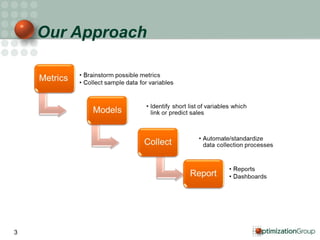
Our Approach
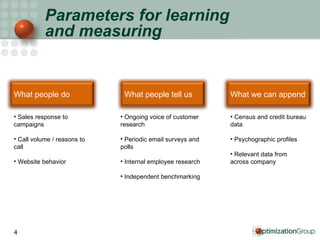
Parameters for learning  and measuring Sales response to campaigns Call volume / reasons to call Website behavior Ongoing voice of customer research  Periodic email surveys and polls Internal employee research Independent benchmarking Census and credit bureau data Psychographic profiles Relevant data from across company What people do  What we can append What people tell us
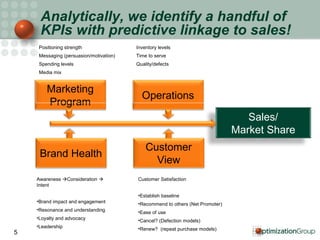
Analytically, we identify a handful of KPIs with predictive linkage to sales! Awareness   Consideration    Intent Brand impact and engagement Resonance and understanding Loyalty and advocacy Leadership Customer Satisfaction Establish baseline Recommend to others (Net Promoter)  Ease of use Cancel? (Defection models) Renew?  (repeat purchase models) Positioning strength Messaging (persuasion/motivation) Spending levels Media mix Inventory levels Time to serve Quality/defects Brand Health Customer View Operations Marketing Program Sales/ Market Share
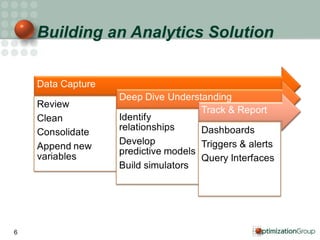
Building an Analytics Solution
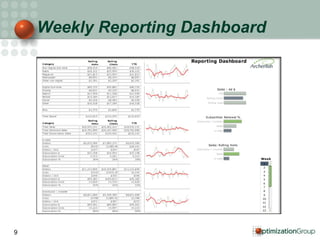
Dashboard Examples
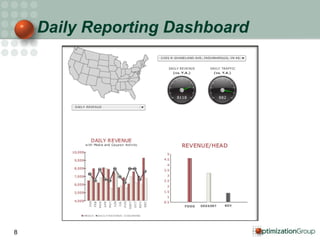
Daily Reporting Dashboard
Weekly Reporting Dashboard
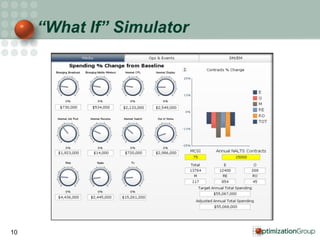
“ What If” Simulator
In Summary… Marketing Analytics … not just “market research” Primary data + secondary data Integrate and synthesize data from throughout the company – not just research data but also sales, marketing plan investments, etc. Using proven tools and templates…   We frame data and convert to actionable information
Contacts Jeff Ewald Founder and CEO E:  jewa [email_address] ationgroup.com T: 248.459.1194 Tom Thompson Business Development Director E:  [email_address] T: 734.748.5460
Intersecting marketing, science and technology™
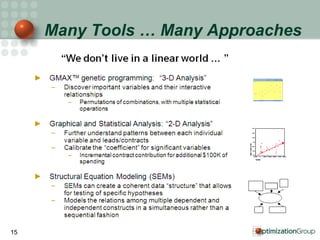
Why is our analytic/modeling  approach different?  Utilize many tools -- selecting the best approach for each task Proprietary tools and data platforms permit examination of more variables Typically 3 orders of magnitude more Identifies complex relationships and patterns in the data Interactions Curvilinear functions (multi-order polynomials) Modeling in the real-world environment
Many Tools … Many Approaches
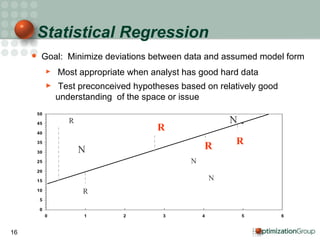
Statistical Regression $10 $9 $5 $4 $7 $8 $3 $2 $1 $6 R R R N R N N N R Goal:  Minimize deviations between data and assumed model form Most appropriate when analyst has good hard data  Test preconceived hypotheses based on relatively good understanding  of the space or issue
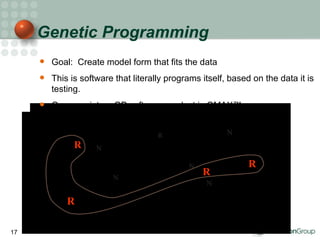
Genetic Programming $10 $9 $5 $4 $7 $8 $3 $2 $1 $6 R R R N R N N N N R Goal:  Create model form that fits the data This is software that literally programs itself, based on the data it is testing.  Our proprietary GP software product is GMAX™
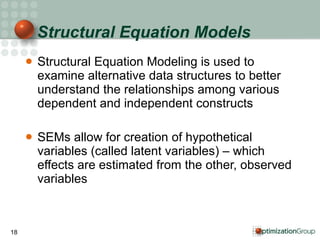
Structural Equation Models Structural Equation Modeling is used to examine alternative data structures to better understand the relationships among various dependent and independent constructs SEMs allow for creation of hypothetical variables (called latent variables) – which effects are estimated from the other, observed variables
Simulators Allows decision maker to view outcomes under a wide range of scenarios “ Stress test” the decision Improves understanding of relationships between variables (internal and external) Various types from simple equations, to Monte Carlo simulation to sophisticated Agent based modeling

Building Analytics Dashboards

  • 1.
    Developing a Marketing Analytics Platform
  • 2.
  • 3.
  • 4.
    Parameters for learning and measuring Sales response to campaigns Call volume / reasons to call Website behavior Ongoing voice of customer research Periodic email surveys and polls Internal employee research Independent benchmarking Census and credit bureau data Psychographic profiles Relevant data from across company What people do What we can append What people tell us
  • 5.
    Analytically, we identifya handful of KPIs with predictive linkage to sales! Awareness  Consideration  Intent Brand impact and engagement Resonance and understanding Loyalty and advocacy Leadership Customer Satisfaction Establish baseline Recommend to others (Net Promoter) Ease of use Cancel? (Defection models) Renew? (repeat purchase models) Positioning strength Messaging (persuasion/motivation) Spending levels Media mix Inventory levels Time to serve Quality/defects Brand Health Customer View Operations Marketing Program Sales/ Market Share
  • 6.
  • 7.
  • 8.
  • 9.
  • 10.
    “ What If”Simulator
  • 11.
    In Summary… MarketingAnalytics … not just “market research” Primary data + secondary data Integrate and synthesize data from throughout the company – not just research data but also sales, marketing plan investments, etc. Using proven tools and templates… We frame data and convert to actionable information
  • 12.
    Contacts Jeff EwaldFounder and CEO E: jewa [email_address] ationgroup.com T: 248.459.1194 Tom Thompson Business Development Director E: [email_address] T: 734.748.5460
  • 13.
  • 14.
    Why is ouranalytic/modeling approach different? Utilize many tools -- selecting the best approach for each task Proprietary tools and data platforms permit examination of more variables Typically 3 orders of magnitude more Identifies complex relationships and patterns in the data Interactions Curvilinear functions (multi-order polynomials) Modeling in the real-world environment
  • 15.
    Many Tools …Many Approaches
  • 16.
    Statistical Regression $10$9 $5 $4 $7 $8 $3 $2 $1 $6 R R R N R N N N R Goal: Minimize deviations between data and assumed model form Most appropriate when analyst has good hard data Test preconceived hypotheses based on relatively good understanding of the space or issue
  • 17.
    Genetic Programming $10$9 $5 $4 $7 $8 $3 $2 $1 $6 R R R N R N N N N R Goal: Create model form that fits the data This is software that literally programs itself, based on the data it is testing. Our proprietary GP software product is GMAX™
  • 18.
    Structural Equation ModelsStructural Equation Modeling is used to examine alternative data structures to better understand the relationships among various dependent and independent constructs SEMs allow for creation of hypothetical variables (called latent variables) – which effects are estimated from the other, observed variables
  • 19.
    Simulators Allows decisionmaker to view outcomes under a wide range of scenarios “ Stress test” the decision Improves understanding of relationships between variables (internal and external) Various types from simple equations, to Monte Carlo simulation to sophisticated Agent based modeling

Editor's Notes