Data Communication - What is
Data Communication?
Data communication refers to the exchange of data
between a source and a receiver. Data communication is
said to be local if communicating devices are in the same
building or a similarly restricted geographical area.
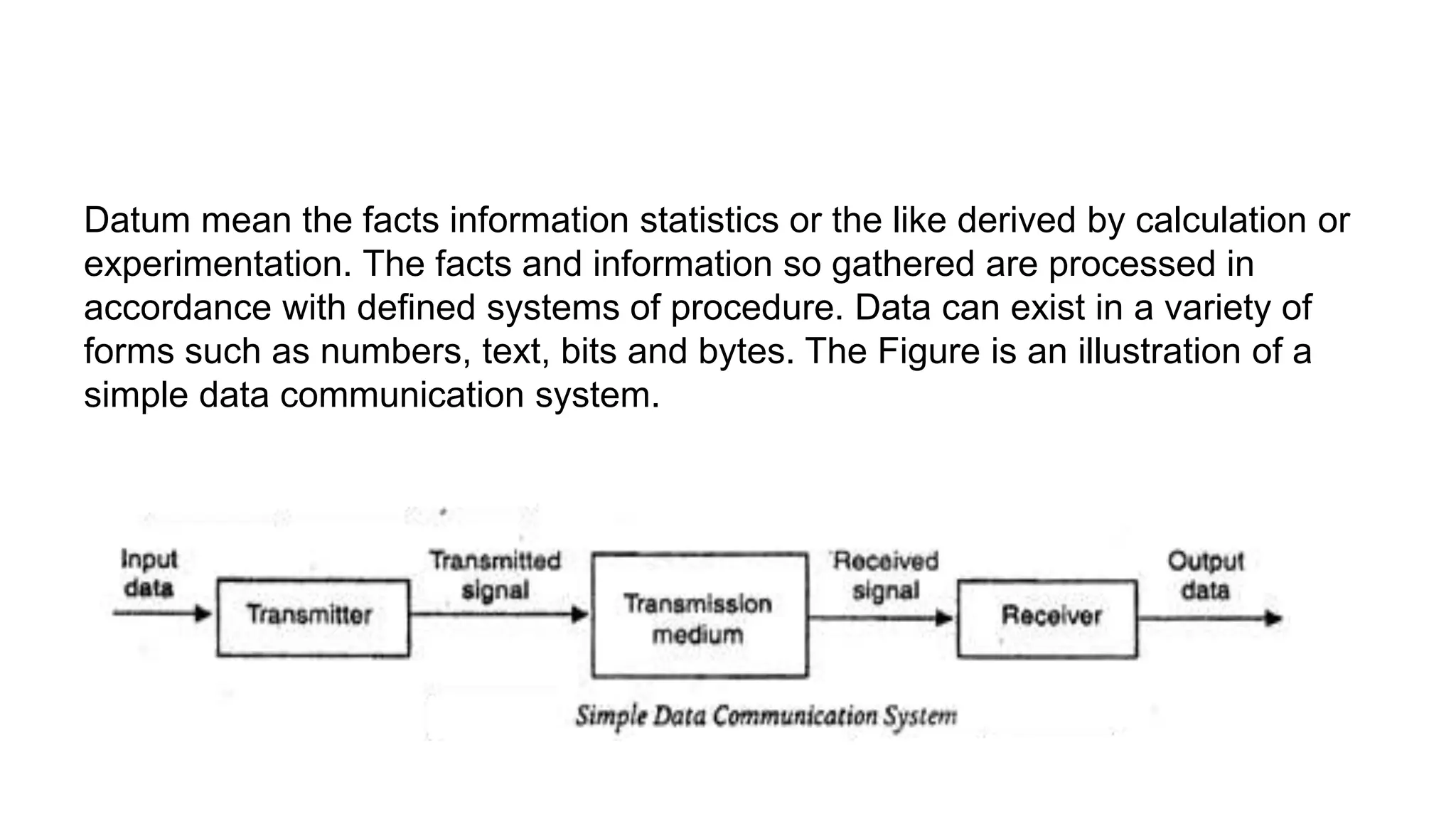
Datum mean the facts information statistics or the like derived by calculation or
experimentation. The facts and information so gathered are processed in
accordance with defined systems of procedure. Data can exist in a variety of
forms such as numbers, text, bits and bytes. The Figure is an illustration of a
simple data communication system.
A data communication system may collect data from remote locations through data transmission
circuits, and then outputs processed results to remote locations. Figure provides a broader view
of data communication networks. The different data communication techniques which are
presently in widespread use evolved gradually either to improve the data communication
techniques already existing or to replace the same with better options and features. Then, there
are data communication jargons to contend with such as baud rate, modems, routers, LAN,
WAN, TCP/IP, ISDN, during the selection of communication systems. Hence, it becomes
necessary to review and understand these terms and gradual development of data
communication methods.
Components of data communication
system
1. Message: It is the information or data to be
communicated. It can consist of text, numbers, pictures,
sound or video or any combination of these.
2. Sender: It is the device/computer that generates and
sends that message.
3. Receiver: It is the device or computer that receives the message. The
location of receiver computer is generally different from the sender computer.
The distance between sender and receiver depends upon the types of network
used in between.
4. Medium: It is the channel or physical path through which the message is
carried from sender to the receiver. The medium can be wired like twisted pair
wire, coaxial cable, fiber-optic cable or wireless like laser, radio waves, and
microwaves.
5. Protocol: It is a set of rules that govern the
communication between the devices. Both sender and
receiver follow same protocols to communicate with each
other.
A protocol performs the following
functions:
1. Data sequencing. It refers to breaking a long message into
smaller packets of fixed size. Data sequencing rules define the
method of numbering packets to detect loss or duplication of
packets, and to correctly identify packets, which belong to same
message.
2. Data routing. Data routing defines the most efficient path between
the source and destination.
3. Data formatting. Data formatting rules define which group of bits or
characters within packet constitute data, control, addressing, or other
information.
4. Flow control. A communication protocol also prevents a fast sender from
overwhelming a slow receiver. It ensures resource sharing and protection
against traffic congestion by regulating the flow of data on communication lines.
5. Error control. These rules are designed to detect errors in messages and to
ensure transmission of correct messages. The most common method is to
retransmit erroneous message block. In such a case, a block having error is
discarded by the receiver and is retransmitted by the sender.
6. Precedence and order of transmission. These rules ensure that all the nodes
get a chance to use the communication lines and other resources of the
network based on the priorities assigned to them.
7. Connection establishment and termination. These rules
define how connections are established, maintained and
terminated when two nodes of a network want to
communicate with each other.
Data communication

Data communication

  • 2.
    Data Communication -What is Data Communication? Data communication refers to the exchange of data between a source and a receiver. Data communication is said to be local if communicating devices are in the same building or a similarly restricted geographical area.
  • 4.
    Datum mean thefacts information statistics or the like derived by calculation or experimentation. The facts and information so gathered are processed in accordance with defined systems of procedure. Data can exist in a variety of forms such as numbers, text, bits and bytes. The Figure is an illustration of a simple data communication system.
  • 5.
    A data communicationsystem may collect data from remote locations through data transmission circuits, and then outputs processed results to remote locations. Figure provides a broader view of data communication networks. The different data communication techniques which are presently in widespread use evolved gradually either to improve the data communication techniques already existing or to replace the same with better options and features. Then, there are data communication jargons to contend with such as baud rate, modems, routers, LAN, WAN, TCP/IP, ISDN, during the selection of communication systems. Hence, it becomes necessary to review and understand these terms and gradual development of data communication methods.
  • 7.
    Components of datacommunication system 1. Message: It is the information or data to be communicated. It can consist of text, numbers, pictures, sound or video or any combination of these. 2. Sender: It is the device/computer that generates and sends that message.
  • 8.
    3. Receiver: Itis the device or computer that receives the message. The location of receiver computer is generally different from the sender computer. The distance between sender and receiver depends upon the types of network used in between. 4. Medium: It is the channel or physical path through which the message is carried from sender to the receiver. The medium can be wired like twisted pair wire, coaxial cable, fiber-optic cable or wireless like laser, radio waves, and microwaves.
  • 9.
    5. Protocol: Itis a set of rules that govern the communication between the devices. Both sender and receiver follow same protocols to communicate with each other.
  • 11.
    A protocol performsthe following functions: 1. Data sequencing. It refers to breaking a long message into smaller packets of fixed size. Data sequencing rules define the method of numbering packets to detect loss or duplication of packets, and to correctly identify packets, which belong to same message. 2. Data routing. Data routing defines the most efficient path between the source and destination.
  • 12.
    3. Data formatting.Data formatting rules define which group of bits or characters within packet constitute data, control, addressing, or other information. 4. Flow control. A communication protocol also prevents a fast sender from overwhelming a slow receiver. It ensures resource sharing and protection against traffic congestion by regulating the flow of data on communication lines.
  • 13.
    5. Error control.These rules are designed to detect errors in messages and to ensure transmission of correct messages. The most common method is to retransmit erroneous message block. In such a case, a block having error is discarded by the receiver and is retransmitted by the sender. 6. Precedence and order of transmission. These rules ensure that all the nodes get a chance to use the communication lines and other resources of the network based on the priorities assigned to them.
  • 14.
    7. Connection establishmentand termination. These rules define how connections are established, maintained and terminated when two nodes of a network want to communicate with each other.