โ€œMachine Learning
in Healthcare Diagnosticsโ€
Xconomy Forum: Human Impact of Innovation
San Diego, CA
April 19, 2017
Dr. Larry Smarr
Director, California Institute for Telecommunications and Information Technology
Harry E. Gruber Professor,
Dept. of Computer Science and Engineering
Jacobs School of Engineering, UCSD
http://lsmarr.calit2.net
1
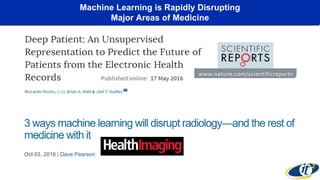
Machine Learning is Rapidly Disrupting
Major Areas of Medicine
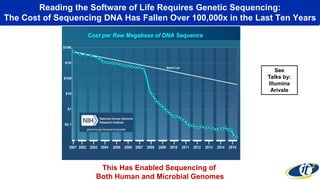
Reading the Software of Life Requires Genetic Sequencing:
The Cost of Sequencing DNA Has Fallen Over 100,000x in the Last Ten Years
This Has Enabled Sequencing of
Both Human and Microbial Genomes
See
Talks by:
Illumina
Arivale
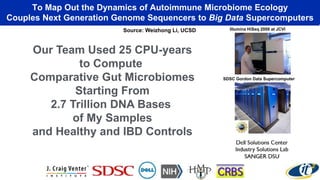
To Map Out the Dynamics of Autoimmune Microbiome Ecology
Couples Next Generation Genome Sequencers to Big Data Supercomputers
Source: Weizhong Li, UCSD
Our Team Used 25 CPU-years
to Compute
Comparative Gut Microbiomes
Starting From
2.7 Trillion DNA Bases
of My Samples
and Healthy and IBD Controls
Illumina HiSeq 2000 at JCVI
SDSC Gordon Data Supercomputer
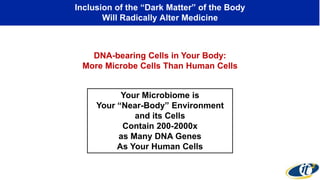
Your Microbiome is
Your โ€œNear-Bodyโ€ Environment
and its Cells
Contain 200-2000x
as Many DNA Genes
As Your Human Cells
DNA-bearing Cells in Your Body:
More Microbe Cells Than Human Cells
Inclusion of the โ€œDark Matterโ€ of the Body
Will Radically Alter Medicine
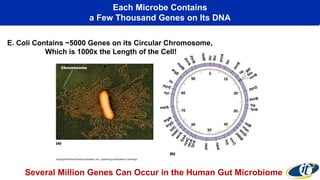
Each Microbe Contains
a Few Thousand Genes on Its DNA
E. Coli Contains ~5000 Genes on its Circular Chromosome,
Which is 1000x the Length of the Cell!
Several Million Genes Can Occur in the Human Gut Microbiome
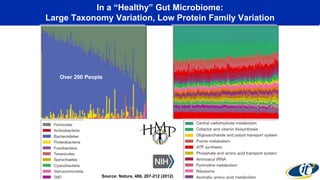
In a โ€œHealthyโ€ Gut Microbiome:
Large Taxonomy Variation, Low Protein Family Variation
Source: Nature, 486, 207-212 (2012)
Over 200 People
Using Machine Learning to Determine Major Differences
Between Gut Microbiome in Health and Disease
IEEE International Conference on Big Data (December 5-8, 2016)
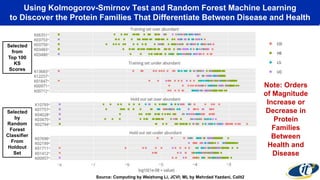
Using Kolmogorov-Smirnov Test and Random Forest Machine Learning
to Discover the Protein Families That Differentiate Between Disease and Health
Selected
from
Top 100
KS
Scores
Selected
by
Random
Forest
Classifier
From
Holdout
Set
Note: Orders
of Magnitude
Increase or
Decrease in
Protein
Families
Between
Health and
Disease
Source: Computing by Weizhong Li, JCVI; ML by Mehrdad Yazdani, Calit2
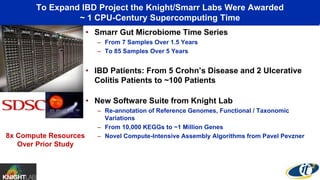
To Expand IBD Project the Knight/Smarr Labs Were Awarded
~ 1 CPU-Century Supercomputing Time
โ€ข Smarr Gut Microbiome Time Series
โ€“ From 7 Samples Over 1.5 Years
โ€“ To 85 Samples Over 5 Years
โ€ข IBD Patients: From 5 Crohnโ€™s Disease and 2 Ulcerative
Colitis Patients to ~100 Patients
โ€ข New Software Suite from Knight Lab
โ€“ Re-annotation of Reference Genomes, Functional / Taxonomic
Variations
โ€“ From 10,000 KEGGs to ~1 Million Genes
โ€“ Novel Compute-Intensive Assembly Algorithms from Pavel Pevzner8x Compute Resources
Over Prior Study
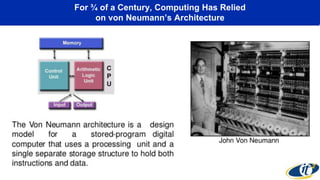
For ยพ of a Century, Computing Has Relied
on von Neumannโ€™s Architecture
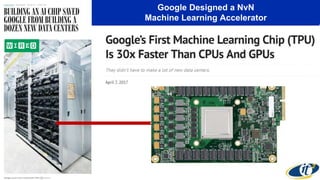
Google Designed a NvN
Machine Learning Accelerator
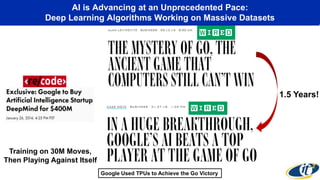
AI is Advancing at an Unprecedented Pace:
Deep Learning Algorithms Working on Massive Datasets
1.5 Years!
Training on 30M Moves,
Then Playing Against Itself
Google Used TPUs to Achieve the Go Victory
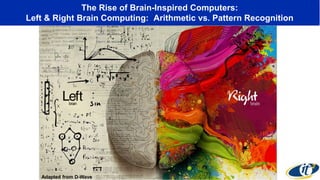
The Rise of Brain-Inspired Computers:
Left & Right Brain Computing: Arithmetic vs. Pattern Recognition
Adapted from D-Wave
Brain-Inspired Processors
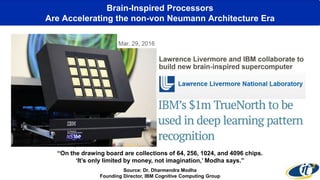
Are Accelerating the non-von Neumann Architecture Era
โ€œOn the drawing board are collections of 64, 256, 1024, and 4096 chips.
โ€˜Itโ€™s only limited by money, not imagination,โ€™ Modha says.โ€
Source: Dr. Dharmendra Modha
Founding Director, IBM Cognitive Computing Group
August 8, 2014
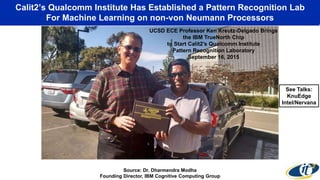
Calit2โ€™s Qualcomm Institute Has Established a Pattern Recognition Lab
For Machine Learning on non-von Neumann Processors
โ€œOn the drawing board are collections of 64, 256, 1024, and 4096 chips.
โ€˜Itโ€™s only limited by money, not imagination,โ€™ Modha says.โ€
Source: Dr. Dharmendra Modha
Founding Director, IBM Cognitive Computing Group
August 8, 2014
UCSD ECE Professor Ken Kreutz-Delgado Brings
the IBM TrueNorth Chip
to Start Calit2โ€™s Qualcomm Institute
Pattern Recognition Laboratory
September 16, 2015
See Talks:
KnuEdge
Intel/Nervana
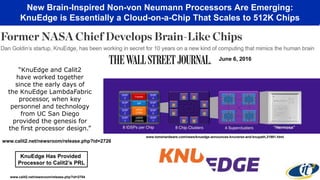
New Brain-Inspired Non-von Neumann Processors Are Emerging:
KnuEdge is Essentially a Cloud-on-a-Chip That Scales to 512K Chips
www.tomshardware.com/news/knuedge-announces-knuverse-and-knupath,31981.html
www.calit2.net/newsroom/release.php?id=2704
โ€œKnuEdge and Calit2
have worked together
since the early days of
the KnuEdge LambdaFabric
processor, when key
personnel and technology
from UC San Diego
provided the genesis for
the first processor design.โ€
www.calit2.net/newsroom/release.php?id=2726
June 6, 2016
KnuEdge Has Provided
Processor to Calit2โ€™s PRL
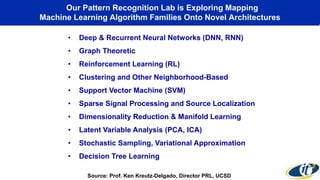
Our Pattern Recognition Lab is Exploring Mapping
Machine Learning Algorithm Families Onto Novel Architectures
โ€ข Deep & Recurrent Neural Networks (DNN, RNN)
โ€ข Graph Theoretic
โ€ข Reinforcement Learning (RL)
โ€ข Clustering and Other Neighborhood-Based
โ€ข Support Vector Machine (SVM)
โ€ข Sparse Signal Processing and Source Localization
โ€ข Dimensionality Reduction & Manifold Learning
โ€ข Latent Variable Analysis (PCA, ICA)
โ€ข Stochastic Sampling, Variational Approximation
โ€ข Decision Tree Learning
Source: Prof. Ken Kreutz-Delgado, Director PRL, UCSD
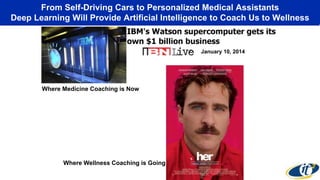
From Self-Driving Cars to Personalized Medical Assistants
Deep Learning Will Provide Artificial Intelligence to Coach Us to Wellness
Where Medicine Coaching is Now
Where Wellness Coaching is Going
January 10, 2014
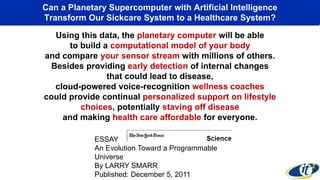
Can a Planetary Supercomputer with Artificial Intelligence
Transform Our Sickcare System to a Healthcare System?
Using this data, the planetary computer will be able
to build a computational model of your body
and compare your sensor stream with millions of others.
Besides providing early detection of internal changes
that could lead to disease,
cloud-powered voice-recognition wellness coaches
could provide continual personalized support on lifestyle
choices, potentially staving off disease
and making health care affordable for everyone.
ESSAY
An Evolution Toward a Programmable
Universe
By LARRY SMARR
Published: December 5, 2011
For Further Information:
http://lsmarr.calit2.net/

Machine Learning in Healthcare Diagnostics

  • 1.
    โ€œMachine Learning in HealthcareDiagnosticsโ€ Xconomy Forum: Human Impact of Innovation San Diego, CA April 19, 2017 Dr. Larry Smarr Director, California Institute for Telecommunications and Information Technology Harry E. Gruber Professor, Dept. of Computer Science and Engineering Jacobs School of Engineering, UCSD http://lsmarr.calit2.net 1
  • 2.
    Machine Learning isRapidly Disrupting Major Areas of Medicine
  • 4.
    Reading the Softwareof Life Requires Genetic Sequencing: The Cost of Sequencing DNA Has Fallen Over 100,000x in the Last Ten Years This Has Enabled Sequencing of Both Human and Microbial Genomes See Talks by: Illumina Arivale
  • 5.
    To Map Outthe Dynamics of Autoimmune Microbiome Ecology Couples Next Generation Genome Sequencers to Big Data Supercomputers Source: Weizhong Li, UCSD Our Team Used 25 CPU-years to Compute Comparative Gut Microbiomes Starting From 2.7 Trillion DNA Bases of My Samples and Healthy and IBD Controls Illumina HiSeq 2000 at JCVI SDSC Gordon Data Supercomputer
  • 6.
    Your Microbiome is Yourโ€œNear-Bodyโ€ Environment and its Cells Contain 200-2000x as Many DNA Genes As Your Human Cells DNA-bearing Cells in Your Body: More Microbe Cells Than Human Cells Inclusion of the โ€œDark Matterโ€ of the Body Will Radically Alter Medicine
  • 7.
    Each Microbe Contains aFew Thousand Genes on Its DNA E. Coli Contains ~5000 Genes on its Circular Chromosome, Which is 1000x the Length of the Cell! Several Million Genes Can Occur in the Human Gut Microbiome
  • 8.
    In a โ€œHealthyโ€Gut Microbiome: Large Taxonomy Variation, Low Protein Family Variation Source: Nature, 486, 207-212 (2012) Over 200 People
  • 9.
    Using Machine Learningto Determine Major Differences Between Gut Microbiome in Health and Disease IEEE International Conference on Big Data (December 5-8, 2016)
  • 10.
    Using Kolmogorov-Smirnov Testand Random Forest Machine Learning to Discover the Protein Families That Differentiate Between Disease and Health Selected from Top 100 KS Scores Selected by Random Forest Classifier From Holdout Set Note: Orders of Magnitude Increase or Decrease in Protein Families Between Health and Disease Source: Computing by Weizhong Li, JCVI; ML by Mehrdad Yazdani, Calit2
  • 11.
    To Expand IBDProject the Knight/Smarr Labs Were Awarded ~ 1 CPU-Century Supercomputing Time โ€ข Smarr Gut Microbiome Time Series โ€“ From 7 Samples Over 1.5 Years โ€“ To 85 Samples Over 5 Years โ€ข IBD Patients: From 5 Crohnโ€™s Disease and 2 Ulcerative Colitis Patients to ~100 Patients โ€ข New Software Suite from Knight Lab โ€“ Re-annotation of Reference Genomes, Functional / Taxonomic Variations โ€“ From 10,000 KEGGs to ~1 Million Genes โ€“ Novel Compute-Intensive Assembly Algorithms from Pavel Pevzner8x Compute Resources Over Prior Study
  • 12.
    For ยพ ofa Century, Computing Has Relied on von Neumannโ€™s Architecture
  • 13.
    Google Designed aNvN Machine Learning Accelerator
  • 14.
    AI is Advancingat an Unprecedented Pace: Deep Learning Algorithms Working on Massive Datasets 1.5 Years! Training on 30M Moves, Then Playing Against Itself Google Used TPUs to Achieve the Go Victory
  • 15.
    The Rise ofBrain-Inspired Computers: Left & Right Brain Computing: Arithmetic vs. Pattern Recognition Adapted from D-Wave
  • 16.
    Brain-Inspired Processors Are Acceleratingthe non-von Neumann Architecture Era โ€œOn the drawing board are collections of 64, 256, 1024, and 4096 chips. โ€˜Itโ€™s only limited by money, not imagination,โ€™ Modha says.โ€ Source: Dr. Dharmendra Modha Founding Director, IBM Cognitive Computing Group August 8, 2014
  • 17.
    Calit2โ€™s Qualcomm InstituteHas Established a Pattern Recognition Lab For Machine Learning on non-von Neumann Processors โ€œOn the drawing board are collections of 64, 256, 1024, and 4096 chips. โ€˜Itโ€™s only limited by money, not imagination,โ€™ Modha says.โ€ Source: Dr. Dharmendra Modha Founding Director, IBM Cognitive Computing Group August 8, 2014 UCSD ECE Professor Ken Kreutz-Delgado Brings the IBM TrueNorth Chip to Start Calit2โ€™s Qualcomm Institute Pattern Recognition Laboratory September 16, 2015 See Talks: KnuEdge Intel/Nervana
  • 18.
    New Brain-Inspired Non-vonNeumann Processors Are Emerging: KnuEdge is Essentially a Cloud-on-a-Chip That Scales to 512K Chips www.tomshardware.com/news/knuedge-announces-knuverse-and-knupath,31981.html www.calit2.net/newsroom/release.php?id=2704 โ€œKnuEdge and Calit2 have worked together since the early days of the KnuEdge LambdaFabric processor, when key personnel and technology from UC San Diego provided the genesis for the first processor design.โ€ www.calit2.net/newsroom/release.php?id=2726 June 6, 2016 KnuEdge Has Provided Processor to Calit2โ€™s PRL
  • 19.
    Our Pattern RecognitionLab is Exploring Mapping Machine Learning Algorithm Families Onto Novel Architectures โ€ข Deep & Recurrent Neural Networks (DNN, RNN) โ€ข Graph Theoretic โ€ข Reinforcement Learning (RL) โ€ข Clustering and Other Neighborhood-Based โ€ข Support Vector Machine (SVM) โ€ข Sparse Signal Processing and Source Localization โ€ข Dimensionality Reduction & Manifold Learning โ€ข Latent Variable Analysis (PCA, ICA) โ€ข Stochastic Sampling, Variational Approximation โ€ข Decision Tree Learning Source: Prof. Ken Kreutz-Delgado, Director PRL, UCSD
  • 20.
    From Self-Driving Carsto Personalized Medical Assistants Deep Learning Will Provide Artificial Intelligence to Coach Us to Wellness Where Medicine Coaching is Now Where Wellness Coaching is Going January 10, 2014
  • 21.
    Can a PlanetarySupercomputer with Artificial Intelligence Transform Our Sickcare System to a Healthcare System? Using this data, the planetary computer will be able to build a computational model of your body and compare your sensor stream with millions of others. Besides providing early detection of internal changes that could lead to disease, cloud-powered voice-recognition wellness coaches could provide continual personalized support on lifestyle choices, potentially staving off disease and making health care affordable for everyone. ESSAY An Evolution Toward a Programmable Universe By LARRY SMARR Published: December 5, 2011
  • 22.

Editor's Notes