International Research Journal of Engineering and Technology (IRJET) e-ISSN: 2395-0056
Volume: 09 Issue: 04 | Apr 2022 www.irjet.net p-ISSN: 2395-0072
© 2022, IRJET | Impact Factor value: 7.529 | ISO 9001:2008 Certified Journal | Page 61
Predicting Heart Disease Using Machine Learning Algorithms.
Mihir Patel1, Rahul Patange2, Chaitanya Patil3, Prof. Anuradha Kapoor4
1Mihir Patel, Dept of Information Technology Engineering, Atharva College of Engineering
2Rahul Patange, Dept of Information Technology Engineering, Atharva College of Engineering
3Chaitanya Patil, Dept of Information Technology Engineering, Atharva College of Engineering
4Prof. Anuradha Kapoor, Dept of Information Technology Engineering, Atharva College of Engineering
---------------------------------------------------------------------***---------------------------------------------------------------------
Abstract - As we all know heart is the most important part
of our body other than brain. For having a healthy heart,
there are many solutions available in market. Exercise can
also play an important role for maintaining heart healthy.
Apart from medical treatments, technologycanalsoproveto
be very useful in treating any heart disease. Any heart
disease is predicted beforehand, then curing it would be not
much complex. But predicting it would be a tough task.
According to the survey by WHO (World Health
Organization), Cardiovascular diseasesaretheleadingcause
of death globally. Estimate deaths per year are 17.9 Million.
The datasets used are classified in terms of medical
parameters. This system evaluates those parameters using
data mining classification technique. The datasets are
processed in python programming using Machine Learning
Algorithm that isLogistic RegressionAlgorithmwhichshows
the best algorithm in terms ofaccuracylevel ofheartdisease.
Key Words: Heart Diseases, Machine Learning
Algorithms, Logistic Regression, Random Forest,
Decision Tree.
1.INTRODUCTION
Heart attacks are the most commonly cause of death among
all deadly disorders. Medical professionals perform several
surveys on heart disorders in order to acquire information
on heart patients, their symptoms, and the development of
their disease. These days, heart attack is a common
occurrence that can be fatal. Some symptoms foreshadowed
the future. Medical science has made excellent use of
technological breakthroughs to raise the standard of
healthcare These technological developments have opened
the path for precise illness diagnosis and prognosis Machine
learning might be a great option for you obtaina highlevel of
accuracy when it comes to forecasting heart illnesses As a
result, three algorithms will be implemented.
It is an algorithms containing Logistic Regression Decision
tree and Random forest. Furthermore, these three methods
gives significantly more rapid and consistent outcomes.
Predictions are becomingmorestraightforwardasa resultof
technological advancements. Peoplenowadaysliveinluxury
all over the world, and they work like machines to acquire a
lot of money and fame. People forget to take care of their
health because of their hectic schedules.
As a result, the food they eat and the way they live have
changed. Blood pressure, diabetes, and a variety of other
ailments develop in young people as a result of strain and
stress in their lives. All of these factors contribute to the
onset of heart disease.
1.1 Description
In this paper, the heart disease dataset of UCI repository is
taken and subjected to various classification and clustering
algorithms using python. The main focus is to target all
possible combinations of the attributes against various
algorithms. Then of all the techniques it is the techniquethat
works the best to predict the heart disease at an early stage
is identified.
Implementing 3 algorithms such as Decision tree, Random
forest and Logistic regression would make it easier to
identify and sort out the disease. Dataset is used to classify
and train the model. After training the model, the most
accurate and successful algorithm was later used to predict
the disease.
1.2 Problem statement
The most difficult aspect of cardiac disease is detecting it.
There are tools that can forecast heart disease, but they are
either too expensive or too inefficient to quantify the risk of
heart disease in humans. Early identification of heart
disorders has been shown to reduce mortality and overall
consequences. However, it is not possible to correctly
monitor patients every day in all circumstances, and
consultation with a doctor for 24 hours is not availablesince
it takes more intelligence, time, and competence. We may
use various machine learning algorithmstoevaluatedata for
hidden patterns in today's environment since we have a lot
of data. Hidden patterns in medical data can be utilised for
health diagnosis.
1.3 Proposed Approach
People all across the globe now live luxury lives, and they
work like machines to gain a lot of money and recognition.
People fail to care on their health because of their hectic
schedules. As a result, the food they eat has changed, as has
their way of life. Because of the strain and stress in their
International Research Journal of Engineering and Technology (IRJET) e-ISSN: 2395-0056
Volume: 09 Issue: 04 | Apr 2022 www.irjet.net p-ISSN: 2395-0072
© 2022, IRJET | Impact Factor value: 7.529 | ISO 9001:2008 Certified Journal | Page 62
lives, they develop high blood pressure, diabetes, and a
variety of other disorders at an early age. All of these factors
contribute to the onset of heart disease. We are employing
the Logistic Regression approach to develop an effective
heart attack prediction system in this system. We can
provide input to the system in the form of a CSV file or by
entering it manually. Logistic Regressionisanalgorithmthat
is applied after accepting input. The operation is carried out
after accessing the data set, and an effective heart attack
level is created. The suggested method would incorporate
some more criteria relevant to heart attacks, such as weight,
age, and priority levels, after consultation with specialist
doctors and medical professionals. The heart attack
prediction system is intended to assist in identifying
different risk levels of heart attack, such as normal, low, or
high, as well as providing prescription data based on the
expected outcome. The user can also register and login or
else user can quickly predict the heart disease by just one
click, but after quickly predicting the result the user’s data
will not be stored and neither user can access his/her
previous record. After Successful registration and login the
user can feed the values on the website and click on predict,
on the very next screen the user can see the result . It will
show the probability of heart disease in the percentage. If
the percentage is greater than 60%, it will display "Your
chance of having heart disease is high" and will provide
prevention and symptoms as well as a doctor's contact
information for further assistance; if the percentage is less
than 60%, it will display "Your chance of having heart
disease is low." The user data is saved in the database using
their name and username, and any doctor who wants to add
his/her details can do so using the admin panel. Our major
goal is to save the prior record so that the user may see how
much progress has been made by the user.
2. LITERATURE SURVEY
According to [1] numerous readingshave beencarriedoutto
produce a prediction model using not only distinct
techniques but also by relating two or more techniques. The
dataset with a radial basis function network (RBFN) is used
for classification, where 70% of the data is used for training
and the remaining 30% is used for classification. The
prediction model is introduced with different combinations
of features and several known classification techniques. It
produced an enhanced performance level of 88.7% through
the prediction model for heart disease with Hybrid Random
Forest with Linear Model (HRFLM).
Sakshi Goel,AbhinavDeepShilpa Srivastava,Aparna Tripathi
[2] has proposed a number of models for predicting heart
diseases using different technologiessuchasartificial neural
networks, machine learning, data mining, etc. This paper
analyses the work done by various researchers on the
accuracy of heart disease prediction through the different
approaches. A detail literature review has been provided in
the study. The analysis has also been presented on the basis
on technology used. Data mininggivesmaximumaccuracyof
92.1% with SVM algorithm and minimum accuracyof89.6%
with Decision Tree algorithm.
Mohini Chakarverti, Saumya Yadav, Rajiv Rajan [3]
approached as the useful data is extract from raw dataset
with the help of data mining approach. The alike and unlike
information is clustered after measuring a resemblance
among input dataset. Both alike and unlike data types are
classified using KNN classifier. The KNN is the classifier
which can classify the data based on the nearest neighbor.
The execution time of the KNN classifier is also low as
compared to SVM classifier. Here KNN has given the highest
accuracy of 83% as compared to SVM. In future, the
proposed approach will be further enhanced to design
hybrid classifier for the prediction of heart diseases.
M.Preethi and Dr.J.Selvakumar [4] reviewed a literature
survey that delivers the concept of various techniques has
been studied for diagnosing the cardiovascular disease. Use
of big data, machine learning along with data mining can
provide promising results to bring the most effective
accuracy in analyzing the prediction model .The main aim of
this paper diagnosing the cardiovasculardiseaseortheheart
disease and using different methods and many approaches
to get prediction.
3. COMPARISON ANALYSIS
For the comparison analysis, we have compared different
machine learning algorithms like Decision tree, Logistic
Regression, Random forest. The overall result was 77% for
decision tree, 84% for random forest and 92% for logistic
regression. From the comparison, we get to know that
Logistic Regression is preferable as it gives better
classification and higher prediction results for the detection
of Heart disease diseases.
Chart 1- Chart showing prediction accuracy percentage for
different algorithms.
International Research Journal of Engineering and Technology (IRJET) e-ISSN: 2395-0056
Volume: 09 Issue: 04 | Apr 2022 www.irjet.net p-ISSN: 2395-0072
© 2022, IRJET | Impact Factor value: 7.529 | ISO 9001:2008 Certified Journal | Page 63
4. ARCHITECHTURE
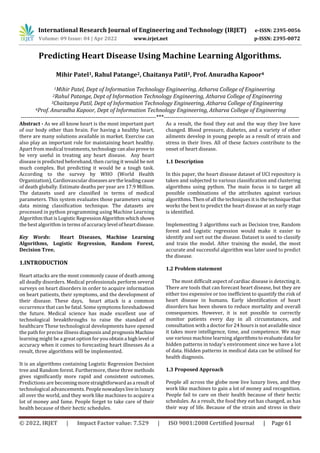
4.1 Block Diagram
In our project we have created a UI with the database,where
user can register and login to predict their heart disease if
user did not want to register and login than they candirectly
predict the heart disease on clicking on quickly predict
button. After that the user have to insert the 13 attributes
like age , gender, cholesterol level, etc. And afterenteringthe
details on basis of user details the model will be build and
the dataset will be trained we have divided Test into 25%
and Train into 75%. The build model and the percentage of
heart disease risk will be displayed on the screen, if the
percentage is more than 60% than there is the risk of heart
disease and on our UI the user can get prevention and
symptoms option. The user can gettheirpreviousrecords on
our website if the user has login from same credentials if
they have predicted earlier. If the model predicted the heart
disease then the user have the option to contact directly via
email or phone. All the user information is stored in the
database to access whenever they required.
We have compared three algorithms which are Decision
Tree, Logistic Regression and Random Forest. After
comparison we have found that Logistic Regression has
given the highest accuracy of 92% followed by Random
Forest given accuracy of 84% and Decision Tree of 77%. So
we have used Logistic Regression model in our project
because of highest accuracy.
5. METHODOLOGY
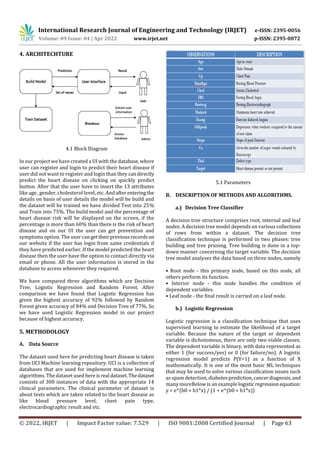
A. Data Source
The dataset used here for predicting heart disease is taken
from UCI Machine learning repository. UCI is a collection of
databases that are used for implement machine learning
algorithms. The dataset used hereisreal dataset.Thedataset
consists of 300 instances of data with the appropriate 14
clinical parameters. The clinical parameter of dataset is
about tests which are taken related to the heart disease as
like blood pressure level, chest pain type,
electrocardiographic result and etc.
5.1 Parameters
B. DESCRIPTION OF METHODS AND ALGORITHMS.
a.) Decision Tree Classifier
A decision tree structure comprises root, internal and leaf
nodes. A decision tree model depends on various collections
of rows from within a dataset. The decision tree
classification technique is performed in two phases: tree
building and tree pruning. Tree building is done in a top-
down manner concerning the target variable. The decision
tree model analyses the data based on three nodes, namely
• Root node - this primary node, based on this node, all
others perform its function.
• Interior node - this node handles the condition of
dependent variables.
• Leaf node - the final result is carried on a leaf node.
b.) Logistic Regression
Logistic regression is a classification technique that uses
supervised learning to estimate the likelihood of a target
variable. Because the nature of the target or dependent
variable is dichotomous, there are only two viable classes.
The dependent variable is binary, with data represented as
either 1 (for success/yes) or 0 (for failure/no). A logistic
regression model predicts P(Y=1) as a function of X
mathematically. It is one of the most basic ML techniques
that may be used to solve various classification issues such
as spam detection, diabetesprediction,cancerdiagnosis,and
many moreBelow is an examplelogisticregression equation:
y = e^(b0 + b1*x) / (1 + e^(b0 + b1*x))
International Research Journal of Engineering and Technology (IRJET) e-ISSN: 2395-0056
Volume: 09 Issue: 04 | Apr 2022 www.irjet.net p-ISSN: 2395-0072
© 2022, IRJET | Impact Factor value: 7.529 | ISO 9001:2008 Certified Journal | Page 64
c.) Random Forest
Random forest is a supervised classification machine
learning algorithm that uses the ensemble method. A
random forest is made up of numerous decision trees and
helps to tackle the problem of over-fitting in decision trees.
These decision trees are randomly constructed by selecting
random features from the given dataset.
Random forest arrives at a decision or prediction based on
the maximum number of votes received from the decision
trees. The outcome, which is arrived at a maximum number
of times through the numerous decision trees, is considered
the outcome by the random forest.
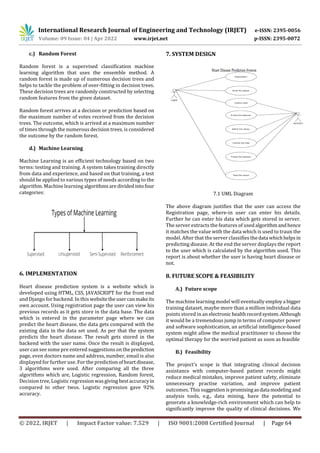
d.) Machine Learning
Machine Learning is an efficient technology based on two
terms: testing and training. A system takes training directly
from data and experience, and based on that training, a test
should be applied to various types of needs according to the
algorithm. Machine learning algorithmsaredividedintofour
categories:
6. IMPLEMENTATION
Heart disease prediction system is a website which is
developed using HTML, CSS, JAVASCRIPT for the front end
and Django for backend. In this websitetheusercanmakeits
own account. Using registration page the user can view his
previous records as it gets store in the data base. The data
which is entered in the parameter page where we can
predict the heart disease, the data gets compared with the
existing data in the data set used. As per that the system
predicts the heart disease. The result gets stored in the
backend with the user name. Once the result is displayed,
user can see some pre entered suggestions on theprediction
page, even doctors name and address, number, email is also
displayed for further use. For the predictionofheartdisease,
3 algorithms were used. After comparing all the three
algorithms which are, Logistic regression, Random forest,
Decision tree, Logistic regressionwasgiving bestaccuracyin
compared to other twos. Logistic regression gave 92%
accuracy.
7. SYSTEM DESIGN
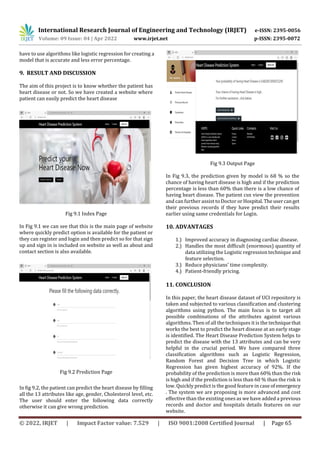
7.1 UML Diagram
The above diagram justifies that the user can access the
Registration page, where-in user can enter his details.
Further he can enter his data which gets stored in server.
The server extracts the features of usedalgorithmandhence
it matches the value with the data which is used to traun the
model. After that the server classifies thedata whichhelpsin
predicting disease. At the end the server displays the report
to the user which is calculated by the algorithm used. This
report is about whether the user is having heart disease or
not.
8. FUTURE SCOPE & FEASIBILITY
A.) Future scope
The machine learning model will eventually employa bigger
training dataset, maybe more than a million individual data
points stored in an electronic healthrecordsystem.Although
it would be a tremendous jump in terms of computer power
and software sophistication, an artificial intelligence-based
system might allow the medical practitioner to choose the
optimal therapy for the worried patient as soon as feasible
B.) Feasibility
The project's scope is that integrating clinical decision
assistance with computer-based patient records might
reduce medical mistakes, improve patient safety, eliminate
unnecessary practise variation, and improve patient
outcomes. This suggestionispromisingasdata modeling and
analysis tools, e.g., data mining, have the potential to
generate a knowledge-rich environment which can help to
significantly improve the quality of clinical decisions. We
International Research Journal of Engineering and Technology (IRJET) e-ISSN: 2395-0056
Volume: 09 Issue: 04 | Apr 2022 www.irjet.net p-ISSN: 2395-0072
© 2022, IRJET | Impact Factor value: 7.529 | ISO 9001:2008 Certified Journal | Page 65
have to use algorithms like logistic regression for creating a
model that is accurate and less error percentage.
9. RESULT AND DISCUSSION
The aim of this project is to know whether the patient has
heart disease or not. So we have created a website where
patient can easily predict the heart disease
Fig 9.1 Index Page
In Fig 9.1 we can see that this is the main page of website
where quickly predict option is available for the patient or
they can register and login and then predict so for that sign
up and sign in is included on website as well as about and
contact section is also available.
Fig 9.2 Prediction Page
In fig 9.2, the patient can predict the heart disease by filling
all the 13 attributes like age, gender, Cholesterol level, etc.
The user should enter the following data correctly
otherwise it can give wrong prediction.
Fig 9.3 Output Page
In Fig 9.3, the prediction given by model is 68 % so the
chance of having heart disease is high and if the prediction
percentage is less than 60% than there is a low chance of
having heart disease. The patient csn view the prevention
and can further assist to Doctor orHospital.Theusercanget
their previous records if they have predict their results
earlier using same credentials for Login.
10. ADVANTAGES
1.) Improved accuracy in diagnosing cardiac disease.
2.) Handles the most difficult (enormous) quantity of
data utilizing the Logistic regression technique and
feature selection.
3.) Reduce physicians' time complexity.
4.) Patient-friendly pricing.
11. CONCLUSION
In this paper, the heart disease dataset of UCI repository is
taken and subjected to various classification and clustering
algorithms using python. The main focus is to target all
possible combinations of the attributes against various
algorithms. Then of all the techniques it is the techniquethat
works the best to predict the heart disease at an early stage
is identified. The Heart Disease Prediction System helps to
predict the disease with the 13 attributes and can be very
helpful in the crucial period. We have compared three
classification algorithms such as Logistic Regression,
Random Forest and Decision Tree in which Logistic
Regression has given highest accuracy of 92%. If the
probability of the prediction is more than 60% than the risk
is high and if the prediction is less than 60 % than the risk is
low. Quickly predict is the good feature in case ofemergency
. The system we are proposing is more advanced and cost
effective than the existing ones as we have added a previous
records and doctor and hospitals details features on our
website.
International Research Journal of Engineering and Technology (IRJET) e-ISSN: 2395-0056
Volume: 09 Issue: 04 | Apr 2022 www.irjet.net p-ISSN: 2395-0072
© 2022, IRJET | Impact Factor value: 7.529 | ISO 9001:2008 Certified Journal | Page 66
ACKNOWLEDGEMENT
We owe sincere thanks to our college Atharva College of
Engineering for giving us a platform to prepare a project on
the topic "Predicting Heart disease using machine learning
algorithms" and would like to thank our principal Dr.
Shrikant Kallurkar for giving us the opportunities and time
to conduct and research on the subject. We are sincerely
grateful for Prof. Anuradha Kapoor as our guide and Prof.
Deepali Maste, Head ofInformationTechnologyDepartment,
and our project coordinator Prof. Renuka Nagpure for
providing help during our research, which would have
seemed difficult without their motivation, constant support,
and valuable suggestion. Moreover, the complication of this
research paper would have been impossible without the co-
operation, suggestion, and help of our friends and family.
REFERENCES
[1] Senthilkumar Mohan, Chandrasegar Thirumalai, and
Gautam Srivastava, “Effective HeartDiseasePredictionusing
Hybrid Machine Learning Techniques”, IEEE Access 2019.
[2] Sakshi Goel, Abhinav Deep, Shilpa Srivastava, Aparna
Tripathi, “Comparative Analysis of Various Techniques for
Heart Disease Prediction System”, ISCON 2019.
[3] Mohini Chakarverti, Saumya Yadav, Rajiv Rajan,
“Classification Techniques for Heart Disease Prediction in
Data Mining”, IEEE 2019.
[4] Dr.J.Selvakumar, M.Preethi, “A Literature Survey Of
Predicting Heart Disease”, IRJET 2020.
[5] Gandhi, Monika, and Shailendra Narayan Singh.
"Predictions in heart disease using techniques of data
mining." In 2015 International Conference on Futuristic
Trends on Computational Analysis and Knowledge
Management (ABLAZE), pp. 520-525. IEEE, 2015.
[6]. Chen, A. H., Huang, S. Y., Hong, P. S., Cheng, C. H., & Lin, E.
J. (2011, September).HDPS:Heartdiseasepredictionsystem.
In 2011 Computing in Cardiology (pp. 557-560). IEEE.
[7]. Aldallal, A., & Al-Moosa, A. A.A.(2018,September).Using
Data Mining Techniques to Predict Diabetes and Heart
Diseases. In 2018 4th International Conference on Frontiers
of Signal Processing (ICFSP) (pp. 150-154). IEEE.
[8]. Sultana, Marjia, Afrin Haider, and Mohammad Shorif
Uddin. "Analysis of data mining techniques for heart disease
prediction." In 2016 3rd International Conference on
Electrical Engineering and Information Communication
Technology (ICEEICT), pp. 1-5. IEEE, 2016.
[9].Al Essa, Ali Radhi, and Christian Bach. "Data Mining and
Warehousing." American Society for Engineering Education
(ASEE Zone 1) Journal (2014).
[10].Shetty, Deeraj, KishorRit,Sohail Shaikh,andNikita Patil.
"Diabetes disease prediction using data mining." In 2017
International Conference on Innovations in Information,
Embedded and Communication Systems (ICIIECS), pp. 1-5.
IEEE, 2017.
[11]. Methaila, Aditya, Prince Kansal, Himanshu Arya, and
Pankaj Kumar. "Early heart disease prediction using data
mining techniques." Computer Science & Information
Technology Journal (2014): 53-59.
[12]. Dewan, Ankita, and Meghna Sharma. "Prediction of
heart disease using a hybrid technique in data mining
classification." In 2015 2nd International Conference on
Computing for Sustainable Global Development
(INDIACom), pp. 704-706. IEEE, 2015.
[13] G. Purusothaman, and P. Krishnakumari, June 2015,“A
Survey of Data Mining Techniques on Risk Prediction: Heart
Disease”, Indian Journal of Science and Technology, Vol.
8(12), DOI:10.17485/ijst/2015/v8i12/58385, pp. 1-5.
[14] Ashish Chhabbi,Lakhan Ahuja,Sahil Ahir, and Y. K.
Sharma,19 March2016,“HeartDiseasePredictionUsingData
Mining Techniques”, International Journal of Research in
AdventTechnology,E-ISSN:2321-9637,Special IssueNational
Conference “NCPC-2016”, pp. 104-106.
[15] Boshra Bahrami, and Mirsaeid Hosseini
Shirvani,February 2015,“Prediction and Diagnosis of Heart
Disease by Data Mining Techniques”,Journal of
Multidisciplinary Engineering Science and
Technology(JMEST), ISSN:3159- 0040, Vol. 2, Issue 2, pp.
164-168.
[15] Siddharth Mundra, Kiran Manjrekar, Nimit Lalwani,
Nilesh Rathod. Review on prediction of heart disease using
data mining, International Journal of Advance Research,
Ideas and Innovations in Technology5.6 (2019),
www.IJARIIT.com.
[16] Jayami Patel, Prof. Tejal Upadhay, Dr. Samir Patel,
“Heart disease Prediction using Machine Learning and Data
mining Technique”, March 2017.
[17] Ashwini Shetty A, Chandra Naik, “Different Data Mining
Approaches for Predicting Heart Disease”, International
Journal of InnovativeinScienceEngineeringandTechnology,
Vol.5, May 2016, pp.277- 281
[18] Sharan Monica.L, Sathees Kumar.B, “Analysis of
CardioVasular Disease Prediction using Data Mining
Techniques”, International Journal of Modern Computer
Science, vol.4, 1 February 2016, pp.55-58.

Predicting Heart Disease Using Machine Learning Algorithms.

  • 1.
    International Research Journalof Engineering and Technology (IRJET) e-ISSN: 2395-0056 Volume: 09 Issue: 04 | Apr 2022 www.irjet.net p-ISSN: 2395-0072 © 2022, IRJET | Impact Factor value: 7.529 | ISO 9001:2008 Certified Journal | Page 61 Predicting Heart Disease Using Machine Learning Algorithms. Mihir Patel1, Rahul Patange2, Chaitanya Patil3, Prof. Anuradha Kapoor4 1Mihir Patel, Dept of Information Technology Engineering, Atharva College of Engineering 2Rahul Patange, Dept of Information Technology Engineering, Atharva College of Engineering 3Chaitanya Patil, Dept of Information Technology Engineering, Atharva College of Engineering 4Prof. Anuradha Kapoor, Dept of Information Technology Engineering, Atharva College of Engineering ---------------------------------------------------------------------***--------------------------------------------------------------------- Abstract - As we all know heart is the most important part of our body other than brain. For having a healthy heart, there are many solutions available in market. Exercise can also play an important role for maintaining heart healthy. Apart from medical treatments, technologycanalsoproveto be very useful in treating any heart disease. Any heart disease is predicted beforehand, then curing it would be not much complex. But predicting it would be a tough task. According to the survey by WHO (World Health Organization), Cardiovascular diseasesaretheleadingcause of death globally. Estimate deaths per year are 17.9 Million. The datasets used are classified in terms of medical parameters. This system evaluates those parameters using data mining classification technique. The datasets are processed in python programming using Machine Learning Algorithm that isLogistic RegressionAlgorithmwhichshows the best algorithm in terms ofaccuracylevel ofheartdisease. Key Words: Heart Diseases, Machine Learning Algorithms, Logistic Regression, Random Forest, Decision Tree. 1.INTRODUCTION Heart attacks are the most commonly cause of death among all deadly disorders. Medical professionals perform several surveys on heart disorders in order to acquire information on heart patients, their symptoms, and the development of their disease. These days, heart attack is a common occurrence that can be fatal. Some symptoms foreshadowed the future. Medical science has made excellent use of technological breakthroughs to raise the standard of healthcare These technological developments have opened the path for precise illness diagnosis and prognosis Machine learning might be a great option for you obtaina highlevel of accuracy when it comes to forecasting heart illnesses As a result, three algorithms will be implemented. It is an algorithms containing Logistic Regression Decision tree and Random forest. Furthermore, these three methods gives significantly more rapid and consistent outcomes. Predictions are becomingmorestraightforwardasa resultof technological advancements. Peoplenowadaysliveinluxury all over the world, and they work like machines to acquire a lot of money and fame. People forget to take care of their health because of their hectic schedules. As a result, the food they eat and the way they live have changed. Blood pressure, diabetes, and a variety of other ailments develop in young people as a result of strain and stress in their lives. All of these factors contribute to the onset of heart disease. 1.1 Description In this paper, the heart disease dataset of UCI repository is taken and subjected to various classification and clustering algorithms using python. The main focus is to target all possible combinations of the attributes against various algorithms. Then of all the techniques it is the techniquethat works the best to predict the heart disease at an early stage is identified. Implementing 3 algorithms such as Decision tree, Random forest and Logistic regression would make it easier to identify and sort out the disease. Dataset is used to classify and train the model. After training the model, the most accurate and successful algorithm was later used to predict the disease. 1.2 Problem statement The most difficult aspect of cardiac disease is detecting it. There are tools that can forecast heart disease, but they are either too expensive or too inefficient to quantify the risk of heart disease in humans. Early identification of heart disorders has been shown to reduce mortality and overall consequences. However, it is not possible to correctly monitor patients every day in all circumstances, and consultation with a doctor for 24 hours is not availablesince it takes more intelligence, time, and competence. We may use various machine learning algorithmstoevaluatedata for hidden patterns in today's environment since we have a lot of data. Hidden patterns in medical data can be utilised for health diagnosis. 1.3 Proposed Approach People all across the globe now live luxury lives, and they work like machines to gain a lot of money and recognition. People fail to care on their health because of their hectic schedules. As a result, the food they eat has changed, as has their way of life. Because of the strain and stress in their
  • 2.
    International Research Journalof Engineering and Technology (IRJET) e-ISSN: 2395-0056 Volume: 09 Issue: 04 | Apr 2022 www.irjet.net p-ISSN: 2395-0072 © 2022, IRJET | Impact Factor value: 7.529 | ISO 9001:2008 Certified Journal | Page 62 lives, they develop high blood pressure, diabetes, and a variety of other disorders at an early age. All of these factors contribute to the onset of heart disease. We are employing the Logistic Regression approach to develop an effective heart attack prediction system in this system. We can provide input to the system in the form of a CSV file or by entering it manually. Logistic Regressionisanalgorithmthat is applied after accepting input. The operation is carried out after accessing the data set, and an effective heart attack level is created. The suggested method would incorporate some more criteria relevant to heart attacks, such as weight, age, and priority levels, after consultation with specialist doctors and medical professionals. The heart attack prediction system is intended to assist in identifying different risk levels of heart attack, such as normal, low, or high, as well as providing prescription data based on the expected outcome. The user can also register and login or else user can quickly predict the heart disease by just one click, but after quickly predicting the result the user’s data will not be stored and neither user can access his/her previous record. After Successful registration and login the user can feed the values on the website and click on predict, on the very next screen the user can see the result . It will show the probability of heart disease in the percentage. If the percentage is greater than 60%, it will display "Your chance of having heart disease is high" and will provide prevention and symptoms as well as a doctor's contact information for further assistance; if the percentage is less than 60%, it will display "Your chance of having heart disease is low." The user data is saved in the database using their name and username, and any doctor who wants to add his/her details can do so using the admin panel. Our major goal is to save the prior record so that the user may see how much progress has been made by the user. 2. LITERATURE SURVEY According to [1] numerous readingshave beencarriedoutto produce a prediction model using not only distinct techniques but also by relating two or more techniques. The dataset with a radial basis function network (RBFN) is used for classification, where 70% of the data is used for training and the remaining 30% is used for classification. The prediction model is introduced with different combinations of features and several known classification techniques. It produced an enhanced performance level of 88.7% through the prediction model for heart disease with Hybrid Random Forest with Linear Model (HRFLM). Sakshi Goel,AbhinavDeepShilpa Srivastava,Aparna Tripathi [2] has proposed a number of models for predicting heart diseases using different technologiessuchasartificial neural networks, machine learning, data mining, etc. This paper analyses the work done by various researchers on the accuracy of heart disease prediction through the different approaches. A detail literature review has been provided in the study. The analysis has also been presented on the basis on technology used. Data mininggivesmaximumaccuracyof 92.1% with SVM algorithm and minimum accuracyof89.6% with Decision Tree algorithm. Mohini Chakarverti, Saumya Yadav, Rajiv Rajan [3] approached as the useful data is extract from raw dataset with the help of data mining approach. The alike and unlike information is clustered after measuring a resemblance among input dataset. Both alike and unlike data types are classified using KNN classifier. The KNN is the classifier which can classify the data based on the nearest neighbor. The execution time of the KNN classifier is also low as compared to SVM classifier. Here KNN has given the highest accuracy of 83% as compared to SVM. In future, the proposed approach will be further enhanced to design hybrid classifier for the prediction of heart diseases. M.Preethi and Dr.J.Selvakumar [4] reviewed a literature survey that delivers the concept of various techniques has been studied for diagnosing the cardiovascular disease. Use of big data, machine learning along with data mining can provide promising results to bring the most effective accuracy in analyzing the prediction model .The main aim of this paper diagnosing the cardiovasculardiseaseortheheart disease and using different methods and many approaches to get prediction. 3. COMPARISON ANALYSIS For the comparison analysis, we have compared different machine learning algorithms like Decision tree, Logistic Regression, Random forest. The overall result was 77% for decision tree, 84% for random forest and 92% for logistic regression. From the comparison, we get to know that Logistic Regression is preferable as it gives better classification and higher prediction results for the detection of Heart disease diseases. Chart 1- Chart showing prediction accuracy percentage for different algorithms.
  • 3.
    International Research Journalof Engineering and Technology (IRJET) e-ISSN: 2395-0056 Volume: 09 Issue: 04 | Apr 2022 www.irjet.net p-ISSN: 2395-0072 © 2022, IRJET | Impact Factor value: 7.529 | ISO 9001:2008 Certified Journal | Page 63 4. ARCHITECHTURE 4.1 Block Diagram In our project we have created a UI with the database,where user can register and login to predict their heart disease if user did not want to register and login than they candirectly predict the heart disease on clicking on quickly predict button. After that the user have to insert the 13 attributes like age , gender, cholesterol level, etc. And afterenteringthe details on basis of user details the model will be build and the dataset will be trained we have divided Test into 25% and Train into 75%. The build model and the percentage of heart disease risk will be displayed on the screen, if the percentage is more than 60% than there is the risk of heart disease and on our UI the user can get prevention and symptoms option. The user can gettheirpreviousrecords on our website if the user has login from same credentials if they have predicted earlier. If the model predicted the heart disease then the user have the option to contact directly via email or phone. All the user information is stored in the database to access whenever they required. We have compared three algorithms which are Decision Tree, Logistic Regression and Random Forest. After comparison we have found that Logistic Regression has given the highest accuracy of 92% followed by Random Forest given accuracy of 84% and Decision Tree of 77%. So we have used Logistic Regression model in our project because of highest accuracy. 5. METHODOLOGY A. Data Source The dataset used here for predicting heart disease is taken from UCI Machine learning repository. UCI is a collection of databases that are used for implement machine learning algorithms. The dataset used hereisreal dataset.Thedataset consists of 300 instances of data with the appropriate 14 clinical parameters. The clinical parameter of dataset is about tests which are taken related to the heart disease as like blood pressure level, chest pain type, electrocardiographic result and etc. 5.1 Parameters B. DESCRIPTION OF METHODS AND ALGORITHMS. a.) Decision Tree Classifier A decision tree structure comprises root, internal and leaf nodes. A decision tree model depends on various collections of rows from within a dataset. The decision tree classification technique is performed in two phases: tree building and tree pruning. Tree building is done in a top- down manner concerning the target variable. The decision tree model analyses the data based on three nodes, namely • Root node - this primary node, based on this node, all others perform its function. • Interior node - this node handles the condition of dependent variables. • Leaf node - the final result is carried on a leaf node. b.) Logistic Regression Logistic regression is a classification technique that uses supervised learning to estimate the likelihood of a target variable. Because the nature of the target or dependent variable is dichotomous, there are only two viable classes. The dependent variable is binary, with data represented as either 1 (for success/yes) or 0 (for failure/no). A logistic regression model predicts P(Y=1) as a function of X mathematically. It is one of the most basic ML techniques that may be used to solve various classification issues such as spam detection, diabetesprediction,cancerdiagnosis,and many moreBelow is an examplelogisticregression equation: y = e^(b0 + b1*x) / (1 + e^(b0 + b1*x))
  • 4.
    International Research Journalof Engineering and Technology (IRJET) e-ISSN: 2395-0056 Volume: 09 Issue: 04 | Apr 2022 www.irjet.net p-ISSN: 2395-0072 © 2022, IRJET | Impact Factor value: 7.529 | ISO 9001:2008 Certified Journal | Page 64 c.) Random Forest Random forest is a supervised classification machine learning algorithm that uses the ensemble method. A random forest is made up of numerous decision trees and helps to tackle the problem of over-fitting in decision trees. These decision trees are randomly constructed by selecting random features from the given dataset. Random forest arrives at a decision or prediction based on the maximum number of votes received from the decision trees. The outcome, which is arrived at a maximum number of times through the numerous decision trees, is considered the outcome by the random forest. d.) Machine Learning Machine Learning is an efficient technology based on two terms: testing and training. A system takes training directly from data and experience, and based on that training, a test should be applied to various types of needs according to the algorithm. Machine learning algorithmsaredividedintofour categories: 6. IMPLEMENTATION Heart disease prediction system is a website which is developed using HTML, CSS, JAVASCRIPT for the front end and Django for backend. In this websitetheusercanmakeits own account. Using registration page the user can view his previous records as it gets store in the data base. The data which is entered in the parameter page where we can predict the heart disease, the data gets compared with the existing data in the data set used. As per that the system predicts the heart disease. The result gets stored in the backend with the user name. Once the result is displayed, user can see some pre entered suggestions on theprediction page, even doctors name and address, number, email is also displayed for further use. For the predictionofheartdisease, 3 algorithms were used. After comparing all the three algorithms which are, Logistic regression, Random forest, Decision tree, Logistic regressionwasgiving bestaccuracyin compared to other twos. Logistic regression gave 92% accuracy. 7. SYSTEM DESIGN 7.1 UML Diagram The above diagram justifies that the user can access the Registration page, where-in user can enter his details. Further he can enter his data which gets stored in server. The server extracts the features of usedalgorithmandhence it matches the value with the data which is used to traun the model. After that the server classifies thedata whichhelpsin predicting disease. At the end the server displays the report to the user which is calculated by the algorithm used. This report is about whether the user is having heart disease or not. 8. FUTURE SCOPE & FEASIBILITY A.) Future scope The machine learning model will eventually employa bigger training dataset, maybe more than a million individual data points stored in an electronic healthrecordsystem.Although it would be a tremendous jump in terms of computer power and software sophistication, an artificial intelligence-based system might allow the medical practitioner to choose the optimal therapy for the worried patient as soon as feasible B.) Feasibility The project's scope is that integrating clinical decision assistance with computer-based patient records might reduce medical mistakes, improve patient safety, eliminate unnecessary practise variation, and improve patient outcomes. This suggestionispromisingasdata modeling and analysis tools, e.g., data mining, have the potential to generate a knowledge-rich environment which can help to significantly improve the quality of clinical decisions. We
  • 5.
    International Research Journalof Engineering and Technology (IRJET) e-ISSN: 2395-0056 Volume: 09 Issue: 04 | Apr 2022 www.irjet.net p-ISSN: 2395-0072 © 2022, IRJET | Impact Factor value: 7.529 | ISO 9001:2008 Certified Journal | Page 65 have to use algorithms like logistic regression for creating a model that is accurate and less error percentage. 9. RESULT AND DISCUSSION The aim of this project is to know whether the patient has heart disease or not. So we have created a website where patient can easily predict the heart disease Fig 9.1 Index Page In Fig 9.1 we can see that this is the main page of website where quickly predict option is available for the patient or they can register and login and then predict so for that sign up and sign in is included on website as well as about and contact section is also available. Fig 9.2 Prediction Page In fig 9.2, the patient can predict the heart disease by filling all the 13 attributes like age, gender, Cholesterol level, etc. The user should enter the following data correctly otherwise it can give wrong prediction. Fig 9.3 Output Page In Fig 9.3, the prediction given by model is 68 % so the chance of having heart disease is high and if the prediction percentage is less than 60% than there is a low chance of having heart disease. The patient csn view the prevention and can further assist to Doctor orHospital.Theusercanget their previous records if they have predict their results earlier using same credentials for Login. 10. ADVANTAGES 1.) Improved accuracy in diagnosing cardiac disease. 2.) Handles the most difficult (enormous) quantity of data utilizing the Logistic regression technique and feature selection. 3.) Reduce physicians' time complexity. 4.) Patient-friendly pricing. 11. CONCLUSION In this paper, the heart disease dataset of UCI repository is taken and subjected to various classification and clustering algorithms using python. The main focus is to target all possible combinations of the attributes against various algorithms. Then of all the techniques it is the techniquethat works the best to predict the heart disease at an early stage is identified. The Heart Disease Prediction System helps to predict the disease with the 13 attributes and can be very helpful in the crucial period. We have compared three classification algorithms such as Logistic Regression, Random Forest and Decision Tree in which Logistic Regression has given highest accuracy of 92%. If the probability of the prediction is more than 60% than the risk is high and if the prediction is less than 60 % than the risk is low. Quickly predict is the good feature in case ofemergency . The system we are proposing is more advanced and cost effective than the existing ones as we have added a previous records and doctor and hospitals details features on our website.
  • 6.
    International Research Journalof Engineering and Technology (IRJET) e-ISSN: 2395-0056 Volume: 09 Issue: 04 | Apr 2022 www.irjet.net p-ISSN: 2395-0072 © 2022, IRJET | Impact Factor value: 7.529 | ISO 9001:2008 Certified Journal | Page 66 ACKNOWLEDGEMENT We owe sincere thanks to our college Atharva College of Engineering for giving us a platform to prepare a project on the topic "Predicting Heart disease using machine learning algorithms" and would like to thank our principal Dr. Shrikant Kallurkar for giving us the opportunities and time to conduct and research on the subject. We are sincerely grateful for Prof. Anuradha Kapoor as our guide and Prof. Deepali Maste, Head ofInformationTechnologyDepartment, and our project coordinator Prof. Renuka Nagpure for providing help during our research, which would have seemed difficult without their motivation, constant support, and valuable suggestion. Moreover, the complication of this research paper would have been impossible without the co- operation, suggestion, and help of our friends and family. REFERENCES [1] Senthilkumar Mohan, Chandrasegar Thirumalai, and Gautam Srivastava, “Effective HeartDiseasePredictionusing Hybrid Machine Learning Techniques”, IEEE Access 2019. [2] Sakshi Goel, Abhinav Deep, Shilpa Srivastava, Aparna Tripathi, “Comparative Analysis of Various Techniques for Heart Disease Prediction System”, ISCON 2019. [3] Mohini Chakarverti, Saumya Yadav, Rajiv Rajan, “Classification Techniques for Heart Disease Prediction in Data Mining”, IEEE 2019. [4] Dr.J.Selvakumar, M.Preethi, “A Literature Survey Of Predicting Heart Disease”, IRJET 2020. [5] Gandhi, Monika, and Shailendra Narayan Singh. "Predictions in heart disease using techniques of data mining." In 2015 International Conference on Futuristic Trends on Computational Analysis and Knowledge Management (ABLAZE), pp. 520-525. IEEE, 2015. [6]. Chen, A. H., Huang, S. Y., Hong, P. S., Cheng, C. H., & Lin, E. J. (2011, September).HDPS:Heartdiseasepredictionsystem. In 2011 Computing in Cardiology (pp. 557-560). IEEE. [7]. Aldallal, A., & Al-Moosa, A. A.A.(2018,September).Using Data Mining Techniques to Predict Diabetes and Heart Diseases. In 2018 4th International Conference on Frontiers of Signal Processing (ICFSP) (pp. 150-154). IEEE. [8]. Sultana, Marjia, Afrin Haider, and Mohammad Shorif Uddin. "Analysis of data mining techniques for heart disease prediction." In 2016 3rd International Conference on Electrical Engineering and Information Communication Technology (ICEEICT), pp. 1-5. IEEE, 2016. [9].Al Essa, Ali Radhi, and Christian Bach. "Data Mining and Warehousing." American Society for Engineering Education (ASEE Zone 1) Journal (2014). [10].Shetty, Deeraj, KishorRit,Sohail Shaikh,andNikita Patil. "Diabetes disease prediction using data mining." In 2017 International Conference on Innovations in Information, Embedded and Communication Systems (ICIIECS), pp. 1-5. IEEE, 2017. [11]. Methaila, Aditya, Prince Kansal, Himanshu Arya, and Pankaj Kumar. "Early heart disease prediction using data mining techniques." Computer Science & Information Technology Journal (2014): 53-59. [12]. Dewan, Ankita, and Meghna Sharma. "Prediction of heart disease using a hybrid technique in data mining classification." In 2015 2nd International Conference on Computing for Sustainable Global Development (INDIACom), pp. 704-706. IEEE, 2015. [13] G. Purusothaman, and P. Krishnakumari, June 2015,“A Survey of Data Mining Techniques on Risk Prediction: Heart Disease”, Indian Journal of Science and Technology, Vol. 8(12), DOI:10.17485/ijst/2015/v8i12/58385, pp. 1-5. [14] Ashish Chhabbi,Lakhan Ahuja,Sahil Ahir, and Y. K. Sharma,19 March2016,“HeartDiseasePredictionUsingData Mining Techniques”, International Journal of Research in AdventTechnology,E-ISSN:2321-9637,Special IssueNational Conference “NCPC-2016”, pp. 104-106. [15] Boshra Bahrami, and Mirsaeid Hosseini Shirvani,February 2015,“Prediction and Diagnosis of Heart Disease by Data Mining Techniques”,Journal of Multidisciplinary Engineering Science and Technology(JMEST), ISSN:3159- 0040, Vol. 2, Issue 2, pp. 164-168. [15] Siddharth Mundra, Kiran Manjrekar, Nimit Lalwani, Nilesh Rathod. Review on prediction of heart disease using data mining, International Journal of Advance Research, Ideas and Innovations in Technology5.6 (2019), www.IJARIIT.com. [16] Jayami Patel, Prof. Tejal Upadhay, Dr. Samir Patel, “Heart disease Prediction using Machine Learning and Data mining Technique”, March 2017. [17] Ashwini Shetty A, Chandra Naik, “Different Data Mining Approaches for Predicting Heart Disease”, International Journal of InnovativeinScienceEngineeringandTechnology, Vol.5, May 2016, pp.277- 281 [18] Sharan Monica.L, Sathees Kumar.B, “Analysis of CardioVasular Disease Prediction using Data Mining Techniques”, International Journal of Modern Computer Science, vol.4, 1 February 2016, pp.55-58.