PRECISION
AGRICULTURE
BY: JOSEPH SARPONG DWUMOH (BSC, ADV. DIP., MSC)
DEFINITION
“Precision Agriculture is a management strategy that gathers, processes and
analyzes temporal, spatial and individual data and combines it with other
information to support management decisions according to estimated variability for
improved resource use efficiency, productivity, quality, profitability and
sustainability of agricultural production.” (International Association of Precision
Agriculture, 2021)
DEFINITION…CONT.
• Using PA allows access to significant amounts of time and location
data to drive decision-making.
• PA allows agriculturalists to observe, evaluate and control farming
operations (Romanov et al., 2016)
• It appears that all definitions of precision agriculture acknowledge
the ultimate goals of environmental stewardship and maximizing
profits by reducing redundancy and waste.
WHAT IS INVOLVED?
• components of a typical PA system
are:
1) Information
2) technology or tools
3) information management
(Mandal & Maity, 2013)
• Typical protocol for PA
implementation follows the following
order:
1. collection of data on variability in
field conditions
2. data processing/information
management
3. execution of informed input
application
(Liaghat & Balasundram, 2010)
WHAT IS INVOLVED?...CONT.
The concept and practice of PA involves combining
information- and technology-based farm management
systems to recognize, evaluate, and control inconsistencies
in field conditions to assure that farming operations are
economically and environmentally sustainable
(Bramley, 2009; Liaghat & Balasundram, 2010; Mondal & Basu, 2009)
HISTORY OF PRECISION AGRICULTURE
• Concept of precision agriculture or precision farming arose in the mid-
1980s with increased public and commercial availability of computing,
satellite imaging and georeferencing capabilities
• The US Military’s GPS facility, which began to be available to the public
worldwide in the 1980s, allowed for unprecedented quick access to
accurate autonomous geo-spatial positioning of any location or asset on
earth (GPS.gov, 2021)
HISTORY OF PRECISION AGRICULTURE…CONT.
• Developments in Global Navigation Satellite System (GNSS) and
other sensing technology, and their availability to the public were
direct antecedents to the development of precision agriculture as
the technologies found application in agriculture
• Synonyms: satellite agriculture, site-specific crop management
TECHNOLOGY, TOOLS, AND APPLICATIONS
• Presently, the wide array of
precision agriculture
technologies (PAT) available
include
o GNSS technology
o Geographic Information
Systems
o yield monitors
o soil sampling tools
o remote sensing tools
o farm management
applications
o variable rate application
technologies
EXAMPLES
• Examples of GIS applications
include
o ArcGIS applications suite
offered by ESRI
o MapMaker 5
• Farm management systems
available on the market
include
o Agrivi®
o Granular®
o Trimble®
o Agworld®
EXAMPLES…CONT.
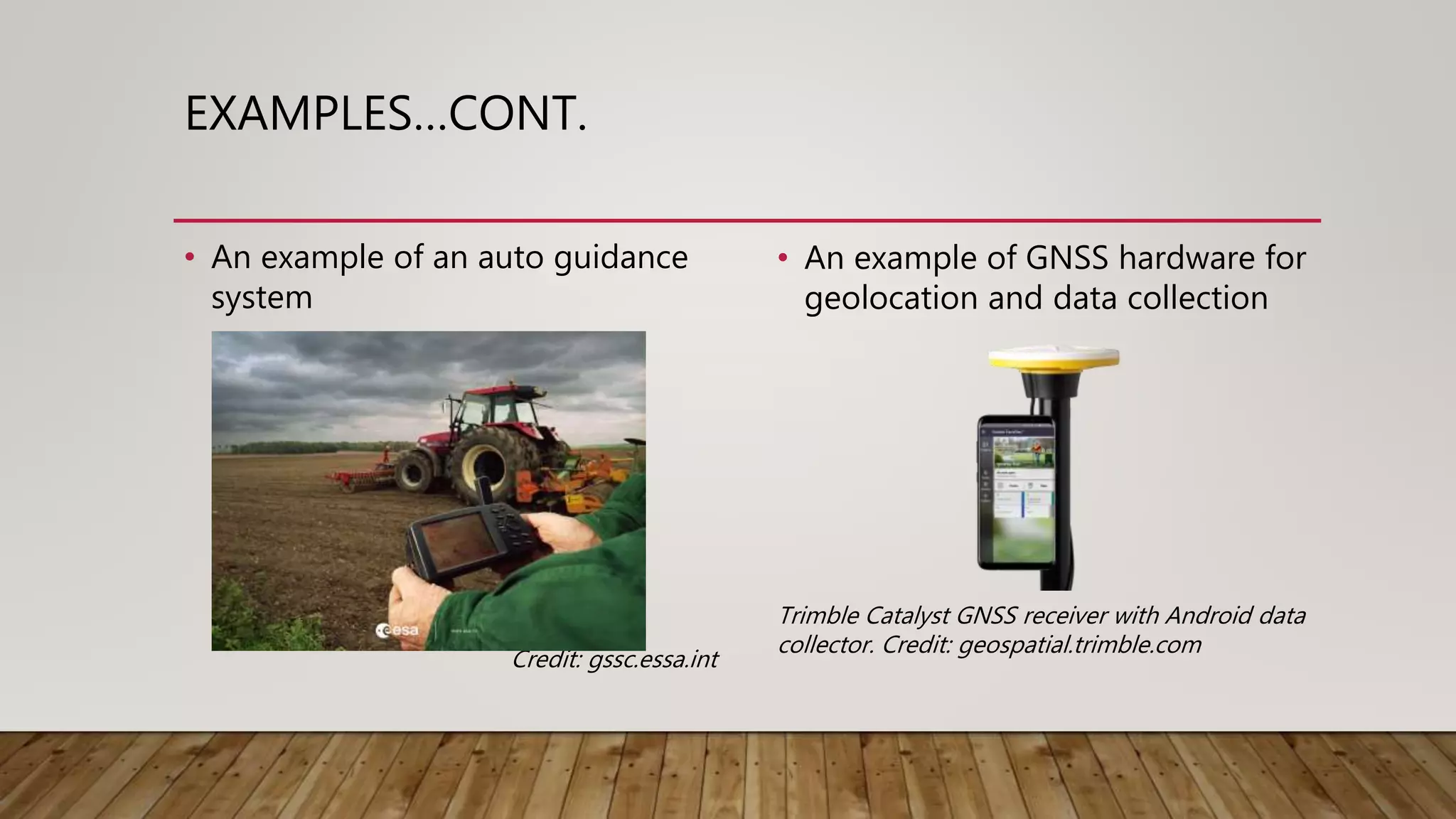
• An example of an auto guidance
system
Credit: gssc.essa.int
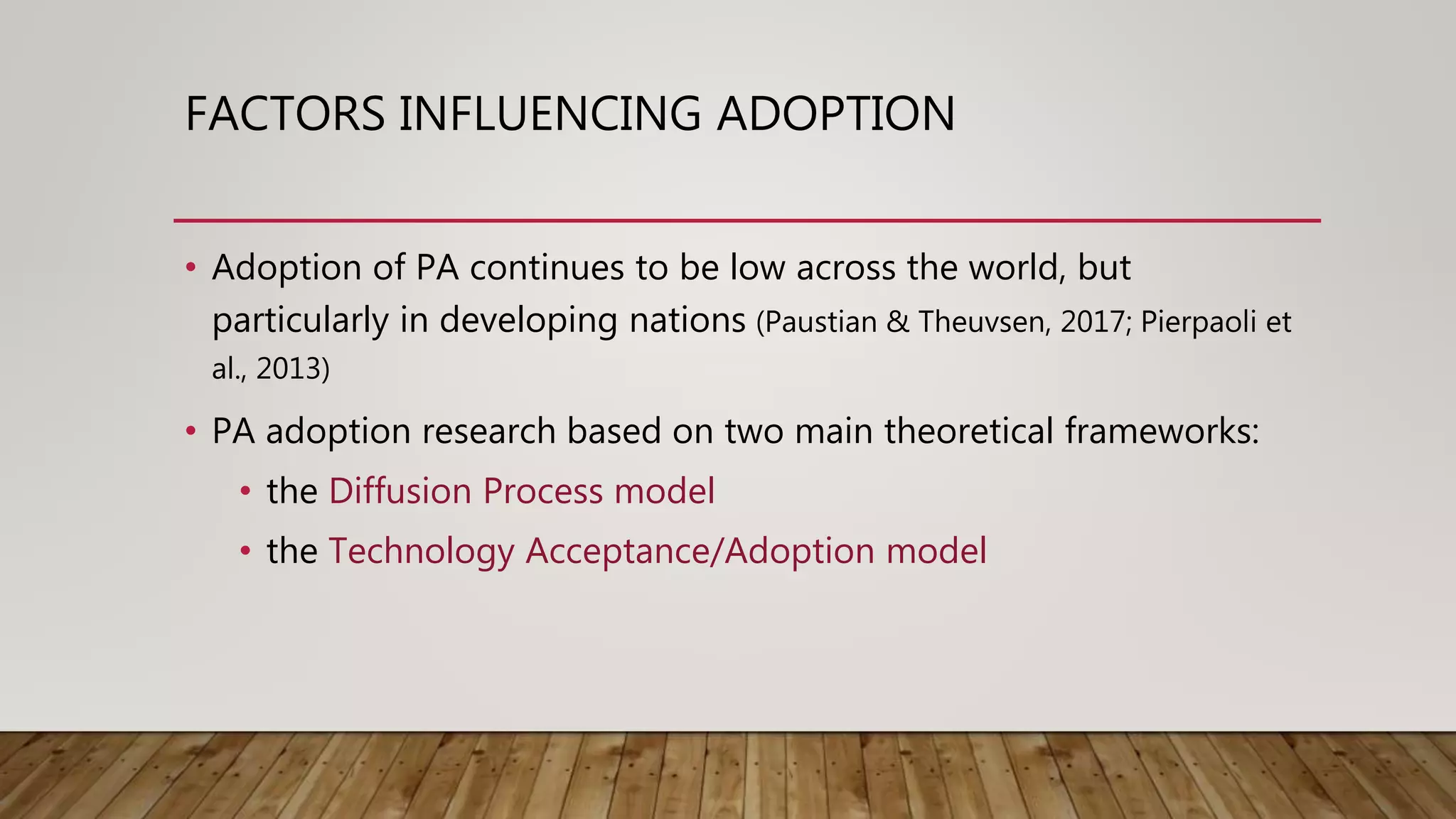
• An example of GNSS hardware for
geolocation and data collection
Trimble Catalyst GNSS receiver with Android data
collector. Credit: geospatial.trimble.com
FACTORS INFLUENCING ADOPTION
• Adoption of PA continues to be low across the world, but
particularly in developing nations (Paustian & Theuvsen, 2017; Pierpaoli et
al., 2013)
• PA adoption research based on two main theoretical frameworks:
• the Diffusion Process model
• the Technology Acceptance/Adoption model
FACTORS INFLUENCING ADOPTION…CONT.
• The Diffusion Process Model (Coleman et al., 1955)
the acceptance and adoption of an agricultural innovation is a
complicated process encompassing a series of thoughts and
actions.
The adoption decision is preceded by communicative events set in
time.
the adoption of a new idea (in this context precision agriculture) can
be expected to follow 5 steps: awareness, interest, evaluation, trial,
and adoption.
• Four types of change in a farm enterprise that would likely
occur with the introduction of a new idea or technology
(Coleman et al., 1955) :
ochange in materials and equipment without change in
techniques or operations;
ochange in existing operations without change in equipment or
materials;
ochange involving new operations and techniques; and,
ochange in total enterprise.
• A more disruptive change requires more focused, personal communication than
does a less disruptive one
FACTORS AFFECTING ADOPTION…CONT.
• the Technology Acceptance/Adoption Model (TAM)
derived from the Theory of Planned Behaviour as formulated by
Ajzen (1991)
TAM provides a framework for identifying and testing the relevance
of factors that influence [a farmer’s] decision on the adoption of an
innovation
TAM is dependent on the perceptions and attitudes of farmers
concerning their intention to utilize a technology (Pierpaoli et al.,
2013)
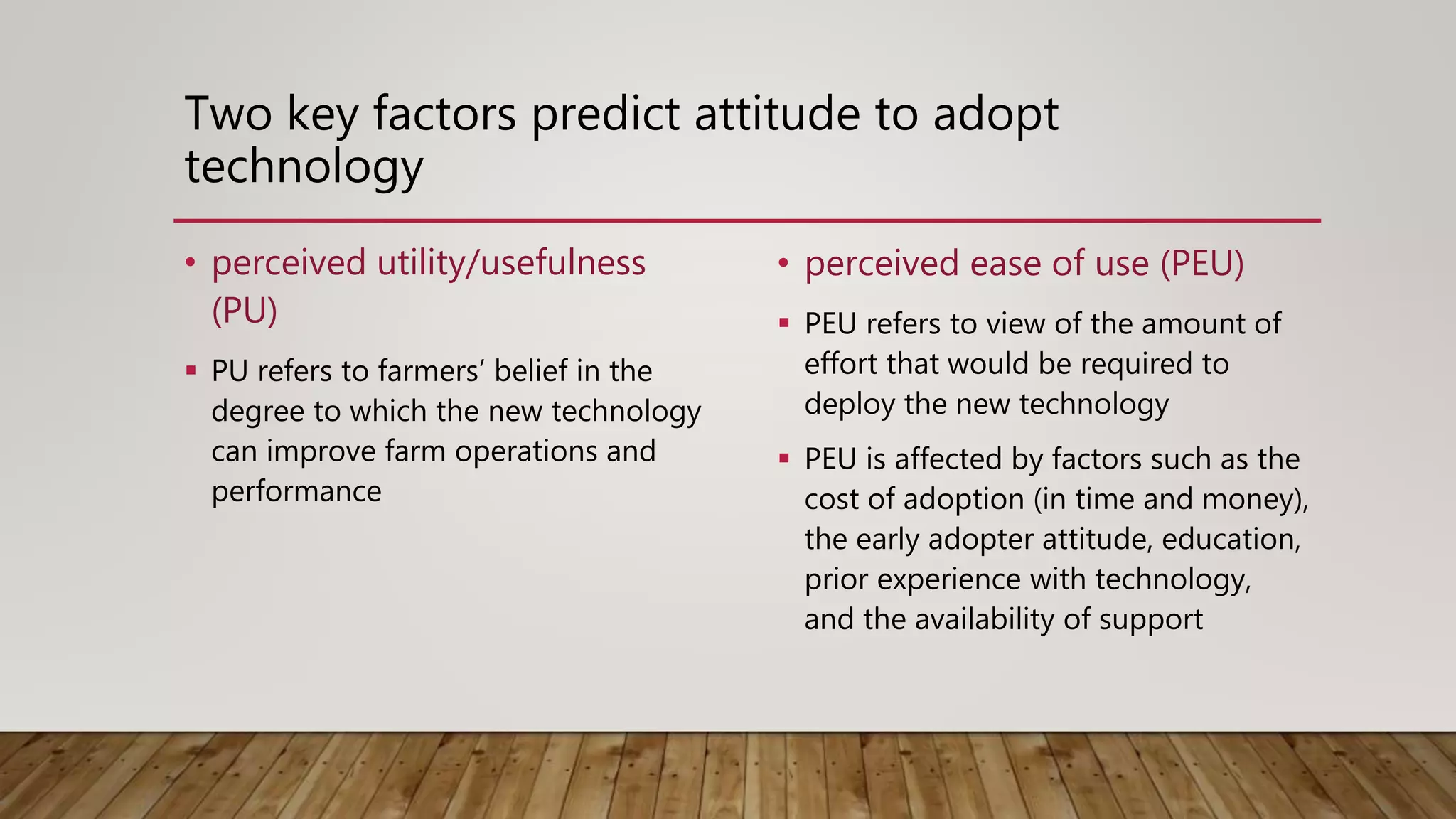
Two key factors predict attitude to adopt
technology
• perceived utility/usefulness
(PU)
 PU refers to farmers’ belief in the
degree to which the new technology
can improve farm operations and
performance
• perceived ease of use (PEU)
 PEU refers to view of the amount of
effort that would be required to
deploy the new technology
 PEU is affected by factors such as the
cost of adoption (in time and money),
the early adopter attitude, education,
prior experience with technology,
and the availability of support
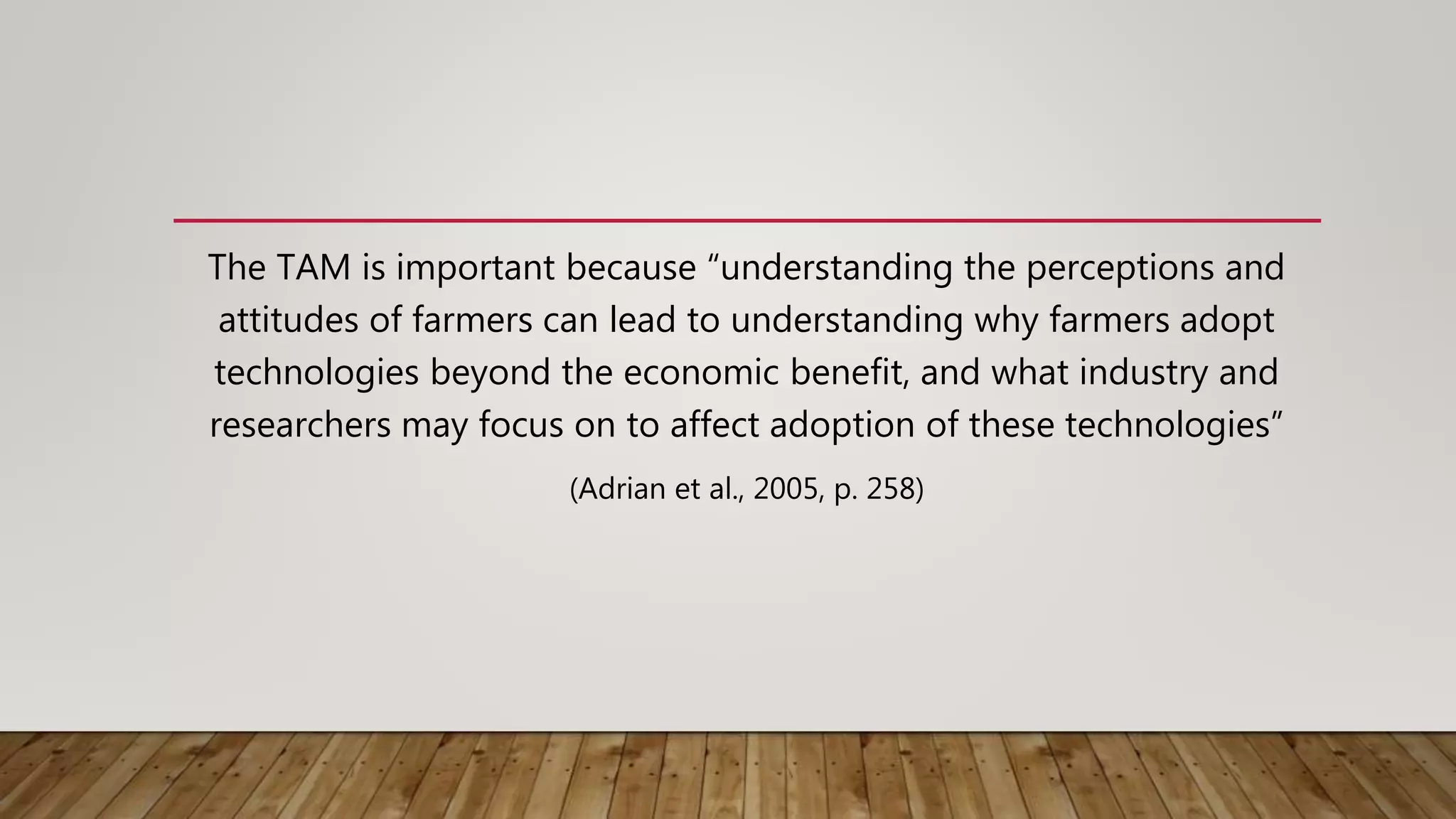
The TAM is important because “understanding the perceptions and
attitudes of farmers can lead to understanding why farmers adopt
technologies beyond the economic benefit, and what industry and
researchers may focus on to affect adoption of these technologies”
(Adrian et al., 2005, p. 258)
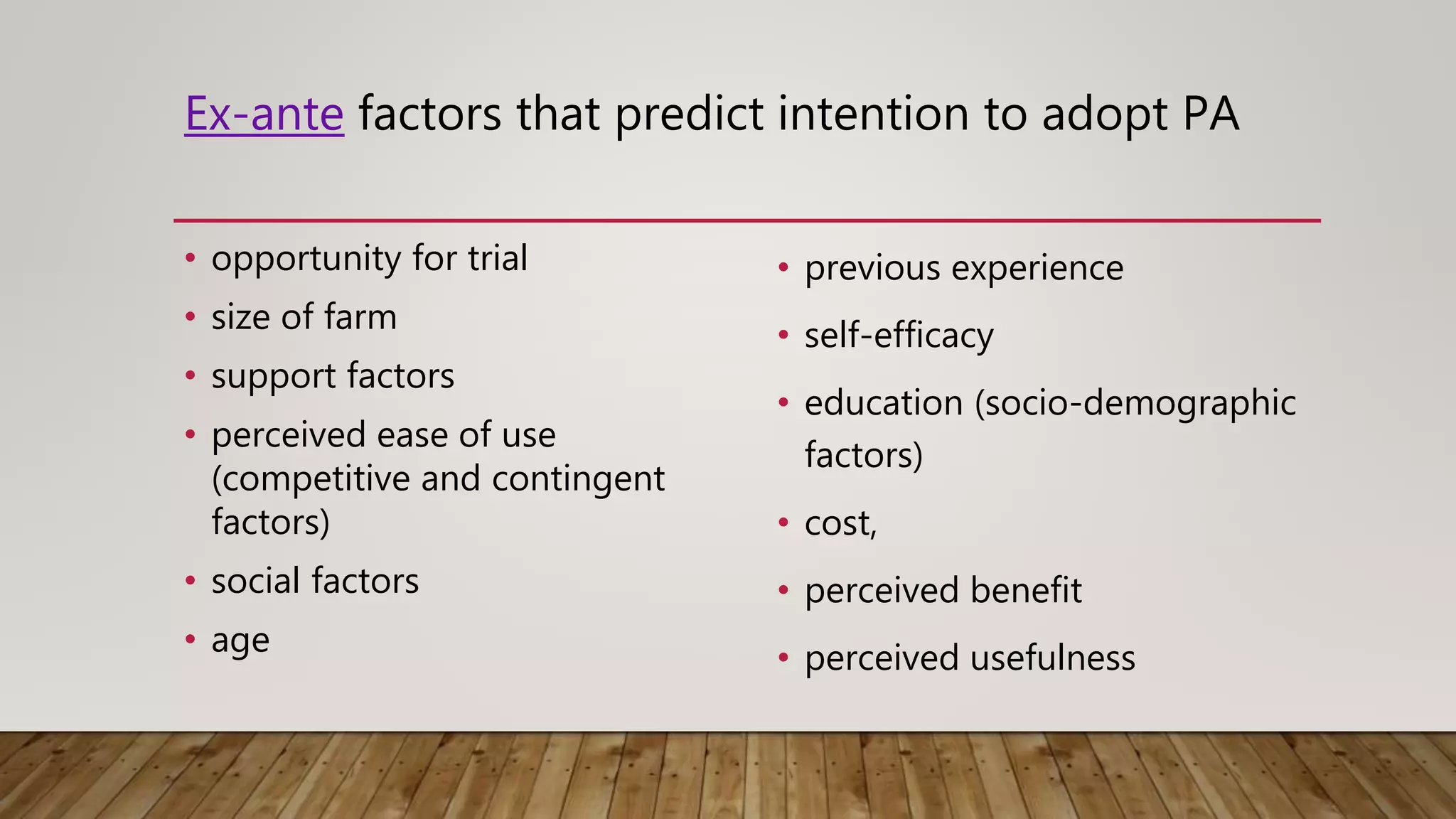
Ex-ante factors that predict intention to adopt PA
• opportunity for trial
• size of farm
• support factors
• perceived ease of use
(competitive and contingent
factors)
• social factors
• age
• previous experience
• self-efficacy
• education (socio-demographic
factors)
• cost,
• perceived benefit
• perceived usefulness
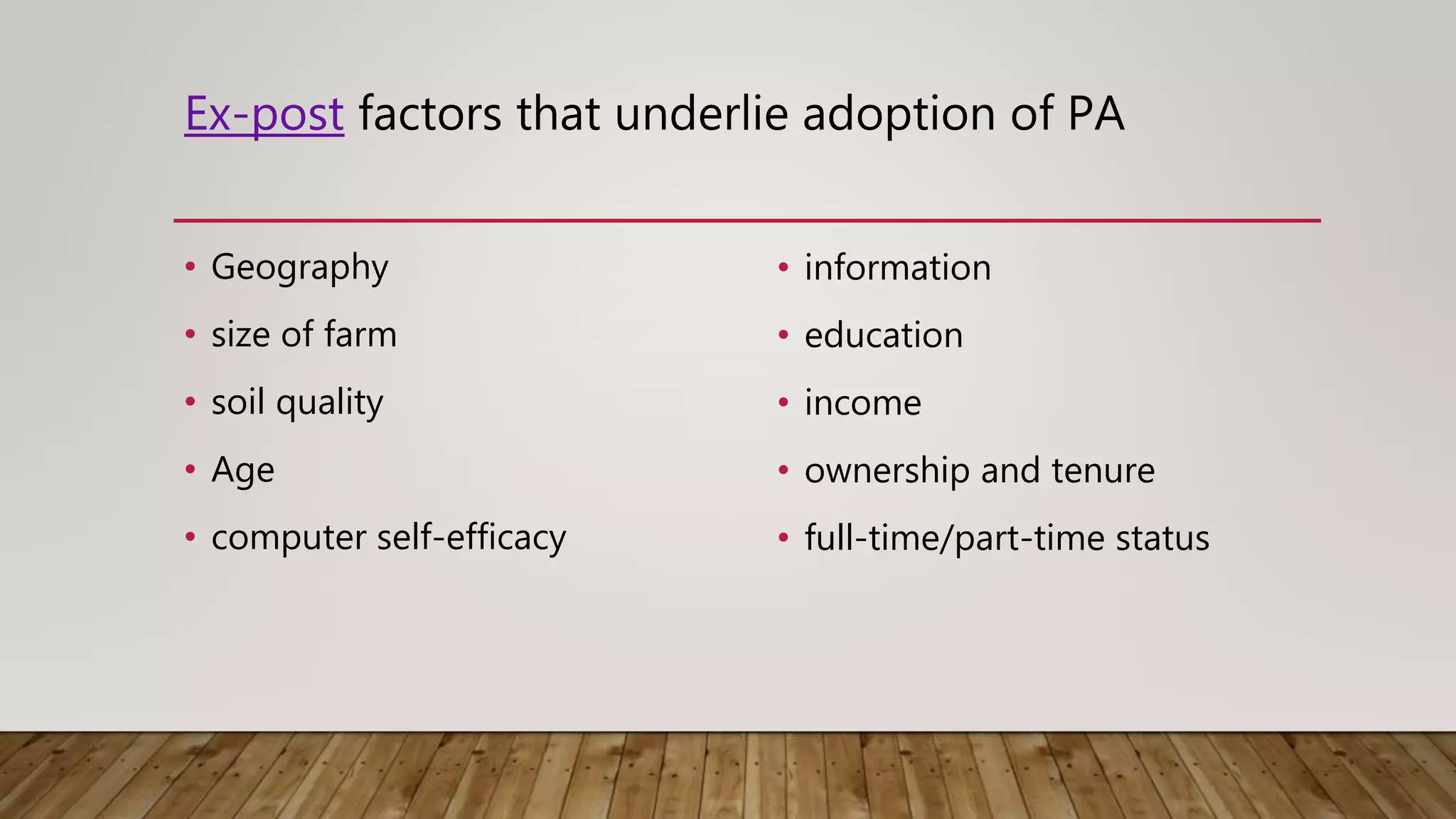
Ex-post factors that underlie adoption of PA
• Geography
• size of farm
• soil quality
• Age
• computer self-efficacy
• information
• education
• income
• ownership and tenure
• full-time/part-time status
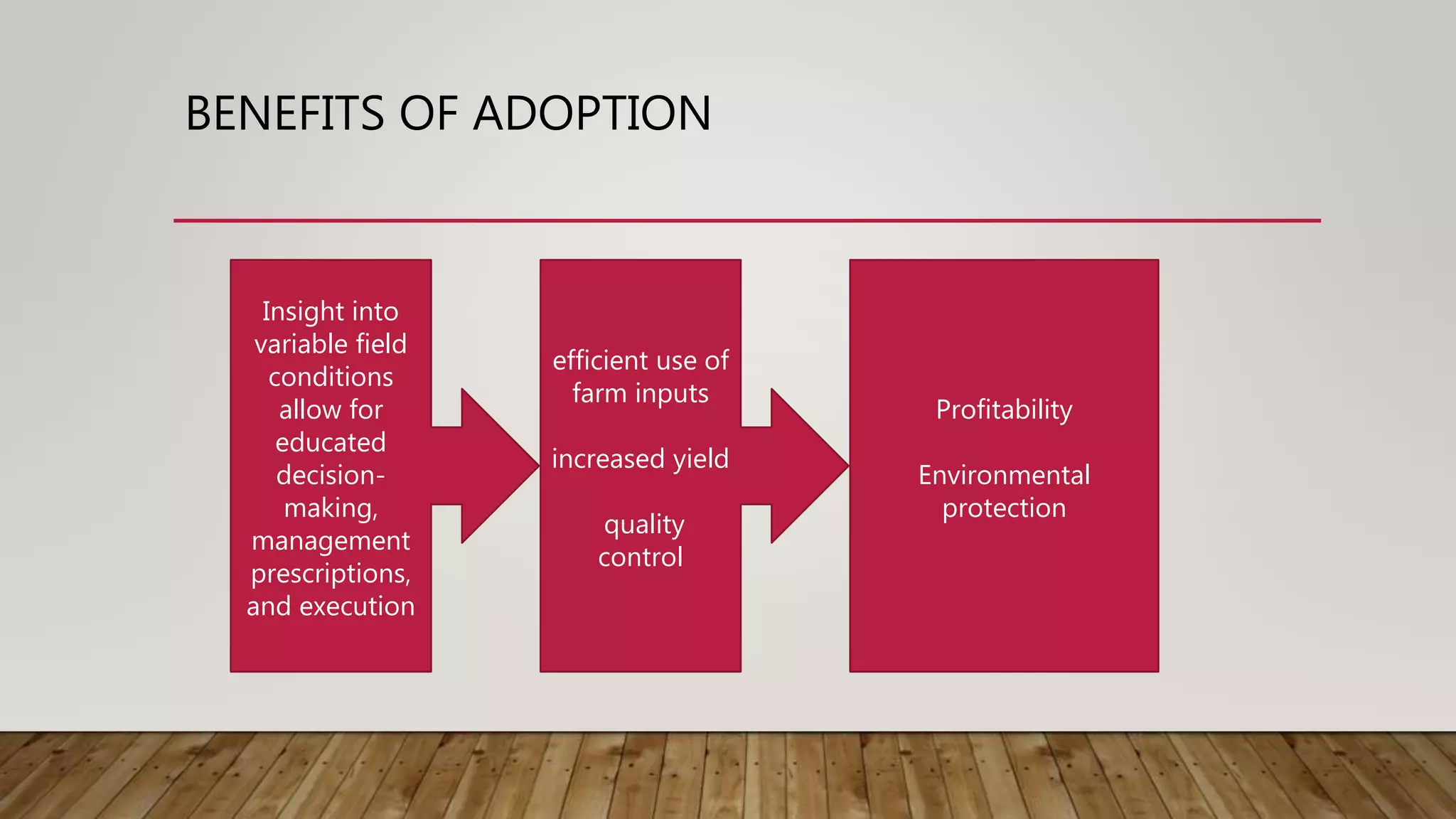
BENEFITS OF ADOPTION
Insight into
variable field
conditions
allow for
educated
decision-
making,
management
prescriptions,
and execution
efficient use of
farm inputs
increased yield
quality
control
Profitability
Environmental
protection
CHALLENGES TO ADOPTION OF PA
• Possible extensive data handling and synthesis
• Acquisition of new equipment and learning to use same
• Possible modifications to existing equipment and systems
• Poor perception of benefits
• Limited technical support
• Cost!!
THAT’S ALL, FOLKS. FOR NOW.

Precision Agriculture: a concise introduction

  • 1.
    PRECISION AGRICULTURE BY: JOSEPH SARPONGDWUMOH (BSC, ADV. DIP., MSC)
  • 2.
    DEFINITION “Precision Agriculture isa management strategy that gathers, processes and analyzes temporal, spatial and individual data and combines it with other information to support management decisions according to estimated variability for improved resource use efficiency, productivity, quality, profitability and sustainability of agricultural production.” (International Association of Precision Agriculture, 2021)
  • 3.
    DEFINITION…CONT. • Using PAallows access to significant amounts of time and location data to drive decision-making. • PA allows agriculturalists to observe, evaluate and control farming operations (Romanov et al., 2016) • It appears that all definitions of precision agriculture acknowledge the ultimate goals of environmental stewardship and maximizing profits by reducing redundancy and waste.
  • 4.
    WHAT IS INVOLVED? •components of a typical PA system are: 1) Information 2) technology or tools 3) information management (Mandal & Maity, 2013) • Typical protocol for PA implementation follows the following order: 1. collection of data on variability in field conditions 2. data processing/information management 3. execution of informed input application (Liaghat & Balasundram, 2010)
  • 5.
    WHAT IS INVOLVED?...CONT. Theconcept and practice of PA involves combining information- and technology-based farm management systems to recognize, evaluate, and control inconsistencies in field conditions to assure that farming operations are economically and environmentally sustainable (Bramley, 2009; Liaghat & Balasundram, 2010; Mondal & Basu, 2009)
  • 6.
    HISTORY OF PRECISIONAGRICULTURE • Concept of precision agriculture or precision farming arose in the mid- 1980s with increased public and commercial availability of computing, satellite imaging and georeferencing capabilities • The US Military’s GPS facility, which began to be available to the public worldwide in the 1980s, allowed for unprecedented quick access to accurate autonomous geo-spatial positioning of any location or asset on earth (GPS.gov, 2021)
  • 7.
    HISTORY OF PRECISIONAGRICULTURE…CONT. • Developments in Global Navigation Satellite System (GNSS) and other sensing technology, and their availability to the public were direct antecedents to the development of precision agriculture as the technologies found application in agriculture • Synonyms: satellite agriculture, site-specific crop management
  • 8.
    TECHNOLOGY, TOOLS, ANDAPPLICATIONS • Presently, the wide array of precision agriculture technologies (PAT) available include o GNSS technology o Geographic Information Systems o yield monitors o soil sampling tools o remote sensing tools o farm management applications o variable rate application technologies
  • 9.
    EXAMPLES • Examples ofGIS applications include o ArcGIS applications suite offered by ESRI o MapMaker 5 • Farm management systems available on the market include o Agrivi® o Granular® o Trimble® o Agworld®
  • 10.
    EXAMPLES…CONT. • An exampleof an auto guidance system Credit: gssc.essa.int • An example of GNSS hardware for geolocation and data collection Trimble Catalyst GNSS receiver with Android data collector. Credit: geospatial.trimble.com
  • 11.
    FACTORS INFLUENCING ADOPTION •Adoption of PA continues to be low across the world, but particularly in developing nations (Paustian & Theuvsen, 2017; Pierpaoli et al., 2013) • PA adoption research based on two main theoretical frameworks: • the Diffusion Process model • the Technology Acceptance/Adoption model
  • 12.
    FACTORS INFLUENCING ADOPTION…CONT. •The Diffusion Process Model (Coleman et al., 1955) the acceptance and adoption of an agricultural innovation is a complicated process encompassing a series of thoughts and actions. The adoption decision is preceded by communicative events set in time. the adoption of a new idea (in this context precision agriculture) can be expected to follow 5 steps: awareness, interest, evaluation, trial, and adoption.
  • 13.
    • Four typesof change in a farm enterprise that would likely occur with the introduction of a new idea or technology (Coleman et al., 1955) : ochange in materials and equipment without change in techniques or operations; ochange in existing operations without change in equipment or materials; ochange involving new operations and techniques; and, ochange in total enterprise. • A more disruptive change requires more focused, personal communication than does a less disruptive one
  • 14.
    FACTORS AFFECTING ADOPTION…CONT. •the Technology Acceptance/Adoption Model (TAM) derived from the Theory of Planned Behaviour as formulated by Ajzen (1991) TAM provides a framework for identifying and testing the relevance of factors that influence [a farmer’s] decision on the adoption of an innovation TAM is dependent on the perceptions and attitudes of farmers concerning their intention to utilize a technology (Pierpaoli et al., 2013)
  • 15.
    Two key factorspredict attitude to adopt technology • perceived utility/usefulness (PU)  PU refers to farmers’ belief in the degree to which the new technology can improve farm operations and performance • perceived ease of use (PEU)  PEU refers to view of the amount of effort that would be required to deploy the new technology  PEU is affected by factors such as the cost of adoption (in time and money), the early adopter attitude, education, prior experience with technology, and the availability of support
  • 16.
    The TAM isimportant because “understanding the perceptions and attitudes of farmers can lead to understanding why farmers adopt technologies beyond the economic benefit, and what industry and researchers may focus on to affect adoption of these technologies” (Adrian et al., 2005, p. 258)
  • 17.
    Ex-ante factors thatpredict intention to adopt PA • opportunity for trial • size of farm • support factors • perceived ease of use (competitive and contingent factors) • social factors • age • previous experience • self-efficacy • education (socio-demographic factors) • cost, • perceived benefit • perceived usefulness
  • 18.
    Ex-post factors thatunderlie adoption of PA • Geography • size of farm • soil quality • Age • computer self-efficacy • information • education • income • ownership and tenure • full-time/part-time status
  • 19.
    BENEFITS OF ADOPTION Insightinto variable field conditions allow for educated decision- making, management prescriptions, and execution efficient use of farm inputs increased yield quality control Profitability Environmental protection
  • 20.
    CHALLENGES TO ADOPTIONOF PA • Possible extensive data handling and synthesis • Acquisition of new equipment and learning to use same • Possible modifications to existing equipment and systems • Poor perception of benefits • Limited technical support • Cost!!
  • 21.