Understanding the Weather
7th class Social Exploring society India and beyond
By:K Sandeep Swamy(M.Sc,B.Ed)
For Online Classes (IITJEE & NEET foundation and academics) contact : 9491878325
Subscribe Samyans Eduhub youtube channel
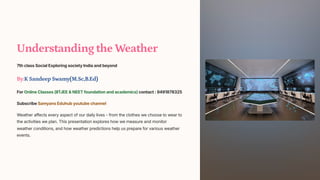
Weather affects every aspect of our daily lives - from the clothes we choose to wear to
the activities we plan. This presentation explores how we measure and monitor
weather conditions, and how weather predictions help us prepare for various weather
events.
The Big Questions
How can we measure and
monitor the weather
around us?
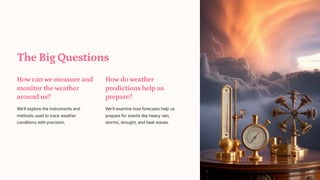
We'll explore the instruments and
methods used to track weather
conditions with precision.
How do weather
predictions help us
prepare?
We'll examine how forecasts help us
prepare for events like heavy rain,
storms, drought, and heat waves.
What is Weather?
Weather is the state of the Earth's atmosphere at a particular time and place. The
atmosphere is the layer of gases (air) surrounding our planet.
The troposphere is the layer closest to Earth's surface where all weather phenomena
occur. It extends 6-18 kilometers from the ground - thinner at the poles (where cold air
contracts) and thicker in tropical zones (where warm air expands).
Elements of Weather
Temperature
How hot or cold the atmosphere is
Precipitation
Any form of water (rain, snow, sleet, hail)
that falls from the sky
Atmospheric Pressure
The weight of air above us, felt on Earth's
surface
Wind
The movement of air, including speed and direction
Humidity
The amount of water vapor in the air
Traditional Weather Forecasting
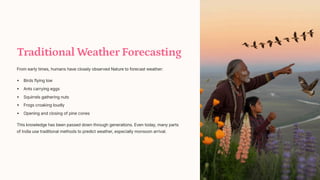
From early times, humans have closely observed Nature to forecast weather:
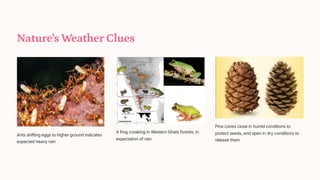
Birds flying low
Ants carrying eggs
Squirrels gathering nuts
Frogs croaking loudly
Opening and closing of pine cones
This knowledge has been passed down through generations. Even today, many parts
of India use traditional methods to predict weather, especially monsoon arrival.
Nature's Weather Clues
Ants shifting eggs to higher ground indicates
expected heavy rain
A frog croaking in Western Ghats forests, in
expectation of rain
Pine cones close in humid conditions to
protect seeds, and open in dry conditions to
release them
Modern Weather Science
In recent centuries, scientists have developed methods to measure and monitor weather elements with great precision.
Meteorology is the systematic study of weather and its evolution. Meteorologists predict how weather will behave in a particular region after hours,
days, or weeks.
Measure
Collect precise data using specialized instruments
Monitor
Track patterns and changes over time
Analyze
Study data using scientific methods
Predict
Forecast future weather conditions
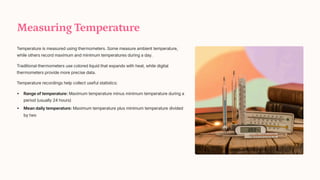
Measuring Temperature
Temperature is measured using thermometers. Some measure ambient temperature,
while others record maximum and minimum temperatures during a day.
Traditional thermometers use colored liquid that expands with heat, while digital
thermometers provide more precise data.
Temperature recordings help collect useful statistics:
Range of temperature: Maximum temperature minus minimum temperature during a
period (usually 24 hours)
Mean daily temperature: Maximum temperature plus minimum temperature divided
by two
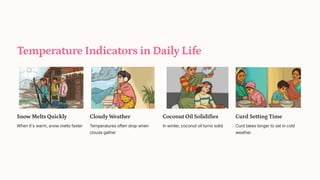
Temperature Indicators in Daily Life
Snow Melts Quickly
When it's warm, snow melts faster
Cloudy Weather
Temperatures often drop when
clouds gather
Coconut Oil Solidifies
In winter, coconut oil turns solid
Curd Setting Time
Curd takes longer to set in cold
weather
India Meteorological
Department
The India Meteorological Department was established in 1875.
Its motto is dityt jyate vrihti, which means, From the sun arises rain.
This phrase comes from the ancient text Manusm_iti, and the complete sentence reads,
From the sun arises rain, from rain comes food, and from food, living beings originate.
This ancient wisdom recognizes the sun's role in the water cycle - heating causes
evaporation, which leads to cloud formation and eventually rain.
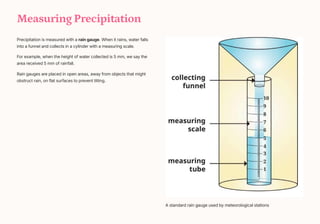
Measuring Precipitation
Precipitation is measured with a rain gauge. When it rains, water falls
into a funnel and collects in a cylinder with a measuring scale.
For example, when the height of water collected is 5 mm, we say the
area received 5 mm of rainfall.
Rain gauges are placed in open areas, away from objects that might
obstruct rain, on flat surfaces to prevent tilting.
A standard rain gauge used by meteorological stations
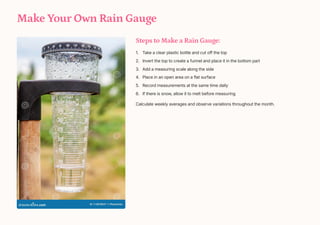
Make Your Own Rain Gauge
Steps to Make a Rain Gauge:
Take a clear plastic bottle and cut off the top
1.
Invert the top to create a funnel and place it in the bottom part
2.
Add a measuring scale along the side
3.
Place in an open area on a flat surface
4.
Record measurements at the same time daily
5.
If there is snow, allow it to melt before measuring
6.
Calculate weekly averages and observe variations throughout the month.
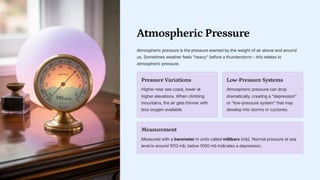
Atmospheric Pressure
Atmospheric pressure is the pressure exerted by the weight of air above and around
us. Sometimes weather feels heavy before a thunderstorm - this relates to
atmospheric pressure.
Pressure Variations
Higher near sea coast, lower at
higher elevations. When climbing
mountains, the air gets thinner with
less oxygen available.
Low-Pressure Systems
Atmospheric pressure can drop
dramatically, creating a depression
or low-pressure system that may
develop into storms or cyclones.
Measurement
Measured with a barometer in units called millibars (mb). Normal pressure at sea
level is around 1013 mb; below 1000 mb indicates a depression.
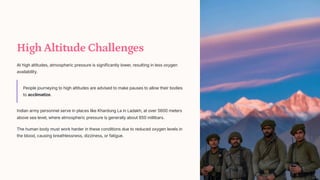
High Altitude Challenges
At high altitudes, atmospheric pressure is significantly lower, resulting in less oxygen
availability.
People journeying to high altitudes are advised to make pauses to allow their bodies
to acclimatize.
Indian army personnel serve in places like Khardung La in Ladakh, at over 5600 meters
above sea level, where atmospheric pressure is generally about 650 millibars.
The human body must work harder in these conditions due to reduced oxygen levels in
the blood, causing breathlessness, dizziness, or fatigue.
Wind: Movement of Air
Wind is the movement of air from areas of high pressure to areas of low pressure.
Speed and direction are two important factors when describing wind.
Wind is crucial for:
Weather forecasting
Aviation and sailing navigation
Farmers predicting rain direction
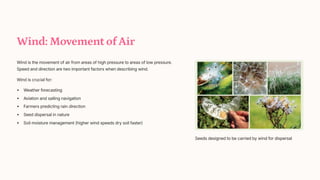
Seed dispersal in nature
Soil moisture management (higher wind speeds dry soil faster)
Seeds designed to be carried by wind for dispersal
Measuring Wind
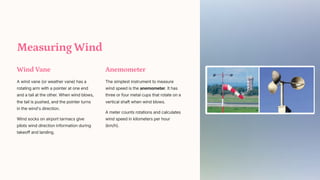
Wind Vane
A wind vane (or weather vane) has a
rotating arm with a pointer at one end
and a tail at the other. When wind blows,
the tail is pushed, and the pointer turns
in the wind's direction.
Wind socks on airport tarmacs give
pilots wind direction information during
takeoff and landing.
Anemometer
The simplest instrument to measure
wind speed is the anemometer. It has
three or four metal cups that rotate on a
vertical shaft when wind blows.
A meter counts rotations and calculates
wind speed in kilometers per hour
(km/h).
Humidity: Water in the Air
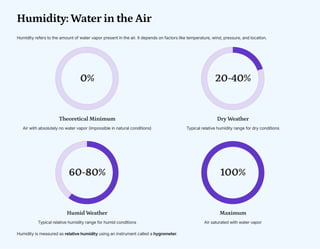
Humidity refers to the amount of water vapor present in the air. It depends on factors like temperature, wind, pressure, and location.
0%
Theoretical Minimum
Air with absolutely no water vapor (impossible in natural conditions)
20-40%
Dry Weather
Typical relative humidity range for dry conditions
60-80%
Humid Weather
Typical relative humidity range for humid conditions
100%
Maximum
Air saturated with water vapor
Humidity is measured as relative humidity using an instrument called a hygrometer.
Humidity Effects
Evaporation
When water evaporates, it causes a
cooling effect. If humidity is already high,
water evaporates more slowly (typical
on rainy days).
This affects:
How quickly clothes dry
How much we sweat
Comfort levels indoors
Practical Applications
Humidity measurement is important in:
Industrial processes like food
processing
Museums (need dry environments to
preserve exhibits)
Agriculture (affects plant growth and
irrigation needs)
Health (impacts respiratory
conditions)
Weather Stations
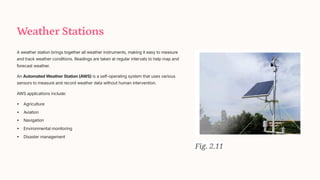
A weather station brings together all weather instruments, making it easy to measure
and track weather conditions. Readings are taken at regular intervals to help map and
forecast weather.
An Automated Weather Station (AWS) is a self-operating system that uses various
sensors to measure and record weather data without human intervention.
AWS applications include:
Agriculture
Aviation
Navigation
Environmental monitoring
Disaster management
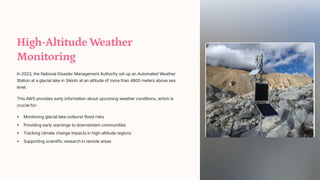
High-Altitude Weather
Monitoring
In 2023, the National Disaster Management Authority set up an Automated Weather
Station at a glacial lake in Sikkim at an altitude of more than 4800 meters above sea
level.
This AWS provides early information about upcoming weather conditions, which is
crucial for:
Monitoring glacial lake outburst flood risks
Providing early warnings to downstream communities
Tracking climate change impacts in high-altitude regions
Supporting scientific research in remote areas
Weather Prediction and Its Importance
Meteorologists collect data using weather instruments over long periods. They study this data and use scientific methods to predict weather patterns.
Such predictions are increasingly important as climate change makes extreme weather events more frequent.
Disaster Preparedness
Accurate predictions help communities prepare for events like
cyclones, floods, and droughts
Resource Mobilization
Local governments can mobilize resources and prepare for potential
disasters
Safety Warnings
Fishermen can be warned about venturing out during stormy
weather
Evacuation Planning
Coastal areas can be evacuated if a cyclone is expected
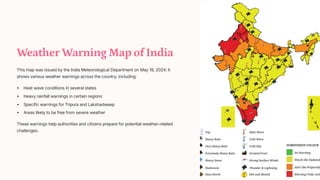
Weather Warning Map of India
This map was issued by the India Meteorological Department on May 19, 2024. It
shows various weather warnings across the country, including:
Heat wave conditions in several states
Heavy rainfall warnings in certain regions
Specific warnings for Tripura and Lakshadweep
Areas likely to be free from severe weather
These warnings help authorities and citizens prepare for potential weather-related
challenges.
Weather Prediction Applications
Aviation
Flight planning, takeoff and landing safety, turbulence avoidance
Agriculture
Planting schedules, irrigation planning, harvest timing, crop
protection
Maritime
Shipping routes, fishing expeditions, port operations, safety at
sea
Energy
Power demand forecasting, renewable energy production, grid
management
Event Planning
Outdoor events, sports competitions, construction scheduling
Emergency Services
Resource allocation, response planning, evacuation coordination
Key Takeaways
1 Weather Elements
Temperature, humidity, precipitation, wind, and atmospheric
pressure together define the weather at a particular place.
2 Measurement Instruments
Special instruments measure weather conditions. Data collected
helps monitor and predict weather patterns.
3 Dominant Elements
Different elements dominate in different situations - rainfall in July,
temperature in May and December, pressure during cyclones,
wind during loo or forest fires.
4 Climate Connection
Weather is closely linked to climate - weather represents short-
term conditions while climate describes long-term patterns.
Thank You
Everybody talks about the weather, but
nobody does anything about it.
- Mark Twain