Pre-1990 Indian
Economy
India : The Beginning
Pre Colonial : Refers to the economic history of
India since Indus Valley Civilization to 1700 AD.
During Indus Valley Civilization Indian economy
was very well developed.

India had very good trade relations with other parts
of world, which is evident from the coins of various
civilizations found at the site of Indus valley.

Before the advent of East India Company, each
village in India was a self sufficient entity. Each
village was economically independent.
British Invasion
The arrival of East India Company in India
ruined the Indian economy.
During this phase India's share of world
income declined from 22.3% in 1700 AD to
3.8% in 1952.
Two-way depletion of resources.
  British bought raw materials from India at cheaper
  rates.
  Then, the finished goods were sold at high price in
  Indian markets.
Indian economy after
           independence

Indian economy was influenced by the colonial
experience, which was seen by Indian leaders as
exploitative.
Domestic policy tended towards protectionism, with
a strong emphasis on import
substitution, industrialization, economic
interventionism, a large public sector, business
regulation and central planning, while trade and
foreign investment policies were relatively liberal.
Jawaharlal Nehru, the first prime minister of
India, along with the statistician Prasanta
Chandra Mahalanobis, formulated and
oversaw economic policy during the initial
years of the country's existence.
 First five year plan for the development of
Indian economy came into implementation in
1952.
The rate of growth of the Indian economy in
the first three decades after independence
was derisively referred to as the Hindu rate of
growth by communists.
Since 1965, the use of high-yielding varieties
of seeds, increased fertilisers and improved
irrigation facilities collectively contributed to the
Green Revolution in India, which improved the
condition of agriculture by increasing crop
productivity, improving crop patterns and
strengthening forward and backward linkages
between agriculture and industry.
Economic Policy
Socialist Policy
Concentration and emphasis on heavy industries
and subsidizing manual, low-skill cottage
industries
Tough Controls for private sector
   License Raj

Refusal to change policy with changing time
  India followed the same policy over the years and
  this degraded India’s situation in the world even
  more
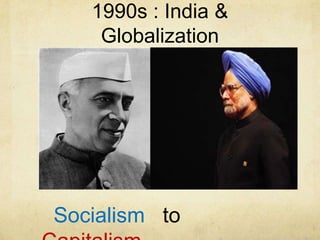
1990s : India &
    Globalization


Socialism to
India first felt Globalization in the 1990s when Dr
Manmohan Singh, then finance minister under
the government of P V Narsimha Rao, initiated
the economic liberalization plan.

Before the 1990s, India’s economy focused on
equity over growth.

In 1991, India began liberalizing its economy by
decreasing government control over many
domestic industries and increasing its openness
to the rest of the world. Combined, these actions
sought to increase competitiveness and
encourage innovation.
Major Reforms
Trade liberalization
Financial Liberalization
Opening up to Privatization
Tax reforms
Inflation control measures
Opening up to foreign investments
Reinforced focus on Agricultural
Development
Need for Reforms
Govt not being able to repay debts
The biggest reason : Unsustainable govt expenditure
Foreign exchange reserves had hit the bottom.
Uncontrolled Inflation
Continual expenditure on development programmes of
the government did not generate additional
revenue, thus government had to overshoot its revenue
to meet problems like unemployment, poverty and
population explosion.
Tax revenues insufficient
Exports not enough to pay for growing imports
Reasons for Globalization
To resolve revenue crisis, India took a loan of $7
billion from the World Bank and the International
Monetary Fund.
In leau of the loan, they expected India to
liberalise and open up the economy by
  Removing restrictions on the private sector
  Reduce the role of the government in many areas
  Remove trade restrictions.

India agreed to the conditions and announced
the New Economic Policy (NEP).
India’s major steps towards
        Globalization
Devaluation:
  Announcement of the devaluation of Indian currency
  by 18-19 percent against major currencies in the
  international foreign exchange market.


Disinvestment :
  Under the privatization scheme, most of the public
  sector undertakings have been/ are being sold to
  private sector
THANK YOU!

                            Any Questions??


Group Members : Seencha Bhutia, Shivani Sharma,

                               Srimoyee Dasgupta & Yasmin
   Hussain

Pre 1990 Indian Economy

  • 1.
  • 2.
    India : TheBeginning Pre Colonial : Refers to the economic history of India since Indus Valley Civilization to 1700 AD. During Indus Valley Civilization Indian economy was very well developed. India had very good trade relations with other parts of world, which is evident from the coins of various civilizations found at the site of Indus valley. Before the advent of East India Company, each village in India was a self sufficient entity. Each village was economically independent.
  • 3.
    British Invasion The arrivalof East India Company in India ruined the Indian economy. During this phase India's share of world income declined from 22.3% in 1700 AD to 3.8% in 1952. Two-way depletion of resources. British bought raw materials from India at cheaper rates. Then, the finished goods were sold at high price in Indian markets.
  • 4.
    Indian economy after independence Indian economy was influenced by the colonial experience, which was seen by Indian leaders as exploitative. Domestic policy tended towards protectionism, with a strong emphasis on import substitution, industrialization, economic interventionism, a large public sector, business regulation and central planning, while trade and foreign investment policies were relatively liberal.
  • 5.
    Jawaharlal Nehru, thefirst prime minister of India, along with the statistician Prasanta Chandra Mahalanobis, formulated and oversaw economic policy during the initial years of the country's existence. First five year plan for the development of Indian economy came into implementation in 1952. The rate of growth of the Indian economy in the first three decades after independence was derisively referred to as the Hindu rate of growth by communists.
  • 6.
    Since 1965, theuse of high-yielding varieties of seeds, increased fertilisers and improved irrigation facilities collectively contributed to the Green Revolution in India, which improved the condition of agriculture by increasing crop productivity, improving crop patterns and strengthening forward and backward linkages between agriculture and industry.
  • 7.
    Economic Policy Socialist Policy Concentrationand emphasis on heavy industries and subsidizing manual, low-skill cottage industries Tough Controls for private sector License Raj Refusal to change policy with changing time India followed the same policy over the years and this degraded India’s situation in the world even more
  • 8.
    1990s : India& Globalization Socialism to
  • 9.
    India first feltGlobalization in the 1990s when Dr Manmohan Singh, then finance minister under the government of P V Narsimha Rao, initiated the economic liberalization plan. Before the 1990s, India’s economy focused on equity over growth. In 1991, India began liberalizing its economy by decreasing government control over many domestic industries and increasing its openness to the rest of the world. Combined, these actions sought to increase competitiveness and encourage innovation.
  • 10.
    Major Reforms Trade liberalization FinancialLiberalization Opening up to Privatization Tax reforms Inflation control measures Opening up to foreign investments Reinforced focus on Agricultural Development
  • 11.
    Need for Reforms Govtnot being able to repay debts The biggest reason : Unsustainable govt expenditure Foreign exchange reserves had hit the bottom. Uncontrolled Inflation Continual expenditure on development programmes of the government did not generate additional revenue, thus government had to overshoot its revenue to meet problems like unemployment, poverty and population explosion. Tax revenues insufficient Exports not enough to pay for growing imports
  • 12.
    Reasons for Globalization Toresolve revenue crisis, India took a loan of $7 billion from the World Bank and the International Monetary Fund. In leau of the loan, they expected India to liberalise and open up the economy by Removing restrictions on the private sector Reduce the role of the government in many areas Remove trade restrictions. India agreed to the conditions and announced the New Economic Policy (NEP).
  • 13.
    India’s major stepstowards Globalization Devaluation: Announcement of the devaluation of Indian currency by 18-19 percent against major currencies in the international foreign exchange market. Disinvestment : Under the privatization scheme, most of the public sector undertakings have been/ are being sold to private sector
  • 14.
    THANK YOU! Any Questions?? Group Members : Seencha Bhutia, Shivani Sharma, Srimoyee Dasgupta & Yasmin Hussain

Editor's Notes

  • #6 The Hindu rate of growth is a controversial and derogatory expressionused to refer to the low annual growth rate of the socialist economy of India before 1991, which stagnated around 3.5% from 1950s to 1980s, while per capita income growth averaged 1.3%
  • #8 Policy ignored the sphere of consumer goods and focused on building industrial equipment. As a result, the Indian consumers had few goods to buy and had no choice.The Licence Raj was a result of India's decision to have a planned economy where all aspects of the economy are controlled by the state and licences are given to a select few. Up to 80 government agencies had to be satisfied before private companies could produce something and, if granted, the government would regulate production
  • #10 Before the 1990s most of theindustrial sector was dominated by a select band of family-based conglomerates that had been dominant historically. Post 1991, a major restructuring has taken place with the emergence of more technologically advanced segments among industrial companies. Nowadays, more small and medium scale enterprises contribute significantly to the economy