1
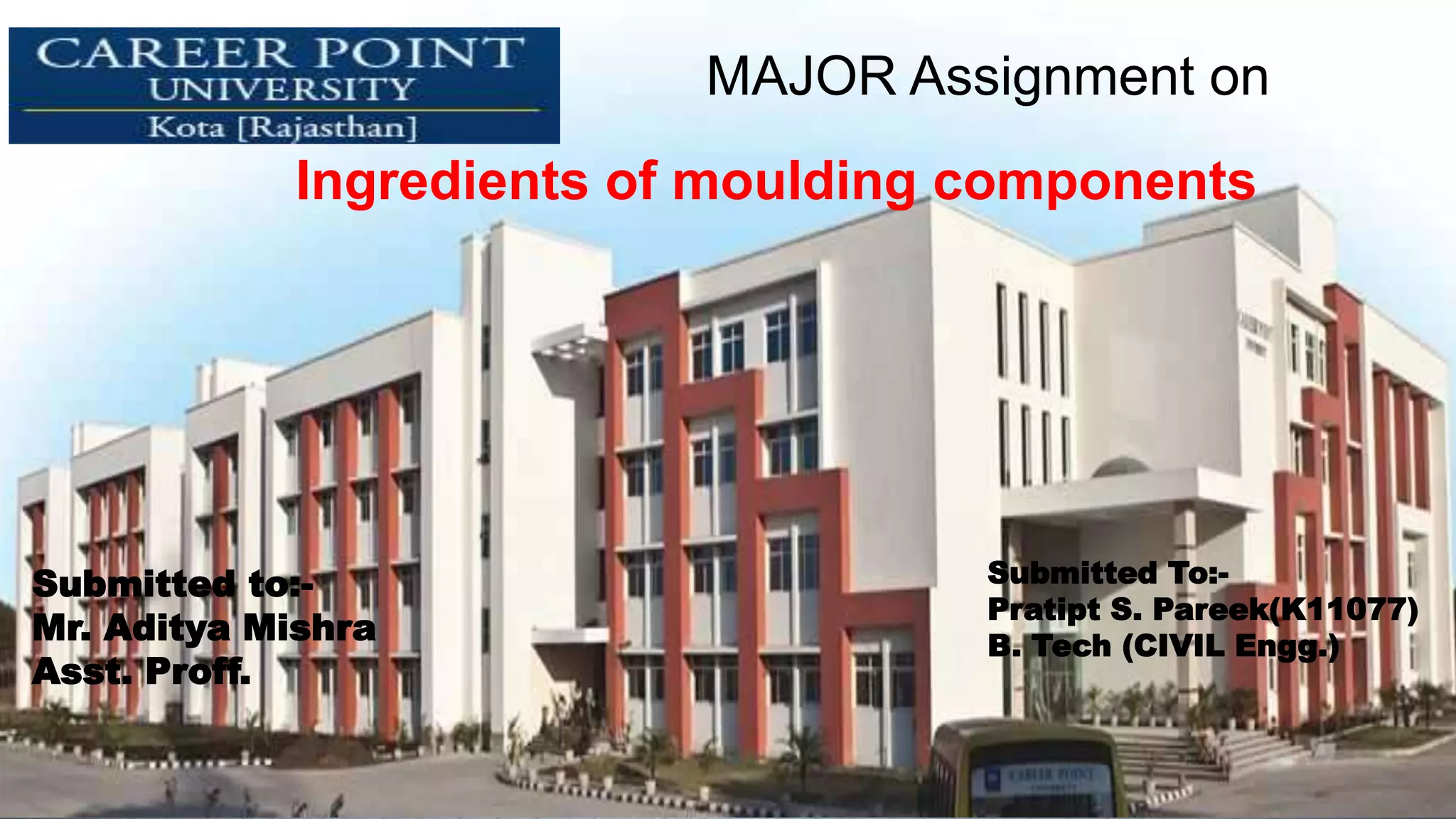
Submitted to:-
Mr. Aditya Mishra
Asst. Proff.
Submitted To:-
Pratipt S. Pareek(K11077)
B. Tech (CIVIL Engg.)
MAJOR Assignment on
Ingredients of moulding components
TABLE OF CONTENT
O Introduction
O Definition
O Principle
O Procedure/Working
O Special Feature/Characteristics
O Advantage/Disadvantage
O Future Scope
O Conclusion
Introduction / literature Review
O The moulding process has several advantages comparing to other
moulding processes. It does not use flasks, which avoids a need of
their transporting, storing and maintaining. It is very productive and
fully automatic. This reduces the labor consumption. Moulding sand
consumption can be minimized due to variable mould thickness that
can be adjusted to the necessary minimum.
O The castings produced on the moulding lines are very accurate
dimensionally since once the moulds have been cored and closed
there are no perpendicular forces affecting the mould string. There
are very few wear parts and movable parts in the moulding machine.
This decreases spare parts consumption and increases efficiency of
the moulding line.
Definition
O The moulding is a process of making a cavity or mould
out of sand by means of a pattern.
O The molten metal is poured into the moulds to produce
casting. In the casting process a pattern is made in the
shape of the desired part.
O Simple designs can be made in a single piece or solid
pattern. More complex designs are made in two parts,
called split patterns.
O A split pattern has a top or upper section, called a cope,
and a bottom or lower section called a drag.
Principle
O1. Moisture:- moisture is necessary quantity furnished bonding
action of clay. While water is additional to clay, It penetrate the
combination with forms a microfilm which coats surface of flake
shaped clay element.
02. Clay:- it is identified as individual element of sand that fails to
resolve at a rate of 25mm per minute while on the edge in water. Clay
have of two element find silt and true clay.
03. Silica sand grains:- Silica in the type of grainy quartz itself sand
is the principal element of moulding sands. Silica sand have edge of
80%-90% of silicon dioxide with is describe by high softened
temperature with thermal constancy.
Procedure/Working
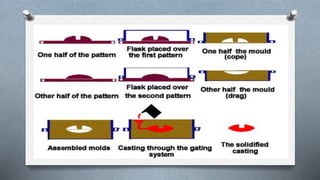
There are six steps in this process:
O Place a pattern in sand to create a mould.
O Incorporate the pattern and sand in a gating system.
O Remove the pattern.
O Fill the mould cavity with molten metal.
O Allow the metal to cool.
O Break away the sand mould and remove the casting.
Melting
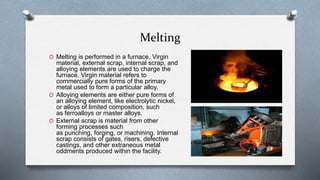
O Melting is performed in a furnace. Virgin
material, external scrap, internal scrap, and
alloying elements are used to charge the
furnace. Virgin material refers to
commercially pure forms of the primary
metal used to form a particular alloy.
O Alloying elements are either pure forms of
an alloying element, like electrolytic nickel,
or alloys of limited composition, such
as ferroalloys or master alloys.
O External scrap is material from other
forming processes such
as punching, forging, or machining. Internal
scrap consists of gates, risers, defective
castings, and other extraneous metal
oddments produced within the facility.
Furnace
O Several specialized furnaces are used to heat the metal. Furnaces are
refractory lined vessels that contain the material to be melted and
provide the energy to melt it. Modern furnace types include electric arc
furnaces (EAF), induction furnaces, cupolas, reverberator, and crucible
furnaces.
O Furnace choice is dependent on the alloy system quantities produced.
For ferrous materials EAFs, cupolas, and induction furnaces are
commonly used. Reverberator and crucible furnaces are common for
producing aluminum, bronze, and brass castings.
O Furnace design is a complex process, and the design can be
optimized based on multiple factors. Furnaces in foundries can be any
size, ranging from small ones used to melt precious metals to furnaces
weighing several tons, designed to melt hundreds of pounds of scrap
at one time. They are designed according to the type of metals that are
to be melted.
Characteristics
Moisture Content:
O Moisture content affects the other properties of the mixture such as strength and
permeability. Too much moisture can cause steam bubbles to be entrapped in the
metal casting.
Grain Size:
O This property represents the size of the individual particles of sand.
Shape of Grains:
O This property evaluates the shape of the individual grains of sand based on
how round they are. Less round grains are said to be more irregular.
Strength:
O The explanation of strength is, the ability of the sand casting mixture to hold its
geometric shape under the conditions of mechanical stress imposed during the
sand casting process.
Permeability:
O The ability of the sand mold to permit the escape of air, gases, and steam during
the sand casting process.
Collapsibility:
O The ability of the sand mixture to collapse under force. Collapsibility is a
very important property in this type of casting manufacture. Collapsibility
of the mold will allow the metal casting to shrink freely during the
solidification phase of the process. If the molding sand cannot collapse
adequately for the casting's shrinkage, hot tearing or cracking will
develop in the casting.
Flowability:
O The ability of the sand mixture to flow over and fill the sand casting
pattern during the impression making phase of the manufacturing
process, more flowability is useful for a more detailed casting.
Refractory Strength:
O During the pouring of the molten metal in sand casting manufacture, the
sand mixture in the mold must not melt, burn, crack, or sinter. The
refractory strength is the ability of the mold sand mixture to withstand
levels of extreme temperature.
Advantage/Disadvantage
O The main advantages are the reusable mold, good surface finish, good
dimensional accuracy, and high production rates. Typical tolerances are
0.4 mm for the first 25 mm (0.015 in for the first inch) and 0.02 mm for
each additional centimeter (0.002 in per in);
O If the dimension crosses the parting line add an additional 0.25 mm
(0.0098 in). Typical surface finishes are 2.5 to 7.5 μm (100–250 μin) RMS.
A draft of 2 to 3° is required. Wall thicknesses are limited to 3 to 50 mm
(0.12 to 1.97 in).
O Typical part sizes range from 100 g to 75 kg (several ounces to 150 lb).
Other advantages include the ease of inducing directional solidification by
changing the mold wall thickness or by heating or cooling portions of the
mold.
O The fast cooling rates created by using a metal mold results in a
finer grain structure than sand casting. Retractable metal cores can be
used to create undercuts while maintaining a quick action mold.
Future Scope
O High surface finish
O Low labour cost
O Complex jobs can be easily manufactured
O No problem for withdrawal of pattern
O Cheaply available
Conclusion
O Hence the objective of the work i.e. to conceptually
design the casting patterned has been completed by
taking all those issue into consideration. Also choosing
the best alternative among all those concept. Finally the
lost foam type casting method has been given the highest
priority.
O The pattern material used is foam so there is no need for
the arrangement of avoiding the mould breakage during
pattern withdrawal. Since foam melts under that
temperature of molten metal so no need to withdraw it
from the mould flask.
THANK YOU

Pratipt S. Pareek K11077

  • 1.
    1 Submitted to:- Mr. AdityaMishra Asst. Proff. Submitted To:- Pratipt S. Pareek(K11077) B. Tech (CIVIL Engg.) MAJOR Assignment on Ingredients of moulding components
  • 2.
    TABLE OF CONTENT OIntroduction O Definition O Principle O Procedure/Working O Special Feature/Characteristics O Advantage/Disadvantage O Future Scope O Conclusion
  • 3.
    Introduction / literatureReview O The moulding process has several advantages comparing to other moulding processes. It does not use flasks, which avoids a need of their transporting, storing and maintaining. It is very productive and fully automatic. This reduces the labor consumption. Moulding sand consumption can be minimized due to variable mould thickness that can be adjusted to the necessary minimum. O The castings produced on the moulding lines are very accurate dimensionally since once the moulds have been cored and closed there are no perpendicular forces affecting the mould string. There are very few wear parts and movable parts in the moulding machine. This decreases spare parts consumption and increases efficiency of the moulding line.
  • 4.
    Definition O The mouldingis a process of making a cavity or mould out of sand by means of a pattern. O The molten metal is poured into the moulds to produce casting. In the casting process a pattern is made in the shape of the desired part. O Simple designs can be made in a single piece or solid pattern. More complex designs are made in two parts, called split patterns. O A split pattern has a top or upper section, called a cope, and a bottom or lower section called a drag.
  • 5.
    Principle O1. Moisture:- moistureis necessary quantity furnished bonding action of clay. While water is additional to clay, It penetrate the combination with forms a microfilm which coats surface of flake shaped clay element. 02. Clay:- it is identified as individual element of sand that fails to resolve at a rate of 25mm per minute while on the edge in water. Clay have of two element find silt and true clay. 03. Silica sand grains:- Silica in the type of grainy quartz itself sand is the principal element of moulding sands. Silica sand have edge of 80%-90% of silicon dioxide with is describe by high softened temperature with thermal constancy.
  • 6.
    Procedure/Working There are sixsteps in this process: O Place a pattern in sand to create a mould. O Incorporate the pattern and sand in a gating system. O Remove the pattern. O Fill the mould cavity with molten metal. O Allow the metal to cool. O Break away the sand mould and remove the casting.
  • 8.
    Melting O Melting isperformed in a furnace. Virgin material, external scrap, internal scrap, and alloying elements are used to charge the furnace. Virgin material refers to commercially pure forms of the primary metal used to form a particular alloy. O Alloying elements are either pure forms of an alloying element, like electrolytic nickel, or alloys of limited composition, such as ferroalloys or master alloys. O External scrap is material from other forming processes such as punching, forging, or machining. Internal scrap consists of gates, risers, defective castings, and other extraneous metal oddments produced within the facility.
  • 9.
    Furnace O Several specializedfurnaces are used to heat the metal. Furnaces are refractory lined vessels that contain the material to be melted and provide the energy to melt it. Modern furnace types include electric arc furnaces (EAF), induction furnaces, cupolas, reverberator, and crucible furnaces. O Furnace choice is dependent on the alloy system quantities produced. For ferrous materials EAFs, cupolas, and induction furnaces are commonly used. Reverberator and crucible furnaces are common for producing aluminum, bronze, and brass castings. O Furnace design is a complex process, and the design can be optimized based on multiple factors. Furnaces in foundries can be any size, ranging from small ones used to melt precious metals to furnaces weighing several tons, designed to melt hundreds of pounds of scrap at one time. They are designed according to the type of metals that are to be melted.
  • 10.
    Characteristics Moisture Content: O Moisturecontent affects the other properties of the mixture such as strength and permeability. Too much moisture can cause steam bubbles to be entrapped in the metal casting. Grain Size: O This property represents the size of the individual particles of sand. Shape of Grains: O This property evaluates the shape of the individual grains of sand based on how round they are. Less round grains are said to be more irregular. Strength: O The explanation of strength is, the ability of the sand casting mixture to hold its geometric shape under the conditions of mechanical stress imposed during the sand casting process. Permeability: O The ability of the sand mold to permit the escape of air, gases, and steam during the sand casting process.
  • 11.
    Collapsibility: O The abilityof the sand mixture to collapse under force. Collapsibility is a very important property in this type of casting manufacture. Collapsibility of the mold will allow the metal casting to shrink freely during the solidification phase of the process. If the molding sand cannot collapse adequately for the casting's shrinkage, hot tearing or cracking will develop in the casting. Flowability: O The ability of the sand mixture to flow over and fill the sand casting pattern during the impression making phase of the manufacturing process, more flowability is useful for a more detailed casting. Refractory Strength: O During the pouring of the molten metal in sand casting manufacture, the sand mixture in the mold must not melt, burn, crack, or sinter. The refractory strength is the ability of the mold sand mixture to withstand levels of extreme temperature.
  • 12.
    Advantage/Disadvantage O The mainadvantages are the reusable mold, good surface finish, good dimensional accuracy, and high production rates. Typical tolerances are 0.4 mm for the first 25 mm (0.015 in for the first inch) and 0.02 mm for each additional centimeter (0.002 in per in); O If the dimension crosses the parting line add an additional 0.25 mm (0.0098 in). Typical surface finishes are 2.5 to 7.5 μm (100–250 μin) RMS. A draft of 2 to 3° is required. Wall thicknesses are limited to 3 to 50 mm (0.12 to 1.97 in). O Typical part sizes range from 100 g to 75 kg (several ounces to 150 lb). Other advantages include the ease of inducing directional solidification by changing the mold wall thickness or by heating or cooling portions of the mold. O The fast cooling rates created by using a metal mold results in a finer grain structure than sand casting. Retractable metal cores can be used to create undercuts while maintaining a quick action mold.
  • 13.
    Future Scope O Highsurface finish O Low labour cost O Complex jobs can be easily manufactured O No problem for withdrawal of pattern O Cheaply available
  • 14.
    Conclusion O Hence theobjective of the work i.e. to conceptually design the casting patterned has been completed by taking all those issue into consideration. Also choosing the best alternative among all those concept. Finally the lost foam type casting method has been given the highest priority. O The pattern material used is foam so there is no need for the arrangement of avoiding the mould breakage during pattern withdrawal. Since foam melts under that temperature of molten metal so no need to withdraw it from the mould flask.
  • 15.