Basic Manufacturing Processes
Lecture 1
By
Dilip Kumar Bagal
Assistant Professor,
Govt. College of Engg., Kalahandi
Introduction
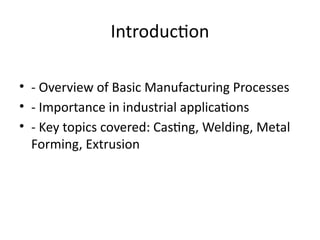
• - Overview of Basic Manufacturing Processes
• - Importance in industrial applications
• - Key topics covered: Casting, Welding, Metal
Forming, Extrusion
Foundry and Casting
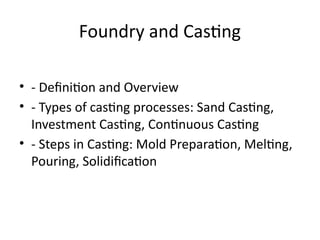
• - Definition and Overview
• - Types of casting processes: Sand Casting,
Investment Casting, Continuous Casting
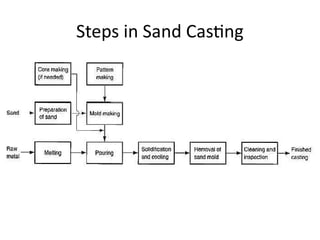
• - Steps in Casting: Mold Preparation, Melting,
Pouring, Solidification
FOUNDRY
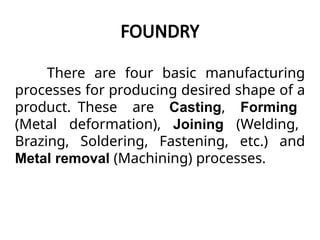
There are four basic manufacturing
processes for producing desired shape of a
product. These are Casting, Forming
(Metal deformation), Joining (Welding,
Brazing, Soldering, Fastening, etc.) and
Metal removal (Machining) processes.
Definitions
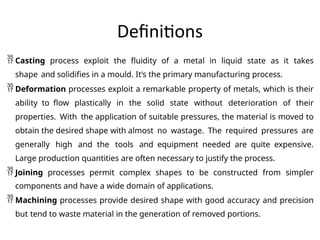
 Casting process exploit the fluidity of a metal in liquid state as it takes
shape and solidifies in a mould. It’s the primary manufacturing process.
 Deformation processes exploit a remarkable property of metals, which is their
ability to flow plastically in the solid state without deterioration of their
properties. With the application of suitable pressures, the material is moved to
obtain the desired shape with almost no wastage. The required pressures are
generally high and the tools and equipment needed are quite expensive.
Large production quantities are often necessary to justify the process.
 Joining processes permit complex shapes to be constructed from simpler
components and have a wide domain of applications.
 Machining processes provide desired shape with good accuracy and precision
but tend to waste material in the generation of removed portions.
Steps to be followed for a casting
operation
a)Making mould cavity
b)Liquefy or melt the material by properly
heating it in a suitable furnace.
c)Liquid or molten metal is poured into a
prepared mould cavity
d)Allowed to solidify
e)Product is taken out of the mould cavity,
trimmed and made to shape.
• Advantages of casting process:
Molten material can flow into very small sections so that intricate shapes can be made
by this process. As a result, many other operations, such as machining, forging, and
welding, can be minimized.
Possible to cast both ferrous and non-ferrous materials
Tools are very simple and expensive
Useful for small lot production
Weight reduction in design
No directional property
• There are certain parts (like turbine blades) made from metals and alloys that can only
be processed this way. Turbine blades: Fully casting + last machining.
• Limitations casting process:
 Accuracy and surface finish are not very good for final application.
 Difficult to remove defects due to presence of moisture.
 Metal casting is a labor intensive process.
 Automation
• Application casting process:
• Cylindrical bocks, wheels, housings, pipes, bells, pistons, piston rings, machine tool
beds etc.
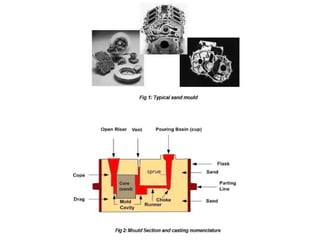
Important casting terms
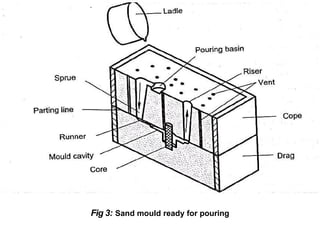
•Flask: A metal or wood frame, without fixed top or bottom, in which the mould is formed. Depending
upon the position of the flask in the moulding structure, it is referred to by various names such as:
•Drag: lower moulding flask,cope – upper moulding flask,
•Cheek: intermediate moulding flask used in three piece moulding.
•Pattern: It is the replica of the final object to be made. The mould cavity ismade with the help of pattern.
•Parting line: This is the dividing line between the two moulding flasks thatmakes up the mould.
•Moulding sand: Sand, which binds strongly without losing its permeability to air or gases. It is a mixture of
silica sand, clay, and moisture in appropriate proportions.
•Facing sand: The small amount of carbonaceous material sprinkled on the inner surface of the mould
cavity to give a better surface finish to the castings.
•Bottom board: Board used to start mould making (wood)
•Backing sand: used and burnt sand
•Core: A separate part of the mould, made of sand and generally baked, which is used to create openings and
various shaped cavities in the castings.
•Pouring basin: A small funnel shaped cavity at the top of the mould into which the molten metal is poured.
•Sprue: The passage through which the molten metal, from the pouring basin, reaches the mould cavity. In
many cases it controls the flow of metal into the mould.
•Runner: The channel through which the molten metal is carried from the sprue to the gate.
•Gate: A channel through which the molten metal enters the mould cavity.
•Chaplets: Chaplets are used to support the cores inside the mould cavity to take care of its own weight and
overcome the metallostatic force.
•Riser: A column of molten metal placed in the mould to feed the castings as it shrinks and solidifies.
Also known as “feed head”.
•Vent: Small opening in the mould to facilitate escape of air and gases.
Fig 3: Sand mould ready for pouring
Steps in Sand Casting
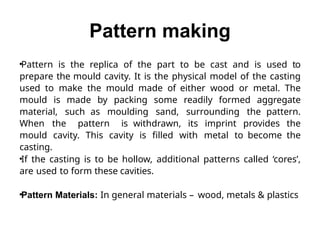
Pattern making
•Pattern is the replica of the part to be cast and is used to
prepare the mould cavity. It is the physical model of the casting
used to make the mould made of either wood or metal. The
mould is made by packing some readily formed aggregate
material, such as moulding sand, surrounding the pattern.
When the pattern is withdrawn, its imprint provides the
mould cavity. This cavity is filled with metal to become the
casting.
•If the casting is to be hollow, additional patterns called ‘cores’,
are used to form these cavities.
•Pattern Materials: In general materials – wood, metals & plastics
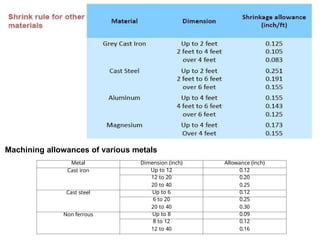
Machining allowances of various metals
Metal Dimension (inch) Allowance (inch)
Cast iron Up to 12 0.12
12 to 20 0.20
20 to 40 0.25
Cast steel Up to 6 0.12
6 to 20 0.25
20 to 40 0.30
Non ferrous Up to 8 0.09
8 to 12 0.12
12 to 40 0.16
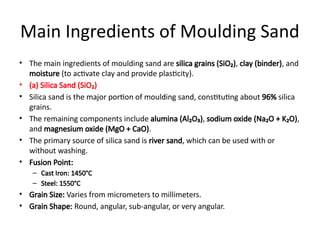
Main Ingredients of Moulding Sand
• The main ingredients of moulding sand are silica grains (SiO₂), clay (binder), and
moisture (to activate clay and provide plasticity).
• (a) Silica Sand (SiO₂)
• Silica sand is the major portion of moulding sand, constituting about 96% silica
grains.
• The remaining components include alumina (Al₂O₃), sodium oxide (Na₂O + K₂O),
and magnesium oxide (MgO + CaO).
• The primary source of silica sand is river sand, which can be used with or
without washing.
• Fusion Point:
– Cast Iron: 1450°C
– Steel: 1550°C
• Grain Size: Varies from micrometers to millimeters.
• Grain Shape: Round, angular, sub-angular, or very angular.
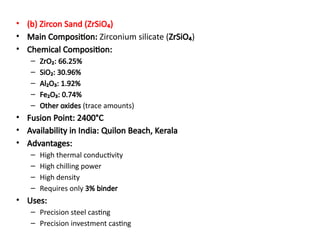
• (b) Zircon Sand (ZrSiO₄)
• Main Composition: Zirconium silicate (ZrSiO₄)
• Chemical Composition:
– ZrO₂: 66.25%
– SiO₂: 30.96%
– Al₂O₃: 1.92%
– Fe₂O₃: 0.74%
– Other oxides (trace amounts)
• Fusion Point: 2400°C
• Availability in India: Quilon Beach, Kerala
• Advantages:
– High thermal conductivity
– High chilling power
– High density
– Requires only 3% binder
• Uses:
– Precision steel casting
– Precision investment casting
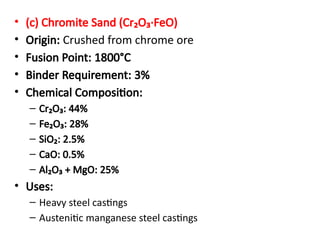
• (c) Chromite Sand (Cr₂O₃·FeO)
• Origin: Crushed from chrome ore
• Fusion Point: 1800°C
• Binder Requirement: 3%
• Chemical Composition:
– Cr₂O₃: 44%
– Fe₂O₃: 28%
– SiO₂: 2.5%
– CaO: 0.5%
– Al₂O₃ + MgO: 25%
• Uses:
– Heavy steel castings
– Austenitic manganese steel castings
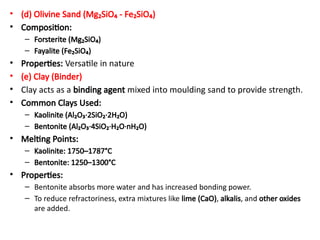
• (d) Olivine Sand (Mg₂SiO₄ - Fe₂SiO₄)
• Composition:
– Forsterite (Mg₂SiO₄)
– Fayalite (Fe₂SiO₄)
• Properties: Versatile in nature
• (e) Clay (Binder)
• Clay acts as a binding agent mixed into moulding sand to provide strength.
• Common Clays Used:
– Kaolinite (Al₂O₃·2SiO₂·2H₂O)
– Bentonite (Al₂O₃·4SiO₂·H₂O·nH₂O)
• Melting Points:
– Kaolinite: 1750–1787°C
– Bentonite: 1250–1300°C
• Properties:
– Bentonite absorbs more water and has increased bonding power.
– To reduce refractoriness, extra mixtures like lime (CaO), alkalis, and other oxides
are added.
Thank You..

Basic_Manufacturing_Processes LECTURE 01

  • 1.
    Basic Manufacturing Processes Lecture1 By Dilip Kumar Bagal Assistant Professor, Govt. College of Engg., Kalahandi
  • 2.
    Introduction • - Overviewof Basic Manufacturing Processes • - Importance in industrial applications • - Key topics covered: Casting, Welding, Metal Forming, Extrusion
  • 3.
    Foundry and Casting •- Definition and Overview • - Types of casting processes: Sand Casting, Investment Casting, Continuous Casting • - Steps in Casting: Mold Preparation, Melting, Pouring, Solidification
  • 4.
    FOUNDRY There are fourbasic manufacturing processes for producing desired shape of a product. These are Casting, Forming (Metal deformation), Joining (Welding, Brazing, Soldering, Fastening, etc.) and Metal removal (Machining) processes.
  • 5.
    Definitions  Casting processexploit the fluidity of a metal in liquid state as it takes shape and solidifies in a mould. It’s the primary manufacturing process.  Deformation processes exploit a remarkable property of metals, which is their ability to flow plastically in the solid state without deterioration of their properties. With the application of suitable pressures, the material is moved to obtain the desired shape with almost no wastage. The required pressures are generally high and the tools and equipment needed are quite expensive. Large production quantities are often necessary to justify the process.  Joining processes permit complex shapes to be constructed from simpler components and have a wide domain of applications.  Machining processes provide desired shape with good accuracy and precision but tend to waste material in the generation of removed portions.
  • 6.
    Steps to befollowed for a casting operation a)Making mould cavity b)Liquefy or melt the material by properly heating it in a suitable furnace. c)Liquid or molten metal is poured into a prepared mould cavity d)Allowed to solidify e)Product is taken out of the mould cavity, trimmed and made to shape.
  • 7.
    • Advantages ofcasting process: Molten material can flow into very small sections so that intricate shapes can be made by this process. As a result, many other operations, such as machining, forging, and welding, can be minimized. Possible to cast both ferrous and non-ferrous materials Tools are very simple and expensive Useful for small lot production Weight reduction in design No directional property • There are certain parts (like turbine blades) made from metals and alloys that can only be processed this way. Turbine blades: Fully casting + last machining. • Limitations casting process:  Accuracy and surface finish are not very good for final application.  Difficult to remove defects due to presence of moisture.  Metal casting is a labor intensive process.  Automation • Application casting process: • Cylindrical bocks, wheels, housings, pipes, bells, pistons, piston rings, machine tool beds etc.
  • 9.
    Important casting terms •Flask:A metal or wood frame, without fixed top or bottom, in which the mould is formed. Depending upon the position of the flask in the moulding structure, it is referred to by various names such as: •Drag: lower moulding flask,cope – upper moulding flask, •Cheek: intermediate moulding flask used in three piece moulding. •Pattern: It is the replica of the final object to be made. The mould cavity ismade with the help of pattern. •Parting line: This is the dividing line between the two moulding flasks thatmakes up the mould. •Moulding sand: Sand, which binds strongly without losing its permeability to air or gases. It is a mixture of silica sand, clay, and moisture in appropriate proportions. •Facing sand: The small amount of carbonaceous material sprinkled on the inner surface of the mould cavity to give a better surface finish to the castings. •Bottom board: Board used to start mould making (wood) •Backing sand: used and burnt sand •Core: A separate part of the mould, made of sand and generally baked, which is used to create openings and various shaped cavities in the castings. •Pouring basin: A small funnel shaped cavity at the top of the mould into which the molten metal is poured. •Sprue: The passage through which the molten metal, from the pouring basin, reaches the mould cavity. In many cases it controls the flow of metal into the mould. •Runner: The channel through which the molten metal is carried from the sprue to the gate. •Gate: A channel through which the molten metal enters the mould cavity. •Chaplets: Chaplets are used to support the cores inside the mould cavity to take care of its own weight and overcome the metallostatic force. •Riser: A column of molten metal placed in the mould to feed the castings as it shrinks and solidifies. Also known as “feed head”. •Vent: Small opening in the mould to facilitate escape of air and gases.
  • 10.
    Fig 3: Sandmould ready for pouring
  • 11.
  • 12.
    Pattern making •Pattern isthe replica of the part to be cast and is used to prepare the mould cavity. It is the physical model of the casting used to make the mould made of either wood or metal. The mould is made by packing some readily formed aggregate material, such as moulding sand, surrounding the pattern. When the pattern is withdrawn, its imprint provides the mould cavity. This cavity is filled with metal to become the casting. •If the casting is to be hollow, additional patterns called ‘cores’, are used to form these cavities. •Pattern Materials: In general materials – wood, metals & plastics
  • 13.
    Machining allowances ofvarious metals Metal Dimension (inch) Allowance (inch) Cast iron Up to 12 0.12 12 to 20 0.20 20 to 40 0.25 Cast steel Up to 6 0.12 6 to 20 0.25 20 to 40 0.30 Non ferrous Up to 8 0.09 8 to 12 0.12 12 to 40 0.16
  • 14.
    Main Ingredients ofMoulding Sand • The main ingredients of moulding sand are silica grains (SiO₂), clay (binder), and moisture (to activate clay and provide plasticity). • (a) Silica Sand (SiO₂) • Silica sand is the major portion of moulding sand, constituting about 96% silica grains. • The remaining components include alumina (Al₂O₃), sodium oxide (Na₂O + K₂O), and magnesium oxide (MgO + CaO). • The primary source of silica sand is river sand, which can be used with or without washing. • Fusion Point: – Cast Iron: 1450°C – Steel: 1550°C • Grain Size: Varies from micrometers to millimeters. • Grain Shape: Round, angular, sub-angular, or very angular.
  • 15.
    • (b) ZirconSand (ZrSiO₄) • Main Composition: Zirconium silicate (ZrSiO₄) • Chemical Composition: – ZrO₂: 66.25% – SiO₂: 30.96% – Al₂O₃: 1.92% – Fe₂O₃: 0.74% – Other oxides (trace amounts) • Fusion Point: 2400°C • Availability in India: Quilon Beach, Kerala • Advantages: – High thermal conductivity – High chilling power – High density – Requires only 3% binder • Uses: – Precision steel casting – Precision investment casting
  • 16.
    • (c) ChromiteSand (Cr₂O₃·FeO) • Origin: Crushed from chrome ore • Fusion Point: 1800°C • Binder Requirement: 3% • Chemical Composition: – Cr₂O₃: 44% – Fe₂O₃: 28% – SiO₂: 2.5% – CaO: 0.5% – Al₂O₃ + MgO: 25% • Uses: – Heavy steel castings – Austenitic manganese steel castings
  • 17.
    • (d) OlivineSand (Mg₂SiO₄ - Fe₂SiO₄) • Composition: – Forsterite (Mg₂SiO₄) – Fayalite (Fe₂SiO₄) • Properties: Versatile in nature • (e) Clay (Binder) • Clay acts as a binding agent mixed into moulding sand to provide strength. • Common Clays Used: – Kaolinite (Al₂O₃·2SiO₂·2H₂O) – Bentonite (Al₂O₃·4SiO₂·H₂O·nH₂O) • Melting Points: – Kaolinite: 1750–1787°C – Bentonite: 1250–1300°C • Properties: – Bentonite absorbs more water and has increased bonding power. – To reduce refractoriness, extra mixtures like lime (CaO), alkalis, and other oxides are added.
  • 18.