Mortality
Trends after
pPCI
for
STEMI
By
Dr Muhammad Tufail
PGR Cardiology MMC
Observational Studies  Mortality rates remained stagnant between 2006 – 2010
DANAMI-2 Trial  Inter-Hospital transport to pPCI  Superior to Thrombolysis in the local
hospital.
 pPCI implemented as National Strategy for STEMI (2003)
Other strategies Implemented;
 Prophylactic Rx with High-Intensity Statins + P2Y12 Inhibitors (Ticagrelor) + DES (drug-eluting-
stents)
 Heart Failure clinics + Cardiac Rehabilitation Programs
To determine whether Mortality rates after STEMI have Declined or Stagnated. To examine
how Death
Rates have changed over time in three specific periods after STEMI. These periods are:
1. Within 1 year after the heart attack.
2. Within the first 30 days after the heart attack.
3. From 31 days to 1 year after the heart attack.
Cohort Study conducted in Denmark (2003 – 2018)
Background & Objectives
 High Income European Country having Fully Implemented pPCI, 3 High-Volume PCI-
centres offering 24/7 services.
 Patients are registered in the database with their unique personal identification number in
the Western Denmark Heart Registry (WDHR), which all Danish citizens receive at birth
or immigration
Denmark
Inclusion
 All adult (aged 18 years) first-time PCI-treated patients who underwent pPCI for STEMI
≥
between January 1, 2003, and October 31, 2018, in Western Denmark
Exclusion;
 Patients not residing in Denmark at the date of PCI
 Patients with symptom duration 12 hours were excluded.
≥
 Patients with a past history of PCI  to ensure a first-time pPCI-treated cohort
Patients were divided into 4 groups according to the year of pPCI (2003-2006,
2007-2010, 2011-2014, or 2015- 2018).
Mortality was compared with individuals without history of MI, PCI, or coronary
artery bypass grafting (CABG)
Inclusion & Exclusion Criteria
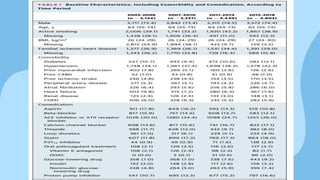
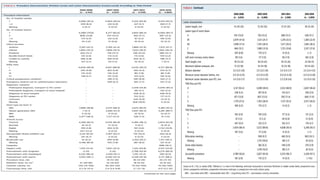
Baseline Data: At the time of pPCI, details like body mass index, smoking status,
hypertension,
diabetes, Killip class, and critical preoperative conditions (e.g. arrhythmias, resuscitation,
ventilation)
were recorded.
Medication: Medication use was tracked through prescriptions filled 6 months before and
after pPCI
using the Danish National Prescription Database.
Treatment Delays: Delays were measured, including:
 Total Delay: From symptom onset to wire crossing, combining patient and system delays.
 System Delay: From first medical contact to wire crossing.
Outcomes: Mortality rates (death from any cause) were tracked at 1 year, within 30 days, and
from 31
to 365 days using data from the Danish Civil Registration System.
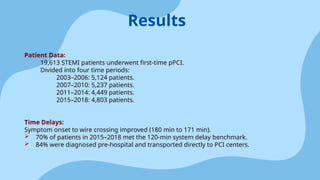
Patient Data:
19,613 STEMI patients underwent first-time pPCI.
Divided into four time periods:
2003–2006: 5,124 patients.
2007–2010: 5,237 patients.
2011–2014: 4,449 patients.
2015–2018: 4,803 patients.
Time Delays:
Symptom onset to wire crossing improved (180 min to 171 min).
 70% of patients in 2015–2018 met the 120-min system delay benchmark.
 84% were diagnosed pre-hospital and transported directly to PCI centers.
Results
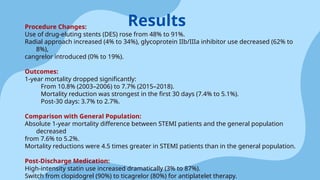
Procedure Changes:
Use of drug-eluting stents (DES) rose from 48% to 91%.
Radial approach increased (4% to 34%), glycoprotein IIb/IIIa inhibitor use decreased (62% to
8%),
cangrelor introduced (0% to 19%).
Outcomes:
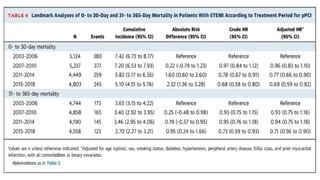
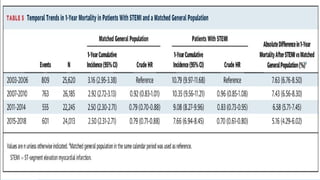
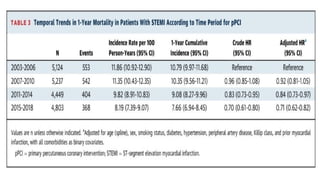
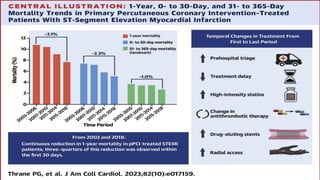
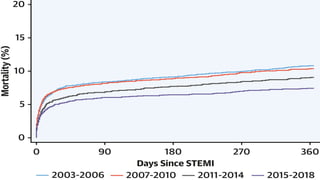
1-year mortality dropped significantly:
From 10.8% (2003–2006) to 7.7% (2015–2018).
Mortality reduction was strongest in the first 30 days (7.4% to 5.1%).
Post-30 days: 3.7% to 2.7%.
Comparison with General Population:
Absolute 1-year mortality difference between STEMI patients and the general population
decreased
from 7.6% to 5.2%.
Mortality reductions were 4.5 times greater in STEMI patients than in the general population.
Post-Discharge Medication:
High-intensity statin use increased dramatically (3% to 87%).
Switch from clopidogrel (90%) to ticagrelor (80%) for antiplatelet therapy.
Results
Key Findings:
 Mortality Decline:
1-year mortality decreased continuously (2003-2018) with a 3.1% absolute risk reduction (30%
adjusted relative risk reduction).
 Timing of Mortality Reduction:
Largest decline observed within 0–30 days post-pPCI (2.3% reduction).
Smaller decline in 31–365 days (1% reduction).
 Management Changes:
Improvements in prehospital triage, increased use of secondary prevention, and newer-
generation
drug-eluting stents (DES). Median delay from symptom onset to wire crossing reduced to 171
minutes
in 2015-2018 (down from 224 minutes in DANAMI-2 trial).
 Comparison with General Population:
STEMI mortality reduction was 4.5 times larger than mortality reduction in the general
population.
Discussion
Treatment Delay Insights
Reduction in Mortality:
Largest benefit observed in the first 30 days post-pPCI (1 death
prevented per
43 patients in 2015–2018). From 31–365 days, 1 death prevented per 105
patients.
Role of Prehospital Diagnosis:
Enabled earlier treatment initiation with aspirin, heparin, and P2Y12
inhibitors
(e.g., switch from clopidogrel to ticagrelor after 2011).
Time to Treatment Improvements:
Prehospital ECG transmission and direct triage to PCI centers reduced
delays.
Median treatment delay in 2015-2018 (171 minutes) was a substantial
Discussion
Advances in Pharmacological and Interventional Management
Medications:
Increased use of high-intensity statins (post-2012) and ticagrelor (post-
2011).
Stent Technology:
Transition from bare-metal stents to newer-generation DES (89% use in
2015
2018).
Reduced risk of restenosis and stent thrombosis.
Procedural Improvements:
Shift from femoral to radial access reduced bleeding complications.
Optimized antithrombotic regimens (e.g., reduced glycoprotein IIb/IIIa
inhibitor
use).
Discussion
Strengths:
Accurate linkage of patient records in a universal healthcare system.
Consecutive data from a fully pPCI-based STEMI treatment strategy.
Limitations:
Observational design; causality cannot be established.
Limited data on prehospital delays for some cases.
Study Strengths and Limitations
 In a high-income European country where pPCI has been the strategy
for all patients with STEMI since 2003, 1-year mortality was reduced by
approximately 30% from 2003-2006 to 2015-2018, with three quarters of
this mortality reduction observed within the first 30 days.
 These results indicate that optimization in the early management of
patients with STEMI, including reductions in time delays and uptake
of new guideline-initiated pharmacologic and interventional
treatments, offers great opportunities for improving overall survival
in clinical practice
Conclusion
Thank you
for
bearing with me

Mortality Trends after pPCI for STEMI.pptx

  • 1.
  • 2.
    Observational Studies Mortality rates remained stagnant between 2006 – 2010 DANAMI-2 Trial  Inter-Hospital transport to pPCI  Superior to Thrombolysis in the local hospital.  pPCI implemented as National Strategy for STEMI (2003) Other strategies Implemented;  Prophylactic Rx with High-Intensity Statins + P2Y12 Inhibitors (Ticagrelor) + DES (drug-eluting- stents)  Heart Failure clinics + Cardiac Rehabilitation Programs To determine whether Mortality rates after STEMI have Declined or Stagnated. To examine how Death Rates have changed over time in three specific periods after STEMI. These periods are: 1. Within 1 year after the heart attack. 2. Within the first 30 days after the heart attack. 3. From 31 days to 1 year after the heart attack. Cohort Study conducted in Denmark (2003 – 2018) Background & Objectives
  • 3.
     High IncomeEuropean Country having Fully Implemented pPCI, 3 High-Volume PCI- centres offering 24/7 services.  Patients are registered in the database with their unique personal identification number in the Western Denmark Heart Registry (WDHR), which all Danish citizens receive at birth or immigration Denmark
  • 4.
    Inclusion  All adult(aged 18 years) first-time PCI-treated patients who underwent pPCI for STEMI ≥ between January 1, 2003, and October 31, 2018, in Western Denmark Exclusion;  Patients not residing in Denmark at the date of PCI  Patients with symptom duration 12 hours were excluded. ≥  Patients with a past history of PCI  to ensure a first-time pPCI-treated cohort Patients were divided into 4 groups according to the year of pPCI (2003-2006, 2007-2010, 2011-2014, or 2015- 2018). Mortality was compared with individuals without history of MI, PCI, or coronary artery bypass grafting (CABG) Inclusion & Exclusion Criteria
  • 5.
    Baseline Data: Atthe time of pPCI, details like body mass index, smoking status, hypertension, diabetes, Killip class, and critical preoperative conditions (e.g. arrhythmias, resuscitation, ventilation) were recorded. Medication: Medication use was tracked through prescriptions filled 6 months before and after pPCI using the Danish National Prescription Database. Treatment Delays: Delays were measured, including:  Total Delay: From symptom onset to wire crossing, combining patient and system delays.  System Delay: From first medical contact to wire crossing. Outcomes: Mortality rates (death from any cause) were tracked at 1 year, within 30 days, and from 31 to 365 days using data from the Danish Civil Registration System.
  • 8.
    Patient Data: 19,613 STEMIpatients underwent first-time pPCI. Divided into four time periods: 2003–2006: 5,124 patients. 2007–2010: 5,237 patients. 2011–2014: 4,449 patients. 2015–2018: 4,803 patients. Time Delays: Symptom onset to wire crossing improved (180 min to 171 min).  70% of patients in 2015–2018 met the 120-min system delay benchmark.  84% were diagnosed pre-hospital and transported directly to PCI centers. Results
  • 9.
    Procedure Changes: Use ofdrug-eluting stents (DES) rose from 48% to 91%. Radial approach increased (4% to 34%), glycoprotein IIb/IIIa inhibitor use decreased (62% to 8%), cangrelor introduced (0% to 19%). Outcomes: 1-year mortality dropped significantly: From 10.8% (2003–2006) to 7.7% (2015–2018). Mortality reduction was strongest in the first 30 days (7.4% to 5.1%). Post-30 days: 3.7% to 2.7%. Comparison with General Population: Absolute 1-year mortality difference between STEMI patients and the general population decreased from 7.6% to 5.2%. Mortality reductions were 4.5 times greater in STEMI patients than in the general population. Post-Discharge Medication: High-intensity statin use increased dramatically (3% to 87%). Switch from clopidogrel (90%) to ticagrelor (80%) for antiplatelet therapy. Results
  • 15.
    Key Findings:  MortalityDecline: 1-year mortality decreased continuously (2003-2018) with a 3.1% absolute risk reduction (30% adjusted relative risk reduction).  Timing of Mortality Reduction: Largest decline observed within 0–30 days post-pPCI (2.3% reduction). Smaller decline in 31–365 days (1% reduction).  Management Changes: Improvements in prehospital triage, increased use of secondary prevention, and newer- generation drug-eluting stents (DES). Median delay from symptom onset to wire crossing reduced to 171 minutes in 2015-2018 (down from 224 minutes in DANAMI-2 trial).  Comparison with General Population: STEMI mortality reduction was 4.5 times larger than mortality reduction in the general population. Discussion
  • 16.
    Treatment Delay Insights Reductionin Mortality: Largest benefit observed in the first 30 days post-pPCI (1 death prevented per 43 patients in 2015–2018). From 31–365 days, 1 death prevented per 105 patients. Role of Prehospital Diagnosis: Enabled earlier treatment initiation with aspirin, heparin, and P2Y12 inhibitors (e.g., switch from clopidogrel to ticagrelor after 2011). Time to Treatment Improvements: Prehospital ECG transmission and direct triage to PCI centers reduced delays. Median treatment delay in 2015-2018 (171 minutes) was a substantial Discussion
  • 17.
    Advances in Pharmacologicaland Interventional Management Medications: Increased use of high-intensity statins (post-2012) and ticagrelor (post- 2011). Stent Technology: Transition from bare-metal stents to newer-generation DES (89% use in 2015 2018). Reduced risk of restenosis and stent thrombosis. Procedural Improvements: Shift from femoral to radial access reduced bleeding complications. Optimized antithrombotic regimens (e.g., reduced glycoprotein IIb/IIIa inhibitor use). Discussion
  • 18.
    Strengths: Accurate linkage ofpatient records in a universal healthcare system. Consecutive data from a fully pPCI-based STEMI treatment strategy. Limitations: Observational design; causality cannot be established. Limited data on prehospital delays for some cases. Study Strengths and Limitations
  • 19.
     In ahigh-income European country where pPCI has been the strategy for all patients with STEMI since 2003, 1-year mortality was reduced by approximately 30% from 2003-2006 to 2015-2018, with three quarters of this mortality reduction observed within the first 30 days.  These results indicate that optimization in the early management of patients with STEMI, including reductions in time delays and uptake of new guideline-initiated pharmacologic and interventional treatments, offers great opportunities for improving overall survival in clinical practice Conclusion
  • 20.