EXISTENTIALISM
Maddy Devine
Matt Goebel
Aaron Wright
Definition of Existentialism
• Existentialism is a philosophical outlook
that stresses the importance of free will,
freedom of choice, and personal
responsibility.
– Decisions & Consequences
– Rationality
– Personal responsibility/discipline
– Society and religion
– Worldly desire
Kierkegaard’s Biography
• Born May 5, 1813
• Raised in town of Copenhagen
– Rarely left town, only traveled abroad 5 times
• Attended theatre, walked streets to chat,
carriage jaunts to countryside
• Attended Copenhagen University
– Studied philosophy and theology
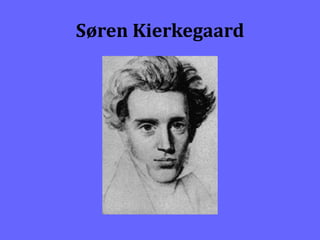
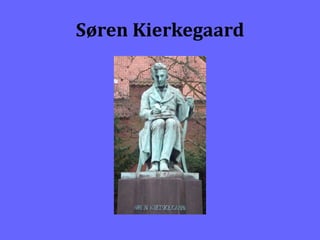
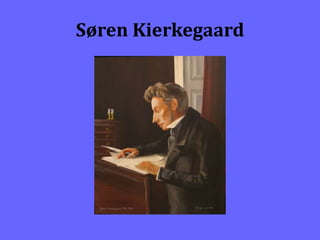
Søren Kierkegaard
Kierkegaard’s Biography
• His life significantly relevant to his work
• His critique of Hegelianism abstracted from lives of its
proponents
– How life and work of a philosopher contradicted
– Greek notion of judging philosophers
• Writer’s work is important, but judgment should be based on
their life
• His writings double as means of working through events in his
life
– Particularly to his mother, father, and fiancée
– Similar to Socrates: “His whole life was personal preoccupation with
himself, and then Governance comes and adds world-historical
significance to it.”
– Kierkegaard believed personal life was transfigured by divine
Governance into universal significance
Søren Kierkegaard
Kierkegaard’s Biography
• Influence from Mother
– Indirect and hidden in work, never actually
mentioned
• Placed much emphasis on indirect communication
• Writings were in his mother-tongue (Danish)
• Significant due to Latin being the language of science and
scholarship
– Had to petition to the king to write one of his philosophical
works in Danish
• He defied the used languages (Latin and German) in order
to connect with his mother through use of Danish
language
Kierkegaard’s Biography
• Influence from Father
– Often noted in Kierkegaard’s works
– Kierkegaard inherited trait of melancholy and sense of
guilt and anxiety
– Had father’s emphasis on Christian faith and talents for
philosophical argument and imagination
– Father’s wealth allowed Kierkegaard to be a free-lance
writer
– Father felt guilt/punishment from God, believed all of
his 7 sons would die before the age of 34
• 5 of 7 sons did die before 34
• Kierkegaard astonished to survive and perhaps may explain
why he wrote so much up to his 34th birthday
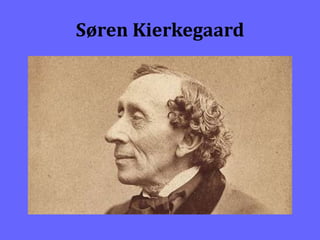
Søren Kierkegaard
Kierkegaard’s Biography
• Influence from fiancée Regine Olsen
– Theme of young man and woman being
“poeticized” recurs in Kierkegaard’s works
– Theme of sacrificing world happiness for higher
purpose
– Engagement was broken: Kierkegaard devotes
himself to his religious purpose
– Establishes outsider status (unmarried)
– No longer held personal relationships, objectified
them as ideal creatures
– Created patriarchal values on church and father
Søren Kierkegaard
Who did Kierkegaard base his
thoughts on?
• Father of Existentialism
• Writing based on Socrates
• Originally specifically focused on flaws of G.W.F.
Hegel’s philosophy
• Later stemmed ideas from hatred of Danish
National Church
Kierkegaard’s philosophical
contributions
• Credited with creating existential
psychology and therapy through writings
– Unlimited free will
– Go against what’s good for them
• “Leap of faith”
• Humans cannot know certain things based
on reason
– God/religion
– Take leap of faith
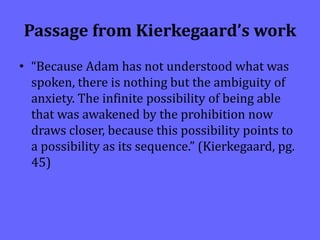
Passage from Kierkegaard’s work
• “Because Adam has not understood what was
spoken, there is nothing but the ambiguity of
anxiety. The infinite possibility of being able
that was awakened by the prohibition now
draws closer, because this possibility points to
a possibility as its sequence.” (Kierkegaard, pg.
45)
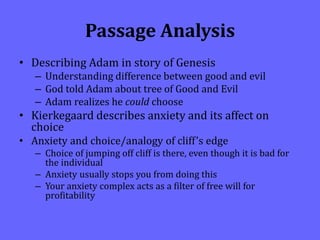
Passage Analysis
• Describing Adam in story of Genesis
– Understanding difference between good and evil
– God told Adam about tree of Good and Evil
– Adam realizes he could choose
• Kierkegaard describes anxiety and its affect on
choice
• Anxiety and choice/analogy of cliff’s edge
– Choice of jumping off cliff is there, even though it is bad for
the individual
– Anxiety usually stops you from doing this
– Your anxiety complex acts as a filter of free will for
profitability
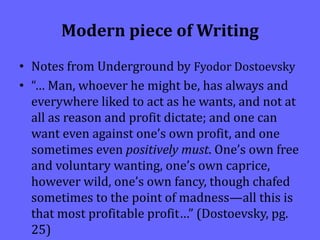
Modern piece of Writing
• Notes from Underground by Fyodor Dostoevsky
• “… Man, whoever he might be, has always and
everywhere liked to act as he wants, and not at
all as reason and profit dictate; and one can
want even against one’s own profit, and one
sometimes even positively must. One’s own free
and voluntary wanting, one’s own caprice,
however wild, one’s own fancy, though chafed
sometimes to the point of madness—all this is
that most profitable profit…” (Dostoevsky, pg.
25)
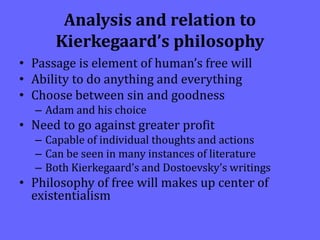
Analysis and relation to
Kierkegaard’s philosophy
• Passage is element of human’s free will
• Ability to do anything and everything
• Choose between sin and goodness
– Adam and his choice
• Need to go against greater profit
– Capable of individual thoughts and actions
– Can be seen in many instances of literature
– Both Kierkegaard’s and Dostoevsky’s writings
• Philosophy of free will makes up center of
existentialism
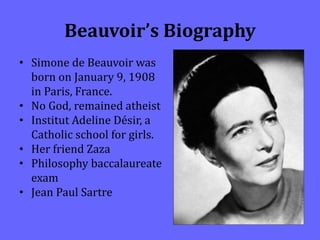
Beauvoir’s Biography
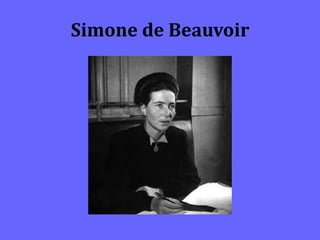
• Simone de Beauvoir was
born on January 9, 1908
in Paris, France.
• No God, remained atheist
• Institut Adeline Désir, a
Catholic school for girls.
• Her friend Zaza
• Philosophy baccalaureate
exam
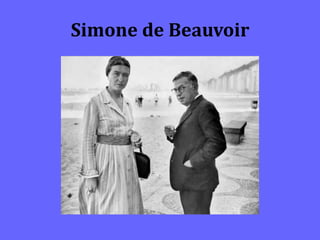
• Jean Paul Sartre
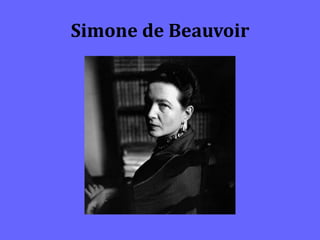
Simone de Beauvoir
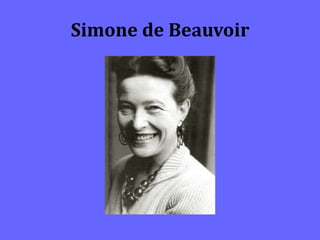
Simone de Beauvoir
Beauvoir’s Biography
• Large role in developing existentialism and
feminism during the twentieth century
• Beauvoir and Sartre relationship
• Sartre’s ideas involving the idea of human
freedom and endless possibilities
• An inner life and an outer life
– The inner life is our personality and consciousness
while the outer life includes our material
belongings.
Simone de Beauvoir
Beauvoir’s Works
• “The Second Sex” intertwines the ideas of feminism
and
– believed that women were seen as something other and
completely different than men
– women were being repressed
• Earlier works, “Ethics of Ambiguity”
– “the spirit of seriousness”
• “La Sang des Autres”
– the major existentialist piece from the French Resistance
• Her influences include Descartes, Bergson, Husserl,
Heidegger, and Karl Marx.
Simone de Beauvoir
Passage from Beauvoir’s Work
• “The Second Sex”
• “It has been declared that if she resigns
herself to this surrender, it is because
physically and morally she has become
inferior to boys and incapable of competing
with them: forsaking hopeless competition,
she entrusts that assurance of her happiness
to a member of the superior caste.”
(Beauvoir, 342)
Analysis of Passage
• Traditional patriarchal system suppresses free
will of women
• This passage discusses how from a young age
women are seen as inferior and “fragile” beings
– This relates to Beauvoir’s philosophy that women
are seen as “the second sex” and nothing like men
Modern Passage
• “Full Frontal Feminism” by Jessica Valenti
• “You are a b*tch. You are a c*nt. You are a
sl*t. You are a wh*re. The worst thing you
can call a girl is a girl. The worst thing you
can call a guy is a girl. Being a woman is the
ultimate insult. Now tell me that’s not
royally [messed] up.” (Valenti 5)
Analysis and Relation to
Beauvoir’s Work
• Relates to the idea that women are belittled
• Being a woman is a major insult
• This is engraved at a young age
– Young girl referred to in “The Second Sex”
• Both existentialist and feminist
Summary
• Existentialism is a philosophical outlook
that stresses the importance of free will,
freedom of choice, and personal
responsibility.
• Kierkegaard looked at existentialism in
regards to religion
• Beauvoir looked at existentialism in feminist
ways
Bibliography
• Beauvoir, S. (1949). The Second Sex. Paris, France: Editions
Gallimard, 2009.
• Cherry, K. (2010). What is existentialism? Retrieved from
www.allaboutphilosophy.org/existentialism on May 6,
2010.
• Dostoevsky, F. (1865). Notes from Underground. New York, New
York: Vintage Books, 1994.
• Kierkegaard, S. (1844). The Concept of Anxiety. Princeton, N.J.:
Princeton University Press, 1980.
• McDonald, W. (2009). Søren Kierkegaard. Standford
Encyclopedia of Philosophy. Retrieved from
www.plato.stanford.edu/entries/kierkegaard on May 6, 2010
• Mussett, S. (2010). Simone de Beauvoir (1908-1986).
Retrieved from www.iep.edu/beauvoir on May 8, 2010.
• Valenti, J. (2007). Full Frontal Feminism. Emeryville, California:
Avalon Publishing Group, 2007.

Existentialism Devine Goebel Wright

  • 1.
  • 2.
    Definition of Existentialism •Existentialism is a philosophical outlook that stresses the importance of free will, freedom of choice, and personal responsibility. – Decisions & Consequences – Rationality – Personal responsibility/discipline – Society and religion – Worldly desire
  • 3.
    Kierkegaard’s Biography • BornMay 5, 1813 • Raised in town of Copenhagen – Rarely left town, only traveled abroad 5 times • Attended theatre, walked streets to chat, carriage jaunts to countryside • Attended Copenhagen University – Studied philosophy and theology
  • 4.
  • 5.
    Kierkegaard’s Biography • Hislife significantly relevant to his work • His critique of Hegelianism abstracted from lives of its proponents – How life and work of a philosopher contradicted – Greek notion of judging philosophers • Writer’s work is important, but judgment should be based on their life • His writings double as means of working through events in his life – Particularly to his mother, father, and fiancée – Similar to Socrates: “His whole life was personal preoccupation with himself, and then Governance comes and adds world-historical significance to it.” – Kierkegaard believed personal life was transfigured by divine Governance into universal significance
  • 6.
  • 7.
    Kierkegaard’s Biography • Influencefrom Mother – Indirect and hidden in work, never actually mentioned • Placed much emphasis on indirect communication • Writings were in his mother-tongue (Danish) • Significant due to Latin being the language of science and scholarship – Had to petition to the king to write one of his philosophical works in Danish • He defied the used languages (Latin and German) in order to connect with his mother through use of Danish language
  • 8.
    Kierkegaard’s Biography • Influencefrom Father – Often noted in Kierkegaard’s works – Kierkegaard inherited trait of melancholy and sense of guilt and anxiety – Had father’s emphasis on Christian faith and talents for philosophical argument and imagination – Father’s wealth allowed Kierkegaard to be a free-lance writer – Father felt guilt/punishment from God, believed all of his 7 sons would die before the age of 34 • 5 of 7 sons did die before 34 • Kierkegaard astonished to survive and perhaps may explain why he wrote so much up to his 34th birthday
  • 9.
  • 10.
    Kierkegaard’s Biography • Influencefrom fiancée Regine Olsen – Theme of young man and woman being “poeticized” recurs in Kierkegaard’s works – Theme of sacrificing world happiness for higher purpose – Engagement was broken: Kierkegaard devotes himself to his religious purpose – Establishes outsider status (unmarried) – No longer held personal relationships, objectified them as ideal creatures – Created patriarchal values on church and father
  • 11.
  • 12.
    Who did Kierkegaardbase his thoughts on? • Father of Existentialism • Writing based on Socrates • Originally specifically focused on flaws of G.W.F. Hegel’s philosophy • Later stemmed ideas from hatred of Danish National Church
  • 13.
    Kierkegaard’s philosophical contributions • Creditedwith creating existential psychology and therapy through writings – Unlimited free will – Go against what’s good for them • “Leap of faith” • Humans cannot know certain things based on reason – God/religion – Take leap of faith
  • 14.
    Passage from Kierkegaard’swork • “Because Adam has not understood what was spoken, there is nothing but the ambiguity of anxiety. The infinite possibility of being able that was awakened by the prohibition now draws closer, because this possibility points to a possibility as its sequence.” (Kierkegaard, pg. 45)
  • 15.
    Passage Analysis • DescribingAdam in story of Genesis – Understanding difference between good and evil – God told Adam about tree of Good and Evil – Adam realizes he could choose • Kierkegaard describes anxiety and its affect on choice • Anxiety and choice/analogy of cliff’s edge – Choice of jumping off cliff is there, even though it is bad for the individual – Anxiety usually stops you from doing this – Your anxiety complex acts as a filter of free will for profitability
  • 16.
    Modern piece ofWriting • Notes from Underground by Fyodor Dostoevsky • “… Man, whoever he might be, has always and everywhere liked to act as he wants, and not at all as reason and profit dictate; and one can want even against one’s own profit, and one sometimes even positively must. One’s own free and voluntary wanting, one’s own caprice, however wild, one’s own fancy, though chafed sometimes to the point of madness—all this is that most profitable profit…” (Dostoevsky, pg. 25)
  • 17.
    Analysis and relationto Kierkegaard’s philosophy • Passage is element of human’s free will • Ability to do anything and everything • Choose between sin and goodness – Adam and his choice • Need to go against greater profit – Capable of individual thoughts and actions – Can be seen in many instances of literature – Both Kierkegaard’s and Dostoevsky’s writings • Philosophy of free will makes up center of existentialism
  • 18.
    Beauvoir’s Biography • Simonede Beauvoir was born on January 9, 1908 in Paris, France. • No God, remained atheist • Institut Adeline Désir, a Catholic school for girls. • Her friend Zaza • Philosophy baccalaureate exam • Jean Paul Sartre
  • 19.
  • 20.
  • 21.
    Beauvoir’s Biography • Largerole in developing existentialism and feminism during the twentieth century • Beauvoir and Sartre relationship • Sartre’s ideas involving the idea of human freedom and endless possibilities • An inner life and an outer life – The inner life is our personality and consciousness while the outer life includes our material belongings.
  • 22.
  • 23.
    Beauvoir’s Works • “TheSecond Sex” intertwines the ideas of feminism and – believed that women were seen as something other and completely different than men – women were being repressed • Earlier works, “Ethics of Ambiguity” – “the spirit of seriousness” • “La Sang des Autres” – the major existentialist piece from the French Resistance • Her influences include Descartes, Bergson, Husserl, Heidegger, and Karl Marx.
  • 24.
  • 25.
    Passage from Beauvoir’sWork • “The Second Sex” • “It has been declared that if she resigns herself to this surrender, it is because physically and morally she has become inferior to boys and incapable of competing with them: forsaking hopeless competition, she entrusts that assurance of her happiness to a member of the superior caste.” (Beauvoir, 342)
  • 26.
    Analysis of Passage •Traditional patriarchal system suppresses free will of women • This passage discusses how from a young age women are seen as inferior and “fragile” beings – This relates to Beauvoir’s philosophy that women are seen as “the second sex” and nothing like men
  • 27.
    Modern Passage • “FullFrontal Feminism” by Jessica Valenti • “You are a b*tch. You are a c*nt. You are a sl*t. You are a wh*re. The worst thing you can call a girl is a girl. The worst thing you can call a guy is a girl. Being a woman is the ultimate insult. Now tell me that’s not royally [messed] up.” (Valenti 5)
  • 28.
    Analysis and Relationto Beauvoir’s Work • Relates to the idea that women are belittled • Being a woman is a major insult • This is engraved at a young age – Young girl referred to in “The Second Sex” • Both existentialist and feminist
  • 29.
    Summary • Existentialism isa philosophical outlook that stresses the importance of free will, freedom of choice, and personal responsibility. • Kierkegaard looked at existentialism in regards to religion • Beauvoir looked at existentialism in feminist ways
  • 30.
    Bibliography • Beauvoir, S.(1949). The Second Sex. Paris, France: Editions Gallimard, 2009. • Cherry, K. (2010). What is existentialism? Retrieved from www.allaboutphilosophy.org/existentialism on May 6, 2010. • Dostoevsky, F. (1865). Notes from Underground. New York, New York: Vintage Books, 1994. • Kierkegaard, S. (1844). The Concept of Anxiety. Princeton, N.J.: Princeton University Press, 1980. • McDonald, W. (2009). Søren Kierkegaard. Standford Encyclopedia of Philosophy. Retrieved from www.plato.stanford.edu/entries/kierkegaard on May 6, 2010 • Mussett, S. (2010). Simone de Beauvoir (1908-1986). Retrieved from www.iep.edu/beauvoir on May 8, 2010. • Valenti, J. (2007). Full Frontal Feminism. Emeryville, California: Avalon Publishing Group, 2007.