PRACTICE II, DIDACTICS OF ELT. Prof. ADJUNTO REGULAR Estela N.
Braun. Teacher Assistants: Prof. Vanesa Cabral and Prof. Johana Herran.
STUDENTS’ NAMES: Martinez Paula, Nieto Paola, Moreno Ana, and Loza
Claudia.
PRACTICAL 3:
Critical Analysis of Textbooks and Integration of main concepts in Module 1:
Activities:
1. Davies Paul A. and Falla T. (1992). Flashlight 1. Focus on the World.
Oxford [England] ; New York: Oxford University Press. (page) Public
Schools.
This page shows different activities as regards The United Kingdom culture in
Britain. In activity number 1 students have to look at the pictures and solve a quiz.
Then, number 2 refers to a listening and check their answers, and finally, in activity
number 3, they have to find the cities in the quiz on the map on page 64. As
regards the view of English language teaching this textbook represents, we found
that the activities are not connected with the Argentinian culture; the three activities
deal with the British one in which students are asked to know about a foreign
culture (famous people, a British prince, a British football team…) and even to
locate some cities on a map.
We could see that these kind of activities have nothing to do with Argentinian
students’ reality, in which they are asked to know about a culture that they do not
belong to (the
British one). In this regard we agree with Borrow (1990) and Valdes (1990) when
they state that teaching a language involves the transmission of ideas or concepts
implicitly or explicitly and we also agree with Holly (1990), who said that English
language teaching could be a form of cultural and ideological colonization. As a
consequence, students’ cultures remain totally submerged and the English
language becomes a threat for their national identities.
The variety of English taught we think is the British RP, perhaps because it is used
as a model for English textbooks. It is the hegemonic variety for English teaching. It
is closely connected with the concept of imperialism, since through the textbooks
they impose (implicitly) their culture as well as their political, ideological, economic
and social practices (Robert Phillipson, linguistic imperialism. Said, 1993:3-8).
Monolingual perspective: just one language, English.
Finally, in these activities we have analysed in which ways culture is depicted as a
model to follow ( since not any culture is presented or talked about, just the British
one). Moreover, the title of the section of the book is “focus on the world” but the
activities selected portray just English culture, which made us think that they may
see themselves as the centre of the world and their culture a model to study and
imitate.
2. Hutchinson T. (). Project English 1. English across the Curriculum. Oxford
[England] ; New York: Oxford University Press. Page 13. Public Schools.
This page shows different consolidation activities that enclose all the activities
worked so far in class. Activity 1 refers to looking at the symbols, listen and repeat.
In activity number 2, the students have to write the missing symbols or numbers. In
activity 3, they have to test their partners through asking two questions. In activity
number 4, the students have to look at the map and answer the questions below.
In activity number 5, they have to look at some pictures, answer questions,
and say which colour the winner is. Finally, the activity number 6, they have to say
which the answer is by looking at different numbers.
Despite the fact that this kind of activities does not portray the students’ culture, we
agree with Silvana Barboni when she explains that through the learning process of
English, people can interact with many texts, people and different situations from
other cultures, so as to enrich their views about the world and sociocultural
surroundings. Moreover, English classes show the cultural diversity which helps
learners to strengthen their own identity. At the same time, English language lets
different students of different cultures communicate each other sharing the same
linguistic code. This means that we agree with the activities if they can be adapted
taking into account the level of English students have, and the age as well.
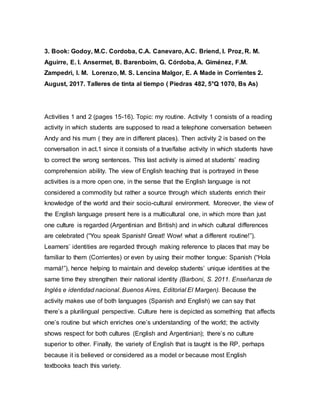
3. Book: Godoy, M.C. Cordoba, C.A. Canevaro, A.C. Briend, I. Proz, R. M.
Aguirre, E. I. Ansermet, B. Barenboim, G. Córdoba, A. Giménez, F.M.
Zampedri, I. M. Lorenzo, M. S. Lencina Malgor, E. A Made in Corrientes 2.
August, 2017. Talleres de tinta al tiempo ( Piedras 482, 5°Q 1070, Bs As)
Activities 1 and 2 (pages 15-16). Topic: my routine. Activity 1 consists of a reading
activity in which students are supposed to read a telephone conversation between
Andy and his mum ( they are in different places). Then activity 2 is based on the
conversation in act.1 since it consists of a true/false activity in which students have
to correct the wrong sentences. This last activity is aimed at students’ reading
comprehension ability. The view of English teaching that is portrayed in these
activities is a more open one, in the sense that the English language is not
considered a commodity but rather a source through which students enrich their
knowledge of the world and their socio-cultural environment. Moreover, the view of
the English language present here is a multicultural one, in which more than just
one culture is regarded (Argentinian and British) and in which cultural differences
are celebrated (“You speak Spanish! Great! Wow! what a different routine!”).
Learners’ identities are regarded through making reference to places that may be
familiar to them (Corrientes) or even by using their mother tongue: Spanish (“Hola
mamá!”), hence helping to maintain and develop students’ unique identities at the
same time they strengthen their national identity (Barboni, S. 2011. Enseñanza de
Inglés e identidad nacional. Buenos Aires, Editorial El Margen). Because the
activity makes use of both languages (Spanish and English) we can say that
there’s a plurilingual perspective. Culture here is depicted as something that affects
one’s routine but which enriches one’s understanding of the world; the activity
shows respect for both cultures (English and Argentinian); there’s no culture
superior to other. Finally, the variety of English that is taught is the RP, perhaps
because it is believed or considered as a model or because most English
textbooks teach this variety.
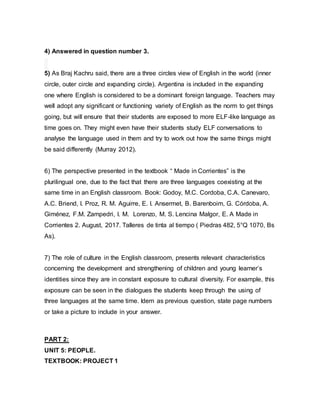
4) Answered in question number 3.
5) As Braj Kachru said, there are a three circles view of English in the world (inner
circle, outer circle and expanding circle). Argentina is included in the expanding
one where English is considered to be a dominant foreign language. Teachers may
well adopt any significant or functioning variety of English as the norm to get things
going, but will ensure that their students are exposed to more ELF-like language as
time goes on. They might even have their students study ELF conversations to
analyse the language used in them and try to work out how the same things might
be said differently (Murray 2012).
6) The perspective presented in the textbook “ Made in Corrientes” is the
plurilingual one, due to the fact that there are three languages coexisting at the
same time in an English classroom. Book: Godoy, M.C. Cordoba, C.A. Canevaro,
A.C. Briend, I. Proz, R. M. Aguirre, E. I. Ansermet, B. Barenboim, G. Córdoba, A.
Giménez, F.M. Zampedri, I. M. Lorenzo, M. S. Lencina Malgor, E. A Made in
Corrientes 2. August, 2017. Talleres de tinta al tiempo ( Piedras 482, 5°Q 1070, Bs
As).
7) The role of culture in the English classroom, presents relevant characteristics
concerning the development and strengthening of children and young learner’s
identities since they are in constant exposure to cultural diversity. For example, this
exposure can be seen in the dialogues the students keep through the using of
three languages at the same time. Idem as previous question, state page numbers
or take a picture to include in your answer.
PART 2:
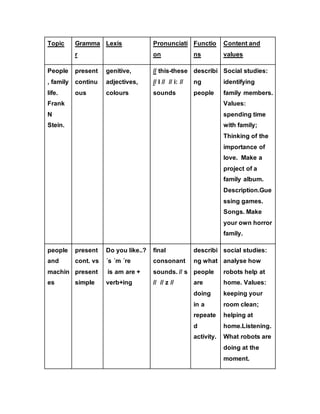
UNIT 5: PEOPLE.
TEXTBOOK: PROJECT 1
Topic Gramma
r
Lexis Pronunciati
on
Functio
ns
Content and
values
People
, family
life.
Frank
N
Stein.
present
continu
ous
genitive,
adjectives,
colours
// this-these
// I // // i: //
sounds
describi
ng
people
Social studies:
identifying
family members.
Values:
spending time
with family;
Thinking of the
importance of
love. Make a
project of a
family album.
Description.Gue
ssing games.
Songs. Make
your own horror
family.
people
and
machin
es
present
cont. vs
present
simple
Do you like..?
´s ´m ´re
is am are +
verb+ing
final
consonant
sounds. // s
// // z //
describi
ng what
people
are
doing
in a
repeate
d
activity.
social studies:
analyse how
robots help at
home. Values:
keeping your
room clean;
helping at
home.Listening.
What robots are
doing at the
moment.
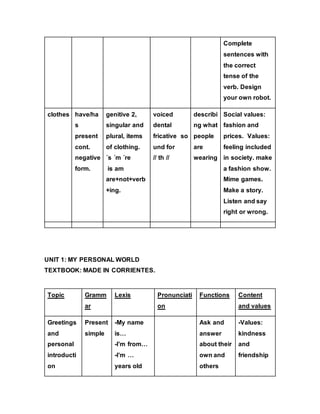
Complete
sentences with
the correct
tense of the
verb. Design
your own robot.
clothes have/ha
s
present
cont.
negative
form.
genitive 2,
singular and
plural, items
of clothing.
´s ´m ´re
is am
are+not+verb
+ing.
voiced
dental
fricative so
und for
// th //
describi
ng what
people
are
wearing
Social values:
fashion and
prices. Values:
feeling included
in society. make
a fashion show.
Mime games.
Make a story.
Listen and say
right or wrong.
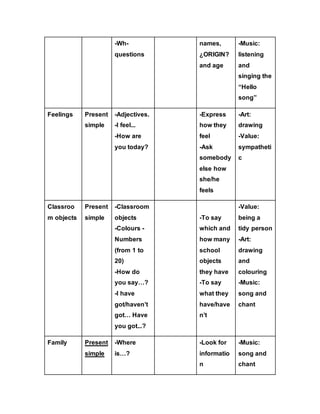
UNIT 1: MY PERSONAL WORLD
TEXTBOOK: MADE IN CORRIENTES.
Topic Gramm
ar
Lexis Pronunciati
on
Functions Content
and values
Greetings
and
personal
introducti
on
Present
simple
-My name
is…
-I’m from…
-I’m …
years old
Ask and
answer
about their
own and
others
-Values:
kindness
and
friendship
-Wh-
questions
names,
¿ORIGIN?
and age
-Music:
listening
and
singing the
“Hello
song”
Feelings Present
simple
-Adjectives.
-I feel...
-How are
you today?
-Express
how they
feel
-Ask
somebody
else how
she/he
feels
-Art:
drawing
-Value:
sympatheti
c
Classroo
m objects
Present
simple
-Classroom
objects
-Colours -
Numbers
(from 1 to
20)
-How do
you say…?
-I have
got/haven’t
got… Have
you got...?
-To say
which and
how many
school
objects
they have
-To say
what they
have/have
n’t
-Value:
being a
tidy person
-Art:
drawing
and
colouring
-Music:
song and
chant
Family Present
simple
-Where
is…?
-Look for
informatio
n
-Music:
song and
chant
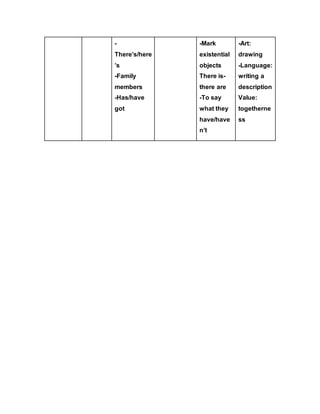
-
There’s/here
’s
-Family
members
-Has/have
got
-Mark
existential
objects
There is-
there are
-To say
what they
have/have
n’t
-Art:
drawing
-Language:
writing a
description
Value:
togetherne
ss

Practice ii practical 3

  • 1.
    PRACTICE II, DIDACTICSOF ELT. Prof. ADJUNTO REGULAR Estela N. Braun. Teacher Assistants: Prof. Vanesa Cabral and Prof. Johana Herran. STUDENTS’ NAMES: Martinez Paula, Nieto Paola, Moreno Ana, and Loza Claudia. PRACTICAL 3: Critical Analysis of Textbooks and Integration of main concepts in Module 1: Activities: 1. Davies Paul A. and Falla T. (1992). Flashlight 1. Focus on the World. Oxford [England] ; New York: Oxford University Press. (page) Public Schools. This page shows different activities as regards The United Kingdom culture in Britain. In activity number 1 students have to look at the pictures and solve a quiz. Then, number 2 refers to a listening and check their answers, and finally, in activity number 3, they have to find the cities in the quiz on the map on page 64. As regards the view of English language teaching this textbook represents, we found that the activities are not connected with the Argentinian culture; the three activities deal with the British one in which students are asked to know about a foreign culture (famous people, a British prince, a British football team…) and even to locate some cities on a map. We could see that these kind of activities have nothing to do with Argentinian students’ reality, in which they are asked to know about a culture that they do not belong to (the British one). In this regard we agree with Borrow (1990) and Valdes (1990) when they state that teaching a language involves the transmission of ideas or concepts implicitly or explicitly and we also agree with Holly (1990), who said that English language teaching could be a form of cultural and ideological colonization. As a consequence, students’ cultures remain totally submerged and the English language becomes a threat for their national identities. The variety of English taught we think is the British RP, perhaps because it is used as a model for English textbooks. It is the hegemonic variety for English teaching. It
  • 2.
    is closely connectedwith the concept of imperialism, since through the textbooks they impose (implicitly) their culture as well as their political, ideological, economic and social practices (Robert Phillipson, linguistic imperialism. Said, 1993:3-8). Monolingual perspective: just one language, English. Finally, in these activities we have analysed in which ways culture is depicted as a model to follow ( since not any culture is presented or talked about, just the British one). Moreover, the title of the section of the book is “focus on the world” but the activities selected portray just English culture, which made us think that they may see themselves as the centre of the world and their culture a model to study and imitate. 2. Hutchinson T. (). Project English 1. English across the Curriculum. Oxford [England] ; New York: Oxford University Press. Page 13. Public Schools. This page shows different consolidation activities that enclose all the activities worked so far in class. Activity 1 refers to looking at the symbols, listen and repeat. In activity number 2, the students have to write the missing symbols or numbers. In activity 3, they have to test their partners through asking two questions. In activity number 4, the students have to look at the map and answer the questions below. In activity number 5, they have to look at some pictures, answer questions, and say which colour the winner is. Finally, the activity number 6, they have to say which the answer is by looking at different numbers. Despite the fact that this kind of activities does not portray the students’ culture, we agree with Silvana Barboni when she explains that through the learning process of English, people can interact with many texts, people and different situations from other cultures, so as to enrich their views about the world and sociocultural surroundings. Moreover, English classes show the cultural diversity which helps learners to strengthen their own identity. At the same time, English language lets different students of different cultures communicate each other sharing the same linguistic code. This means that we agree with the activities if they can be adapted taking into account the level of English students have, and the age as well.
  • 3.
    3. Book: Godoy,M.C. Cordoba, C.A. Canevaro, A.C. Briend, I. Proz, R. M. Aguirre, E. I. Ansermet, B. Barenboim, G. Córdoba, A. Giménez, F.M. Zampedri, I. M. Lorenzo, M. S. Lencina Malgor, E. A Made in Corrientes 2. August, 2017. Talleres de tinta al tiempo ( Piedras 482, 5°Q 1070, Bs As) Activities 1 and 2 (pages 15-16). Topic: my routine. Activity 1 consists of a reading activity in which students are supposed to read a telephone conversation between Andy and his mum ( they are in different places). Then activity 2 is based on the conversation in act.1 since it consists of a true/false activity in which students have to correct the wrong sentences. This last activity is aimed at students’ reading comprehension ability. The view of English teaching that is portrayed in these activities is a more open one, in the sense that the English language is not considered a commodity but rather a source through which students enrich their knowledge of the world and their socio-cultural environment. Moreover, the view of the English language present here is a multicultural one, in which more than just one culture is regarded (Argentinian and British) and in which cultural differences are celebrated (“You speak Spanish! Great! Wow! what a different routine!”). Learners’ identities are regarded through making reference to places that may be familiar to them (Corrientes) or even by using their mother tongue: Spanish (“Hola mamá!”), hence helping to maintain and develop students’ unique identities at the same time they strengthen their national identity (Barboni, S. 2011. Enseñanza de Inglés e identidad nacional. Buenos Aires, Editorial El Margen). Because the activity makes use of both languages (Spanish and English) we can say that there’s a plurilingual perspective. Culture here is depicted as something that affects one’s routine but which enriches one’s understanding of the world; the activity shows respect for both cultures (English and Argentinian); there’s no culture superior to other. Finally, the variety of English that is taught is the RP, perhaps because it is believed or considered as a model or because most English textbooks teach this variety.
  • 4.
    4) Answered inquestion number 3. 5) As Braj Kachru said, there are a three circles view of English in the world (inner circle, outer circle and expanding circle). Argentina is included in the expanding one where English is considered to be a dominant foreign language. Teachers may well adopt any significant or functioning variety of English as the norm to get things going, but will ensure that their students are exposed to more ELF-like language as time goes on. They might even have their students study ELF conversations to analyse the language used in them and try to work out how the same things might be said differently (Murray 2012). 6) The perspective presented in the textbook “ Made in Corrientes” is the plurilingual one, due to the fact that there are three languages coexisting at the same time in an English classroom. Book: Godoy, M.C. Cordoba, C.A. Canevaro, A.C. Briend, I. Proz, R. M. Aguirre, E. I. Ansermet, B. Barenboim, G. Córdoba, A. Giménez, F.M. Zampedri, I. M. Lorenzo, M. S. Lencina Malgor, E. A Made in Corrientes 2. August, 2017. Talleres de tinta al tiempo ( Piedras 482, 5°Q 1070, Bs As). 7) The role of culture in the English classroom, presents relevant characteristics concerning the development and strengthening of children and young learner’s identities since they are in constant exposure to cultural diversity. For example, this exposure can be seen in the dialogues the students keep through the using of three languages at the same time. Idem as previous question, state page numbers or take a picture to include in your answer. PART 2: UNIT 5: PEOPLE. TEXTBOOK: PROJECT 1
  • 5.
    Topic Gramma r Lexis Pronunciati on Functio ns Contentand values People , family life. Frank N Stein. present continu ous genitive, adjectives, colours // this-these // I // // i: // sounds describi ng people Social studies: identifying family members. Values: spending time with family; Thinking of the importance of love. Make a project of a family album. Description.Gue ssing games. Songs. Make your own horror family. people and machin es present cont. vs present simple Do you like..? ´s ´m ´re is am are + verb+ing final consonant sounds. // s // // z // describi ng what people are doing in a repeate d activity. social studies: analyse how robots help at home. Values: keeping your room clean; helping at home.Listening. What robots are doing at the moment.
  • 6.
    Complete sentences with the correct tenseof the verb. Design your own robot. clothes have/ha s present cont. negative form. genitive 2, singular and plural, items of clothing. ´s ´m ´re is am are+not+verb +ing. voiced dental fricative so und for // th // describi ng what people are wearing Social values: fashion and prices. Values: feeling included in society. make a fashion show. Mime games. Make a story. Listen and say right or wrong. UNIT 1: MY PERSONAL WORLD TEXTBOOK: MADE IN CORRIENTES. Topic Gramm ar Lexis Pronunciati on Functions Content and values Greetings and personal introducti on Present simple -My name is… -I’m from… -I’m … years old Ask and answer about their own and others -Values: kindness and friendship
  • 7.
    -Wh- questions names, ¿ORIGIN? and age -Music: listening and singing the “Hello song” FeelingsPresent simple -Adjectives. -I feel... -How are you today? -Express how they feel -Ask somebody else how she/he feels -Art: drawing -Value: sympatheti c Classroo m objects Present simple -Classroom objects -Colours - Numbers (from 1 to 20) -How do you say…? -I have got/haven’t got… Have you got...? -To say which and how many school objects they have -To say what they have/have n’t -Value: being a tidy person -Art: drawing and colouring -Music: song and chant Family Present simple -Where is…? -Look for informatio n -Music: song and chant
  • 8.
    - There’s/here ’s -Family members -Has/have got -Mark existential objects There is- there are -Tosay what they have/have n’t -Art: drawing -Language: writing a description Value: togetherne ss