High Performance Work Organizations: Payoffs to Participation? Arne L. Kalleberg Department of Sociology, University of North Carolina at Chapel Hill November 17, 2003 Dublin, Ireland
Components of a High Performance Work  System High Performance Work Organizations seek to elicit the discretionary effort of workers by giving them: Opportunity to Participate in Decisions Autonomy, self-directed teams, offline teams, communication structures Training and Skills Formal and informal training, education, employment tenure Incentives and Motivation Pay for performance, employment security, promotion opportunities
Research Questions How widespread are High Performance Work Organizations (HPWO)? What are the correlates of HPWOs? What are the consequences of HPWOs for organizations and individuals? What are the mechanisms by which HPWOs generate these consequences? What are the barriers to adoption of HPWOs?
Studying High Performance Work Organizations National Surveys of Organizations National Organizations Survey—II (1996-7) and III (2002-3) Surveys of Employers and Their Employees National Organizations Survey-I (1991): Data on U.S. Establishments linked to General Social Survey Three Industry Study (Steel, Apparel, Medical Electronics)(1995-7)(Reported in  Manufacturing Advantage ) Surveys of Union Members Panel Study of International Association of Machinists
National Organizations Study-II Data were collected from 1,002 establishments in 1996-7 Information obtained from human resource managers via telephone interviews in most cases; some chose to fill out abbreviated mail questionnaires.  Two or more informants were used in 11% of the cases Response rate was 55 percent Establishments were sampled with probability proportional to size from Dun and Bradstreet Information Services lists Distributions of establishments by size and industry closely resemble national distributions 68% of establishments were independent organizations; the rest were part of larger firms Data were collected on several occupations: core and support (clerical)
U.S. Establishments’ Use of High Performance Work Components: NOS-II Survey Self-Directed Teams : 4 indicators (Use teams at all; Teams decide on tasks/methods; Teams meet to solve problems; Teams choose own leaders) About 60% had no items; 8% had all four Multi-skilling Practices : 3 indicators (Any cross-training; Any job rotation; Often or very often transfer to other job family) About 25% had no items; 13% had all three Offline Committees : 4 types of worker-management committees, used for: implementing new technology; quality control/improvement, other production problems, health and safety About 40% had no items; 18% had all four Performance Incentives : 3 indicators (Group incentives such as gain sharing; Pay for learning new skills; Profit-sharing or bonus program) About 60% had no items; 4% had all four
Correlates of High Performance Work Organizations in the United States: NOS-II Survey Larger  establishments use more of all four HPWO dimensions Manufacturing  establishments are more likely than those in service industries to use offline committees, performance incentives and multi-skilling practices;  Service  establishments are more likely to use self-directed teams Public sector  and  non-profit  establishments are more likely than for-profit establishments to use self-directed teams and offline committees;  For-profit  organizations are more likely to use performance incentives and multi-skilling practices Unionized  establishments are less likely to use teams and performance incentives Establishments are more likely to use self-directed teams and performance incentives in  core  occupations as opposed to support occupations
Impacts of Participation on Organizational and Worker Outcomes Organizational Performance Objective measures (vary by industry) Subjective “benchmarking” measures Worker outcomes Intrinsic rewards Wages Job satisfaction Stress Characteristics of the Employment Relationship Trust Organizational Commitment
Three Industry Study ( Manufacturing Advantage ):  Sample Visits to 40+ manufacturing facilities in the steel, apparel, and medical electronics industries in the U.S. from 1995-1997. Telephone survey of 4,109 non-supervisory workers. Response rate was 68 percent. 37 percent female 46 percent graduated from high school 14 percent are college graduates 44 years old is the average age
Impacts of Participation on Performance: Evidence from the Three Industry Study In S teel , use of HPWO increased average uptime In  Apparel , organization of work in modules (as opposed to the traditional bundle system) reduced throughput time without increasing unit labor costs. In  Medical Electronics , the opportunity to participate scale was highly correlated with value added per dollar of costs.
Impacts of High Performance Work Organizations on Workers: Evidence from the Three Industry Study Workers who have greater opportunities to participate in decisions: Report that they receive higher intrinsic rewards from their jobs (especially when they have more autonomy and communicate more with other workers) Are more satisfied with their jobs Earn more (especially in the steel and apparel industries)
Impacts of Participation on Stress at Work Role overload No effect in the total sample or medical electronics Extensive Communication increases overload in Steel Offline team increases overload in Apparel Required overtime Autonomy has a negative effect on required overtime in each industry but steel Offline team has a positive effect on required overtime in apparel and medical electronics  Co-worker conflict Autonomy, self-directed team, and communication have no effect or a negative effect on co-worker conflict Offline team has a positive effect in the total sample and in medical electronics Job stress Only communication has a positive effect on job stress in the total sample and in the steel industry All other components of the opportunity to participate scale are insignificant
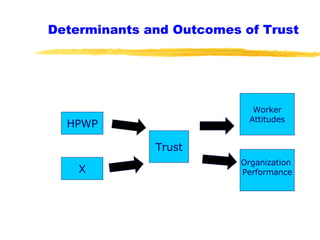
Determinants and Outcomes of Trust HPWP Trust Worker Attitudes Organization  Performance X
Measuring Trust “ To what extent do you  trust  management at this company?” (1=Not at all, 4=To a great extent) “ Most of the time, supervisors in this department treat workers  fairly .” (1=False, 4=True) “ In general, top management treats workers at this plant  fairly .” (1=False, 4=True) “ In general, how would you describe  relations  in your workplace between management and employees?” (1=Very bad, 5=Very good) TRUST SCALE: Reliability (Cronbach’s Alpha) = .79
Determinants of Trust: Results Regression Analysis  of Trust scale on High Performance Work Practices (scale and components), for total sample and each industry. Equations control  for Industry (Medical, Apparel), Occupation (Blue-Collar vs. White-Collar), Union status, Formal and Informal Training, Company seniority, Employment security, Company competitiveness, Whether company shares information, Work intensification, Education, Gender and Race High performance work practices  enhance trust (especially autonomy and communication) in each of the three industries.
Effects of Trust on Perceived Performance: Results Regression Analysis  of Perceived Performance on Trust scale and Opportunity to Participate scale, for total sample and each industry. Equations control  for Industry (Medical, Apparel), Occupation (Blue-Collar vs. White-Collar), Union status, Formal and Informal Training, Wages, Pay for performance, Company seniority, Employment security, Company competitiveness, Whether company shares information, Work intensification, Education, Gender and Race Trust  is positively related to perceived work group/team productivity in steel and medical electronics, and to perceived quality of work in steel. Trust  is also positively related (p < .10) to an objective measure of performance (average uptime) in the steel industry. Opportunity to Participate in Decisions  is positively related to the two measures of perceived performance in steel and medical electronics.
Effects of Trust on Worker Attitudes: Results Regression Analysis  of Work Attitudes on Trust scale and Opportunity to Participate scale, for total sample and each industry. Equations control  for Industry (Medical, Apparel), Occupation (Blue-Collar vs. White-Collar), Union status, Formal and Informal Training, Wages, Pay for performance, Company seniority, Employment security, Company competitiveness, Whether company shares information, Work intensity, Education, Gender and Race Organizational commitment and Job satisfaction  are positively related to trust, in each of the three industries. Opportunity to Participate in Decisions  is positively related to commitment and satisfaction in the steel industry, and to satisfaction in medical.
Survey of the International Association of Machinists Data were collected via telephone interviews with 840 members of the International Association of Machinists in 2002. Response rate was 71 percent. The IAM is the largest labor organization in North America in the air transportation and aerospace industries and represents over 750,000 people, with collective bargaining agreements with about 5,000 collective bargaining agreements covering small, medium and large employers. The IAM represents a diverse array of workers in 6-7 broad occupations and in 25 broad industry groups
HPWOs, Trust,  and Organizational Citizenship Behaviors among the Machinists Union members who have more autonomy are more likely to trust their managers; those who work in self-directed teams are less likely to trust their managers Union members who participate in decision-making and who work with others to solve problems are more likely to share their knowledge with co-workers  Union members who are more likely to trust their managers and to share knowledge with their co-workers are more likely to engage in organizational citizenship behaviors (e.g., to do work beyond that which is required, such as to work overtime, volunteer for difficult tasks) Union members who have more autonomy, who are able to participate in decision-making, and to work with others to solve problems are more likely to engage in organizational citizenship behaviors
Why Aren’t High Performance Work Organizations More Common? Costs to managers Investments in training Require sharing of power The business case for HPWO practices may not be convincing Need to establish causality (e.g., do HPWOs create trust, or does trust lead to adoption of HPWO?  Does participation generate positive work attitudes or vice versa?) Organizations often adopt pieces of these systems (e.g., participation) but not others (e.g., skill and training, incentives)

Presentation By Arne Kalleberg

  • 1.
    High Performance WorkOrganizations: Payoffs to Participation? Arne L. Kalleberg Department of Sociology, University of North Carolina at Chapel Hill November 17, 2003 Dublin, Ireland
  • 2.
    Components of aHigh Performance Work System High Performance Work Organizations seek to elicit the discretionary effort of workers by giving them: Opportunity to Participate in Decisions Autonomy, self-directed teams, offline teams, communication structures Training and Skills Formal and informal training, education, employment tenure Incentives and Motivation Pay for performance, employment security, promotion opportunities
  • 3.
    Research Questions Howwidespread are High Performance Work Organizations (HPWO)? What are the correlates of HPWOs? What are the consequences of HPWOs for organizations and individuals? What are the mechanisms by which HPWOs generate these consequences? What are the barriers to adoption of HPWOs?
  • 4.
    Studying High PerformanceWork Organizations National Surveys of Organizations National Organizations Survey—II (1996-7) and III (2002-3) Surveys of Employers and Their Employees National Organizations Survey-I (1991): Data on U.S. Establishments linked to General Social Survey Three Industry Study (Steel, Apparel, Medical Electronics)(1995-7)(Reported in Manufacturing Advantage ) Surveys of Union Members Panel Study of International Association of Machinists
  • 5.
    National Organizations Study-IIData were collected from 1,002 establishments in 1996-7 Information obtained from human resource managers via telephone interviews in most cases; some chose to fill out abbreviated mail questionnaires. Two or more informants were used in 11% of the cases Response rate was 55 percent Establishments were sampled with probability proportional to size from Dun and Bradstreet Information Services lists Distributions of establishments by size and industry closely resemble national distributions 68% of establishments were independent organizations; the rest were part of larger firms Data were collected on several occupations: core and support (clerical)
  • 6.
    U.S. Establishments’ Useof High Performance Work Components: NOS-II Survey Self-Directed Teams : 4 indicators (Use teams at all; Teams decide on tasks/methods; Teams meet to solve problems; Teams choose own leaders) About 60% had no items; 8% had all four Multi-skilling Practices : 3 indicators (Any cross-training; Any job rotation; Often or very often transfer to other job family) About 25% had no items; 13% had all three Offline Committees : 4 types of worker-management committees, used for: implementing new technology; quality control/improvement, other production problems, health and safety About 40% had no items; 18% had all four Performance Incentives : 3 indicators (Group incentives such as gain sharing; Pay for learning new skills; Profit-sharing or bonus program) About 60% had no items; 4% had all four
  • 7.
    Correlates of HighPerformance Work Organizations in the United States: NOS-II Survey Larger establishments use more of all four HPWO dimensions Manufacturing establishments are more likely than those in service industries to use offline committees, performance incentives and multi-skilling practices; Service establishments are more likely to use self-directed teams Public sector and non-profit establishments are more likely than for-profit establishments to use self-directed teams and offline committees; For-profit organizations are more likely to use performance incentives and multi-skilling practices Unionized establishments are less likely to use teams and performance incentives Establishments are more likely to use self-directed teams and performance incentives in core occupations as opposed to support occupations
  • 8.
    Impacts of Participationon Organizational and Worker Outcomes Organizational Performance Objective measures (vary by industry) Subjective “benchmarking” measures Worker outcomes Intrinsic rewards Wages Job satisfaction Stress Characteristics of the Employment Relationship Trust Organizational Commitment
  • 9.
    Three Industry Study( Manufacturing Advantage ): Sample Visits to 40+ manufacturing facilities in the steel, apparel, and medical electronics industries in the U.S. from 1995-1997. Telephone survey of 4,109 non-supervisory workers. Response rate was 68 percent. 37 percent female 46 percent graduated from high school 14 percent are college graduates 44 years old is the average age
  • 10.
    Impacts of Participationon Performance: Evidence from the Three Industry Study In S teel , use of HPWO increased average uptime In Apparel , organization of work in modules (as opposed to the traditional bundle system) reduced throughput time without increasing unit labor costs. In Medical Electronics , the opportunity to participate scale was highly correlated with value added per dollar of costs.
  • 11.
    Impacts of HighPerformance Work Organizations on Workers: Evidence from the Three Industry Study Workers who have greater opportunities to participate in decisions: Report that they receive higher intrinsic rewards from their jobs (especially when they have more autonomy and communicate more with other workers) Are more satisfied with their jobs Earn more (especially in the steel and apparel industries)
  • 12.
    Impacts of Participationon Stress at Work Role overload No effect in the total sample or medical electronics Extensive Communication increases overload in Steel Offline team increases overload in Apparel Required overtime Autonomy has a negative effect on required overtime in each industry but steel Offline team has a positive effect on required overtime in apparel and medical electronics Co-worker conflict Autonomy, self-directed team, and communication have no effect or a negative effect on co-worker conflict Offline team has a positive effect in the total sample and in medical electronics Job stress Only communication has a positive effect on job stress in the total sample and in the steel industry All other components of the opportunity to participate scale are insignificant
  • 13.
    Determinants and Outcomesof Trust HPWP Trust Worker Attitudes Organization Performance X
  • 14.
    Measuring Trust “To what extent do you trust management at this company?” (1=Not at all, 4=To a great extent) “ Most of the time, supervisors in this department treat workers fairly .” (1=False, 4=True) “ In general, top management treats workers at this plant fairly .” (1=False, 4=True) “ In general, how would you describe relations in your workplace between management and employees?” (1=Very bad, 5=Very good) TRUST SCALE: Reliability (Cronbach’s Alpha) = .79
  • 15.
    Determinants of Trust:Results Regression Analysis of Trust scale on High Performance Work Practices (scale and components), for total sample and each industry. Equations control for Industry (Medical, Apparel), Occupation (Blue-Collar vs. White-Collar), Union status, Formal and Informal Training, Company seniority, Employment security, Company competitiveness, Whether company shares information, Work intensification, Education, Gender and Race High performance work practices enhance trust (especially autonomy and communication) in each of the three industries.
  • 16.
    Effects of Truston Perceived Performance: Results Regression Analysis of Perceived Performance on Trust scale and Opportunity to Participate scale, for total sample and each industry. Equations control for Industry (Medical, Apparel), Occupation (Blue-Collar vs. White-Collar), Union status, Formal and Informal Training, Wages, Pay for performance, Company seniority, Employment security, Company competitiveness, Whether company shares information, Work intensification, Education, Gender and Race Trust is positively related to perceived work group/team productivity in steel and medical electronics, and to perceived quality of work in steel. Trust is also positively related (p < .10) to an objective measure of performance (average uptime) in the steel industry. Opportunity to Participate in Decisions is positively related to the two measures of perceived performance in steel and medical electronics.
  • 17.
    Effects of Truston Worker Attitudes: Results Regression Analysis of Work Attitudes on Trust scale and Opportunity to Participate scale, for total sample and each industry. Equations control for Industry (Medical, Apparel), Occupation (Blue-Collar vs. White-Collar), Union status, Formal and Informal Training, Wages, Pay for performance, Company seniority, Employment security, Company competitiveness, Whether company shares information, Work intensity, Education, Gender and Race Organizational commitment and Job satisfaction are positively related to trust, in each of the three industries. Opportunity to Participate in Decisions is positively related to commitment and satisfaction in the steel industry, and to satisfaction in medical.
  • 18.
    Survey of theInternational Association of Machinists Data were collected via telephone interviews with 840 members of the International Association of Machinists in 2002. Response rate was 71 percent. The IAM is the largest labor organization in North America in the air transportation and aerospace industries and represents over 750,000 people, with collective bargaining agreements with about 5,000 collective bargaining agreements covering small, medium and large employers. The IAM represents a diverse array of workers in 6-7 broad occupations and in 25 broad industry groups
  • 19.
    HPWOs, Trust, and Organizational Citizenship Behaviors among the Machinists Union members who have more autonomy are more likely to trust their managers; those who work in self-directed teams are less likely to trust their managers Union members who participate in decision-making and who work with others to solve problems are more likely to share their knowledge with co-workers Union members who are more likely to trust their managers and to share knowledge with their co-workers are more likely to engage in organizational citizenship behaviors (e.g., to do work beyond that which is required, such as to work overtime, volunteer for difficult tasks) Union members who have more autonomy, who are able to participate in decision-making, and to work with others to solve problems are more likely to engage in organizational citizenship behaviors
  • 20.
    Why Aren’t HighPerformance Work Organizations More Common? Costs to managers Investments in training Require sharing of power The business case for HPWO practices may not be convincing Need to establish causality (e.g., do HPWOs create trust, or does trust lead to adoption of HPWO? Does participation generate positive work attitudes or vice versa?) Organizations often adopt pieces of these systems (e.g., participation) but not others (e.g., skill and training, incentives)