PREPARED BY :
Mr. GANESH NAIK
MSC PEDIATRIC NURSING
DEFINITION
Asthma isa non-communicablechronic lung disease,
characterized by the following features:
 Airway inflammation
Airway obstruction mainly due to muscle spasm,
associated with mucosal edemaand stagnation of the
mucus
 Airway hyper-reactivity to aerobiologicalirritants.
INCIDENCE
The incidence of asthma has steadily increased in both
developed and developing countries from 1970 to2000.
 Asthma is the leading chronic illnessamong child
 Deaths from asthma have increased by 31% since1980.
 By 1 year – 26%
 1-5 years – 51.4%
 > 5 years – 22.3%
 77% Of Asthma Begins In Children Less Than 5Years.
ETIOLOGY
1. Host factors:
1. Genetic; Genes predisposing to airway hyperresponsiveness
2. Sex: More in males 2:1
2. Environmental factors:
1. Allergens –
 Indoor – Domestic mites, furred animals (dogs, cats, mice), cockroach
allergens, fungi, yeasts.
 Outdoor – Pollens, fungi, yeasts.
2. Infections: (predominantly viral in 40% ofchildren)
3. Seasonal: Seasonal variation of asthmaattacks is experienced
by 35% of children.
4. Diet: certain foodsalso triggerit ( peanuts, eggs, wheat).
3. Sensitization toallergen.
4. Pollutants (particularly environmental tobaccosmoke,
mosquito coil smoke, sprays, perfumesetc).
5. Respiratory (viral) infections.
6. Psychosocial factors.
7. Drugs (aspirin, beta blockers)
PATHOPHYSIOLOGY
 Asthma is a complex condition where interaction of genetics and
environment occurs involving many inflammatory cells which release a
wide range of variety ofmediators.
 These mediators act on the cells of the airway leading to smooth muscle
contraction, mucus hyper secretion, plasma leakage, edema, activation of
cholinergic reflexes and activation of sensory nerves, which lead to
amplification of the continuing inflammatoryresponse.
 The chronic inflammation leads to structural changes, including sub-
epithelial fibrosis and smooth muscle hypertrophy and hyperplasia.
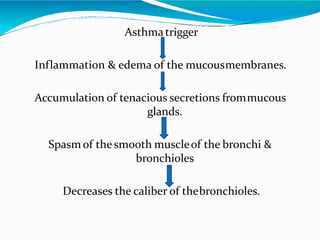
Asthma trigger
Inflammation & edema of the mucousmembranes.
Accumulation of tenacious secretions frommucous
glands.
Spasm of the smooth muscleof the bronchi &
bronchioles
Decreases the caliber of thebronchioles.
CLINICAL MANIFESTATIONS:
The classical manifestations are:dyspnea,
wheezing, & cough.
Theepisodeof asthma usually begins with thechild
feeling irritable & increasinglyrestless.
 Nocturnal Cough/Breathlessness.
Asthmatic child may complain headache, feelingtired,
& chesttightness.
 Recurrent cough:
 Post-tussivevomiting (vomiting aftera boutof coughing)
occurs in 5% of cases
 Abdominal pain rarelyoccurs due toover-working of
expiratory abdominal muscles
 Chest pain is presentrarely.
 Othercomorbid conditions likeallergic rhinitis, sinusitis,
serous otitis media, eczemaetc.
 Shortness of breath, prolonged expiration, wheezy chest,
cyanosed nail beds, & dark red color lips that mayprogress
by time to blue..
DIAGNOSTIC EVALUATION
1. History taking
 Has the child had an attack or recurrent episode of
wheezing (high-pitched whistling sounds whenbreathing
out)?
 Does thechild havea troublesomecough which is
particularlyworse at nightoron waking?
 Is thechild awakened bycoughing ordifficult breathing?
 Does thechild cough orwheezeafterphysical activity (like
games and exercise) orexcessive crying?
 Does thechild experience breathing problems during a
particularseason?
2. Physical Examination .
Dyspnea, Expiratory wheeze
Irritability toCough
Eczema, Allergic Rhinitis
3. Chestx ray
4. Pulmonary function test
5. Blood test- eosinophil count increased
MEDICAL MANAGEMENT
1. Oxygen : Give oxygen to keep oxygen saturation > 95% in all
children with asthmawhoarecyanosed
2. Pharmacotherapy:
 Quick relievers: Used for acute attacks to relieve bronchospasm as
and when needed.
 Salbutamol
 Terbutaline
 Adrenaline
 Aminophylline
 Preventers: Used for long-term tocontrol the inflammation and to
prevent furtherattacks.
 - Steroids ( Oral and Inhaled) likeprednisolone.
 - Theophylline
 Long-term symptom relievers: Used torelieve
bronchospasm for longerhours.
– Salmeterol
– Formoterol
– Bambuterol
Always use with inhaled Steroids
NURSING MANAGEMENT
The management of asthmaincludes:
Education
Environmentcontrol
Evaluation
Emotional support
Regular follow-up.
1. Education: The nurse must spend time to clear the misconceptions
about the disease, sexual bias, non-communicability of thedisease, fear
of inhalers, steroids, etc.
2. EnvironmentControl
It is the most important factor in the control of asthma. The aim should be
to avoid allergens andirritants:
 Dust mites: Avoid carpets, use plastic covers to pillows and mattresses;
and expose tosunlightoncea week; and wet mop thefloorings.
 Cockroach: Cover garbage and unused foodcontainers.
 Fungus: Attend todamp walls, havegood ventilation
 Pets: Keep them away fromsleeping area, if possibleoutside the
house
 Avoid strong odors, smoke, mosquitocoil burning, and especially tobacco
smoke.
3. Evaluating respiratorystatusand patientsgeneral
condition
Frequent assessment of respiratorypattern.
Cyanosis
Breath sounds
Vital signs
Cerebral functions
4. Providing emotional support:-
Calm and quietapproach
Trusting relationship
Reassurance
Play and recreation
Parental participations
5. Positioning:-
Comfortable sitting position and supportingwith
pillow.
Leaning forward with support may beallowed
Administering oxygen
6. Administering fluid therapy:-
During asthma they take lessfluid.
Vomiting and insensible loss dueto hyperventilation.
Maintain input outputchart
7. Maintaining adequate dietary intake:-
Clear liquids in smallamounts.
Allergic foods to beavoided.
Spicyand gas forming foods to beavoided.
Balanced diet.
7. Maintenance of hygienic measures:-
Routine hygienecare.
Dust and allergen freeenvironment.
Aseptic technique.
8. Supporting parents and family
Emotional support
Parent participation incare
Discuss treatmentplan.
Health education.
THANK YOU

asthma-200611150329 2.pdfcipd cops copsk

  • 1.
    PREPARED BY : Mr.GANESH NAIK MSC PEDIATRIC NURSING
  • 2.
    DEFINITION Asthma isa non-communicablechroniclung disease, characterized by the following features:  Airway inflammation Airway obstruction mainly due to muscle spasm, associated with mucosal edemaand stagnation of the mucus  Airway hyper-reactivity to aerobiologicalirritants.
  • 3.
    INCIDENCE The incidence ofasthma has steadily increased in both developed and developing countries from 1970 to2000.  Asthma is the leading chronic illnessamong child  Deaths from asthma have increased by 31% since1980.  By 1 year – 26%  1-5 years – 51.4%  > 5 years – 22.3%  77% Of Asthma Begins In Children Less Than 5Years.
  • 4.
    ETIOLOGY 1. Host factors: 1.Genetic; Genes predisposing to airway hyperresponsiveness 2. Sex: More in males 2:1 2. Environmental factors: 1. Allergens –  Indoor – Domestic mites, furred animals (dogs, cats, mice), cockroach allergens, fungi, yeasts.  Outdoor – Pollens, fungi, yeasts. 2. Infections: (predominantly viral in 40% ofchildren) 3. Seasonal: Seasonal variation of asthmaattacks is experienced by 35% of children. 4. Diet: certain foodsalso triggerit ( peanuts, eggs, wheat).
  • 5.
    3. Sensitization toallergen. 4.Pollutants (particularly environmental tobaccosmoke, mosquito coil smoke, sprays, perfumesetc). 5. Respiratory (viral) infections. 6. Psychosocial factors. 7. Drugs (aspirin, beta blockers)
  • 6.
    PATHOPHYSIOLOGY  Asthma isa complex condition where interaction of genetics and environment occurs involving many inflammatory cells which release a wide range of variety ofmediators.  These mediators act on the cells of the airway leading to smooth muscle contraction, mucus hyper secretion, plasma leakage, edema, activation of cholinergic reflexes and activation of sensory nerves, which lead to amplification of the continuing inflammatoryresponse.  The chronic inflammation leads to structural changes, including sub- epithelial fibrosis and smooth muscle hypertrophy and hyperplasia.
  • 7.
    Asthma trigger Inflammation &edema of the mucousmembranes. Accumulation of tenacious secretions frommucous glands. Spasm of the smooth muscleof the bronchi & bronchioles Decreases the caliber of thebronchioles.
  • 8.
    CLINICAL MANIFESTATIONS: The classicalmanifestations are:dyspnea, wheezing, & cough. Theepisodeof asthma usually begins with thechild feeling irritable & increasinglyrestless.  Nocturnal Cough/Breathlessness. Asthmatic child may complain headache, feelingtired, & chesttightness.
  • 9.
     Recurrent cough: Post-tussivevomiting (vomiting aftera boutof coughing) occurs in 5% of cases  Abdominal pain rarelyoccurs due toover-working of expiratory abdominal muscles  Chest pain is presentrarely.  Othercomorbid conditions likeallergic rhinitis, sinusitis, serous otitis media, eczemaetc.  Shortness of breath, prolonged expiration, wheezy chest, cyanosed nail beds, & dark red color lips that mayprogress by time to blue..
  • 10.
    DIAGNOSTIC EVALUATION 1. Historytaking  Has the child had an attack or recurrent episode of wheezing (high-pitched whistling sounds whenbreathing out)?  Does thechild havea troublesomecough which is particularlyworse at nightoron waking?  Is thechild awakened bycoughing ordifficult breathing?  Does thechild cough orwheezeafterphysical activity (like games and exercise) orexcessive crying?  Does thechild experience breathing problems during a particularseason?
  • 11.
    2. Physical Examination. Dyspnea, Expiratory wheeze Irritability toCough Eczema, Allergic Rhinitis 3. Chestx ray
  • 12.
    4. Pulmonary functiontest 5. Blood test- eosinophil count increased
  • 13.
    MEDICAL MANAGEMENT 1. Oxygen: Give oxygen to keep oxygen saturation > 95% in all children with asthmawhoarecyanosed 2. Pharmacotherapy:  Quick relievers: Used for acute attacks to relieve bronchospasm as and when needed.  Salbutamol  Terbutaline  Adrenaline  Aminophylline  Preventers: Used for long-term tocontrol the inflammation and to prevent furtherattacks.  - Steroids ( Oral and Inhaled) likeprednisolone.  - Theophylline
  • 14.
     Long-term symptomrelievers: Used torelieve bronchospasm for longerhours. – Salmeterol – Formoterol – Bambuterol Always use with inhaled Steroids
  • 15.
    NURSING MANAGEMENT The managementof asthmaincludes: Education Environmentcontrol Evaluation Emotional support Regular follow-up.
  • 16.
    1. Education: Thenurse must spend time to clear the misconceptions about the disease, sexual bias, non-communicability of thedisease, fear of inhalers, steroids, etc. 2. EnvironmentControl It is the most important factor in the control of asthma. The aim should be to avoid allergens andirritants:  Dust mites: Avoid carpets, use plastic covers to pillows and mattresses; and expose tosunlightoncea week; and wet mop thefloorings.  Cockroach: Cover garbage and unused foodcontainers.  Fungus: Attend todamp walls, havegood ventilation  Pets: Keep them away fromsleeping area, if possibleoutside the house  Avoid strong odors, smoke, mosquitocoil burning, and especially tobacco smoke.
  • 17.
    3. Evaluating respiratorystatusandpatientsgeneral condition Frequent assessment of respiratorypattern. Cyanosis Breath sounds Vital signs Cerebral functions
  • 18.
    4. Providing emotionalsupport:- Calm and quietapproach Trusting relationship Reassurance Play and recreation Parental participations 5. Positioning:- Comfortable sitting position and supportingwith pillow. Leaning forward with support may beallowed Administering oxygen
  • 19.
    6. Administering fluidtherapy:- During asthma they take lessfluid. Vomiting and insensible loss dueto hyperventilation. Maintain input outputchart 7. Maintaining adequate dietary intake:- Clear liquids in smallamounts. Allergic foods to beavoided. Spicyand gas forming foods to beavoided. Balanced diet.
  • 20.
    7. Maintenance ofhygienic measures:- Routine hygienecare. Dust and allergen freeenvironment. Aseptic technique. 8. Supporting parents and family Emotional support Parent participation incare Discuss treatmentplan. Health education.
  • 21.