
INTRODUCTION
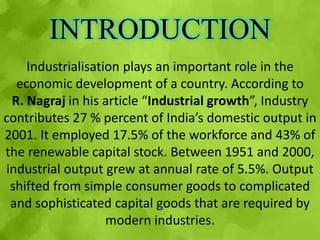
Industrialisation plays an important role in the
economic development of a country. According to
R. Nagraj in his article “Industrial growth”, Industry
contributes 27 % percent of India’s domestic output in
2001. It employed 17.5% of the workforce and 43% of
the renewable capital stock. Between 1951 and 2000,
industrial output grew at annual rate of 5.5%. Output
shifted from simple consumer goods to complicated
and sophisticated capital goods that are required by
modern industries.
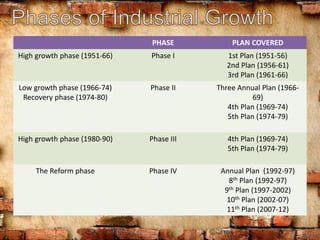
PHASE PLAN COVERED
High growth phase (1951-66) Phase I 1st Plan (1951-56)
2nd Plan (1956-61)
3rd Plan (1961-66)
Low growth phase (1966-74)
Recovery phase (1974-80)
Phase II Three Annual Plan (1966-
69)
4th Plan (1969-74)
5th Plan (1974-79)
High growth phase (1980-90) Phase III 4th Plan (1969-74)
5th Plan (1974-79)
The Reform phase Phase IV Annual Plan (1992-97)
8th Plan (1992-97)
9th Plan (1997-2002)
10th Plan (2002-07)
11th Plan (2007-12)
• Phase I
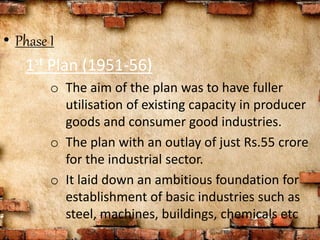
1st Plan (1951-56)
o The aim of the plan was to have fuller
utilisation of existing capacity in producer
goods and consumer good industries.
o The plan with an outlay of just Rs.55 crore
for the industrial sector.
o It laid down an ambitious foundation for
establishment of basic industries such as
steel, machines, buildings, chemicals etc
2nd Plan (1956-61)
o 2nd Plan was based on Mahalanobis Model
o The second plan envisaged expansion of
public sector in areas like iron steel, coal,
cement, non-ferrous metals, etc.
o Setting up of the three steel plants in the
public sector at Bhilai, Rourkela and
Durgapur.
o An outlay of Rs.938 crore was kept for the
industrial sector.
3rd Plan (1961-66)
o 3rd plan was to hasten the process of
industrial and technological change.
o The basic strategy was the same as it was
in the second plan.
o The targets laid down for industrial sector
were realised only to the extent of 70%
o Indian steel was probably one of the
cheapest steel in the world.
• Phase II
4th Plan (1969-74)
o The three years plan holiday from 66-69
had a depressing effect on industrial
development.
o Good weather conditions in almost all
parts of the country could with a marked
improvement in wheat output raised food
grain productions to a new peak.
o The objectives of this plan were completing
the ongoing Projects and expanding the
capacities of levels needed for future
development.
o Industrial production during the 4rth plan
was increased by 4% per annum against
the target of 8 to 10% per annum.
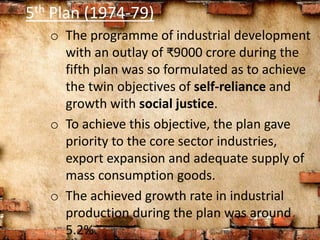
5th Plan (1974-79)
o The programme of industrial development
with an outlay of ₹9000 crore during the
fifth plan was so formulated as to achieve
the twin objectives of self-reliance and
growth with social justice.
o To achieve this objective, the plan gave
priority to the core sector industries,
export expansion and adequate supply of
mass consumption goods.
o The achieved growth rate in industrial
production during the plan was around
5.2%.
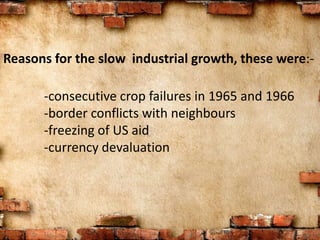
Reasons for the slow industrial growth, these were:-
-consecutive crop failures in 1965 and 1966
-border conflicts with neighbours
-freezing of US aid
-currency devaluation
• Phase Iii
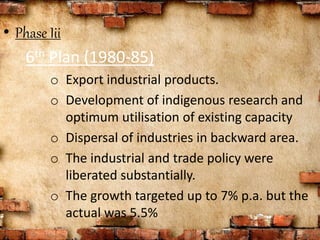
6th Plan (1980-85)
o Export industrial products.
o Development of indigenous research and
optimum utilisation of existing capacity
o Dispersal of industries in backward area.
o The industrial and trade policy were
liberated substantially.
o The growth targeted up to 7% p.a. but the
actual was 5.5%
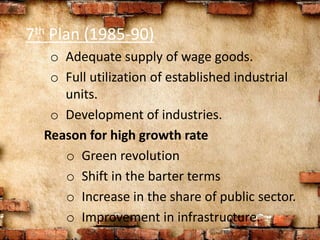
7th Plan (1985-90)
o Adequate supply of wage goods.
o Full utilization of established industrial
units.
o Development of industries.
Reason for high growth rate
o Green revolution
o Shift in the barter terms
o Increase in the share of public sector.
o Improvement in infrastructure.
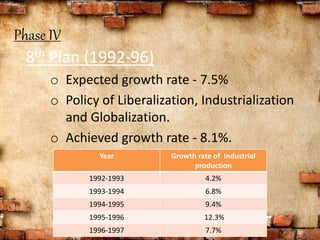
8th Plan (1992-96)
o Expected growth rate - 7.5%
o Policy of Liberalization, Industrialization
and Globalization.
o Achieved growth rate - 8.1%.
Year Growth rate of Industrial
production
1992-1993 4.2%
1993-1994 6.8%
1994-1995 9.4%
1995-1996 12.3%
1996-1997 7.7%
Phase IV
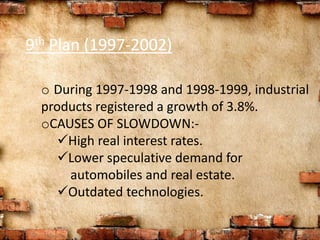
9th Plan (1997-2002)
o During 1997-1998 and 1998-1999, industrial
products registered a growth of 3.8%.
oCAUSES OF SLOWDOWN:-
High real interest rates.
Lower speculative demand for
automobiles and real estate.
Outdated technologies.
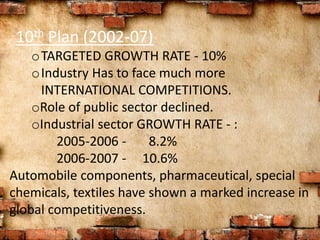
10th Plan (2002-07)
oTARGETED GROWTH RATE - 10%
oIndustry Has to face much more
INTERNATIONAL COMPETITIONS.
oRole of public sector declined.
oIndustrial sector GROWTH RATE - :
2005-2006 - 8.2%
2006-2007 - 10.6%
Automobile components, pharmaceutical, special
chemicals, textiles have shown a marked increase in
global competitiveness.
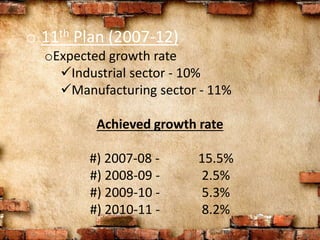
o 11th Plan (2007-12)
oExpected growth rate
Industrial sector - 10%
Manufacturing sector - 11%
Achieved growth rate
#) 2007-08 - 15.5%
#) 2008-09 - 2.5%
#) 2009-10 - 5.3%
#) 2010-11 - 8.2%
•Rapid and inclusive growth.
•Emphasis on social sector.
•Empowerment through education and skill
development.
•Growth rate of industrial sector to 10%.
OIL SHOCK
Challenges faced by INDUSTRIAL SECTOR in 12th
plan
a) Cost effective.
b) Environment and Security concerns.
c) Need to facilitate growth of labour intensive
industries.
d) Large investment plan made for
infrastructure.
o Increasing role of public sector and technology
incentive industries.
o Mahalanobis strategy was based upon the
assumption that lack of capital goods industries
was the barrier to maximising long-term growth.
o To meet the employment objectives, protection
was given to domestic and local industries.
o Indian industry is pre-deominantly domestically
financed.
o Foreign capital is often tied in with the
technology import requirements for very large
operations. Since the 1990s, the role of foreign
capital has increased.
o Commercial banks meet most of the long-term
finance requirements of the industries.
o The stock market has played a limited role, that
too mainly financing very large companies.
The industrial labour market remains dualistic. That
is, there is existence of :
1. Organised Labour
(a) They are factory workers.
(b) They are protected by numerous labour
laws.
(c) Size of organised industrial labour
is decreasing due to decline in strength
of labour.
2. Unorganised Labour
(a) They are part of growing urban unorganised
labour market.
(b)Due to excess supply of unskilled labour, there
is competitive
equilibrium of wages that is marginally higher
than that for those in rural areas, adjusted. For
cost differences.
(c) These workers have better access to education,
vocational training and healthcare.
1. Classical Economic View
In a large agrarian economy, industrial growth is
explained by size and growth of agricultural
surplus and of exports. Since the trade ratios for
large economies are small, agricultural
productivity mainly determines industrial demand.
There is inadequate, public investment in irrigation
and power, which have resulted in low agricultural
productivity.
2. Alternate Economic View
Industrial sector is small because of policy-induced
restrictions on output and investment, which have
cut off the foreign market for domestic players.
International trade and investment opportunity
have proved to be an effective transition
mechanism for increase in domestic demand and
technology.
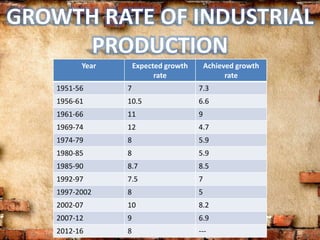
Year Expected growth
rate
Achieved growth
rate
1951-56 7 7.3
1956-61 10.5 6.6
1961-66 11 9
1969-74 12 4.7
1974-79 8 5.9
1980-85 8 5.9
1985-90 8.7 8.5
1992-97 7.5 7
1997-2002 8 5
2002-07 10 8.2
2007-12 9 6.9
2012-16 8 ---
Industrial growth (B.COM)

Industrial growth (B.COM)

  • 2.
    INTRODUCTION Industrialisation plays animportant role in the economic development of a country. According to R. Nagraj in his article “Industrial growth”, Industry contributes 27 % percent of India’s domestic output in 2001. It employed 17.5% of the workforce and 43% of the renewable capital stock. Between 1951 and 2000, industrial output grew at annual rate of 5.5%. Output shifted from simple consumer goods to complicated and sophisticated capital goods that are required by modern industries.
  • 3.
    PHASE PLAN COVERED Highgrowth phase (1951-66) Phase I 1st Plan (1951-56) 2nd Plan (1956-61) 3rd Plan (1961-66) Low growth phase (1966-74) Recovery phase (1974-80) Phase II Three Annual Plan (1966- 69) 4th Plan (1969-74) 5th Plan (1974-79) High growth phase (1980-90) Phase III 4th Plan (1969-74) 5th Plan (1974-79) The Reform phase Phase IV Annual Plan (1992-97) 8th Plan (1992-97) 9th Plan (1997-2002) 10th Plan (2002-07) 11th Plan (2007-12)
  • 4.
    • Phase I 1stPlan (1951-56) o The aim of the plan was to have fuller utilisation of existing capacity in producer goods and consumer good industries. o The plan with an outlay of just Rs.55 crore for the industrial sector. o It laid down an ambitious foundation for establishment of basic industries such as steel, machines, buildings, chemicals etc
  • 5.
    2nd Plan (1956-61) o2nd Plan was based on Mahalanobis Model o The second plan envisaged expansion of public sector in areas like iron steel, coal, cement, non-ferrous metals, etc. o Setting up of the three steel plants in the public sector at Bhilai, Rourkela and Durgapur. o An outlay of Rs.938 crore was kept for the industrial sector.
  • 6.
    3rd Plan (1961-66) o3rd plan was to hasten the process of industrial and technological change. o The basic strategy was the same as it was in the second plan. o The targets laid down for industrial sector were realised only to the extent of 70% o Indian steel was probably one of the cheapest steel in the world.
  • 7.
    • Phase II 4thPlan (1969-74) o The three years plan holiday from 66-69 had a depressing effect on industrial development. o Good weather conditions in almost all parts of the country could with a marked improvement in wheat output raised food grain productions to a new peak.
  • 8.
    o The objectivesof this plan were completing the ongoing Projects and expanding the capacities of levels needed for future development. o Industrial production during the 4rth plan was increased by 4% per annum against the target of 8 to 10% per annum.
  • 9.
    5th Plan (1974-79) oThe programme of industrial development with an outlay of ₹9000 crore during the fifth plan was so formulated as to achieve the twin objectives of self-reliance and growth with social justice. o To achieve this objective, the plan gave priority to the core sector industries, export expansion and adequate supply of mass consumption goods. o The achieved growth rate in industrial production during the plan was around 5.2%.
  • 10.
    Reasons for theslow industrial growth, these were:- -consecutive crop failures in 1965 and 1966 -border conflicts with neighbours -freezing of US aid -currency devaluation
  • 11.
    • Phase Iii 6thPlan (1980-85) o Export industrial products. o Development of indigenous research and optimum utilisation of existing capacity o Dispersal of industries in backward area. o The industrial and trade policy were liberated substantially. o The growth targeted up to 7% p.a. but the actual was 5.5%
  • 12.
    7th Plan (1985-90) oAdequate supply of wage goods. o Full utilization of established industrial units. o Development of industries. Reason for high growth rate o Green revolution o Shift in the barter terms o Increase in the share of public sector. o Improvement in infrastructure.
  • 13.
    8th Plan (1992-96) oExpected growth rate - 7.5% o Policy of Liberalization, Industrialization and Globalization. o Achieved growth rate - 8.1%. Year Growth rate of Industrial production 1992-1993 4.2% 1993-1994 6.8% 1994-1995 9.4% 1995-1996 12.3% 1996-1997 7.7% Phase IV
  • 14.
    9th Plan (1997-2002) oDuring 1997-1998 and 1998-1999, industrial products registered a growth of 3.8%. oCAUSES OF SLOWDOWN:- High real interest rates. Lower speculative demand for automobiles and real estate. Outdated technologies.
  • 15.
    10th Plan (2002-07) oTARGETEDGROWTH RATE - 10% oIndustry Has to face much more INTERNATIONAL COMPETITIONS. oRole of public sector declined. oIndustrial sector GROWTH RATE - : 2005-2006 - 8.2% 2006-2007 - 10.6% Automobile components, pharmaceutical, special chemicals, textiles have shown a marked increase in global competitiveness.
  • 16.
    o 11th Plan(2007-12) oExpected growth rate Industrial sector - 10% Manufacturing sector - 11% Achieved growth rate #) 2007-08 - 15.5% #) 2008-09 - 2.5% #) 2009-10 - 5.3% #) 2010-11 - 8.2%
  • 17.
    •Rapid and inclusivegrowth. •Emphasis on social sector. •Empowerment through education and skill development. •Growth rate of industrial sector to 10%. OIL SHOCK
  • 18.
    Challenges faced byINDUSTRIAL SECTOR in 12th plan a) Cost effective. b) Environment and Security concerns. c) Need to facilitate growth of labour intensive industries. d) Large investment plan made for infrastructure.
  • 19.
    o Increasing roleof public sector and technology incentive industries. o Mahalanobis strategy was based upon the assumption that lack of capital goods industries was the barrier to maximising long-term growth. o To meet the employment objectives, protection was given to domestic and local industries.
  • 20.
    o Indian industryis pre-deominantly domestically financed. o Foreign capital is often tied in with the technology import requirements for very large operations. Since the 1990s, the role of foreign capital has increased. o Commercial banks meet most of the long-term finance requirements of the industries. o The stock market has played a limited role, that too mainly financing very large companies.
  • 21.
    The industrial labourmarket remains dualistic. That is, there is existence of : 1. Organised Labour (a) They are factory workers. (b) They are protected by numerous labour laws. (c) Size of organised industrial labour is decreasing due to decline in strength of labour.
  • 22.
    2. Unorganised Labour (a)They are part of growing urban unorganised labour market. (b)Due to excess supply of unskilled labour, there is competitive equilibrium of wages that is marginally higher than that for those in rural areas, adjusted. For cost differences. (c) These workers have better access to education, vocational training and healthcare.
  • 23.
    1. Classical EconomicView In a large agrarian economy, industrial growth is explained by size and growth of agricultural surplus and of exports. Since the trade ratios for large economies are small, agricultural productivity mainly determines industrial demand. There is inadequate, public investment in irrigation and power, which have resulted in low agricultural productivity.
  • 24.
    2. Alternate EconomicView Industrial sector is small because of policy-induced restrictions on output and investment, which have cut off the foreign market for domestic players. International trade and investment opportunity have proved to be an effective transition mechanism for increase in domestic demand and technology.
  • 25.
    Year Expected growth rate Achievedgrowth rate 1951-56 7 7.3 1956-61 10.5 6.6 1961-66 11 9 1969-74 12 4.7 1974-79 8 5.9 1980-85 8 5.9 1985-90 8.7 8.5 1992-97 7.5 7 1997-2002 8 5 2002-07 10 8.2 2007-12 9 6.9 2012-16 8 ---