GreenTech industry
Index
USA	 6
Summary	7
Actual Country Situation	 8
Tendencies	8
Government Plans for the Sector	 13
Swot Analysis	 16
Market Evolution	 17
Demand Analysis	 18
Evolution of Demand	 20
Multilateral Organisms	 20
Technical Barriers – Non-tariff Barriers	 21
List of Renewable Energy Companies in the US Industry	 22
Identification of Market Opportunities	 23
Specific Opportunities for the RYME’s Companies	 23
Global Opportunities in the Industry	 25
Strategic Partners	 26
Implementation, Legal Requirements	 27
Contact List of American RYME’s Companies	 28
Renewable Energy and Water Technology Sectoral Events	 29
Green Certificate	 29
Appendants	31
Brazil	32
Summary	33
Actual Country Situation	 34
Tendencies	34
Governmental plans for the sector	 39
Swot Analysis	 40
Market Evolution	 40
Demand Analysis	 41
Evolution of Demand	 42
Multilateral organisms	 43
Technical barriers – Non-tarrif Barriers	 45
Competition. Local and international companies in Brazil	 45
List of Renewable Energy companies in Brazil and industry	 46
RYME’s companies positioning in the market	 46
Identification of Market Opportunities	 46
Specific Opportunities for the RYME’s Companies	 46
Global Opportunities in the industry	 48
Strategic Partners	 49
Contacts list of RYME’s companies in Brazil	 49
Renewable Energy Sectorial Events	 50
Green Certificate	 50
Appendants	51
France	52
Summary	53
Actual Country Situation 54
Tendencies	54
Governmental plans for the sector	 55
Swot Analysis	 56
Market Evolution	 57
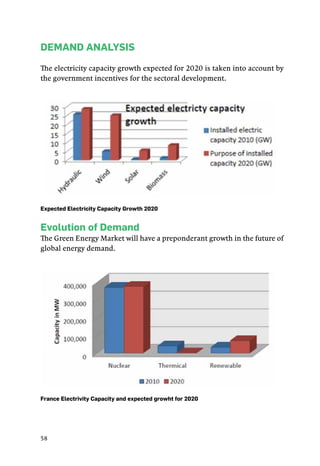
Demand Analysis	 58
Evolution of Demand	 58
Multilateral organisms	 59
Technical barriers – Non-tarrif Barriers	 60
List of Renewable Energy companies in France and industry	 60
Spanish companies positioning in the market	 61
Identification of Market Opportunities	 62
Specific Opportunities for the RYME’s Companies	 62
Global Opportunities in the industry	 62
Strategic Partners	 63
Contacts list of RYME’s companies in France	 63
Renewable Energy Sectorial Events	 64
Green Certificate	 64
Appendants	64
Spain	 66
Summary	67
Actual Country Situation	 68
Tendencies	68
Governmental plans for the sector	 71
Swot Analysis	72
Market Evolution	 73
Demand Analysis	 73
Evolution of Demand	 74
Multilateral organisms	 76
Analysis of the Spanish RYME’s companies Offer	 77
Technical barriers – Non-tariff Barriers	 79
Situation of Spanish companies in the market	 79
Identification of Market Opportunities	 80
Specific Opportunities for RYME’s Companies	 80
Global Opportunities in the industry	 80
Strategic Partners	 81
Implementation, legal requirements	 82
Renewable Energy and Water Technology Sectorial Events 	 83
Green Certificate	 83
Appendants	83
Portugal	84
Summary	85
Actual Country Situation	 86
Tendencies	86
Govermmental Plans for the Sector	 87
Swot Analysis	89
Market Evolution	 89
Demand Analysis	 90
Evolution of Demand	 91
Multilateral Organisms	 91
Technical Barriers – Non-tariff Barriers	 92
Spanish Companies Position in the Market	 93
Identification of Market Opportunities	 93
Specific Opportunities for the RYME’s Companies	 93
Global Opportunities in the Industry	 93
Strategic Partners	 94
Implementation, Legal Requirements	 95
Contact List of Portuguese RYME’s Companies	 96
Renewable Energy Sectoral Events	 98
Green Certificate	 98
Appendants	98
6
USA
7
SUMMARY
This market study explores the renewable energy sector in the U.S. and pos-
sible opportunities of doing business between RYME and North American
companies operating in the sector of advanced technologies and global
vision of the sector industry.
The US solar industry experienced a transformative 2013, with a prolif-
eration of physical assets, installed capacity and new finance mechanisms.
The wind industry raced to begin projects by end-2013 in order to receive
production tax credits. The next few years, 2014 in particular, will be marked
by new advancements in these sectors as rooftop and utility-scale solar con-
tinue to mature, utilities grapple with changing business models and inves-
tors continue the search for opportunities that offer the greatest yield.
This market research comprises the following:
– Tendencies in the Renewable Energy Sector.
– Government plans for the sector.
– Description of strengths, weaknesses, opportunities and threats in
energy sector.
– American multilateral organism supporting the market development.
– Non-technical barriers to market entry.
– Specific and global Opportunities for RYME’s companies sector.
– Strategic Partners.
– Legal Requirements.
– List of American companies as potential business partners.
– Renewable Energy sector annual Events.
– Green Certificates.
8
Actual Country Situation
Tendencies
The importance of state-set Renewable Portfolio Standards in the US is
declining as many jurisdictions have met or exceeded them. The trends are
for greater use of environmental regulation, state emission initiatives such
as the California carbon market, and the extension of tax-efficient structures
for clean energy investment.
1
US States with Renewable Portfolio Standards, and those without
Source: DSIRE: Database of Energy Efficiency, Renewable Energy in U.S.A.
Low electricity demand growth and continued increases in electricity
generation capacity, fueled by natural gas and renewable energy, which
when combined with environmental regulations put pressure on coal use
in the electric power sector. In some cases, coal’s share of total electricity
generation falls below the natural gas share through the end of the projec-
tion period.
1
Global trends in renewable energy investment 2013 Bloomberg
9
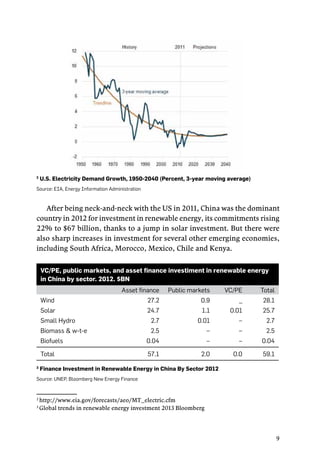
2
U.S. Electricity Demand Growth, 1950-2040 (Percent, 3-year moving average)
Source: EIA, Energy Information Administration
After being neck-and-neck with the US in 2011, China was the dominant
country in 2012 for investment in renewable energy, its commitments rising
22% to $67 billion, thanks to a jump in solar investment. But there were
also sharp increases in investment for several other emerging economies,
including South Africa, Morocco, Mexico, Chile and Kenya.
vc/pe, public markets, and asset finance investiment in renewable energy
in China by sector. 2012. $bn
Asset finance Public markets VC/PE Total
Wind 27.2 0.9 _ 28.1
Solar 24.7 1.1 0.01 25.7
Small Hydro 2.7 0.01 – 2.7
Biomass & w-t-e 2.5 – – 2.5
Biofuels 0.04 – – 0.04
Total 57.1 2.0 0.0 59.1
3
Finance Investment in Renewable Energy in China By Sector 2012
Source: UNEP, Bloomberg New Energy Finance
2
http://www.eia.gov/forecasts/aeo/MT_electric.cfm
3
Global trends in renewable energy investment 2013 Bloomberg
10
4
Finance Investment in Renewable Energy in Africa by Country 2012
Source: UNEP, Bloomberg New Energy Finance
Activity trends were downbeat in many, but not all, developed econo-
mies. Policy uncertainty took a heavy toll of investment in the US – down
34% at $36 billion – and also in former renewable energy early-movers such
as Italy and Spain.
USA leads particularly in private sector metrics, with US start-ups con-
sistently attracting capital from both local and international investors. On
the other hand, a lack of energy or environmental consistency with regard
to federal policy has led to a degree of uncertainty on the future of the pub-
lic sector’s role in promoting a renewable and low-carbon future. Nonethe-
less, the Obama administration has put forth a climate plan that proposed
a cut in carbon emissions from power plants of 30 percent by 2030.
Investmentinspecialistrenewableenergycompaniesbypublicmarketinves-
tors dropped 61% to $4 billion, while that by venture capital and private equity
investors fell 30% to $4 billion, the lowest since 2005. Corporate and govern-
ment research and development spending, however, edged up 1% to 10 billion.
The main reason for the 12% decline in 2012 was investor concern over
policies to support renewable energy in its longest-established markets,
Europe and the US. In part this was a case of uncertainty – developers,
equity providers and lenders were unsure about whether commitments to
4
Global trends in renewable energy investment 2013 Bloomberg
11
subsidize renewable energy deployment would continue beyond scheduled
expiry dates in countries like the US, the UK and Germany.
In part it was a case of actual action – Spain’s late- 2010 retroactive cuts
in tariff support for existing PV projects were followed in 2012 by further
negative developments in the same country (a moratorium over feed-in tar-
iff support for all new projects, and a tax on the revenues of clean power
plants), and in Italy (a tight cap on capacity eligible for feed-in tariffs).
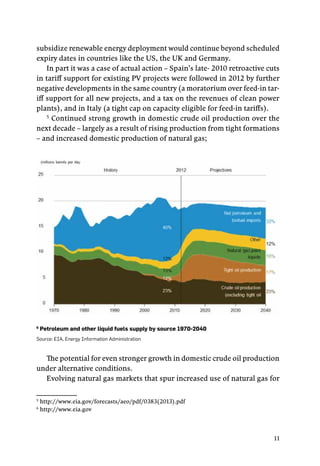
5
Continued strong growth in domestic crude oil production over the
next decade – largely as a result of rising production from tight formations
– and increased domestic production of natural gas;
6
Petroleum and other liquid fuels supply by source 1970-2040
Source: EIA, Energy Information Administration
The potential for even stronger growth in domestic crude oil production
under alternative conditions.
Evolving natural gas markets that spur increased use of natural gas for
5
http://www.eia.gov/forecasts/aeo/pdf/0383(2013).pdf
6
http://www.eia.gov
12
electric power generation and transportation and an expanding natural gas
export market.
A decline in motor gasoline consumption over the projection period,
reflecting the effects of more stringent corporate average fuel economy
(CAFE) standard, as well as growth in diesel fuel consumption and increased
use of natural gas to power heavy-duty vehicles.
There was also negative impact on investment levels stemming from
other factors, notably pressure on utility balance sheets in some European
countries, the low natural gas price in the US (which reduced the value
of power purchasing agreements available to generators, including wind
developers), and the poor performance, once again, of clean energy share
prices. The later factor hit public market investment in specialist renew-
able energy.
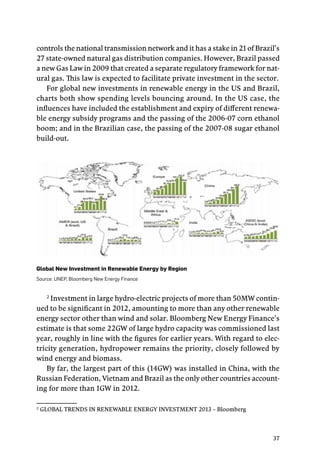
Global New Investment in Renewable Energy by Region 2004-2012
Source: UNEP, Bloomberg New Energy Finance
7
Investment in large hydro-electric projects of more than 50MW contin-
ued to be significant in 2012, amounting to more than any other renewable
energy sector other than wind and solar. Bloomberg New Energy Finance’s
estimate is that some 22GW of large hydro capacity was commissioned last
year, roughly in line with the figures for earlier years.
7
Global trends in renewable energy investment 2013 – Bloomberg
13
Large Hydro Capacity Additions by Country 2012
Source: Bloomberg New Energy Finance
Governmental Plans for the Sector
States have adopted a number of policies to support greater investment in
and adoption of renewable energy technologies.
Renewable Portfolio Standards (RPS) requires electric utilities and
other retail electric providers to deliver a specified percentage or amount
of customer electricity with eligible renewable resources. EPA has held mul-
tiple State Technical Forum Webcasts on RPS. Policy details are available
from EPA’s Clean Energy-Environment Guide to Action Chapter, Renewa-
ble Portfolio Standards (PDF) (11 pp, 780K)
Public Benefits Funds for Renewable Energy are a pool of resources
used by states to invest in clean energy supply projects. Funds are typically
created by levying a small charge on customers’ electricity rates (i.e., a sys-
tem benefits charge). Policy details are available from EPA’s Clean Ener-
gy-Environment Guide to Action Chapter, Public Benefits Funds for State
Clean Energy Supply Programs (PDF) (11 pp, 780K).
Output-Based Environmental Regulations establish emissions limits
per unit of productive energy output of a process (i.e., electricity, thermal
energy, or shaft power), with the goal of encouraging fuel conversion effi-
ciency and renewable energy as air pollution control measures. EPA held
a State Technical Forum Webcast on output-based environmental regula-
tions. Policy details are available from EPA’s Clean Energy-Environment
Guide to Action Chapter, Output-Based Environmental Regulations to
Support Clean Energy Supply (PDF) (11 pp, 780K).
China 14%
Russia
Federation
3.3%
Vietnam
1.6% Brasil
1.3%
Iran
1.3%
India
0.5%
Other
0.8%
Peru 0.2%
Canadá 0.2%
Sri Lanka 0.2%
Namibia 0.1%
Guatemala 0.1%
Pasquistan 0.1%
Chile 0.1%
14
Interconnection Standards are processes and technical requirements
that delineate how electric utilities in a state will treat renewable energy
sources that need to connect to the electric grid. The establishment of stand-
ard procedures can reduce uncertainty and delays that renewable energy sys-
tems can encounter when obtaining electric grid connection in states that
have not established interconnection standards. Policy details are availa-
ble from EPA’s Clean Energy-Environment Guide to Action Chapter, Inter-
connection Standards (PDF) (16 pp, 1.4M). The Interstate Renewable
Energy Council (IREC) offers Model Interconnection Procedures (PDF)
(2009) (48 pp, 2.75M) for utility regulators.
Net Metering enables residential or commercial customers who generate
their own renewable electricity (e.g., solar photovoltaic panels) to receive com-
pensation for the electricity they generate. Net metering rules require electric
utilities in a state to ensure that customers’ electric meters accurately track how
much electricity is used on site or returned to the electric grid. When electricity
generated on site is not used, it is returned to the grid; when on site generation
isnotsufficienttomeetthecustomer’sneeds,thecustomeruseselectricityfrom
the grid. In effect, excess electricity is returned to the customer at a later time
when they otherwise would have paid for it. The Interstate Renewable Energy
Council (IREC) offers Model Net Metering Rules (2009) (PDF) (7 pp, 1.55M) 
Feed–In Tariffs encourage the development of renewable energy by obli-
gating electric utilities to pay pre-established above-market rates for renew-
able power fed onto the grid. These tariffs, which may vary depending on
the type of resource used, provide renewable generators with a set stream of
income from their projects. Although common in Europe, in 2009, Califor-
nia, Hawaii, Vermont,and Washington werethefirststatesintheUStoestab-
lish feed–in tariffs. Policy details are available from the National Renewable
Energy Laboratory State Clean Energy Policies Analysis (SCEPA) Project: An
Analysis of Renewable Energy Feed–in Tariffs in the United States (PDF).
Property Assessed Clean Energy (PACE) is a financing option that
attaches the obligation to repay the cost of renewable energy installations
or energy efficiency retrofits to a residential property rather than an indi-
vidual borrower. This mechanism encourages property owners to invest in
clean energy improvements even if the payback period is longer than the
owner intends to keep the property. Similarly, in Environmental Finance
Districts, a local government issues bonds to fund projects with a pub-
lic purpose, and property owners that benefit from the improvement then
15
repay the bond through assessments on their property taxes. PACE NOW
maintains a list of states and local governments that allow PACE programs.
Financial Incentives – such as grants, loans, rebates, and tax credits –
are provided in some states to encourage renewable energy development.
The Database of State Incentives for Renewables and Efficiency  tracks the
availability of incentives offered by state.
8
The President established a national goal in 2011 to reduce oil imports
by one third by 2020 and elevated the goal in 2012 to reduce them by one
half by 2020. 
Petroleum Overview 2020
Source: Eia; Monthly Energy Review
There are three basic elements to achieving this goal:
­– Increasing domestic production of oil. Government funded research
supplemented private industry’s work to develop the technology that sparked
the boom in oil and gas production. Crude oil production has grown each
year (see chart above). In fact, over the past four years, domestic oil supply
growth has accounted for over one-third of global oil production growth.
– Developing substitutes for oil. This includes almost doubling the pro-
duction of biofuels since 2007 – to a near all-time high – and the substitu-
8
http://www.whitehouse.gov/blog/2013/08/29/reducing-america-s-dependence-foreign-oil
-strategy-increase-economic-growth-and-redu
16
tion as a transportation fuel of oil with natural gas, production of which
increased by 25% to an all-time high in 2012.
– Increase energy efficiency to reduce the use of oil overall. With a com-
bination of the stronger fuel efficiency standards and investments in cutting
edge technologies, the US currently have the most fuel efficient light-duty
vehicle fleet ever, and are working to increase the efficiency of the medium-
and heavy-duty fleet as well.
Swot Analysis
Strengths Weaknesses
S1 – The US is the largest global natural
gas producer (overtaking Russia).
S2 – Long experience and expertise of
engineers and engineering companies
concerning renewable technologies, so-
lar PV and biomass.
S3 – Good research infrastructures, an
energy research center, very active asso-
ciations of renewable energy companies.
S4 – Leading research to the practical
implementation of innovative technolo-
gies and practices.
W1 – Lack of global policy for renewable
energy.
W2 – Regulatory Authorities slowing new
technologies.
W3 – High number of administrative pro-
cedures to create a company.
W4 – Difficult administrative procedures
to register a RREE project
Opportunities Threats
O1 – Deteriorating infrastructure in the
US graded D (Poor).
O2 – Governmental goal of reducing oil
imports by one third by 2020.
O3 – Development of substitutes for oil,
including doubling the production of bio-
fuels.
O4 – The price of petroleum will continue
increasing in short, medium term, result-
ing in higher prices for the energy coming
from petroleum derivative products.
O5 – Big societal concern about the need
of becoming more energy efficient and of
reducing CO2 emissions.
T1 – Price competitiveness of renewable
energy installations.
T2 – Uncertainty in onshore production
forecasts for the United States comes
primarily from upside supply risks.
17
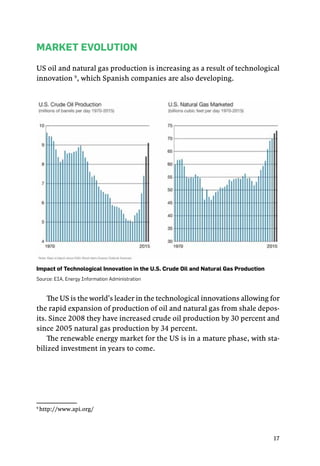
Market Evolution
US oil and natural gas production is increasing as a result of technological
innovation 9
, which Spanish companies are also developing.
Impact of Technological Innovation in the U.S. Crude Oil and Natural Gas Production
Source: EIA, Energy Information Administration
The US is the world’s leader in the technological innovations allowing for
the rapid expansion of production of oil and natural gas from shale depos-
its. Since 2008 they have increased crude oil production by 30 percent and
since 2005 natural gas production by 34 percent.
The renewable energy market for the US is in a mature phase, with sta-
bilized investment in years to come.
9
http://www.api.org/
18
Use of Energy from Renewable Sources
Source: EIA, Energy Information Administration
Demand Analysis
Key issues for the overall demand for renewable energy in USA
Renewable energy has a continued representation in the State’s Renewa-
ble Portfolio Standards (RPS), extension of production tax credits (PTC),
investment tax credits (ITC), and loan guarantees.
Environmental rules:
– SO2 and NOx: Clean Air Interstate Rule (CAIR) modeled as cap and trade.
– Mercury: modeled as a 90 percent Maximum Achievable Control Tech-
nology (MACT) for several coal demand regions based on State-level ini-
tiatives.
– CO2: Regional Greenhouse Gas Initiative (RGGI).
Expectation of greenhouse gas regulations:
– 3% higher cost of capital for greenhouse gas intensive projects.
– Financial community adoption of “Carbon Principles”.
2 gigawatts of coal w/ carbon capture and sequestration (CCS) assumed
by 2017 (investment tax credits in the Energy Improvement and Extension
Act of 2008 and funding from the American Recovery and Revitalization
Act).
19
Energy Consumption by Fuel 1980-2035 (quadrillion Bru)
Source: EIA- Energy Information Agency
Global investment on Renewable Energy by Sector 10
10
http://fs-unep-centre.org/sites/default/files/attachments/gtr2013keyfindings.pdf
20
Evolution of Demand
The Green Energy Market will register a significant growth in the future of
global energy demand. 11
Future Global Energy Demand
Source: EIA, International Energy Agency
Multilateral Organisms
EPA (United States Environmental Protection Agency) Programs Sup-
porting Renewable Energy
Organizations can meet EPA Partnership requirements using any combina-
tion of three different product options: (1) Renewable Energy Certificates,
(2) On-site generation, and (3) Utility green power products.
12
Green Power Partnership (GPP)
GPP is a voluntary program that supports the organizational procurement
of green power by offering expert advice, technical support, tools and
11
http://www.api.org/
12
http://www.epa.gov/greenpower/
21
resources. The Partnership works with hundreds of companies, colleges
and universities, organizations, and local, state, and federal government
agencies. GPP provides resources to states on how they can lead by exam-
ple by purchasing green power for government operations.
13
Landfill Methane Outreach Program (LMOP)
LMOP is a voluntary assistance and partnership program that promotes the
use of landfill gas as a renewable, green energy source. By preventing emis-
sions of methane through the development of landfill gas energy projects,
LMOP helps businesses, states, energy providers, and communities protect
the environment and build a sustainable future.
14
AgSTAR
AgSTAR is a voluntary program jointly sponsored by EPA, the US Depart-
ment of Agriculture, and the US Department of Energy. The program encour-
ages the use of methane recovery (biogas) technologies at confined animal
feeding operations that manage manure as liquids or slurries.
15
RE-Powering America’s Lands
EPA is encouraging renewable energy development on current and formerly
contaminated land and mining sites. This initiative identifies the renewa-
ble energy potential of these sites and provides other useful resources for
communities, developers, industry, state and local governments or anyone
interested in reusing these sites for renewable energy development.
Technical Barriers – Non-tariff Barriers
Price competitiveness is the most obvious barrier to renewable energy instal-
lations. In many cases, barriers to expanding renewable energy are regula-
tory and therefore within state control. Some examples include:
Utility Rate Structures. Unfavorable utility rate structures have per-
ennially been a barrier to increased deployment of renewable energy
technologies. Unless carefully monitored to encourage the development
13
http://www.epa.gov/lmop/
14
http://www.epa.gov/agstar/
15
http://www.epa.gov/oswercpa/
22
of distributed generation, rate structures can increase the cost of renewa-
bles (e.g., through stand-by rates, lack of net metering) or completely dis-
allow connection to the electrical grid.
Lack of Interconnection Standards. The absence of standard interconnec-
tion rules, or uniform procedures and technical requirements for connecting
renewable energy systems to the electric utility’s grid, can make it difficult, if
not impossible, for renewable systems to connect to the electric utility’s grid.
Barriers in Environmental Permitting. Large-scale renewable energy
technologies are subject to all the necessary environmental permits of major
industrial facilities. Renewable energy generation using new technologies
can face permitting hurdles until permitting officials are familiar with the
environmental effects of the generation processes.
Lack of Transmission. Many renewable resources are located in remote
areas that lack ready or cost-effective access to transmission. States that have
not established clear utility regulations that enable investments in trans-
mission to be reimbursable (i.e., cost recovery), nor coordinated planning
and permitting processes, slow the development of utility-scale renewable
projects in their territory.
List of Renewable Energy Companies
in the US Industry
Sparc Technological
Silver Spring Technological
ThinkLite Technological
Plug smart Technological
Enphase energy Technological
GridPoint Technological
A2Z Group Solar Thermal
Abengoa, SA Solar Thermal
Alternative Energy, LTD Renewables
Alterra Power Geothermal, Hydro, Wind, Solar
23
Anwell Technologies Photovoltaics
Ascent Solar Technologies, INC Photovoltaics
Canadian Solar, INC Photovoltaics
Centrotherm Photovoltaics, AG Photovoltaics
China Sunergy Co, LTD Photovoltaics
Comtec Solar Systems Group Limited Photovoltaics
Conergy, AG Photovoltaics
Motech Industries Inc. Photovoltaics
Ocean Power Technologies, INC Wave
SMA Solar Technology, AG Photovoltaics
SolarWorld, AG Photovoltaics
WaterFurnace Renewable Energy, Inc. Geothermal
Identification of Market Opportunities
Specific Opportunities for the RYME’s Companies
USA came in third place in the Global Cleantech Innovation 2014 index,
with its clean technology start-ups clearly attracting the most venture capital
on an absolute basis, due to the funds set up to invest by US government.
16
New and more cost effective assessments (e.g., leak detection, predic-
tion models of condition systems, asset management models) and rehabili-
tation techniques are needed. Increased emphasis should be placed on green
infrastructure for storm water management and decentralized approaches
(e.g., downsizing to small piping systems) that can reduce pumping and
treatments costs.
The United States is facing serious challenges (e.g., deteriorating infra-
structure, emerging contaminants) therefore technology innovation needs
to be accelerated. In March 2013, the EPA presented the Blueprint for Inte-
16
http://www.rvo.nl/sites/default/files/2013/10/The%20water%20technology%20sec-
tor%20in%20the%20US.pdf
24
grating Technology Innovation. The blueprint calls for national support
of emerging technologies in water and wastewater treatment, testing, and
reuse. Also, collaboration between academic, industry and government
researchers need to be stimulated and made easier. In this blueprint several
key market opportunities to employ innovative technology are identified.
Industrial water reuse technologies e.g., sewer mining, decentral-
ized onsite treatment systems, MBR systems. Water reuse and the use of
reclaimed water are already widely applied in the US and are becoming
more popular. There is a significant need for technologies and approaches
that foster substantially greater water reuse or sewer mining, that are also
capable of reducing pollution and energy consumption.
Brine treatment techniques e.g., brine disposal, pretreatment optimi-
zation, energy conservation and overall productivity of membrane systems;
are addressed in the permitting processes and the long period of time it
takes to implement a new technology.
Storm water management tools and green infrastructure techniques
e.g., recharge basins, rapid infiltration beds, bioretention systems, storm
water control mechanism, reducing total maximum daily loads. An impor-
tant issue in the American water technology sector is storm water manage-
ment. Stricter federal and state regulations for wastewater and storm water
systems are the main drivers for improving such systems. Threats for surface
and groundwater quality are the combined sewer overflows and the sani-
tary sewer overflows, due to periods of heavy rainfall and aging wastewa-
ter management systems. There is a need for technologies that can address
nonpoint sources of pollution, storm water control mechanisms and green
infrastructure.
Nutrient recovery and removal techniques e.g., wastewater mining
technologies, deammonification. Nutrient recovery (e.g., wastewater min-
ing) is expected to become an increasingly important topic in the United
States in the coming years. Driven by the need to reduce nutrient pollution
because of stricter regulations in surface water and drinking water supplies
(caused by e.g., nitrogen, phosphorous), emerging technologies that can
both treat and recover nutrients from water and wastewater will be needed
in the United States. However, any new technology must be able to make the
case that recovery and reuse of the materials or water is economically feasible.
Advanced disinfection techniques e.g., ultraviolet radiation systems,
advanced oxidation, ozonation, electro chlorination, biological filtration. In
25
the US many utilities are considering changes to their treatment processes
to avoid noncompliance issues with new disinfection byproduct (DBP) rules.
A transition is visible in disinfection methods in the American drinking
water sector; from only chlorine disinfection to upcoming ultraviolet radi-
ation systems in combination with chloramines. Also advanced oxidation,
ozonation, electro-chlorination, biological filtration and other disinfection
methods are becoming more popular in the US. Until now disinfection has
always been combined with chloramines or chlorine.
Smart water grid techniques e.g., smart water meters, electromagnetic
and acoustic sensors, real-time communication channels, basic data man-
agement software, real-time data analytics and modeling software, automa-
tion and control tools.
Global Opportunities in the Industry
Energy conservation and recovery techniques e.g., effective pumps, mem-
branes, downsizing pipelines, geothermal energy, geo-exchange, sewer
heat-recovery systems, thermal hydrolysis, biogas production; In the US
water and wastewater utilities require significant amounts of electricity.
Moreover, the electricity industry is the second largest user of water. Water
reuse, climate change and the water & energy nexus are closely related.
Turning water and wastewater facilities into net zero energy consumers or
net producers of energy is the latest trend in the American water technology
market. This change can be achieved by installing renewable energy tech-
nologies (e.g., geothermal energy, geo-exchange, and sewer heat-recovery
systems) or by anaerobic digestion of sludge and other organic materials.
Techniques for monitoring and removal of emerging contaminants
e.g., contaminants of emerging concern, hexavalent chromium, pharmaceu-
ticals, nanomaterial. Monitoring and removal of emerging contaminants,
which are often unregulated, will be a trending topic in the US water tech-
nology market in the coming years. The EPA is also implementing new or
stricter drinking water limits on numerous contaminants, including arsenic,
radioactive contaminants, microbial and disinfection byproducts. CCL 3 is a
list of contaminants that are currently not subject to any proposed or prom-
ulgated national primary drinking water regulations, but that are known or
anticipated to occur in public water systems, and which may require regu-
lation under the Safe Drinking Water Act (SDWA).
26
Strategic Partners
Green Mountain Energy
Texas
New Commercial Service: Call 855-GMEC-4TX (855-463-2489)
Customer Service: Mon. – Fri. 7:00am – 7pm (Central Time)
Call 1-866-280-3603; E-mail: gmecbizcare@greenmountain.com
New York
New Commercial Service: Call 855-GMEC-4NY (855-463-2469)
Customer Service: Mon. – Fri. 8:30am – 7:00 pm (Eastern Time)
Call 800-455-8545; E-mail: nybizcs@greenmountain.com
New Jersey
New Commercial Service: Call 855-GMEC-4NY (855-463-2465)
Customer Service: Mon. – Fri. 8:00am – 7:00 pm (Eastern Time)
Call 888-232-3658; E-mail: customercare@greenmountain.com
Pennsylvania
New Commercial Service: Call 855-GMEC-4PA (855-463-2472
Customer Service: Mon. – Fri. 8:00am – 7:00 pm (Eastern Time)
Call 888-232-3658; E-mail: customercare@greenmountain.com
Renewable Choice Energy
Renewable Choice is a renewable energy provider, carbon offset provider,
and carbon accounting solutions provider that offers products and services
to measure emissions, manage reduction opportunities and report to volun-
tary and mandatory programs. The products and services include:
­– Renewable Energy Credits
­– Carbon offsets
­– Green power for LEED® Projects
­– Professional Services from their subsidiary, Mosaic Labs
­– Wind Power for Homes
4775 Walnut Street, Suite 230, Boulder, CO 80301
Toll Free 877.810.8670; Local 303.468.0405
27
3Degrees
3Degrees partners with organizations that seek to utilize environmental
markets to build value for their customers, employees, investors and other
stakeholders. 3Degrees helps these organizations buy, sell and market envi-
ronmental commodities such as Renewable Energy Certificates (RECs) and
verified carbon offsets.
San Francisco, California, 2 Embarcadero Center
Suite 2950, San Francisco, CA 94111
Toll-Free Phone: 866.476.9378; Fax: 415.680.1561
ClearView energy
Technology for environmental friendly renewable energy.
Pacific Power
Building new generation and an extensive transmission and distribution
system to serve electric customers in Oregon and Washington, and later in
Idaho, Wyoming, Montana and Northern California.
Implementation, Legal Requirements
A large range of policies are considered to be under the RPS umbrella. In
general, an RPS sets a minimum requirement for the share of electricity to
be supplied from designated renewable energy resources by a certain date/
year. Often, the selected eligible resources are tailored to best fit the State’s
particular resource base or local preferences. Some States also set targets for
specific types of renewable energy sources or technologies to encourage their
development and use. Many State RPS programs have “escape clauses” if the
extra cost of renewable generation exceeds a specified threshold. (Detailed
descriptions of State RPS programs are available from the Database of State
Incentives for Renewables & Efficiency.)
17
Having adequate transmission capacity to accommodate generation from
renewable resources is important for the success of an RPS. States with suc-
cessful RPSs either have adequate transmission available or plan to build it.
17
http://www.nrel.gov/tech_deployment/state_local_activities/basics_portfolio_stan-
dards.html
28
Ratepayer impacts of an RPS can also derail its adoption politically. A
counterbalance to the impacts on ratepayers is that RPS mandates usually
drive local economic growth. Under a well-designed RPS, costs are shared
fairly by all ratepayers. Another way to address ratepayer impacts is to
include provisions in the RPS to prevent costs from escalating excessively.
Contact List of American RYME’s Companies
Joulenza Chicago, IL – Technical capabilities to work with clients in any
heating application by offering a full product line of industrial electric heat-
ers supported by advanced mathematical simulation and testing center.
134 N. LaSalle Street, Suite 1140. Chicago, IL. 60602 USA  
Tel. +1 (312) 578-8262; Fax +1 (312) 578-8264
Green Tech Buyer Chicago, IL – Helps property owners and managers make
intelligent green technology and energy savings purchases.
Built In Chicago, 440 N. Wells, Suite 720, Chicago, IL 60654
Verde Sustainable Solutions Chicago, IL – Platform that helps consumers
and business alike understand the cost that lighting and appliances will
require to operate, and help them make better decisions for their pocketbook
and the planet. Verde has recently pivoted to Subscription LED Lighting
which is free LED lighting installations for restaurants and small businesses
in Chicago, with a small subscription that is lower than the energy savings.
224 Merchandise Mart Plaza, 1871 , Chicago, IL 60654 
Phone: 773 413 9587; Email: contact@verdel3c.com
Effortless Energy – Makes home energy efficiency the no-brainer like insu-
lation and air sealing at no cost to homeowners, then recoups its investment
by splitting the energy bill savings with customers. Residents get the satis-
faction of lower monthly utility bills, increased home value, and improved
health and home comfort, in addition to doing something good for the
environment.
Email: info@goeffortless.com
29
InBalance Buildings – The InBalance Buildings team think of themselves
like surgeons and buildings like a human body. They go into sick factories
with their sophisticated engineering tools to custom repair underlying inef-
ficiencies – problems they are often unaware of. To keep the “patients” in
perfect health they are developing a subscription based software service
which will predictively mitigate and even eliminate costly and unforeseen
electrical problems going forward.
430 N. Michigan Avenue, Second Floor, Chicago, Illinois, 60611
(866) 930-6111; info@inbalancebuildings.com
GreenPSF – Has a scalable platform to accelerate adoption of energy effi-
ciency by leveraging data, channel partnerships, and software. They collect
data on thousands of buildings, products, services providers, and utility
incentives programs. They generate revenue by facilitating transactions
between buildings and service providers (eProcurement), selling subscrip-
tions for their data and analysis tools (SaaS), and advertising from prod-
uct manufacturers.
330 N Wabash Ave, Suite 2300, Chicago, IL 60611
(888) 950-0474
Renewable Energy and Water Technology
Sectoral Events
Annual Renewable Energy Markets Conference
WEFTEC – The Annual Water & Environment Federation Technical Exhi-
bition and Conference;
American Water Works Association – (AWWA) Conferences.
Green Certificate
Options for using renewable energy include:
Purchasing green power through renewable energy certificates (RECs) –
also known as green tags, green energy certificates, or tradable renewable
30
certificates – that represent the technology and environmental attributes
of electricity generated from renewable resources.
http://www.green-e.org/
There are three categories of contracts available to providers of RECs.
A flat fee is charged for each REC certification. The contract categories are:
REC Single Mix Product – This category covers certification of one
unique mix of eligible renewable resource types. An example of one mix is
50% wind RECs and 50% geothermal RECs. A single mix REC product may
be sold to residential, commercial, and/or wholesale customers.
REC Multiple Mix Product – This category covers certification of up to
100 unique REC mixes of eligible resources offered to commercial and/or
wholesale customers only. 50% wind RECs and 50% geothermal RECs is
considered a distinct mix from 100% wind RECs, for example.
REC Broker Certification – This category covers certification of brokered
transactions between renewable energy generators and end-use (residential
and/or commercial) customers only.
Definition of Wholesale Products
The first two categories above include a license to offer Green-e certified
wholesale RECs consisting of eligible renewable resources. Wholesale prod-
ucts are those sold to a purchaser that will re-sell the RECs and will not
make any renewable energy claims about their own electricity use. In con-
trast, retail customers (residential and commercial) buy RECs specifically
to make renewable electricity claims and do not (an cannot) re-sell their
purchased RECs.
The fees for either of the first two categories are the same regardless of
the combination of allowable customer types you choose to sell to. The only
difference in fees between customer types has to do with volumetric fees.
Generating renewable energy on–site using a system or device at the
location where the power is used (e.g., PV panels on a state building, geo-
thermal heat pumps, biomass-fueled combined heat and power).
Purchasing renewable energy from an electric utility through a green
pricing or green marketing program, where buyers pay a small premium
in exchange for electricity generated locally from green power resources.
31
Appendants
Documents of interest for the RYME’s companies:
– Global Trends in Renewable Energy Investment 2013. Bloomberg New
Energy Finance. http://www.unep.org/pdf/GTR-UNEP-FS-BNEF2.pdf
– The Water Technology Sector in the United States. http://www.rvo.nl/
sites/default/files/2013/10/The%20water%20technology%20sector%20
in%20the%20US.pdf
–National Renewable Energy Laboratory. Beyond Renewable Portfo-
lio Standards. An assessment of Regional Supply and Demand Conditions
Affecting the Future of Renewable Energy in the West. http://www.nrel.
gov/docs/fy13osti/57830-1.pdf
–Short-Term Energy Outlook (STEO) EIA, U.S. Energy Information
Administration. http://www.eia.gov/forecasts/steo/pdf/steo_full.pdf
– The Global Cleantech Innovation Index 2014 http://awsassets.panda.
org/downloads/cleantechrepsm.pdf
Brazil
33
SUMMARY
This market study explores the renewable energy sector in Brazil and possible
opportunitiesofdoingbusinessbetweenRYMEandBraziliancompaniesoper-
ating in the sector of advanced technologies and global vision of the industry.
Brazil has one of the cleanest energy matrices in the world: approximately
47% of the overall energy production originates from renewable sources,
mainly hydropower. During the past five years, the government has shifted
its focus towards three other renewable resources for large scale electricity
generation: wind power, small hydro and biomass. Wind power is the fast-
est growing source of power generation in Brazil, with a market potential of
300GW. Since 2009, when the government took a series of incentive meas-
ures to introduce wind power into the energy matrix, the energy auctions
have already contracted about 6.7GW of installed power. Moreover, energy
demand is expected to increase by 2GW per year until 2020.
This market research comprises the following:
– Tendencies in the Renewable Energy Sector
– Government plans for the sector.
– Description of strengths, weaknesses, opportunities and threats in
the energy sector.
– Brazilian multilateral organism supporting the market development.
– Non-technical barriers for market entry.
– Specific and global Opportunities for RYME’s companies sector
– Strategic Partners.
– Legal Requirements
– List of Brazilian companies as potential business partners.
34
– Renewable Energy sector annual Events.
– Green Certificates
Actual country situation
Tendencies
Brazil is the 8th
largest total energy consumer and 10th
largest producer in the
world. Total primary energy consumption in Brazil has increased by more
than one third in the past decade because of sustained economic growth.
The success of renewable energy in Brazil can be mainly attributed to the
development of hydroelectric plants, geographical advantage and to foreign
dependency avoidance (especially by the military government from 1964 to
1980) as well as a response to the oil crisis of 1979. The subsequent govern-
ments have increased the country’s independence in energy as a sovereign
asset, which recently achieved its peak with vast oil reserves discovered off
the coast of Rio de Janeiro and São Paulo.
Increasing domestic oil production has been a long-term goal of the
Brazilian government, and recent discoveries of large offshore, pre-salt oil
deposits could transform Brazil into one of the largest oil producers in the
world. Pre-salt oil is generally characterized as oil reserves situated excep-
tionally deep under thick layers of rock and salt and requiring substantial
investment to extract. Recent announcements have generated excitement
about new gas production. Along with the potential to significantly increase
oil production in the country, the pre-salt areas are estimated to contain
sizable natural gas reserves as well. According to Petrobras, Tupi (Region
of Brazil) alone could contain 5-7 Tcf of recoverable natural gas, which if
proven could increase Brazil’s total natural gas reserves by 50%.
1
Brazil has one of the cleanest energy matrices in the world, 47% of the
overall energy production comes from renewable sources and 18% of the
fuel consumed in Brazil is now renewable. Elsewhere in the world, 86% of
energy comes from non-renewable energy sources. World pioneer in biofu-
els, Brazil achieved a desired position for many countries seeking renewa-
ble energy sources such as strategic alternatives to oil.
1
http://www.anp.gov.br/?pg=60467&m=&t1=&t2=&t3=&t4=&ar=&ps=&cache-
bust=1399451877195
35
Energy Supply Structure
Source: BEN 2010
Primarly Energy Production:
Primarly Energy Production
Source: BEN 2011, Chapter 1 Energy Analysis and Aggregated data
36
Renewable Energy Matrix predictions in the Brazilian Market.
Brazil has a ten-year energy plan (2012-2021) that requires an investment
of approximately US$ 18.1 billion, of which US$ 58.7 billion have already
been assigned through energy auctions.
Within this plan, the remaining US$ 59.4 billion are to be invested
throughout the next ten years on Hydro, Small Hydro, Biomass and Wind
energy plants.
Renewable Energy on the Brazilian Energetic Matrix
Source: PDE 2012 – Results
In the ten-year horizon there is a large potential supply of energy from
renewable sources renewable. In this list, there are basically two groups:
hydro plants (HPP) and other renewable sources, notably the PCH, wind and
biomass thermal plants. These sources may contribute to maintain a high
share of renewables in the Brazilian energy matrix, with competitive pric-
ing and technologies that are already in an appropriate degree of maturity.
The top three energy management practices already adopted in the Bra-
zilian respondents’ facilities are: measuring and verifying energy project
savings, tracking and analyzing energy data and creating an action plan to
implement energy improvement projects.
Petrobras plays a dominant role in the Brazilian entire natural gas sup-
ply chain. In addition to controlling the vast majority of the country’s nat-
ural gas reserves, the company is responsible for most domestic Brazilian
gas production and for gas imports from Bolivia. Furthermore, Petrobras
37
controls the national transmission network and it has a stake in 21 of Brazil’s
27 state-owned natural gas distribution companies. However, Brazil passed
a new Gas Law in 2009 that created a separate regulatory framework for nat-
ural gas. This law is expected to facilitate private investment in the sector.
For global new investments in renewable energy in the US and Brazil,
charts both show spending levels bouncing around. In the US case, the
influences have included the establishment and expiry of different renewa-
ble energy subsidy programs and the passing of the 2006-07 corn ethanol
boom; and in the Brazilian case, the passing of the 2007-08 sugar ethanol
build-out.
Global New Investment in Renewable Energy by Region
Source: UNEP, Bloomberg New Energy Finance
2
Investment in large hydro-electric projects of more than 50MW contin-
ued to be significant in 2012, amounting to more than any other renewable
energy sector other than wind and solar. Bloomberg New Energy Finance’s
estimate is that some 22GW of large hydro capacity was commissioned last
year, roughly in line with the figures for earlier years. With regard to elec-
tricity generation, hydropower remains the priority, closely followed by
wind energy and biomass.
By far, the largest part of this (14GW) was installed in China, with the
Russian Federation, Vietnam and Brazil as the only other countries account-
ing for more than 1GW in 2012.
2
GLOBAL TRENDS IN RENEWABLE ENERGY INVESTMENT 2013 – Bloomberg
38
Brazil´s Liquid Fuels Production and Consumption, 2002-2014
Source: U.S. Energy Information Administration
Brazil, the largest economy in South America, has managed to attract
some of the lowest tariff bids in the world when it tendered for wind projects.
China 14%
Russia
Federation
3.3%
Vietnam
1.6% Brasil
1.3%
Iran
1.3%
India
0.5%
Other
0.8%
Peru 0.2%
Canadá 0.2%
Sri Lanka 0.2%
Namibia 0.1%
Guatemala 0.1%
Pasquistan 0.1%
Chile 0.1%
Large Hydro Capacity Additions by Country, 2012
Source: Bloomberg New Energy Finance
According to the ANP, Brazil exported nearly 550,000 bbl/d of crude oil
in 2012. The United States imported 187,000 bbl/d in 2012 and has been
Brazil’s largest crude oil export destination for the past decade. According
to customs data, China was the second largest customer, at over 121,000
bbl/d, followed by India at over 91,000 bbl/d in 2012.
39
Governmental plans for the sector
The Brazilian Energy Research Company published in 2010 the 10 Year
National Energy Expansion Plan providing projections for energy demand
and offer in a 10-year horizon and general energy guideline policies.
In all pre-salt projects Petrobras will be the sole operator of each produc-
tion sharing agreement and will hold a minimum 30% stake.
Policy-makers in countries like India, Brazil and South Africa took two
important decisions as they launched their own renewable energy programs.
First, they decided to limit incentives to a fixed defined capacity. Second,
they opted for reverse auctions on tariffs.
To protect Brazil’s local market, the government is obligating turbine
manufactures to increasingly source, produce or assemble components
locally. These obligations have accelerated the market entrance of foreign
players, either by setting up a local facility, strategic alliance, joint venture
or via acquisitions. Currently, players from all over the world are active and
a competitive market is developing.
The Electricity Development for States and Municipalities, called
PRODEEM, and the Luz para Todos (“Electricity for All”) federal govern-
ment initiatives encourage the development of alternative energy systems
in rural and isolated parts of Brazil;
Electricity regulator ANEEL has changed the rules to allow independ-
ent and individual producers to use renewable generation to connect to the
national grid and a net metering Power Compensation System has been
introduced to offer credits on energy bills;
Regulatory Policies
40
Swot Analysis3
Strenghts Weaknesses
S1 –Brazil has the technical and scientific
capacity to innovate in renewable energy
R&D, with the largest universities in the
country offering courses in renewable
energy management as well as wind and
solar energy.
S2 – Abundant natural resources (includ-
ing ideal solar and wind profiles).
S3 – Strong government incentives, com-
pelling financing options and facilitated
logistics.
S4 – Good research infrastructures, an
energy research center, very active asso-
ciations of renewable energy companies.
S5 – Leading research to the practical
implementation of innovative technolo-
gies and practices.
W1 – The industry is managed by Petro-
bras that is the dominant participant in
Brazil’s oil sector.
W2 – High administrative costs.
W2 – Lack of qualified and trained labor
force in the field of operations.
Opportunities Thearths
O1 – The price of petroleum will continue
increasing in short, medium term, making
moreexpensivethepriceoftheenergycom-
ing from petroleum derivate products.
O2 – Big concern in the society about the
need of been more energy efficient, and the
need of reduce CO2 emission.
O3 – Favorabletaxincentivesforbothlocal
and international companies.
T1 – Protectionism, bureaucracy and a
complex regulatory framework.
T2 – Price competitiveness to renewable
energy installations.
T3 – No planned gradual reduction of LCRs
(Liquidity Coverage Ratio) overtime.
T4 – The link of ethanol production to mas-
sive deforestation.
T5 – Regulation and difficulties obtaining
environmentallicensesinacomplexframe-
work.
Market Evolution
The renewable energy market in Brazil is undergoing a growth phase, pre-
3
http://www2.apexbrasil.com.br/en/invest-in-brazil/attractive-sectors/environmental-solutions
41
senting a stable investment in the years to come despite some challenges
across the sector.4
Global New Investment in Renewable Energy by Asset Class, 2004-2012
Source: UNEP, Bloomberg New Energy Finance
Demand Analysis
4
GLOBAL TRENDS IN RENEWABLE ENERGY INVESTMENT 2013 - Bloomberg	
Oil and other
liquid fuels 47%
Hydroeletricity
35%
Natural Gas
8%
Coal
5%
Nuclear
1%
Other renewables
4%
42
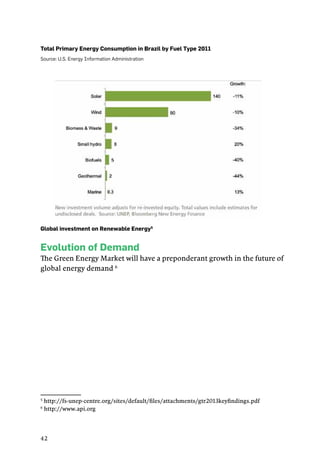
Total Primary Energy Consumption in Brazil by Fuel Type 2011
Source: U.S. Energy Information Administration
Global investment on Renewable Energy5
Evolution of Demand
The Green Energy Market will have a preponderant growth in the future of
global energy demand 6
5
http://fs-unep-centre.org/sites/default/files/attachments/gtr2013keyfindings.pdf
6
http://www.api.org
43
Future Global Demand (Quadrillion Btu)
Source: EIA, International Energy Outlook 2011
Multilateral organisms
Aneel
Brazilian National Electric Energy Agency (ANNEL) Provide favorable con-
ditions for the electric power market to develop a in a balanced environ-
ment, amongst other agents, for the benefit of society.
ABEAMA
Brazilian Association of Renewable Energies and Environment (ABEAMA)
Through its members, partners and supporters, for over 15 years, promotes,
educates and enables the use of alternative energy sources such as solar,
wind, hybrid, and other renewables. The institution is also intended to
encourage the practice of energy conservation; and efficient use of their
sources, for the preservation of the environment.
ABEEólica
Brazilian Association of Wind Energy (ABEEOLICA) A private nonprofit
organization, that brings together companies belonging to the chain of
wind power generation, throughout Brazil. Its goal is to promote the pro-
44
duction of electricity that stems from wind power as a complementary source
to the national energy matrix, as well as to defend the consolidation and
competitiveness of the wind power sector, mainly through a long-term gov-
ernmental program.
Abens
Brazilian Association of Solar Energy (ABENS) Created in order to bring
together all professionals involved in research, development, education,
promotion and direct and indirect solar energy applications.
abinee
Brazilian Association of Electrical and Electronics Industries (ABINEE)
A not-for-profit organization with the purpose of representing the Brazil-
ian electrical and electronic industrial sector, having its board of directors
elected directly from its associate member companies and seating for a 4
years term of office.
Renove
Brazilian Network of Civil Organizations for Renewable Energy (RENOVE)
The largest network of Brazilian non-governmental organizations dedicated
to the promotion and inclusion of renewable energy in the agenda of sus-
tainable development in Brazil.
EPE
Brazilian Energy Research Company or Empresa de Pesquisa Energética
(EPE) Is focused on providing services in the area of studies and research,
to support the planning of the energy sector, such as electricity, oil and
natural gas and its derivatives, coal, renewable energy sources and energy
efficiency, among others.
GFCC
Brazilian Agency for Industrial Development (ABDI) Promotes the imple-
mentation of the national industrial policy.
45
Technical barriers – Non-tarrif Barriers
	
Price competitiveness is the most obvious barrier to renewable energy instal-
lations. In many cases, barriers to expanding renewable energy are regula-
tory and therefore within state control.
The top barrier to pursuing energy efficiency in Brazil was “no organ-
izational ownership/dedicated attention to managing energy efficiency”
(17%, up from 7% in 2011), followed closely by “lack of funding to pay for
improvements” (16.5%) and “insufficient payback/ROI” (16.5%)
Most common entrance barriers are listed in the “Ease of doing busi-
ness ranking”, a ranking produced annually by the World Bank, where Bra-
zil only ranks 116 of 189 in 2014. The most important reasons are:
– Business activities are generally regulated;
– Considerable documentation and bureaucracy are involved in day-to-day
operations: in the wind energy sector, these include inefficiency of public
distribution companies and the long and elaborate process to obtain envi-
ronmental licenses;
– Multiple taxes, high taxation and payroll rates;
– There are no special federal tax incentives to attract foreign investors;
– Foreign ownership of rural land is restricted.
Competition. Local and International
companies in Brazil
Solarterra – Solar electric power systems, photovoltaic modules, inverters.
Web Site: www.solarterra.com.br
Bahia Solar – Solar electric power systems, photovoltaic modules, inverters.
Web Site: www.bahiasolar.com.br
S90renovaveis–Solarelectricpowersystems,photovoltaicmodules,inverters.
Web Site: www.s90renovaveis.com.br
Solar Brazil – Solar electric power systems, photovoltaic modules, inverters.
Web Site: www.solarbrasil.com.br
46
Instalo Engenharia & Construçôes LTDA – Solar electric power systems,
photovoltaic modules, inverters.
Web Site: www.instalo.com.br
List of Renewable Energy companies
in Brazil and industry
Braselco Servicos
Tecnometal Equipamentos Ltda.
Aquecedor Solar KISOL
Enalter – Engenharia Alternativa Ind. Com. Ltda
Br Solar
Full Gauge Controls
Intercambio Eletro Mecanico – IEM
Ryme’s companies positioning in the market
The EU and Brazil conference in renewable energy converge in creating
strategic partnerships and underline the huge potential for technological
cooperation between both regions. The EU has a higher level of human and
technological capital for the transition to low carbon energy. This knowl-
edge holds an enormous potential for Brazil, where stagnation in innovation
has taken place, for example, in the development of efficient green energy
cars. Future exchanges could be win-win situations whereby dramatic reduc-
tions in emissions are realized while creating opportunities for Brazilian
and European companies.
Identification of Market Opportunities
Specific Opportunities for the RYME’s companies
There is no shortage of innovation in Brazil, companies have to think
creatively about how their technology can complement the solutions of
emerging local clean tech companies, especially in sectors other than
their own.
47
The challenging bureaucratic landscape of Brazil , with its high taxes,
labor costs and regulatory barriers, is only one reason why local partners are
crucial to success. Entering the market with a Brazilian partner can help a
foreign small or medium-sized enterprise navigate these bureaucratic chal-
lenges while taking advantage of the investment opportunities available.
For Solar Energy Related Equipment:
Medium to Longer-term opportunities in Brazil include:
Liquid pumps for photovoltaic (PV) generation.
– Air cooling systems.
– Photovoltaic panels.
– Solar inverters and batteries as well as their parts.
– Power Distribution Subsector
Lightning arresters:
– Ground and surge protection systems.
– Relays.
– Insulated electric conductors.
– Surge suppressors.
– Innovative technologies to reduce technical and commercial losses.
– Smart grid technologies.
Requirement of trained management and staff and new technologies to
produce the energy at the price level of the A-3 and A-5 auctions as wind
farms are becoming larger and the need to run them as smoothly as possi-
ble is increasing.
7
India-Brazil-South Africa Declaration on Clean Energy. The declara-
tion indicated that cooperation would include clean coal technologies and
renewable energies such as biomass and innovative ways to transfer develop
and commercialize clean energy. The countries agreed to pool resources to
ensure a secure supply of safe, sustainable and non-polluting energy to meet
global demand, particularly in developing countries.
Several small companies are investing in services and technology for
micro wind farms, operated by small businesses and farmers at isolated
7
http://projects.wri.org/sd-pams-database/brazil/india-brazil-south-africa-declaration-clean-
energy
48
locations. Smaller, less expensive systems will be required, together with
lead and nickel batteries to support these systems.
In general, Brazil has enormous business potential. The most important
opportunities countrywide can be listed as follows (PWC, 2013):
­– Huge internal growth potential;
– Diversified economy;
– Fast-changing business conditions;
– Inflation is under control;
– Abundance of semiskilled and unskilled labor;
– Tax incentives are negotiable in some locations;
– Experienced industrial modernization during the last decade.
Global Opportunities in the industry
The Ten-year Plan for Energy 2011-2020 foresees an important increase in
the consumption of energy, which will go from 237.7 million TOE (tonnes of
oil equivalent) in 2010 to 372 million in 2020, with a 5.3% annual growth.
The federal government has therefore decided, in these ten years, to invest
the equivalent of EUR 450 billion in the development of the energy sector,
with about EUR 200 billion to finance renewable energy projects.
Sugarcane as Biofuel – Alternative Energy. Sugar isn’t a food staple, so
making ethanol from it hasn’t driven up food prices as has the production
of large amounts of corn ethanol. Brazil makes nearly as much ethanol from
sugar cane as the U.S. does from corn; cane provides nearly half of Brazil’s
transportation fuel from plants grown using about 1% of its arable land.
Transmission and connection to the (smart) grid. The most recent auc-
tion has changed regulations as developers are now also responsible for
connection to the grid. There will be a need for knowledge and experience.
The overall need to improve the energy infrastructure through techno-
logical innovation is an opportunity. An example is the connection of the
wind farms to the grid. Grid connection used to be done separately by pub-
lic companies that suffered from bureaucracy, but now instead need to be
taken care of by the wind farm developers. According to APINE, this is a
good development for the wind energy sector in Brazil.
49
Strategic Partners
Dresser-Rande Guascor – With presence in Spain, uses innovative technol-
ogy in sectors like windpower, hydropower.
Kyocera
Energia Essencial
Renova Energia
Desenvix
Queiroz Galvão Construção
Contacts list of RYME’s companies in Brazil
Vertical Parking Gestão de Ativos LTDA – ME
São Paulo / SP
Automatized system for vertical parking
ACT Sistemas LTDA ME
http://www.actsistemas.com.br/
São Miguel do Oeste/SC
The company’s main product is a solution-oriented environmental moni-
toring, computerization of the Ringelmann scale of the solution to monitor
electronically the level of pollution emitted by diesel driven vehicles and a
stationary sources, as well as registering the inventory and keep track of
the measurements.
Offers
SmokeShot
With this environmental concern, we created a system to manage the
emission of black smoke through Computer Vision. It is the computeriza-
tion of the Ringelmann Scale, used worldwide to measure the emission of
smoke from diesel engines and chimneys. With the capture, measurement
and emission data made by the software monitor emitting black smoke was
free of human errors and Negligence.
With the fast and efficient capture obtains a greater number of vehicles and
chimneysinspectedandsentforanadjustment.Thiswillreducetheemissionof
black smoke ridding the environment of tons of this waste and also freeing the
professional sealer to expose the smoke to measure it, preserving your health.
50
AquaFluxus Consultoria Ambiental em Recursos Hídricos
www.aquafluxus.com.br
Rio de Janeiro / RJ
– Safety diagnostic for enterprise located close to the river margin;
– Flood control project;
– Reservatory detention project;
– Sustainable drainage system for condominio;
– Flood mapping in the urban and rural drainage basin;
– Hydrology study
Renewable Energy Sectorial Events
Brazil Windpower – Annual Brazil Windpower Conference and Exhibition.
Organized annually by ABEEolica, GWEC (Brussels) and Canal Energy Group
is the best opportunity to do business in the wind energy market.
EnerSolar+ Brasil – The international fair for the photovoltaic, thermal
and CSP solar industry in Brazil. ENERSOLAR+ BRASIL is an important
opportunity for all professionals of the sector interested in the important
market of South America.
World Bio Markets – Annual Bio based conference is Brazil
Green Certificate
Brazil: Green Label
Part of CONPET, the green label of energy efficiency recognizes domestic
appliances with the best energy performance in their class.
8
Seal CONPET
The Energy Efficiency CONPET Seal aims to highlight to consumers, mod-
els that reach the highest degree of efficiency in the National Energy
Conservation Program Labelling Brazilian INMETRO. Awarded annually
8
http://www.conpet.gov.br/portal/conpet/pt_br/conteudo-gerais/selo-conpet.shtml
51
by Petrobras, the seal is a stimulus for the production of more efficient
models.
9
Brazilian Labeling Program
The Brazilian Labeling Program (PBE) is coordinated and regulated by
INMETRO and implemented in collaboration with the CONPET for fuel
consuming equipment (stoves, gas water heaters and automobiles). Through
the National Label Conservation (ENCE), attached to products mandatory
or voluntary basis, the consumer is informed, at the time of purchase on
the energy efficiency or consumption of similar models and can compare to
“a” (most efficient) to “E” (least efficient). The EBP contributes to the mar-
keting and use of devices with lower power consumption.
Appendants
Documents of interest for the RYME’s companies:
– Global Trends in Renewable Energy Investment 2013. Bloomberg New
Energy Finace 2013. http://www.unep.org/pdf/GTR-UNEP-FS-BNEF2.pdf
– US Energy Information Administration for Brazil 2013. http://www.
eia.gov/countries/analysisbriefs/brazil/brazil.pdf
– Plano Decenal de Expansão de Energia - PDE - EPE 2022.
http://www.mme.gov.br/mme/galerias/arquivos/noticias/2013/
PDE2022_ConsultaPublica.pdf
– Market study: Wind energy in Brazil. 2014 https://www.rvo.nl/sites/
default/files/2014/04/Eindrapport%20Marktstudie%20Wind,%20Bra-
zilie%202014.pdf
– The Global Cleantech Innovation Index 2014 http://awsassets.panda.
org/downloads/cleantechrepsm.pdf
9
http://www2.inmetro.gov.br/pbe/orientacoes_regulamentacao.php
France
53
SUMMARY
This market study explores the renewable energy sector in France and pos-
sible opportunities between RYME and French companies operating in the
sector of advanced technologies and global vision of the sector industry.
France is the second largest producer of renewable energy in the Euro-
pean Union, mainly through its timber resources and hydropower (82.5%
of the renewable energy production in France in 2009). It may be noted that
the timber and hydropower account for more than 75% of the renewable
energy production in France, despite a surge in wind power (40% growth
in one year).
This market research comprises the following:
­– Tendencies in the Renewable Energy Sector
– Government plans for the sector.
– Description of strengths, weaknesses, opportunities and threats in
the energy sector.
– French multilateral organism supporting the sectorial development.
– Non-technical barriers for the market entry.
– Specific and global Opportunities for RYME’s companies sector.
– Strategic Partners.
– Legal Requirements.
– List of French companies as potential business partners.
– Renewable Energy sector annual Events in France.
– Green Certificates
54
Actual country situation
Tendencies
The start of 2013 has shown signs of recovery for the country’s solar sector,
following the announcement that the Governmet has doubled its target for
new solar projects to at least 1GW for the year ahead.
Under the provisions of Directive 2009/28/EU of 23 April 2009
(the Renewable Energy Directive), by 2020 23% of France’s final energy
consumption must be generated from RES. The Electricity Law established,
among other things:
– the creation of the company RTE to manage the transmission grid;
– the creation of the energy regulation commission;
– the introduction of the obligation to purchase renewable energy pro-
duced at a fixed tariff or through tender procedures; and
– the rules of access and management of the utility grid.
France also produces a significant amount of energy from renewable
resources. France is the second-largest producer of biofuels in Europe, after
Germany, and the country produces mostly biodiesel for the transporta-
tion sector.
Electricity Forecast for 2020
Renewable
130 000
23%
Nuclear
435 217
77%
Hydraulic
82%
Wind
11%
Biomass
6%
Photovoltaic
1%
Electricity Production from Renewable
Energies in France, 2010 (%)
Source: EDF, Observ 2010
55
France has very little domestic natural gas production, and the French
government banned the use of hydraulic fracturing, a drilling technique
used to extract shale oil and gas resources. French authorities project natural
gas demand to remain stable or fall slightly through 2020. France imports
natural gas through a variety of cross-border pipelines from the Nether-
lands, Norway, and Russia. France also imports liquefied natural gas (LNG)
from countries around the world, notably Algeria , Nigeria, Qatar, and Egypt.
The power and industrial sectors have growing gas demand, while residen-
tial sector gas demand is starting to decrease, mostly because of efficiency
gains, according to the International Energy Agency.
The energy consumption problem in older buildings is serious in France
and its capital in particular. The old buildings in Paris alone generated 21% of
CO2 emissions, ie 43% of total power reported companies in France. Accord-
ing to the Agence nationale de l’Habitat, 2.8 million homes belonged to the
class F and 4.7 million apartments belonged to the category G in late 2007.
Govermmental plans for the sector
National Commitments
The 2005 French Energy law laid down the basis of French energy policy:
– 10 % of the energy consumption should come from renewable energy
sources by 2010.
– 50 % increase of renewable heat (which in the end should amount to
10Mtoe in 2005).
– 5.75% by the end of 2008, 7 % biofuels incorporated in 2010 and 10%
in 2015. In September 2005, the Prime Minister presented measures to
encourage the production of biofuels. The objective to incorporate biofuels
at 5.57% initially anticipated for 2010 was expected to be attained in 2008.
In addition, new “grenelle de l’environnement commitments” are in the
legislative process for adoption. Some of the measures envisaged:
In new buildings, new energy performance norms will have to apply to
public and tertiary buildings (primary energy consumption not exceeding
of 50kWh/m2
/ year in average) by 2010 and to all buildings by 2012. A “Pos-
itive energy building5” norm for all building will enter into force by 2020.
– Existing buildings: a decrease of 38 % of the energy consumption of
the existing building stock will have to be achieved by 2020.
– A target of 30% low energy farms by 2013.
56
Incentives
The development of renewable energy sources in France is based on two
mechanisms:
The feed-in-tariff (FiT) scheme, which provides support for energy from
wind power, solar power, hydro power, biomass and geothermal sources,
among other technologies. The FiT scheme is the key RES support mech-
anism. It was introduced and imposed on EDF and non-national distribu-
tors by the Law n° 2000-108 dated 10 February 2000, entitled loi relative à
la modernisation et au développement du service public de l’électricité. The
system is financed through the public contribution to the electricity service
orcontribution au service public de l’électricité (CSPE) which is an amount
added to the electricity bill of each French electricity consumer, a mecha-
nism  which provides security for investors by guaranteeing revenues with
a long-term perspective to production capacity for renewable energy; and
A tender system for large renewable projects (used for offshore wind
power, solar power, biomass, hydro and other projects built at scale).
Swot Analysis
Strenghts Weakness
S1 – Good research infrastructures, an
energy research center, very active asso-
ciations of renewable energy companies.
S2 – France has the technical and sci-
entific capacity to innovate in renewable
energy R&D, with universities offering
PHD´s in renewable energy management
as well as wind and solar energy.
S3 – France is currently dominant in seed
and early-stage cleantech venture capital.
W1 – Lack of incentives and of firm com-
mitment by local industry to become
competitive.
W2 – High administrative costs.
57
Opportunities Thearths
O1 O2 – The price of petroleum will con-
tinue increasing in short, medium term,
making more expensive the price of the
energy coming from petroleum derivate
products.
O3 – Big concern in the society about the
need of being more energy efficient, and
the need of reducing CO2 emission.
T1 – Price competitiveness to renewable
energy installations.
Market Evolution
The renewable energy market in France is in a mature phase and requires
great investments in order to achieve the goals set by the government and
the EU.
Electricity Production in France
58
Demand Analysis
The electricity capacity growth expected for 2020 is taken into account by
the government incentives for the sectoral development.
Expected Electricity Capacity Growth 2020
Evolution of Demand
The Green Energy Market will have a preponderant growth in the future of
global energy demand.
France Electrivity Capacity and expected growht for 2020
59
Future Global Energy Demand (Quadrillion Btu)
Source: EIA, Internacional Energy Outlook 2011
Multilateral organisms
ADEME
The purpose of these programs is to develop organizational and technological
responses to reduce the environmental and energy impact of human activities.
ANCRE
Consistent with the national energy strategy and the strategic directions
laid out by ADEME, ANCRE maintains a coordinated policy of projects in
research and innovation (R&I).
ANR
As a mechanism for financing research-support projects, the ANR focuses
simultaneously on new energy technologies (photovoltaic, bioenergy, hydro-
gen and fuel cells, energy storage, CO2 capture and sequestration) and
energy efficiency in construction, manufacturing, and transportation.
Association Instituts Carnot
The network of the 33 Carnot Institutes is dedicated to the development of
60
research partnerships with socioeconomic actors (large industrial groups,
small and mid-sized businesses, startups, and local governments) and to
the promotion of technology transfer.
Technical barriers – Non-tarrif Barriers
Reports have identified a long lead time to obtain the necessary permits as
a key problem for the expansion of RES, as a result of the excessive number
of authorities involved in the permitting procedures. Lengthy procedures
have been actually mentioned by stakeholders as a problem in France.
The civil servants dealing with the permitting procedures are not familiar
with renewables, specially in new technologies, which leads to confusion,
delays or unmotivated denials of authorizations.
Unclear administrative framework problems have been registered, such
as legal uncertainty, contradicting legal provisions, excessive discretionary
powers of the administration and corruption. This leads to broad margins
of discretion for the administration; unpredictability and lack of transpar-
ency; besides corruption itself.
There is insufficient spatial planning, creating uncertainty and a latent
risk of finding no place for new renewable energy installations.
In France, renewable energy equipment for building integration requires
an additional French certification before it can be installed, even if it is
already validly certified according to the European standards. This is a sig-
nificant barrier to market players in the photovoltaic, solar thermal and
heat pump sector.
List of Renewable Energy companies
in France and industry
CDEAI – Solar electric power systems, photovoltaic modules, inverters.
AMPEREL – Solar electric power systems, photovoltaic modules, inverters.
SOLEMS – Manufacturer of indoor solar cells and solar modules, including
very small sizes. Amorphous silicon technology. 
61
Milton Roy – Designs, manufactures and markets dosing and mixing equip-
ment for all type of liquids (clear, viscous, abrasive, corrosive, volatile and
more).
Energies-Sol – Solutions Energies Renouvelables
Meteodyn develops software for wind resource assessment and wind fore-
casting: meteodyn WT and meteodyn Forecast. 
TEXSYS – Provides services and products for monitoring and control of
renewable electricity power plants. 
Ryme’s companies positioning in the market
The Spanish companies need to take in consideration that France is experienc-
ing macroeconomic imbalances, which require monitoring and decisive policy
action. In particular, the deterioration in the trade balance and competitive-
ness levels, driven both by cost and non-cost factors, against a background
of a deteriorating external position and high public debt deserves continued
attention. The need for action so as to reduce the risk of adverse effects on
the functioning of the French economy and of the Economic and Monetary
Union, is particularly important notably given the size of the French economy.
More specifically, the growing trade deficit reflects the long term decline
in export market shares which is linked to persistent losses in both cost and
non-price competitiveness. Wages have risen fast and put pressure on prices
and firms’ profitability. The low and decreasing profitability of private com-
panies, in particular in the manufacturing sector, have not only weighed on
their indebtedness, but more importantly may have hampered their ability
to innovate and to strengthen their non-price competitiveness. Other fac-
tors, including the decreasing number of exporting firms have aggravated
these competitiveness issues. In particular, rigidities in the French labor
market, which also contributed to the development in the cost of labor, may
have limited the potential for adjustment of the economy and hampered
productivity developments. In addition to the competitiveness issues, the
rising public debt exposes France to potential financial market turbulence
and brings risks of crowding out private investment.
62
Identification of Market Opportunities
Specific Opportunities for the RYME’s companies
France has a high number of early stage investors securing new cleantech
funds (including Demeter Partners, Emertec, and Idinvest Partners) through
the governmental support of €600 million.
French industrial interests have weighed heavily into tidal technology,
in recent years.
Industrial water reuse technologies e.g., sewer mining, decentral-
ized onsite treatment systems, MBR systems. Water reuse and the use of
reclaimed water are already widely applied in the US and are becoming
more popular. There is a significant need for technologies and approaches
that foster substantially greater water reuse or sewer mining, that are also
capable of reducing pollution and energy consumption.
Smart water grid techniques e.g., smart water meters, electromagnetic
and acoustic sensors, real-time communication channels, basic data man-
agement software, real-time data analytics and modeling software, automa-
tion and control tools.
Global Opportunities in the industry
Some initiatives are taking place to make the photovoltaic sector in France
better organized, produce locally, generate green jobs, and avoid an exces-
sive carbon footprint of panels from other nations across the planet.
France strengths lie in the cleantech innovation drivers. France has a
strong public R&D and attractive infrastructure for renewable as well as
abundant cleantech funds. The country scores relatively high on emerging
cleantech innovation, thanks to good VC investment and environmental
patents. France’s other scores are below average.
Energy conservation and recovery techniques e.g., effective pumps,
membranes, downsizing pipelines, geothermal energy, geo-exchange,
sewer heat-recovery systems, thermal hydrolysis, biogas production. In
the US, water and wastewater utilities require significant amounts of
electricity. Moreover, the electricity industry is the second largest user
of water. Water reuse, climate change and the water & energy nexus are
closely related. Turning water and wastewater facilities into net zero energy
consumers or net producers of energy is the latest trend in the Ameri-
can water technology market. This change can be achieved by installing
63
renewable energy technologies (e.g., geothermal energy, geo-exchange,
and sewer heat-recovery systems) or by anaerobic digestion of sludge and
other organic materials.
Techniques for monitoring and removal of emerging contaminants
e.g., contaminants of emerging concern, hexavalent chromium, pharmaceu-
ticals, nanomaterial. Monitoring and removal of emerging contaminants,
which are often unregulated, will be a trending topic in the US water tech-
nology market in the coming years. The EPA is also implementing new or
stricter drinking water limits on numerous contaminants, including arsenic,
radioactive contaminants, microbial and disinfection byproducts. CCL 3 is a
list of contaminants that are currently not subject to any proposed or prom-
ulgated national primary drinking water regulations, but that are known or
anticipated to occur in public water systems, and which may require regu-
lation under the Safe Drinking Water Act (SDWA).
Strategic Partners
Internat Energy Solutions – Internat Energy Solutions is an engineering
company, committed to the protection of the environment, through exten-
sive use of renewable energies. 
SOCOMEC – Independent specialist manufacturer providing cutting-edge
solutions for distribution, control, security and availability of LV electrical
networks. 
ITEBE – The International Association of Bioenergy Professionals which
actively promotes and supports the full value chain of actors and stake-
holders belonging to the bioenergy sector.
Contacts list of RYME’s companies in France
APILAB is an engineering office specialized in environmental monitor-
ing using bees. Concretely we use bee sensitivity to assess the quality of an
environment.
64
Biogénie is both a cosmetic brand and cosmetic care concept which is based
on the use of a cellular device electroesthetic care (which sends electrical
impulses) and the protocol of care that follows the beautician. Recently the
device runs in an iPad application.
DRAKKAR Bois is the French manufacturer of end-grain wood floor called
“les Pavés de Paris”. Our product is very innovative and is revolution in
comparison to the other end-grain floor: easiness of installation on floor or
walls, a finished product, it doesn’t require sanding or oiling once installed,
very hard-wearing, a 20 years warranty.
ReviPlast is in recovery, recycling and trading of plastic waste.
Renewable Energy Sectorial Events
Energaïa – Annual Energy Forum to promote active networking and tar-
geted business meetings.
BATI Energie Paris – Annual Forum.
Eco bat Paris provides all the news in Renewable Energy. Building Tech-
nologies, Ecology, Sustainability, Environment, Construction.
EWEA – 2015 France Paris event.
Green Certificate
Energy Performance Certificate for buildings, premises or property. Doc-
ument that describes how effective it is a building in terms of energy con-
sumption. It will be implemented by a system of labels with a color coded
scale ranging from “A” (the most efficient) to “G” (least).
Appendants
Documents of interest for the RYME’s companies:
65
– Global Trends in Renewable Energy Investment 2013. Bloomberg New
Energy Finace. http://www.unep.org/pdf/GTR-UNEP-FS-BNEF2.pdf
– Is 100% Renewable Energy Possible in France by 2020? http://www.
geni.org/globalenergy/research/renewable-energy-potential-of-france/
Renewable%20Energy%20in%20France.%20PBM%20final.pdf
The Global Cleantech Innovation Index 2014 http://awsassets.panda.
org/downloads/cleantechrepsm.pdf
Spain
67
SUMMARY
This market study explores the renewable energy sector in Spain and pos-
sible opportunities of doing business between RYME and Spanish compa-
nies operating in the sector of advanced technologies and global vision of
the industry.
From an energetic point of view, Spain is characterized for its consump-
tion structure dominated by the presence of petroleum products, mostly
imported, which, together with the little availability of native resources, has
led to the high energy dependence of approximately 80%, much more sig-
nificant than the European average (55%), translating into reduced self-suf-
ficiency.
The impact of the 2008 crisis on the industry sub-fields has resulted in
a significant decrease of oil and gas consumption, which largely explains
the decline recorded in the global demand for energy products, in 2009.
This market research comprises the following:
– Tendencies in the Renewable Energy Sector
– Government plans for the sector.
– Description of strengths, weaknesses, opportunities and threats in
the energy sector.
– Spanish multilateral organism supporting the market development
– Non-technical barriers for market entry.
– Specific and global Opportunities for RYME’s companies sector
– Strategic Partners.
– Legal Requirements
– List of Spanish companies as potential business partners.
68
– Renewable Energy sector annual Events.
– National Certificates for Renewable Energy.
Actual country situation
Tendencies
Spain is one of the countries who signed the Kyoto Protocol, a legally bind-
ing agreement by which industrialized countries shall reduce their collec-
tive emissions of greenhouse gases by 5.2%, in comparison to the year 1990
(but note that, compared to the emission levels that would be expected by
2010 without the Protocol, this target represents a 29% cut). The goal is
to lower overall emissions of six greenhouse gases – carbon dioxide, meth-
ane, nitrous oxide, sulfur hexafluoride, HFCs, and PFCs – calculated as an
average over the five-year period of 2008-12. National targets range from
8% reductions for the European Union, to 7% for the US, 6% for Japan,
0% for Russia, and also permitted increases of 8% for Australia and 10%
for Iceland.”
1
Forecasts about the behavior of different energy sources
1
http://www.lamoncloa.gob.es/consejodeministros/enlaces/111111-energias.htm
Hidráulica
2%
.
Eólica y solar y geot
1%
Biomasa y resid.
3%
Carbón
17%
Petróleo
52%
Gas
natural
12%
Nuclear
13%
año 2000 – 125 Mtep
Hidráulica
1%
Eólica y solar y geot.
1%
Biomasa y resid.
4%
Carbón
15%
Petróleo
49%
Gas
natural
20%
Nuclear
10%
año 2005 – 145,6 Mtep
69
Trends in Energy Sources
Source: IDEA, Instituto para la Diversificación y Ahorro de Energía (Institute for Energy Diversification and Saving).
2
Spain has bilateral agreements with France, Italy and Portugal, allow-
ing Spanish operators to place part of their security stocks within these ter-
ritories. The amount of emergency reserves a company can hold abroad is
limited to 15% of its obligation.
3
Regarding the Energy Efficiency in New Construction in Spain, one of
the objectives of the European Union (EU) is to reduce the production of
greenhouse gases in the domestic sector, for 2050, by 80%, as compared to
1990 levels. To achieve this target and make improvements in existing build-
ings energy efficiency it is intended that all tertiary buildings and homes
built between 2020 and 2050 have an energy consumption close to zero.
Spain aims to reach nearly 4% of the demand in the photovoltaic mar-
ket. However, the current measures in adoption (with retroactive effects on
existing plants) are worrying, sending wrong signals to the investor com-
munity. The sectoral potential identified foresees that Spain could easily
surpass 7% of the power demand with PV.
Trends in consumption and primary energy:
The trends currently observed result from the synergies between changes
2
http://www.iea.org/explanationstocks.asp?country_name=Spain
3
http://www.madrimasd.org/blogs/energiasalternativas/
año 2020 – 142,2 Mtep
Hidráulica
2%
Eólica y solar y geot.
10%
Biomasa y resid.
8%
Carbón
7%
Petróleo
36%
Gas
natural
27%
Nuclear
10%
año 2010 – 131,9 Mtep
Hidráulica
3%
Eólica y solar y geot.
4%
Biomasa y resid.
5%
Carbón
6%
Petróleo
47%Gas
natural
23%
Nuclear
12%
70
being made in efficiency improvement since 2004 and the crisis, that
together contribute for a sharp decline in energy demand.
Evolution of the Consumption of Primary Energy
Source: IDEA, Instituto para la Diversificación y Ahorro de Energía (Institute for Energy Diversification and Saving).
In 2012, a 12% decline was verified, mainly due to investors concerns over
renewable energy supporting policies in the longest-established markets,
Europe and the US. In some extent this was a case of uncertainty – develop-
ers, equity providers and lenders were unsure about whether commitments
to subsidise renewable energy deployment would continue beyond sched-
uled expiry dates in countries like the US, the UK and Germany.
Hydropower is expected to represent 10.5% of electricity consumption
in 2020. Around 90% of Small Hydro Power (SHP) installed capacity will
be concentrated in six countries in 2020, namely Italy, France, Spain, Ger-
many, Austria and Sweden.
Negative impact on investment levels also stemmed from other factors,
notably the pressure on utility balance sheets verified in some European
countries, the low natural gas price in the US (which reduced the value
of power purchasing agreements available to generators, including wind
developers) and, once more, the poor performance in clean energy share
prices. This last factor hit public market investment, specially renewable
energy.
71
Investment in Renewable Energy by Region 2004-2012.
Source: UNEP, Bloomberg New Energy Finance
For years, a large number of barriers have been removed through regula-
tion, subsidy schemes and development programs as well as technological
development. However, lack of information and of end users confidence,
along with the need for a larger down payment and administrative difficul-
ties for aid, continue to hinder its development.
Governmental plans for the sector
The European Union has an overall Renewable Energy Plan for the period
2011-2020 , contemplated by the Directive 2009/28/EC of the European
Parliament and of the Council of 23 April 2009.
It addresses the use of energy from renewable sources, setting general
objectives for each Member State, for 2020, in order to ensure its minimum
share of 20% in the European Union (EU) gross final consumption and a
minimum quota of 10% when applied to the transport sector.
To achieve this, targets for each Member State were set, for 2020, along
with a minimum indicative trajectory until that year. In Spain, the goal is
that renewable sources account for at least 20% of the final energy consump-
tion in 2020, the same as for the EU-average, ensuring a minimum contri-
bution of 10% for the transport sector. These objectives are established by
the Spanish Law 2/2011, on Sustainable Economy.
However, the Council of Ministers approved on January 27, 2014 a Royal
Decree to temporarily suspend procedures on renewable remuneration and
economic incentives for new installations of electricity production from
renewable energy sources, waste and cogeneration. The main reasons for this
72
decision were the economic crisis and the current state of the electrical system,
which draws a large and growing deficit that threatens its sustainability fee,
The power objectives for 2020 included in the recently approved Renew-
able Energy Plan allow the government to have a comfortable margin for
maneuver in setting the path for the implementation of facilities for elec-
tricity production from renewable sources.
Swot Analysis
The Spanish market for renewable energy is facing major setbacks. In the
following analysis we can see the internal vs the external environmental
challenges of the industry.
Strenghts Weaknesses
S1 – Long experience and expertise of
engineers and engineering companies
in renewable technologies, solar PV and
biomass.
S2 – Good research infrastructures, an
energy research center, very active asso-
ciations of renewable energy companies.
S3 – Leading research on practical im-
plementation of innovative technologies
and practices.
S4 – Home of the World’s Largest Pho-
tovoltaic (PV) Solar Power Plants, in Al-
icante, Murcia, Salamanca.
W1 – Government actual politics to re-
frain international and national invest-
ment in renewables until 2018.
W2 – Legal procedures against Spain for
the international companies.
W3 – Insecurity of the actual invest-
ments in renewables for international
and local companies.
W4 – Cuts to be paid for renewables al-
ready made, but also for those who are to
be enacted.
W5 – Lack of strong entrepreneurial cul-
ture, public R&D spending, and access to
private finance.
Opportunities Thearths
O1 – The price of petroleum will contin-
ue increasing in the short, medium term,
making the price of energy coming from
petroleum derivate products more ex-
pensive.
O2 – Major public concern over the need
of being more energy efficient, and of re-
ducing CO2 emissions.
O3 – Development of ‘Smart grids’ in the
energy sector.
T1 – High cost of investment and genera-
tion (installation and maintenance). High
risk.
73
Market Evolution
The Spanish market has been rising since the 1970´s
; the EU and the Gov-
ernment have established goals in order to reduce the contamination in
the cities. In the next table the evolution of every sector of the Renewables
Energies is displayed.
Consumption and Gross Generation of Electricty in Spain
Source: MINETUR, Ministry of Industry, Energy and Tourism
Demand Analysis
From an environmental point of view, the use and promotion of renewable
energy presents obvious advantages over the conventional energies, as the
impairment, reversibility and simple restoration of the impacts along with
the minimization of greenhouse gases emissions.
In a scenario where renewable energy development would be abruptly
refrained, not only the environmental damages would increase, due to the
new facilities based on fossil fuels, as it would also mean a setback in the
fight against climate change, making Spanish current lifestyle unsustainable.
74
Contribution for primarly Energy by Renewable 2010
Contribution for the Electric Balance by Renewable 2010
Source: IDEA, Instituto para la Diversificación y Ahorro de Energía (Institute for Energy Diversification and Savings).
Evolution of Demand
Green Energy Market will register the highest grow in the future of global
energy demand 4
4
http://www.api.org/
Nuclear
12,2%
Saldo
eléctrico
-0,5%
Renovables
11,4%
Carbón 6,4%
Petróleo
47,2%
Gas Natural
23,4%
hidráulica 2,7%
eólica 2,9%
rsu 0,2%
Biomasa 3,6%
Biogás 0,1%
Biocarburantes 1,1%
Geotérmica 0,01%
solar Fotovoltaica 0,4%
solar Térmoeléctrica 0,2%
solar Térmica 0,1%
Nuclear
20,6%
32,4%
Producción
bombeo:
1,1%
Carbón
8,6%
Gas Natural
31,7%
hidráulica 14,1%
eólica 14,7%
rsu 0,3%
Biomasa 0,8%
Biogás 0,2%
Fotovoltaica 2,1%
s. Termoeléctrica 0,2%
Petróleo
5,7%
Renovables
75
Future Global Demand (Quadrillion Btu)
Source: EIA, U.S. Energy Information Administration
Despite the current uncertainty regarding the developments of global
economy and its future recovery, global energy demand continues growing
at a considerable rate: 5% in the year of 2010. In the scenarios foreseen by
the Energy Information Administration (EIA), by 2035 the world demand
will increase energy by a third, mainly in countries outside the OECD.
Accordingtothesescenarios,fossilfuelswillcontinuetoplayaleadingrole,
butitisexpectedasmalldecreaseintheiroverallshareasprimaryenergyworld-
wide, from 81%, in 2010, to 75% in 2035. As much as possible, this demand
will particularly focus the sector of transports, despite the best efforts made
by the developed countries for the improvement of energy efficiency. If, in the
future,newtransportvehiclescapableofreducingthedependenceonthepetro-
leum products sector are not introduced in the market, this captive demand
will be very sensitive to oil price fluctuations. As a consequence, the demand
for oil in 2035 may increase from the 87 million barrels per day registered
in 2010 to 99 million barrels, according to the International Energy Agency.
In contrast with the expectations for the oil industry, the natural gas
sector offers a more positive outlook. The importance of gas in the global
energy consumption has increased, along with the input in the market called
unconventional gas, which, according to the IEA, could represent 20% of
the world production of natural gas in 2035.
76
However, the Spanish reality presents some differences from this global
projections. In the long term, the main gas supplies of Spanish companies
are indexed to oil prices, therefore the national prospect may follow a dif-
ferent trend. The aforementioned study estimates that the price of natural
gas in Spain will experience an increase in the period of the Renewable
Energy Plan 2011-2020.
5
Evolution of the primary consumption of renewable ernergies in Spain 1990-2010.
Source: IDEA, Instituto para la Diversificación y Ahorro de Energía (Institute for Energy Diversification and Saving).
Multilateral organisms
Alinne
The Alliance for Energy Research and Innovation (ALINNE) is a public-pri-
vate national covenant, which was established with the challenge of strength-
ening Spain’s international leadership in energy innovation.
Institute iMdea
Promotes transfer of technology for the industrial sector
5
http://www.idae.es/uploads/documentos/documentos_Boletin_de_Energias_Renovables_
_1._Datos_2010._2011_12FINAL_a242d62f.pdf
77
Aicia
One of the areas of research, innovation and development is Industrial
Electronics, namely Sensory Wireless Networks, which translates into the
application of wireless sensor networks, actuators and cooperating objects
including nodes for detection of chemical and biological substances and
nodes with cameras.
Agencia Andaluza de la Energía
Instrument for the implementation of energy policy.
Analysis of the Spanish RYME’s companies
offer
The Spanish RYME’s companies for Green Energy are the following:
Proasistech
Offers
–Industrialtechnicalwritingprojectsformnewwatertreatmentplantandexistingreforms.
– PLC Programming (software).
– Design and programming of data acquisition systems in real time.
– Design and manufacture of electronic devices on demand; for example: energy related
reading, sensors and Internet of things.
Demands
– Looking forward to collaborate on projects with specialized suppliers on Energy field,
Water treatment, the Internet of the Things.
– Partners to sell our products, they should have: product knowledge and service, the
product physically and commercial material.
78
Speen2
Offers
–Electronicdevelopment:Developcustomelectronicdevicesfromtheideatofinalproduct.
– Product consultancy: Offer new ideas to improve your company.
– Viability study: Offer consultancy in inputs needed and do ability.
– Manufacturing cost analysis: Offer skills to estimate production costs.
– Technological partner: Offer collaborates in: Hardware design, firmware program-
ming (mainly for microcontrollers], wireless and wired communications, control, sen-
sors and actuators, power electronics, design under normative specifications, prototype
PCB manufacturing by drilling-milling machine, electronic parts soldering, debugging
working prototypes, smart devices, among others. Our expertise allows us work in spe-
cific sectors as smarmetering and submetering.
Demands
– Market researcher: Seeking a partner which could suggest a new electronic device
under a focus close to market. The idea should be born from a real chance in a real case,
and it would be analyzed to be developed as a prototype for testing.
– Commercial/technological partner: Looking for a strong commercial profile with knowl-
edge about electronic devices and technologies. Partner should have: Strong commer-
cial profile and skills, extensive client portfolio, technical knowledge about electronic
devices, development and technologies and Creative focus, able to suggest solutions to
specific engineering problems.
Certifications
– CMMI (in process] ISO 9001 (in process]
– UNE166002 (in process), about R&D
+idea
Offers
Engineering development and design. Focused in environment and industrial automa-
tion for Water treatment, measurement and control.
Demands
Smart Cities
Certifications
– ISO 9001
– ISO 1 4000
79
Sistemas y Control del Mediterrâneo, s.l
Offers
Manufactures high technology and low-cost measurement, correction and control of
energy in buildings and industries.
Demands
Energy / Efficient Programs
Technical barriers – Non-tariff Barriers
Price competitiveness is the most obvious barrier to renewable energy instal-
lations. In many cases, barriers to expand renewable energy have a regu-
latory nature, as it has occurred in Spain as a consequence of the Annual
Budget. In order to reduce the impact and balance the economy, the gov-
ernment decided to stop local and international investment in renewable
energy because of the numbers subsidy in the field.
Situation of Spanish companies in the market
The overall objective for biofuels in Spain, fixed from last year at 4.1% of
fuel consumption automotive, is at the bottom of the European Union. Of
the twenty EU countries that use this mechanism to support biofuels, only
three have a minimum target for 2014 below the Spanish, according to the
comparative analysis “Minimum Millennium Biofuels in the EU by 2014
“conducted by APPA biofuels.
The Spanish goal is from 45% to 35% lower than those prevailing in the
two main markets for biofuels in the EU (France and Germany), while 20%
is below the EU average.
This drastic reduction of the targets has caused a decrease in the biofu-
els consumption in Spain, causing consequent damages to the domestic
industry. The impact has been particularly strong in the case of biodiesel;
the demand in 2013 experienced a drop of 59% from the previous year to
just stand at 600,000 tones, the lowest figure since 2008. The consumption
of bioethanol also fell last year (-16%) when compared to 2012.
80
The fact that the National Action Plan for Renewable Energy (PANER)
2011-2020 foresaw that the renewable energy consumption in transports
would reach 8%, in 2014, confirms that Spain is currently out of the path
marked to achieve the EU target for renewables in the sector, set for 2020
(10%).
Identification of Market Opportunities
Specific Opportunities for RYME’s companies
– According to the new Spanish Construction Law, it is mandatory that
any new building meets the performance parameters determined by the
governmental objectives to reduce the impact of greenhouse gases in the
domestic sector by 80%, in 2050.
– The development of the ESCO (Energy Service Companies) in Spain is
recent, but very promising. The ESCO develop energy efficiency projects for
their customers, assuming the investment risk and participating the sav-
ings obtained from the investments made.
– Smart water grid techniques e.g., smart water meters, electromagnetic
and acoustic sensors, real-time communication channels, basic data man-
agement software, real-time data analytics and modeling software, automa-
tion and control tools.
Global Opportunities in the industry
– The existence of ambitious goals set by the Action Plan Energy Saving
and Efficiency 2011 – 2020.
– The new regulation ICAREN, consisting of incentives for thermal energy
applications based on renewable sources, encourage the investment on this
sector.
– The impulse in promoting the use of new insulating materials and
structures, due to problems related to poor insulation in the tertiary sector,
housing sectors, hotel and industrial sector.
– Need for all types of equipment and technologies to help reduce energy
consumption. The current situation, along with an increase in energy prices,
create a favorable framework for replacing inefficient equipment and com-
ponents from urban lighting to electronic devices, also through the auto-
motive industry and others.
81
Strategic Partners
1A Ingenieros – Services oriented to change the impact of technology on
the natural environment, covering the complete cycle of measures (studies,
behaviors, new techniques, alternatives, etc...).
Azigrene Consultants is a Consulting and Energy Engineering company,
which operates in: Energy Saving and Efficiency, advice for Power Purchase,
energy Consulting Multisite, energy Generation in the Special Regime, ISO
5000, and Energy Certification.
Enevia is a company for energy efficiency at homes, introducing the latest
systems in home automation and renewable energy to achieve maximum
savings and independence of conventional energy.
Eurocontrol – Research, development and technological innovation, like new
test methods and control, applied to aeronautical, communications and traffic
control technologies, communications infrastructure design for homes and
buildings, network Architecture and optimization, home Automation, net-
working applications, connectivity solutions for voice and data, wireless net-
working,developmentofmanagementtoolsandenvironments,amongothers.
J2 Ingenieros – Energy Audits | Energy Certificates | Energy Management
Services | Optimizing energy procurement. Activities and Services from Pro-
ject Development, Feasibility Studies, audits, Renewable Energy Promotion.
Proener Engineering, s.L. is a Castilian-Manchego company oriented to
comprehensive consulting and project management.
Protecma S. L. – Energy and environment management of R&D and pro-
duction consultancy in the field of energy and environmental technologies.
Saveffi Solutions – Solutions for Energy Certification, Energy Efficiency,
Energy Audits, Engineering projects, project management.
Vermytec – Authorized and collaborator in the Specific Programmed Effi-
cient Lighting Company of Andalusia.
82
Implementation, legal requirements
The Spanish framework for renewable energy suffers immediate impact from
overall regulations. The last ones that will likely affect the next years are:
– Royal Decree 238/2013, of 5 April, amending certain articles and tech-
nical instructions of the Regulation of Thermal Installations in Buildings
are modified, approved by Royal Decree 1027/2007 of 20 July.
– Royal Decree 235/2013 of 5 April, the basic procedure for the certifi-
cation of the energy performance of buildings is approved.
– Royal Decree-Law 2/2013 of 1 February, urgent electrical system and
measures in the financial sector.
– Royal Decree-Law 29/2012 of 28 December on improving management
and social protection in the Special Scheme for Domestic Workers and other
measures of economic and social character.
– Law 15/2012, of 27 December, on tax measures for energy sustainability.
– Royal Decree-Law 1/2012, of 27 January, which made the suspension
of pre-allocation procedures and the removal of economic incentives for
new production of electricity from cogeneration sources renewable energy
and waste.
– Royal Decree 1699/2011 of 18 November, on the networking facilities
producing electricity from small power is regulated.
– Royal Decree-Law 14/2010, of 23 December, on urgent measures to
correct the tariff deficit in the electricity industry.
– Royal Decree 1614/2010 of 7 December, which regulates and modifies
certain aspects of the activity of electricity production from thermal and
wind power technologies.
– Royal Decree 1565/2010 of 19 November, which regulates and modifies
certain aspects of the activity of electricity production in the special regime.
– Royal Decree-Law 6/2009 of 30 April, certain measures are taken in
the energy sector and the social bond passes
– Royal Decree 1578/2008 of 26 September, remuneration for produc-
tion of electricity using solar photovoltaic technology
– Royal Decree 661/2007, of 25 May, on the regulated activityproduction
of electricity under the special regime.
– Royal Decree 1.700/2003 on the use of biofuels
– Water Act (2004)
– Error Correction of Royal Decree 436/2004
83
– Royal Decree 436/2004 on the legal and economic framework of elec-
tricity production in the special regime
– Electricity Memory for 2004
– Royal Decree Prices 2004
Renewable Energy and Water Technology
Sectorial Events
Egética Expo Energética – Annual Event.
Bioterra – Annual Event.
Green Certificate
Energy Performance Certificate for ebuildings, premises or property. Docu-
ment that describes how effective is a building in terms of energy consump-
tion. It will be implemented by a system of labels with a color coded scale
ranging from “A” (the most efficient) to “G” (least).
Appendants
Documents of interest for the RYME’s companies:
– Global Trends in Renewable Energy Investment 2013. Bloomberg New
Energy Finace. http://www.unep.org/pdf/GTR-UNEP-FS-BNEF2.pdf
– Plan de acción de ahorro y eficiencia energética 2011-2020. http://www.
minetur.gob.es/energia/es-ES/Novedades/Documents/PAAEE2011_2020.pdf
– The Global Cleantech Innovation Index 2014 http://awsassets.panda.
org/downloads/cleantechrepsm.pdf
Portugal
85
SUMMARY
This market study explores the renewable energy sector in Portugal and
possible opportunities between RYME’s and Portuguese companies oper-
ating in the sector of advanced technologies and global vision of the sec-
tor industry.
Portugal is currently one of the European countries with the highest tar-
gets to achieve the EU goals for reduction of CO2. It has the 2nd
largest wind
farm in Europe, the world’s largest photovoltaic plant in an urban area, it
pioneered the launch of the National Electric Mobility Grid, an integrated
mobility model based on renewable energy and it is the leader in intelligent
networks with institutes like the INESC, leader in mobile energy resources
for electricity grids, the largest EU-backed research project in the field of
intelligent grids. Portugal has a pilot city for intelligent grids, Évora, which
is also the number two most livable city in Portugal.
This market research comprises the following:
– Tendencies in the Renewable Energy Sector.
– Government plans for the sector.
– Description of strengths, weaknesses, opportunities and threats in
the energy sector.
– Portuguese Multilateral organism supporting the sector development.
– Non-technical barriers to market entry.
– Specific and global Opportunities for the RYME’s companies sector.
– Strategic Partners.
– Legal Requirements.
– List of Portuguese companies as potential business partners.
86
– Renewable Energy sector annual Events in Portugal.
– Green Certificates.
Actual Country Situation
Tendencies
1
Portugal is becoming the star of renewable energy with nearly 45 per-
cent of its electricity grid now coming from renewable sources. Using a
combination of wind, hydro-power, solar and even ocean waves, the coun-
try has increased its use of renewable energy sources in almost 30 percent,
in five years.
The solar energy farm on the hills outside Serpa, Alentejo, contribute
for placing Portugal as the renewable energy leader. Its 52,000 PV mod-
ules span over 60 hectares. They produce enough energy for about 8,000
homes. In addition to this plant, Portugal will invest $10.8 billion USD in
renewable energy.
Portugal’s climate and energy policies are closely intertwined. The coun-
try is highly dependent on imported fossil fuels, which has stimulated
diversification of the energy mix. The increased use of both natural gas
and renewable energy sources is the main reason for the decline in green-
house gas emissions since 2005. The challenge will be to sustain this reduc-
tion once economic growth resumes, with a view to achieving Portugal’s
targets by 2020.
Portugal has introduced strong incentives to the usage of more efficient
vehicles and has developed ambitious plans to promote electric vehicles.
In the universe of environmental patent applications, in 2012, energy
was the area that was central in the majority of the requests submitted, rep-
resenting approximately 77.3% of the total.
The area of waste and concentrated wastewater treatment was focused
on 13.6% of the applications submitted, whereas transport and agriculture
gathered only 9.1%. This emphasizes the fact that there are areas that were
not addressed in any request for environmental patent, such as soils, cli-
mate change and air quality and water supply.
1
http://www.cleanhouston.org/energy/features/green_europe.htm
87
Environmental inventions requests, by thematic area, in Portugal, in 2012
Source: INE, I.P.
The European offshore wind industry is growing exponentially, driven
by supportive policies in countries such as the UK, Germany, Belgium and
France; in 2012, Europe commissioned 1.8GW of new capacity, a near six-
fold increase in 2011.
Portugal seeks to develop a national market and attract investors by set-
ting high fed-in-tariff and constructing a pilot zone off its coast, rather than
develop national technologies.
2
Marine energies offer a golden opportunity for Portugal due to:
Low technological maturity at world wide level
A very large Exclusive Economic Zone Adequate characteristics of the
Portuguese coast for wave and floating wind energy.
Governmental Plans for the Sector
The Renewable Energy targets and objectives for 2020 are the following:
– 3
Free competition, price transparency and fully deregulated energy
markets.
– Reduction of the overall energy consumption by 25% and of the gov-
ernmental consumption by 30%.
– Reduction of the greenhouse gases emissions.
2
http://www.wavec.org/content/files/02_-_Nuno_Matos.pdf
3
http://www.portugalglobal.pt/EN/Biblioteca/Documents/Renewables.pdf
Energia 77,3%
Resíduos (resíduos urbanos e setoriais) 6,8%
Saneamento de águas residuais 6,8%
Alterações climáticas e qualidade do ar
Transportes 4,5%
Agricultura 4,5%
Abastecimento de água
88
– Diversification of the primary energy sources: reduction of the fluctu-
ations of the commodities prices.
– Reduction of oil dependence: biofuels and public transports might rep-
resent an important impact.
– Support to the internationalization of enterprises, mainly those focused
in high-tech renewable sources.
2020 Targets (Directive 2009/28/CE)
Source: Resolução do Conselho de Ministros nº 20/2013
In 2013, the Portuguese Government went even further by increasing
the targets for renewable energy.
Weight of Renewable
energy
2020 Targets
(as defined in 2010)
2020 Targets (new resolutions
of Council of Ministers 2013)
In final energy consumption 31% (53‘ highest in the EU) 34,5%
In electricity 55.3% 59.6%
In Climate control 30.6% 35.9%
In Transportation 10% 11.3%
2020 New Targets (Directive 2009/28/CE)
Source: Plano de Acção para as Energias Renováveis ao abrigo da Directiva 2009/28/CE
89
Swot Analysis
Strengths Weaknesses
S1 – Ideal conditions for the develop-
ment of marine renewables.
S2 – Leader in intelligent networks.
S3 – Highly skilled and educated work-
force.
S4 – TOP 3 in the EU with highest in-
stalled capacity per capita.
W1 – Highly dependent on imported fos-
sil fuels
Opportunities Threats
O1 – Low technological maturity of ma-
rine energies, at world-wide level.
O2 – The price of petroleum will continue
increasing in short, medium term, result-
ing in higher prices for the energy coming
from petroleum derivative products.
O3 – Big societal concern about the need
of becoming more energy efficient and of
reducing CO2 emissions.
T1 – Price competitiveness of renewable
energy installations.
Market Evolution
The renewable energy production in Portugal is increasing as a result of
technological innovation and governmental policies.
Portugal 2004-2012 2012-2020
Water 978 3.401
Wind 3.913 850
Solar 223 495
Biomass 157 207
Increase in Production Capacity (MW)
Source: Resolução do Conselho de Ministros nº 20/2013, Aicep Portugal Global
90
Demand Analysis
Breakdown per Energy Source
Source: Resolução do Conselho de Ministros nº 20/2013, Aicep Portugal Global.
Global investment on Renewable Energy 4
Source: UNEP, Bloomberg New Energy
4
http://fs-unep-centre.org/sites/default/files/attachments/gtr2013keyfindings.pdf
91
Evolution of Demand
The Green Energy Market will register a significant growth in the future of
global energy demand.5
Future Energy Demand (Quadrillion Btu)
Source: EIA, Energy Information Agency USA.
Multilateral Organisms
Centro Habitat
The Sustainable Construction Platform is a nonprofit association gather-
ing companies, R&D centers, municipalities and other agents of the Hab-
itat Cluster in Portugal.
EnergyIn
Its mission is to cooperate with the companies linked to the energy sector,
established in Portugal, including equipment manufacturers and service pro-
viders, aiming to foster partnerships and improve their competitiveness in
the global market (with emphasis on Renewable Energies and Energy Effi-
ciency) stimulating appropriate activities on technology and innovation.
5
http://www.api.org/
92
Produtech
Portuguese Production Technologies Cluster.
Portuguese Water Partnership
Promotes an effective link between professionals, institutions and compa-
nies in order to project the knowledge and skills of the Portuguese water
sector in the world.
Technical Barriers – Non-tariff Barriers
There are various barriers to the implementation of renewable energies in
Portugal:
– Extended payback period, the difference between supply prices or appli-
cable tariffs and short-term marginal costs.
– External factors, lack of information and high transaction costs asso-
ciated, misalignment of interests between agents and the financial con-
straints of consumers.
The adoption of more efficient equipment and consumption habits, along
with the possible existence of external environmental factors not reflected
in the price, justifies the implementation of measures to promote efficiency
in consumption.
The ERSE (Portuguese National Energy Regulatory Authority) undertakes
a set of activities which are aimed at promoting the active participation of
consumers in the great challenge of sustainability, in terms of the efficient
use of energy. ERSE has tried to ensure that the regulation of the sector fos-
ters actions that contribute for the promotion of energy efficiency in this
area. In particular, in the tariff code for electricity, a competitive mecha-
nism called the Consumption Efficiency Promotion Plan (PPEC) has been
established to promote measures for managing demand.
The existence of major barriers to the integration of RES-E production,
along with the complicate and time-consuming licensing procedures, were
indicated by stakeholders as main issues in grid connection. According to
one stakeholder practical experience, the average time to connect wind
farms is of 6 years, which can take longer if the farm setup is planned to be
made in an environmentally sensitive area, and in the cases of small hydro-
power plants it can take more than 10 years.
93
Spanish Companies Position in the Market
According to the “Renewable Energy Country Attractiveness Index” latest
report, from December 2010, Spain has become one of the best placed coun-
tries regarding solar thermal energy, despite the decline in its global posi-
tion. This reflects the uncertainties associated with legal instability and
regulatory changes, with the possible retroactivity of photovoltaic rates as
a consequence.
Iberdrola SA (IBE), based in Bilbao, became the world biggest owner of
wind farms, taking its Spanish experience abroad over the past decade. It
campaigned for solar subsidies to be ended, because much of the power-tar-
iff deficit sits on the utilities balance sheets, straining their finances. Iber-
drola, which also runs gas, hydro and nuclear plants, is the Spanish biggest
utilities company.
Identification of Market Opportunities
Specific Opportunities for the RYME’s Companies
Price competitiveness is a barrier to renewable energy installations, never-
theless, the very competitive industry is driving the costs down.
The Portuguese government has placed a strong emphasis on increas-
ing the share of renewable energy generation. The share of environmentally
related revenues is higher than the OECD average and the share of public
research and development (R&D) spending related to the environment is
among the highest in the OECD.
Brine treatment techniques e.g., brine disposal, pretreatment optimi-
zation, energy conservation and overall productivity of membrane systems;
these are addressed in the permitting processes and are also responsible for
the long period of time it takes to implement a new technology.
Smart water grid techniques e.g., smart water meters, electromagnetic
and acoustic sensors, real-time communication channels, basic data man-
agement software, real-time data analytics and modeling software, automa-
tion and control tools.
Global Opportunities in the Industry
Energy conservation and recovery techniques e.g., effective pumps, mem-
94
branes, downsizing pipelines, geothermal energy, geo-exchange, sewer
heat-recovery systems, thermal hydrolysis, biogas production.
Strategic Partners
Bioalvo – Biotech for Natural Products
Cem + nem - – Casas em movimento, lda
Ambisys provides wastewater and organic waste treatment solutions with
a reduced environmental footprint. As such, Ambisys tries to incorporate
renewable energy production and/or use and specializes in anaerobic treat-
ment systems that result in production of biogas, a renewable energy source.
Cezero is a Consultancy & Engineering company aiming to promote sustain-
ability, by providing integrated solutions for rational use of energy and envi-
ronmental efficiency, for the entire building life cycle. Operates in the field
of Construction, since 2009, in the Portuguese and International markets. 
Ecodepur – Ecodepur mission is to offer innovative technical solutions with
a great quality, fulfilling the costumer constant needs and contributing to
minimize human activities impacts, with a focus on sustainable develop-
ment, environment and the organization and their workers.
EcoinSide – Personalized services to companies in all fields.
EcoPerfil intends to build a reliable technical support base for evaluating
eco-measures.
Ecotoro energia – Adapt Portuguese biomasses, and equipments to supply
thermal energy (hot water) produced by biomass, to medium scale build-
ings, for central heating and sanitary hot waters.
Enermeter is a technological based company working in the development
of innovative solutions, on metering and artificial vision sectors.
95
Implementation, Legal Requirements
The aim of ERSE’s (Portuguese National Energy Regulatory Authority) activ-
ities are: to protect the interests of consumers, in particular those vulnera-
ble, with regard to prices, service quality, access to information; to ensure
the existence of economic and financial balance in the activities of the reg-
ulated sectors exercised in the public interest, when managed properly and
efficiently; promoting as regulator, and in accordance to the applicable law,
the competition in the energy markets; to encourage the efficient energy
use and protection of the environment; and also to arbitrate and resolve
disputes, encouraging its settlement outside courts.
RES policy
The Portuguese Government promotes RES, principally via guaranteed
feed-in tariffs for renewable electricity, direct subsidy payments (PRIME-Pro-
gram) and tax incentives. Beginning in 2005, a tendering/concession pro-
cess has also been established. Subsidy payments and tax incentives have
been largely, though not entirely, used for smaller-scale renewable energy
applications. Feed-in tariffs and tendering schemes have been used princi-
pally for larger-scale renewable applications.
Grid issues
In Portugal, the existing electricity generation regimes, namely the Ordi-
nary Regime and the Special Regime, have been reviewed and changed by
DL 215-B/2012. It promoted the consolidation of the legal regime appli-
cable to the production of electricity from renewable sources. The Special
Regime (Regime Especial) applies to electricity from renewable energy
sources (except large hydro-power plants) as well as CHP plants that ben-
efit from a tariff or guaranteed remuneration, and electricity traded in the
market (DL 215-A/2012). The obligation to purchase all electricity gener-
ated under the Special Regime during the period it benefits from the FiT
or the guaranteed remuneration (art. 55 of DL 172/2006 amended by DL
215-B/2012) creates favorable conditions for the deployment of RES-E.
This obligation ceases when the electricity is remunerated under the mar-
ket regime. However, DL 215-A/2012 created a new supplier, namely
the “market facilitator”, which purchases the electricity at market price. 
In February 2012, the Decree-Law 25/2012 suspended the allocation of power
96
injectionintotheelectricgrid,coveringapplicationswithnetworkconnections
points not assigned, except in cases of public interest (Art. 2 of DL 25/2012).
However,DL25/2012wasrepealedinOctober2012byDecree-Law215-B/2012.
Contact List of Portuguese RYME’s Companies
WSBP – Privately held, high-tech company focused on buildings sustaina-
bility, a pioneer in providing global building real-time information in order
to save energy and water resources, taking into account thermal conditions.
Eneida Wireless & Sensors SA
Offers:
Copper Theft Sensors for Secondary Distribution Substations
Eneida® developed a smart sensor that will advise automatically the per-
sons in charge, and if required the authorities (police), when a robbery
starts on copper, in the Secondary Distribution Substations, specially the
Pole Mounted.
This is a stand alone, small and robust smart sensor, designed for imme-
diate alert, that will allow to pick the robbers in flagrant. It communicates
over SMS or GPRS to several different numbers.
Secondary Distribution Substations Monitoring
Eneida® provides a smart condition monitoring solution of secondary dis-
tribution substations, based on an innovative distributed platform integrat-
ing smart sensors over wireless networks. This is a cost effective solution,
modular, reliable and simple to install, that enables the utility to remotely
manage and optimize its assets through the use of advanced analytics and
warnings, while minimizing outages, increasing network reliability and
optimizing maintenance.
This solution consists of a fully modular platform that encompasses a
number of different, independent and self-contained smart devices which,
being adequately located throughout a secondary substation, are function-
ally integrated by a higher level unit over a wireless network. This single
controller unit in a substation acts primarily as data collector and processor
from a number of sensors representing the status and condition of different
devices and telecommunication node of a WAN-IP network (over GPRS). As
97
depicted, besides acting locally as node of a low power, short-range wireless
network (WPAN), this integrating unit has a role as gateway to the upper
levels in the overall information system, for database maintenance, condi-
tion assessment, and alarm issuing.
Functionally, this system addresses the condition monitoring and diag-
nosis of electric components and, in accordance with the constructive type
of secondary distribution substation – whether it is cabin, underground
or pole-type, the intrinsic safety evaluation and the prompt detection of
impending security and safety risks of the whole of substation premises,
as follows:
– Switchboard: status information on all existing fuses, and real-time
fuse blow-out detection;
– Transformer: vibration pattern and/or temperature taken at the top
lid, with a non-intrusive sensors, thus detecting both mechanical and ther-
mal deviations from standard normal behavior;
– Switchboard: data acquisition of RMS current and voltage flowing at
each and every output LV single-phase circuit;
– Environmental safety: data acquisition of both temperature and rela-
tive humidity in the air, thus leading to abilities of fire detection and ven-
tilation malfunction diagnosis;
– Environmental safety: flood detection and water pump malfunction
diagnosis, alarms and control;
– Intrusion alarm and access control: prompt detection of intrusion
through doors and ventilation grilles;
– Transformer attempted theft: prompt detection of transformer removal
and damage;
– Partial discharges: detection and monitoring of partial discharges
inside of SDS;
– LV line monitoring: data acquisition of RMS current and voltage flow-
ing at LV electrical lines.
Demands:
Complementary Products
Eneida® seeks to complement its offer to energy utilities through smart
sensing. Eneida would like to talk to companies with potentially comple-
mentary products, that would, add value to the utilities, in order to discuss
the possibility of complementing their final solution.
98
Commercial contacts
To make contacts in the participating countries that would be able to
facilitate the entry into the respective markets.
Renewable Energy Sectoral Events
EnergyLiveExpo – Annual Event
RenExpo – Annual Event
Green Certificate
Energy Performance Certificate for buildings, premises or property. Docu-
ment that describes how effective is a building in terms of energy consump-
tion. It will be implemented by a system of labels with a color coded scale
ranging from “A” (the most efficient) to “G” (least).
Appendants
Documents of interest for the RYME’s companies:
– Global Trends in Renewable Energy Investment 2013. Bloomberg New
Energy Finance. http://www.unep.org/pdf/GTR-UNEP-FS-BNEF2.pdf
– Energy Policies of EIA countries http://www.iea.org/publications/free-
publications/publication/Portugal2009.pdf
– The Global Cleantech Innovation Index 2014 http://awsassets.panda.
org/downloads/cleantechrepsm.pdf
Ficha Técnica
Title
GreenTech industry
Author
Mª del Carmén Márquez Diáz
Edition
IPN – Instituto Pedro Nunes
Design
FBA. – Ana Simões
Printing
Papelmunde
Published copies
500
December 2014

Greentech Industry

  • 1.
  • 3.
    Index USA 6 Summary 7 Actual CountrySituation 8 Tendencies 8 Government Plans for the Sector 13 Swot Analysis 16 Market Evolution 17 Demand Analysis 18 Evolution of Demand 20 Multilateral Organisms 20 Technical Barriers – Non-tariff Barriers 21 List of Renewable Energy Companies in the US Industry 22 Identification of Market Opportunities 23 Specific Opportunities for the RYME’s Companies 23 Global Opportunities in the Industry 25 Strategic Partners 26 Implementation, Legal Requirements 27 Contact List of American RYME’s Companies 28 Renewable Energy and Water Technology Sectoral Events 29 Green Certificate 29 Appendants 31 Brazil 32 Summary 33 Actual Country Situation 34 Tendencies 34 Governmental plans for the sector 39 Swot Analysis 40 Market Evolution 40 Demand Analysis 41 Evolution of Demand 42 Multilateral organisms 43 Technical barriers – Non-tarrif Barriers 45 Competition. Local and international companies in Brazil 45 List of Renewable Energy companies in Brazil and industry 46 RYME’s companies positioning in the market 46
  • 4.
    Identification of MarketOpportunities 46 Specific Opportunities for the RYME’s Companies 46 Global Opportunities in the industry 48 Strategic Partners 49 Contacts list of RYME’s companies in Brazil 49 Renewable Energy Sectorial Events 50 Green Certificate 50 Appendants 51 France 52 Summary 53 Actual Country Situation 54 Tendencies 54 Governmental plans for the sector 55 Swot Analysis 56 Market Evolution 57 Demand Analysis 58 Evolution of Demand 58 Multilateral organisms 59 Technical barriers – Non-tarrif Barriers 60 List of Renewable Energy companies in France and industry 60 Spanish companies positioning in the market 61 Identification of Market Opportunities 62 Specific Opportunities for the RYME’s Companies 62 Global Opportunities in the industry 62 Strategic Partners 63 Contacts list of RYME’s companies in France 63 Renewable Energy Sectorial Events 64 Green Certificate 64 Appendants 64 Spain 66 Summary 67 Actual Country Situation 68 Tendencies 68 Governmental plans for the sector 71 Swot Analysis 72 Market Evolution 73 Demand Analysis 73
  • 5.
    Evolution of Demand 74 Multilateral organisms 76 Analysis of the Spanish RYME’s companies Offer 77 Technical barriers – Non-tariff Barriers 79 Situation of Spanish companies in the market 79 Identification of Market Opportunities 80 Specific Opportunities for RYME’s Companies 80 Global Opportunities in the industry 80 Strategic Partners 81 Implementation, legal requirements 82 Renewable Energy and Water Technology Sectorial Events 83 Green Certificate 83 Appendants 83 Portugal 84 Summary 85 Actual Country Situation 86 Tendencies 86 Govermmental Plans for the Sector 87 Swot Analysis 89 Market Evolution 89 Demand Analysis 90 Evolution of Demand 91 Multilateral Organisms 91 Technical Barriers – Non-tariff Barriers 92 Spanish Companies Position in the Market 93 Identification of Market Opportunities 93 Specific Opportunities for the RYME’s Companies 93 Global Opportunities in the Industry 93 Strategic Partners 94 Implementation, Legal Requirements 95 Contact List of Portuguese RYME’s Companies 96 Renewable Energy Sectoral Events 98 Green Certificate 98 Appendants 98
  • 6.
  • 7.
    7 SUMMARY This market studyexplores the renewable energy sector in the U.S. and pos- sible opportunities of doing business between RYME and North American companies operating in the sector of advanced technologies and global vision of the sector industry. The US solar industry experienced a transformative 2013, with a prolif- eration of physical assets, installed capacity and new finance mechanisms. The wind industry raced to begin projects by end-2013 in order to receive production tax credits. The next few years, 2014 in particular, will be marked by new advancements in these sectors as rooftop and utility-scale solar con- tinue to mature, utilities grapple with changing business models and inves- tors continue the search for opportunities that offer the greatest yield. This market research comprises the following: – Tendencies in the Renewable Energy Sector. – Government plans for the sector. – Description of strengths, weaknesses, opportunities and threats in energy sector. – American multilateral organism supporting the market development. – Non-technical barriers to market entry. – Specific and global Opportunities for RYME’s companies sector. – Strategic Partners. – Legal Requirements. – List of American companies as potential business partners. – Renewable Energy sector annual Events. – Green Certificates.
  • 8.
    8 Actual Country Situation Tendencies Theimportance of state-set Renewable Portfolio Standards in the US is declining as many jurisdictions have met or exceeded them. The trends are for greater use of environmental regulation, state emission initiatives such as the California carbon market, and the extension of tax-efficient structures for clean energy investment. 1 US States with Renewable Portfolio Standards, and those without Source: DSIRE: Database of Energy Efficiency, Renewable Energy in U.S.A. Low electricity demand growth and continued increases in electricity generation capacity, fueled by natural gas and renewable energy, which when combined with environmental regulations put pressure on coal use in the electric power sector. In some cases, coal’s share of total electricity generation falls below the natural gas share through the end of the projec- tion period. 1 Global trends in renewable energy investment 2013 Bloomberg
  • 9.
    9 2 U.S. Electricity DemandGrowth, 1950-2040 (Percent, 3-year moving average) Source: EIA, Energy Information Administration After being neck-and-neck with the US in 2011, China was the dominant country in 2012 for investment in renewable energy, its commitments rising 22% to $67 billion, thanks to a jump in solar investment. But there were also sharp increases in investment for several other emerging economies, including South Africa, Morocco, Mexico, Chile and Kenya. vc/pe, public markets, and asset finance investiment in renewable energy in China by sector. 2012. $bn Asset finance Public markets VC/PE Total Wind 27.2 0.9 _ 28.1 Solar 24.7 1.1 0.01 25.7 Small Hydro 2.7 0.01 – 2.7 Biomass & w-t-e 2.5 – – 2.5 Biofuels 0.04 – – 0.04 Total 57.1 2.0 0.0 59.1 3 Finance Investment in Renewable Energy in China By Sector 2012 Source: UNEP, Bloomberg New Energy Finance 2 http://www.eia.gov/forecasts/aeo/MT_electric.cfm 3 Global trends in renewable energy investment 2013 Bloomberg
  • 10.
    10 4 Finance Investment inRenewable Energy in Africa by Country 2012 Source: UNEP, Bloomberg New Energy Finance Activity trends were downbeat in many, but not all, developed econo- mies. Policy uncertainty took a heavy toll of investment in the US – down 34% at $36 billion – and also in former renewable energy early-movers such as Italy and Spain. USA leads particularly in private sector metrics, with US start-ups con- sistently attracting capital from both local and international investors. On the other hand, a lack of energy or environmental consistency with regard to federal policy has led to a degree of uncertainty on the future of the pub- lic sector’s role in promoting a renewable and low-carbon future. Nonethe- less, the Obama administration has put forth a climate plan that proposed a cut in carbon emissions from power plants of 30 percent by 2030. Investmentinspecialistrenewableenergycompaniesbypublicmarketinves- tors dropped 61% to $4 billion, while that by venture capital and private equity investors fell 30% to $4 billion, the lowest since 2005. Corporate and govern- ment research and development spending, however, edged up 1% to 10 billion. The main reason for the 12% decline in 2012 was investor concern over policies to support renewable energy in its longest-established markets, Europe and the US. In part this was a case of uncertainty – developers, equity providers and lenders were unsure about whether commitments to 4 Global trends in renewable energy investment 2013 Bloomberg
  • 11.
    11 subsidize renewable energydeployment would continue beyond scheduled expiry dates in countries like the US, the UK and Germany. In part it was a case of actual action – Spain’s late- 2010 retroactive cuts in tariff support for existing PV projects were followed in 2012 by further negative developments in the same country (a moratorium over feed-in tar- iff support for all new projects, and a tax on the revenues of clean power plants), and in Italy (a tight cap on capacity eligible for feed-in tariffs). 5 Continued strong growth in domestic crude oil production over the next decade – largely as a result of rising production from tight formations – and increased domestic production of natural gas; 6 Petroleum and other liquid fuels supply by source 1970-2040 Source: EIA, Energy Information Administration The potential for even stronger growth in domestic crude oil production under alternative conditions. Evolving natural gas markets that spur increased use of natural gas for 5 http://www.eia.gov/forecasts/aeo/pdf/0383(2013).pdf 6 http://www.eia.gov
  • 12.
    12 electric power generationand transportation and an expanding natural gas export market. A decline in motor gasoline consumption over the projection period, reflecting the effects of more stringent corporate average fuel economy (CAFE) standard, as well as growth in diesel fuel consumption and increased use of natural gas to power heavy-duty vehicles. There was also negative impact on investment levels stemming from other factors, notably pressure on utility balance sheets in some European countries, the low natural gas price in the US (which reduced the value of power purchasing agreements available to generators, including wind developers), and the poor performance, once again, of clean energy share prices. The later factor hit public market investment in specialist renew- able energy. Global New Investment in Renewable Energy by Region 2004-2012 Source: UNEP, Bloomberg New Energy Finance 7 Investment in large hydro-electric projects of more than 50MW contin- ued to be significant in 2012, amounting to more than any other renewable energy sector other than wind and solar. Bloomberg New Energy Finance’s estimate is that some 22GW of large hydro capacity was commissioned last year, roughly in line with the figures for earlier years. 7 Global trends in renewable energy investment 2013 – Bloomberg
  • 13.
    13 Large Hydro CapacityAdditions by Country 2012 Source: Bloomberg New Energy Finance Governmental Plans for the Sector States have adopted a number of policies to support greater investment in and adoption of renewable energy technologies. Renewable Portfolio Standards (RPS) requires electric utilities and other retail electric providers to deliver a specified percentage or amount of customer electricity with eligible renewable resources. EPA has held mul- tiple State Technical Forum Webcasts on RPS. Policy details are available from EPA’s Clean Energy-Environment Guide to Action Chapter, Renewa- ble Portfolio Standards (PDF) (11 pp, 780K) Public Benefits Funds for Renewable Energy are a pool of resources used by states to invest in clean energy supply projects. Funds are typically created by levying a small charge on customers’ electricity rates (i.e., a sys- tem benefits charge). Policy details are available from EPA’s Clean Ener- gy-Environment Guide to Action Chapter, Public Benefits Funds for State Clean Energy Supply Programs (PDF) (11 pp, 780K). Output-Based Environmental Regulations establish emissions limits per unit of productive energy output of a process (i.e., electricity, thermal energy, or shaft power), with the goal of encouraging fuel conversion effi- ciency and renewable energy as air pollution control measures. EPA held a State Technical Forum Webcast on output-based environmental regula- tions. Policy details are available from EPA’s Clean Energy-Environment Guide to Action Chapter, Output-Based Environmental Regulations to Support Clean Energy Supply (PDF) (11 pp, 780K). China 14% Russia Federation 3.3% Vietnam 1.6% Brasil 1.3% Iran 1.3% India 0.5% Other 0.8% Peru 0.2% Canadá 0.2% Sri Lanka 0.2% Namibia 0.1% Guatemala 0.1% Pasquistan 0.1% Chile 0.1%
  • 14.
    14 Interconnection Standards are processesand technical requirements that delineate how electric utilities in a state will treat renewable energy sources that need to connect to the electric grid. The establishment of stand- ard procedures can reduce uncertainty and delays that renewable energy sys- tems can encounter when obtaining electric grid connection in states that have not established interconnection standards. Policy details are availa- ble from EPA’s Clean Energy-Environment Guide to Action Chapter, Inter- connection Standards (PDF) (16 pp, 1.4M). The Interstate Renewable Energy Council (IREC) offers Model Interconnection Procedures (PDF) (2009) (48 pp, 2.75M) for utility regulators. Net Metering enables residential or commercial customers who generate their own renewable electricity (e.g., solar photovoltaic panels) to receive com- pensation for the electricity they generate. Net metering rules require electric utilities in a state to ensure that customers’ electric meters accurately track how much electricity is used on site or returned to the electric grid. When electricity generated on site is not used, it is returned to the grid; when on site generation isnotsufficienttomeetthecustomer’sneeds,thecustomeruseselectricityfrom the grid. In effect, excess electricity is returned to the customer at a later time when they otherwise would have paid for it. The Interstate Renewable Energy Council (IREC) offers Model Net Metering Rules (2009) (PDF) (7 pp, 1.55M)  Feed–In Tariffs encourage the development of renewable energy by obli- gating electric utilities to pay pre-established above-market rates for renew- able power fed onto the grid. These tariffs, which may vary depending on the type of resource used, provide renewable generators with a set stream of income from their projects. Although common in Europe, in 2009, Califor- nia, Hawaii, Vermont,and Washington werethefirststatesintheUStoestab- lish feed–in tariffs. Policy details are available from the National Renewable Energy Laboratory State Clean Energy Policies Analysis (SCEPA) Project: An Analysis of Renewable Energy Feed–in Tariffs in the United States (PDF). Property Assessed Clean Energy (PACE) is a financing option that attaches the obligation to repay the cost of renewable energy installations or energy efficiency retrofits to a residential property rather than an indi- vidual borrower. This mechanism encourages property owners to invest in clean energy improvements even if the payback period is longer than the owner intends to keep the property. Similarly, in Environmental Finance Districts, a local government issues bonds to fund projects with a pub- lic purpose, and property owners that benefit from the improvement then
  • 15.
    15 repay the bondthrough assessments on their property taxes. PACE NOW maintains a list of states and local governments that allow PACE programs. Financial Incentives – such as grants, loans, rebates, and tax credits – are provided in some states to encourage renewable energy development. The Database of State Incentives for Renewables and Efficiency  tracks the availability of incentives offered by state. 8 The President established a national goal in 2011 to reduce oil imports by one third by 2020 and elevated the goal in 2012 to reduce them by one half by 2020.  Petroleum Overview 2020 Source: Eia; Monthly Energy Review There are three basic elements to achieving this goal: ­– Increasing domestic production of oil. Government funded research supplemented private industry’s work to develop the technology that sparked the boom in oil and gas production. Crude oil production has grown each year (see chart above). In fact, over the past four years, domestic oil supply growth has accounted for over one-third of global oil production growth. – Developing substitutes for oil. This includes almost doubling the pro- duction of biofuels since 2007 – to a near all-time high – and the substitu- 8 http://www.whitehouse.gov/blog/2013/08/29/reducing-america-s-dependence-foreign-oil -strategy-increase-economic-growth-and-redu
  • 16.
    16 tion as atransportation fuel of oil with natural gas, production of which increased by 25% to an all-time high in 2012. – Increase energy efficiency to reduce the use of oil overall. With a com- bination of the stronger fuel efficiency standards and investments in cutting edge technologies, the US currently have the most fuel efficient light-duty vehicle fleet ever, and are working to increase the efficiency of the medium- and heavy-duty fleet as well. Swot Analysis Strengths Weaknesses S1 – The US is the largest global natural gas producer (overtaking Russia). S2 – Long experience and expertise of engineers and engineering companies concerning renewable technologies, so- lar PV and biomass. S3 – Good research infrastructures, an energy research center, very active asso- ciations of renewable energy companies. S4 – Leading research to the practical implementation of innovative technolo- gies and practices. W1 – Lack of global policy for renewable energy. W2 – Regulatory Authorities slowing new technologies. W3 – High number of administrative pro- cedures to create a company. W4 – Difficult administrative procedures to register a RREE project Opportunities Threats O1 – Deteriorating infrastructure in the US graded D (Poor). O2 – Governmental goal of reducing oil imports by one third by 2020. O3 – Development of substitutes for oil, including doubling the production of bio- fuels. O4 – The price of petroleum will continue increasing in short, medium term, result- ing in higher prices for the energy coming from petroleum derivative products. O5 – Big societal concern about the need of becoming more energy efficient and of reducing CO2 emissions. T1 – Price competitiveness of renewable energy installations. T2 – Uncertainty in onshore production forecasts for the United States comes primarily from upside supply risks.
  • 17.
    17 Market Evolution US oiland natural gas production is increasing as a result of technological innovation 9 , which Spanish companies are also developing. Impact of Technological Innovation in the U.S. Crude Oil and Natural Gas Production Source: EIA, Energy Information Administration The US is the world’s leader in the technological innovations allowing for the rapid expansion of production of oil and natural gas from shale depos- its. Since 2008 they have increased crude oil production by 30 percent and since 2005 natural gas production by 34 percent. The renewable energy market for the US is in a mature phase, with sta- bilized investment in years to come. 9 http://www.api.org/
  • 18.
    18 Use of Energyfrom Renewable Sources Source: EIA, Energy Information Administration Demand Analysis Key issues for the overall demand for renewable energy in USA Renewable energy has a continued representation in the State’s Renewa- ble Portfolio Standards (RPS), extension of production tax credits (PTC), investment tax credits (ITC), and loan guarantees. Environmental rules: – SO2 and NOx: Clean Air Interstate Rule (CAIR) modeled as cap and trade. – Mercury: modeled as a 90 percent Maximum Achievable Control Tech- nology (MACT) for several coal demand regions based on State-level ini- tiatives. – CO2: Regional Greenhouse Gas Initiative (RGGI). Expectation of greenhouse gas regulations: – 3% higher cost of capital for greenhouse gas intensive projects. – Financial community adoption of “Carbon Principles”. 2 gigawatts of coal w/ carbon capture and sequestration (CCS) assumed by 2017 (investment tax credits in the Energy Improvement and Extension Act of 2008 and funding from the American Recovery and Revitalization Act).
  • 19.
    19 Energy Consumption byFuel 1980-2035 (quadrillion Bru) Source: EIA- Energy Information Agency Global investment on Renewable Energy by Sector 10 10 http://fs-unep-centre.org/sites/default/files/attachments/gtr2013keyfindings.pdf
  • 20.
    20 Evolution of Demand TheGreen Energy Market will register a significant growth in the future of global energy demand. 11 Future Global Energy Demand Source: EIA, International Energy Agency Multilateral Organisms EPA (United States Environmental Protection Agency) Programs Sup- porting Renewable Energy Organizations can meet EPA Partnership requirements using any combina- tion of three different product options: (1) Renewable Energy Certificates, (2) On-site generation, and (3) Utility green power products. 12 Green Power Partnership (GPP) GPP is a voluntary program that supports the organizational procurement of green power by offering expert advice, technical support, tools and 11 http://www.api.org/ 12 http://www.epa.gov/greenpower/
  • 21.
    21 resources. The Partnershipworks with hundreds of companies, colleges and universities, organizations, and local, state, and federal government agencies. GPP provides resources to states on how they can lead by exam- ple by purchasing green power for government operations. 13 Landfill Methane Outreach Program (LMOP) LMOP is a voluntary assistance and partnership program that promotes the use of landfill gas as a renewable, green energy source. By preventing emis- sions of methane through the development of landfill gas energy projects, LMOP helps businesses, states, energy providers, and communities protect the environment and build a sustainable future. 14 AgSTAR AgSTAR is a voluntary program jointly sponsored by EPA, the US Depart- ment of Agriculture, and the US Department of Energy. The program encour- ages the use of methane recovery (biogas) technologies at confined animal feeding operations that manage manure as liquids or slurries. 15 RE-Powering America’s Lands EPA is encouraging renewable energy development on current and formerly contaminated land and mining sites. This initiative identifies the renewa- ble energy potential of these sites and provides other useful resources for communities, developers, industry, state and local governments or anyone interested in reusing these sites for renewable energy development. Technical Barriers – Non-tariff Barriers Price competitiveness is the most obvious barrier to renewable energy instal- lations. In many cases, barriers to expanding renewable energy are regula- tory and therefore within state control. Some examples include: Utility Rate Structures. Unfavorable utility rate structures have per- ennially been a barrier to increased deployment of renewable energy technologies. Unless carefully monitored to encourage the development 13 http://www.epa.gov/lmop/ 14 http://www.epa.gov/agstar/ 15 http://www.epa.gov/oswercpa/
  • 22.
    22 of distributed generation, ratestructures can increase the cost of renewa- bles (e.g., through stand-by rates, lack of net metering) or completely dis- allow connection to the electrical grid. Lack of Interconnection Standards. The absence of standard interconnec- tion rules, or uniform procedures and technical requirements for connecting renewable energy systems to the electric utility’s grid, can make it difficult, if not impossible, for renewable systems to connect to the electric utility’s grid. Barriers in Environmental Permitting. Large-scale renewable energy technologies are subject to all the necessary environmental permits of major industrial facilities. Renewable energy generation using new technologies can face permitting hurdles until permitting officials are familiar with the environmental effects of the generation processes. Lack of Transmission. Many renewable resources are located in remote areas that lack ready or cost-effective access to transmission. States that have not established clear utility regulations that enable investments in trans- mission to be reimbursable (i.e., cost recovery), nor coordinated planning and permitting processes, slow the development of utility-scale renewable projects in their territory. List of Renewable Energy Companies in the US Industry Sparc Technological Silver Spring Technological ThinkLite Technological Plug smart Technological Enphase energy Technological GridPoint Technological A2Z Group Solar Thermal Abengoa, SA Solar Thermal Alternative Energy, LTD Renewables Alterra Power Geothermal, Hydro, Wind, Solar
  • 23.
    23 Anwell Technologies Photovoltaics AscentSolar Technologies, INC Photovoltaics Canadian Solar, INC Photovoltaics Centrotherm Photovoltaics, AG Photovoltaics China Sunergy Co, LTD Photovoltaics Comtec Solar Systems Group Limited Photovoltaics Conergy, AG Photovoltaics Motech Industries Inc. Photovoltaics Ocean Power Technologies, INC Wave SMA Solar Technology, AG Photovoltaics SolarWorld, AG Photovoltaics WaterFurnace Renewable Energy, Inc. Geothermal Identification of Market Opportunities Specific Opportunities for the RYME’s Companies USA came in third place in the Global Cleantech Innovation 2014 index, with its clean technology start-ups clearly attracting the most venture capital on an absolute basis, due to the funds set up to invest by US government. 16 New and more cost effective assessments (e.g., leak detection, predic- tion models of condition systems, asset management models) and rehabili- tation techniques are needed. Increased emphasis should be placed on green infrastructure for storm water management and decentralized approaches (e.g., downsizing to small piping systems) that can reduce pumping and treatments costs. The United States is facing serious challenges (e.g., deteriorating infra- structure, emerging contaminants) therefore technology innovation needs to be accelerated. In March 2013, the EPA presented the Blueprint for Inte- 16 http://www.rvo.nl/sites/default/files/2013/10/The%20water%20technology%20sec- tor%20in%20the%20US.pdf
  • 24.
    24 grating Technology Innovation.The blueprint calls for national support of emerging technologies in water and wastewater treatment, testing, and reuse. Also, collaboration between academic, industry and government researchers need to be stimulated and made easier. In this blueprint several key market opportunities to employ innovative technology are identified. Industrial water reuse technologies e.g., sewer mining, decentral- ized onsite treatment systems, MBR systems. Water reuse and the use of reclaimed water are already widely applied in the US and are becoming more popular. There is a significant need for technologies and approaches that foster substantially greater water reuse or sewer mining, that are also capable of reducing pollution and energy consumption. Brine treatment techniques e.g., brine disposal, pretreatment optimi- zation, energy conservation and overall productivity of membrane systems; are addressed in the permitting processes and the long period of time it takes to implement a new technology. Storm water management tools and green infrastructure techniques e.g., recharge basins, rapid infiltration beds, bioretention systems, storm water control mechanism, reducing total maximum daily loads. An impor- tant issue in the American water technology sector is storm water manage- ment. Stricter federal and state regulations for wastewater and storm water systems are the main drivers for improving such systems. Threats for surface and groundwater quality are the combined sewer overflows and the sani- tary sewer overflows, due to periods of heavy rainfall and aging wastewa- ter management systems. There is a need for technologies that can address nonpoint sources of pollution, storm water control mechanisms and green infrastructure. Nutrient recovery and removal techniques e.g., wastewater mining technologies, deammonification. Nutrient recovery (e.g., wastewater min- ing) is expected to become an increasingly important topic in the United States in the coming years. Driven by the need to reduce nutrient pollution because of stricter regulations in surface water and drinking water supplies (caused by e.g., nitrogen, phosphorous), emerging technologies that can both treat and recover nutrients from water and wastewater will be needed in the United States. However, any new technology must be able to make the case that recovery and reuse of the materials or water is economically feasible. Advanced disinfection techniques e.g., ultraviolet radiation systems, advanced oxidation, ozonation, electro chlorination, biological filtration. In
  • 25.
    25 the US manyutilities are considering changes to their treatment processes to avoid noncompliance issues with new disinfection byproduct (DBP) rules. A transition is visible in disinfection methods in the American drinking water sector; from only chlorine disinfection to upcoming ultraviolet radi- ation systems in combination with chloramines. Also advanced oxidation, ozonation, electro-chlorination, biological filtration and other disinfection methods are becoming more popular in the US. Until now disinfection has always been combined with chloramines or chlorine. Smart water grid techniques e.g., smart water meters, electromagnetic and acoustic sensors, real-time communication channels, basic data man- agement software, real-time data analytics and modeling software, automa- tion and control tools. Global Opportunities in the Industry Energy conservation and recovery techniques e.g., effective pumps, mem- branes, downsizing pipelines, geothermal energy, geo-exchange, sewer heat-recovery systems, thermal hydrolysis, biogas production; In the US water and wastewater utilities require significant amounts of electricity. Moreover, the electricity industry is the second largest user of water. Water reuse, climate change and the water & energy nexus are closely related. Turning water and wastewater facilities into net zero energy consumers or net producers of energy is the latest trend in the American water technology market. This change can be achieved by installing renewable energy tech- nologies (e.g., geothermal energy, geo-exchange, and sewer heat-recovery systems) or by anaerobic digestion of sludge and other organic materials. Techniques for monitoring and removal of emerging contaminants e.g., contaminants of emerging concern, hexavalent chromium, pharmaceu- ticals, nanomaterial. Monitoring and removal of emerging contaminants, which are often unregulated, will be a trending topic in the US water tech- nology market in the coming years. The EPA is also implementing new or stricter drinking water limits on numerous contaminants, including arsenic, radioactive contaminants, microbial and disinfection byproducts. CCL 3 is a list of contaminants that are currently not subject to any proposed or prom- ulgated national primary drinking water regulations, but that are known or anticipated to occur in public water systems, and which may require regu- lation under the Safe Drinking Water Act (SDWA).
  • 26.
    26 Strategic Partners Green MountainEnergy Texas New Commercial Service: Call 855-GMEC-4TX (855-463-2489) Customer Service: Mon. – Fri. 7:00am – 7pm (Central Time) Call 1-866-280-3603; E-mail: gmecbizcare@greenmountain.com New York New Commercial Service: Call 855-GMEC-4NY (855-463-2469) Customer Service: Mon. – Fri. 8:30am – 7:00 pm (Eastern Time) Call 800-455-8545; E-mail: nybizcs@greenmountain.com New Jersey New Commercial Service: Call 855-GMEC-4NY (855-463-2465) Customer Service: Mon. – Fri. 8:00am – 7:00 pm (Eastern Time) Call 888-232-3658; E-mail: customercare@greenmountain.com Pennsylvania New Commercial Service: Call 855-GMEC-4PA (855-463-2472 Customer Service: Mon. – Fri. 8:00am – 7:00 pm (Eastern Time) Call 888-232-3658; E-mail: customercare@greenmountain.com Renewable Choice Energy Renewable Choice is a renewable energy provider, carbon offset provider, and carbon accounting solutions provider that offers products and services to measure emissions, manage reduction opportunities and report to volun- tary and mandatory programs. The products and services include: ­– Renewable Energy Credits ­– Carbon offsets ­– Green power for LEED® Projects ­– Professional Services from their subsidiary, Mosaic Labs ­– Wind Power for Homes 4775 Walnut Street, Suite 230, Boulder, CO 80301 Toll Free 877.810.8670; Local 303.468.0405
  • 27.
    27 3Degrees 3Degrees partners withorganizations that seek to utilize environmental markets to build value for their customers, employees, investors and other stakeholders. 3Degrees helps these organizations buy, sell and market envi- ronmental commodities such as Renewable Energy Certificates (RECs) and verified carbon offsets. San Francisco, California, 2 Embarcadero Center Suite 2950, San Francisco, CA 94111 Toll-Free Phone: 866.476.9378; Fax: 415.680.1561 ClearView energy Technology for environmental friendly renewable energy. Pacific Power Building new generation and an extensive transmission and distribution system to serve electric customers in Oregon and Washington, and later in Idaho, Wyoming, Montana and Northern California. Implementation, Legal Requirements A large range of policies are considered to be under the RPS umbrella. In general, an RPS sets a minimum requirement for the share of electricity to be supplied from designated renewable energy resources by a certain date/ year. Often, the selected eligible resources are tailored to best fit the State’s particular resource base or local preferences. Some States also set targets for specific types of renewable energy sources or technologies to encourage their development and use. Many State RPS programs have “escape clauses” if the extra cost of renewable generation exceeds a specified threshold. (Detailed descriptions of State RPS programs are available from the Database of State Incentives for Renewables & Efficiency.) 17 Having adequate transmission capacity to accommodate generation from renewable resources is important for the success of an RPS. States with suc- cessful RPSs either have adequate transmission available or plan to build it. 17 http://www.nrel.gov/tech_deployment/state_local_activities/basics_portfolio_stan- dards.html
  • 28.
    28 Ratepayer impacts ofan RPS can also derail its adoption politically. A counterbalance to the impacts on ratepayers is that RPS mandates usually drive local economic growth. Under a well-designed RPS, costs are shared fairly by all ratepayers. Another way to address ratepayer impacts is to include provisions in the RPS to prevent costs from escalating excessively. Contact List of American RYME’s Companies Joulenza Chicago, IL – Technical capabilities to work with clients in any heating application by offering a full product line of industrial electric heat- ers supported by advanced mathematical simulation and testing center. 134 N. LaSalle Street, Suite 1140. Chicago, IL. 60602 USA   Tel. +1 (312) 578-8262; Fax +1 (312) 578-8264 Green Tech Buyer Chicago, IL – Helps property owners and managers make intelligent green technology and energy savings purchases. Built In Chicago, 440 N. Wells, Suite 720, Chicago, IL 60654 Verde Sustainable Solutions Chicago, IL – Platform that helps consumers and business alike understand the cost that lighting and appliances will require to operate, and help them make better decisions for their pocketbook and the planet. Verde has recently pivoted to Subscription LED Lighting which is free LED lighting installations for restaurants and small businesses in Chicago, with a small subscription that is lower than the energy savings. 224 Merchandise Mart Plaza, 1871 , Chicago, IL 60654  Phone: 773 413 9587; Email: contact@verdel3c.com Effortless Energy – Makes home energy efficiency the no-brainer like insu- lation and air sealing at no cost to homeowners, then recoups its investment by splitting the energy bill savings with customers. Residents get the satis- faction of lower monthly utility bills, increased home value, and improved health and home comfort, in addition to doing something good for the environment. Email: info@goeffortless.com
  • 29.
    29 InBalance Buildings –The InBalance Buildings team think of themselves like surgeons and buildings like a human body. They go into sick factories with their sophisticated engineering tools to custom repair underlying inef- ficiencies – problems they are often unaware of. To keep the “patients” in perfect health they are developing a subscription based software service which will predictively mitigate and even eliminate costly and unforeseen electrical problems going forward. 430 N. Michigan Avenue, Second Floor, Chicago, Illinois, 60611 (866) 930-6111; info@inbalancebuildings.com GreenPSF – Has a scalable platform to accelerate adoption of energy effi- ciency by leveraging data, channel partnerships, and software. They collect data on thousands of buildings, products, services providers, and utility incentives programs. They generate revenue by facilitating transactions between buildings and service providers (eProcurement), selling subscrip- tions for their data and analysis tools (SaaS), and advertising from prod- uct manufacturers. 330 N Wabash Ave, Suite 2300, Chicago, IL 60611 (888) 950-0474 Renewable Energy and Water Technology Sectoral Events Annual Renewable Energy Markets Conference WEFTEC – The Annual Water & Environment Federation Technical Exhi- bition and Conference; American Water Works Association – (AWWA) Conferences. Green Certificate Options for using renewable energy include: Purchasing green power through renewable energy certificates (RECs) – also known as green tags, green energy certificates, or tradable renewable
  • 30.
    30 certificates – thatrepresent the technology and environmental attributes of electricity generated from renewable resources. http://www.green-e.org/ There are three categories of contracts available to providers of RECs. A flat fee is charged for each REC certification. The contract categories are: REC Single Mix Product – This category covers certification of one unique mix of eligible renewable resource types. An example of one mix is 50% wind RECs and 50% geothermal RECs. A single mix REC product may be sold to residential, commercial, and/or wholesale customers. REC Multiple Mix Product – This category covers certification of up to 100 unique REC mixes of eligible resources offered to commercial and/or wholesale customers only. 50% wind RECs and 50% geothermal RECs is considered a distinct mix from 100% wind RECs, for example. REC Broker Certification – This category covers certification of brokered transactions between renewable energy generators and end-use (residential and/or commercial) customers only. Definition of Wholesale Products The first two categories above include a license to offer Green-e certified wholesale RECs consisting of eligible renewable resources. Wholesale prod- ucts are those sold to a purchaser that will re-sell the RECs and will not make any renewable energy claims about their own electricity use. In con- trast, retail customers (residential and commercial) buy RECs specifically to make renewable electricity claims and do not (an cannot) re-sell their purchased RECs. The fees for either of the first two categories are the same regardless of the combination of allowable customer types you choose to sell to. The only difference in fees between customer types has to do with volumetric fees. Generating renewable energy on–site using a system or device at the location where the power is used (e.g., PV panels on a state building, geo- thermal heat pumps, biomass-fueled combined heat and power). Purchasing renewable energy from an electric utility through a green pricing or green marketing program, where buyers pay a small premium in exchange for electricity generated locally from green power resources.
  • 31.
    31 Appendants Documents of interestfor the RYME’s companies: – Global Trends in Renewable Energy Investment 2013. Bloomberg New Energy Finance. http://www.unep.org/pdf/GTR-UNEP-FS-BNEF2.pdf – The Water Technology Sector in the United States. http://www.rvo.nl/ sites/default/files/2013/10/The%20water%20technology%20sector%20 in%20the%20US.pdf –National Renewable Energy Laboratory. Beyond Renewable Portfo- lio Standards. An assessment of Regional Supply and Demand Conditions Affecting the Future of Renewable Energy in the West. http://www.nrel. gov/docs/fy13osti/57830-1.pdf –Short-Term Energy Outlook (STEO) EIA, U.S. Energy Information Administration. http://www.eia.gov/forecasts/steo/pdf/steo_full.pdf – The Global Cleantech Innovation Index 2014 http://awsassets.panda. org/downloads/cleantechrepsm.pdf
  • 32.
  • 33.
    33 SUMMARY This market studyexplores the renewable energy sector in Brazil and possible opportunitiesofdoingbusinessbetweenRYMEandBraziliancompaniesoper- ating in the sector of advanced technologies and global vision of the industry. Brazil has one of the cleanest energy matrices in the world: approximately 47% of the overall energy production originates from renewable sources, mainly hydropower. During the past five years, the government has shifted its focus towards three other renewable resources for large scale electricity generation: wind power, small hydro and biomass. Wind power is the fast- est growing source of power generation in Brazil, with a market potential of 300GW. Since 2009, when the government took a series of incentive meas- ures to introduce wind power into the energy matrix, the energy auctions have already contracted about 6.7GW of installed power. Moreover, energy demand is expected to increase by 2GW per year until 2020. This market research comprises the following: – Tendencies in the Renewable Energy Sector – Government plans for the sector. – Description of strengths, weaknesses, opportunities and threats in the energy sector. – Brazilian multilateral organism supporting the market development. – Non-technical barriers for market entry. – Specific and global Opportunities for RYME’s companies sector – Strategic Partners. – Legal Requirements – List of Brazilian companies as potential business partners.
  • 34.
    34 – Renewable Energysector annual Events. – Green Certificates Actual country situation Tendencies Brazil is the 8th largest total energy consumer and 10th largest producer in the world. Total primary energy consumption in Brazil has increased by more than one third in the past decade because of sustained economic growth. The success of renewable energy in Brazil can be mainly attributed to the development of hydroelectric plants, geographical advantage and to foreign dependency avoidance (especially by the military government from 1964 to 1980) as well as a response to the oil crisis of 1979. The subsequent govern- ments have increased the country’s independence in energy as a sovereign asset, which recently achieved its peak with vast oil reserves discovered off the coast of Rio de Janeiro and São Paulo. Increasing domestic oil production has been a long-term goal of the Brazilian government, and recent discoveries of large offshore, pre-salt oil deposits could transform Brazil into one of the largest oil producers in the world. Pre-salt oil is generally characterized as oil reserves situated excep- tionally deep under thick layers of rock and salt and requiring substantial investment to extract. Recent announcements have generated excitement about new gas production. Along with the potential to significantly increase oil production in the country, the pre-salt areas are estimated to contain sizable natural gas reserves as well. According to Petrobras, Tupi (Region of Brazil) alone could contain 5-7 Tcf of recoverable natural gas, which if proven could increase Brazil’s total natural gas reserves by 50%. 1 Brazil has one of the cleanest energy matrices in the world, 47% of the overall energy production comes from renewable sources and 18% of the fuel consumed in Brazil is now renewable. Elsewhere in the world, 86% of energy comes from non-renewable energy sources. World pioneer in biofu- els, Brazil achieved a desired position for many countries seeking renewa- ble energy sources such as strategic alternatives to oil. 1 http://www.anp.gov.br/?pg=60467&m=&t1=&t2=&t3=&t4=&ar=&ps=&cache- bust=1399451877195
  • 35.
    35 Energy Supply Structure Source:BEN 2010 Primarly Energy Production: Primarly Energy Production Source: BEN 2011, Chapter 1 Energy Analysis and Aggregated data
  • 36.
    36 Renewable Energy Matrixpredictions in the Brazilian Market. Brazil has a ten-year energy plan (2012-2021) that requires an investment of approximately US$ 18.1 billion, of which US$ 58.7 billion have already been assigned through energy auctions. Within this plan, the remaining US$ 59.4 billion are to be invested throughout the next ten years on Hydro, Small Hydro, Biomass and Wind energy plants. Renewable Energy on the Brazilian Energetic Matrix Source: PDE 2012 – Results In the ten-year horizon there is a large potential supply of energy from renewable sources renewable. In this list, there are basically two groups: hydro plants (HPP) and other renewable sources, notably the PCH, wind and biomass thermal plants. These sources may contribute to maintain a high share of renewables in the Brazilian energy matrix, with competitive pric- ing and technologies that are already in an appropriate degree of maturity. The top three energy management practices already adopted in the Bra- zilian respondents’ facilities are: measuring and verifying energy project savings, tracking and analyzing energy data and creating an action plan to implement energy improvement projects. Petrobras plays a dominant role in the Brazilian entire natural gas sup- ply chain. In addition to controlling the vast majority of the country’s nat- ural gas reserves, the company is responsible for most domestic Brazilian gas production and for gas imports from Bolivia. Furthermore, Petrobras
  • 37.
    37 controls the nationaltransmission network and it has a stake in 21 of Brazil’s 27 state-owned natural gas distribution companies. However, Brazil passed a new Gas Law in 2009 that created a separate regulatory framework for nat- ural gas. This law is expected to facilitate private investment in the sector. For global new investments in renewable energy in the US and Brazil, charts both show spending levels bouncing around. In the US case, the influences have included the establishment and expiry of different renewa- ble energy subsidy programs and the passing of the 2006-07 corn ethanol boom; and in the Brazilian case, the passing of the 2007-08 sugar ethanol build-out. Global New Investment in Renewable Energy by Region Source: UNEP, Bloomberg New Energy Finance 2 Investment in large hydro-electric projects of more than 50MW contin- ued to be significant in 2012, amounting to more than any other renewable energy sector other than wind and solar. Bloomberg New Energy Finance’s estimate is that some 22GW of large hydro capacity was commissioned last year, roughly in line with the figures for earlier years. With regard to elec- tricity generation, hydropower remains the priority, closely followed by wind energy and biomass. By far, the largest part of this (14GW) was installed in China, with the Russian Federation, Vietnam and Brazil as the only other countries account- ing for more than 1GW in 2012. 2 GLOBAL TRENDS IN RENEWABLE ENERGY INVESTMENT 2013 – Bloomberg
  • 38.
    38 Brazil´s Liquid FuelsProduction and Consumption, 2002-2014 Source: U.S. Energy Information Administration Brazil, the largest economy in South America, has managed to attract some of the lowest tariff bids in the world when it tendered for wind projects. China 14% Russia Federation 3.3% Vietnam 1.6% Brasil 1.3% Iran 1.3% India 0.5% Other 0.8% Peru 0.2% Canadá 0.2% Sri Lanka 0.2% Namibia 0.1% Guatemala 0.1% Pasquistan 0.1% Chile 0.1% Large Hydro Capacity Additions by Country, 2012 Source: Bloomberg New Energy Finance According to the ANP, Brazil exported nearly 550,000 bbl/d of crude oil in 2012. The United States imported 187,000 bbl/d in 2012 and has been Brazil’s largest crude oil export destination for the past decade. According to customs data, China was the second largest customer, at over 121,000 bbl/d, followed by India at over 91,000 bbl/d in 2012.
  • 39.
    39 Governmental plans forthe sector The Brazilian Energy Research Company published in 2010 the 10 Year National Energy Expansion Plan providing projections for energy demand and offer in a 10-year horizon and general energy guideline policies. In all pre-salt projects Petrobras will be the sole operator of each produc- tion sharing agreement and will hold a minimum 30% stake. Policy-makers in countries like India, Brazil and South Africa took two important decisions as they launched their own renewable energy programs. First, they decided to limit incentives to a fixed defined capacity. Second, they opted for reverse auctions on tariffs. To protect Brazil’s local market, the government is obligating turbine manufactures to increasingly source, produce or assemble components locally. These obligations have accelerated the market entrance of foreign players, either by setting up a local facility, strategic alliance, joint venture or via acquisitions. Currently, players from all over the world are active and a competitive market is developing. The Electricity Development for States and Municipalities, called PRODEEM, and the Luz para Todos (“Electricity for All”) federal govern- ment initiatives encourage the development of alternative energy systems in rural and isolated parts of Brazil; Electricity regulator ANEEL has changed the rules to allow independ- ent and individual producers to use renewable generation to connect to the national grid and a net metering Power Compensation System has been introduced to offer credits on energy bills; Regulatory Policies
  • 40.
    40 Swot Analysis3 Strenghts Weaknesses S1–Brazil has the technical and scientific capacity to innovate in renewable energy R&D, with the largest universities in the country offering courses in renewable energy management as well as wind and solar energy. S2 – Abundant natural resources (includ- ing ideal solar and wind profiles). S3 – Strong government incentives, com- pelling financing options and facilitated logistics. S4 – Good research infrastructures, an energy research center, very active asso- ciations of renewable energy companies. S5 – Leading research to the practical implementation of innovative technolo- gies and practices. W1 – The industry is managed by Petro- bras that is the dominant participant in Brazil’s oil sector. W2 – High administrative costs. W2 – Lack of qualified and trained labor force in the field of operations. Opportunities Thearths O1 – The price of petroleum will continue increasing in short, medium term, making moreexpensivethepriceoftheenergycom- ing from petroleum derivate products. O2 – Big concern in the society about the need of been more energy efficient, and the need of reduce CO2 emission. O3 – Favorabletaxincentivesforbothlocal and international companies. T1 – Protectionism, bureaucracy and a complex regulatory framework. T2 – Price competitiveness to renewable energy installations. T3 – No planned gradual reduction of LCRs (Liquidity Coverage Ratio) overtime. T4 – The link of ethanol production to mas- sive deforestation. T5 – Regulation and difficulties obtaining environmentallicensesinacomplexframe- work. Market Evolution The renewable energy market in Brazil is undergoing a growth phase, pre- 3 http://www2.apexbrasil.com.br/en/invest-in-brazil/attractive-sectors/environmental-solutions
  • 41.
    41 senting a stableinvestment in the years to come despite some challenges across the sector.4 Global New Investment in Renewable Energy by Asset Class, 2004-2012 Source: UNEP, Bloomberg New Energy Finance Demand Analysis 4 GLOBAL TRENDS IN RENEWABLE ENERGY INVESTMENT 2013 - Bloomberg Oil and other liquid fuels 47% Hydroeletricity 35% Natural Gas 8% Coal 5% Nuclear 1% Other renewables 4%
  • 42.
    42 Total Primary EnergyConsumption in Brazil by Fuel Type 2011 Source: U.S. Energy Information Administration Global investment on Renewable Energy5 Evolution of Demand The Green Energy Market will have a preponderant growth in the future of global energy demand 6 5 http://fs-unep-centre.org/sites/default/files/attachments/gtr2013keyfindings.pdf 6 http://www.api.org
  • 43.
    43 Future Global Demand(Quadrillion Btu) Source: EIA, International Energy Outlook 2011 Multilateral organisms Aneel Brazilian National Electric Energy Agency (ANNEL) Provide favorable con- ditions for the electric power market to develop a in a balanced environ- ment, amongst other agents, for the benefit of society. ABEAMA Brazilian Association of Renewable Energies and Environment (ABEAMA) Through its members, partners and supporters, for over 15 years, promotes, educates and enables the use of alternative energy sources such as solar, wind, hybrid, and other renewables. The institution is also intended to encourage the practice of energy conservation; and efficient use of their sources, for the preservation of the environment. ABEEólica Brazilian Association of Wind Energy (ABEEOLICA) A private nonprofit organization, that brings together companies belonging to the chain of wind power generation, throughout Brazil. Its goal is to promote the pro-
  • 44.
    44 duction of electricitythat stems from wind power as a complementary source to the national energy matrix, as well as to defend the consolidation and competitiveness of the wind power sector, mainly through a long-term gov- ernmental program. Abens Brazilian Association of Solar Energy (ABENS) Created in order to bring together all professionals involved in research, development, education, promotion and direct and indirect solar energy applications. abinee Brazilian Association of Electrical and Electronics Industries (ABINEE) A not-for-profit organization with the purpose of representing the Brazil- ian electrical and electronic industrial sector, having its board of directors elected directly from its associate member companies and seating for a 4 years term of office. Renove Brazilian Network of Civil Organizations for Renewable Energy (RENOVE) The largest network of Brazilian non-governmental organizations dedicated to the promotion and inclusion of renewable energy in the agenda of sus- tainable development in Brazil. EPE Brazilian Energy Research Company or Empresa de Pesquisa Energética (EPE) Is focused on providing services in the area of studies and research, to support the planning of the energy sector, such as electricity, oil and natural gas and its derivatives, coal, renewable energy sources and energy efficiency, among others. GFCC Brazilian Agency for Industrial Development (ABDI) Promotes the imple- mentation of the national industrial policy.
  • 45.
    45 Technical barriers –Non-tarrif Barriers Price competitiveness is the most obvious barrier to renewable energy instal- lations. In many cases, barriers to expanding renewable energy are regula- tory and therefore within state control. The top barrier to pursuing energy efficiency in Brazil was “no organ- izational ownership/dedicated attention to managing energy efficiency” (17%, up from 7% in 2011), followed closely by “lack of funding to pay for improvements” (16.5%) and “insufficient payback/ROI” (16.5%) Most common entrance barriers are listed in the “Ease of doing busi- ness ranking”, a ranking produced annually by the World Bank, where Bra- zil only ranks 116 of 189 in 2014. The most important reasons are: – Business activities are generally regulated; – Considerable documentation and bureaucracy are involved in day-to-day operations: in the wind energy sector, these include inefficiency of public distribution companies and the long and elaborate process to obtain envi- ronmental licenses; – Multiple taxes, high taxation and payroll rates; – There are no special federal tax incentives to attract foreign investors; – Foreign ownership of rural land is restricted. Competition. Local and International companies in Brazil Solarterra – Solar electric power systems, photovoltaic modules, inverters. Web Site: www.solarterra.com.br Bahia Solar – Solar electric power systems, photovoltaic modules, inverters. Web Site: www.bahiasolar.com.br S90renovaveis–Solarelectricpowersystems,photovoltaicmodules,inverters. Web Site: www.s90renovaveis.com.br Solar Brazil – Solar electric power systems, photovoltaic modules, inverters. Web Site: www.solarbrasil.com.br
  • 46.
    46 Instalo Engenharia &Construçôes LTDA – Solar electric power systems, photovoltaic modules, inverters. Web Site: www.instalo.com.br List of Renewable Energy companies in Brazil and industry Braselco Servicos Tecnometal Equipamentos Ltda. Aquecedor Solar KISOL Enalter – Engenharia Alternativa Ind. Com. Ltda Br Solar Full Gauge Controls Intercambio Eletro Mecanico – IEM Ryme’s companies positioning in the market The EU and Brazil conference in renewable energy converge in creating strategic partnerships and underline the huge potential for technological cooperation between both regions. The EU has a higher level of human and technological capital for the transition to low carbon energy. This knowl- edge holds an enormous potential for Brazil, where stagnation in innovation has taken place, for example, in the development of efficient green energy cars. Future exchanges could be win-win situations whereby dramatic reduc- tions in emissions are realized while creating opportunities for Brazilian and European companies. Identification of Market Opportunities Specific Opportunities for the RYME’s companies There is no shortage of innovation in Brazil, companies have to think creatively about how their technology can complement the solutions of emerging local clean tech companies, especially in sectors other than their own.
  • 47.
    47 The challenging bureaucraticlandscape of Brazil , with its high taxes, labor costs and regulatory barriers, is only one reason why local partners are crucial to success. Entering the market with a Brazilian partner can help a foreign small or medium-sized enterprise navigate these bureaucratic chal- lenges while taking advantage of the investment opportunities available. For Solar Energy Related Equipment: Medium to Longer-term opportunities in Brazil include: Liquid pumps for photovoltaic (PV) generation. – Air cooling systems. – Photovoltaic panels. – Solar inverters and batteries as well as their parts. – Power Distribution Subsector Lightning arresters: – Ground and surge protection systems. – Relays. – Insulated electric conductors. – Surge suppressors. – Innovative technologies to reduce technical and commercial losses. – Smart grid technologies. Requirement of trained management and staff and new technologies to produce the energy at the price level of the A-3 and A-5 auctions as wind farms are becoming larger and the need to run them as smoothly as possi- ble is increasing. 7 India-Brazil-South Africa Declaration on Clean Energy. The declara- tion indicated that cooperation would include clean coal technologies and renewable energies such as biomass and innovative ways to transfer develop and commercialize clean energy. The countries agreed to pool resources to ensure a secure supply of safe, sustainable and non-polluting energy to meet global demand, particularly in developing countries. Several small companies are investing in services and technology for micro wind farms, operated by small businesses and farmers at isolated 7 http://projects.wri.org/sd-pams-database/brazil/india-brazil-south-africa-declaration-clean- energy
  • 48.
    48 locations. Smaller, lessexpensive systems will be required, together with lead and nickel batteries to support these systems. In general, Brazil has enormous business potential. The most important opportunities countrywide can be listed as follows (PWC, 2013): ­– Huge internal growth potential; – Diversified economy; – Fast-changing business conditions; – Inflation is under control; – Abundance of semiskilled and unskilled labor; – Tax incentives are negotiable in some locations; – Experienced industrial modernization during the last decade. Global Opportunities in the industry The Ten-year Plan for Energy 2011-2020 foresees an important increase in the consumption of energy, which will go from 237.7 million TOE (tonnes of oil equivalent) in 2010 to 372 million in 2020, with a 5.3% annual growth. The federal government has therefore decided, in these ten years, to invest the equivalent of EUR 450 billion in the development of the energy sector, with about EUR 200 billion to finance renewable energy projects. Sugarcane as Biofuel – Alternative Energy. Sugar isn’t a food staple, so making ethanol from it hasn’t driven up food prices as has the production of large amounts of corn ethanol. Brazil makes nearly as much ethanol from sugar cane as the U.S. does from corn; cane provides nearly half of Brazil’s transportation fuel from plants grown using about 1% of its arable land. Transmission and connection to the (smart) grid. The most recent auc- tion has changed regulations as developers are now also responsible for connection to the grid. There will be a need for knowledge and experience. The overall need to improve the energy infrastructure through techno- logical innovation is an opportunity. An example is the connection of the wind farms to the grid. Grid connection used to be done separately by pub- lic companies that suffered from bureaucracy, but now instead need to be taken care of by the wind farm developers. According to APINE, this is a good development for the wind energy sector in Brazil.
  • 49.
    49 Strategic Partners Dresser-Rande Guascor– With presence in Spain, uses innovative technol- ogy in sectors like windpower, hydropower. Kyocera Energia Essencial Renova Energia Desenvix Queiroz Galvão Construção Contacts list of RYME’s companies in Brazil Vertical Parking Gestão de Ativos LTDA – ME São Paulo / SP Automatized system for vertical parking ACT Sistemas LTDA ME http://www.actsistemas.com.br/ São Miguel do Oeste/SC The company’s main product is a solution-oriented environmental moni- toring, computerization of the Ringelmann scale of the solution to monitor electronically the level of pollution emitted by diesel driven vehicles and a stationary sources, as well as registering the inventory and keep track of the measurements. Offers SmokeShot With this environmental concern, we created a system to manage the emission of black smoke through Computer Vision. It is the computeriza- tion of the Ringelmann Scale, used worldwide to measure the emission of smoke from diesel engines and chimneys. With the capture, measurement and emission data made by the software monitor emitting black smoke was free of human errors and Negligence. With the fast and efficient capture obtains a greater number of vehicles and chimneysinspectedandsentforanadjustment.Thiswillreducetheemissionof black smoke ridding the environment of tons of this waste and also freeing the professional sealer to expose the smoke to measure it, preserving your health.
  • 50.
    50 AquaFluxus Consultoria Ambientalem Recursos Hídricos www.aquafluxus.com.br Rio de Janeiro / RJ – Safety diagnostic for enterprise located close to the river margin; – Flood control project; – Reservatory detention project; – Sustainable drainage system for condominio; – Flood mapping in the urban and rural drainage basin; – Hydrology study Renewable Energy Sectorial Events Brazil Windpower – Annual Brazil Windpower Conference and Exhibition. Organized annually by ABEEolica, GWEC (Brussels) and Canal Energy Group is the best opportunity to do business in the wind energy market. EnerSolar+ Brasil – The international fair for the photovoltaic, thermal and CSP solar industry in Brazil. ENERSOLAR+ BRASIL is an important opportunity for all professionals of the sector interested in the important market of South America. World Bio Markets – Annual Bio based conference is Brazil Green Certificate Brazil: Green Label Part of CONPET, the green label of energy efficiency recognizes domestic appliances with the best energy performance in their class. 8 Seal CONPET The Energy Efficiency CONPET Seal aims to highlight to consumers, mod- els that reach the highest degree of efficiency in the National Energy Conservation Program Labelling Brazilian INMETRO. Awarded annually 8 http://www.conpet.gov.br/portal/conpet/pt_br/conteudo-gerais/selo-conpet.shtml
  • 51.
    51 by Petrobras, theseal is a stimulus for the production of more efficient models. 9 Brazilian Labeling Program The Brazilian Labeling Program (PBE) is coordinated and regulated by INMETRO and implemented in collaboration with the CONPET for fuel consuming equipment (stoves, gas water heaters and automobiles). Through the National Label Conservation (ENCE), attached to products mandatory or voluntary basis, the consumer is informed, at the time of purchase on the energy efficiency or consumption of similar models and can compare to “a” (most efficient) to “E” (least efficient). The EBP contributes to the mar- keting and use of devices with lower power consumption. Appendants Documents of interest for the RYME’s companies: – Global Trends in Renewable Energy Investment 2013. Bloomberg New Energy Finace 2013. http://www.unep.org/pdf/GTR-UNEP-FS-BNEF2.pdf – US Energy Information Administration for Brazil 2013. http://www. eia.gov/countries/analysisbriefs/brazil/brazil.pdf – Plano Decenal de Expansão de Energia - PDE - EPE 2022. http://www.mme.gov.br/mme/galerias/arquivos/noticias/2013/ PDE2022_ConsultaPublica.pdf – Market study: Wind energy in Brazil. 2014 https://www.rvo.nl/sites/ default/files/2014/04/Eindrapport%20Marktstudie%20Wind,%20Bra- zilie%202014.pdf – The Global Cleantech Innovation Index 2014 http://awsassets.panda. org/downloads/cleantechrepsm.pdf 9 http://www2.inmetro.gov.br/pbe/orientacoes_regulamentacao.php
  • 52.
  • 53.
    53 SUMMARY This market studyexplores the renewable energy sector in France and pos- sible opportunities between RYME and French companies operating in the sector of advanced technologies and global vision of the sector industry. France is the second largest producer of renewable energy in the Euro- pean Union, mainly through its timber resources and hydropower (82.5% of the renewable energy production in France in 2009). It may be noted that the timber and hydropower account for more than 75% of the renewable energy production in France, despite a surge in wind power (40% growth in one year). This market research comprises the following: ­– Tendencies in the Renewable Energy Sector – Government plans for the sector. – Description of strengths, weaknesses, opportunities and threats in the energy sector. – French multilateral organism supporting the sectorial development. – Non-technical barriers for the market entry. – Specific and global Opportunities for RYME’s companies sector. – Strategic Partners. – Legal Requirements. – List of French companies as potential business partners. – Renewable Energy sector annual Events in France. – Green Certificates
  • 54.
    54 Actual country situation Tendencies Thestart of 2013 has shown signs of recovery for the country’s solar sector, following the announcement that the Governmet has doubled its target for new solar projects to at least 1GW for the year ahead. Under the provisions of Directive 2009/28/EU of 23 April 2009 (the Renewable Energy Directive), by 2020 23% of France’s final energy consumption must be generated from RES. The Electricity Law established, among other things: – the creation of the company RTE to manage the transmission grid; – the creation of the energy regulation commission; – the introduction of the obligation to purchase renewable energy pro- duced at a fixed tariff or through tender procedures; and – the rules of access and management of the utility grid. France also produces a significant amount of energy from renewable resources. France is the second-largest producer of biofuels in Europe, after Germany, and the country produces mostly biodiesel for the transporta- tion sector. Electricity Forecast for 2020 Renewable 130 000 23% Nuclear 435 217 77% Hydraulic 82% Wind 11% Biomass 6% Photovoltaic 1% Electricity Production from Renewable Energies in France, 2010 (%) Source: EDF, Observ 2010
  • 55.
    55 France has verylittle domestic natural gas production, and the French government banned the use of hydraulic fracturing, a drilling technique used to extract shale oil and gas resources. French authorities project natural gas demand to remain stable or fall slightly through 2020. France imports natural gas through a variety of cross-border pipelines from the Nether- lands, Norway, and Russia. France also imports liquefied natural gas (LNG) from countries around the world, notably Algeria , Nigeria, Qatar, and Egypt. The power and industrial sectors have growing gas demand, while residen- tial sector gas demand is starting to decrease, mostly because of efficiency gains, according to the International Energy Agency. The energy consumption problem in older buildings is serious in France and its capital in particular. The old buildings in Paris alone generated 21% of CO2 emissions, ie 43% of total power reported companies in France. Accord- ing to the Agence nationale de l’Habitat, 2.8 million homes belonged to the class F and 4.7 million apartments belonged to the category G in late 2007. Govermmental plans for the sector National Commitments The 2005 French Energy law laid down the basis of French energy policy: – 10 % of the energy consumption should come from renewable energy sources by 2010. – 50 % increase of renewable heat (which in the end should amount to 10Mtoe in 2005). – 5.75% by the end of 2008, 7 % biofuels incorporated in 2010 and 10% in 2015. In September 2005, the Prime Minister presented measures to encourage the production of biofuels. The objective to incorporate biofuels at 5.57% initially anticipated for 2010 was expected to be attained in 2008. In addition, new “grenelle de l’environnement commitments” are in the legislative process for adoption. Some of the measures envisaged: In new buildings, new energy performance norms will have to apply to public and tertiary buildings (primary energy consumption not exceeding of 50kWh/m2 / year in average) by 2010 and to all buildings by 2012. A “Pos- itive energy building5” norm for all building will enter into force by 2020. – Existing buildings: a decrease of 38 % of the energy consumption of the existing building stock will have to be achieved by 2020. – A target of 30% low energy farms by 2013.
  • 56.
    56 Incentives The development ofrenewable energy sources in France is based on two mechanisms: The feed-in-tariff (FiT) scheme, which provides support for energy from wind power, solar power, hydro power, biomass and geothermal sources, among other technologies. The FiT scheme is the key RES support mech- anism. It was introduced and imposed on EDF and non-national distribu- tors by the Law n° 2000-108 dated 10 February 2000, entitled loi relative à la modernisation et au développement du service public de l’électricité. The system is financed through the public contribution to the electricity service orcontribution au service public de l’électricité (CSPE) which is an amount added to the electricity bill of each French electricity consumer, a mecha- nism  which provides security for investors by guaranteeing revenues with a long-term perspective to production capacity for renewable energy; and A tender system for large renewable projects (used for offshore wind power, solar power, biomass, hydro and other projects built at scale). Swot Analysis Strenghts Weakness S1 – Good research infrastructures, an energy research center, very active asso- ciations of renewable energy companies. S2 – France has the technical and sci- entific capacity to innovate in renewable energy R&D, with universities offering PHD´s in renewable energy management as well as wind and solar energy. S3 – France is currently dominant in seed and early-stage cleantech venture capital. W1 – Lack of incentives and of firm com- mitment by local industry to become competitive. W2 – High administrative costs.
  • 57.
    57 Opportunities Thearths O1 O2– The price of petroleum will con- tinue increasing in short, medium term, making more expensive the price of the energy coming from petroleum derivate products. O3 – Big concern in the society about the need of being more energy efficient, and the need of reducing CO2 emission. T1 – Price competitiveness to renewable energy installations. Market Evolution The renewable energy market in France is in a mature phase and requires great investments in order to achieve the goals set by the government and the EU. Electricity Production in France
  • 58.
    58 Demand Analysis The electricitycapacity growth expected for 2020 is taken into account by the government incentives for the sectoral development. Expected Electricity Capacity Growth 2020 Evolution of Demand The Green Energy Market will have a preponderant growth in the future of global energy demand. France Electrivity Capacity and expected growht for 2020
  • 59.
    59 Future Global EnergyDemand (Quadrillion Btu) Source: EIA, Internacional Energy Outlook 2011 Multilateral organisms ADEME The purpose of these programs is to develop organizational and technological responses to reduce the environmental and energy impact of human activities. ANCRE Consistent with the national energy strategy and the strategic directions laid out by ADEME, ANCRE maintains a coordinated policy of projects in research and innovation (R&I). ANR As a mechanism for financing research-support projects, the ANR focuses simultaneously on new energy technologies (photovoltaic, bioenergy, hydro- gen and fuel cells, energy storage, CO2 capture and sequestration) and energy efficiency in construction, manufacturing, and transportation. Association Instituts Carnot The network of the 33 Carnot Institutes is dedicated to the development of
  • 60.
    60 research partnerships withsocioeconomic actors (large industrial groups, small and mid-sized businesses, startups, and local governments) and to the promotion of technology transfer. Technical barriers – Non-tarrif Barriers Reports have identified a long lead time to obtain the necessary permits as a key problem for the expansion of RES, as a result of the excessive number of authorities involved in the permitting procedures. Lengthy procedures have been actually mentioned by stakeholders as a problem in France. The civil servants dealing with the permitting procedures are not familiar with renewables, specially in new technologies, which leads to confusion, delays or unmotivated denials of authorizations. Unclear administrative framework problems have been registered, such as legal uncertainty, contradicting legal provisions, excessive discretionary powers of the administration and corruption. This leads to broad margins of discretion for the administration; unpredictability and lack of transpar- ency; besides corruption itself. There is insufficient spatial planning, creating uncertainty and a latent risk of finding no place for new renewable energy installations. In France, renewable energy equipment for building integration requires an additional French certification before it can be installed, even if it is already validly certified according to the European standards. This is a sig- nificant barrier to market players in the photovoltaic, solar thermal and heat pump sector. List of Renewable Energy companies in France and industry CDEAI – Solar electric power systems, photovoltaic modules, inverters. AMPEREL – Solar electric power systems, photovoltaic modules, inverters. SOLEMS – Manufacturer of indoor solar cells and solar modules, including very small sizes. Amorphous silicon technology. 
  • 61.
    61 Milton Roy –Designs, manufactures and markets dosing and mixing equip- ment for all type of liquids (clear, viscous, abrasive, corrosive, volatile and more). Energies-Sol – Solutions Energies Renouvelables Meteodyn develops software for wind resource assessment and wind fore- casting: meteodyn WT and meteodyn Forecast.  TEXSYS – Provides services and products for monitoring and control of renewable electricity power plants.  Ryme’s companies positioning in the market The Spanish companies need to take in consideration that France is experienc- ing macroeconomic imbalances, which require monitoring and decisive policy action. In particular, the deterioration in the trade balance and competitive- ness levels, driven both by cost and non-cost factors, against a background of a deteriorating external position and high public debt deserves continued attention. The need for action so as to reduce the risk of adverse effects on the functioning of the French economy and of the Economic and Monetary Union, is particularly important notably given the size of the French economy. More specifically, the growing trade deficit reflects the long term decline in export market shares which is linked to persistent losses in both cost and non-price competitiveness. Wages have risen fast and put pressure on prices and firms’ profitability. The low and decreasing profitability of private com- panies, in particular in the manufacturing sector, have not only weighed on their indebtedness, but more importantly may have hampered their ability to innovate and to strengthen their non-price competitiveness. Other fac- tors, including the decreasing number of exporting firms have aggravated these competitiveness issues. In particular, rigidities in the French labor market, which also contributed to the development in the cost of labor, may have limited the potential for adjustment of the economy and hampered productivity developments. In addition to the competitiveness issues, the rising public debt exposes France to potential financial market turbulence and brings risks of crowding out private investment.
  • 62.
    62 Identification of MarketOpportunities Specific Opportunities for the RYME’s companies France has a high number of early stage investors securing new cleantech funds (including Demeter Partners, Emertec, and Idinvest Partners) through the governmental support of €600 million. French industrial interests have weighed heavily into tidal technology, in recent years. Industrial water reuse technologies e.g., sewer mining, decentral- ized onsite treatment systems, MBR systems. Water reuse and the use of reclaimed water are already widely applied in the US and are becoming more popular. There is a significant need for technologies and approaches that foster substantially greater water reuse or sewer mining, that are also capable of reducing pollution and energy consumption. Smart water grid techniques e.g., smart water meters, electromagnetic and acoustic sensors, real-time communication channels, basic data man- agement software, real-time data analytics and modeling software, automa- tion and control tools. Global Opportunities in the industry Some initiatives are taking place to make the photovoltaic sector in France better organized, produce locally, generate green jobs, and avoid an exces- sive carbon footprint of panels from other nations across the planet. France strengths lie in the cleantech innovation drivers. France has a strong public R&D and attractive infrastructure for renewable as well as abundant cleantech funds. The country scores relatively high on emerging cleantech innovation, thanks to good VC investment and environmental patents. France’s other scores are below average. Energy conservation and recovery techniques e.g., effective pumps, membranes, downsizing pipelines, geothermal energy, geo-exchange, sewer heat-recovery systems, thermal hydrolysis, biogas production. In the US, water and wastewater utilities require significant amounts of electricity. Moreover, the electricity industry is the second largest user of water. Water reuse, climate change and the water & energy nexus are closely related. Turning water and wastewater facilities into net zero energy consumers or net producers of energy is the latest trend in the Ameri- can water technology market. This change can be achieved by installing
  • 63.
    63 renewable energy technologies(e.g., geothermal energy, geo-exchange, and sewer heat-recovery systems) or by anaerobic digestion of sludge and other organic materials. Techniques for monitoring and removal of emerging contaminants e.g., contaminants of emerging concern, hexavalent chromium, pharmaceu- ticals, nanomaterial. Monitoring and removal of emerging contaminants, which are often unregulated, will be a trending topic in the US water tech- nology market in the coming years. The EPA is also implementing new or stricter drinking water limits on numerous contaminants, including arsenic, radioactive contaminants, microbial and disinfection byproducts. CCL 3 is a list of contaminants that are currently not subject to any proposed or prom- ulgated national primary drinking water regulations, but that are known or anticipated to occur in public water systems, and which may require regu- lation under the Safe Drinking Water Act (SDWA). Strategic Partners Internat Energy Solutions – Internat Energy Solutions is an engineering company, committed to the protection of the environment, through exten- sive use of renewable energies.  SOCOMEC – Independent specialist manufacturer providing cutting-edge solutions for distribution, control, security and availability of LV electrical networks.  ITEBE – The International Association of Bioenergy Professionals which actively promotes and supports the full value chain of actors and stake- holders belonging to the bioenergy sector. Contacts list of RYME’s companies in France APILAB is an engineering office specialized in environmental monitor- ing using bees. Concretely we use bee sensitivity to assess the quality of an environment.
  • 64.
    64 Biogénie is botha cosmetic brand and cosmetic care concept which is based on the use of a cellular device electroesthetic care (which sends electrical impulses) and the protocol of care that follows the beautician. Recently the device runs in an iPad application. DRAKKAR Bois is the French manufacturer of end-grain wood floor called “les Pavés de Paris”. Our product is very innovative and is revolution in comparison to the other end-grain floor: easiness of installation on floor or walls, a finished product, it doesn’t require sanding or oiling once installed, very hard-wearing, a 20 years warranty. ReviPlast is in recovery, recycling and trading of plastic waste. Renewable Energy Sectorial Events Energaïa – Annual Energy Forum to promote active networking and tar- geted business meetings. BATI Energie Paris – Annual Forum. Eco bat Paris provides all the news in Renewable Energy. Building Tech- nologies, Ecology, Sustainability, Environment, Construction. EWEA – 2015 France Paris event. Green Certificate Energy Performance Certificate for buildings, premises or property. Doc- ument that describes how effective it is a building in terms of energy con- sumption. It will be implemented by a system of labels with a color coded scale ranging from “A” (the most efficient) to “G” (least). Appendants Documents of interest for the RYME’s companies:
  • 65.
    65 – Global Trendsin Renewable Energy Investment 2013. Bloomberg New Energy Finace. http://www.unep.org/pdf/GTR-UNEP-FS-BNEF2.pdf – Is 100% Renewable Energy Possible in France by 2020? http://www. geni.org/globalenergy/research/renewable-energy-potential-of-france/ Renewable%20Energy%20in%20France.%20PBM%20final.pdf The Global Cleantech Innovation Index 2014 http://awsassets.panda. org/downloads/cleantechrepsm.pdf
  • 66.
  • 67.
    67 SUMMARY This market studyexplores the renewable energy sector in Spain and pos- sible opportunities of doing business between RYME and Spanish compa- nies operating in the sector of advanced technologies and global vision of the industry. From an energetic point of view, Spain is characterized for its consump- tion structure dominated by the presence of petroleum products, mostly imported, which, together with the little availability of native resources, has led to the high energy dependence of approximately 80%, much more sig- nificant than the European average (55%), translating into reduced self-suf- ficiency. The impact of the 2008 crisis on the industry sub-fields has resulted in a significant decrease of oil and gas consumption, which largely explains the decline recorded in the global demand for energy products, in 2009. This market research comprises the following: – Tendencies in the Renewable Energy Sector – Government plans for the sector. – Description of strengths, weaknesses, opportunities and threats in the energy sector. – Spanish multilateral organism supporting the market development – Non-technical barriers for market entry. – Specific and global Opportunities for RYME’s companies sector – Strategic Partners. – Legal Requirements – List of Spanish companies as potential business partners.
  • 68.
    68 – Renewable Energysector annual Events. – National Certificates for Renewable Energy. Actual country situation Tendencies Spain is one of the countries who signed the Kyoto Protocol, a legally bind- ing agreement by which industrialized countries shall reduce their collec- tive emissions of greenhouse gases by 5.2%, in comparison to the year 1990 (but note that, compared to the emission levels that would be expected by 2010 without the Protocol, this target represents a 29% cut). The goal is to lower overall emissions of six greenhouse gases – carbon dioxide, meth- ane, nitrous oxide, sulfur hexafluoride, HFCs, and PFCs – calculated as an average over the five-year period of 2008-12. National targets range from 8% reductions for the European Union, to 7% for the US, 6% for Japan, 0% for Russia, and also permitted increases of 8% for Australia and 10% for Iceland.” 1 Forecasts about the behavior of different energy sources 1 http://www.lamoncloa.gob.es/consejodeministros/enlaces/111111-energias.htm Hidráulica 2% . Eólica y solar y geot 1% Biomasa y resid. 3% Carbón 17% Petróleo 52% Gas natural 12% Nuclear 13% año 2000 – 125 Mtep Hidráulica 1% Eólica y solar y geot. 1% Biomasa y resid. 4% Carbón 15% Petróleo 49% Gas natural 20% Nuclear 10% año 2005 – 145,6 Mtep
  • 69.
    69 Trends in EnergySources Source: IDEA, Instituto para la Diversificación y Ahorro de Energía (Institute for Energy Diversification and Saving). 2 Spain has bilateral agreements with France, Italy and Portugal, allow- ing Spanish operators to place part of their security stocks within these ter- ritories. The amount of emergency reserves a company can hold abroad is limited to 15% of its obligation. 3 Regarding the Energy Efficiency in New Construction in Spain, one of the objectives of the European Union (EU) is to reduce the production of greenhouse gases in the domestic sector, for 2050, by 80%, as compared to 1990 levels. To achieve this target and make improvements in existing build- ings energy efficiency it is intended that all tertiary buildings and homes built between 2020 and 2050 have an energy consumption close to zero. Spain aims to reach nearly 4% of the demand in the photovoltaic mar- ket. However, the current measures in adoption (with retroactive effects on existing plants) are worrying, sending wrong signals to the investor com- munity. The sectoral potential identified foresees that Spain could easily surpass 7% of the power demand with PV. Trends in consumption and primary energy: The trends currently observed result from the synergies between changes 2 http://www.iea.org/explanationstocks.asp?country_name=Spain 3 http://www.madrimasd.org/blogs/energiasalternativas/ año 2020 – 142,2 Mtep Hidráulica 2% Eólica y solar y geot. 10% Biomasa y resid. 8% Carbón 7% Petróleo 36% Gas natural 27% Nuclear 10% año 2010 – 131,9 Mtep Hidráulica 3% Eólica y solar y geot. 4% Biomasa y resid. 5% Carbón 6% Petróleo 47%Gas natural 23% Nuclear 12%
  • 70.
    70 being made inefficiency improvement since 2004 and the crisis, that together contribute for a sharp decline in energy demand. Evolution of the Consumption of Primary Energy Source: IDEA, Instituto para la Diversificación y Ahorro de Energía (Institute for Energy Diversification and Saving). In 2012, a 12% decline was verified, mainly due to investors concerns over renewable energy supporting policies in the longest-established markets, Europe and the US. In some extent this was a case of uncertainty – develop- ers, equity providers and lenders were unsure about whether commitments to subsidise renewable energy deployment would continue beyond sched- uled expiry dates in countries like the US, the UK and Germany. Hydropower is expected to represent 10.5% of electricity consumption in 2020. Around 90% of Small Hydro Power (SHP) installed capacity will be concentrated in six countries in 2020, namely Italy, France, Spain, Ger- many, Austria and Sweden. Negative impact on investment levels also stemmed from other factors, notably the pressure on utility balance sheets verified in some European countries, the low natural gas price in the US (which reduced the value of power purchasing agreements available to generators, including wind developers) and, once more, the poor performance in clean energy share prices. This last factor hit public market investment, specially renewable energy.
  • 71.
    71 Investment in RenewableEnergy by Region 2004-2012. Source: UNEP, Bloomberg New Energy Finance For years, a large number of barriers have been removed through regula- tion, subsidy schemes and development programs as well as technological development. However, lack of information and of end users confidence, along with the need for a larger down payment and administrative difficul- ties for aid, continue to hinder its development. Governmental plans for the sector The European Union has an overall Renewable Energy Plan for the period 2011-2020 , contemplated by the Directive 2009/28/EC of the European Parliament and of the Council of 23 April 2009. It addresses the use of energy from renewable sources, setting general objectives for each Member State, for 2020, in order to ensure its minimum share of 20% in the European Union (EU) gross final consumption and a minimum quota of 10% when applied to the transport sector. To achieve this, targets for each Member State were set, for 2020, along with a minimum indicative trajectory until that year. In Spain, the goal is that renewable sources account for at least 20% of the final energy consump- tion in 2020, the same as for the EU-average, ensuring a minimum contri- bution of 10% for the transport sector. These objectives are established by the Spanish Law 2/2011, on Sustainable Economy. However, the Council of Ministers approved on January 27, 2014 a Royal Decree to temporarily suspend procedures on renewable remuneration and economic incentives for new installations of electricity production from renewable energy sources, waste and cogeneration. The main reasons for this
  • 72.
    72 decision were theeconomic crisis and the current state of the electrical system, which draws a large and growing deficit that threatens its sustainability fee, The power objectives for 2020 included in the recently approved Renew- able Energy Plan allow the government to have a comfortable margin for maneuver in setting the path for the implementation of facilities for elec- tricity production from renewable sources. Swot Analysis The Spanish market for renewable energy is facing major setbacks. In the following analysis we can see the internal vs the external environmental challenges of the industry. Strenghts Weaknesses S1 – Long experience and expertise of engineers and engineering companies in renewable technologies, solar PV and biomass. S2 – Good research infrastructures, an energy research center, very active asso- ciations of renewable energy companies. S3 – Leading research on practical im- plementation of innovative technologies and practices. S4 – Home of the World’s Largest Pho- tovoltaic (PV) Solar Power Plants, in Al- icante, Murcia, Salamanca. W1 – Government actual politics to re- frain international and national invest- ment in renewables until 2018. W2 – Legal procedures against Spain for the international companies. W3 – Insecurity of the actual invest- ments in renewables for international and local companies. W4 – Cuts to be paid for renewables al- ready made, but also for those who are to be enacted. W5 – Lack of strong entrepreneurial cul- ture, public R&D spending, and access to private finance. Opportunities Thearths O1 – The price of petroleum will contin- ue increasing in the short, medium term, making the price of energy coming from petroleum derivate products more ex- pensive. O2 – Major public concern over the need of being more energy efficient, and of re- ducing CO2 emissions. O3 – Development of ‘Smart grids’ in the energy sector. T1 – High cost of investment and genera- tion (installation and maintenance). High risk.
  • 73.
    73 Market Evolution The Spanishmarket has been rising since the 1970´s ; the EU and the Gov- ernment have established goals in order to reduce the contamination in the cities. In the next table the evolution of every sector of the Renewables Energies is displayed. Consumption and Gross Generation of Electricty in Spain Source: MINETUR, Ministry of Industry, Energy and Tourism Demand Analysis From an environmental point of view, the use and promotion of renewable energy presents obvious advantages over the conventional energies, as the impairment, reversibility and simple restoration of the impacts along with the minimization of greenhouse gases emissions. In a scenario where renewable energy development would be abruptly refrained, not only the environmental damages would increase, due to the new facilities based on fossil fuels, as it would also mean a setback in the fight against climate change, making Spanish current lifestyle unsustainable.
  • 74.
    74 Contribution for primarlyEnergy by Renewable 2010 Contribution for the Electric Balance by Renewable 2010 Source: IDEA, Instituto para la Diversificación y Ahorro de Energía (Institute for Energy Diversification and Savings). Evolution of Demand Green Energy Market will register the highest grow in the future of global energy demand 4 4 http://www.api.org/ Nuclear 12,2% Saldo eléctrico -0,5% Renovables 11,4% Carbón 6,4% Petróleo 47,2% Gas Natural 23,4% hidráulica 2,7% eólica 2,9% rsu 0,2% Biomasa 3,6% Biogás 0,1% Biocarburantes 1,1% Geotérmica 0,01% solar Fotovoltaica 0,4% solar Térmoeléctrica 0,2% solar Térmica 0,1% Nuclear 20,6% 32,4% Producción bombeo: 1,1% Carbón 8,6% Gas Natural 31,7% hidráulica 14,1% eólica 14,7% rsu 0,3% Biomasa 0,8% Biogás 0,2% Fotovoltaica 2,1% s. Termoeléctrica 0,2% Petróleo 5,7% Renovables
  • 75.
    75 Future Global Demand(Quadrillion Btu) Source: EIA, U.S. Energy Information Administration Despite the current uncertainty regarding the developments of global economy and its future recovery, global energy demand continues growing at a considerable rate: 5% in the year of 2010. In the scenarios foreseen by the Energy Information Administration (EIA), by 2035 the world demand will increase energy by a third, mainly in countries outside the OECD. Accordingtothesescenarios,fossilfuelswillcontinuetoplayaleadingrole, butitisexpectedasmalldecreaseintheiroverallshareasprimaryenergyworld- wide, from 81%, in 2010, to 75% in 2035. As much as possible, this demand will particularly focus the sector of transports, despite the best efforts made by the developed countries for the improvement of energy efficiency. If, in the future,newtransportvehiclescapableofreducingthedependenceonthepetro- leum products sector are not introduced in the market, this captive demand will be very sensitive to oil price fluctuations. As a consequence, the demand for oil in 2035 may increase from the 87 million barrels per day registered in 2010 to 99 million barrels, according to the International Energy Agency. In contrast with the expectations for the oil industry, the natural gas sector offers a more positive outlook. The importance of gas in the global energy consumption has increased, along with the input in the market called unconventional gas, which, according to the IEA, could represent 20% of the world production of natural gas in 2035.
  • 76.
    76 However, the Spanishreality presents some differences from this global projections. In the long term, the main gas supplies of Spanish companies are indexed to oil prices, therefore the national prospect may follow a dif- ferent trend. The aforementioned study estimates that the price of natural gas in Spain will experience an increase in the period of the Renewable Energy Plan 2011-2020. 5 Evolution of the primary consumption of renewable ernergies in Spain 1990-2010. Source: IDEA, Instituto para la Diversificación y Ahorro de Energía (Institute for Energy Diversification and Saving). Multilateral organisms Alinne The Alliance for Energy Research and Innovation (ALINNE) is a public-pri- vate national covenant, which was established with the challenge of strength- ening Spain’s international leadership in energy innovation. Institute iMdea Promotes transfer of technology for the industrial sector 5 http://www.idae.es/uploads/documentos/documentos_Boletin_de_Energias_Renovables_ _1._Datos_2010._2011_12FINAL_a242d62f.pdf
  • 77.
    77 Aicia One of theareas of research, innovation and development is Industrial Electronics, namely Sensory Wireless Networks, which translates into the application of wireless sensor networks, actuators and cooperating objects including nodes for detection of chemical and biological substances and nodes with cameras. Agencia Andaluza de la Energía Instrument for the implementation of energy policy. Analysis of the Spanish RYME’s companies offer The Spanish RYME’s companies for Green Energy are the following: Proasistech Offers –Industrialtechnicalwritingprojectsformnewwatertreatmentplantandexistingreforms. – PLC Programming (software). – Design and programming of data acquisition systems in real time. – Design and manufacture of electronic devices on demand; for example: energy related reading, sensors and Internet of things. Demands – Looking forward to collaborate on projects with specialized suppliers on Energy field, Water treatment, the Internet of the Things. – Partners to sell our products, they should have: product knowledge and service, the product physically and commercial material.
  • 78.
    78 Speen2 Offers –Electronicdevelopment:Developcustomelectronicdevicesfromtheideatofinalproduct. – Product consultancy:Offer new ideas to improve your company. – Viability study: Offer consultancy in inputs needed and do ability. – Manufacturing cost analysis: Offer skills to estimate production costs. – Technological partner: Offer collaborates in: Hardware design, firmware program- ming (mainly for microcontrollers], wireless and wired communications, control, sen- sors and actuators, power electronics, design under normative specifications, prototype PCB manufacturing by drilling-milling machine, electronic parts soldering, debugging working prototypes, smart devices, among others. Our expertise allows us work in spe- cific sectors as smarmetering and submetering. Demands – Market researcher: Seeking a partner which could suggest a new electronic device under a focus close to market. The idea should be born from a real chance in a real case, and it would be analyzed to be developed as a prototype for testing. – Commercial/technological partner: Looking for a strong commercial profile with knowl- edge about electronic devices and technologies. Partner should have: Strong commer- cial profile and skills, extensive client portfolio, technical knowledge about electronic devices, development and technologies and Creative focus, able to suggest solutions to specific engineering problems. Certifications – CMMI (in process] ISO 9001 (in process] – UNE166002 (in process), about R&D +idea Offers Engineering development and design. Focused in environment and industrial automa- tion for Water treatment, measurement and control. Demands Smart Cities Certifications – ISO 9001 – ISO 1 4000
  • 79.
    79 Sistemas y Controldel Mediterrâneo, s.l Offers Manufactures high technology and low-cost measurement, correction and control of energy in buildings and industries. Demands Energy / Efficient Programs Technical barriers – Non-tariff Barriers Price competitiveness is the most obvious barrier to renewable energy instal- lations. In many cases, barriers to expand renewable energy have a regu- latory nature, as it has occurred in Spain as a consequence of the Annual Budget. In order to reduce the impact and balance the economy, the gov- ernment decided to stop local and international investment in renewable energy because of the numbers subsidy in the field. Situation of Spanish companies in the market The overall objective for biofuels in Spain, fixed from last year at 4.1% of fuel consumption automotive, is at the bottom of the European Union. Of the twenty EU countries that use this mechanism to support biofuels, only three have a minimum target for 2014 below the Spanish, according to the comparative analysis “Minimum Millennium Biofuels in the EU by 2014 “conducted by APPA biofuels. The Spanish goal is from 45% to 35% lower than those prevailing in the two main markets for biofuels in the EU (France and Germany), while 20% is below the EU average. This drastic reduction of the targets has caused a decrease in the biofu- els consumption in Spain, causing consequent damages to the domestic industry. The impact has been particularly strong in the case of biodiesel; the demand in 2013 experienced a drop of 59% from the previous year to just stand at 600,000 tones, the lowest figure since 2008. The consumption of bioethanol also fell last year (-16%) when compared to 2012.
  • 80.
    80 The fact thatthe National Action Plan for Renewable Energy (PANER) 2011-2020 foresaw that the renewable energy consumption in transports would reach 8%, in 2014, confirms that Spain is currently out of the path marked to achieve the EU target for renewables in the sector, set for 2020 (10%). Identification of Market Opportunities Specific Opportunities for RYME’s companies – According to the new Spanish Construction Law, it is mandatory that any new building meets the performance parameters determined by the governmental objectives to reduce the impact of greenhouse gases in the domestic sector by 80%, in 2050. – The development of the ESCO (Energy Service Companies) in Spain is recent, but very promising. The ESCO develop energy efficiency projects for their customers, assuming the investment risk and participating the sav- ings obtained from the investments made. – Smart water grid techniques e.g., smart water meters, electromagnetic and acoustic sensors, real-time communication channels, basic data man- agement software, real-time data analytics and modeling software, automa- tion and control tools. Global Opportunities in the industry – The existence of ambitious goals set by the Action Plan Energy Saving and Efficiency 2011 – 2020. – The new regulation ICAREN, consisting of incentives for thermal energy applications based on renewable sources, encourage the investment on this sector. – The impulse in promoting the use of new insulating materials and structures, due to problems related to poor insulation in the tertiary sector, housing sectors, hotel and industrial sector. – Need for all types of equipment and technologies to help reduce energy consumption. The current situation, along with an increase in energy prices, create a favorable framework for replacing inefficient equipment and com- ponents from urban lighting to electronic devices, also through the auto- motive industry and others.
  • 81.
    81 Strategic Partners 1A Ingenieros– Services oriented to change the impact of technology on the natural environment, covering the complete cycle of measures (studies, behaviors, new techniques, alternatives, etc...). Azigrene Consultants is a Consulting and Energy Engineering company, which operates in: Energy Saving and Efficiency, advice for Power Purchase, energy Consulting Multisite, energy Generation in the Special Regime, ISO 5000, and Energy Certification. Enevia is a company for energy efficiency at homes, introducing the latest systems in home automation and renewable energy to achieve maximum savings and independence of conventional energy. Eurocontrol – Research, development and technological innovation, like new test methods and control, applied to aeronautical, communications and traffic control technologies, communications infrastructure design for homes and buildings, network Architecture and optimization, home Automation, net- working applications, connectivity solutions for voice and data, wireless net- working,developmentofmanagementtoolsandenvironments,amongothers. J2 Ingenieros – Energy Audits | Energy Certificates | Energy Management Services | Optimizing energy procurement. Activities and Services from Pro- ject Development, Feasibility Studies, audits, Renewable Energy Promotion. Proener Engineering, s.L. is a Castilian-Manchego company oriented to comprehensive consulting and project management. Protecma S. L. – Energy and environment management of R&D and pro- duction consultancy in the field of energy and environmental technologies. Saveffi Solutions – Solutions for Energy Certification, Energy Efficiency, Energy Audits, Engineering projects, project management. Vermytec – Authorized and collaborator in the Specific Programmed Effi- cient Lighting Company of Andalusia.
  • 82.
    82 Implementation, legal requirements TheSpanish framework for renewable energy suffers immediate impact from overall regulations. The last ones that will likely affect the next years are: – Royal Decree 238/2013, of 5 April, amending certain articles and tech- nical instructions of the Regulation of Thermal Installations in Buildings are modified, approved by Royal Decree 1027/2007 of 20 July. – Royal Decree 235/2013 of 5 April, the basic procedure for the certifi- cation of the energy performance of buildings is approved. – Royal Decree-Law 2/2013 of 1 February, urgent electrical system and measures in the financial sector. – Royal Decree-Law 29/2012 of 28 December on improving management and social protection in the Special Scheme for Domestic Workers and other measures of economic and social character. – Law 15/2012, of 27 December, on tax measures for energy sustainability. – Royal Decree-Law 1/2012, of 27 January, which made the suspension of pre-allocation procedures and the removal of economic incentives for new production of electricity from cogeneration sources renewable energy and waste. – Royal Decree 1699/2011 of 18 November, on the networking facilities producing electricity from small power is regulated. – Royal Decree-Law 14/2010, of 23 December, on urgent measures to correct the tariff deficit in the electricity industry. – Royal Decree 1614/2010 of 7 December, which regulates and modifies certain aspects of the activity of electricity production from thermal and wind power technologies. – Royal Decree 1565/2010 of 19 November, which regulates and modifies certain aspects of the activity of electricity production in the special regime. – Royal Decree-Law 6/2009 of 30 April, certain measures are taken in the energy sector and the social bond passes – Royal Decree 1578/2008 of 26 September, remuneration for produc- tion of electricity using solar photovoltaic technology – Royal Decree 661/2007, of 25 May, on the regulated activityproduction of electricity under the special regime. – Royal Decree 1.700/2003 on the use of biofuels – Water Act (2004) – Error Correction of Royal Decree 436/2004
  • 83.
    83 – Royal Decree436/2004 on the legal and economic framework of elec- tricity production in the special regime – Electricity Memory for 2004 – Royal Decree Prices 2004 Renewable Energy and Water Technology Sectorial Events Egética Expo Energética – Annual Event. Bioterra – Annual Event. Green Certificate Energy Performance Certificate for ebuildings, premises or property. Docu- ment that describes how effective is a building in terms of energy consump- tion. It will be implemented by a system of labels with a color coded scale ranging from “A” (the most efficient) to “G” (least). Appendants Documents of interest for the RYME’s companies: – Global Trends in Renewable Energy Investment 2013. Bloomberg New Energy Finace. http://www.unep.org/pdf/GTR-UNEP-FS-BNEF2.pdf – Plan de acción de ahorro y eficiencia energética 2011-2020. http://www. minetur.gob.es/energia/es-ES/Novedades/Documents/PAAEE2011_2020.pdf – The Global Cleantech Innovation Index 2014 http://awsassets.panda. org/downloads/cleantechrepsm.pdf
  • 84.
  • 85.
    85 SUMMARY This market studyexplores the renewable energy sector in Portugal and possible opportunities between RYME’s and Portuguese companies oper- ating in the sector of advanced technologies and global vision of the sec- tor industry. Portugal is currently one of the European countries with the highest tar- gets to achieve the EU goals for reduction of CO2. It has the 2nd largest wind farm in Europe, the world’s largest photovoltaic plant in an urban area, it pioneered the launch of the National Electric Mobility Grid, an integrated mobility model based on renewable energy and it is the leader in intelligent networks with institutes like the INESC, leader in mobile energy resources for electricity grids, the largest EU-backed research project in the field of intelligent grids. Portugal has a pilot city for intelligent grids, Évora, which is also the number two most livable city in Portugal. This market research comprises the following: – Tendencies in the Renewable Energy Sector. – Government plans for the sector. – Description of strengths, weaknesses, opportunities and threats in the energy sector. – Portuguese Multilateral organism supporting the sector development. – Non-technical barriers to market entry. – Specific and global Opportunities for the RYME’s companies sector. – Strategic Partners. – Legal Requirements. – List of Portuguese companies as potential business partners.
  • 86.
    86 – Renewable Energysector annual Events in Portugal. – Green Certificates. Actual Country Situation Tendencies 1 Portugal is becoming the star of renewable energy with nearly 45 per- cent of its electricity grid now coming from renewable sources. Using a combination of wind, hydro-power, solar and even ocean waves, the coun- try has increased its use of renewable energy sources in almost 30 percent, in five years. The solar energy farm on the hills outside Serpa, Alentejo, contribute for placing Portugal as the renewable energy leader. Its 52,000 PV mod- ules span over 60 hectares. They produce enough energy for about 8,000 homes. In addition to this plant, Portugal will invest $10.8 billion USD in renewable energy. Portugal’s climate and energy policies are closely intertwined. The coun- try is highly dependent on imported fossil fuels, which has stimulated diversification of the energy mix. The increased use of both natural gas and renewable energy sources is the main reason for the decline in green- house gas emissions since 2005. The challenge will be to sustain this reduc- tion once economic growth resumes, with a view to achieving Portugal’s targets by 2020. Portugal has introduced strong incentives to the usage of more efficient vehicles and has developed ambitious plans to promote electric vehicles. In the universe of environmental patent applications, in 2012, energy was the area that was central in the majority of the requests submitted, rep- resenting approximately 77.3% of the total. The area of waste and concentrated wastewater treatment was focused on 13.6% of the applications submitted, whereas transport and agriculture gathered only 9.1%. This emphasizes the fact that there are areas that were not addressed in any request for environmental patent, such as soils, cli- mate change and air quality and water supply. 1 http://www.cleanhouston.org/energy/features/green_europe.htm
  • 87.
    87 Environmental inventions requests,by thematic area, in Portugal, in 2012 Source: INE, I.P. The European offshore wind industry is growing exponentially, driven by supportive policies in countries such as the UK, Germany, Belgium and France; in 2012, Europe commissioned 1.8GW of new capacity, a near six- fold increase in 2011. Portugal seeks to develop a national market and attract investors by set- ting high fed-in-tariff and constructing a pilot zone off its coast, rather than develop national technologies. 2 Marine energies offer a golden opportunity for Portugal due to: Low technological maturity at world wide level A very large Exclusive Economic Zone Adequate characteristics of the Portuguese coast for wave and floating wind energy. Governmental Plans for the Sector The Renewable Energy targets and objectives for 2020 are the following: – 3 Free competition, price transparency and fully deregulated energy markets. – Reduction of the overall energy consumption by 25% and of the gov- ernmental consumption by 30%. – Reduction of the greenhouse gases emissions. 2 http://www.wavec.org/content/files/02_-_Nuno_Matos.pdf 3 http://www.portugalglobal.pt/EN/Biblioteca/Documents/Renewables.pdf Energia 77,3% Resíduos (resíduos urbanos e setoriais) 6,8% Saneamento de águas residuais 6,8% Alterações climáticas e qualidade do ar Transportes 4,5% Agricultura 4,5% Abastecimento de água
  • 88.
    88 – Diversification ofthe primary energy sources: reduction of the fluctu- ations of the commodities prices. – Reduction of oil dependence: biofuels and public transports might rep- resent an important impact. – Support to the internationalization of enterprises, mainly those focused in high-tech renewable sources. 2020 Targets (Directive 2009/28/CE) Source: Resolução do Conselho de Ministros nº 20/2013 In 2013, the Portuguese Government went even further by increasing the targets for renewable energy. Weight of Renewable energy 2020 Targets (as defined in 2010) 2020 Targets (new resolutions of Council of Ministers 2013) In final energy consumption 31% (53‘ highest in the EU) 34,5% In electricity 55.3% 59.6% In Climate control 30.6% 35.9% In Transportation 10% 11.3% 2020 New Targets (Directive 2009/28/CE) Source: Plano de Acção para as Energias Renováveis ao abrigo da Directiva 2009/28/CE
  • 89.
    89 Swot Analysis Strengths Weaknesses S1– Ideal conditions for the develop- ment of marine renewables. S2 – Leader in intelligent networks. S3 – Highly skilled and educated work- force. S4 – TOP 3 in the EU with highest in- stalled capacity per capita. W1 – Highly dependent on imported fos- sil fuels Opportunities Threats O1 – Low technological maturity of ma- rine energies, at world-wide level. O2 – The price of petroleum will continue increasing in short, medium term, result- ing in higher prices for the energy coming from petroleum derivative products. O3 – Big societal concern about the need of becoming more energy efficient and of reducing CO2 emissions. T1 – Price competitiveness of renewable energy installations. Market Evolution The renewable energy production in Portugal is increasing as a result of technological innovation and governmental policies. Portugal 2004-2012 2012-2020 Water 978 3.401 Wind 3.913 850 Solar 223 495 Biomass 157 207 Increase in Production Capacity (MW) Source: Resolução do Conselho de Ministros nº 20/2013, Aicep Portugal Global
  • 90.
    90 Demand Analysis Breakdown perEnergy Source Source: Resolução do Conselho de Ministros nº 20/2013, Aicep Portugal Global. Global investment on Renewable Energy 4 Source: UNEP, Bloomberg New Energy 4 http://fs-unep-centre.org/sites/default/files/attachments/gtr2013keyfindings.pdf
  • 91.
    91 Evolution of Demand TheGreen Energy Market will register a significant growth in the future of global energy demand.5 Future Energy Demand (Quadrillion Btu) Source: EIA, Energy Information Agency USA. Multilateral Organisms Centro Habitat The Sustainable Construction Platform is a nonprofit association gather- ing companies, R&D centers, municipalities and other agents of the Hab- itat Cluster in Portugal. EnergyIn Its mission is to cooperate with the companies linked to the energy sector, established in Portugal, including equipment manufacturers and service pro- viders, aiming to foster partnerships and improve their competitiveness in the global market (with emphasis on Renewable Energies and Energy Effi- ciency) stimulating appropriate activities on technology and innovation. 5 http://www.api.org/
  • 92.
    92 Produtech Portuguese Production TechnologiesCluster. Portuguese Water Partnership Promotes an effective link between professionals, institutions and compa- nies in order to project the knowledge and skills of the Portuguese water sector in the world. Technical Barriers – Non-tariff Barriers There are various barriers to the implementation of renewable energies in Portugal: – Extended payback period, the difference between supply prices or appli- cable tariffs and short-term marginal costs. – External factors, lack of information and high transaction costs asso- ciated, misalignment of interests between agents and the financial con- straints of consumers. The adoption of more efficient equipment and consumption habits, along with the possible existence of external environmental factors not reflected in the price, justifies the implementation of measures to promote efficiency in consumption. The ERSE (Portuguese National Energy Regulatory Authority) undertakes a set of activities which are aimed at promoting the active participation of consumers in the great challenge of sustainability, in terms of the efficient use of energy. ERSE has tried to ensure that the regulation of the sector fos- ters actions that contribute for the promotion of energy efficiency in this area. In particular, in the tariff code for electricity, a competitive mecha- nism called the Consumption Efficiency Promotion Plan (PPEC) has been established to promote measures for managing demand. The existence of major barriers to the integration of RES-E production, along with the complicate and time-consuming licensing procedures, were indicated by stakeholders as main issues in grid connection. According to one stakeholder practical experience, the average time to connect wind farms is of 6 years, which can take longer if the farm setup is planned to be made in an environmentally sensitive area, and in the cases of small hydro- power plants it can take more than 10 years.
  • 93.
    93 Spanish Companies Positionin the Market According to the “Renewable Energy Country Attractiveness Index” latest report, from December 2010, Spain has become one of the best placed coun- tries regarding solar thermal energy, despite the decline in its global posi- tion. This reflects the uncertainties associated with legal instability and regulatory changes, with the possible retroactivity of photovoltaic rates as a consequence. Iberdrola SA (IBE), based in Bilbao, became the world biggest owner of wind farms, taking its Spanish experience abroad over the past decade. It campaigned for solar subsidies to be ended, because much of the power-tar- iff deficit sits on the utilities balance sheets, straining their finances. Iber- drola, which also runs gas, hydro and nuclear plants, is the Spanish biggest utilities company. Identification of Market Opportunities Specific Opportunities for the RYME’s Companies Price competitiveness is a barrier to renewable energy installations, never- theless, the very competitive industry is driving the costs down. The Portuguese government has placed a strong emphasis on increas- ing the share of renewable energy generation. The share of environmentally related revenues is higher than the OECD average and the share of public research and development (R&D) spending related to the environment is among the highest in the OECD. Brine treatment techniques e.g., brine disposal, pretreatment optimi- zation, energy conservation and overall productivity of membrane systems; these are addressed in the permitting processes and are also responsible for the long period of time it takes to implement a new technology. Smart water grid techniques e.g., smart water meters, electromagnetic and acoustic sensors, real-time communication channels, basic data man- agement software, real-time data analytics and modeling software, automa- tion and control tools. Global Opportunities in the Industry Energy conservation and recovery techniques e.g., effective pumps, mem-
  • 94.
    94 branes, downsizing pipelines,geothermal energy, geo-exchange, sewer heat-recovery systems, thermal hydrolysis, biogas production. Strategic Partners Bioalvo – Biotech for Natural Products Cem + nem - – Casas em movimento, lda Ambisys provides wastewater and organic waste treatment solutions with a reduced environmental footprint. As such, Ambisys tries to incorporate renewable energy production and/or use and specializes in anaerobic treat- ment systems that result in production of biogas, a renewable energy source. Cezero is a Consultancy & Engineering company aiming to promote sustain- ability, by providing integrated solutions for rational use of energy and envi- ronmental efficiency, for the entire building life cycle. Operates in the field of Construction, since 2009, in the Portuguese and International markets.  Ecodepur – Ecodepur mission is to offer innovative technical solutions with a great quality, fulfilling the costumer constant needs and contributing to minimize human activities impacts, with a focus on sustainable develop- ment, environment and the organization and their workers. EcoinSide – Personalized services to companies in all fields. EcoPerfil intends to build a reliable technical support base for evaluating eco-measures. Ecotoro energia – Adapt Portuguese biomasses, and equipments to supply thermal energy (hot water) produced by biomass, to medium scale build- ings, for central heating and sanitary hot waters. Enermeter is a technological based company working in the development of innovative solutions, on metering and artificial vision sectors.
  • 95.
    95 Implementation, Legal Requirements Theaim of ERSE’s (Portuguese National Energy Regulatory Authority) activ- ities are: to protect the interests of consumers, in particular those vulnera- ble, with regard to prices, service quality, access to information; to ensure the existence of economic and financial balance in the activities of the reg- ulated sectors exercised in the public interest, when managed properly and efficiently; promoting as regulator, and in accordance to the applicable law, the competition in the energy markets; to encourage the efficient energy use and protection of the environment; and also to arbitrate and resolve disputes, encouraging its settlement outside courts. RES policy The Portuguese Government promotes RES, principally via guaranteed feed-in tariffs for renewable electricity, direct subsidy payments (PRIME-Pro- gram) and tax incentives. Beginning in 2005, a tendering/concession pro- cess has also been established. Subsidy payments and tax incentives have been largely, though not entirely, used for smaller-scale renewable energy applications. Feed-in tariffs and tendering schemes have been used princi- pally for larger-scale renewable applications. Grid issues In Portugal, the existing electricity generation regimes, namely the Ordi- nary Regime and the Special Regime, have been reviewed and changed by DL 215-B/2012. It promoted the consolidation of the legal regime appli- cable to the production of electricity from renewable sources. The Special Regime (Regime Especial) applies to electricity from renewable energy sources (except large hydro-power plants) as well as CHP plants that ben- efit from a tariff or guaranteed remuneration, and electricity traded in the market (DL 215-A/2012). The obligation to purchase all electricity gener- ated under the Special Regime during the period it benefits from the FiT or the guaranteed remuneration (art. 55 of DL 172/2006 amended by DL 215-B/2012) creates favorable conditions for the deployment of RES-E. This obligation ceases when the electricity is remunerated under the mar- ket regime. However, DL 215-A/2012 created a new supplier, namely the “market facilitator”, which purchases the electricity at market price.  In February 2012, the Decree-Law 25/2012 suspended the allocation of power
  • 96.
    96 injectionintotheelectricgrid,coveringapplicationswithnetworkconnections points not assigned,except in cases of public interest (Art. 2 of DL 25/2012). However,DL25/2012wasrepealedinOctober2012byDecree-Law215-B/2012. Contact List of Portuguese RYME’s Companies WSBP – Privately held, high-tech company focused on buildings sustaina- bility, a pioneer in providing global building real-time information in order to save energy and water resources, taking into account thermal conditions. Eneida Wireless & Sensors SA Offers: Copper Theft Sensors for Secondary Distribution Substations Eneida® developed a smart sensor that will advise automatically the per- sons in charge, and if required the authorities (police), when a robbery starts on copper, in the Secondary Distribution Substations, specially the Pole Mounted. This is a stand alone, small and robust smart sensor, designed for imme- diate alert, that will allow to pick the robbers in flagrant. It communicates over SMS or GPRS to several different numbers. Secondary Distribution Substations Monitoring Eneida® provides a smart condition monitoring solution of secondary dis- tribution substations, based on an innovative distributed platform integrat- ing smart sensors over wireless networks. This is a cost effective solution, modular, reliable and simple to install, that enables the utility to remotely manage and optimize its assets through the use of advanced analytics and warnings, while minimizing outages, increasing network reliability and optimizing maintenance. This solution consists of a fully modular platform that encompasses a number of different, independent and self-contained smart devices which, being adequately located throughout a secondary substation, are function- ally integrated by a higher level unit over a wireless network. This single controller unit in a substation acts primarily as data collector and processor from a number of sensors representing the status and condition of different devices and telecommunication node of a WAN-IP network (over GPRS). As
  • 97.
    97 depicted, besides actinglocally as node of a low power, short-range wireless network (WPAN), this integrating unit has a role as gateway to the upper levels in the overall information system, for database maintenance, condi- tion assessment, and alarm issuing. Functionally, this system addresses the condition monitoring and diag- nosis of electric components and, in accordance with the constructive type of secondary distribution substation – whether it is cabin, underground or pole-type, the intrinsic safety evaluation and the prompt detection of impending security and safety risks of the whole of substation premises, as follows: – Switchboard: status information on all existing fuses, and real-time fuse blow-out detection; – Transformer: vibration pattern and/or temperature taken at the top lid, with a non-intrusive sensors, thus detecting both mechanical and ther- mal deviations from standard normal behavior; – Switchboard: data acquisition of RMS current and voltage flowing at each and every output LV single-phase circuit; – Environmental safety: data acquisition of both temperature and rela- tive humidity in the air, thus leading to abilities of fire detection and ven- tilation malfunction diagnosis; – Environmental safety: flood detection and water pump malfunction diagnosis, alarms and control; – Intrusion alarm and access control: prompt detection of intrusion through doors and ventilation grilles; – Transformer attempted theft: prompt detection of transformer removal and damage; – Partial discharges: detection and monitoring of partial discharges inside of SDS; – LV line monitoring: data acquisition of RMS current and voltage flow- ing at LV electrical lines. Demands: Complementary Products Eneida® seeks to complement its offer to energy utilities through smart sensing. Eneida would like to talk to companies with potentially comple- mentary products, that would, add value to the utilities, in order to discuss the possibility of complementing their final solution.
  • 98.
    98 Commercial contacts To makecontacts in the participating countries that would be able to facilitate the entry into the respective markets. Renewable Energy Sectoral Events EnergyLiveExpo – Annual Event RenExpo – Annual Event Green Certificate Energy Performance Certificate for buildings, premises or property. Docu- ment that describes how effective is a building in terms of energy consump- tion. It will be implemented by a system of labels with a color coded scale ranging from “A” (the most efficient) to “G” (least). Appendants Documents of interest for the RYME’s companies: – Global Trends in Renewable Energy Investment 2013. Bloomberg New Energy Finance. http://www.unep.org/pdf/GTR-UNEP-FS-BNEF2.pdf – Energy Policies of EIA countries http://www.iea.org/publications/free- publications/publication/Portugal2009.pdf – The Global Cleantech Innovation Index 2014 http://awsassets.panda. org/downloads/cleantechrepsm.pdf
  • 100.
    Ficha Técnica Title GreenTech industry Author Mªdel Carmén Márquez Diáz Edition IPN – Instituto Pedro Nunes Design FBA. – Ana Simões Printing Papelmunde Published copies 500 December 2014