Based on analysis report by-
The Pew Charitable Trust


                       Presentation By –
                       Swapnil Gore
                       MS Student
                       Stony Brook University, NY
                       swapnil.energy9@gmail.com
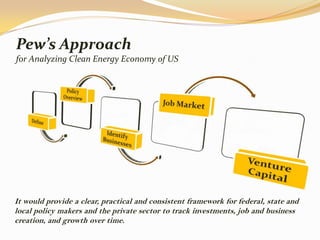
Pew’s Approach
for Analyzing Clean Energy Economy of US


It would provide a clear, practical and consistent framework for federal, state and
local policy makers and the private sector to track investments, job and business
creation, and growth over time.
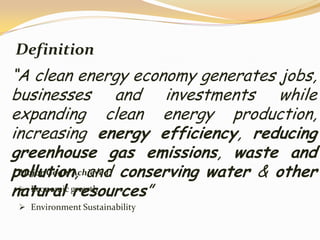
Definition
“A clean energy economy generates jobs,
businesses and investments while
expanding clean energy production,
increasing energy efficiency, reducing
greenhouse gas emissions, waste and
pollution, and conserving water & other
 Major Goals Achieved:

natural growth
  Economic
             resources”
 Environment Sustainability
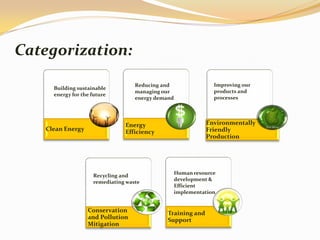
Categorization:
                                   Reducing and                 Improving our
     Building sustainable
                                   managing our                 products and
     energy for the future
                                   energy demand                processes


                               Energy                        Environmentally
   Clean Energy                Efficiency                    Friendly
                                                             Production


                                                   Human resource
                    Recycling and
                                                   development &
                    remediating waste
                                                   Efficient
                                                   implementation


                  Conservation               Training and
                  and Pollution              Support
                  Mitigation
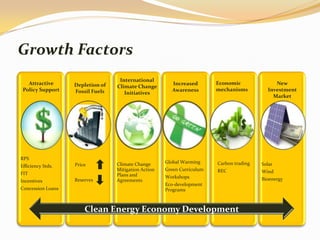
Growth Factors
                                   International
   Attractive      Depletion of                          Increased       Economic              New
                                  Climate Change
 Policy Support    Fossil Fuels                          Awareness       mechanisms         Investment
                                     Initiatives
                                                                                              Market


RPS
                                  Climate Change      Global Warming     Carbon trading   Solar
Efficiency Stds.   Price
                                  Mitigation Action   Green Curriculum   REC              Wind
FIT                               Plans and           Workshops                           Bioenergy
Incentives         Reserves       Agreements
                                                      Eco-development
Concession Loans                                      Programs


                       Clean Energy Economy Development
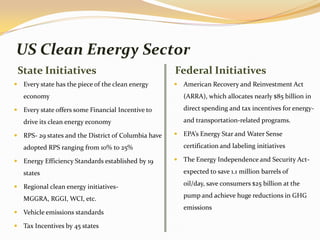
US Clean Energy Sector
 State Initiatives                                   Federal Initiatives
 Every state has the piece of the clean energy       American Recovery and Reinvestment Act
   economy                                              (ARRA), which allocates nearly $85 billion in

 Every state offers some Financial Incentive to        direct spending and tax incentives for energy-

   drive its clean energy economy                       and transportation-related programs.

 RPS- 29 states and the District of Columbia have    EPA’s Energy Star and Water Sense

   adopted RPS ranging from 10% to 25%                  certification and labeling initiatives

 Energy Efficiency Standards established by 19       The Energy Independence and Security Act-

   states                                               expected to save 1.1 million barrels of

 Regional clean energy initiatives-
                                                        oil/day, save consumers $25 billion at the

   MGGRA, RGGI, WCI, etc.                               pump and achieve huge reductions in GHG
                                                        emissions
 Vehicle emissions standards

 Tax Incentives by 45 states
American Recovery and Reinvestment Act (ARRA)
 The federal stimulus bill enacted in February 2009 includes an array of provisions to
  spur clean energy generation and energy efficiency businesses, jobs and investments.
 The program would apply to electric utilities, oil companies and other entities that
  produce more than 25,000 tons of carbon dioxide each year.
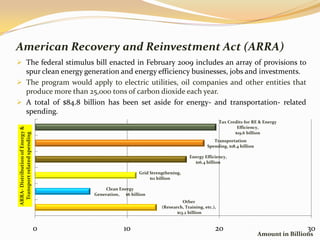
 A total of $84.8 billion has been set aside for energy- and transportation- related
  spending.
                                                                                                Tax Credits for RE & Energy
                                                                                                        Efficiency,
ARRA- Distribution of Energy &


                                                                                                       $19.6 billion
  Transport related spending


                                                                                           Transportation
                                                                                        Spending, $18.4 billion

                                                                               Energy Efficiency,
                                                                                 $16.4 billion

                                                        Grid Strengthening,
                                                             $11 billion

                                         Clean Energy
                                     Generation, $6 billion
                                                                            Other
                                                                  (Research, Training, etc.),
                                                                         $13.2 billion


                                 0               10                                         20                                    30
                                                                                                                  Amount in Billions
Businesses & Jobs
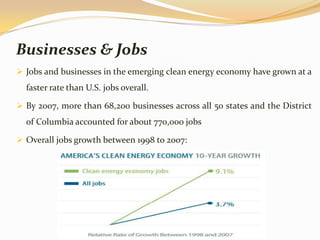
 Jobs and businesses in the emerging clean energy economy have grown at a
  faster rate than U.S. jobs overall.

 By 2007, more than 68,200 businesses across all 50 states and the District
  of Columbia accounted for about 770,000 jobs

 Overall jobs growth between 1998 to 2007:
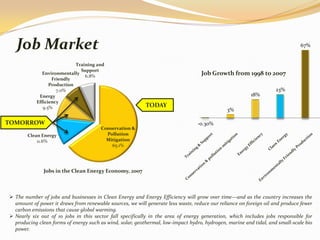
Job Market                                                                                                                 67%


                            Training and
                              Support
              Environmentally
                                6.8%
                                                                                   Job Growth from 1998 to 2007
                  Friendly
                 Production
                    7.0%                                                                                            23%
            Energy                                                                                       18%
           Efficiency
              9.5%                                         TODAY
                                                                                              3%

TOMORROW                                                                          -0.30%
                                       Conservation &
       Clean Energy                      Pollution
           11.6%                         Mitigation
                                           65.1%


              Jobs in the Clean Energy Economy, 2007


 The number of jobs and businesses in Clean Energy and Energy Efficiency will grow over time—and as the country increases the
  amount of power it draws from renewable sources, we will generate less waste, reduce our reliance on foreign oil and produce fewer
  carbon emissions that cause global warming.
 Nearly six out of 10 jobs in this sector fall specifically in the area of energy generation, which includes jobs responsible for
  producing clean forms of energy such as wind, solar, geothermal, low-impact hydro, hydrogen, marine and tidal, and small-scale bio
  power.
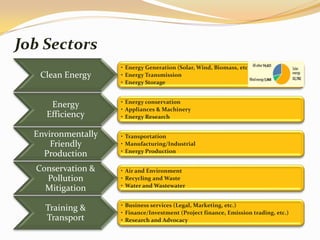
Job Sectors
                    • Energy Generation (Solar, Wind, Biomass, etc.)
   Clean Energy     • Energy Transmission
                    • Energy Storage


                    • Energy conservation
      Energy        • Appliances & Machinery
     Efficiency     • Energy Research


  Environmentally   • Transportation
      Friendly      • Manufacturing/Industrial
                    • Energy Production
    Production
  Conservation &    • Air and Environment
    Pollution       • Recycling and Waste
                    • Water and Wastewater
    Mitigation
                    • Business services (Legal, Marketing, etc.)
    Training &      • Finance/Investment (Project finance, Emission trading, etc.)
    Transport       • Research and Advocacy
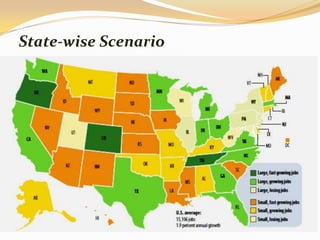
State-wise Scenario
Patents & Venture Capital Investments
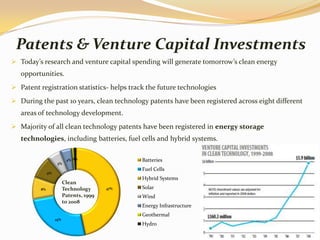
 Today’s research and venture capital spending will generate tomorrow’s clean energy
   opportunities.
 Patent registration statistics- helps track the future technologies

 During the past 10 years, clean technology patents have been registered across eight different
   areas of technology development.
 Majority of all clean technology patents have been registered in energy storage
   technologies, including batteries, fuel cells and hybrid systems.

                               1%
                           4% 1%                Batteries
                     5%
                                                Fuel Cells
               9%
                                                Hybrid Systems
                          Clean
          8%              Technology      47%   Solar
                          Patents, 1999         Wind
                          to 2008
                                                Energy Infrastructure
                                                Geothermal
                    25%
                                                Hydro
Investments
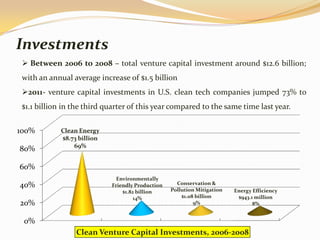
  Between 2006 to 2008 – total venture capital investment around $12.6 billion;
 with an annual average increase of $1.5 billion
 2011- venture capital investments in U.S. clean tech companies jumped 73% to
 $1.1 billion in the third quarter of this year compared to the same time last year.


100%         Clean Energy
             $8.73 billion
                 69%
80%

60%
                               Environmentally
40%                          Friendly Production     Conservation &
                                 $1.82 billion     Pollution Mitigation   Energy Efficiency
                                      14%              $1.08 billion       $943.1 million
20%                                                         9%                   8%


 0%
                  Clean Venture Capital Investments, 2006-2008
State-wise Economy
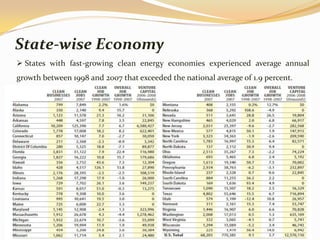
 States with fast-growing clean energy economies experienced average annual
growth between 1998 and 2007 that exceeded the national average of 1.9 percent.
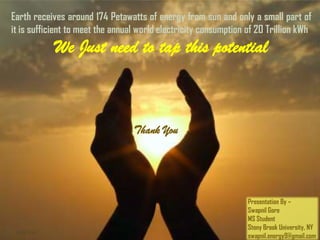
Earth receives around 174 Petawatts of energy from sun and only a small part of
it is sufficient to meet the annual world electricity consumption of 20 Trillion kWh
             We Just need to tap this potential
                  Thank You
                                  Thank You


                                                                  Presentation By –
                                                                  Swapnil Gore
                                                                  MS Student
                                                                  Stony Brook University, NY
 5/16/2011
                                                                  swapnil.energy9@gmail.com

Clean Energy Economy

  • 1.
    Based on analysisreport by- The Pew Charitable Trust Presentation By – Swapnil Gore MS Student Stony Brook University, NY swapnil.energy9@gmail.com
  • 2.
    Pew’s Approach for AnalyzingClean Energy Economy of US It would provide a clear, practical and consistent framework for federal, state and local policy makers and the private sector to track investments, job and business creation, and growth over time.
  • 3.
    Definition “A clean energyeconomy generates jobs, businesses and investments while expanding clean energy production, increasing energy efficiency, reducing greenhouse gas emissions, waste and pollution, and conserving water & other Major Goals Achieved: natural growth  Economic resources”  Environment Sustainability
  • 4.
    Categorization: Reducing and Improving our Building sustainable managing our products and energy for the future energy demand processes Energy Environmentally Clean Energy Efficiency Friendly Production Human resource Recycling and development & remediating waste Efficient implementation Conservation Training and and Pollution Support Mitigation
  • 5.
    Growth Factors International Attractive Depletion of Increased Economic New Climate Change Policy Support Fossil Fuels Awareness mechanisms Investment Initiatives Market RPS Climate Change Global Warming Carbon trading Solar Efficiency Stds. Price Mitigation Action Green Curriculum REC Wind FIT Plans and Workshops Bioenergy Incentives Reserves Agreements Eco-development Concession Loans Programs Clean Energy Economy Development
  • 6.
    US Clean EnergySector State Initiatives Federal Initiatives  Every state has the piece of the clean energy  American Recovery and Reinvestment Act economy (ARRA), which allocates nearly $85 billion in  Every state offers some Financial Incentive to direct spending and tax incentives for energy- drive its clean energy economy and transportation-related programs.  RPS- 29 states and the District of Columbia have  EPA’s Energy Star and Water Sense adopted RPS ranging from 10% to 25% certification and labeling initiatives  Energy Efficiency Standards established by 19  The Energy Independence and Security Act- states expected to save 1.1 million barrels of  Regional clean energy initiatives- oil/day, save consumers $25 billion at the MGGRA, RGGI, WCI, etc. pump and achieve huge reductions in GHG emissions  Vehicle emissions standards  Tax Incentives by 45 states
  • 7.
    American Recovery andReinvestment Act (ARRA)  The federal stimulus bill enacted in February 2009 includes an array of provisions to spur clean energy generation and energy efficiency businesses, jobs and investments.  The program would apply to electric utilities, oil companies and other entities that produce more than 25,000 tons of carbon dioxide each year.  A total of $84.8 billion has been set aside for energy- and transportation- related spending. Tax Credits for RE & Energy Efficiency, ARRA- Distribution of Energy & $19.6 billion Transport related spending Transportation Spending, $18.4 billion Energy Efficiency, $16.4 billion Grid Strengthening, $11 billion Clean Energy Generation, $6 billion Other (Research, Training, etc.), $13.2 billion 0 10 20 30 Amount in Billions
  • 8.
    Businesses & Jobs Jobs and businesses in the emerging clean energy economy have grown at a faster rate than U.S. jobs overall.  By 2007, more than 68,200 businesses across all 50 states and the District of Columbia accounted for about 770,000 jobs  Overall jobs growth between 1998 to 2007:
  • 9.
    Job Market 67% Training and Support Environmentally 6.8% Job Growth from 1998 to 2007 Friendly Production 7.0% 23% Energy 18% Efficiency 9.5% TODAY 3% TOMORROW -0.30% Conservation & Clean Energy Pollution 11.6% Mitigation 65.1% Jobs in the Clean Energy Economy, 2007  The number of jobs and businesses in Clean Energy and Energy Efficiency will grow over time—and as the country increases the amount of power it draws from renewable sources, we will generate less waste, reduce our reliance on foreign oil and produce fewer carbon emissions that cause global warming.  Nearly six out of 10 jobs in this sector fall specifically in the area of energy generation, which includes jobs responsible for producing clean forms of energy such as wind, solar, geothermal, low-impact hydro, hydrogen, marine and tidal, and small-scale bio power.
  • 10.
    Job Sectors • Energy Generation (Solar, Wind, Biomass, etc.) Clean Energy • Energy Transmission • Energy Storage • Energy conservation Energy • Appliances & Machinery Efficiency • Energy Research Environmentally • Transportation Friendly • Manufacturing/Industrial • Energy Production Production Conservation & • Air and Environment Pollution • Recycling and Waste • Water and Wastewater Mitigation • Business services (Legal, Marketing, etc.) Training & • Finance/Investment (Project finance, Emission trading, etc.) Transport • Research and Advocacy
  • 11.
  • 12.
    Patents & VentureCapital Investments  Today’s research and venture capital spending will generate tomorrow’s clean energy opportunities.  Patent registration statistics- helps track the future technologies  During the past 10 years, clean technology patents have been registered across eight different areas of technology development.  Majority of all clean technology patents have been registered in energy storage technologies, including batteries, fuel cells and hybrid systems. 1% 4% 1% Batteries 5% Fuel Cells 9% Hybrid Systems Clean 8% Technology 47% Solar Patents, 1999 Wind to 2008 Energy Infrastructure Geothermal 25% Hydro
  • 13.
    Investments  Between2006 to 2008 – total venture capital investment around $12.6 billion; with an annual average increase of $1.5 billion 2011- venture capital investments in U.S. clean tech companies jumped 73% to $1.1 billion in the third quarter of this year compared to the same time last year. 100% Clean Energy $8.73 billion 69% 80% 60% Environmentally 40% Friendly Production Conservation & $1.82 billion Pollution Mitigation Energy Efficiency 14% $1.08 billion $943.1 million 20% 9% 8% 0% Clean Venture Capital Investments, 2006-2008
  • 14.
    State-wise Economy  Stateswith fast-growing clean energy economies experienced average annual growth between 1998 and 2007 that exceeded the national average of 1.9 percent.
  • 15.
    Earth receives around174 Petawatts of energy from sun and only a small part of it is sufficient to meet the annual world electricity consumption of 20 Trillion kWh We Just need to tap this potential Thank You Thank You Presentation By – Swapnil Gore MS Student Stony Brook University, NY 5/16/2011 swapnil.energy9@gmail.com