SELF DEVT.
GOLAK MALIK
Self-Development
What is self-development ?
Self-development can be defined in general as
gaining information needed in a person's
working life acquiring new information and
skills open to change, learning for the sake of
learning and maintaining all this knowledge
throughout life.
What Is Personal Development
Personal development is a lifelong process. It is a
way for people to assess their skills and qualities,
consider their aims in life and set goals to realize
and maximize their potential.
Personal development covers activities that improve
awareness and identity, develop talents and
potential, build human capital and enhance the
quality of life and contribute to the realization of
dreams and aspirations.
Process Of Self-Development
The process of self-development includes :-
1. Developing awareness about self
2. Adopting methods of development
Developing Self-Awareness
Personal effectiveness is increased through self-awareness.
Self-awareness is the level of awareness/understanding on an
individual of his own self.
According to the Johari model, there are two dimensions of
understanding self:
1. Those aspects of a person's behavior and style that are
known to himself.
2. Those aspects of his behavior known to those with whom
he interacts(others).
Adopting Methods Of Self-Development
This can be done in the following ways :
1. Constructive behavior
2. Time Management
3. Upgrading knowledge
Constructive Behavior
The person should engage in Constructive behavior which
leads to goal attainment. Stimuli that evoke undesirable
behavior should be removed and should promote stimuli that
evoke desirable behavior.
Time Management
The person is usually constrained by time in achieving the
organizational goals. Time management reduces the elements
that leads to time waste.
Upgrading Knowledge
Person should not only do the assigned task or formal organizational
activities, but also enrich their knowledge by reading good books,
newspaper, journals etc.
Why Self-Development Is Important
1. Increases self-awareness and understanding
2. Builds self-confident
3. Improve relationships
4. Helps in fulfillment and purpose
Competence
Competence is the ability of an individual to do a work properly.
A competency is a set of defined behaviors that provides a structured
guide enabling the identification, evaluation and development of
behaviors in individual person
Competencies are skills, knowledge and attributes that are specifically
valued by professional association, organizations and bodies
connected to future perspectives.
It is described as the ability one possess of doing something efficiently
without any difficulties. This is achieved by an individual through
professional development. Professional development is a way of
ensuring one development in a way of ensuring one develops and
sharpens their competencies that are required for their profession.
Competence is Basically…
1. Experience
2. Knowledge
3. Ability
4. Attitude
5. Behavior
Types Of Competencies
 Communication Competencies
 Interpersonal Competencies
 Organizational Competencies
 Thinking Competencies
 Human Research Competencies
 Leadership Competencies
 Self-Management Competencies
Professional Competencies
 Professional competence is the ability to
carry out the professional activities
characterized by smoot and even perfect
completion of work.
 Professional competence are the system of
knowledge, skills, abilities and motivational
depositions which provides the effective
realization of the professional activities.
 It helps us to stay current with the changing
work environment and prepare for any
potential future adjustments.
Professional Competencies
Benefits Of Professional Competencies
a) Improves the productivity of an individual
b) Improves the performance of the individual
c) Sets clear expectations to an individual in their
profession
d) It fully equips an individual with essential skills
Indicators Of Professional Competence
Given below are some of the indicators of professional competence :
1. Expertise:- demonstrate knowledge and skills in a specific field
2. Problem -solving ability:- effectively identity and resolve complex issues
3. Communication skills:- clear, concise and effective communication
4. Adaptability:- ability to adjust to changing situations, environment or
requirements
5. Leadership:- capability to inspire, , motivate, and others
6. Ethical conduct:- consistently demonstrating integrity, honesty and accountability
in profession
7. Collaboration:- working effectively with others.
8. Continuous learning:- commitment to stay updated with the trend.
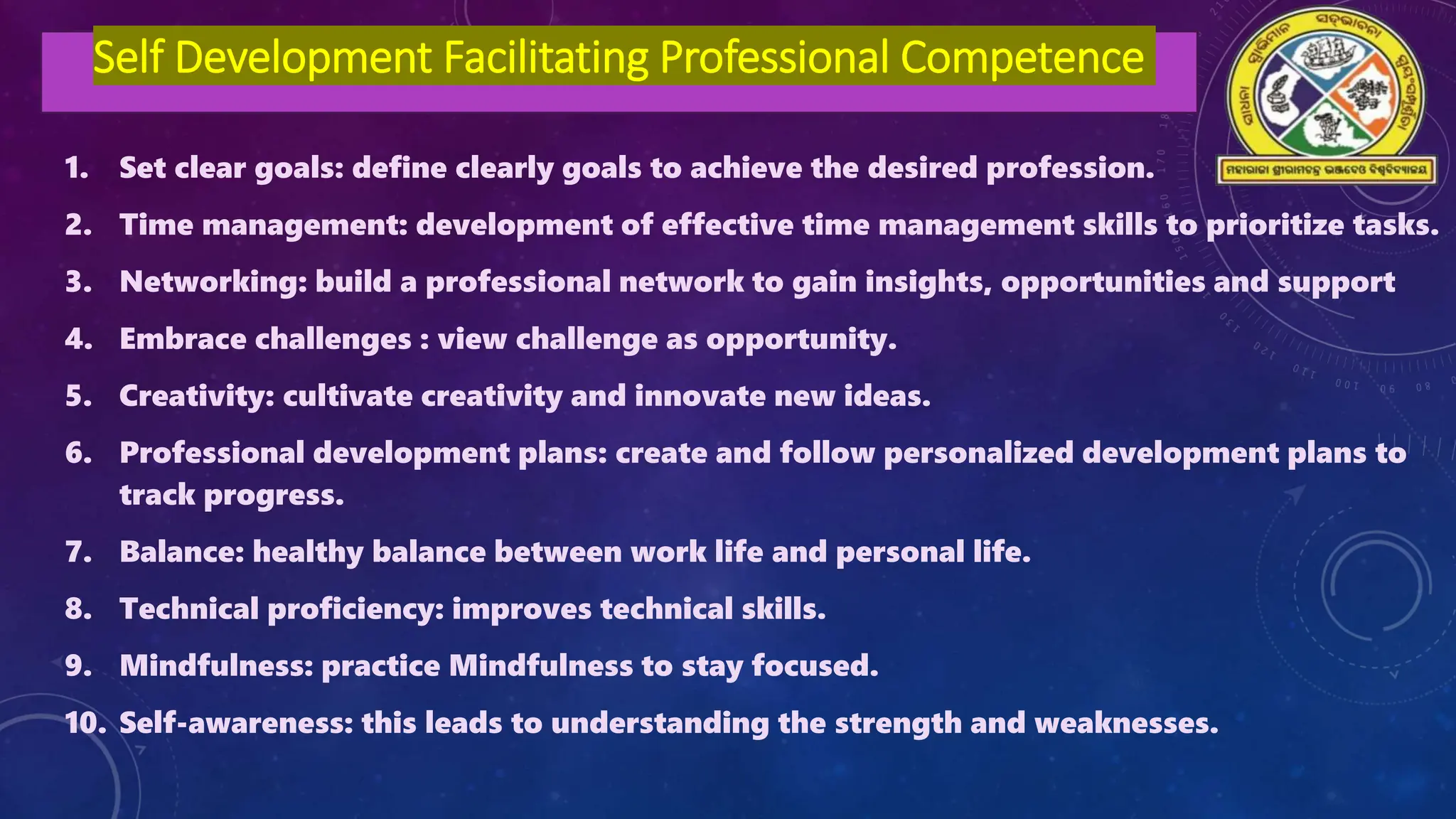
Self Development Facilitating Professional Competence
1. Set clear goals: define clearly goals to achieve the desired profession.
2. Time management: development of effective time management skills to prioritize tasks.
3. Networking: build a professional network to gain insights, opportunities and support
4. Embrace challenges : view challenge as opportunity.
5. Creativity: cultivate creativity and innovate new ideas.
6. Professional development plans: create and follow personalized development plans to
track progress.
7. Balance: healthy balance between work life and personal life.
8. Technical proficiency: improves technical skills.
9. Mindfulness: practice Mindfulness to stay focused.
10. Self-awareness: this leads to understanding the strength and weaknesses.
Thank You…

PPT On Self-Development & Professional Competence - By Jyotiska Das 1.pptx

  • 1.
  • 2.
    Self-Development What is self-development? Self-development can be defined in general as gaining information needed in a person's working life acquiring new information and skills open to change, learning for the sake of learning and maintaining all this knowledge throughout life.
  • 3.
    What Is PersonalDevelopment Personal development is a lifelong process. It is a way for people to assess their skills and qualities, consider their aims in life and set goals to realize and maximize their potential. Personal development covers activities that improve awareness and identity, develop talents and potential, build human capital and enhance the quality of life and contribute to the realization of dreams and aspirations.
  • 4.
    Process Of Self-Development Theprocess of self-development includes :- 1. Developing awareness about self 2. Adopting methods of development
  • 5.
    Developing Self-Awareness Personal effectivenessis increased through self-awareness. Self-awareness is the level of awareness/understanding on an individual of his own self. According to the Johari model, there are two dimensions of understanding self: 1. Those aspects of a person's behavior and style that are known to himself. 2. Those aspects of his behavior known to those with whom he interacts(others).
  • 6.
    Adopting Methods OfSelf-Development This can be done in the following ways : 1. Constructive behavior 2. Time Management 3. Upgrading knowledge
  • 7.
    Constructive Behavior The personshould engage in Constructive behavior which leads to goal attainment. Stimuli that evoke undesirable behavior should be removed and should promote stimuli that evoke desirable behavior. Time Management The person is usually constrained by time in achieving the organizational goals. Time management reduces the elements that leads to time waste. Upgrading Knowledge Person should not only do the assigned task or formal organizational activities, but also enrich their knowledge by reading good books, newspaper, journals etc.
  • 8.
    Why Self-Development IsImportant 1. Increases self-awareness and understanding 2. Builds self-confident 3. Improve relationships 4. Helps in fulfillment and purpose
  • 9.
    Competence Competence is theability of an individual to do a work properly. A competency is a set of defined behaviors that provides a structured guide enabling the identification, evaluation and development of behaviors in individual person Competencies are skills, knowledge and attributes that are specifically valued by professional association, organizations and bodies connected to future perspectives. It is described as the ability one possess of doing something efficiently without any difficulties. This is achieved by an individual through professional development. Professional development is a way of ensuring one development in a way of ensuring one develops and sharpens their competencies that are required for their profession.
  • 10.
    Competence is Basically… 1.Experience 2. Knowledge 3. Ability 4. Attitude 5. Behavior
  • 11.
    Types Of Competencies Communication Competencies  Interpersonal Competencies  Organizational Competencies  Thinking Competencies  Human Research Competencies  Leadership Competencies  Self-Management Competencies
  • 12.
    Professional Competencies  Professionalcompetence is the ability to carry out the professional activities characterized by smoot and even perfect completion of work.  Professional competence are the system of knowledge, skills, abilities and motivational depositions which provides the effective realization of the professional activities.  It helps us to stay current with the changing work environment and prepare for any potential future adjustments.
  • 13.
  • 14.
    Benefits Of ProfessionalCompetencies a) Improves the productivity of an individual b) Improves the performance of the individual c) Sets clear expectations to an individual in their profession d) It fully equips an individual with essential skills
  • 15.
    Indicators Of ProfessionalCompetence Given below are some of the indicators of professional competence : 1. Expertise:- demonstrate knowledge and skills in a specific field 2. Problem -solving ability:- effectively identity and resolve complex issues 3. Communication skills:- clear, concise and effective communication 4. Adaptability:- ability to adjust to changing situations, environment or requirements 5. Leadership:- capability to inspire, , motivate, and others 6. Ethical conduct:- consistently demonstrating integrity, honesty and accountability in profession 7. Collaboration:- working effectively with others. 8. Continuous learning:- commitment to stay updated with the trend.
  • 16.
    Self Development FacilitatingProfessional Competence 1. Set clear goals: define clearly goals to achieve the desired profession. 2. Time management: development of effective time management skills to prioritize tasks. 3. Networking: build a professional network to gain insights, opportunities and support 4. Embrace challenges : view challenge as opportunity. 5. Creativity: cultivate creativity and innovate new ideas. 6. Professional development plans: create and follow personalized development plans to track progress. 7. Balance: healthy balance between work life and personal life. 8. Technical proficiency: improves technical skills. 9. Mindfulness: practice Mindfulness to stay focused. 10. Self-awareness: this leads to understanding the strength and weaknesses.
  • 17.