GOKHALE’S BILL (1910-1912)
Priti Kalsia
Assistant Professor
Malwa central college of education for women,
Ludhiana
INTRODUCTION
In the beginning of the twentieth century Indian
people started realizing that the country needs a
nationalistic system of education based on the
cultural heritage and tradition of the nation.
INTRODUCTION…..
At the Calcutta conference of the Congress in 1906, Annie
Besant{Britisher,womenright activist, theosophist}declared
that throughout the country a national education should be
organised.
IN 1910
 Literate people = 6%
 School Going
 2.38% boys
 2.07% girls
 The demand for compulsory primary education
was strengthened by the fact that the Maharaja
Sayaji Rao Gaikwad of Boroda had made
primary education free and compulsory within
the territories of his state.
 This attempt inspired Gokhale.
 Made heroic efforts to make the Government
accept the same.
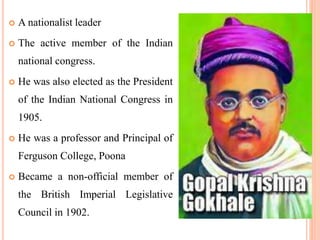
 A nationalist leader
 The active member of the Indian
national congress.
 He was also elected as the President
of the Indian National Congress in
1905.
 He was a professor and Principal of
Ferguson College, Poona
 Became a non-official member of
the British Imperial Legislative
Council in 1902.
PROPOSAL FOR COMPULSORY PRIMARY
EDUCATION IN 1910
“A beginning should be made in the
direction of making elementary education
free and compulsory throughout the
country, and that a mixed commission of
officials and non officials be appointed at
an early date to frame definite proposal.”
IMPORTANT POINTS OF THE RESOLUTION
 Free and compulsory education: where 35% of boys were
receiving education
 Age group of 6-10 years: Provision should be for
 Expenditure: Cost should be shared in the ration of 2 : 1
Provincial government and Local bodies
 A separate department of education: under the central level to
draw up a scheme for the expansion of primary education
 Appointment of secretary: to organize, supervise and look after
the primary education
 Statement: A statement describing the progress of education
included in budget statement.
REACTION OF THE RESOLUTION
 A department of Education was established under the
Central Government
 The secretary was also appointed.
 The record of the progress of primary education also
started to be published by the Government.
 The main issue of making primary education free and
compulsory remained neglected and unattended by the
Government.
1. Gopal Krishna Gokhale was a_________leader.
2. Gokhale was inspired by the effort of _________ of Baroda.
3. The provision of compulsory primary education should be
applicable to the age group of _________ years.
4. A separate department of _________ shall be established under
_________ Government.
5. A _________ should be appointed to supervise the progress of
compulsory primary education.
6. The cost of compulsory education should be shared by the
_________ and the _________.
GOKHALE’S BILL OF 1912
seeing the indifference of the Government on 16th
March of 1911, Gokhale presented a Bill in the Legislative
Council to make a stronger fight against the Government.
RECOMMENDATIONS
 Compulsory primary education in certain areas for girls
 Fixed percentage of attendance: By Governor- General in
council.
 Choice to local bodies: to introduce compulsion in the
whole or as a part of the area under their jurisdiction.
RECOMMENDATIONS….
 Cost should be shared in the ration of 2 : 1
 Free education to financial weaker sections: monthly
income less than 10/-
 Compulsory education for boys: 6-10 years
 sanction of the Viceroy and the Governor became
necessary
GOVERNMENT REACTION TOWARDS THE BILL
Gokhale’s Bill of 1911 was referred to a
select committee of 15 members for
examination.
sent to the state Governments, the
Universities and local education authorities
for inviting opinion on it.
REACTION…….
 The Bill was taken up for discussion in
legislative council on 17 March, 1912.
 The Bill was debated for two days (March 18 &
19, 1912).
 Gokhale had raised powerful arguments in support of
the Bill.
 But the Government was not ready to accept the Bill
 it was put to vote and was defeated by 38 votes to 13.
This did not come as a surprise to Gokhale.
 He had anticipated the result correctly and earlier in the
debate had already expressed the result of the voting in
the following majestic words :
 “My Lord, I know that my Bill will be thrown out before the
day closes. I make no complaint. I shall not even feel
depressed. We the present generation of India can only hope
to serve our country by our failures. The men and women
who will be privileged to serve her by their successes will
come later” .
 Thus the Bill, though defeated, but it was a heroic defeat.
REASONS OF REJECTIONS
 There was no popular demand for introducing compulsory
primary education in the country.
 As such, the people of the country were not prepared to
accept compulsion.
 The local Governments were not in favour of it.
 The local bodies were not willing to levy educational cess.
 A section of the educated Indians were not supporting the
Bill.
 There was still scope for extension of primary education on
voluntary lines based on the system of grants-in-aid.
 The Government could not entirely ignore the growing popular
demand for the spread of mass education.
 Fortunately, king George V came to India in 1912 and declared a
donation of 50 lakh rupees for the development of primary
education in India.
 The Government of India passed the resolution on educational
policy on February 21, 1913.
 In united provinces, the Punjab, Assam and central provinces too,
the elementary education was introduced widely at a nominal rate
of fees.
Impact of Gokhale’s Bill on Primary Education
CONCLUSION
 Gokhale, was the first person who put his best
efforts to introduce free and compulsory primary
education in phased manner. His struggle for
compulsion of education formed an important part
of the country’s struggle of independence during
the British Rule.
SHORT NOTE ON:
a) Gopal Krishna Gokhale.
b) Gokhale’s Resolution of 1910.
c) Reaction of Government
d) Gokhale’s Bill of 1911.
e) Reasons of rejection of Gokhale’s Bill.
Gokhle bill (1912)

Gokhle bill (1912)

  • 1.
    GOKHALE’S BILL (1910-1912) PritiKalsia Assistant Professor Malwa central college of education for women, Ludhiana
  • 2.
    INTRODUCTION In the beginningof the twentieth century Indian people started realizing that the country needs a nationalistic system of education based on the cultural heritage and tradition of the nation.
  • 3.
    INTRODUCTION….. At the Calcuttaconference of the Congress in 1906, Annie Besant{Britisher,womenright activist, theosophist}declared that throughout the country a national education should be organised.
  • 4.
    IN 1910  Literatepeople = 6%  School Going  2.38% boys  2.07% girls
  • 5.
     The demandfor compulsory primary education was strengthened by the fact that the Maharaja Sayaji Rao Gaikwad of Boroda had made primary education free and compulsory within the territories of his state.  This attempt inspired Gokhale.  Made heroic efforts to make the Government accept the same.
  • 6.
     A nationalistleader  The active member of the Indian national congress.  He was also elected as the President of the Indian National Congress in 1905.  He was a professor and Principal of Ferguson College, Poona  Became a non-official member of the British Imperial Legislative Council in 1902.
  • 7.
    PROPOSAL FOR COMPULSORYPRIMARY EDUCATION IN 1910 “A beginning should be made in the direction of making elementary education free and compulsory throughout the country, and that a mixed commission of officials and non officials be appointed at an early date to frame definite proposal.”
  • 8.
    IMPORTANT POINTS OFTHE RESOLUTION  Free and compulsory education: where 35% of boys were receiving education  Age group of 6-10 years: Provision should be for  Expenditure: Cost should be shared in the ration of 2 : 1 Provincial government and Local bodies  A separate department of education: under the central level to draw up a scheme for the expansion of primary education  Appointment of secretary: to organize, supervise and look after the primary education  Statement: A statement describing the progress of education included in budget statement.
  • 9.
    REACTION OF THERESOLUTION  A department of Education was established under the Central Government  The secretary was also appointed.  The record of the progress of primary education also started to be published by the Government.  The main issue of making primary education free and compulsory remained neglected and unattended by the Government.
  • 10.
    1. Gopal KrishnaGokhale was a_________leader. 2. Gokhale was inspired by the effort of _________ of Baroda. 3. The provision of compulsory primary education should be applicable to the age group of _________ years. 4. A separate department of _________ shall be established under _________ Government. 5. A _________ should be appointed to supervise the progress of compulsory primary education. 6. The cost of compulsory education should be shared by the _________ and the _________.
  • 11.
    GOKHALE’S BILL OF1912 seeing the indifference of the Government on 16th March of 1911, Gokhale presented a Bill in the Legislative Council to make a stronger fight against the Government.
  • 12.
    RECOMMENDATIONS  Compulsory primaryeducation in certain areas for girls  Fixed percentage of attendance: By Governor- General in council.  Choice to local bodies: to introduce compulsion in the whole or as a part of the area under their jurisdiction.
  • 13.
    RECOMMENDATIONS….  Cost shouldbe shared in the ration of 2 : 1  Free education to financial weaker sections: monthly income less than 10/-  Compulsory education for boys: 6-10 years  sanction of the Viceroy and the Governor became necessary
  • 14.
    GOVERNMENT REACTION TOWARDSTHE BILL Gokhale’s Bill of 1911 was referred to a select committee of 15 members for examination. sent to the state Governments, the Universities and local education authorities for inviting opinion on it.
  • 15.
    REACTION…….  The Billwas taken up for discussion in legislative council on 17 March, 1912.  The Bill was debated for two days (March 18 & 19, 1912).
  • 16.
     Gokhale hadraised powerful arguments in support of the Bill.  But the Government was not ready to accept the Bill  it was put to vote and was defeated by 38 votes to 13. This did not come as a surprise to Gokhale.  He had anticipated the result correctly and earlier in the debate had already expressed the result of the voting in the following majestic words :
  • 17.
     “My Lord,I know that my Bill will be thrown out before the day closes. I make no complaint. I shall not even feel depressed. We the present generation of India can only hope to serve our country by our failures. The men and women who will be privileged to serve her by their successes will come later” .  Thus the Bill, though defeated, but it was a heroic defeat.
  • 18.
    REASONS OF REJECTIONS There was no popular demand for introducing compulsory primary education in the country.  As such, the people of the country were not prepared to accept compulsion.  The local Governments were not in favour of it.  The local bodies were not willing to levy educational cess.  A section of the educated Indians were not supporting the Bill.  There was still scope for extension of primary education on voluntary lines based on the system of grants-in-aid.
  • 19.
     The Governmentcould not entirely ignore the growing popular demand for the spread of mass education.  Fortunately, king George V came to India in 1912 and declared a donation of 50 lakh rupees for the development of primary education in India.  The Government of India passed the resolution on educational policy on February 21, 1913.  In united provinces, the Punjab, Assam and central provinces too, the elementary education was introduced widely at a nominal rate of fees. Impact of Gokhale’s Bill on Primary Education
  • 20.
    CONCLUSION  Gokhale, wasthe first person who put his best efforts to introduce free and compulsory primary education in phased manner. His struggle for compulsion of education formed an important part of the country’s struggle of independence during the British Rule.
  • 21.
    SHORT NOTE ON: a)Gopal Krishna Gokhale. b) Gokhale’s Resolution of 1910. c) Reaction of Government d) Gokhale’s Bill of 1911. e) Reasons of rejection of Gokhale’s Bill.