Presented by
Prof.Virendra Jain
Principal, Dinsha Patel College of
Nursing 5/24/2024
1
2. Writing Research Objectives &
Variable in research
Flow of presentations
5/24/2024
2
 Writing objectives
 Variable in research
Research Objectives
5/24/2024
3
 A research objective is a clear, concise,
declarative statement, which provides
direction to investigate the variables.
 Generally research objectives focus on the
ways to measure the variables, such as to
identify or describe them.
 Sometimes objectives are directed towards
identifying the relationship or difference
between two variables.
Why We Need Research Objectives??
5/24/2024
4
 Research objectives will help the researcher to:
1. Focus
2. Avoid
3. Organize
4. Directions
Characteristics of Research Objectives
5/24/2024
5
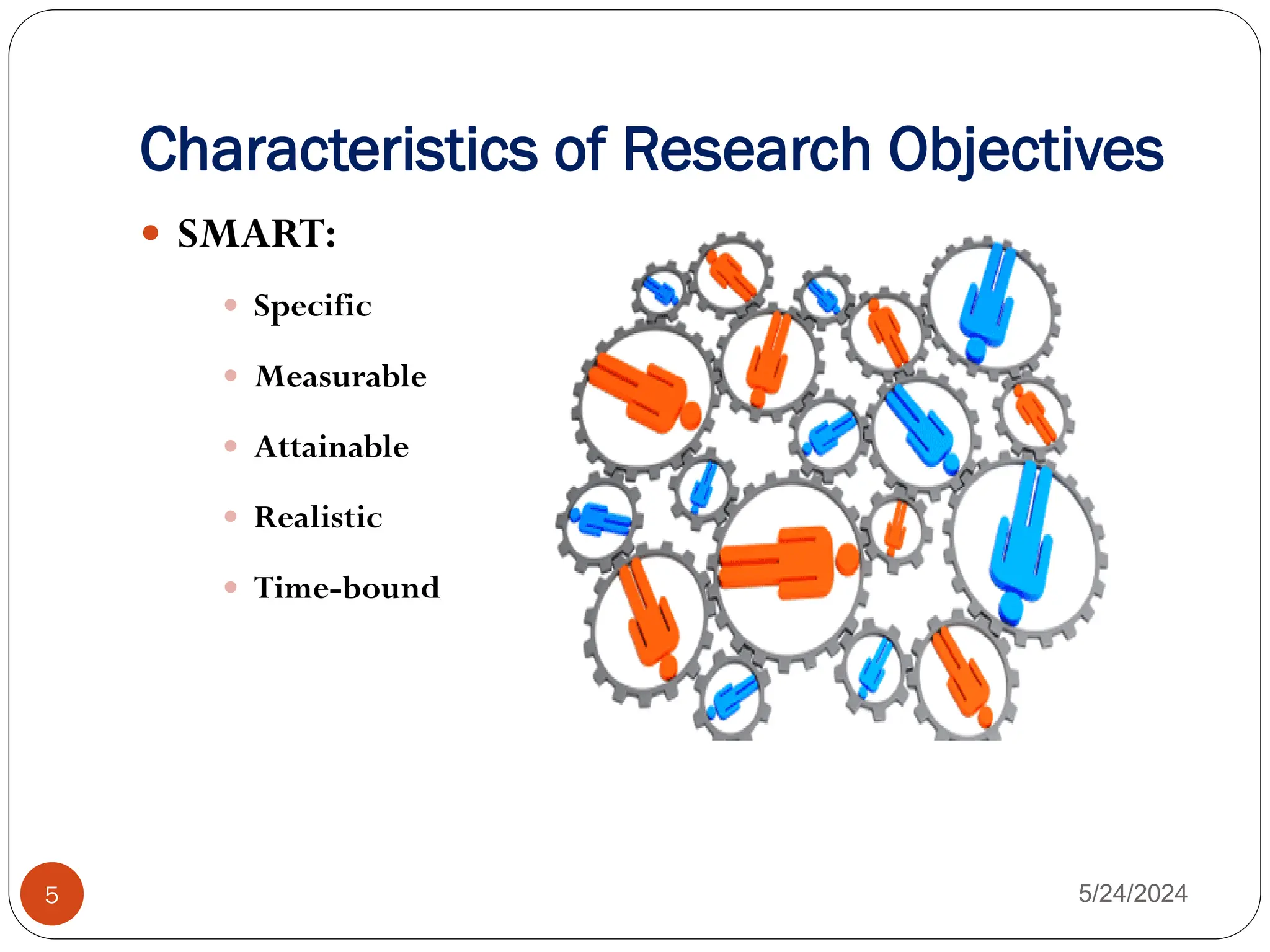
 SMART:
 Specific
 Measurable
 Attainable
 Realistic
 Time-bound
Characteristics of Research Objectives
5/24/2024
6
 Research objective should be:
Relevant
Feasible
Logical
Observable
Unequivocal
Types of Research Objectives
5/24/2024
7
1. Primary Objective: The main objective to be achieved.
2. Secondary Objectives: The subsidiary objectives may
considered to extend the scope of study.
Primary & Secondary Objectives
5/24/2024
8
 Example: Challenges of Home Based Palliative Care Faced By Family
Caregivers ofTerminally Ill Cancer Patients:An Exploratory Study
1. Primary Objective: To assess the issues and challenges of home based
palliative care faced by family care givers of terminally ill cancer
patients.
2. Secondary Objectives:
1) To find the accessibility and affordability of public and private health care support to
home-based palliative care.
2) To recommend strategies to overcome the issues and challenges of home based
palliative care.
Stating the objectives
5/24/2024
9
 The objectives should be presented briefly and concisely.
 Objectives must be in concurrence with research
problem and must be stated in coherent way and in
a logical sequence.
 The objectives are clearly phrased in operational
terms, specifying exactly what researcher is going
to do, where, and for what purpose.
 Use action verbs those are specific enough to be
evaluated.
Commonly used action verbs
5/24/2024
10
1. Descriptive/ Cross-sectional Research
1. Identify
2. Assess
3. Find out
4. Describe
5. Compare
6. Contrast
5/24/2024
11
2. Case-control/ Cohort research
 Determine
 Examine
 Identify
 Discriminate
3. Experimental research
 Determine
 Examine
 Investigate
 Measure
 Detect
VARIABLES
5/24/2024
12
 Anything which vary!!
 E.g.
1. weight,
2. height,
3. Hb,
4. BP,
5. pulse etc.
Types of Variables
5/24/2024
13
 Dependent variable: Outcome/ criterion variable:
observational study
 Independent variable:
 Manipulated variable/Treatment variable
 Predictor variable: in observational study
Dependent variable & Independent
variable
5/24/2024
14
 For example,
 a researcher is observing effect of ginger intake (independent
variable) on morning sickness symptoms (dependent
variable) among pregnant women.
Types of Variables
5/24/2024
15
 Confounding variable/Extraneous variables
 Intervening/ Mediating/Moderating variable/ Control variable.
5/24/2024
16
Types of Variables
5/24/2024
17
 Research variable: (Descriptive,exploratory,comparative,and
qualitative research studies)
 Demographic variable: Age,gender,educational status,
religion,social class,marital status,habitat
Research variable
5/24/2024
18
 Example:
 ‘An exploratory study on factors contributing to sleep
disturbance among patients admitted in selected
intensive care units of AIIMS, New Delhi’.
Miscellaneous variables
5/24/2024
19
 Latent variable: An abstract variable which cannot be
directly observed/ measured without converting them into
manifest variable (concrete concepts)
 Univariate study
 Bivariate study
 Multivariate study
Miscellaneous variables
5/24/2024
20
 Manifest variable/ Indicator variable:
 A concrete variable, which can be observed/ measured
assuming it indicate presence of latent variable.
 Intelligence is a latent variable, whereas IQ test
score, writing or reading ability are manifest
variable.
5/24/2024
21
Thank you
for active Listener

PPT on Research Objectives. for nursing students

  • 1.
    Presented by Prof.Virendra Jain Principal,Dinsha Patel College of Nursing 5/24/2024 1 2. Writing Research Objectives & Variable in research
  • 2.
    Flow of presentations 5/24/2024 2 Writing objectives  Variable in research
  • 3.
    Research Objectives 5/24/2024 3  Aresearch objective is a clear, concise, declarative statement, which provides direction to investigate the variables.  Generally research objectives focus on the ways to measure the variables, such as to identify or describe them.  Sometimes objectives are directed towards identifying the relationship or difference between two variables.
  • 4.
    Why We NeedResearch Objectives?? 5/24/2024 4  Research objectives will help the researcher to: 1. Focus 2. Avoid 3. Organize 4. Directions
  • 5.
    Characteristics of ResearchObjectives 5/24/2024 5  SMART:  Specific  Measurable  Attainable  Realistic  Time-bound
  • 6.
    Characteristics of ResearchObjectives 5/24/2024 6  Research objective should be: Relevant Feasible Logical Observable Unequivocal
  • 7.
    Types of ResearchObjectives 5/24/2024 7 1. Primary Objective: The main objective to be achieved. 2. Secondary Objectives: The subsidiary objectives may considered to extend the scope of study.
  • 8.
    Primary & SecondaryObjectives 5/24/2024 8  Example: Challenges of Home Based Palliative Care Faced By Family Caregivers ofTerminally Ill Cancer Patients:An Exploratory Study 1. Primary Objective: To assess the issues and challenges of home based palliative care faced by family care givers of terminally ill cancer patients. 2. Secondary Objectives: 1) To find the accessibility and affordability of public and private health care support to home-based palliative care. 2) To recommend strategies to overcome the issues and challenges of home based palliative care.
  • 9.
    Stating the objectives 5/24/2024 9 The objectives should be presented briefly and concisely.  Objectives must be in concurrence with research problem and must be stated in coherent way and in a logical sequence.  The objectives are clearly phrased in operational terms, specifying exactly what researcher is going to do, where, and for what purpose.  Use action verbs those are specific enough to be evaluated.
  • 10.
    Commonly used actionverbs 5/24/2024 10 1. Descriptive/ Cross-sectional Research 1. Identify 2. Assess 3. Find out 4. Describe 5. Compare 6. Contrast
  • 11.
    5/24/2024 11 2. Case-control/ Cohortresearch  Determine  Examine  Identify  Discriminate 3. Experimental research  Determine  Examine  Investigate  Measure  Detect
  • 12.
    VARIABLES 5/24/2024 12  Anything whichvary!!  E.g. 1. weight, 2. height, 3. Hb, 4. BP, 5. pulse etc.
  • 13.
    Types of Variables 5/24/2024 13 Dependent variable: Outcome/ criterion variable: observational study  Independent variable:  Manipulated variable/Treatment variable  Predictor variable: in observational study
  • 14.
    Dependent variable &Independent variable 5/24/2024 14  For example,  a researcher is observing effect of ginger intake (independent variable) on morning sickness symptoms (dependent variable) among pregnant women.
  • 15.
    Types of Variables 5/24/2024 15 Confounding variable/Extraneous variables  Intervening/ Mediating/Moderating variable/ Control variable.
  • 16.
  • 17.
    Types of Variables 5/24/2024 17 Research variable: (Descriptive,exploratory,comparative,and qualitative research studies)  Demographic variable: Age,gender,educational status, religion,social class,marital status,habitat
  • 18.
    Research variable 5/24/2024 18  Example: ‘An exploratory study on factors contributing to sleep disturbance among patients admitted in selected intensive care units of AIIMS, New Delhi’.
  • 19.
    Miscellaneous variables 5/24/2024 19  Latentvariable: An abstract variable which cannot be directly observed/ measured without converting them into manifest variable (concrete concepts)  Univariate study  Bivariate study  Multivariate study
  • 20.
    Miscellaneous variables 5/24/2024 20  Manifestvariable/ Indicator variable:  A concrete variable, which can be observed/ measured assuming it indicate presence of latent variable.  Intelligence is a latent variable, whereas IQ test score, writing or reading ability are manifest variable.
  • 21.