Seminar
         on

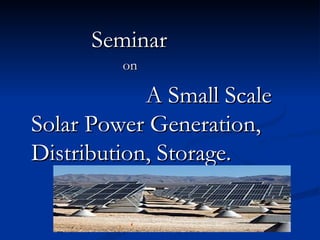
            A Small Scale
Solar Power Generation,
Distribution, Storage.
Solar Energy:
The Ultimate Renewable
       Resource


  Submitted by:-- DEEPESH KUMAR GARG
What is Solar Power?
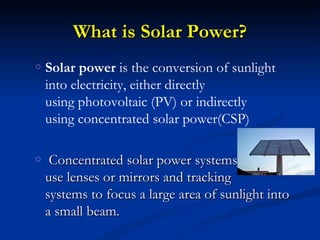
o   Solar power is the conversion of sunlight
    into electricity, either directly
    using photovoltaic (PV) or indirectly
    using concentrated solar power(CSP)

o    Concentrated solar power systems
    use lenses or mirrors and tracking
    systems to focus a large area of sunlight into
    a small beam.
How much solar energy?


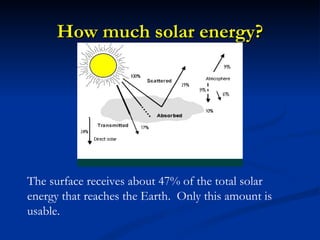
The surface receives about 47% of the total solar
energy that reaches the Earth. Only this amount is
usable.
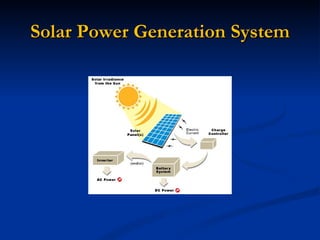
Solar Power Generation System
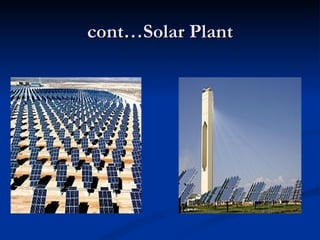
cont…Solar Plant
How To Manufacture?
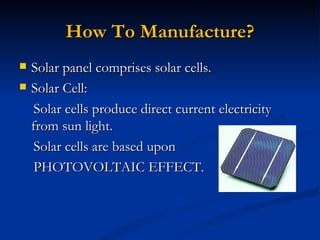
   Solar panel comprises solar cells.
   Solar Cell:
     Solar cells produce direct current electricity
    from sun light.
     Solar cells are based upon
     PHOTOVOLTAIC EFFECT.
PHOTOVOLTAIC EFFECT
   The photovoltaic effect is the creation of a
    voltage (or a corresponding electric current) in a
    material upon exposure to light.
    The photovoltaic effect is that the generated
    electrons are transferred between different
    bands (i.e., from the valence to conduction
    bands) within the material, resulting in the
    buildup of a voltage between two electrodes.
Direct Conversion into Electricity
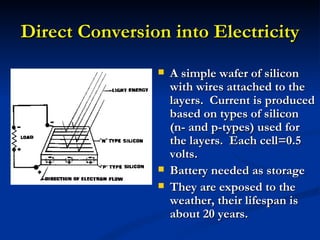
                   A simple wafer of silicon
                    with wires attached to the
                    layers. Current is produced
                    based on types of silicon
                    (n- and p-types) used for
                    the layers. Each cell=0.5
                    volts.
                   Battery needed as storage
                   They are exposed to the
                    weather, their lifespan is
                    about 20 years.
PHOTOVOLTAIC
            APPLICATION…
   Power stations
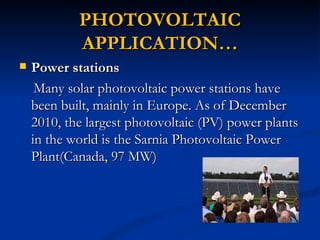
     Many solar photovoltaic power stations have
    been built, mainly in Europe. As of December
    2010, the largest photovoltaic (PV) power plants
    in the world is the Sarnia Photovoltaic Power
    Plant(Canada, 97 MW)
   In buildings
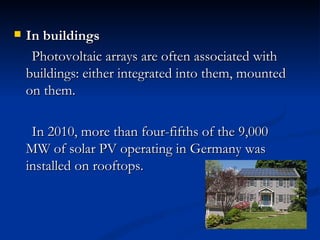
     Photovoltaic arrays are often associated with
    buildings: either integrated into them, mounted
    on them.

     In 2010, more than four-fifths of the 9,000
    MW of solar PV operating in Germany was
    installed on rooftops.
   Standalone devices

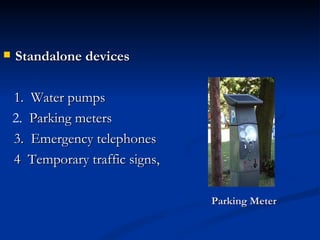
    1.  Water pumps
    2.  Parking meters
    3. Emergency telephones
    4 Temporary traffic signs,

                                 Parking Meter
PERFORMANCE OF PV
   Temperature
     Generally, temperatures above room
    temperature reduce the performance of
    photovoltaic.

   Optimum Orientation of Solar Panels
     For best performance, terrestrial PV systems
    aim to maximize the time they face the sun.
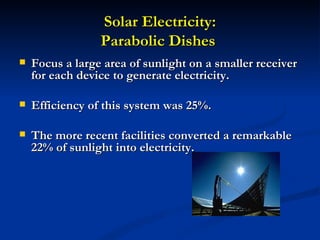
Solar Electricity:
                 Parabolic Dishes
   Focus a large area of sunlight on a smaller receiver
    for each device to generate electricity.

   Efficiency of this system was 25%.

   The more recent facilities converted a remarkable
    22% of sunlight into electricity.
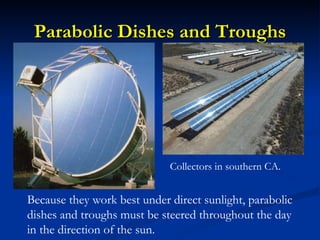
Parabolic Dishes and Troughs


                             Collectors in southern CA.


Because they work best under direct sunlight, parabolic
dishes and troughs must be steered throughout the day
in the direction of the sun.
STORAGE & DISTRIBUTION
   Solar energy is not available at night, making
    energy storage an important issue in order to
    provide the continuous availability of energy
   Solar energy can be stored at high
    temperatures using molten salts. Salts are an
    effective storage medium because they are
    low-cost, have a high specific heat capacity
    and can deliver heat at temperatures
    compatible with conventional power systems.
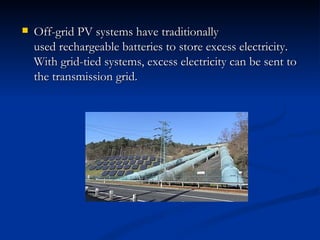
   Off-grid PV systems have traditionally
    used rechargeable batteries to store excess electricity.
    With grid-tied systems, excess electricity can be sent to
    the transmission grid.
ADVANTAGES
   Solar power is pollution-free during use. Production
    end-wastes and emissions are manageable using existing
    pollution controls.

   PV installations can operate for many years with little
    maintenance or intervention after their initial set-up.

   Grid-connected solar electricity can be used locally thus
    reducing transmission/distribution losses.
DISADVANTAGES
   Photovoltaic cells are costly to install.

   Solar electricity is not produced at night and is much
    reduced in cloudy conditions. Therefore, a storage or
    complementary power system is required.

   Solar cells produce DC which must be converted
    to AC (using a grid tie inverter).

   Sun does not shine consistently
EFFICIENCY
   Overall, the efficiency is about 10-14%.

   Efficiency is far lass than the 77% of solar
    spectrum with usable wavelengths.

   43% of photon energy is used to warm the crystal.

   Efficiency drops as temperature increases (from
    24% at 0°C to 14% at 100°C.)

   Light is reflected off the front face and internal
    electrical resistance are other factors.
Thank You.

Solar power

  • 1.
    Seminar on A Small Scale Solar Power Generation, Distribution, Storage.
  • 2.
    Solar Energy: The UltimateRenewable Resource Submitted by:-- DEEPESH KUMAR GARG
  • 3.
    What is SolarPower? o Solar power is the conversion of sunlight into electricity, either directly using photovoltaic (PV) or indirectly using concentrated solar power(CSP) o  Concentrated solar power systems use lenses or mirrors and tracking systems to focus a large area of sunlight into a small beam.
  • 4.
    How much solarenergy? The surface receives about 47% of the total solar energy that reaches the Earth. Only this amount is usable.
  • 5.
  • 6.
  • 7.
    How To Manufacture?  Solar panel comprises solar cells.  Solar Cell: Solar cells produce direct current electricity from sun light. Solar cells are based upon PHOTOVOLTAIC EFFECT.
  • 8.
    PHOTOVOLTAIC EFFECT  The photovoltaic effect is the creation of a voltage (or a corresponding electric current) in a material upon exposure to light.   The photovoltaic effect is that the generated electrons are transferred between different bands (i.e., from the valence to conduction bands) within the material, resulting in the buildup of a voltage between two electrodes.
  • 9.
    Direct Conversion intoElectricity  A simple wafer of silicon with wires attached to the layers. Current is produced based on types of silicon (n- and p-types) used for the layers. Each cell=0.5 volts.  Battery needed as storage  They are exposed to the weather, their lifespan is about 20 years.
  • 10.
    PHOTOVOLTAIC APPLICATION…  Power stations Many solar photovoltaic power stations have been built, mainly in Europe. As of December 2010, the largest photovoltaic (PV) power plants in the world is the Sarnia Photovoltaic Power Plant(Canada, 97 MW)
  • 11.
    In buildings Photovoltaic arrays are often associated with buildings: either integrated into them, mounted on them. In 2010, more than four-fifths of the 9,000 MW of solar PV operating in Germany was installed on rooftops.
  • 12.
    Standalone devices 1.  Water pumps 2.  Parking meters 3. Emergency telephones 4 Temporary traffic signs, Parking Meter
  • 13.
    PERFORMANCE OF PV  Temperature Generally, temperatures above room temperature reduce the performance of photovoltaic.  Optimum Orientation of Solar Panels For best performance, terrestrial PV systems aim to maximize the time they face the sun.
  • 14.
    Solar Electricity: Parabolic Dishes  Focus a large area of sunlight on a smaller receiver for each device to generate electricity.  Efficiency of this system was 25%.  The more recent facilities converted a remarkable 22% of sunlight into electricity.
  • 15.
    Parabolic Dishes andTroughs Collectors in southern CA. Because they work best under direct sunlight, parabolic dishes and troughs must be steered throughout the day in the direction of the sun.
  • 16.
    STORAGE & DISTRIBUTION  Solar energy is not available at night, making energy storage an important issue in order to provide the continuous availability of energy  Solar energy can be stored at high temperatures using molten salts. Salts are an effective storage medium because they are low-cost, have a high specific heat capacity and can deliver heat at temperatures compatible with conventional power systems.
  • 17.
    Off-grid PV systems have traditionally used rechargeable batteries to store excess electricity. With grid-tied systems, excess electricity can be sent to the transmission grid.
  • 18.
    ADVANTAGES  Solar power is pollution-free during use. Production end-wastes and emissions are manageable using existing pollution controls.  PV installations can operate for many years with little maintenance or intervention after their initial set-up.  Grid-connected solar electricity can be used locally thus reducing transmission/distribution losses.
  • 19.
    DISADVANTAGES  Photovoltaic cells are costly to install.  Solar electricity is not produced at night and is much reduced in cloudy conditions. Therefore, a storage or complementary power system is required.  Solar cells produce DC which must be converted to AC (using a grid tie inverter).  Sun does not shine consistently
  • 20.
    EFFICIENCY  Overall, the efficiency is about 10-14%.  Efficiency is far lass than the 77% of solar spectrum with usable wavelengths.  43% of photon energy is used to warm the crystal.  Efficiency drops as temperature increases (from 24% at 0°C to 14% at 100°C.)  Light is reflected off the front face and internal electrical resistance are other factors.
  • 21.