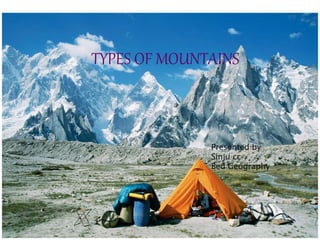
TYPES OF MOUNTAINS
Presented by
Sinju cc
Bed Geography
 Are land form have height of 900 Km or more
from sea level.
 The name for the processes that collectively
produce a mountain belt is orogenesis
 Based on its origin there are
1) Fold mountains
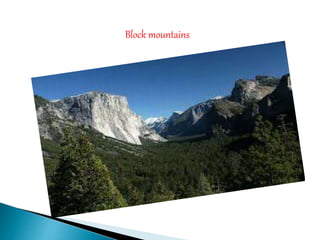
2) Block mountains
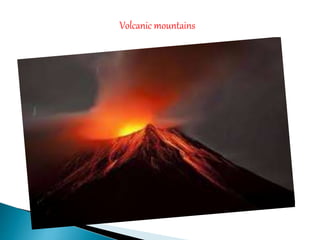
3) Volcanic mountains
4) Residual mountains
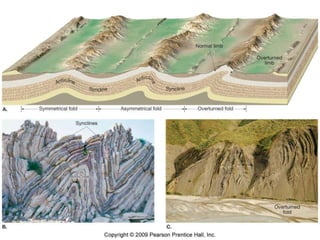
 Formed due to folding of crustal rocks by compressive
force.
 They are young mountains.
 Sediments are found up to great depth.
 Are highest and most extensive mountains.
 Generally found along the margins of continents.
 E.g. Himalaya, Rockies, Andes, Atlas etc
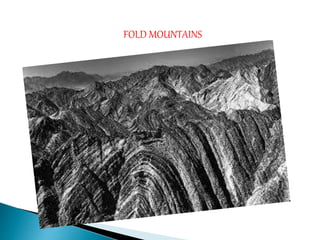
FOLD MOUNTAINS
 Known as fold block mountains.
 Formed due to faulting by compressive force.
 Represent the up standing parts of the ground between
two fault or either side of a rift valley.
 Also called horst mountains
 E.g. Vosges, Black forest mountain, Rhine Rift valley.
Block mountains
 Formed by the accumulation of volcanic materials.
 Based on the mode eruption different types of volcanic
mountains are formed.
 E.g. Kilavea volcano in southern Hawaii Island
Stromboli volcano in Lipasari island.
Volcanic mountains
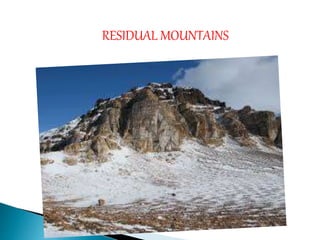
 Formed due to difference in weathering process.
 The upper layer of the rock is removed.
 Hard rock remained as residual mountains.
 E.g. Aravalli range, Nilgiri range

RESIDUAL MOUNTAINS
THANK YOU

Ppt mountain

  • 2.
    TYPES OF MOUNTAINS Presentedby Sinju cc Bed Geography
  • 3.
     Are landform have height of 900 Km or more from sea level.  The name for the processes that collectively produce a mountain belt is orogenesis
  • 4.
     Based onits origin there are 1) Fold mountains 2) Block mountains 3) Volcanic mountains 4) Residual mountains
  • 5.
     Formed dueto folding of crustal rocks by compressive force.  They are young mountains.  Sediments are found up to great depth.  Are highest and most extensive mountains.  Generally found along the margins of continents.  E.g. Himalaya, Rockies, Andes, Atlas etc
  • 6.
  • 8.
     Known asfold block mountains.  Formed due to faulting by compressive force.  Represent the up standing parts of the ground between two fault or either side of a rift valley.  Also called horst mountains  E.g. Vosges, Black forest mountain, Rhine Rift valley.
  • 9.
  • 10.
     Formed bythe accumulation of volcanic materials.  Based on the mode eruption different types of volcanic mountains are formed.  E.g. Kilavea volcano in southern Hawaii Island Stromboli volcano in Lipasari island.
  • 11.
  • 12.
     Formed dueto difference in weathering process.  The upper layer of the rock is removed.  Hard rock remained as residual mountains.  E.g. Aravalli range, Nilgiri range 
  • 13.
  • 14.