Environmental engineering
W
E
L
C O M E
ADVANCED WATER TREATMENT
 Aeration
 IRON AND MANGANESE
SYNOPSIS :
RAMACHANDRAN.T
Removal of Colours, Odours and Tastes from waters
The special treatments which may be given to the water under special conditions for removing
colours, tastes and odours from it, are described below :
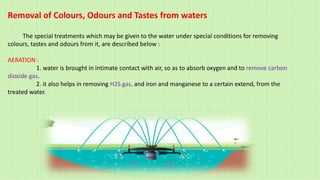
AERATION :
1. water is brought in intimate contact with air, so as to absorb oxygen and to remove carbon
dioxide gas.
2. it also helps in removing H2S gas, and iron and manganese to a certain extend, from the
treated water.
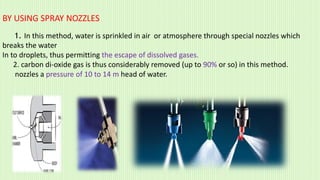
BY USING SPRAY NOZZLES
1. In this method, water is sprinkled in air or atmosphere through special nozzles which
breaks the water
In to droplets, thus permitting the escape of dissolved gases.
2. carbon di-oxide gas is thus considerably removed (up to 90% or so) in this method.
nozzles a pressure of 10 to 14 m head of water.
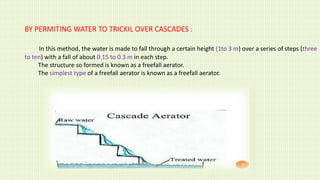
BY PERMITING WATER TO TRICKIL OVER CASCADES :
In this method, the water is made to fall through a certain height (1to 3 m) over a series of steps (three
to ten) with a fall of about 0.15 to 0.3 m in each step.
The structure so formed is known as a freefall aerator.
The simplest type of a freefall aerator is known as a freefall aerator.
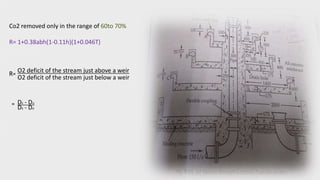
Co2 removed only in the range of 60to 70%
R= 1+0.38abh(1-0.11h)(1+0.046T)
O2 deficit of the stream just above a weir
O2 deficit of the stream just below a weir
R=
DS - DU
DS - Dd
=
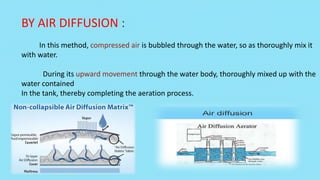
BY AIR DIFFUSION :
In this method, compressed air is bubbled through the water, so as thoroughly mix it
with water.
During its upward movement through the water body, thoroughly mixed up with the
water contained
In the tank, thereby completing the aeration process.
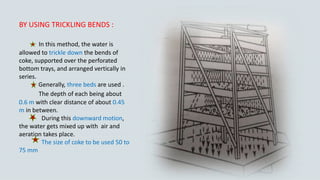
BY USING TRICKLING BENDS :
In this method, the water is
allowed to trickle down the bends of
coke, supported over the perforated
bottom trays, and arranged vertically in
series.
Generally, three beds are used .
The depth of each being about
0.6 m with clear distance of about 0.45
m in between.
During this downward motion,
the water gets mixed up with air and
aeration takes place.
The size of coke to be used 50 to
75 mm
REMOVEAL OF IRON AND MANGANESE FROM WATER :
1. Iron and manganese salts are generally found dissolved together in well water or anaerobic reservoir
Waters, invisible dissolved state.
2. when exposed to air, these reduced forms slowly transform to insoluble visible oxidized ferric iron
And manganese.
3. when the contents exceed about 0.3 mg/l, and 0.05 mg/l
OBJECTIONABLE DUE TO THE FOLLOWING REASONS :
1. They cause discolouration of clothes – red/brown coloured oxides of iron / manganese.
2. They make the water unpleasant in taste.
3. Increasing the ph value of water to about 8.5 to 9
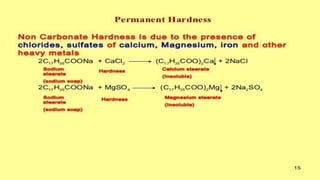
TYPES OF WATER SOFTENING
There are two types used for following
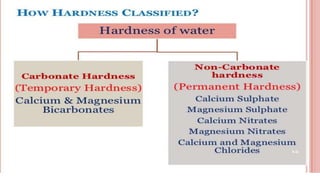
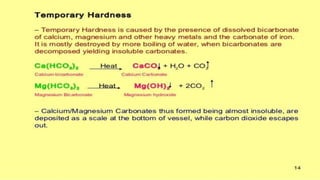
1. Temporary or carbonate hardness.
2. Permanent or non-carbonate hardness.
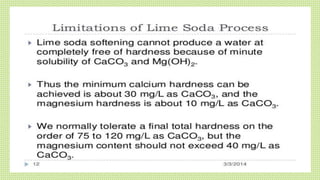
It may also be recalled here that the permissible hardness for public supplies
normally ranges between 75 to 115 mg/I (where 14.25 mg/l is equivalent to one degree of
hardness)
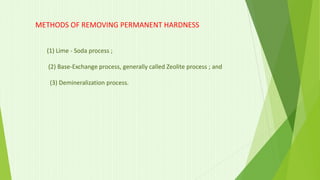
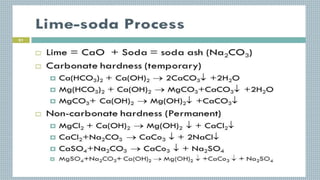
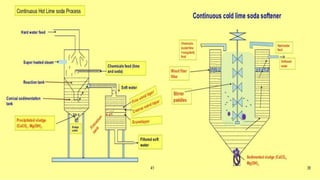
METHODS OF REMOVING PERMANENT HARDNESS
(1) Lime - Soda process ;
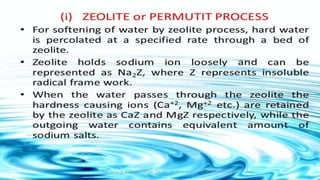
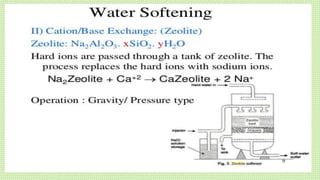
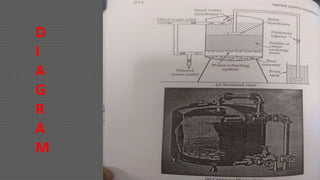
(2) Base-Exchange process, generally called Zeolite process ; and
(3) Demineralization process.
D
I
A
G
R
A
M
THE ADAVNTAGES AND DISADVANTAGES OF THIS METHOD ARE GIVEN BELOW
ADVANTAGS
1. Water of zero hardness can be obtained and hence, useful for specific uses in textile
industries, boiler, etc.
2. The plant is compact, automatic and easy to operate.
3. The RMO cost is quite less.
DISADVANTAGE
1. The process leaves sodium bicarbonate in water, which causes priming and foaming in
industrial.
2. The zeolite process is costlier.
3. Unsuitable for treating waters containing iron and manganese.
AERATION & WATER SOFTENING PROCESS

AERATION & WATER SOFTENING PROCESS

  • 1.
  • 2.
    ADVANCED WATER TREATMENT Aeration  IRON AND MANGANESE SYNOPSIS : RAMACHANDRAN.T
  • 3.
    Removal of Colours,Odours and Tastes from waters The special treatments which may be given to the water under special conditions for removing colours, tastes and odours from it, are described below : AERATION : 1. water is brought in intimate contact with air, so as to absorb oxygen and to remove carbon dioxide gas. 2. it also helps in removing H2S gas, and iron and manganese to a certain extend, from the treated water.
  • 4.
    BY USING SPRAYNOZZLES 1. In this method, water is sprinkled in air or atmosphere through special nozzles which breaks the water In to droplets, thus permitting the escape of dissolved gases. 2. carbon di-oxide gas is thus considerably removed (up to 90% or so) in this method. nozzles a pressure of 10 to 14 m head of water.
  • 5.
    BY PERMITING WATERTO TRICKIL OVER CASCADES : In this method, the water is made to fall through a certain height (1to 3 m) over a series of steps (three to ten) with a fall of about 0.15 to 0.3 m in each step. The structure so formed is known as a freefall aerator. The simplest type of a freefall aerator is known as a freefall aerator.
  • 6.
    Co2 removed onlyin the range of 60to 70% R= 1+0.38abh(1-0.11h)(1+0.046T) O2 deficit of the stream just above a weir O2 deficit of the stream just below a weir R= DS - DU DS - Dd =
  • 7.
    BY AIR DIFFUSION: In this method, compressed air is bubbled through the water, so as thoroughly mix it with water. During its upward movement through the water body, thoroughly mixed up with the water contained In the tank, thereby completing the aeration process.
  • 8.
    BY USING TRICKLINGBENDS : In this method, the water is allowed to trickle down the bends of coke, supported over the perforated bottom trays, and arranged vertically in series. Generally, three beds are used . The depth of each being about 0.6 m with clear distance of about 0.45 m in between. During this downward motion, the water gets mixed up with air and aeration takes place. The size of coke to be used 50 to 75 mm
  • 9.
    REMOVEAL OF IRONAND MANGANESE FROM WATER : 1. Iron and manganese salts are generally found dissolved together in well water or anaerobic reservoir Waters, invisible dissolved state. 2. when exposed to air, these reduced forms slowly transform to insoluble visible oxidized ferric iron And manganese. 3. when the contents exceed about 0.3 mg/l, and 0.05 mg/l OBJECTIONABLE DUE TO THE FOLLOWING REASONS : 1. They cause discolouration of clothes – red/brown coloured oxides of iron / manganese. 2. They make the water unpleasant in taste. 3. Increasing the ph value of water to about 8.5 to 9
  • 11.
    TYPES OF WATERSOFTENING There are two types used for following 1. Temporary or carbonate hardness. 2. Permanent or non-carbonate hardness. It may also be recalled here that the permissible hardness for public supplies normally ranges between 75 to 115 mg/I (where 14.25 mg/l is equivalent to one degree of hardness)
  • 16.
    METHODS OF REMOVINGPERMANENT HARDNESS (1) Lime - Soda process ; (2) Base-Exchange process, generally called Zeolite process ; and (3) Demineralization process.
  • 23.
  • 24.
    THE ADAVNTAGES ANDDISADVANTAGES OF THIS METHOD ARE GIVEN BELOW ADVANTAGS 1. Water of zero hardness can be obtained and hence, useful for specific uses in textile industries, boiler, etc. 2. The plant is compact, automatic and easy to operate. 3. The RMO cost is quite less. DISADVANTAGE 1. The process leaves sodium bicarbonate in water, which causes priming and foaming in industrial. 2. The zeolite process is costlier. 3. Unsuitable for treating waters containing iron and manganese.