
What is reverse osmosis?
Reverse osmosis is the passage of
water from a region of low concentration
to a region of high concentration through
a semi-permeable membrane. It is used
to treat wastewater.
How reverse osmosis works
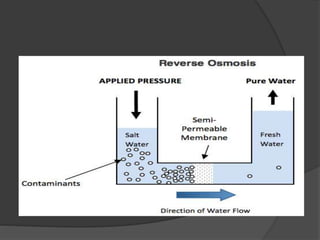
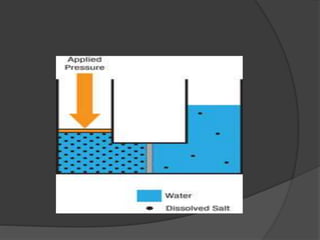
Reverse Osmosis works by applying a
pressure on the salt side of the RO and
force the water across the semi-
permeable membrane which leaves
almost all of the dissolved salts behind
in the reject stream. The amount of
pressure required depends on the salt
concentration of the feed water.
Principles of Reverse Osmosis
Reverse osmosis used in desalination
operates on this principle – to draw fresh
water through a semi-permeable
membrane from high TDS(Total
Dissolved Salts) solutions such as
seawater, brackish water, industrial
effluent and other sources. It is capable
of removing 99%+ of dissolved salts,
bacteria, etc.
Reverse osmosis - Principles and Analysis

Reverse osmosis - Principles and Analysis

  • 2.
    What is reverseosmosis? Reverse osmosis is the passage of water from a region of low concentration to a region of high concentration through a semi-permeable membrane. It is used to treat wastewater.
  • 3.
    How reverse osmosisworks Reverse Osmosis works by applying a pressure on the salt side of the RO and force the water across the semi- permeable membrane which leaves almost all of the dissolved salts behind in the reject stream. The amount of pressure required depends on the salt concentration of the feed water.
  • 5.
    Principles of ReverseOsmosis Reverse osmosis used in desalination operates on this principle – to draw fresh water through a semi-permeable membrane from high TDS(Total Dissolved Salts) solutions such as seawater, brackish water, industrial effluent and other sources. It is capable of removing 99%+ of dissolved salts, bacteria, etc.