ASTR 380
Put your homework in the box at the back of the room
            The History of the Earth


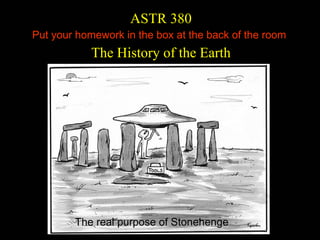
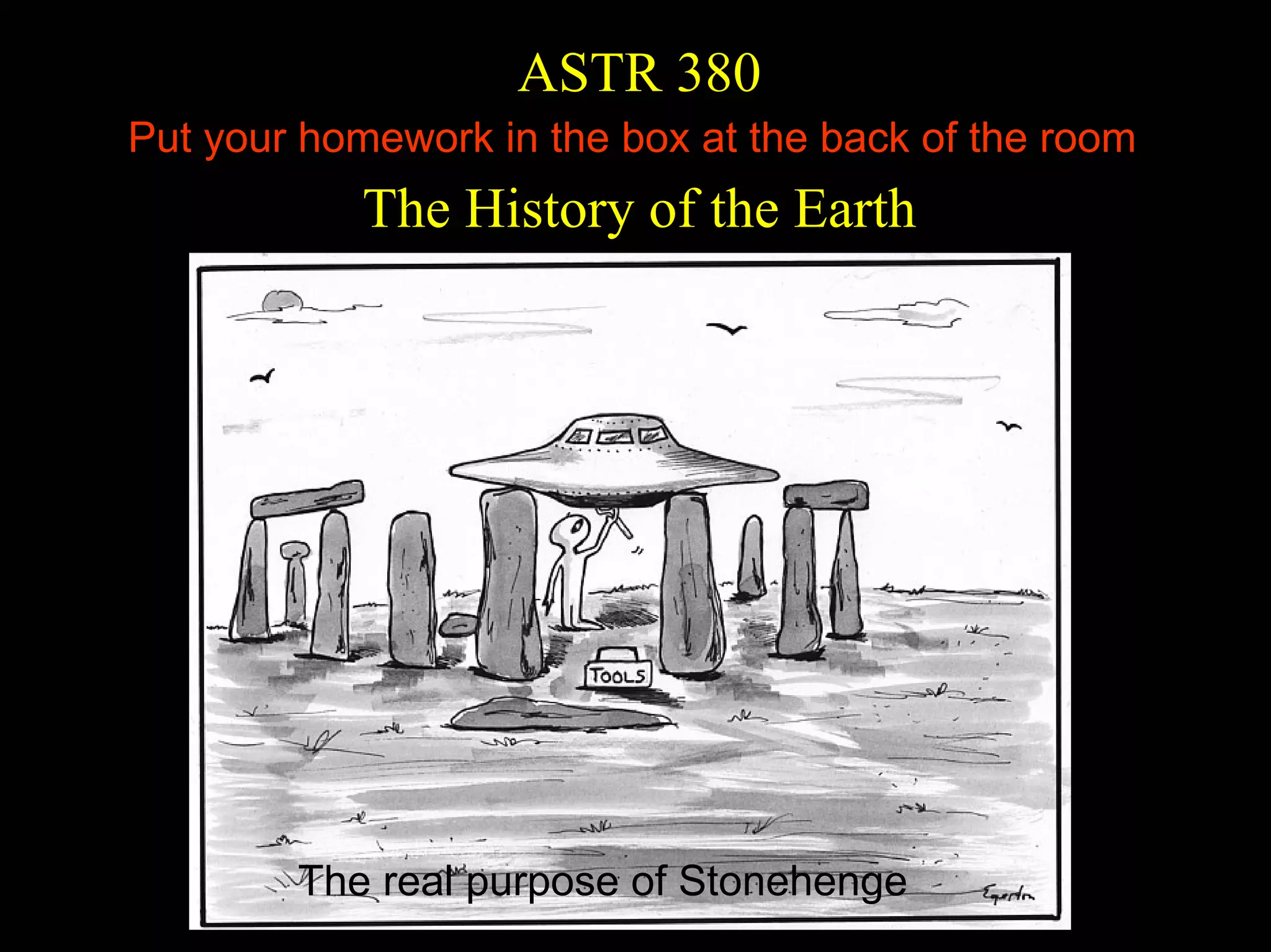
        The real purpose of Stonehenge
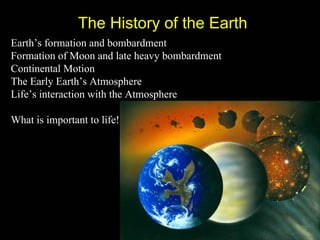
The History of the Earth
Earth’s formation and bombardment
Formation of Moon and late heavy bombardment
Continental Motion
The Early Earth’s Atmosphere
Life’s interaction with the Atmosphere

What is important to life!
Formation and Bombardment
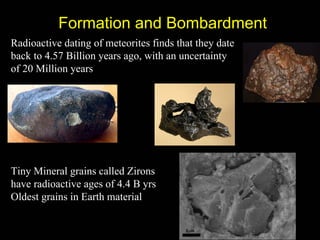
Radioactive dating of meteorites finds that they date
back to 4.57 Billion years ago, with an uncertainty
of 20 Million years


Tiny Mineral grains called Zirons
have radioactive ages of 4.4 B yrs
Oldest grains in Earth material
Formation and Bombardment
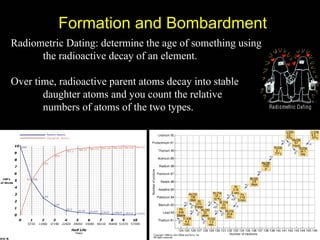
Radiometric Dating: determine the age of something using
      the radioactive decay of an element.

Over time, radioactive parent atoms decay into stable
       daughter atoms and you count the relative
       numbers of atoms of the two types.
Formation and Bombardment
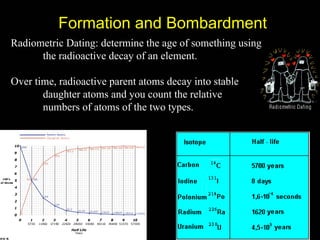
Radiometric Dating: determine the age of something using
      the radioactive decay of an element.

Over time, radioactive parent atoms decay into stable
       daughter atoms and you count the relative
       numbers of atoms of the two types.
Formation and Bombardment
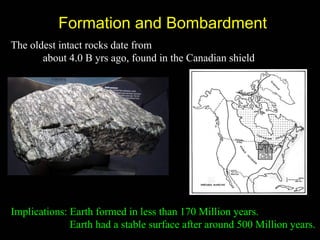
The oldest intact rocks date from
       about 4.0 B yrs ago, found in the Canadian shield


Implications: Earth formed in less than 170 Million years.
              Earth had a stable surface after around 500 Million years.
Formation and Bombardment
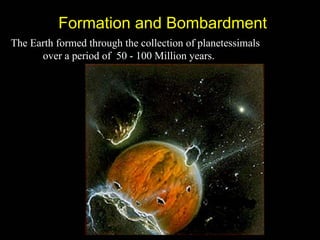
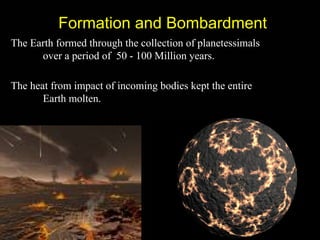
The Earth formed through the collection of planetessimals
      over a period of 50 - 100 Million years.
Formation and Bombardment
The Earth formed through the collection of planetessimals
      over a period of 50 - 100 Million years.

The heat from impact of incoming bodies kept the entire
       Earth molten.
Formation and Bombardment
The Earth formed through the collection of planetessimals
      over a period of 50 - 100 Million years.

The heat from impact of incoming bodies kept the entire
       Earth molten.

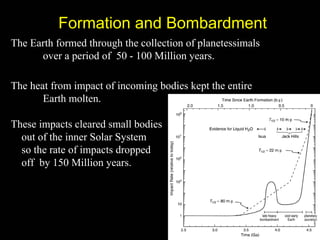
These impacts cleared small bodies
  out of the inner Solar System
  so the rate of impacts dropped
  off by 150 Million years.
Formation and Bombardment
The Earth formed through the collection of planetessimals
      over a period of 50 - 100 Million years.

The heat from impact of incoming bodies kept the entire
       Earth molten.

These impact cleared small bodies
  out of the inner Solar System
  so the rate of impacts dropped
  off by 150 Million years.

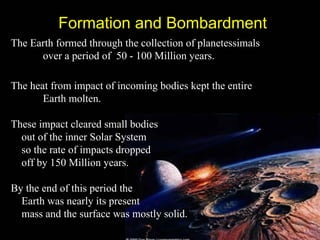
By the end of this period the
  Earth was nearly its present
  mass and the surface was mostly solid.
Formation of the Moon and Late
         Heavy Bombardment
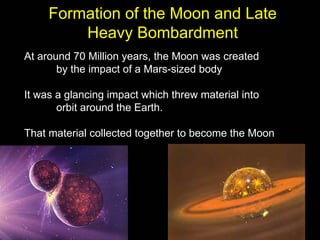
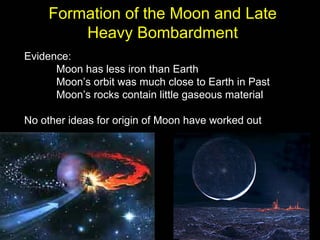
At around 70 Million years, the Moon was created
       by the impact of a Mars-sized body

It was a glancing impact which threw material into
       orbit around the Earth.

That material collected together to become the Moon
Formation of the Moon and Late
         Heavy Bombardment
Evidence:
      Moon has less iron than Earth
      Moon’s orbit was much close to Earth in Past
      Moon’s rocks contain little gaseous material

No other ideas for origin of Moon have worked out
Formation of the Moon and Late
         Heavy Bombardment
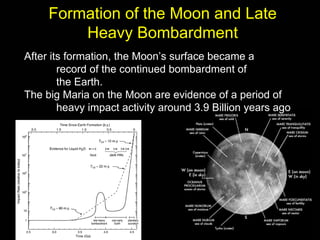
After its formation, the Moon’s surface became a
        record of the continued bombardment of
        the Earth.
The big Maria on the Moon are evidence of a period of
        heavy impact activity around 3.9 Billion years ago
Continental Formation and Motion

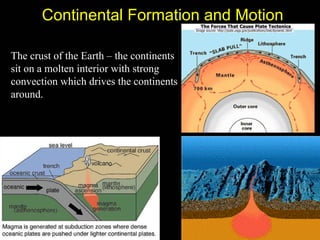
The crust of the Earth – the continents
sit on a molten interior with strong
convection which drives the continents
around.
Continental Formation and Motion
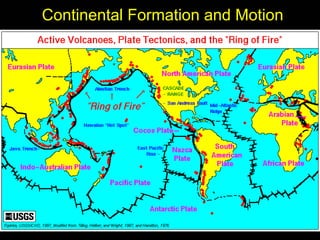
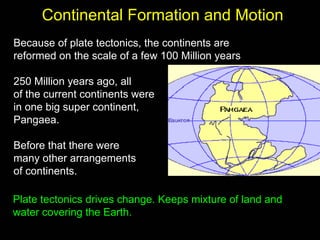
Because of plate tectonics, the continents are
reformed on the scale of a few 100 Million years

250 Million years ago, all
of the current continents were
in one big super continent,
Pangaea.

Before that there were
many other arrangements
of continents.

Plate tectonics drives change. Keeps mixture of land and
water covering the Earth.
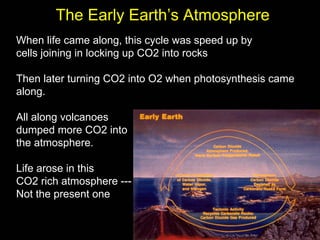
The Early Earth’s Atmosphere
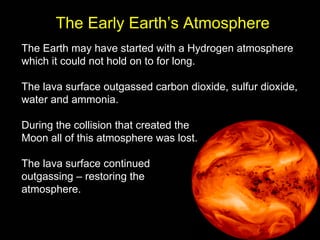
The Earth may have started with a Hydrogen atmosphere
which it could not hold on to for long.

The lava surface outgassed carbon dioxide, sulfur dioxide,
water and ammonia.

During the collision that created the
Moon all of this atmosphere was lost.

The lava surface continued
outgassing – restoring the
atmosphere.
The Early Earth’s Atmosphere
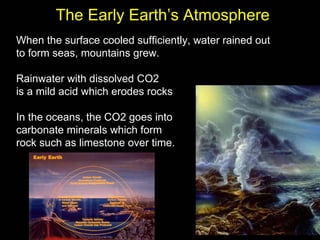
When the surface cooled sufficiently, water rained out
to form seas, mountains grew.

Rainwater with dissolved CO2
is a mild acid which erodes rocks

In the oceans, the CO2 goes into
carbonate minerals which form
rock such as limestone over time.
The Early Earth’s Atmosphere
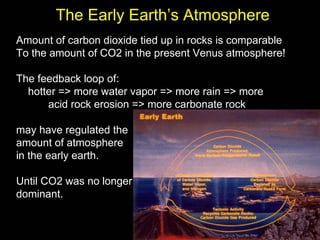
Amount of carbon dioxide tied up in rocks is comparable
To the amount of CO2 in the present Venus atmosphere!

The feedback loop of:
  hotter => more water vapor => more rain => more
      acid rock erosion => more carbonate rock

may have regulated the
amount of atmosphere
in the early earth.

Until CO2 was no longer
dominant.
The Early Earth’s Atmosphere
When life came along, this cycle was speed up by
cells joining in locking up CO2 into rocks

Then later turning CO2 into O2 when photosynthesis came
along.

All along volcanoes
dumped more CO2 into
the atmosphere.

Life arose in this
CO2 rich atmosphere ---
Not the present one
Life’s Interaction with the Atmosphere

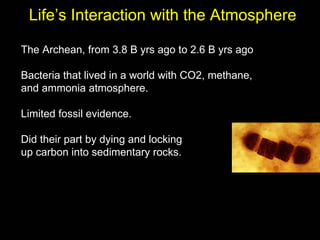
The Archean, from 3.8 B yrs ago to 2.6 B yrs ago

Bacteria that lived in a world with CO2, methane,
and ammonia atmosphere.

Limited fossil evidence.

Did their part by dying and locking
up carbon into sedimentary rocks.
Life’s Interaction with the Atmosphere
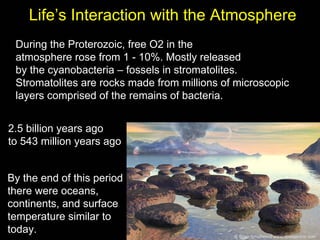
 During the Proterozoic, free O2 in the
 atmosphere rose from 1 - 10%. Mostly released
 by the cyanobacteria – fossels in stromatolites.
 Stromatolites are rocks made from millions of microscopic
 layers comprised of the remains of bacteria.


2.5 billion years ago
to 543 million years ago


By the end of this period
there were oceans,
continents, and surface
temperature similar to
today.
What is important to life?
Energy

Liquid water

Atmosphere

Plate tectonics?

Moon?
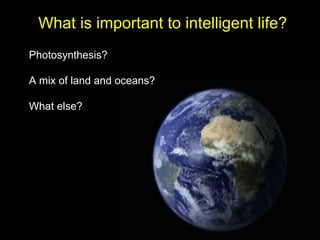
What is important to intelligent life?
Photosynthesis?

A mix of land and oceans?

What else?

Ppt earth

  • 1.
    ASTR 380 Put yourhomework in the box at the back of the room The History of the Earth The real purpose of Stonehenge
  • 2.
    The History ofthe Earth Earth’s formation and bombardment Formation of Moon and late heavy bombardment Continental Motion The Early Earth’s Atmosphere Life’s interaction with the Atmosphere What is important to life!
  • 3.
    Formation and Bombardment Radioactivedating of meteorites finds that they date back to 4.57 Billion years ago, with an uncertainty of 20 Million years Tiny Mineral grains called Zirons have radioactive ages of 4.4 B yrs Oldest grains in Earth material
  • 4.
    Formation and Bombardment RadiometricDating: determine the age of something using the radioactive decay of an element. Over time, radioactive parent atoms decay into stable daughter atoms and you count the relative numbers of atoms of the two types.
  • 5.
    Formation and Bombardment RadiometricDating: determine the age of something using the radioactive decay of an element. Over time, radioactive parent atoms decay into stable daughter atoms and you count the relative numbers of atoms of the two types.
  • 6.
    Formation and Bombardment Theoldest intact rocks date from about 4.0 B yrs ago, found in the Canadian shield Implications: Earth formed in less than 170 Million years. Earth had a stable surface after around 500 Million years.
  • 7.
    Formation and Bombardment TheEarth formed through the collection of planetessimals over a period of 50 - 100 Million years.
  • 8.
    Formation and Bombardment TheEarth formed through the collection of planetessimals over a period of 50 - 100 Million years. The heat from impact of incoming bodies kept the entire Earth molten.
  • 9.
    Formation and Bombardment TheEarth formed through the collection of planetessimals over a period of 50 - 100 Million years. The heat from impact of incoming bodies kept the entire Earth molten. These impacts cleared small bodies out of the inner Solar System so the rate of impacts dropped off by 150 Million years.
  • 10.
    Formation and Bombardment TheEarth formed through the collection of planetessimals over a period of 50 - 100 Million years. The heat from impact of incoming bodies kept the entire Earth molten. These impact cleared small bodies out of the inner Solar System so the rate of impacts dropped off by 150 Million years. By the end of this period the Earth was nearly its present mass and the surface was mostly solid.
  • 11.
    Formation of theMoon and Late Heavy Bombardment At around 70 Million years, the Moon was created by the impact of a Mars-sized body It was a glancing impact which threw material into orbit around the Earth. That material collected together to become the Moon
  • 12.
    Formation of theMoon and Late Heavy Bombardment Evidence: Moon has less iron than Earth Moon’s orbit was much close to Earth in Past Moon’s rocks contain little gaseous material No other ideas for origin of Moon have worked out
  • 13.
    Formation of theMoon and Late Heavy Bombardment After its formation, the Moon’s surface became a record of the continued bombardment of the Earth. The big Maria on the Moon are evidence of a period of heavy impact activity around 3.9 Billion years ago
  • 14.
    Continental Formation andMotion The crust of the Earth – the continents sit on a molten interior with strong convection which drives the continents around.
  • 15.
  • 16.
    Continental Formation andMotion Because of plate tectonics, the continents are reformed on the scale of a few 100 Million years 250 Million years ago, all of the current continents were in one big super continent, Pangaea. Before that there were many other arrangements of continents. Plate tectonics drives change. Keeps mixture of land and water covering the Earth.
  • 17.
    The Early Earth’sAtmosphere The Earth may have started with a Hydrogen atmosphere which it could not hold on to for long. The lava surface outgassed carbon dioxide, sulfur dioxide, water and ammonia. During the collision that created the Moon all of this atmosphere was lost. The lava surface continued outgassing – restoring the atmosphere.
  • 18.
    The Early Earth’sAtmosphere When the surface cooled sufficiently, water rained out to form seas, mountains grew. Rainwater with dissolved CO2 is a mild acid which erodes rocks In the oceans, the CO2 goes into carbonate minerals which form rock such as limestone over time.
  • 19.
    The Early Earth’sAtmosphere Amount of carbon dioxide tied up in rocks is comparable To the amount of CO2 in the present Venus atmosphere! The feedback loop of: hotter => more water vapor => more rain => more acid rock erosion => more carbonate rock may have regulated the amount of atmosphere in the early earth. Until CO2 was no longer dominant.
  • 20.
    The Early Earth’sAtmosphere When life came along, this cycle was speed up by cells joining in locking up CO2 into rocks Then later turning CO2 into O2 when photosynthesis came along. All along volcanoes dumped more CO2 into the atmosphere. Life arose in this CO2 rich atmosphere --- Not the present one
  • 21.
    Life’s Interaction withthe Atmosphere The Archean, from 3.8 B yrs ago to 2.6 B yrs ago Bacteria that lived in a world with CO2, methane, and ammonia atmosphere. Limited fossil evidence. Did their part by dying and locking up carbon into sedimentary rocks.
  • 22.
    Life’s Interaction withthe Atmosphere During the Proterozoic, free O2 in the atmosphere rose from 1 - 10%. Mostly released by the cyanobacteria – fossels in stromatolites. Stromatolites are rocks made from millions of microscopic layers comprised of the remains of bacteria. 2.5 billion years ago to 543 million years ago By the end of this period there were oceans, continents, and surface temperature similar to today.
  • 23.
    What is importantto life? Energy Liquid water Atmosphere Plate tectonics? Moon?
  • 24.
    What is importantto intelligent life? Photosynthesis? A mix of land and oceans? What else?