Table of contents
 Introduction
 Macro environmental Analysis
 SOSTAC Framework
 Conclusion
 Reference List
Introduction
 Marketing can be termed as a crucial “business
function” for-profit and “non-profit” organisations..
Marketing principles are the “marketing ideas” that
organisations use for building effective “marketing
strategy” along with “promotional strategies.” Tesco is
trying to open a new venture in the country of Brazil.
Macro Environmental Analysis
 In political terms, Brazil is the most powerful country in
the South American continent. Brazil has vast potential,
as it is the member of “United Nations”, “World Bank”,
and “World Trade Organisation”.
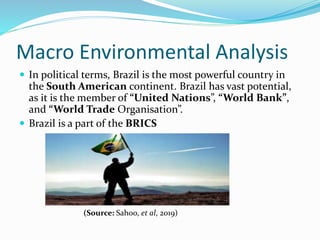
 Brazil is a part of the BRICS
(Source: Sahoo, et al, 2019)
Macro Environmental Analysis
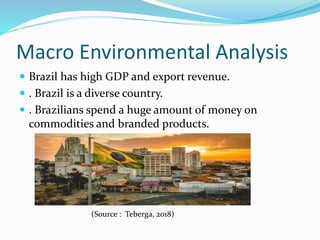
 Brazil has high GDP and export revenue.
 . Brazil is a diverse country.
 . Brazilians spend a huge amount of money on
commodities and branded products.
(Source : Teberga, 2018)
Macro Environmental Analysis
 Brazil is experiencing rapid growth in technologies .
 Brazil has been witnessing deforestation, air and water
pollution, oil spills and land degradation.
 Necessary license and paperwork is needed to open a new
business in brazil
SOSTAC Framework
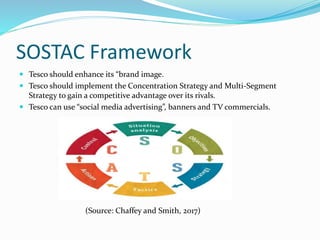
 Tesco should enhance its “brand image.
 Tesco should implement the Concentration Strategy and Multi-Segment
Strategy to gain a competitive advantage over its rivals.
 Tesco can use “social media advertising”, banners and TV commercials.
(Source: Chaffey and Smith, 2017)
SOSTAC Framework
 Tesco should innovate their existing products to
deliver contemporary products to new customers.
 The local competition should be taken into
account along with the aspect of the changing
consumer’s needs.
 Tesco should provide a global offer to its
consumers while taking into account the local
related issues.
SOSTAC Framework
 Tesco can implement new technologies to manufacture its products at
a faster rate than usual. This will increase sales in a less time span,
which will increase the revenue figures of the company.
 Training activities should be conducted by the company to adapt to the
dynamic business environment .
(Source: Wood et al, 2017)
SOSTAC Framework
 Tesco should create a strong customer base in this
country by improving and renovating its logo and
creating a strong brand portfolio.
 The KPI of the overall activities of this new venture
will be the customer acquisition cost and the sales
per employee.
 CAC is the amount that the company has to spend
on marketing, sales and other related expenses.
Conclusion
 Brazil is a viable target for the project as the per capita
income of the people living in this country is high. It is
the member of some big and powerful organisations in
the world. This country is well introduced to
technologies which will help Tesco to conduct ad
campaign on both online and offline. This country is
very cautious about legal aspect and paperwork of
opening a business. This will help the company to be
free from any legal harassment in the future.
Reference List
 Armstrong, G.M., Kotler, P., Harker, M. and Brennan, R., 2018. Marketing: an
introduction. Pearson UK.
 Chaffey, D. and Smith, P.R., 2017. Digital marketing excellence: planning, optimizing and
integrating online marketing. Taylor & Francis.
 Chaffey, D. and Smith, P.R., 2017. Digital marketing excellence: planning, optimizing and
integrating online marketing. Taylor & Francis.
 Gbadamosi, A., 2019. Contemporary Issues in Marketing: Principles and Practice. SAGE
Publications Limited.
 Sahoo, P.K., Guimarães, J.T.F., Souza-Filho, P.W.M., Powell, M.A., da Silva, M.S., Moraes,
A.M., Alves, R., Leite, A.S., Júnior, W.N., Rodrigues, T.M. and Costa, V.E., 2019. Statistical
analysis of lake sediment geochemical data for understanding surface geological factors
and processes: An example from Amazonian upland lakes, Brazil. Catena, 175, pp.47-62.
 Serrat, O., 2017. The future of social marketing. In Knowledge solutions (pp. 119-128).
Springer, Singapore.
 Teberga, P.M.F., Oliva, F.L. and Kotabe, M., 2018. Risk analysis in introduction of new
technologies by start-ups in the Brazilian market. Management Decision.
 Tuten, T.L., 2019. Principles of Marketing for a Digital Age. SAGE Publications Limited.
 Wood, S., Wrigley, N. and Coe, N.M., 2017. Capital discipline and financial market
relations in retail globalization: insights from the case of Tesco plc. Journal of Economic
Geography, 17(1), pp.31-57.
Thank You.

Ppm ppt

  • 2.
    Table of contents Introduction  Macro environmental Analysis  SOSTAC Framework  Conclusion  Reference List
  • 3.
    Introduction  Marketing canbe termed as a crucial “business function” for-profit and “non-profit” organisations.. Marketing principles are the “marketing ideas” that organisations use for building effective “marketing strategy” along with “promotional strategies.” Tesco is trying to open a new venture in the country of Brazil.
  • 4.
    Macro Environmental Analysis In political terms, Brazil is the most powerful country in the South American continent. Brazil has vast potential, as it is the member of “United Nations”, “World Bank”, and “World Trade Organisation”.  Brazil is a part of the BRICS (Source: Sahoo, et al, 2019)
  • 5.
    Macro Environmental Analysis Brazil has high GDP and export revenue.  . Brazil is a diverse country.  . Brazilians spend a huge amount of money on commodities and branded products. (Source : Teberga, 2018)
  • 6.
    Macro Environmental Analysis Brazil is experiencing rapid growth in technologies .  Brazil has been witnessing deforestation, air and water pollution, oil spills and land degradation.  Necessary license and paperwork is needed to open a new business in brazil
  • 7.
    SOSTAC Framework  Tescoshould enhance its “brand image.  Tesco should implement the Concentration Strategy and Multi-Segment Strategy to gain a competitive advantage over its rivals.  Tesco can use “social media advertising”, banners and TV commercials. (Source: Chaffey and Smith, 2017)
  • 8.
    SOSTAC Framework  Tescoshould innovate their existing products to deliver contemporary products to new customers.  The local competition should be taken into account along with the aspect of the changing consumer’s needs.  Tesco should provide a global offer to its consumers while taking into account the local related issues.
  • 9.
    SOSTAC Framework  Tescocan implement new technologies to manufacture its products at a faster rate than usual. This will increase sales in a less time span, which will increase the revenue figures of the company.  Training activities should be conducted by the company to adapt to the dynamic business environment . (Source: Wood et al, 2017)
  • 10.
    SOSTAC Framework  Tescoshould create a strong customer base in this country by improving and renovating its logo and creating a strong brand portfolio.  The KPI of the overall activities of this new venture will be the customer acquisition cost and the sales per employee.  CAC is the amount that the company has to spend on marketing, sales and other related expenses.
  • 11.
    Conclusion  Brazil isa viable target for the project as the per capita income of the people living in this country is high. It is the member of some big and powerful organisations in the world. This country is well introduced to technologies which will help Tesco to conduct ad campaign on both online and offline. This country is very cautious about legal aspect and paperwork of opening a business. This will help the company to be free from any legal harassment in the future.
  • 12.
    Reference List  Armstrong,G.M., Kotler, P., Harker, M. and Brennan, R., 2018. Marketing: an introduction. Pearson UK.  Chaffey, D. and Smith, P.R., 2017. Digital marketing excellence: planning, optimizing and integrating online marketing. Taylor & Francis.  Chaffey, D. and Smith, P.R., 2017. Digital marketing excellence: planning, optimizing and integrating online marketing. Taylor & Francis.  Gbadamosi, A., 2019. Contemporary Issues in Marketing: Principles and Practice. SAGE Publications Limited.  Sahoo, P.K., Guimarães, J.T.F., Souza-Filho, P.W.M., Powell, M.A., da Silva, M.S., Moraes, A.M., Alves, R., Leite, A.S., Júnior, W.N., Rodrigues, T.M. and Costa, V.E., 2019. Statistical analysis of lake sediment geochemical data for understanding surface geological factors and processes: An example from Amazonian upland lakes, Brazil. Catena, 175, pp.47-62.  Serrat, O., 2017. The future of social marketing. In Knowledge solutions (pp. 119-128). Springer, Singapore.  Teberga, P.M.F., Oliva, F.L. and Kotabe, M., 2018. Risk analysis in introduction of new technologies by start-ups in the Brazilian market. Management Decision.  Tuten, T.L., 2019. Principles of Marketing for a Digital Age. SAGE Publications Limited.  Wood, S., Wrigley, N. and Coe, N.M., 2017. Capital discipline and financial market relations in retail globalization: insights from the case of Tesco plc. Journal of Economic Geography, 17(1), pp.31-57.
  • 13.

Editor's Notes

  • #4 Marketing can be termed as a crucial “business function” for-profit and “non-profit” organisations. Marketing comprises of a broader context such as product design, research, promotion, customer service and much more. Marketing principles are the “marketing ideas” that organisations use for building effective “marketing strategy” along with “promotional strategies.” This aspect is used for promotion of services or goods. Tesco is trying to open a new venture in the country of Brazil. This essay will focus on the principles and strategies undertaken by this company to make this venture a success.
  • #5 In political terms, Brazil is the most powerful country in the South American continent. Brazil has vast potential, as it is the member of “United Nations”, “World Bank”, and “World Trade Organisation”. There are some terrorist organisations operating in Brazil. Tesco has to tackle this aspect with sheer intelligence and effective strategy. However, it will benefit from Brazil being a member of the powerful organisations, as any unlawful activities will be counteracted by those organisations. The economic condition of Brazil is good, and it has the potential of being better in the upcoming years. Brazil is a part of the BRICS which facilitates the economic structure of this country
  • #6 Tesco can operate in Brazil due to this country’s high GDP and export revenue. Brazil is a diverse country, which has its middle-class population growing in the social strata. Brazilians spend a huge amount of money on commodities and branded products and they love football.
  • #7 In recent years, Brazil is experiencing rapid growth in technologies and its implementation in the country. The government of this country spends a huge amount of money on the innovation and adaption of technological tools. Brazil has been witnessing deforestation, air and water pollution, oil spills and land degradation. However, this country has undertaken several initiatives to tackle these environmental issues. Opening a new venture or business in Brazil requires a large amount of paperwork and is a lengthy process. The government of this country provides help to new businesses with manuals, which are simplified. Necessary license is also required to open a business in this country. Tesco has to make the most advantage of this country’s citizens knack for trying out new products and being technologically advanced. The tastes and preferences of people have to be researched. The paperwork of the new business venture should be carefully done by Tesco. Tesco should target the middle-class population of Brazil, as they are more in number than the other social classes.
  • #8 The objective is to open a new business venture in Brazil. The marketing department of Tesco should give extra benefits to the new customers to build a strong customer base. The sales executives should educate the customers about the company’s products, and the company should implement good strategies to save money by cost reduction techniques. Tesco should try to enhance its “brand image” by operating both online and offline. Tesco should implement the Concentration Strategy and Multi-Segment Strategy to gain a competitive advantage over its rivals and can increase its overall sales in Brazil. The company should conduct online and offline advertisement such as “social media advertising”, banners and TV commercials. The company should target the “middle-class population”.
  • #9 “Positioning of a brand strategy” can be implemented to boost the sales of Tesco by targeting customers and enhancing the brand value of the company. Tesco should innovate their existing products to deliver contemporary products to new customers. The local competition should be taken into account along with the aspect of the changing consumer’s needs. Tesco should provide a global offer to its consumers while taking into account the local related issues. The price of the products should be based on the GDP and per capita income of Brazil.
  • #10 Tesco can implement new technologies to manufacture its products at a faster rate than usual. This will increase sales in a less time span, which will increase the revenue figures of the company. Training activities should be conducted by the company to adapt to the dynamic business environment and changing demands of the customers. This would also enhance the motivational quotient of the company’s employees, which will result in higher efficiency and productivity, generating more revenue for the company in Brazil.
  • #11 should create a strong customer base in this country by improving and renovating its logo and creating a strong brand portfolio. This attribute will help the company to establish its name in a foreign country. The people of Brazil will be gradually familiar with the products and services of Tesco, which will aid in building a new and strong customer base for this company in Brazil. Since Brazil has a high per capita income, Tesco should make the most of this aspect. The price of the products and services should be marked by targeting the middle-class segment of the society. The KPI of the overall activities o this new venture will be the customer acquisition cost and the sales per employee. CAC is the amount that the company has to spend on marketing, sales and other related expenses. The second KPI will aid in tracking the performance of the employees.