MARKETING MANAGEMENT PRESENTED ON BEHALF OF: INTERNATIONAL SCHOOL OF BUSINESS AND MEDIA BY: PROF. HIMMAT G. ADISARE CORE TEXT: MARKETING MANAGEMENT BY PHILIP KOTLER (11 th  Edition)
INTRODUCTION TO MARKETING MANAGEMENT Ref: Chapter 1 of Core Text
MARKETING MANAGEMENT: DEFINITIONS 1. “Marketing is the creation and delivery of a standard of living”.   2. “Marketing is a managerial and societal process by which individuals and groups obtain what they need and want through creating, offering, and exchanging products and services of value with others”. Ref: Chapter 1 of Core Text
THE SCOPE OF MARKETING Marketers are involved with marketing  ten   types of entities: 1. Physical Goods 2. Services 3. Experiences 4. Events 5. Persons 6. Places 7. Properties 8. Organizations 9. Information 10. Ideas Ref: Chapter 1 of Core Text
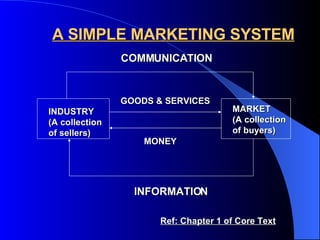
A SIMPLE MARKETING SYSTEM INDUSTRY (A collection of sellers) MARKET (A collection of buyers) COMMUNICATION INFORMATION GOODS & SERVICES MONEY Ref: Chapter 1 of Core Text
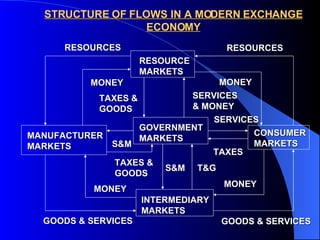
STRUCTURE OF FLOWS IN A MODERN EXCHANGE ECONOMY RESOURCE MARKETS CONSUMER MARKETS INTERMEDIARY MARKETS MANUFACTURER MARKETS GOVERNMENT MARKETS MONEY RESOURCES MONEY RESOURCES MONEY MONEY GOODS & SERVICES GOODS & SERVICES TAXES & GOODS SERVICES & MONEY  S&M TAXES & GOODS SERVICES TAXES S&M T&G
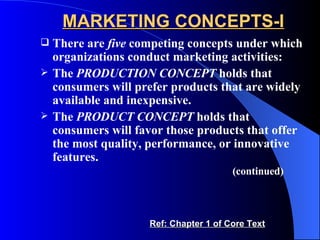
MARKETING CONCEPTS-I There are  five  competing concepts under which organizations conduct marketing activities: The  PRODUCTION CONCEPT  holds that consumers will prefer products that are widely available and inexpensive. The  PRODUCT CONCEPT  holds that consumers will favor those products that offer the most quality, performance, or innovative features. (continued)   Ref: Chapter 1 of Core Text
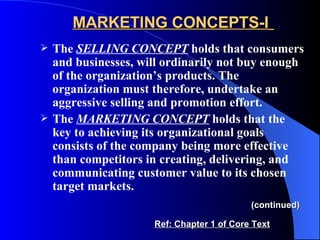
MARKETING CONCEPTS-I   The  SELLING CONCEPT  holds that consumers and businesses, will ordinarily not buy enough of the organization’s products. The organization must therefore, undertake an aggressive selling and promotion effort. The  MARKETING CONCEPT  holds that the key to achieving its organizational goals consists of the company being more effective than competitors in creating, delivering,   and   communicating customer value to its chosen target markets. (continued) Ref: Chapter 1 of Core Text
MARKETING CONCEPTS-I The  SOCIETAL MARKETING  concept holds that the organization’s task is to determine the needs, wants, and interests of the target markets and to deliver the desired satisfactions more effectively than competitors in a way that preserves the consumers’ and society’s well-being.  Ref: Chapter 1 of Core Text
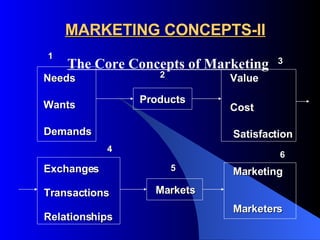
MARKETING CONCEPTS-II The Core Concepts of Marketing Needs Wants Demands Products Value Cost Satisfaction Exchanges Transactions Relationships Markets Marketing Marketers 1 2 3 4 5 6
CUSTOMER RELATIONSHIPS Ref: Chapter 2 of Core Text
CREATING CUSTOMER VALUE AND SATISFACTION Customer delivered value:   the difference between total customer value and total customer cost. Total customer value:  the bundle of benefits customers expect from a given product or service. Total customer cost:   the bundle of costs customers expect to incur in evaluating, obtaining, using, and disposing of the product or service. (continued) Ref: Chapter 2 of Core Text
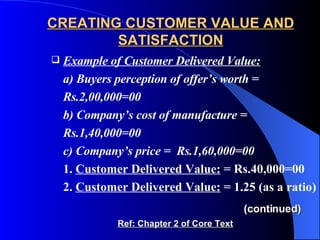
CREATING CUSTOMER VALUE AND SATISFACTION Example of Customer Delivered Value:   a) Buyers perception of offer’s worth = Rs.2,00,000=00 b) Company’s cost of manufacture = Rs.1,40,000=00 c) Company’s price =  Rs.1,60,000=00 1.  Customer Delivered Value:  = Rs.40,000=00 2.  Customer Delivered Value:  = 1.25 (as a ratio)   (continued) Ref: Chapter 2 of Core Text
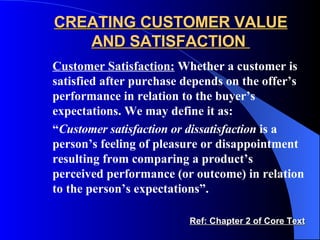
CREATING CUSTOMER VALUE AND SATISFACTION  Customer Satisfaction:  Whether a customer is satisfied after purchase depends on the offer’s performance in relation to the buyer’s expectations. We may define it as: “ Customer satisfaction or dissatisfaction  is a person’s feeling of pleasure or disappointment resulting from comparing a product’s perceived performance (or outcome) in relation to the person’s expectations”. Ref: Chapter 2 of Core Text
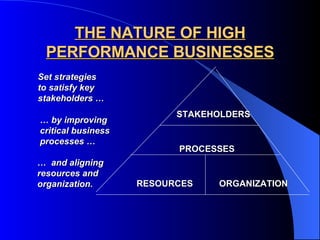
THE NATURE OF HIGH PERFORMANCE BUSINESSES STAKEHOLDERS PROCESSES RESOURCES ORGANIZATION Set strategies to satisfy key stakeholders … …  by improving critical business processes … …  and aligning resources and organization.
MARKET-ORIENTED STRATEGIC PLANNING Ref: Chapter 4 of Core Text
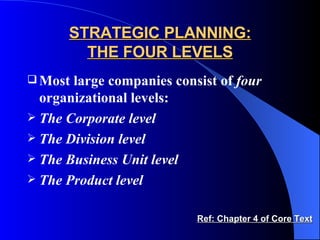
STRATEGIC PLANNING: THE FOUR LEVELS Most large companies consist of   four  organizational levels: The Corporate level The Division level The Business Unit level The Product level Ref: Chapter 4 of Core Text
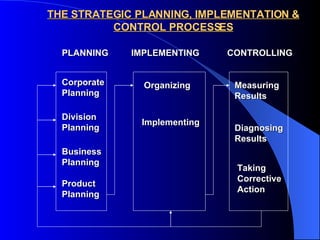
THE STRATEGIC PLANNING, IMPLEMENTATION & CONTROL PROCESSES PLANNING IMPLEMENTING CONTROLLING Corporate Planning Division Planning Business Planning Product Planning Organizing Implementing Measuring Results Diagnosing Results Taking Corrective Action
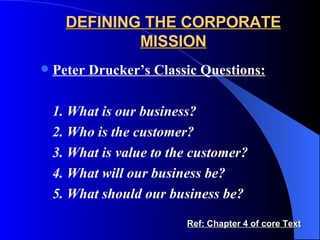
DEFINING THE CORPORATE MISSION Peter Drucker’s Classic Questions: 1. What is our business? 2. Who is the customer? 3. What is value to the customer? 4. What will our business be? 5. What should our business be? Ref: Chapter 4 of core Text
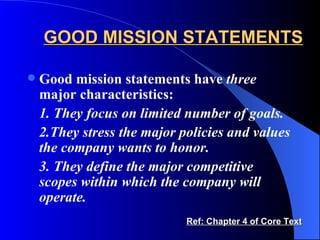
GOOD MISSION STATEMENTS Good mission statements have  three  major characteristics: 1. They focus on limited number of goals. 2.They stress the major policies and values the company wants to honor. 3. They define the major competitive scopes within which the company will operate. Ref: Chapter 4 of Core Text
COMPETITIVE SCOPES OF A COMPANY Industry scope Products and applications scope Competence scope Market segment scope Vertical scope Geographical scope Ref: Chapter 4 of Core Text
ESTABLISHING STRATEGIC BUSINESS UNITS Large companies normally manage different businesses, each requiring its own strategy. These are termed as  Strategic Business Units   (SBUs). An SBU has  three  characteristics: It is a single business or a collection of related businesses that can be planned separately from the rest of the company. It has its own set of competitors. It has a manager who is responsible for strategic planning and profit performance and who controls most of the factors affecting profit. Ref: Chapter 4 of Core Text
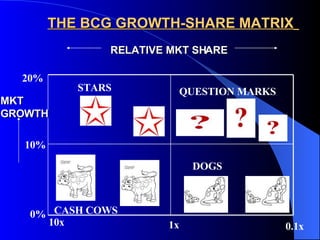
ASSIGNING RESOURCES TO SBUs (THE BCG GROWTH-SHARE MATRIX) The Boston Consulting Group (BCG), a leading management consulting firm, popularized the  growth-share matrix.  It is divided into four cells, each indicating a different type of business. The  market-growth rate  on the vertical axis indicates the annual growth rate of the market in which the business operates. The  relative market   share , measured on the horizontal axis, refers to the SBUs market share relative to that of the largest competitor in the segment.  Ref: Chapter 4 of Core Text
THE BCG GROWTH-SHARE MATRIX   10% 0% 20% 1x 10x 0.1x STARS QUESTION MARKS CASH COWS DOGS RELATIVE MKT SHARE MKT GROWTH
THE BCG MARIX (CONTD) QUESTION MARKS :  New businesses of the company in high growth-rate markets. STARS :   Successful Question-mark businesses become stars that gain market share and generate profits for the company. CASH COWS:   When market-growth rate slows down  as competitors enter the segment, businesses that remain successful become Cash Cows. They fund Stars and new Question-mark businesses. DOGS :   These are businesses in decline and the company has the option to “harvest” or “divest”.
THE MARKETING PROCESS The Marketing Process consists of : Analyzing Marketing Opportunities Researching and Selecting Target Markets Designing Marketing Opportunities Planning Marketing Programs Organizing, Implementing, and Controlling the Marketing Effort Ref: Chapter 4 of Core Text
MARKETING ENVIRONMENT & SYSTEM Ref: Chapter 6 of Core Text
MARKETING ENVIRONMENT FACTORS DEMOGRAPHIC ENVIRONMENT ECONOMIC ENVIRONMENT NATURAL ENVIRONMENT TECHNOLOGICAL ENVIRONMENT POLITICAL-LEGAL ENVIRONMENT SOCIAL-CULTURAL ENVIRONMENT Ref: Chapter 6 of Core Text
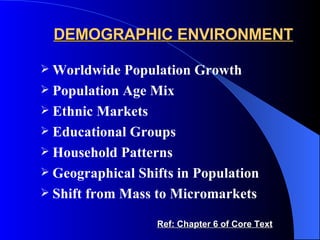
DEMOGRAPHIC ENVIRONMENT Worldwide Population Growth Population Age Mix Ethnic Markets Educational Groups Household Patterns Geographical Shifts in Population Shift from Mass to Micromarkets Ref: Chapter 6 of Core Text
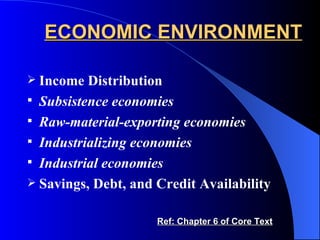
ECONOMIC ENVIRONMENT Income Distribution Subsistence economies Raw-material-exporting economies Industrializing economies Industrial economies Savings, Debt, and Credit Availability Ref: Chapter 6 of Core Text
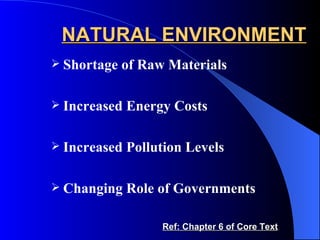
NATURAL ENVIRONMENT Shortage of Raw Materials Increased Energy Costs Increased Pollution Levels Changing Role of Governments Ref: Chapter 6 of Core Text
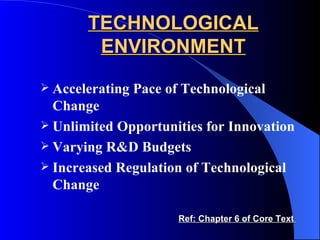
TECHNOLOGICAL ENVIRONMENT Accelerating Pace of Technological Change Unlimited Opportunities for Innovation Varying R&D Budgets Increased Regulation of Technological Change Ref: Chapter 6 of Core Text
POLITICO-LEGAL ENVIRONMENT Legislation Regulating Business: MRTP Act PCBs FDA Growth of Special Interest Groups Ref: Chapter 6 of Core Text
SOCIO-CULTURAL ENVIRONMENT Persistence of Core Cultural Values: Core beliefs Secondary beliefs Existence of Subcultures Shifts of Secondary Cultural Values Through Time Ref: Chapter 6 of Core Text
ANALYZING CONSUMER BEHAVIOR Ref: Chapter 7 of Core Text
ANALYZING CONSUMER BEHAVIOR FACTORS INFLUENCING CONSUMER BEHAVIOR BUYING ROLES TYPES OF BUYING BEHAVIOR THE BUYING DECISION PROCESS Ref: Chapter 7 of Core Text
FACTORS INFLUENCING CONSUMER BEHAVIOR CULTURAL FACTORS : Culture Sub-culture Social Class SOCIAL FACTORS : Reference groups Family Roles & statuses  Ref: Chapter 7 of Core Text
FACTORS INFLUENCING CONSUMER BEHAVIOR(2) PERSONAL FACTORS Age and Life-Cycle Stage Occupation Economic Circumstances Lifestyle Personality & Self-concept  Ref: Chapter 7 of Core Text
FACTORS INFLUENCING CONSUMER BEHAVIOR (3) PSYCHOLOGICAL FACTORS Motivation Learning Perception Beliefs & Attitudes Ref: Chapter 7 of Core Text
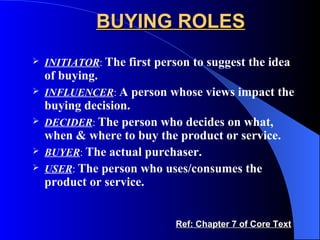
BUYING ROLES INITIATOR :  The first person to suggest the idea of buying. INFLUENCER :  A person whose views impact the buying decision. DECIDER :  The person who decides on what, when & where to buy the product or service. BUYER :  The actual purchaser. USER :  The person who uses/consumes the product or service. Ref: Chapter 7 of Core Text
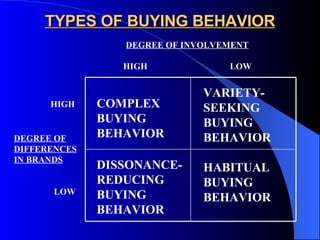
TYPES OF BUYING BEHAVIOR DEGREE OF INVOLVEMENT LOW HIGH DEGREE OF DIFFERENCES IN BRANDS HIGH LOW COMPLEX BUYING BEHAVIOR DISSONANCE- REDUCING BUYING BEHAVIOR VARIETY- SEEKING BUYING BEHAVIOR HABITUAL BUYING BEHAVIOR
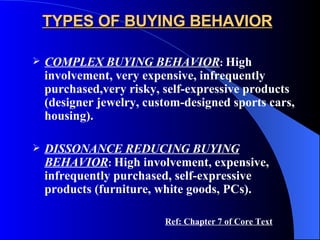
TYPES OF BUYING BEHAVIOR COMPLEX BUYING BEHAVIOR :   High involvement, very expensive, infrequently purchased,very risky, self-expressive products (designer jewelry, custom-designed sports cars, housing). DISSONANCE REDUCING BUYING BEHAVIOR :   High involvement, expensive, infrequently purchased, self-expressive products (furniture, white goods, PCs). Ref: Chapter 7 of Core Text
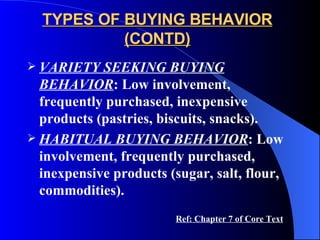
TYPES OF BUYING BEHAVIOR (CONTD) VARIETY SEEKING BUYING BEHAVIOR :   Low involvement, frequently purchased, inexpensive products (pastries, biscuits, snacks). HABITUAL BUYING BEHAVIOR :   Low involvement, frequently purchased, inexpensive products (sugar, salt, flour, commodities).   Ref: Chapter 7 of Core Text
THE BUYING DECISION PROCESS Problem/need Recognition Information Search Evaluation Of Alternatives Purchase Decision Postpurchase Behavior Ref: Chapter 7 of Core Text
PROBLEM/NEED RECOGNITION From Internal Stimuli: Hunger Thirst Fear From External Stimuli: Neighbor’s Purchases Advertisements Window Shopping Newspapers & Magazines Ref: Chapter 7 of Core Text
INFORMATION SEARCH From Personal Sources: Family Friends Neighbors Acquaintances From Commercial Sources: Advertisements Dealers Salespersons Packaging Displays Ref: Chapter 7 of Core Text
INFORMATION SEARCH (CONTD) From Commercial Sources: Advertisements Dealers Salespersons Packaging Displays Ref: Chapter 7 of Core Text
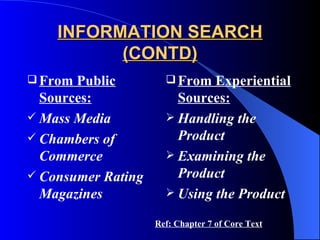
INFORMATION SEARCH (CONTD) From Public Sources: Mass Media Chambers of Commerce Consumer Rating Magazines From Experiential Sources: Handling the Product Examining the Product Using the Product Ref: Chapter 7 of Core Text
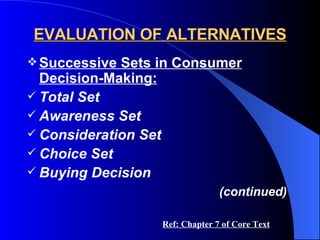
EVALUATION OF ALTERNATIVES Successive Sets in Consumer Decision-Making: Total Set Awareness Set Consideration Set Choice Set Buying Decision (continued) Ref: Chapter 7 of Core Text
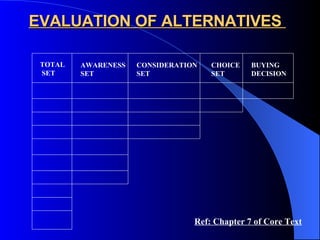
EVALUATION OF ALTERNATIVES  TOTAL SET AWARENESS SET CONSIDERATION SET CHOICE SET BUYING DECISION Ref: Chapter 7 of Core Text
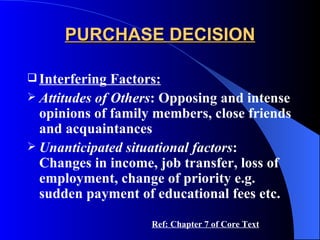
PURCHASE DECISION Interfering Factors: Attitudes of Others : Opposing and intense opinions of family members, close friends and acquaintances Unanticipated situational factors : Changes in income, job transfer, loss of employment, change of priority e.g. sudden payment of educational fees etc. Ref: Chapter 7 of Core Text
POSTPURCHASE BEHAVIOR Post purchase Satisfaction: Keep the Product Store the Product Convert to a Second Use Post purchase Dissatisfaction: Try to return the product/take legal recourse Rent it Get rid of it/Throw it   Ref: Chapter 7 of Core Text
BUSINESS MARKETS VERSUS CONSUMER MARKETS Business Markets: Fewer Buyers Larger Buyers Close Supplier-Customer Relationship Geographically Concentrated Buyers Inelastic Demand Derived Demand Professional Purchasing Multiple Buying Influences Direct Purchasing Reciprocity Leasing Ref: Chapter 8 of Core Text
MARKET SEGMENTATION Ref: Chapter 10 of Core Text
MARKET SEGMENTATION: VARIABLES Geographic Segmentation Demographic Segmentation Psychographic Segmentation Behavioral Segmentation Ref: Chapter 10 of Core Text
SEGMENTATION VARIABLES (CONTD) Geographic Segmentation: By Nations By Regions By States By Cities By Localities  Ref: Chapter 10 of Core Text
SEGMENTATION VARIABLES (CONTD) Demographic Segmentation: By Age By Gender By Income By Education Level By Religion/Race By Nationality Ref: Chapter 10 of Core Text
SEGMENTATION VARIABLES (CONTD) Psychographic Segmentation: By Personality By Lifestyle By Social Class Ref: Chapter 10 of Core Text
SEGMENTATION VARIABLES (CONTD) Behavioral Segmentation: By Usage Pattern By Occasion By Loyalty Factor By Attitude Towards The Product Ref: Chapter 10 of Core Text
THANK YOU ALL FOR YOUR PARTICIPATION IN THIS PROGRAMME

Marketing

  • 1.
    MARKETING MANAGEMENT PRESENTEDON BEHALF OF: INTERNATIONAL SCHOOL OF BUSINESS AND MEDIA BY: PROF. HIMMAT G. ADISARE CORE TEXT: MARKETING MANAGEMENT BY PHILIP KOTLER (11 th Edition)
  • 2.
    INTRODUCTION TO MARKETINGMANAGEMENT Ref: Chapter 1 of Core Text
  • 3.
    MARKETING MANAGEMENT: DEFINITIONS1. “Marketing is the creation and delivery of a standard of living”. 2. “Marketing is a managerial and societal process by which individuals and groups obtain what they need and want through creating, offering, and exchanging products and services of value with others”. Ref: Chapter 1 of Core Text
  • 4.
    THE SCOPE OFMARKETING Marketers are involved with marketing ten types of entities: 1. Physical Goods 2. Services 3. Experiences 4. Events 5. Persons 6. Places 7. Properties 8. Organizations 9. Information 10. Ideas Ref: Chapter 1 of Core Text
  • 5.
    A SIMPLE MARKETINGSYSTEM INDUSTRY (A collection of sellers) MARKET (A collection of buyers) COMMUNICATION INFORMATION GOODS & SERVICES MONEY Ref: Chapter 1 of Core Text
  • 6.
    STRUCTURE OF FLOWSIN A MODERN EXCHANGE ECONOMY RESOURCE MARKETS CONSUMER MARKETS INTERMEDIARY MARKETS MANUFACTURER MARKETS GOVERNMENT MARKETS MONEY RESOURCES MONEY RESOURCES MONEY MONEY GOODS & SERVICES GOODS & SERVICES TAXES & GOODS SERVICES & MONEY S&M TAXES & GOODS SERVICES TAXES S&M T&G
  • 7.
    MARKETING CONCEPTS-I Thereare five competing concepts under which organizations conduct marketing activities: The PRODUCTION CONCEPT holds that consumers will prefer products that are widely available and inexpensive. The PRODUCT CONCEPT holds that consumers will favor those products that offer the most quality, performance, or innovative features. (continued) Ref: Chapter 1 of Core Text
  • 8.
    MARKETING CONCEPTS-I The SELLING CONCEPT holds that consumers and businesses, will ordinarily not buy enough of the organization’s products. The organization must therefore, undertake an aggressive selling and promotion effort. The MARKETING CONCEPT holds that the key to achieving its organizational goals consists of the company being more effective than competitors in creating, delivering, and communicating customer value to its chosen target markets. (continued) Ref: Chapter 1 of Core Text
  • 9.
    MARKETING CONCEPTS-I The SOCIETAL MARKETING concept holds that the organization’s task is to determine the needs, wants, and interests of the target markets and to deliver the desired satisfactions more effectively than competitors in a way that preserves the consumers’ and society’s well-being. Ref: Chapter 1 of Core Text
  • 10.
    MARKETING CONCEPTS-II TheCore Concepts of Marketing Needs Wants Demands Products Value Cost Satisfaction Exchanges Transactions Relationships Markets Marketing Marketers 1 2 3 4 5 6
  • 11.
    CUSTOMER RELATIONSHIPS Ref:Chapter 2 of Core Text
  • 12.
    CREATING CUSTOMER VALUEAND SATISFACTION Customer delivered value: the difference between total customer value and total customer cost. Total customer value: the bundle of benefits customers expect from a given product or service. Total customer cost: the bundle of costs customers expect to incur in evaluating, obtaining, using, and disposing of the product or service. (continued) Ref: Chapter 2 of Core Text
  • 13.
    CREATING CUSTOMER VALUEAND SATISFACTION Example of Customer Delivered Value: a) Buyers perception of offer’s worth = Rs.2,00,000=00 b) Company’s cost of manufacture = Rs.1,40,000=00 c) Company’s price = Rs.1,60,000=00 1. Customer Delivered Value: = Rs.40,000=00 2. Customer Delivered Value: = 1.25 (as a ratio) (continued) Ref: Chapter 2 of Core Text
  • 14.
    CREATING CUSTOMER VALUEAND SATISFACTION Customer Satisfaction: Whether a customer is satisfied after purchase depends on the offer’s performance in relation to the buyer’s expectations. We may define it as: “ Customer satisfaction or dissatisfaction is a person’s feeling of pleasure or disappointment resulting from comparing a product’s perceived performance (or outcome) in relation to the person’s expectations”. Ref: Chapter 2 of Core Text
  • 15.
    THE NATURE OFHIGH PERFORMANCE BUSINESSES STAKEHOLDERS PROCESSES RESOURCES ORGANIZATION Set strategies to satisfy key stakeholders … … by improving critical business processes … … and aligning resources and organization.
  • 16.
    MARKET-ORIENTED STRATEGIC PLANNINGRef: Chapter 4 of Core Text
  • 17.
    STRATEGIC PLANNING: THEFOUR LEVELS Most large companies consist of four organizational levels: The Corporate level The Division level The Business Unit level The Product level Ref: Chapter 4 of Core Text
  • 18.
    THE STRATEGIC PLANNING,IMPLEMENTATION & CONTROL PROCESSES PLANNING IMPLEMENTING CONTROLLING Corporate Planning Division Planning Business Planning Product Planning Organizing Implementing Measuring Results Diagnosing Results Taking Corrective Action
  • 19.
    DEFINING THE CORPORATEMISSION Peter Drucker’s Classic Questions: 1. What is our business? 2. Who is the customer? 3. What is value to the customer? 4. What will our business be? 5. What should our business be? Ref: Chapter 4 of core Text
  • 20.
    GOOD MISSION STATEMENTSGood mission statements have three major characteristics: 1. They focus on limited number of goals. 2.They stress the major policies and values the company wants to honor. 3. They define the major competitive scopes within which the company will operate. Ref: Chapter 4 of Core Text
  • 21.
    COMPETITIVE SCOPES OFA COMPANY Industry scope Products and applications scope Competence scope Market segment scope Vertical scope Geographical scope Ref: Chapter 4 of Core Text
  • 22.
    ESTABLISHING STRATEGIC BUSINESSUNITS Large companies normally manage different businesses, each requiring its own strategy. These are termed as Strategic Business Units (SBUs). An SBU has three characteristics: It is a single business or a collection of related businesses that can be planned separately from the rest of the company. It has its own set of competitors. It has a manager who is responsible for strategic planning and profit performance and who controls most of the factors affecting profit. Ref: Chapter 4 of Core Text
  • 23.
    ASSIGNING RESOURCES TOSBUs (THE BCG GROWTH-SHARE MATRIX) The Boston Consulting Group (BCG), a leading management consulting firm, popularized the growth-share matrix. It is divided into four cells, each indicating a different type of business. The market-growth rate on the vertical axis indicates the annual growth rate of the market in which the business operates. The relative market share , measured on the horizontal axis, refers to the SBUs market share relative to that of the largest competitor in the segment. Ref: Chapter 4 of Core Text
  • 24.
    THE BCG GROWTH-SHAREMATRIX 10% 0% 20% 1x 10x 0.1x STARS QUESTION MARKS CASH COWS DOGS RELATIVE MKT SHARE MKT GROWTH
  • 25.
    THE BCG MARIX(CONTD) QUESTION MARKS : New businesses of the company in high growth-rate markets. STARS : Successful Question-mark businesses become stars that gain market share and generate profits for the company. CASH COWS: When market-growth rate slows down as competitors enter the segment, businesses that remain successful become Cash Cows. They fund Stars and new Question-mark businesses. DOGS : These are businesses in decline and the company has the option to “harvest” or “divest”.
  • 26.
    THE MARKETING PROCESSThe Marketing Process consists of : Analyzing Marketing Opportunities Researching and Selecting Target Markets Designing Marketing Opportunities Planning Marketing Programs Organizing, Implementing, and Controlling the Marketing Effort Ref: Chapter 4 of Core Text
  • 27.
    MARKETING ENVIRONMENT &SYSTEM Ref: Chapter 6 of Core Text
  • 28.
    MARKETING ENVIRONMENT FACTORSDEMOGRAPHIC ENVIRONMENT ECONOMIC ENVIRONMENT NATURAL ENVIRONMENT TECHNOLOGICAL ENVIRONMENT POLITICAL-LEGAL ENVIRONMENT SOCIAL-CULTURAL ENVIRONMENT Ref: Chapter 6 of Core Text
  • 29.
    DEMOGRAPHIC ENVIRONMENT WorldwidePopulation Growth Population Age Mix Ethnic Markets Educational Groups Household Patterns Geographical Shifts in Population Shift from Mass to Micromarkets Ref: Chapter 6 of Core Text
  • 30.
    ECONOMIC ENVIRONMENT IncomeDistribution Subsistence economies Raw-material-exporting economies Industrializing economies Industrial economies Savings, Debt, and Credit Availability Ref: Chapter 6 of Core Text
  • 31.
    NATURAL ENVIRONMENT Shortageof Raw Materials Increased Energy Costs Increased Pollution Levels Changing Role of Governments Ref: Chapter 6 of Core Text
  • 32.
    TECHNOLOGICAL ENVIRONMENT AcceleratingPace of Technological Change Unlimited Opportunities for Innovation Varying R&D Budgets Increased Regulation of Technological Change Ref: Chapter 6 of Core Text
  • 33.
    POLITICO-LEGAL ENVIRONMENT LegislationRegulating Business: MRTP Act PCBs FDA Growth of Special Interest Groups Ref: Chapter 6 of Core Text
  • 34.
    SOCIO-CULTURAL ENVIRONMENT Persistenceof Core Cultural Values: Core beliefs Secondary beliefs Existence of Subcultures Shifts of Secondary Cultural Values Through Time Ref: Chapter 6 of Core Text
  • 35.
    ANALYZING CONSUMER BEHAVIORRef: Chapter 7 of Core Text
  • 36.
    ANALYZING CONSUMER BEHAVIORFACTORS INFLUENCING CONSUMER BEHAVIOR BUYING ROLES TYPES OF BUYING BEHAVIOR THE BUYING DECISION PROCESS Ref: Chapter 7 of Core Text
  • 37.
    FACTORS INFLUENCING CONSUMERBEHAVIOR CULTURAL FACTORS : Culture Sub-culture Social Class SOCIAL FACTORS : Reference groups Family Roles & statuses Ref: Chapter 7 of Core Text
  • 38.
    FACTORS INFLUENCING CONSUMERBEHAVIOR(2) PERSONAL FACTORS Age and Life-Cycle Stage Occupation Economic Circumstances Lifestyle Personality & Self-concept Ref: Chapter 7 of Core Text
  • 39.
    FACTORS INFLUENCING CONSUMERBEHAVIOR (3) PSYCHOLOGICAL FACTORS Motivation Learning Perception Beliefs & Attitudes Ref: Chapter 7 of Core Text
  • 40.
    BUYING ROLES INITIATOR: The first person to suggest the idea of buying. INFLUENCER : A person whose views impact the buying decision. DECIDER : The person who decides on what, when & where to buy the product or service. BUYER : The actual purchaser. USER : The person who uses/consumes the product or service. Ref: Chapter 7 of Core Text
  • 41.
    TYPES OF BUYINGBEHAVIOR DEGREE OF INVOLVEMENT LOW HIGH DEGREE OF DIFFERENCES IN BRANDS HIGH LOW COMPLEX BUYING BEHAVIOR DISSONANCE- REDUCING BUYING BEHAVIOR VARIETY- SEEKING BUYING BEHAVIOR HABITUAL BUYING BEHAVIOR
  • 42.
    TYPES OF BUYINGBEHAVIOR COMPLEX BUYING BEHAVIOR : High involvement, very expensive, infrequently purchased,very risky, self-expressive products (designer jewelry, custom-designed sports cars, housing). DISSONANCE REDUCING BUYING BEHAVIOR : High involvement, expensive, infrequently purchased, self-expressive products (furniture, white goods, PCs). Ref: Chapter 7 of Core Text
  • 43.
    TYPES OF BUYINGBEHAVIOR (CONTD) VARIETY SEEKING BUYING BEHAVIOR : Low involvement, frequently purchased, inexpensive products (pastries, biscuits, snacks). HABITUAL BUYING BEHAVIOR : Low involvement, frequently purchased, inexpensive products (sugar, salt, flour, commodities). Ref: Chapter 7 of Core Text
  • 44.
    THE BUYING DECISIONPROCESS Problem/need Recognition Information Search Evaluation Of Alternatives Purchase Decision Postpurchase Behavior Ref: Chapter 7 of Core Text
  • 45.
    PROBLEM/NEED RECOGNITION FromInternal Stimuli: Hunger Thirst Fear From External Stimuli: Neighbor’s Purchases Advertisements Window Shopping Newspapers & Magazines Ref: Chapter 7 of Core Text
  • 46.
    INFORMATION SEARCH FromPersonal Sources: Family Friends Neighbors Acquaintances From Commercial Sources: Advertisements Dealers Salespersons Packaging Displays Ref: Chapter 7 of Core Text
  • 47.
    INFORMATION SEARCH (CONTD)From Commercial Sources: Advertisements Dealers Salespersons Packaging Displays Ref: Chapter 7 of Core Text
  • 48.
    INFORMATION SEARCH (CONTD)From Public Sources: Mass Media Chambers of Commerce Consumer Rating Magazines From Experiential Sources: Handling the Product Examining the Product Using the Product Ref: Chapter 7 of Core Text
  • 49.
    EVALUATION OF ALTERNATIVESSuccessive Sets in Consumer Decision-Making: Total Set Awareness Set Consideration Set Choice Set Buying Decision (continued) Ref: Chapter 7 of Core Text
  • 50.
    EVALUATION OF ALTERNATIVES TOTAL SET AWARENESS SET CONSIDERATION SET CHOICE SET BUYING DECISION Ref: Chapter 7 of Core Text
  • 51.
    PURCHASE DECISION InterferingFactors: Attitudes of Others : Opposing and intense opinions of family members, close friends and acquaintances Unanticipated situational factors : Changes in income, job transfer, loss of employment, change of priority e.g. sudden payment of educational fees etc. Ref: Chapter 7 of Core Text
  • 52.
    POSTPURCHASE BEHAVIOR Postpurchase Satisfaction: Keep the Product Store the Product Convert to a Second Use Post purchase Dissatisfaction: Try to return the product/take legal recourse Rent it Get rid of it/Throw it Ref: Chapter 7 of Core Text
  • 53.
    BUSINESS MARKETS VERSUSCONSUMER MARKETS Business Markets: Fewer Buyers Larger Buyers Close Supplier-Customer Relationship Geographically Concentrated Buyers Inelastic Demand Derived Demand Professional Purchasing Multiple Buying Influences Direct Purchasing Reciprocity Leasing Ref: Chapter 8 of Core Text
  • 54.
    MARKET SEGMENTATION Ref:Chapter 10 of Core Text
  • 55.
    MARKET SEGMENTATION: VARIABLESGeographic Segmentation Demographic Segmentation Psychographic Segmentation Behavioral Segmentation Ref: Chapter 10 of Core Text
  • 56.
    SEGMENTATION VARIABLES (CONTD)Geographic Segmentation: By Nations By Regions By States By Cities By Localities Ref: Chapter 10 of Core Text
  • 57.
    SEGMENTATION VARIABLES (CONTD)Demographic Segmentation: By Age By Gender By Income By Education Level By Religion/Race By Nationality Ref: Chapter 10 of Core Text
  • 58.
    SEGMENTATION VARIABLES (CONTD)Psychographic Segmentation: By Personality By Lifestyle By Social Class Ref: Chapter 10 of Core Text
  • 59.
    SEGMENTATION VARIABLES (CONTD)Behavioral Segmentation: By Usage Pattern By Occasion By Loyalty Factor By Attitude Towards The Product Ref: Chapter 10 of Core Text
  • 60.
    THANK YOU ALLFOR YOUR PARTICIPATION IN THIS PROGRAMME