Liberalism-development
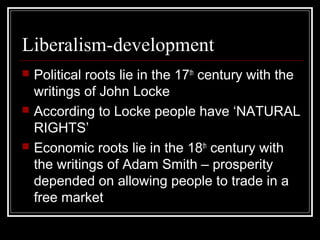
   Political roots lie in the 17th century with the
    writings of John Locke
   According to Locke people have ‘NATURAL
    RIGHTS’
   Economic roots lie in the 18th century with
    the writings of Adam Smith – prosperity
    depended on allowing people to trade in a
    free market
A few key concepts

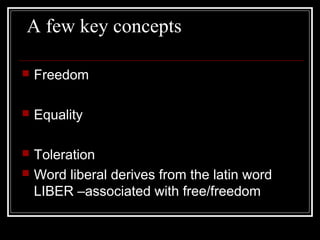
   Freedom

   Equality

   Toleration
   Word liberal derives from the latin word
    LIBER –associated with free/freedom
Strands of liberalism
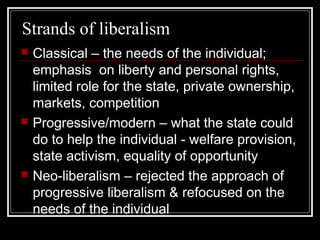
   Classical – the needs of the individual;
    emphasis on liberty and personal rights,
    limited role for the state, private ownership,
    markets, competition
   Progressive/modern – what the state could
    do to help the individual - welfare provision,
    state activism, equality of opportunity
   Neo-liberalism – rejected the approach of
    progressive liberalism & refocused on the
    needs of the individual
Current liberal thinking
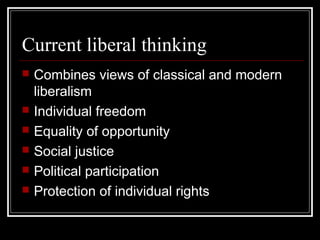
   Combines views of classical and modern
    liberalism
   Individual freedom
   Equality of opportunity
   Social justice
   Political participation
   Protection of individual rights
    Constitutional reform - dispersal of power,
    favours a limited state with institutionalised
    checks and balances –codified constitution,
    entrenched bill of rights, bicameralism
   How far have Labour’s reforms reflected
    the principles of constitutional liberalism?
   Many liberal ideas adopted by the other
    main parties –one nation
    conservatives,Labour tradition of reforming
    liberals
Liberal Democrats-core principles
   Creation of a society where nobody is
    enslaved by poverty, ignorance or
    conformity
   Freedom of individuals to make their own
    choices & free from authoritarian
    government
   Representative democracy, pluralism,
    partnership, devolution,pro Europe

Liberalism2

  • 1.
    Liberalism-development  Political roots lie in the 17th century with the writings of John Locke  According to Locke people have ‘NATURAL RIGHTS’  Economic roots lie in the 18th century with the writings of Adam Smith – prosperity depended on allowing people to trade in a free market
  • 2.
    A few keyconcepts  Freedom  Equality  Toleration  Word liberal derives from the latin word LIBER –associated with free/freedom
  • 3.
    Strands of liberalism  Classical – the needs of the individual; emphasis on liberty and personal rights, limited role for the state, private ownership, markets, competition  Progressive/modern – what the state could do to help the individual - welfare provision, state activism, equality of opportunity  Neo-liberalism – rejected the approach of progressive liberalism & refocused on the needs of the individual
  • 4.
    Current liberal thinking  Combines views of classical and modern liberalism  Individual freedom  Equality of opportunity  Social justice  Political participation  Protection of individual rights
  • 5.
    Constitutional reform - dispersal of power, favours a limited state with institutionalised checks and balances –codified constitution, entrenched bill of rights, bicameralism  How far have Labour’s reforms reflected the principles of constitutional liberalism?  Many liberal ideas adopted by the other main parties –one nation conservatives,Labour tradition of reforming liberals
  • 6.
    Liberal Democrats-core principles  Creation of a society where nobody is enslaved by poverty, ignorance or conformity  Freedom of individuals to make their own choices & free from authoritarian government  Representative democracy, pluralism, partnership, devolution,pro Europe