



This webinar has been made possible with support from the
                  Canadian Institutes of Health Research


       Welcome!
Intersectoral Action and the
  Social Determinants of
           Health:
   What’s the evidence?
 In partnership with:

  You will be placed on hold until the webinar begins.
The webinar will begin shortly, please remain on the line.
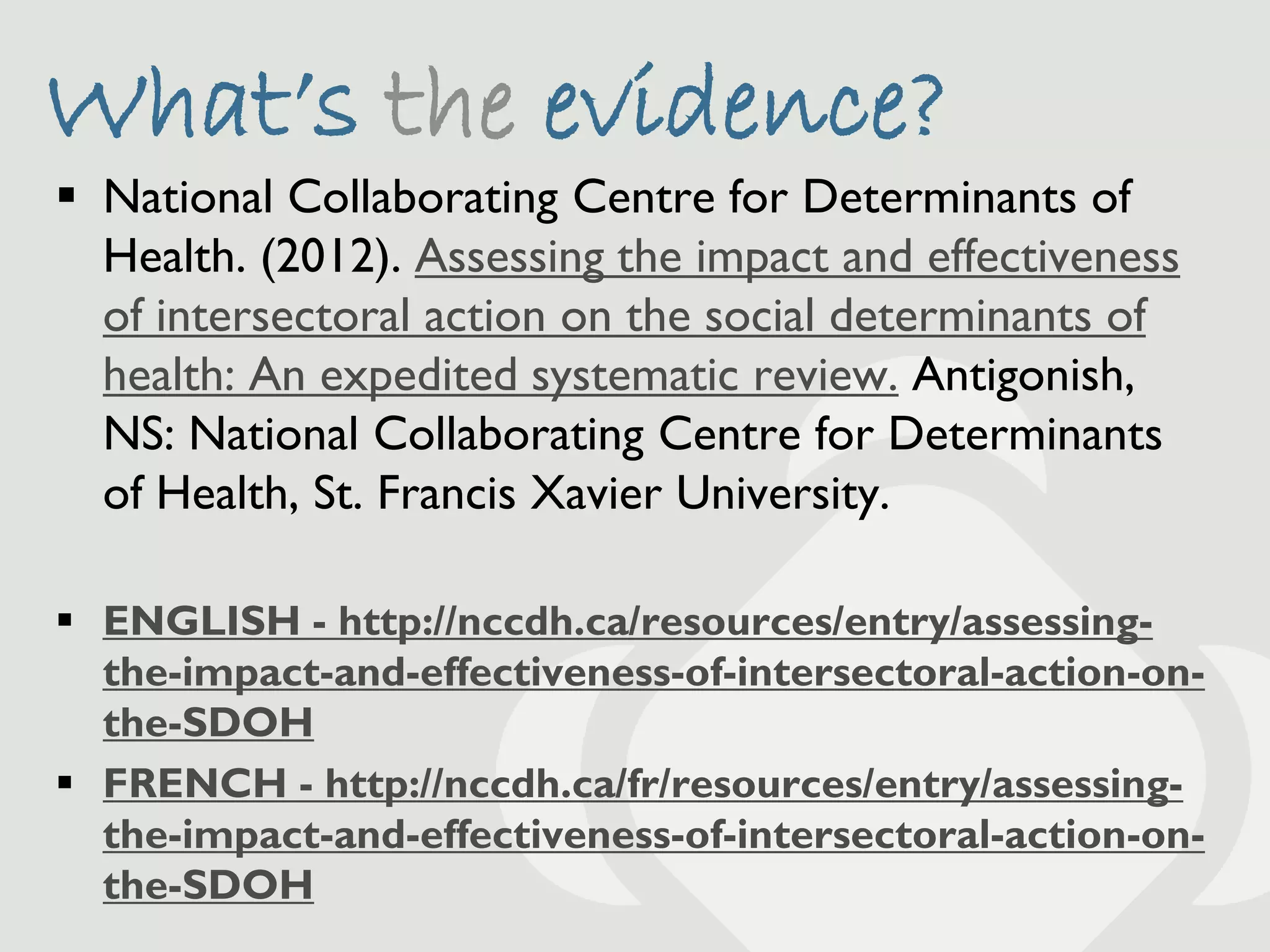
What’s the evidence?
 National Collaborating Centre for Determinants of
  Health. (2012). Assessing the impact and effectiveness
  of intersectoral action on the social determinants of
  health: An expedited systematic review. Antigonish,
  NS: National Collaborating Centre for Determinants
  of Health, St. Francis Xavier University.

 ENGLISH - http://nccdh.ca/resources/entry/assessing-
  the-impact-and-effectiveness-of-intersectoral-action-on-
  the-SDOH
 FRENCH - http://nccdh.ca/fr/resources/entry/assessing-
  the-impact-and-effectiveness-of-intersectoral-action-on-
  the-SDOH
Participant Side Panel


Housekeeping
                                                       in WebEx


 Use Q&A to post comments/questions
  during the webinar
    ‘Send’ questions to All
     (not privately to ‘Host’)

 Connection issues
    Recommend using a wired Internet
     connection (vs. wireless), to help   Q&A
     prevent connection challenges

 WebEx 24/7 help line: 1-866-229-3239
This webinar has been made possible with support from the
             Canadian Institutes of Health Research


   Welcome!
 Intersectoral Action
    and the Social
   Determinants of
        Health:
What’s the evidence?
The Health Evidence Team


                                   Kara DeCorby                  Heather Husson
                                   Administrative Director       Project Manager


Maureen Dobbins
Scientific Director
Tel: 905 525-9140 ext 22481
E-mail: dobbinsm@mcmaster.ca


                               Lori Greco          Robyn Traynor          Lyndsey McRae
                               Knowledge Broker    Research Coordinator   Research Assistant
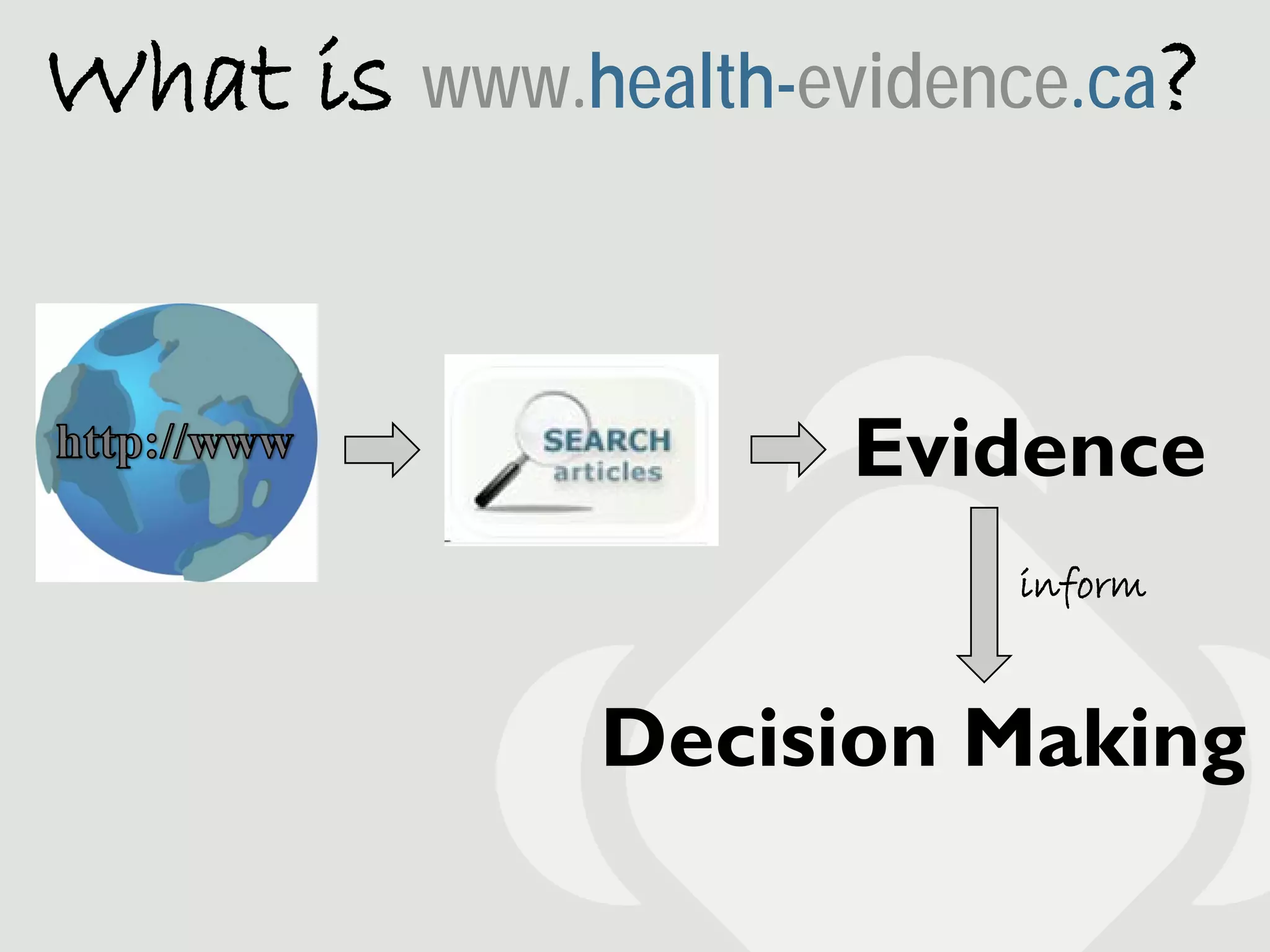
What is www.health-evidence.ca?


                     Evidence
                          inform


              Decision Making
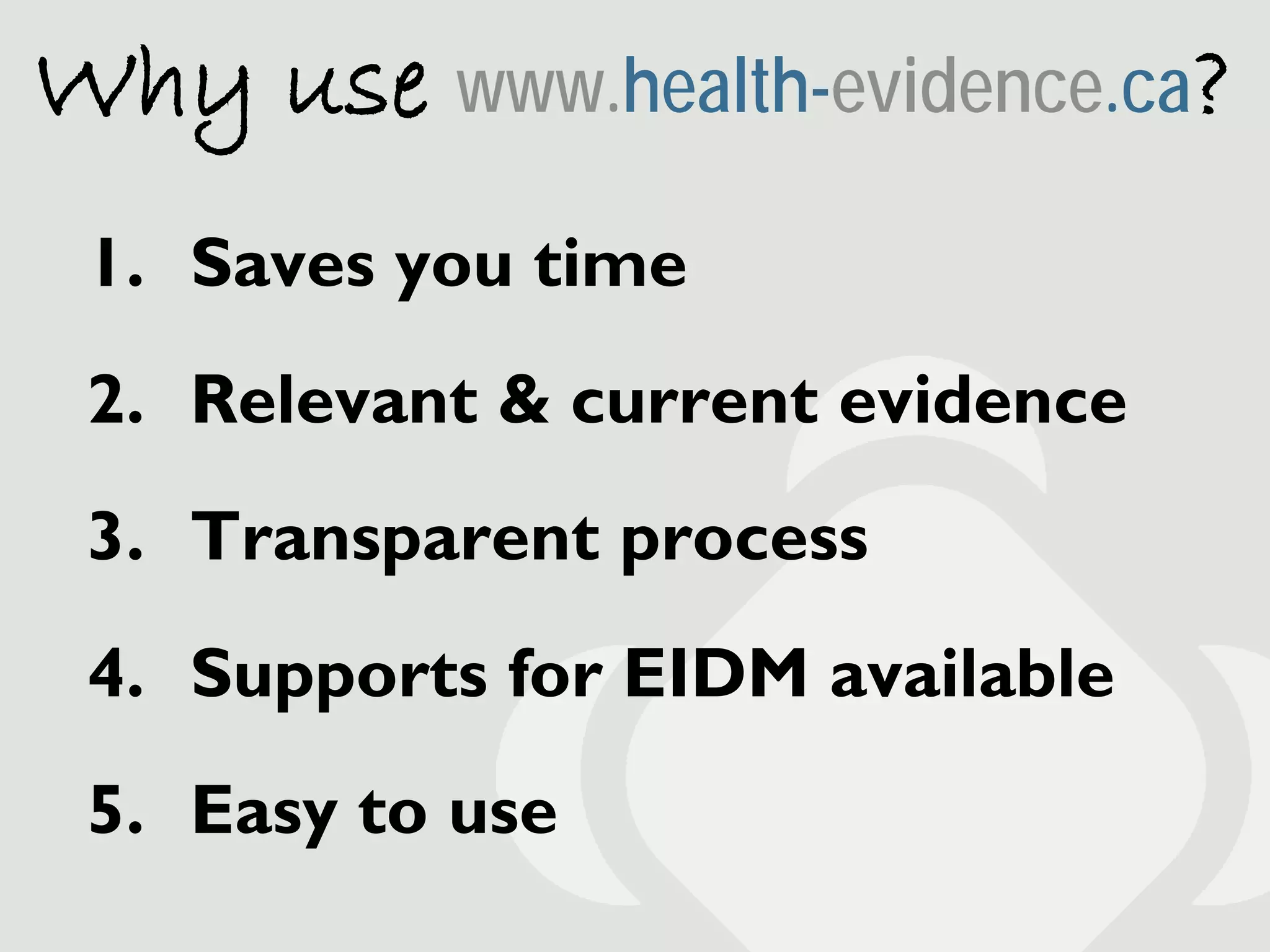
Why use www.health-evidence.ca?
 1. Saves you time
 2. Relevant & current evidence
 3. Transparent process
 4. Supports for EIDM available
 5. Easy to use
Knowledge Translation
 Supplement Project
    CIHR-funded KTB-112487
Review
 National Collaborating Centre for Determinants of
  Health. (2012). Assessing the impact and effectiveness
  of intersectoral action on the social determinants of
  health: An expedited systematic review. Antigonish,
  NS: National Collaborating Centre for Determinants
  of Health, St. Francis Xavier University.
Evaluation
Please check your email for the evaluation
        survey link after the webinar.
      It take 5 minutes to complete!

If you did not personally register for the webinar,
          please e-mail Jennifer McGugan at
    mcgugj@mcmaster.ca
              to be sent the survey
Questions?
National Collaborating Centre for
Determinants of Health


   Sume Ndumbe-Eyoh                Hannah Moffatt
   seyoh@stfx.ca                   hmoffatt@stfx.ca
          Knowledge Translation Specialists
About the National Collaborating Centre
for Determinants of Health

• Our focus
  – Social determinants of health (SDH) & health equity
• Our audience
  – All organizations that make up the public health sector in
    Canada
  – The practitioners, decision makers and researchers who
    work within public health

• Our work
  – Translate and share evidence to influence interrelated
    determinants and advance health equity


                                  Visit us at www.nccdh.ca
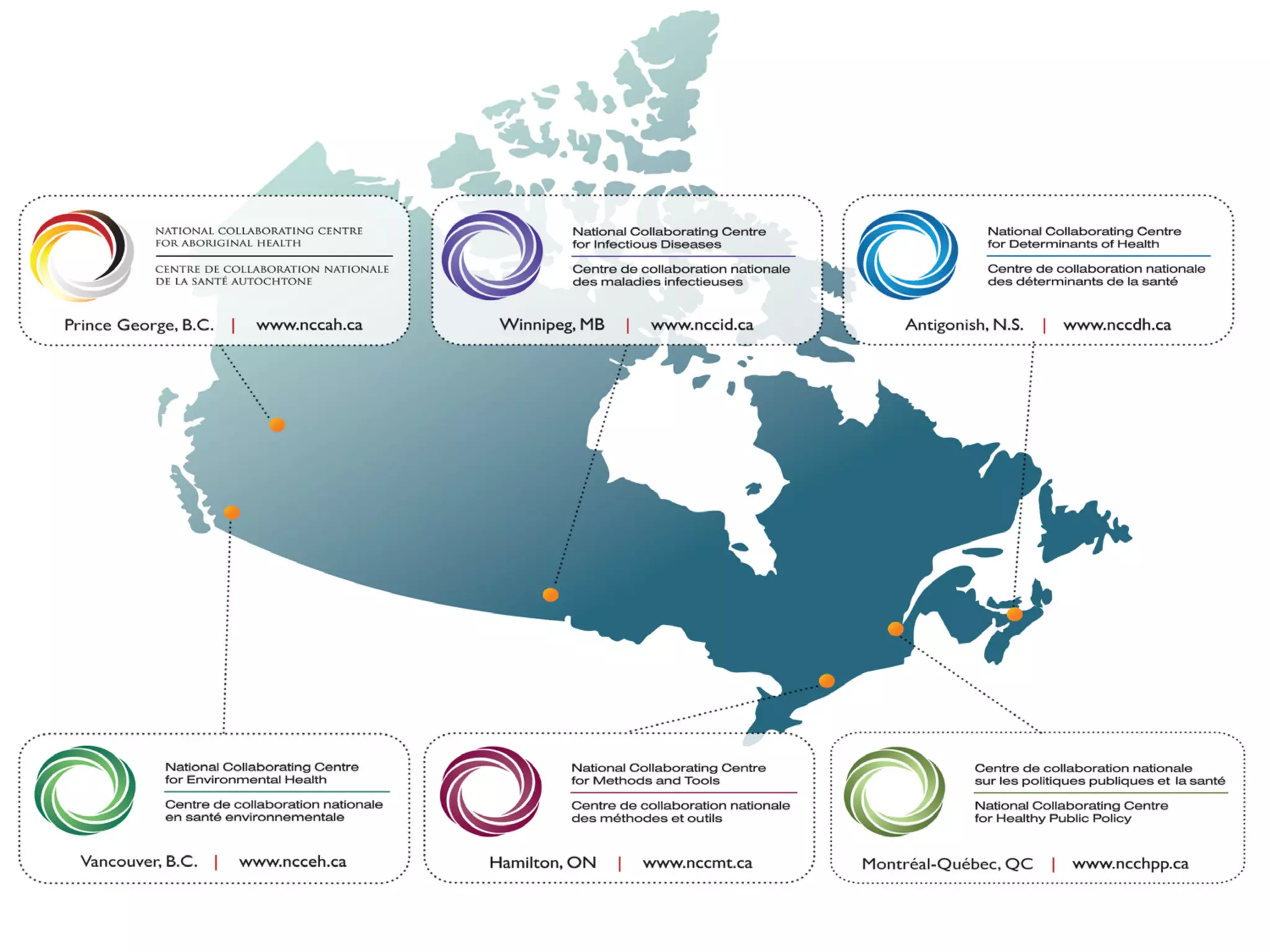
Pan-Canadian
Visit us at www.nccdh.ca


•   Resource Library
•   Health Equity Clicks: Community
•   Health Equity Clicks: Organizations
•   Networking events & workshops
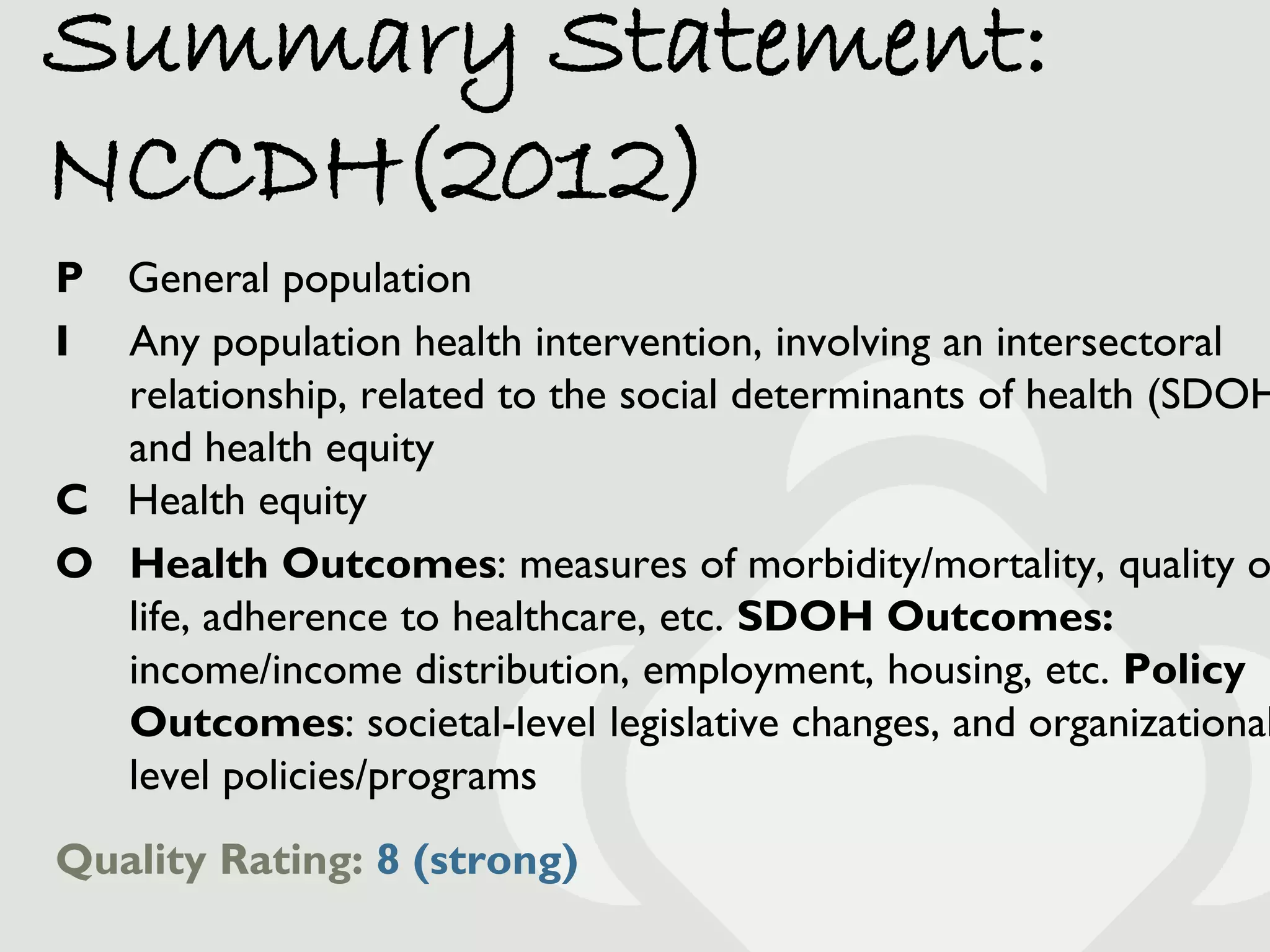
Summary Statement:
NCCDH(2012)
P General population
I Any population health intervention, involving an intersectoral
  relationship, related to the social determinants of health (SDOH
  and health equity
C Health equity
O Health Outcomes: measures of morbidity/mortality, quality o
  life, adherence to healthcare, etc. SDOH Outcomes:
  income/income distribution, employment, housing, etc. Policy
  Outcomes: societal-level legislative changes, and organizational
  level policies/programs
Quality Rating: 8 (strong)
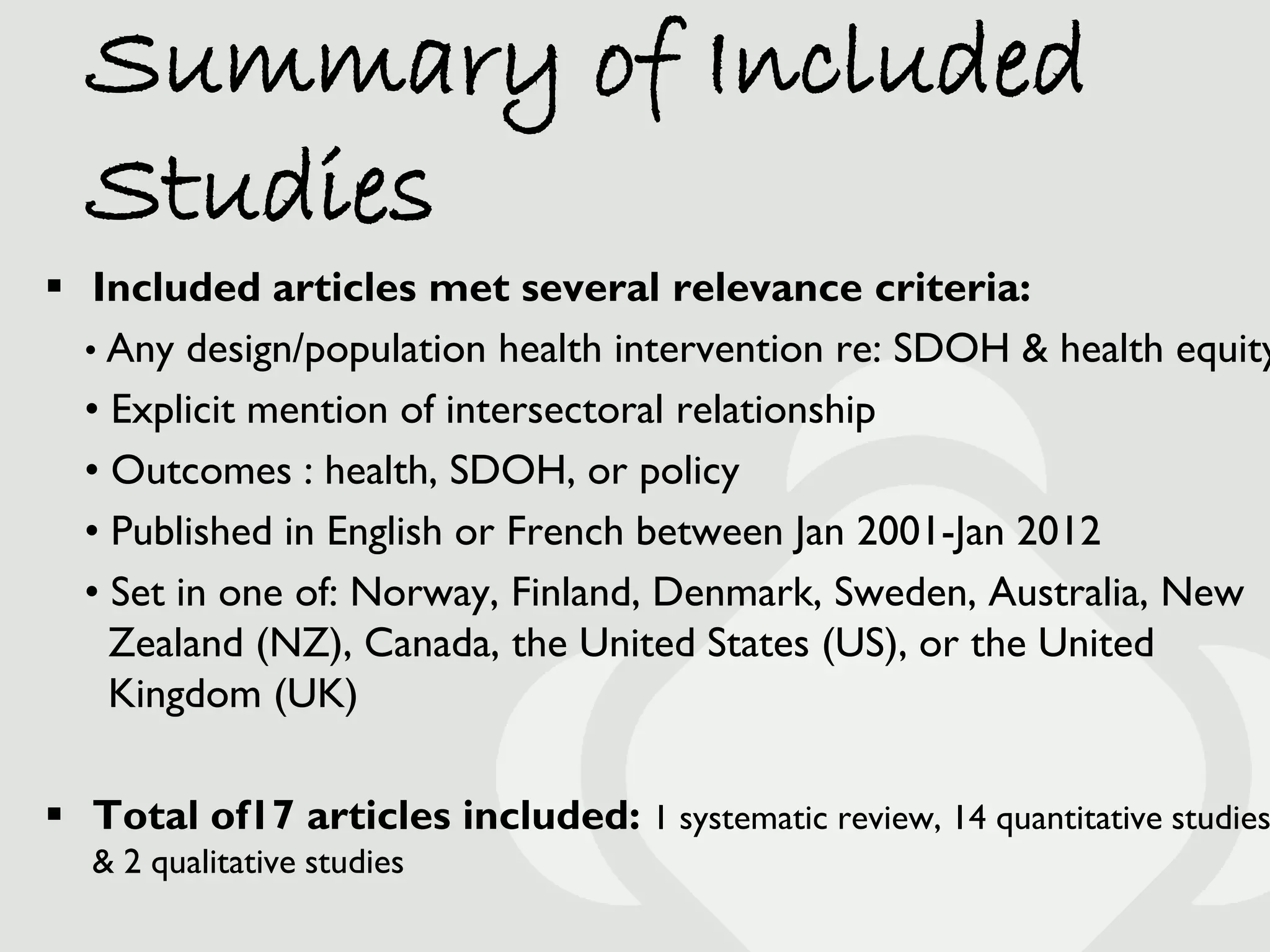
Summary of Included
  Studies
 Included articles met several relevance criteria:
  • Any design/population health intervention re: SDOH & health equity
  • Explicit mention of intersectoral relationship
  • Outcomes : health, SDOH, or policy
  • Published in English or French between Jan 2001-Jan 2012
  • Set in one of: Norway, Finland, Denmark, Sweden, Australia, New
    Zealand (NZ), Canada, the United States (US), or the United
    Kingdom (UK)

 Total of17 articles included: 1 systematic review, 14 quantitative studies
  & 2 qualitative studies
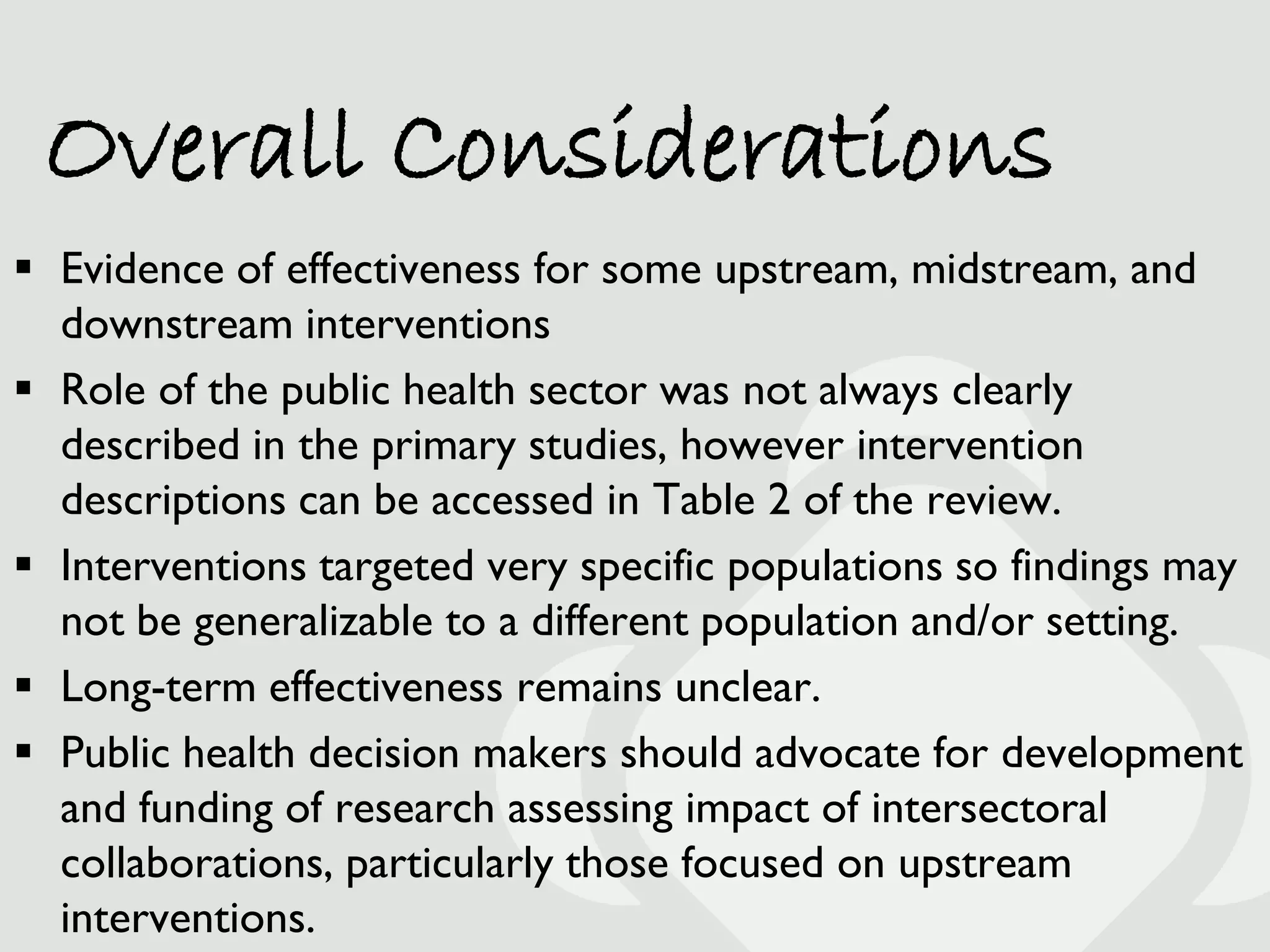
Overall Considerations
 Evidence of effectiveness for some upstream, midstream, and
  downstream interventions
 Role of the public health sector was not always clearly
  described in the primary studies, however intervention
  descriptions can be accessed in Table 2 of the review.
 Interventions targeted very specific populations so findings may
  not be generalizable to a different population and/or setting.
 Long-term effectiveness remains unclear.
 Public health decision makers should advocate for development
  and funding of research assessing impact of intersectoral
  collaborations, particularly those focused on upstream
  interventions.
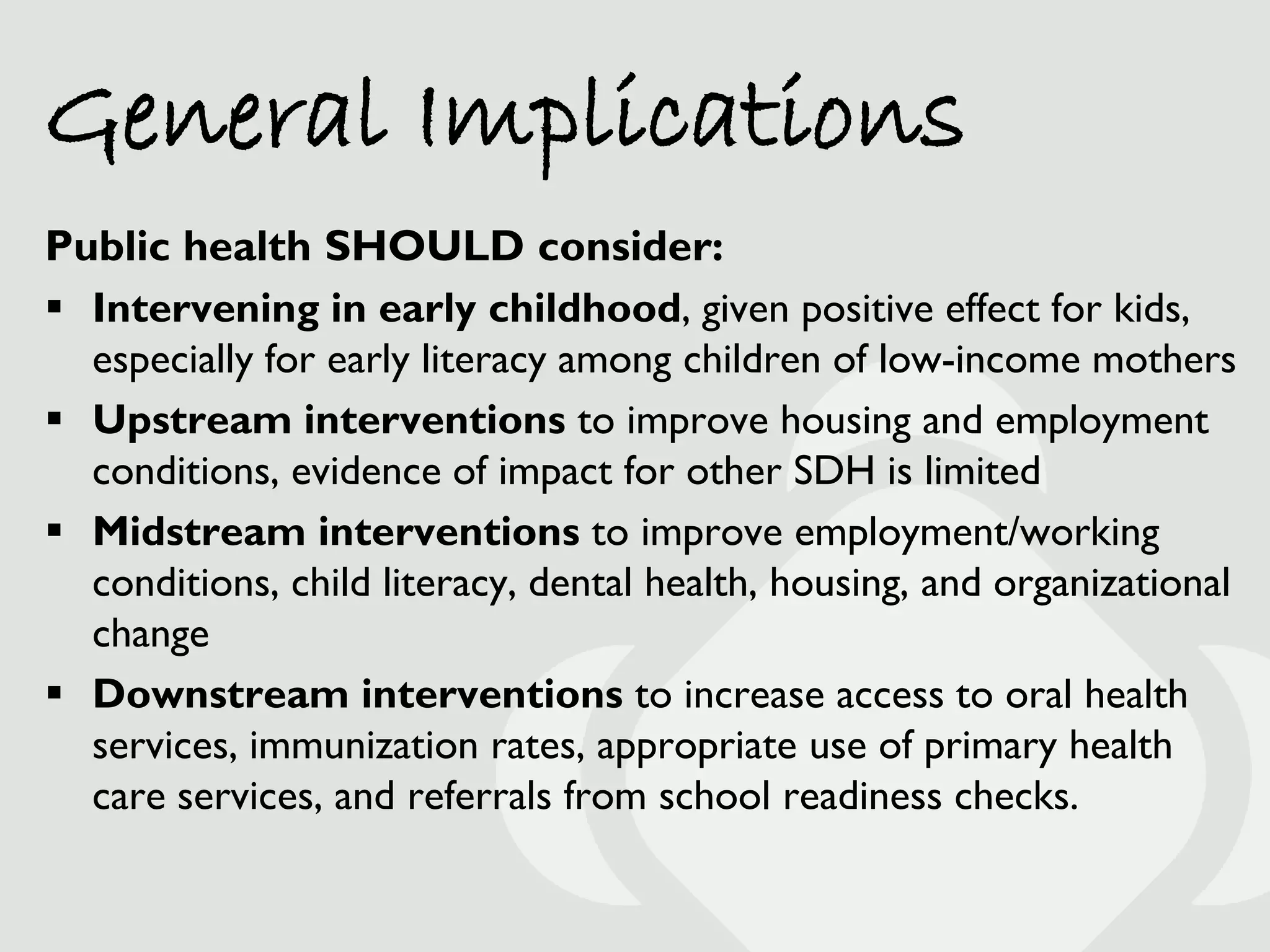
General Implications
Public health SHOULD consider:
 Intervening in early childhood, given positive effect for kids,
  especially for early literacy among children of low-income mothers
 Upstream interventions to improve housing and employment
  conditions, evidence of impact for other SDH is limited
 Midstream interventions to improve employment/working
  conditions, child literacy, dental health, housing, and organizational
  change
 Downstream interventions to increase access to oral health
  services, immunization rates, appropriate use of primary health
  care services, and referrals from school readiness checks.
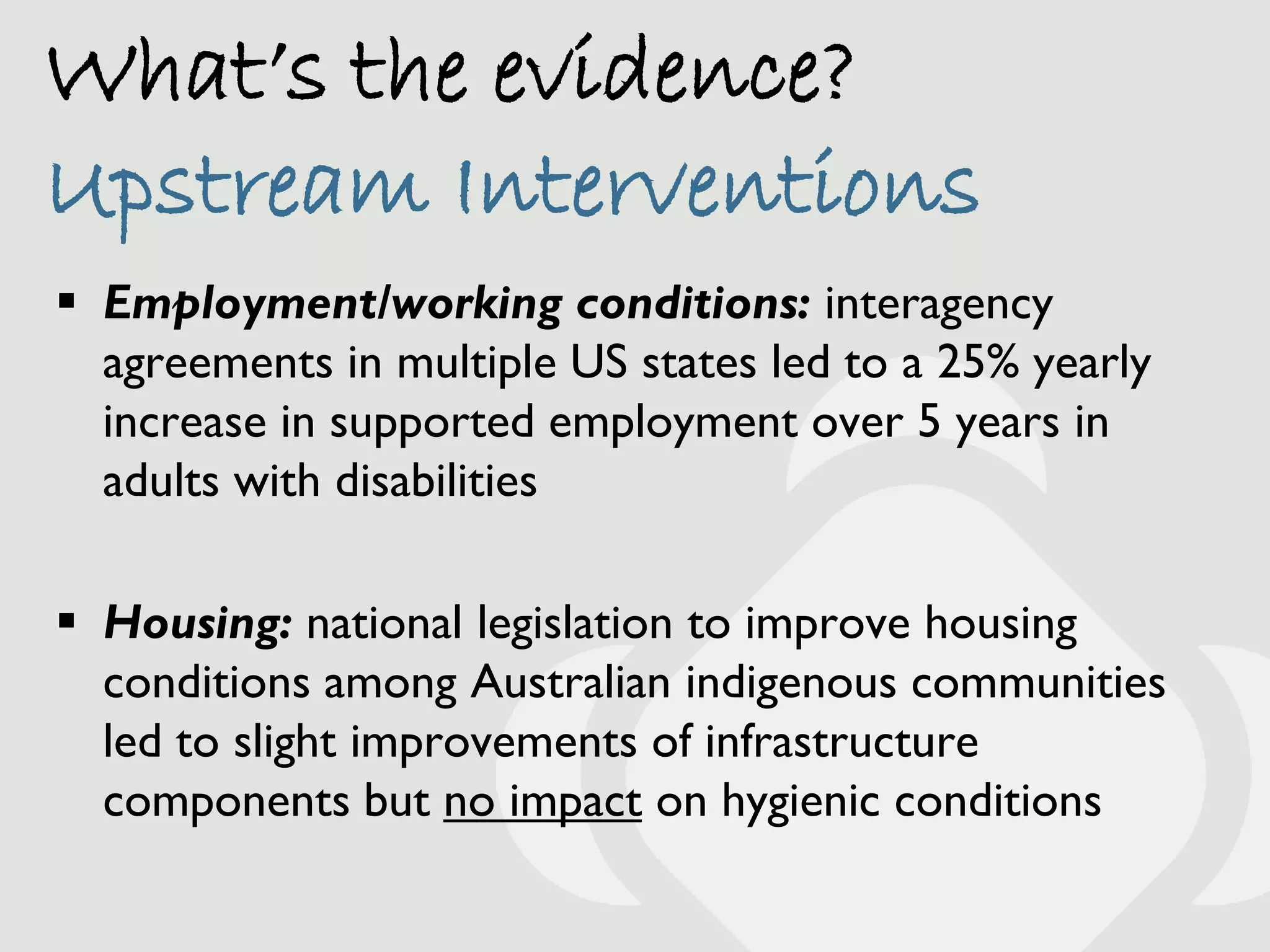
What’s the evidence?
Upstream Interventions
 Employment/working conditions: interagency
  agreements in multiple US states led to a 25% yearly
  increase in supported employment over 5 years in
  adults with disabilities

 Housing: national legislation to improve housing
  conditions among Australian indigenous communities
  led to slight improvements of infrastructure
  components but no impact on hygienic conditions
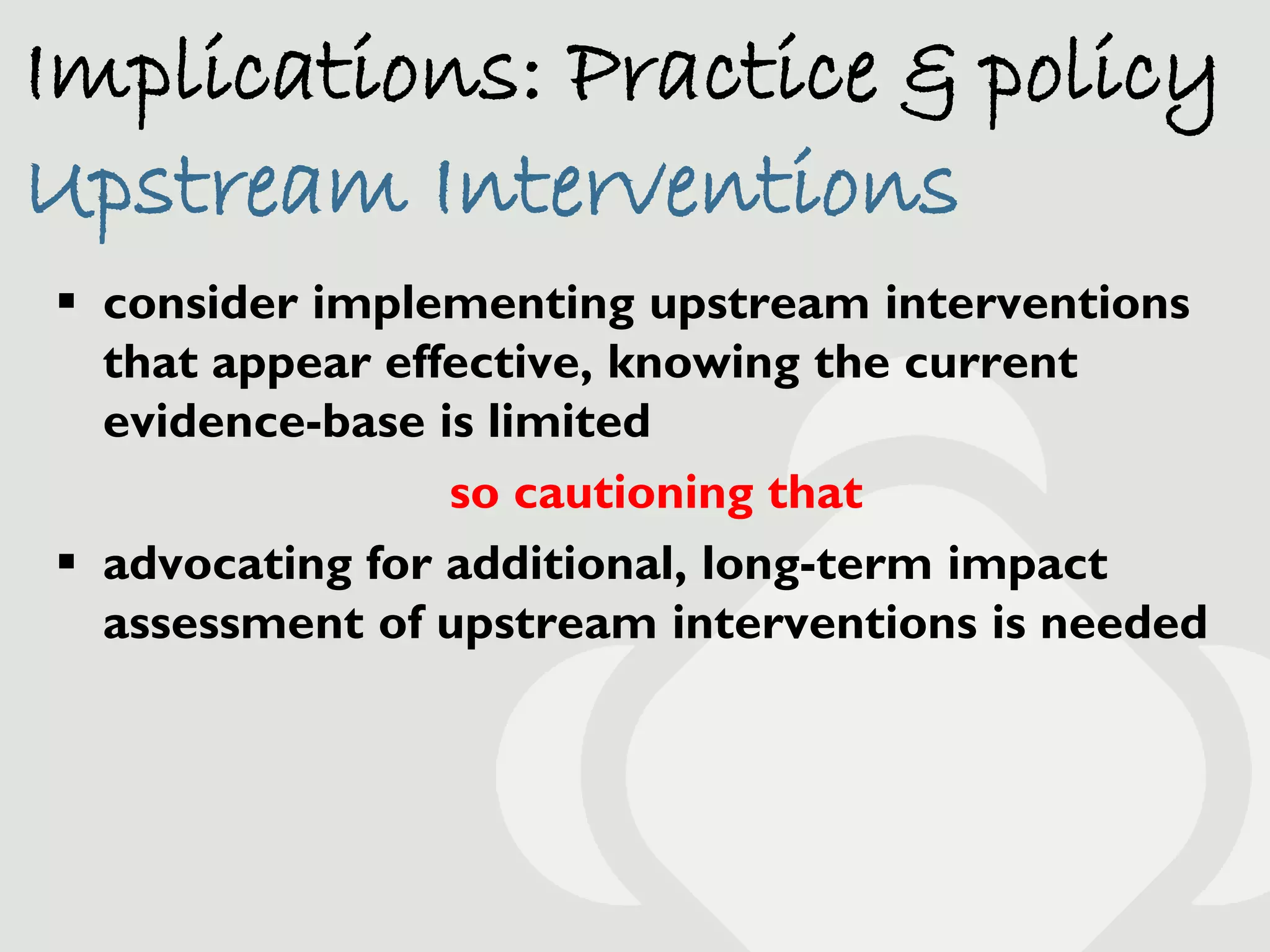
Implications: Practice & policy
Upstream Interventions
 consider implementing upstream interventions
  that appear effective, knowing the current
  evidence-base is limited
                 so cautioning that
 advocating for additional, long-term impact
  assessment of upstream interventions is needed
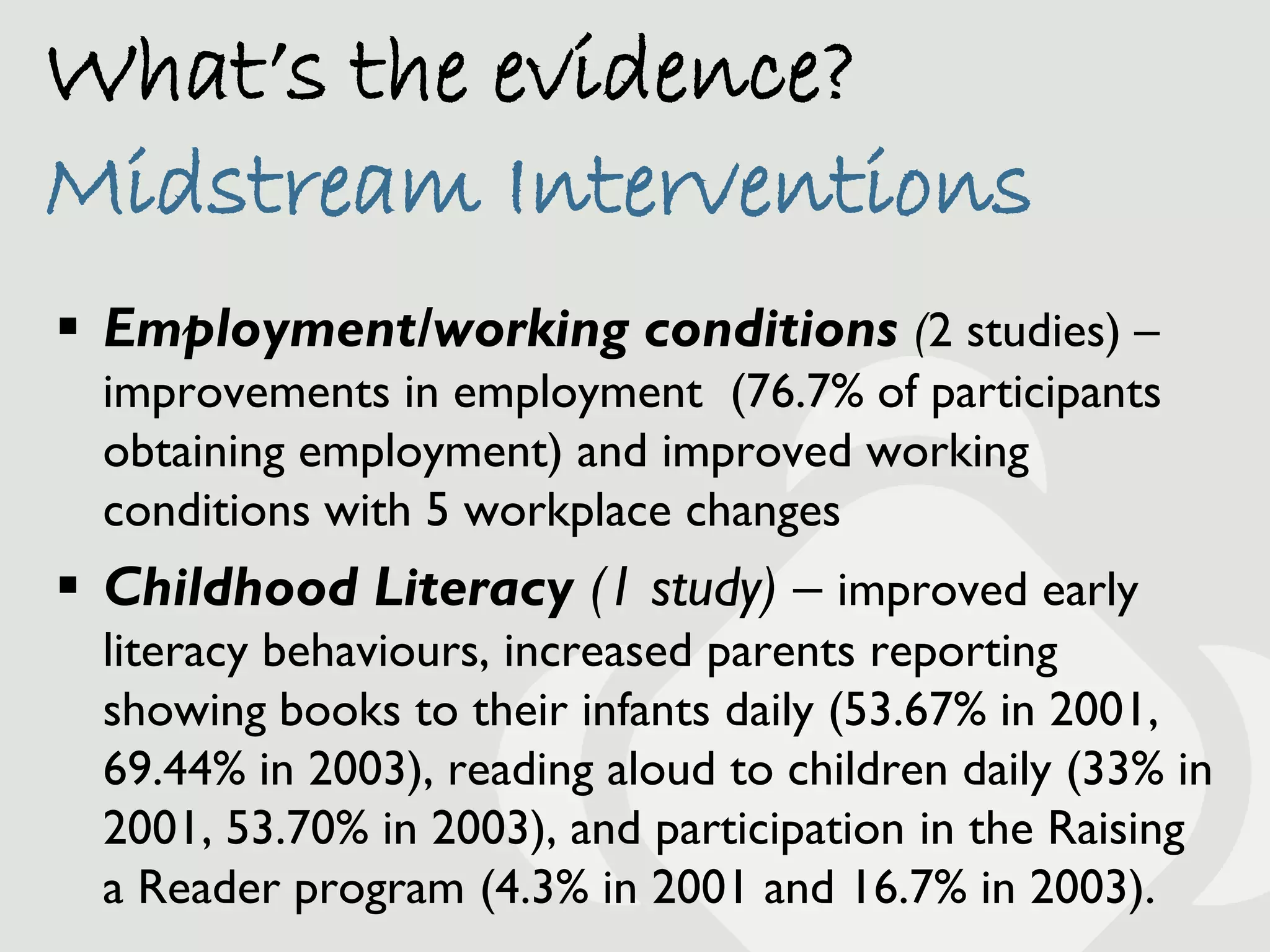
What’s the evidence?
Midstream Interventions
 Employment/working conditions (2 studies) –
  improvements in employment (76.7% of participants
  obtaining employment) and improved working
  conditions with 5 workplace changes
 Childhood Literacy (1 study) – improved early
  literacy behaviours, increased parents reporting
  showing books to their infants daily (53.67% in 2001,
  69.44% in 2003), reading aloud to children daily (33% in
  2001, 53.70% in 2003), and participation in the Raising
  a Reader program (4.3% in 2001 and 16.7% in 2003).
Midstream Interventions,
 cont.
 Housing(1 study) – all households received helpful housing
  modifications, with decreased hospital admissions for those up to 34
  years old, decreased housing-related, preventable hospital
  admissions.
 Social & Physical Environments (3 studies) -
    Eight projects resulting from a collaborative demonstrated organizational change and
     advocacy projects at multiple levels, but had no impact on program integration or policy
    School-based break time snacking reduced indicators of childhood dental disease (DMFT
     changed from 1.13, CI [0.85, 1.40] in year 1 to 1.58, CI [1.28, 1.89] in year 2) and
     increased number of filled permanent teeth in lower SES schools over time: mean 0.49,
     CI [0.20, 0.77] Year 1 and 1.05, CI [0.69, 1.14] Year 2.
    Chronic disease coalition did not report health outcomes but initiated a
      number of programs, policies, and practices with outcomes not yet available
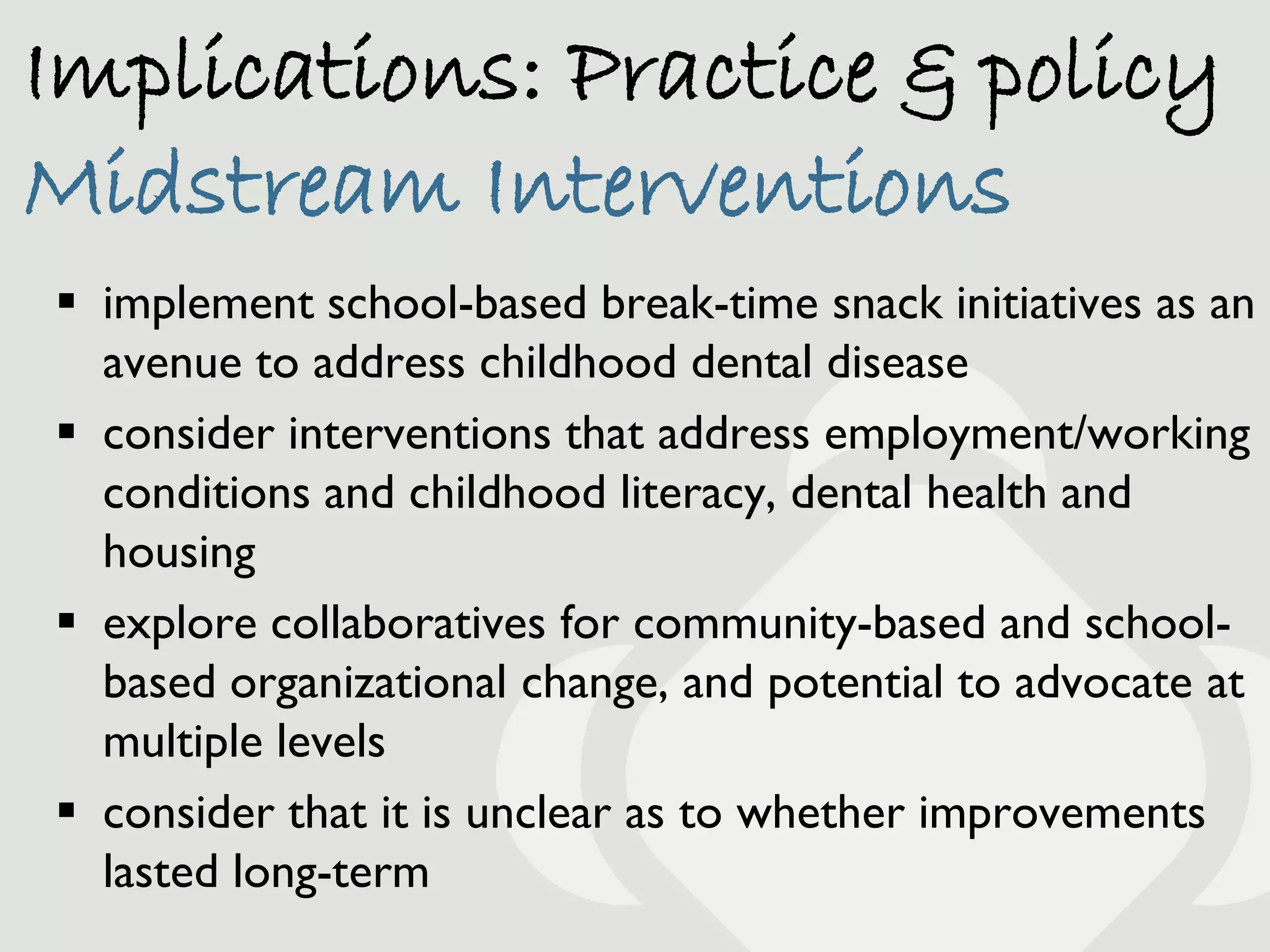
Implications: Practice & policy
Midstream Interventions
 implement school-based break-time snack initiatives as an
  avenue to address childhood dental disease
 consider interventions that address employment/working
  conditions and childhood literacy, dental health and
  housing
 explore collaboratives for community-based and school-
  based organizational change, and potential to advocate at
  multiple levels
 consider that it is unclear as to whether improvements
  lasted long-term
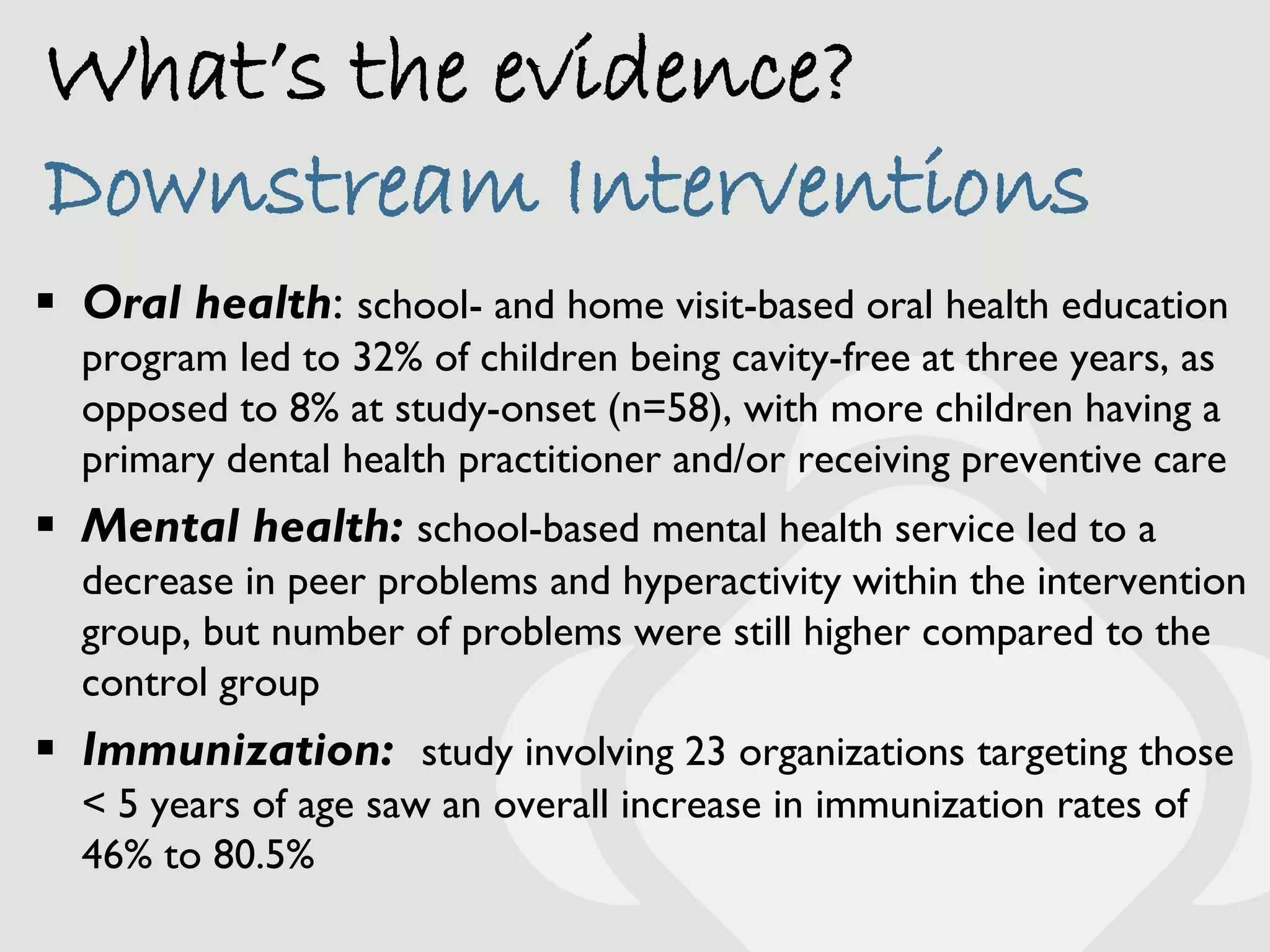
What’s the evidence?
Downstream Interventions
 Oral health: school- and home visit-based oral health education
  program led to 32% of children being cavity-free at three years, as
  opposed to 8% at study-onset (n=58), with more children having a
  primary dental health practitioner and/or receiving preventive care
 Mental health: school-based mental health service led to a
  decrease in peer problems and hyperactivity within the intervention
  group, but number of problems were still higher compared to the
  control group
 Immunization: study involving 23 organizations targeting those
  < 5 years of age saw an overall increase in immunization rates of
  46% to 80.5%
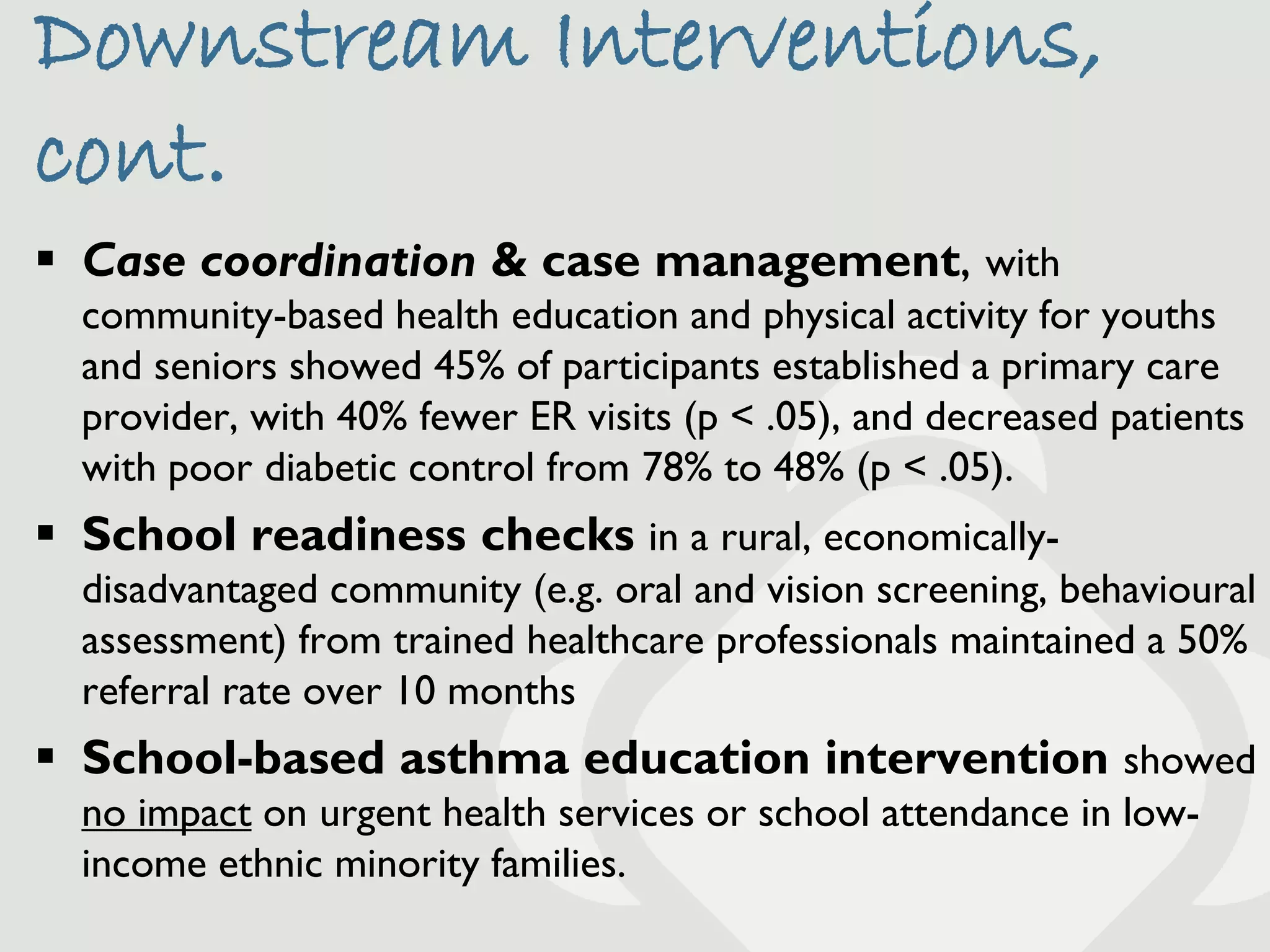
Downstream Interventions,
cont.
 Case coordination & case management, with
  community-based health education and physical activity for youths
  and seniors showed 45% of participants established a primary care
  provider, with 40% fewer ER visits (p < .05), and decreased patients
  with poor diabetic control from 78% to 48% (p < .05).
 School readiness checks in a rural, economically-
  disadvantaged community (e.g. oral and vision screening, behavioural
  assessment) from trained healthcare professionals maintained a 50%
  referral rate over 10 months
 School-based asthma education intervention showed
  no impact on urgent health services or school attendance in low-
  income ethnic minority families.
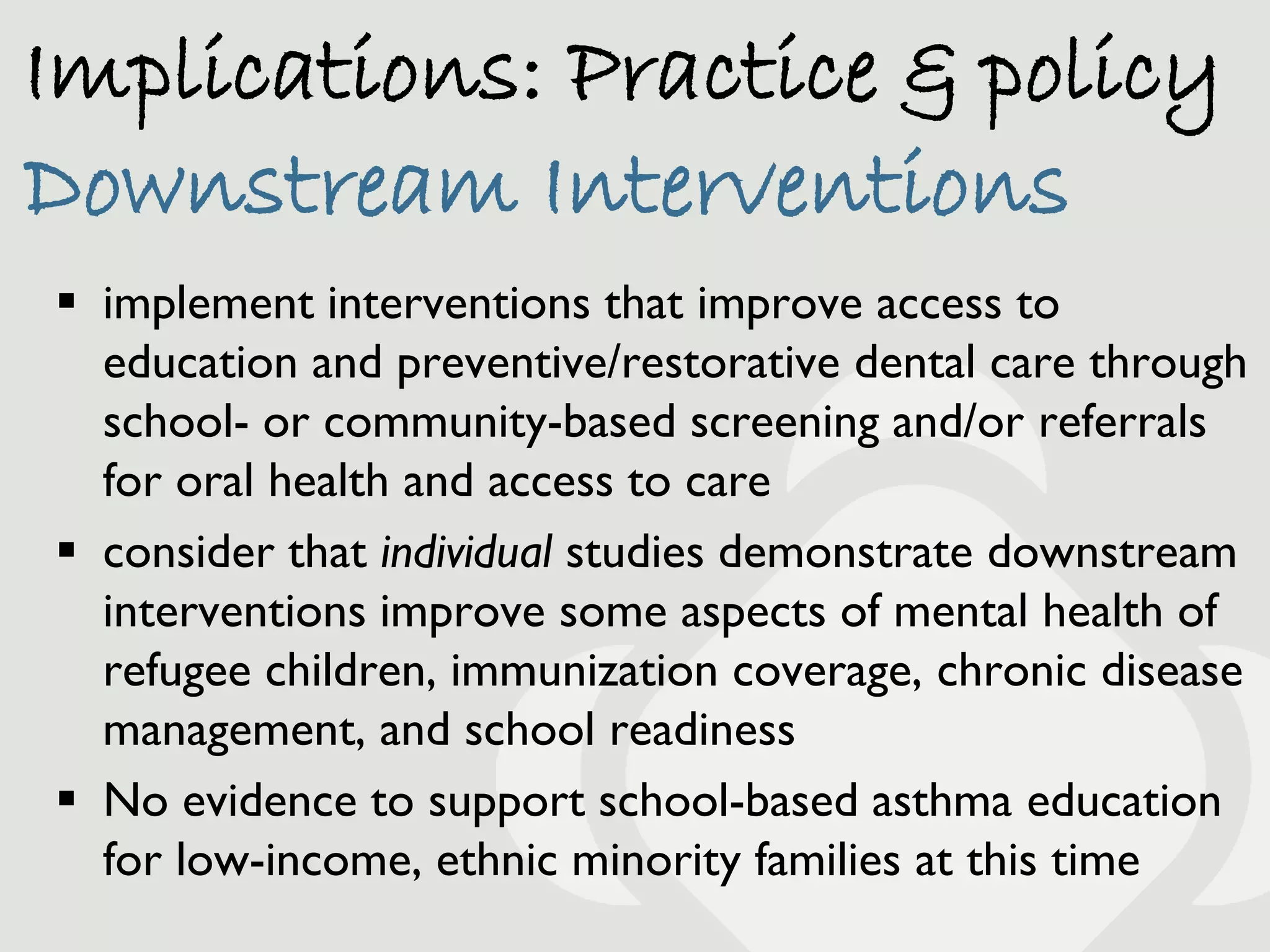
Implications: Practice & policy
Downstream Interventions
 implement interventions that improve access to
  education and preventive/restorative dental care through
  school- or community-based screening and/or referrals
  for oral health and access to care
 consider that individual studies demonstrate downstream
  interventions improve some aspects of mental health of
  refugee children, immunization coverage, chronic disease
  management, and school readiness
 No evidence to support school-based asthma education
  for low-income, ethnic minority families at this time
General Implications
Public health SHOULD promote / support / implement:
 Intervening in early childhood
 Upstream interventions to improve housing and
  employment conditions
 Midstream interventions to improve employment/
  working conditions, child literacy, dental health, housing,
  and organizational change
 Downstream interventions to increase access to oral
  health services, immunization rates, appropriate use of
  primary health care services, and referrals from school
  readiness checks
Questions?


Contact us: Sume Ndumbe-Eyoh seyoh@stfx.ca
Online Conversation
 Please continue to discuss this topic on
     Health Equity Clicks: Community
http://nccdh.ca/community/post/webin
    ar-intersectoral-action-for-health-
                  equity
Login with your Health Equity Clicks: Community username and
         password or register if you aren’t a member yet.
Evaluation
Please check your email and complete the
     evaluation survey for this webinar

If you did not receive an email with a link to the
      survey, please e-mail Jennifer McGugan:
   mcgugj@mcmaster.ca
         Thank you for your participation!

Intersectoral Action & the Social Determinants of Health: What's the Evidence?

  • 1.
    This webinar hasbeen made possible with support from the Canadian Institutes of Health Research Welcome! Intersectoral Action and the Social Determinants of Health: What’s the evidence? In partnership with: You will be placed on hold until the webinar begins. The webinar will begin shortly, please remain on the line.
  • 2.
    What’s the evidence? National Collaborating Centre for Determinants of Health. (2012). Assessing the impact and effectiveness of intersectoral action on the social determinants of health: An expedited systematic review. Antigonish, NS: National Collaborating Centre for Determinants of Health, St. Francis Xavier University.  ENGLISH - http://nccdh.ca/resources/entry/assessing- the-impact-and-effectiveness-of-intersectoral-action-on- the-SDOH  FRENCH - http://nccdh.ca/fr/resources/entry/assessing- the-impact-and-effectiveness-of-intersectoral-action-on- the-SDOH
  • 3.
    Participant Side Panel Housekeeping in WebEx  Use Q&A to post comments/questions during the webinar  ‘Send’ questions to All (not privately to ‘Host’)  Connection issues  Recommend using a wired Internet connection (vs. wireless), to help Q&A prevent connection challenges  WebEx 24/7 help line: 1-866-229-3239
  • 4.
    This webinar hasbeen made possible with support from the Canadian Institutes of Health Research Welcome! Intersectoral Action and the Social Determinants of Health: What’s the evidence?
  • 5.
    The Health EvidenceTeam Kara DeCorby Heather Husson Administrative Director Project Manager Maureen Dobbins Scientific Director Tel: 905 525-9140 ext 22481 E-mail: dobbinsm@mcmaster.ca Lori Greco Robyn Traynor Lyndsey McRae Knowledge Broker Research Coordinator Research Assistant
  • 6.
    What is www.health-evidence.ca? Evidence inform Decision Making
  • 7.
    Why use www.health-evidence.ca? 1. Saves you time 2. Relevant & current evidence 3. Transparent process 4. Supports for EIDM available 5. Easy to use
  • 8.
    Knowledge Translation SupplementProject CIHR-funded KTB-112487
  • 9.
    Review  National CollaboratingCentre for Determinants of Health. (2012). Assessing the impact and effectiveness of intersectoral action on the social determinants of health: An expedited systematic review. Antigonish, NS: National Collaborating Centre for Determinants of Health, St. Francis Xavier University.
  • 10.
    Evaluation Please check youremail for the evaluation survey link after the webinar. It take 5 minutes to complete! If you did not personally register for the webinar, please e-mail Jennifer McGugan at mcgugj@mcmaster.ca to be sent the survey
  • 11.
  • 12.
    National Collaborating Centrefor Determinants of Health Sume Ndumbe-Eyoh Hannah Moffatt seyoh@stfx.ca hmoffatt@stfx.ca Knowledge Translation Specialists
  • 13.
    About the NationalCollaborating Centre for Determinants of Health • Our focus – Social determinants of health (SDH) & health equity • Our audience – All organizations that make up the public health sector in Canada – The practitioners, decision makers and researchers who work within public health • Our work – Translate and share evidence to influence interrelated determinants and advance health equity Visit us at www.nccdh.ca
  • 14.
  • 15.
    Visit us atwww.nccdh.ca • Resource Library • Health Equity Clicks: Community • Health Equity Clicks: Organizations • Networking events & workshops
  • 16.
    Summary Statement: NCCDH(2012) P Generalpopulation I Any population health intervention, involving an intersectoral relationship, related to the social determinants of health (SDOH and health equity C Health equity O Health Outcomes: measures of morbidity/mortality, quality o life, adherence to healthcare, etc. SDOH Outcomes: income/income distribution, employment, housing, etc. Policy Outcomes: societal-level legislative changes, and organizational level policies/programs Quality Rating: 8 (strong)
  • 17.
    Summary of Included Studies  Included articles met several relevance criteria: • Any design/population health intervention re: SDOH & health equity • Explicit mention of intersectoral relationship • Outcomes : health, SDOH, or policy • Published in English or French between Jan 2001-Jan 2012 • Set in one of: Norway, Finland, Denmark, Sweden, Australia, New Zealand (NZ), Canada, the United States (US), or the United Kingdom (UK)  Total of17 articles included: 1 systematic review, 14 quantitative studies & 2 qualitative studies
  • 18.
    Overall Considerations  Evidenceof effectiveness for some upstream, midstream, and downstream interventions  Role of the public health sector was not always clearly described in the primary studies, however intervention descriptions can be accessed in Table 2 of the review.  Interventions targeted very specific populations so findings may not be generalizable to a different population and/or setting.  Long-term effectiveness remains unclear.  Public health decision makers should advocate for development and funding of research assessing impact of intersectoral collaborations, particularly those focused on upstream interventions.
  • 19.
    General Implications Public healthSHOULD consider:  Intervening in early childhood, given positive effect for kids, especially for early literacy among children of low-income mothers  Upstream interventions to improve housing and employment conditions, evidence of impact for other SDH is limited  Midstream interventions to improve employment/working conditions, child literacy, dental health, housing, and organizational change  Downstream interventions to increase access to oral health services, immunization rates, appropriate use of primary health care services, and referrals from school readiness checks.
  • 20.
    What’s the evidence? UpstreamInterventions  Employment/working conditions: interagency agreements in multiple US states led to a 25% yearly increase in supported employment over 5 years in adults with disabilities  Housing: national legislation to improve housing conditions among Australian indigenous communities led to slight improvements of infrastructure components but no impact on hygienic conditions
  • 21.
    Implications: Practice &policy Upstream Interventions  consider implementing upstream interventions that appear effective, knowing the current evidence-base is limited so cautioning that  advocating for additional, long-term impact assessment of upstream interventions is needed
  • 22.
    What’s the evidence? MidstreamInterventions  Employment/working conditions (2 studies) – improvements in employment (76.7% of participants obtaining employment) and improved working conditions with 5 workplace changes  Childhood Literacy (1 study) – improved early literacy behaviours, increased parents reporting showing books to their infants daily (53.67% in 2001, 69.44% in 2003), reading aloud to children daily (33% in 2001, 53.70% in 2003), and participation in the Raising a Reader program (4.3% in 2001 and 16.7% in 2003).
  • 23.
    Midstream Interventions, cont. Housing(1 study) – all households received helpful housing modifications, with decreased hospital admissions for those up to 34 years old, decreased housing-related, preventable hospital admissions.  Social & Physical Environments (3 studies) -  Eight projects resulting from a collaborative demonstrated organizational change and advocacy projects at multiple levels, but had no impact on program integration or policy  School-based break time snacking reduced indicators of childhood dental disease (DMFT changed from 1.13, CI [0.85, 1.40] in year 1 to 1.58, CI [1.28, 1.89] in year 2) and increased number of filled permanent teeth in lower SES schools over time: mean 0.49, CI [0.20, 0.77] Year 1 and 1.05, CI [0.69, 1.14] Year 2.  Chronic disease coalition did not report health outcomes but initiated a number of programs, policies, and practices with outcomes not yet available
  • 24.
    Implications: Practice &policy Midstream Interventions  implement school-based break-time snack initiatives as an avenue to address childhood dental disease  consider interventions that address employment/working conditions and childhood literacy, dental health and housing  explore collaboratives for community-based and school- based organizational change, and potential to advocate at multiple levels  consider that it is unclear as to whether improvements lasted long-term
  • 25.
    What’s the evidence? DownstreamInterventions  Oral health: school- and home visit-based oral health education program led to 32% of children being cavity-free at three years, as opposed to 8% at study-onset (n=58), with more children having a primary dental health practitioner and/or receiving preventive care  Mental health: school-based mental health service led to a decrease in peer problems and hyperactivity within the intervention group, but number of problems were still higher compared to the control group  Immunization: study involving 23 organizations targeting those < 5 years of age saw an overall increase in immunization rates of 46% to 80.5%
  • 26.
    Downstream Interventions, cont.  Casecoordination & case management, with community-based health education and physical activity for youths and seniors showed 45% of participants established a primary care provider, with 40% fewer ER visits (p < .05), and decreased patients with poor diabetic control from 78% to 48% (p < .05).  School readiness checks in a rural, economically- disadvantaged community (e.g. oral and vision screening, behavioural assessment) from trained healthcare professionals maintained a 50% referral rate over 10 months  School-based asthma education intervention showed no impact on urgent health services or school attendance in low- income ethnic minority families.
  • 27.
    Implications: Practice &policy Downstream Interventions  implement interventions that improve access to education and preventive/restorative dental care through school- or community-based screening and/or referrals for oral health and access to care  consider that individual studies demonstrate downstream interventions improve some aspects of mental health of refugee children, immunization coverage, chronic disease management, and school readiness  No evidence to support school-based asthma education for low-income, ethnic minority families at this time
  • 28.
    General Implications Public healthSHOULD promote / support / implement:  Intervening in early childhood  Upstream interventions to improve housing and employment conditions  Midstream interventions to improve employment/ working conditions, child literacy, dental health, housing, and organizational change  Downstream interventions to increase access to oral health services, immunization rates, appropriate use of primary health care services, and referrals from school readiness checks
  • 29.
    Questions? Contact us: SumeNdumbe-Eyoh seyoh@stfx.ca
  • 30.
    Online Conversation Pleasecontinue to discuss this topic on Health Equity Clicks: Community http://nccdh.ca/community/post/webin ar-intersectoral-action-for-health- equity Login with your Health Equity Clicks: Community username and password or register if you aren’t a member yet.
  • 31.
    Evaluation Please check youremail and complete the evaluation survey for this webinar If you did not receive an email with a link to the survey, please e-mail Jennifer McGugan: mcgugj@mcmaster.ca Thank you for your participation!