English 1
LGE 1102
Conjunction
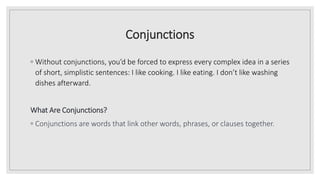
Conjunctions
◦ Without conjunctions, you’d be forced to express every complex idea in a series
of short, simplistic sentences: I like cooking. I like eating. I don’t like washing
dishes afterward.
What Are Conjunctions?
◦ Conjunctions are words that link other words, phrases, or clauses together.
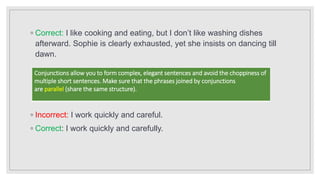
◦ Correct: I like cooking and eating, but I don’t like washing dishes
afterward. Sophie is clearly exhausted, yet she insists on dancing till
dawn.
◦ Incorrect: I work quickly and careful.
◦ Correct: I work quickly and carefully.
Conjunctions allow you to form complex, elegant sentences and avoid the choppiness of
multiple short sentences. Make sure that the phrases joined by conjunctions
are parallel (share the same structure).
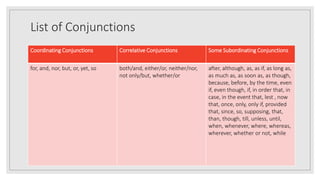
List of Conjunctions
Coordinating Conjunctions Correlative Conjunctions Some Subordinating Conjunctions
for, and, nor, but, or, yet, so both/and, either/or, neither/nor,
not only/but, whether/or
after, although, as, as if, as long as,
as much as, as soon as, as though,
because, before, by the time, even
if, even though, if, in order that, in
case, in the event that, lest , now
that, once, only, only if, provided
that, since, so, supposing, that,
than, though, till, unless, until,
when, whenever, where, whereas,
wherever, whether or not, while
COORDINATING
CONJUNCTIONS
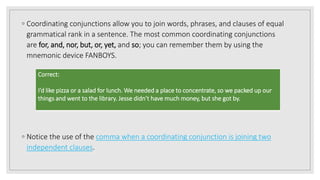
◦ Coordinating conjunctions allow you to join words, phrases, and clauses of equal
grammatical rank in a sentence. The most common coordinating conjunctions
are for, and, nor, but, or, yet, and so; you can remember them by using the
mnemonic device FANBOYS.
◦ Notice the use of the comma when a coordinating conjunction is joining two
independent clauses.
Correct:
I’d like pizza or a salad for lunch. We needed a place to concentrate, so we packed up our
things and went to the library. Jesse didn’t have much money, but she got by.
CORRELATIVE
CONJUNCTIONS
◦ Correlative conjunctions are pairs of conjunctions that work together. Some
examples are either/or, neither/nor, and not only/but also.
Correct:
Not only am I finished studying for English, but I’m also finished writing my history essay. I am
finished with both my English essay and my history essay.
SUBORDINATING
CONJUNCTIONS
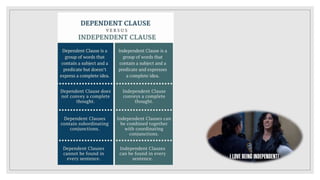
◦ Subordinating conjunctions join independent and dependent clauses. A subordinating conjunction can
signal a cause-and-effect relationship, a contrast, or some other kind of relationship between the
clauses. Common subordinating conjunctions are because, since, as, although, though,
while, and whereas. Sometimes an adverb, such as until, after, or before can function as a conjunction.
◦ Here, the adverb until functions as a subordinating conjunction to connect two ideas: I can stay out (the
independent clause) and the clock strikes twelve (the dependent clause). The independent clause could
stand alone as a sentence; the dependent clause depends on the independent clause to make sense.
Correct:
I can stay out until the clock strikes twelve.
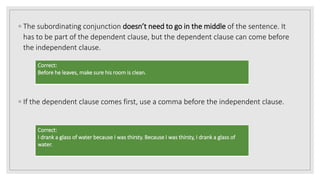
◦ The subordinating conjunction doesn’t need to go in the middle of the sentence. It
has to be part of the dependent clause, but the dependent clause can come before
the independent clause.
◦ If the dependent clause comes first, use a comma before the independent clause.
Correct:
Before he leaves, make sure his room is clean.
Correct:
I drank a glass of water because I was thirsty. Because I was thirsty, I drank a glass of
water.
STARTING A SENTENCE WITH
A CONJUNCTION
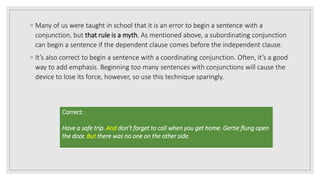
◦ Many of us were taught in school that it is an error to begin a sentence with a
conjunction, but that rule is a myth. As mentioned above, a subordinating conjunction
can begin a sentence if the dependent clause comes before the independent clause.
◦ It’s also correct to begin a sentence with a coordinating conjunction. Often, it’s a good
way to add emphasis. Beginning too many sentences with conjunctions will cause the
device to lose its force, however, so use this technique sparingly.
Correct:
Have a safe trip. And don’t forget to call when you get home. Gertie flung open
the door. But there was no one on the other side.
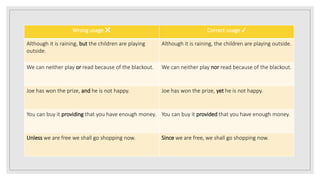
Wrong usage ❌ Correct usage ✔
Although it is raining, but the children are playing
outside.
Although it is raining, the children are playing outside.
We can neither play or read because of the blackout. We can neither play nor read because of the blackout.
Joe has won the prize, and he is not happy. Joe has won the prize, yet he is not happy.
You can buy it providing that you have enough money. You can buy it provided that you have enough money.
Unless we are free we shall go shopping now. Since we are free, we shall go shopping now.
Powerpoint Slides - Grammar - Conjunction.pptx

Powerpoint Slides - Grammar - Conjunction.pptx

  • 1.
  • 2.
    Conjunctions ◦ Without conjunctions,you’d be forced to express every complex idea in a series of short, simplistic sentences: I like cooking. I like eating. I don’t like washing dishes afterward. What Are Conjunctions? ◦ Conjunctions are words that link other words, phrases, or clauses together.
  • 3.
    ◦ Correct: Ilike cooking and eating, but I don’t like washing dishes afterward. Sophie is clearly exhausted, yet she insists on dancing till dawn. ◦ Incorrect: I work quickly and careful. ◦ Correct: I work quickly and carefully. Conjunctions allow you to form complex, elegant sentences and avoid the choppiness of multiple short sentences. Make sure that the phrases joined by conjunctions are parallel (share the same structure).
  • 4.
    List of Conjunctions CoordinatingConjunctions Correlative Conjunctions Some Subordinating Conjunctions for, and, nor, but, or, yet, so both/and, either/or, neither/nor, not only/but, whether/or after, although, as, as if, as long as, as much as, as soon as, as though, because, before, by the time, even if, even though, if, in order that, in case, in the event that, lest , now that, once, only, only if, provided that, since, so, supposing, that, than, though, till, unless, until, when, whenever, where, whereas, wherever, whether or not, while
  • 5.
  • 6.
    ◦ Coordinating conjunctionsallow you to join words, phrases, and clauses of equal grammatical rank in a sentence. The most common coordinating conjunctions are for, and, nor, but, or, yet, and so; you can remember them by using the mnemonic device FANBOYS. ◦ Notice the use of the comma when a coordinating conjunction is joining two independent clauses. Correct: I’d like pizza or a salad for lunch. We needed a place to concentrate, so we packed up our things and went to the library. Jesse didn’t have much money, but she got by.
  • 7.
  • 8.
    ◦ Correlative conjunctionsare pairs of conjunctions that work together. Some examples are either/or, neither/nor, and not only/but also. Correct: Not only am I finished studying for English, but I’m also finished writing my history essay. I am finished with both my English essay and my history essay.
  • 9.
  • 10.
    ◦ Subordinating conjunctionsjoin independent and dependent clauses. A subordinating conjunction can signal a cause-and-effect relationship, a contrast, or some other kind of relationship between the clauses. Common subordinating conjunctions are because, since, as, although, though, while, and whereas. Sometimes an adverb, such as until, after, or before can function as a conjunction. ◦ Here, the adverb until functions as a subordinating conjunction to connect two ideas: I can stay out (the independent clause) and the clock strikes twelve (the dependent clause). The independent clause could stand alone as a sentence; the dependent clause depends on the independent clause to make sense. Correct: I can stay out until the clock strikes twelve.
  • 12.
    ◦ The subordinatingconjunction doesn’t need to go in the middle of the sentence. It has to be part of the dependent clause, but the dependent clause can come before the independent clause. ◦ If the dependent clause comes first, use a comma before the independent clause. Correct: Before he leaves, make sure his room is clean. Correct: I drank a glass of water because I was thirsty. Because I was thirsty, I drank a glass of water.
  • 13.
    STARTING A SENTENCEWITH A CONJUNCTION
  • 14.
    ◦ Many ofus were taught in school that it is an error to begin a sentence with a conjunction, but that rule is a myth. As mentioned above, a subordinating conjunction can begin a sentence if the dependent clause comes before the independent clause. ◦ It’s also correct to begin a sentence with a coordinating conjunction. Often, it’s a good way to add emphasis. Beginning too many sentences with conjunctions will cause the device to lose its force, however, so use this technique sparingly. Correct: Have a safe trip. And don’t forget to call when you get home. Gertie flung open the door. But there was no one on the other side.
  • 15.
    Wrong usage ❌Correct usage ✔ Although it is raining, but the children are playing outside. Although it is raining, the children are playing outside. We can neither play or read because of the blackout. We can neither play nor read because of the blackout. Joe has won the prize, and he is not happy. Joe has won the prize, yet he is not happy. You can buy it providing that you have enough money. You can buy it provided that you have enough money. Unless we are free we shall go shopping now. Since we are free, we shall go shopping now.