Creating a Collaborative Information Technology Policy
and Enhance Capabilities for Education through a New
Strategy on Instructional Technology at Rutgers
University
RIT: Rutgers Information Technology
Sang Nguyen
Welcome
 Thank you all for attending today's presentation.
A special thanks to :
 Dr. Donald Smith, Vice President and Chief Information Officer of Information
Technology for being in attendance.
Presentation Overview
 Instructional Technology
 The Problem – General
 The Problem – Rutgers
 Successful Programs
 RIT
 Budget
 Summary
 Discussion
 References
Instructional Technology?
 The use of technology for
education
 Online Classes
 Learning Management Systems
(sakai, eCollege, etc.)
 Class Podiums
 iClickers
 PowerPoint
 Instructional technologies can help
enhance teaching and learning
abilities.
What technology do most of your Professors use
often?
Source: Technology Survey Qualtrics
The Problem in General
 Lack of training
 Little support for technology
 Online Class software
 Multiple versions of Learning
Management Systems
Source: Barriers to Adopting Technology
Rutgers Problem
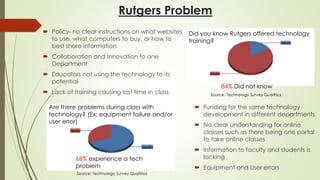
 Policy- no clear instructions on what websites
to use, what computers to buy, or how to
best share information
 Collaboration and Innovation to one
Department
 Educators not using the technology to its
potential
 Lack of training causing lost time in class
Did you know Rutgers offered technology
training?
 Funding for the same technology
development in different departments
 No clear understanding for online
classes such as there being one portal
to take online classes
 Information to faculty and students is
lacking
 Equipment and User errors
Are there problems during class with
technology? (Ex: equipment failure and/or
user error)
68% experience a tech
problem
84% Did not know
Survey Results
How many classes do you take that use
Technology?
Majority of Professors are using
Technology between 4- 5 per semester
per student, overall 53% reported
How often did a technology problem
occur?
At least 1 problem occurred when a
student went to class
Survey Results Cont.
Do you want live Video and Web
Conferencing ?
63.46% want to see
this happen
Should the Professor take training classes?
63% of students said yes
How long before problem was
fixed?
57.14% took 10min or more
Models of Success
 Harvard University
 Pennsylvania State University
 Washington State University- Pullman
 University Of Washington
 University of Massachusetts- Amherst
 University of Arkansas
Harvard University
 HUIT
 CIO Council
 Uniform policy for the whole University
 First year of HUIT: 2012-2013
 63% to 67% Satisfaction
 37% to 40% more helpful
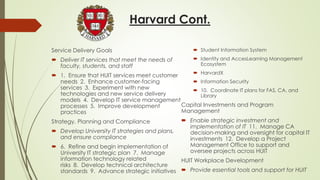
Harvard Cont.
Service Delivery Goals
 Deliver IT services that meet the needs of
faculty, students, and staff
 1. Ensure that HUIT services meet customer
needs 2. Enhance customer-facing
services 3. Experiment with new
technologies and new service delivery
models 4. Develop IT service management
processes 5. Improve development
practices
Strategy, Planning and Compliance
 Develop University IT strategies and plans,
and ensure compliance
 6. Refine and begin implementation of
University IT strategic plan 7. Manage
information technology related
risks 8. Develop technical architecture
standards 9. Advance strategic initiatives
 Student Information System
 Identity and AccesLearning Management
Ecosystem
 HarvardX
 Information Security
 10. Coordinate IT plans for FAS, CA, and
Library
Capital Investments and Program
Management
 Enable strategic investment and
implementation of IT 11. Manage CA
decision-making and oversight for capital IT
investments 12. Develop a Project
Management Office to support and
oversee projects across HUIT
HUIT Workplace Development
 Provide essential tools and support for HUIT
Washington Sate University
 Video and Web Conferencing capabilities
 Distance learning facilities
 Video Streaming and Recording
 Training on technology
University of Massachusetts- Amherst
 Office of Information Technology
 Single entity
 UMass Online
 UMassOnline expands programs to provide
educational access.
 UMass Online reaches diverse and geographically
dispersed learners. In AY 2010-11 course enrollments
for UMass Online were 50,782, an 11% increase over
AY 2009-10.
 No difference of degree whether online or
traditional
 16% increase in revenue for FY11
 12% increase in enrollment for FY11
Pennsylvania State University
 World Campus
 Enrolled over 200,000 online
 96% increase since 2008
 About $80 million from online enrollment in 2012
 Students online paid $6,327 compared to traditional $13,932
 The Replacement Model
 Reduce class-meeting time
 Replace face to face with online meeting
 Reduce from three to one lecture per week
 Utilizing computer and studio labs
University of Arkansas
 ITS: Information Technology Services
 Centralized system for the whole University
 Collaboration between departments
 Control all technology aspects
 LifeSize Video Conferencing
 Able to connect to other parts of University from across the state
 More accessible to more students
 Lower cost to University and Students
 Overflow classrooms
 Use another classroom to accommodate students
University of Washington
 Faculty Development
 Online modules for technology training
 Teaching with simulations
 Learning about online distance learning
 IT connect
 One stop shop
 Overall 100,000 online enrollment for 2011-2012
Revenue 27% increase
2012- $54.2 million
2011- $42.6 million
Gross Revenue 17% increase
2012- $131.1 million
2011- $108.4 million
What we will take
RIT
Harvard
HUIT
Uniform policies
Training
Penn State
The
Replacement
Model
UW
UW Online
Training
WSU
Video and Web
Services
UMASS
UMass Online
UARK
Lifesize
ITS
The Plan
Phase 1
•Develop an IT committee
•Reorganize into RIT
•Policy
Phase 2
•Staff
•Training
Phase 3
•Hardware
•Collaboration
•Survey
Phase 4
•Budget
•Incentives
•Feedback
Phase 5
•Online Classes/Sakai
•Digital Classroom Podium
•Pilot Video Conferencing
Phase 6
•Survey
•Budget
“Moore’s Law: Every 18 months
computers are twice as fast, but also
every 18 months computers energy
usage is cut in half.”
-Dr. Donald Smith
Phase 1
 IT committee of one person per school IT department, Student
representative per school, a Faculty member from each school, and the
Chief Information Officer.
 Rutgers Information Technology (RIT) is created
 Development of Policy on the use of Instructional Technology, standards,
and procedures
 Develop a preliminary budget
Phase 2
 Determine where and how much staff is needed
 Training plan will be put in place,
 Have at least training for faculty in the fall and spring semester
 For any special equipment or classrooms equipment for video conferencing,
there will be a mandatory 1 hour training before using
 Train faculty on new equipment and the possibilities of technology for classes
 Offer student and staff training
 Advertise training via email, facebook, twitter, Targum, and any other source
possible
 Feedback on policy, training, and satisfaction on RIT
 Survey students, faculty, and staff on what instructional technology to use
Phase 3
 Inspect computers, network, servers, and any equipment used for
education
 Replace equipment base on the standards set forth for the whole of the
University that is 4-5 years or older
 Have IT departments collaborate and innovate
 Feedback from staff about RIT
 Reevaluate that instructional technology is be use effectively
Phase 4
 Reevaluate Budget with keeping in mind that technology needs to be
replace between every 4-5 years, more than just a capital investment
 Develop a incentive program for faculty to use instructional technology
 Feedback from faculty, staff, and students on RIT
Phase 5
 Online Distance Learning
 Digital Classroom Services
 Pilot Video Conferencing
 Sakai
Phase 6
 Survey
 Collect data on instructional technology usage
 Collect data on the training program
 Collect data on video conferencing pilot program
 Collect data on online learning
 Improve where we can and should from this point on
Budget
Expense Revenue
Small Classrooms -Digital
Classroom Podiums
$0 x 4 = $0
Large Classrooms -Digital
Classroom Podiums
$0 x 4 = $0
Adobe Connect (currently) $0
LifeSize Video Conferencing
w/3 year service
$15,000 x 6 = $90,000
Initial cost
Faculty Incentive $2,000
NJ Edge (currently) $0
Student Staff (part-time) $52,800 annually
Additional Tech Fee $5 x 65,000 = $325,000
Computer Fee (Currently) $153.50 x 65,000 = $9,977,500
Total $144,800 $10,302,500
*LifeSize Grant Assistance Program- $90 billion in technology grants
*Operating cost unknown do to no separate information on Technology budget
*partnerships with Technology Companies
*Student Service Operating cost $65,829,000
Complications
 Faculty not on board
 Capabilities of the hardware and network
 Not continuing with the plan because of difficulties
 Departments not sharing information
 Lack of student interest
 Not enough bandwidth
 Integration of systems may not work
Is this Technology RIT?
 Demonstration by David Wyrtzen of
Digital Classroom Services
Summary
 RIT: Rutgers Information Technology
 Time for collaboration and innovation
 Policy
 We need an easy and uniform experience
 Training
 Quality of education must be held
 Online Distance Learning
 More possibilities for Students and Faculty
 Sakai
 Better use of software
 Budget for IT as an investment that changes
Is Rutgers Technology RIT for the 21st Century?
Thank You!
Questions?
• Dr. Donald Smith
• David Wyrtzen
• Fellow Rutgers students
References
 Aziz, Christian V. Personal Interview. 17 Feb. 2014.
 Butler, Darrell L., and Martin Sellbom. "Barriers to Adopting Technology." Educause
Quarterly 2 (2002): 22-8. Print.
 Chough, Alex. "Leveraging Technology in Campus Change Initiatives: A Practice
Brief Based on BEAMS Project Outcomes." Institute for Higher Education Policy
(2008) Print.
 Georgina, David A., and Charles C. Hosford. "Higher Education Faculty Perceptions
on Technology Integration and Training." Teaching & Teacher Education 25.5
(2009): 690-6. Print.
 Georgina, David A., and Myrna R. Olson. "Integration of Technology in Higher
Education: A Review of Faculty Self-Perceptions." Internet & Higher Education 11.1
(2008): 1-8. Print.
 Grasha, Anthony F., and Natalia Yangarber-Hicks. "Integrating Teaching Styles and
Learning Styles with Instructional Technology." College Teaching 48.1 (2000): 2. Print.
 Harvard University. "Harvard University Information Technology." Harvard University
Information Technology. 2014. Web. <http://huit.harvard.edu/home>.
 LifeSize. “LifeSize Video solutions for Education.” LifeSize. 2014. Web.
http://www.lifesize.com/en/solutions/industry/education.
References
 Keengwe, Jared, Terry Kidd, and Lydia Kyei-Blankson. "Faculty and Technology: Implications for Faculty
Training and Technology Leadership." Journal of Science Education & Technology 18.1 (2009): 23-8.
Print.
 Olsen, Florence. "Report Details Options on Paying for Technology." Chronicle of Higher Education
47.37 (2001): A40. Print.
 Pennsylvania State University. "Penn State World Campus." Penn State Online.Web.
<http://www.worldcampus.psu.edu/>.
 Phipps, Ronald A., and Jane V. Wellman. "Funding the" Infostructure." A Guide to Financing Technology
Infrastructure in Higher Education, Lumina–Foundation for Education: New Agenda Series 3.2
(2001)Print.
 Robert Barchi. "Initiatives for the First 100 Days of the University Strategic Plan." Rutgers Office of the
President. 2014.Web. Feb 17, 2014 <http://president.rutgers.edu/public-remarks/letters/initiatives-first-
100-days-strategic-plan>.
 Rogers, Donna L. "A Paradigm Shift: Technology Integration for Higher Education in the New
Millennium." AACE Journal 1.13 (2000): 19-33. Print.
 Rutgers. "Office of Instructional & Research Technology." Office of Instructional & Research
Technology. Dec 4 2013.Web. <https://oirt.rutgers.edu/>.
 Rutgers. “Budget Facts and Figures.” Budget Facts and Figures. Dec 20 2013. Web.
<http://budgetfacts.rutgers.edu>.
 Smyth, Robyn. "Broadband Videoconferencing as a Tool for Learner-Centred Distance Learning in
Higher Education." British Journal of Educational Technology 36.5 (2005): 805-20. Print.
 Spotts, Thomas H. "Discriminating Factors in Faculty use of Instructional Technology in Higher
Education." Educational Technology & Society 2.4 (1999): 92-9. Print.
References
 Smith, Donald. Personal Interview. 3 Apr. 2014
 Twigg, Carol A. "Improving Learning and Reducing Costs: New Models for Online Learning."
Educause Review 38.5 (2003): 28. Print.
 Undergraduate Academic Affairs. "Digital Classroom Services." Digital Classroom Services.
2013.Web. <https://dcs.rutgers.edu/>.
 University of Arkansas. “Information Technology Services.” Information Technology Services.
2014. Web. <http://its.uark.edu> .
 University of Massachusetts-Amherst. "Online Learning." UMASS Amherst Countinuing &
Profession Education. 2010.Web. <http://www.umassulearn.net/about>.
 University of Washington. "Metrics: Overview." University of Washington Information
Technology. 2012.Web. <http://www.washington.edu/uwit/metrics/index.html>.
 University Senate Instruction, Curricula, and Advising Committee. "Online Education at
Rutgers University." 2010.Web.
<http://senate.rutgers.edu/ICACOnS1015OnOnlineCoursesApril2011AsAdopted.pdf>.
 Washington State University. "Academic Media Services." Academic Media Services.
2014.Web. <https://ams.wsu.edu/index.aspx>.
 Wyrtzen, David. Personal Interview. 17 Feb. 2014
 Xu, Yonghong (Jade), and Katrina A. Meyer. "Factors Explaining Faculty Technology use
and Productivity." Internet & Higher Education 10.1 (2007): 41-52. Print.

Powerpoint Proposal1

  • 1.
    Creating a CollaborativeInformation Technology Policy and Enhance Capabilities for Education through a New Strategy on Instructional Technology at Rutgers University RIT: Rutgers Information Technology Sang Nguyen
  • 2.
    Welcome  Thank youall for attending today's presentation. A special thanks to :  Dr. Donald Smith, Vice President and Chief Information Officer of Information Technology for being in attendance.
  • 3.
    Presentation Overview  InstructionalTechnology  The Problem – General  The Problem – Rutgers  Successful Programs  RIT  Budget  Summary  Discussion  References
  • 4.
    Instructional Technology?  Theuse of technology for education  Online Classes  Learning Management Systems (sakai, eCollege, etc.)  Class Podiums  iClickers  PowerPoint  Instructional technologies can help enhance teaching and learning abilities. What technology do most of your Professors use often? Source: Technology Survey Qualtrics
  • 5.
    The Problem inGeneral  Lack of training  Little support for technology  Online Class software  Multiple versions of Learning Management Systems Source: Barriers to Adopting Technology
  • 6.
    Rutgers Problem  Policy-no clear instructions on what websites to use, what computers to buy, or how to best share information  Collaboration and Innovation to one Department  Educators not using the technology to its potential  Lack of training causing lost time in class Did you know Rutgers offered technology training?  Funding for the same technology development in different departments  No clear understanding for online classes such as there being one portal to take online classes  Information to faculty and students is lacking  Equipment and User errors Are there problems during class with technology? (Ex: equipment failure and/or user error) 68% experience a tech problem 84% Did not know
  • 7.
    Survey Results How manyclasses do you take that use Technology? Majority of Professors are using Technology between 4- 5 per semester per student, overall 53% reported How often did a technology problem occur? At least 1 problem occurred when a student went to class
  • 8.
    Survey Results Cont. Doyou want live Video and Web Conferencing ? 63.46% want to see this happen Should the Professor take training classes? 63% of students said yes How long before problem was fixed? 57.14% took 10min or more
  • 9.
    Models of Success Harvard University  Pennsylvania State University  Washington State University- Pullman  University Of Washington  University of Massachusetts- Amherst  University of Arkansas
  • 10.
    Harvard University  HUIT CIO Council  Uniform policy for the whole University  First year of HUIT: 2012-2013  63% to 67% Satisfaction  37% to 40% more helpful
  • 11.
    Harvard Cont. Service DeliveryGoals  Deliver IT services that meet the needs of faculty, students, and staff  1. Ensure that HUIT services meet customer needs 2. Enhance customer-facing services 3. Experiment with new technologies and new service delivery models 4. Develop IT service management processes 5. Improve development practices Strategy, Planning and Compliance  Develop University IT strategies and plans, and ensure compliance  6. Refine and begin implementation of University IT strategic plan 7. Manage information technology related risks 8. Develop technical architecture standards 9. Advance strategic initiatives  Student Information System  Identity and AccesLearning Management Ecosystem  HarvardX  Information Security  10. Coordinate IT plans for FAS, CA, and Library Capital Investments and Program Management  Enable strategic investment and implementation of IT 11. Manage CA decision-making and oversight for capital IT investments 12. Develop a Project Management Office to support and oversee projects across HUIT HUIT Workplace Development  Provide essential tools and support for HUIT
  • 12.
    Washington Sate University Video and Web Conferencing capabilities  Distance learning facilities  Video Streaming and Recording  Training on technology
  • 13.
    University of Massachusetts-Amherst  Office of Information Technology  Single entity  UMass Online  UMassOnline expands programs to provide educational access.  UMass Online reaches diverse and geographically dispersed learners. In AY 2010-11 course enrollments for UMass Online were 50,782, an 11% increase over AY 2009-10.  No difference of degree whether online or traditional  16% increase in revenue for FY11  12% increase in enrollment for FY11
  • 14.
    Pennsylvania State University World Campus  Enrolled over 200,000 online  96% increase since 2008  About $80 million from online enrollment in 2012  Students online paid $6,327 compared to traditional $13,932  The Replacement Model  Reduce class-meeting time  Replace face to face with online meeting  Reduce from three to one lecture per week  Utilizing computer and studio labs
  • 15.
    University of Arkansas ITS: Information Technology Services  Centralized system for the whole University  Collaboration between departments  Control all technology aspects  LifeSize Video Conferencing  Able to connect to other parts of University from across the state  More accessible to more students  Lower cost to University and Students  Overflow classrooms  Use another classroom to accommodate students
  • 16.
    University of Washington Faculty Development  Online modules for technology training  Teaching with simulations  Learning about online distance learning  IT connect  One stop shop  Overall 100,000 online enrollment for 2011-2012 Revenue 27% increase 2012- $54.2 million 2011- $42.6 million Gross Revenue 17% increase 2012- $131.1 million 2011- $108.4 million
  • 17.
    What we willtake RIT Harvard HUIT Uniform policies Training Penn State The Replacement Model UW UW Online Training WSU Video and Web Services UMASS UMass Online UARK Lifesize ITS
  • 18.
    The Plan Phase 1 •Developan IT committee •Reorganize into RIT •Policy Phase 2 •Staff •Training Phase 3 •Hardware •Collaboration •Survey Phase 4 •Budget •Incentives •Feedback Phase 5 •Online Classes/Sakai •Digital Classroom Podium •Pilot Video Conferencing Phase 6 •Survey •Budget “Moore’s Law: Every 18 months computers are twice as fast, but also every 18 months computers energy usage is cut in half.” -Dr. Donald Smith
  • 19.
    Phase 1  ITcommittee of one person per school IT department, Student representative per school, a Faculty member from each school, and the Chief Information Officer.  Rutgers Information Technology (RIT) is created  Development of Policy on the use of Instructional Technology, standards, and procedures  Develop a preliminary budget
  • 20.
    Phase 2  Determinewhere and how much staff is needed  Training plan will be put in place,  Have at least training for faculty in the fall and spring semester  For any special equipment or classrooms equipment for video conferencing, there will be a mandatory 1 hour training before using  Train faculty on new equipment and the possibilities of technology for classes  Offer student and staff training  Advertise training via email, facebook, twitter, Targum, and any other source possible  Feedback on policy, training, and satisfaction on RIT  Survey students, faculty, and staff on what instructional technology to use
  • 21.
    Phase 3  Inspectcomputers, network, servers, and any equipment used for education  Replace equipment base on the standards set forth for the whole of the University that is 4-5 years or older  Have IT departments collaborate and innovate  Feedback from staff about RIT  Reevaluate that instructional technology is be use effectively
  • 22.
    Phase 4  ReevaluateBudget with keeping in mind that technology needs to be replace between every 4-5 years, more than just a capital investment  Develop a incentive program for faculty to use instructional technology  Feedback from faculty, staff, and students on RIT
  • 23.
    Phase 5  OnlineDistance Learning  Digital Classroom Services  Pilot Video Conferencing  Sakai
  • 24.
    Phase 6  Survey Collect data on instructional technology usage  Collect data on the training program  Collect data on video conferencing pilot program  Collect data on online learning  Improve where we can and should from this point on
  • 25.
    Budget Expense Revenue Small Classrooms-Digital Classroom Podiums $0 x 4 = $0 Large Classrooms -Digital Classroom Podiums $0 x 4 = $0 Adobe Connect (currently) $0 LifeSize Video Conferencing w/3 year service $15,000 x 6 = $90,000 Initial cost Faculty Incentive $2,000 NJ Edge (currently) $0 Student Staff (part-time) $52,800 annually Additional Tech Fee $5 x 65,000 = $325,000 Computer Fee (Currently) $153.50 x 65,000 = $9,977,500 Total $144,800 $10,302,500 *LifeSize Grant Assistance Program- $90 billion in technology grants *Operating cost unknown do to no separate information on Technology budget *partnerships with Technology Companies *Student Service Operating cost $65,829,000
  • 26.
    Complications  Faculty noton board  Capabilities of the hardware and network  Not continuing with the plan because of difficulties  Departments not sharing information  Lack of student interest  Not enough bandwidth  Integration of systems may not work
  • 27.
    Is this TechnologyRIT?  Demonstration by David Wyrtzen of Digital Classroom Services
  • 28.
    Summary  RIT: RutgersInformation Technology  Time for collaboration and innovation  Policy  We need an easy and uniform experience  Training  Quality of education must be held  Online Distance Learning  More possibilities for Students and Faculty  Sakai  Better use of software  Budget for IT as an investment that changes Is Rutgers Technology RIT for the 21st Century?
  • 29.
    Thank You! Questions? • Dr.Donald Smith • David Wyrtzen • Fellow Rutgers students
  • 30.
    References  Aziz, ChristianV. Personal Interview. 17 Feb. 2014.  Butler, Darrell L., and Martin Sellbom. "Barriers to Adopting Technology." Educause Quarterly 2 (2002): 22-8. Print.  Chough, Alex. "Leveraging Technology in Campus Change Initiatives: A Practice Brief Based on BEAMS Project Outcomes." Institute for Higher Education Policy (2008) Print.  Georgina, David A., and Charles C. Hosford. "Higher Education Faculty Perceptions on Technology Integration and Training." Teaching & Teacher Education 25.5 (2009): 690-6. Print.  Georgina, David A., and Myrna R. Olson. "Integration of Technology in Higher Education: A Review of Faculty Self-Perceptions." Internet & Higher Education 11.1 (2008): 1-8. Print.  Grasha, Anthony F., and Natalia Yangarber-Hicks. "Integrating Teaching Styles and Learning Styles with Instructional Technology." College Teaching 48.1 (2000): 2. Print.  Harvard University. "Harvard University Information Technology." Harvard University Information Technology. 2014. Web. <http://huit.harvard.edu/home>.  LifeSize. “LifeSize Video solutions for Education.” LifeSize. 2014. Web. http://www.lifesize.com/en/solutions/industry/education.
  • 31.
    References  Keengwe, Jared,Terry Kidd, and Lydia Kyei-Blankson. "Faculty and Technology: Implications for Faculty Training and Technology Leadership." Journal of Science Education & Technology 18.1 (2009): 23-8. Print.  Olsen, Florence. "Report Details Options on Paying for Technology." Chronicle of Higher Education 47.37 (2001): A40. Print.  Pennsylvania State University. "Penn State World Campus." Penn State Online.Web. <http://www.worldcampus.psu.edu/>.  Phipps, Ronald A., and Jane V. Wellman. "Funding the" Infostructure." A Guide to Financing Technology Infrastructure in Higher Education, Lumina–Foundation for Education: New Agenda Series 3.2 (2001)Print.  Robert Barchi. "Initiatives for the First 100 Days of the University Strategic Plan." Rutgers Office of the President. 2014.Web. Feb 17, 2014 <http://president.rutgers.edu/public-remarks/letters/initiatives-first- 100-days-strategic-plan>.  Rogers, Donna L. "A Paradigm Shift: Technology Integration for Higher Education in the New Millennium." AACE Journal 1.13 (2000): 19-33. Print.  Rutgers. "Office of Instructional & Research Technology." Office of Instructional & Research Technology. Dec 4 2013.Web. <https://oirt.rutgers.edu/>.  Rutgers. “Budget Facts and Figures.” Budget Facts and Figures. Dec 20 2013. Web. <http://budgetfacts.rutgers.edu>.  Smyth, Robyn. "Broadband Videoconferencing as a Tool for Learner-Centred Distance Learning in Higher Education." British Journal of Educational Technology 36.5 (2005): 805-20. Print.  Spotts, Thomas H. "Discriminating Factors in Faculty use of Instructional Technology in Higher Education." Educational Technology & Society 2.4 (1999): 92-9. Print.
  • 32.
    References  Smith, Donald.Personal Interview. 3 Apr. 2014  Twigg, Carol A. "Improving Learning and Reducing Costs: New Models for Online Learning." Educause Review 38.5 (2003): 28. Print.  Undergraduate Academic Affairs. "Digital Classroom Services." Digital Classroom Services. 2013.Web. <https://dcs.rutgers.edu/>.  University of Arkansas. “Information Technology Services.” Information Technology Services. 2014. Web. <http://its.uark.edu> .  University of Massachusetts-Amherst. "Online Learning." UMASS Amherst Countinuing & Profession Education. 2010.Web. <http://www.umassulearn.net/about>.  University of Washington. "Metrics: Overview." University of Washington Information Technology. 2012.Web. <http://www.washington.edu/uwit/metrics/index.html>.  University Senate Instruction, Curricula, and Advising Committee. "Online Education at Rutgers University." 2010.Web. <http://senate.rutgers.edu/ICACOnS1015OnOnlineCoursesApril2011AsAdopted.pdf>.  Washington State University. "Academic Media Services." Academic Media Services. 2014.Web. <https://ams.wsu.edu/index.aspx>.  Wyrtzen, David. Personal Interview. 17 Feb. 2014  Xu, Yonghong (Jade), and Katrina A. Meyer. "Factors Explaining Faculty Technology use and Productivity." Internet & Higher Education 10.1 (2007): 41-52. Print.