Introduction


•The most frequent ways motorcycle accidents happen.

•The possibility of being killed or injured in a motorcycle
accident.

•Wearing protective gear can make a significant difference.


               Mt. Hood Community College – [Course Title]    1
Introduction


MAIDS (Motorcycle Accident in Depth Study) report:
•Conducted in 1999 and 2000.
•921 accidents and over 900 control cases.

The Hurt Report
•Began in 1976 and published in 1981.
•Over 900 accidents.


               Mt. Hood Community College – [Course Title]   2
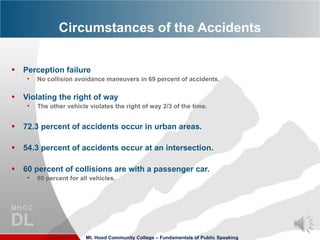
Circumstances of the Accidents


•   Perception failure
     •   No collision avoidance maneuvers in 69 percent of accidents.

•   Violating the right of way
     •   The other vehicle violates the right of way 2/3 of the time.


•   72.3 percent of accidents occur in urban areas.

•   54.3 percent of accidents occur at an intersection.

•   60 percent of collisions are with a passenger car.
     •   80 percent for all vehicles.


                          Mt. Hood Community College – Fundamentals of Public Speaking
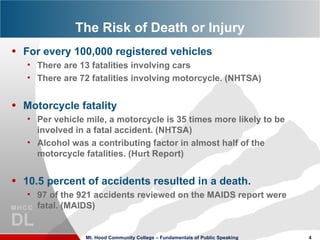
The Risk of Death or Injury
• For every 100,000 registered vehicles
   • There are 13 fatalities involving cars
   • There are 72 fatalities involving motorcycle. (NHTSA)


• Motorcycle fatality
   • Per vehicle mile, a motorcycle is 35 times more likely to be
     involved in a fatal accident. (NHTSA)
   • Alcohol was a contributing factor in almost half of the
     motorcycle fatalities. (Hurt Report)


• 10.5 percent of accidents resulted in a death.
   • 97 of the 921 accidents reviewed on the MAIDS report were
     fatal. (MAIDS)


                 Mt. Hood Community College – Fundamentals of Public Speaking   4
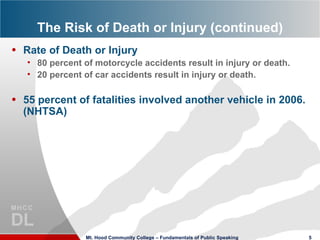
The Risk of Death or Injury (continued)
• Rate of Death or Injury
   • 80 percent of motorcycle accidents result in injury or death.
   • 20 percent of car accidents result in injury or death.

• 55 percent of fatalities involved another vehicle in 2006.
  (NHTSA)


                 Mt. Hood Community College – Fundamentals of Public Speaking   5
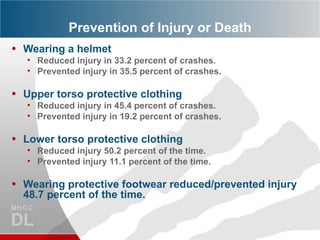
Prevention of Injury or Death
• Wearing a helmet
   • Reduced injury in 33.2 percent of crashes.
   • Prevented injury in 35.5 percent of crashes.

• Upper torso protective clothing
   • Reduced injury in 45.4 percent of crashes.
   • Prevented injury in 19.2 percent of crashes.

• Lower torso protective clothing
   • Reduced injury 50.2 percent of the time.
   • Prevented injury 11.1 percent of the time.

• Wearing protective footwear reduced/prevented injury
  48.7 percent of the time.
Conclusion


• It is my hope that from this data you are now more
  informed about motorcycle accidents and the
  circumstances surrounding them.


               Mt. Hood Community College – [Course Title]   7
Works Cited
• The University of Wisconsin. (20080. Hurt Report
  Summary. Retrieved from
  http://pages.cs.wisc.edu/~john/vfr/hurt.html

• National Highway Traffic Safety Administration. (2012).
  Retrieved from http://www.nhtsa.gov/

• MAIDS Study. (2004). MAIDS Report. Retrieved from
  http://www.maids-study.eu/index.html


               Mt. Hood Community College – [Course Title]   8

Powerpoint pc presentation

  • 1.
    Introduction •The most frequentways motorcycle accidents happen. •The possibility of being killed or injured in a motorcycle accident. •Wearing protective gear can make a significant difference. Mt. Hood Community College – [Course Title] 1
  • 2.
    Introduction MAIDS (Motorcycle Accidentin Depth Study) report: •Conducted in 1999 and 2000. •921 accidents and over 900 control cases. The Hurt Report •Began in 1976 and published in 1981. •Over 900 accidents. Mt. Hood Community College – [Course Title] 2
  • 3.
    Circumstances of theAccidents • Perception failure • No collision avoidance maneuvers in 69 percent of accidents. • Violating the right of way • The other vehicle violates the right of way 2/3 of the time. • 72.3 percent of accidents occur in urban areas. • 54.3 percent of accidents occur at an intersection. • 60 percent of collisions are with a passenger car. • 80 percent for all vehicles. Mt. Hood Community College – Fundamentals of Public Speaking
  • 4.
    The Risk ofDeath or Injury • For every 100,000 registered vehicles • There are 13 fatalities involving cars • There are 72 fatalities involving motorcycle. (NHTSA) • Motorcycle fatality • Per vehicle mile, a motorcycle is 35 times more likely to be involved in a fatal accident. (NHTSA) • Alcohol was a contributing factor in almost half of the motorcycle fatalities. (Hurt Report) • 10.5 percent of accidents resulted in a death. • 97 of the 921 accidents reviewed on the MAIDS report were fatal. (MAIDS) Mt. Hood Community College – Fundamentals of Public Speaking 4
  • 5.
    The Risk ofDeath or Injury (continued) • Rate of Death or Injury • 80 percent of motorcycle accidents result in injury or death. • 20 percent of car accidents result in injury or death. • 55 percent of fatalities involved another vehicle in 2006. (NHTSA) Mt. Hood Community College – Fundamentals of Public Speaking 5
  • 6.
    Prevention of Injuryor Death • Wearing a helmet • Reduced injury in 33.2 percent of crashes. • Prevented injury in 35.5 percent of crashes. • Upper torso protective clothing • Reduced injury in 45.4 percent of crashes. • Prevented injury in 19.2 percent of crashes. • Lower torso protective clothing • Reduced injury 50.2 percent of the time. • Prevented injury 11.1 percent of the time. • Wearing protective footwear reduced/prevented injury 48.7 percent of the time.
  • 7.
    Conclusion • It ismy hope that from this data you are now more informed about motorcycle accidents and the circumstances surrounding them. Mt. Hood Community College – [Course Title] 7
  • 8.
    Works Cited • TheUniversity of Wisconsin. (20080. Hurt Report Summary. Retrieved from http://pages.cs.wisc.edu/~john/vfr/hurt.html • National Highway Traffic Safety Administration. (2012). Retrieved from http://www.nhtsa.gov/ • MAIDS Study. (2004). MAIDS Report. Retrieved from http://www.maids-study.eu/index.html Mt. Hood Community College – [Course Title] 8