
NHTSA  Motorcycle Safety Program Presentation to the American Association  of Motor Vehicle Administrators Rapid City, SD, August 19-22, 2007 Bill Watada, Regional Administrator National Highway Traffic Safety Administration Region 8
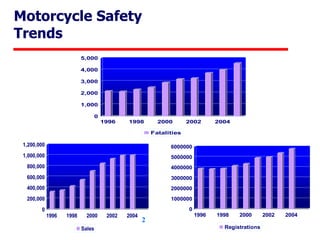
Motorcycle Safety  Trends
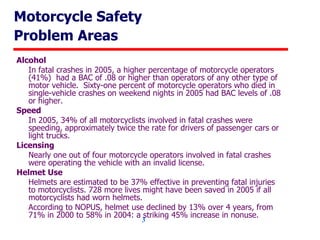
Motorcycle Safety  Problem Areas Alcohol In fatal crashes in 2005, a higher percentage of motorcycle operators (41%)  had a BAC of .08 or higher than operators of any other type of motor vehicle.  Sixty-one percent of motorcycle operators who died in single-vehicle crashes on weekend nights in 2005 had BAC levels of .08 or higher. Speed In 2005, 34% of all motorcyclists involved in fatal crashes were speeding, approximately twice the rate for drivers of passenger cars or light trucks. Licensing Nearly one out of four motorcycle operators involved in fatal crashes were operating the vehicle with an invalid license. Helmet Use Helmets are estimated to be 37% effective in preventing fatal injuries to motorcyclists. 728 more lives might have been saved in 2005 if all motorcyclists had worn helmets.  According to NOPUS, helmet use declined by 13% over 4 years, from 71% in 2000 to 58% in 2004: a striking 45% increase in nonuse.
Motorcycle Safety NHTSA  Research Programs SAFETEA-LU
Motorcycle Safety  Research Study to Determine Motorcyclist Impairment at Different BAC Levels   Pilot Study: Motorcycle Crash Causes and Outcomes   Evaluation of the Reinstatement of the Helmet Law in Louisiana Cooperative Agreement between NHTSA & MSF on Crash Avoidance Skills Evaluation of Strategies to Increase  Motorcyclist Licensing
Motorcycle Safety   Research Motorcycle Braking Motorcycle Conspicuity Novelty Helmet Testing
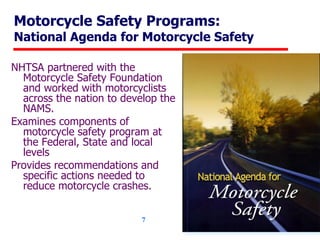
Motorcycle Safety Programs: National Agenda for Motorcycle Safety NHTSA partnered with the Motorcycle Safety Foundation and worked with motorcyclists across the nation to develop the NAMS. Examines components of motorcycle safety program at the Federal, State and local levels  Provides recommendations and specific actions needed to reduce motorcycle crashes.
Motorcycle Safety Programs: Implementation Guide for the National Agenda for Motorcycle Safety Implementation Guide for the NAMS Provides ideas and resources for implementation of  recommendations to States and communities Alcohol and other drugs Personal protective equipment Motorcycle operator training and education Licensing Motorist education Highway and environment Management
Motorcycle Safety Programs: NAMS Forum www.implementNAMS.org Developed by MSF and NHTSA to provide one internet location to  discuss motorcycle safety learn about the NAMS share ideas talk about activities that show promise
Motorcycle Safety Program: Activities Rider Education and Training Promising Practices in Motorcycle Rider Education and Licensing Demonstration Grants Section 2010 Grant Program National Standard for Rider Education
Motorcycle Safety Program: Activities Rider Licensing Updating guidelines for Motor Vehicle Administrators  Efforts to reduce number of improperly licensed motorcyclists
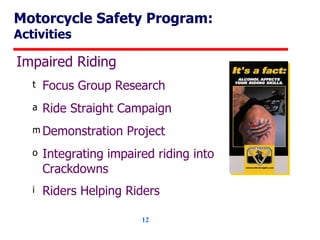
Motorcycle Safety Program: Activities Impaired Riding Focus Group Research Ride Straight Campaign Demonstration Project  Integrating impaired riding into Crackdowns Riders Helping Riders
Motorcycle Safety Program: Activities Helmets and Protective Gear Helmet promotion PSAs Website Video Clip on how to select the right helmet and identify a non-compliant helmet Motorist Awareness Model Share the Road Language Motorcycle Safety Planner Motorists Awareness Campaign Materials
Motorcycle Safety Program: Activities Bystander Care Network Meetings (Quarterly) Older Riders NHTSA Regional Meetings State Motorcycle Program Assessments
SAFETEA-LU Section 2010 :  State Motorcycle Safety Grants Section 2010 :  Motorcycle Share the Road Language Section 2003 :  Impaired Motorcycle Riding Study Section 1914 :  FHWA Motorcycle Advisory Council Section 5511 :  Motorcycle Crash Causation Study
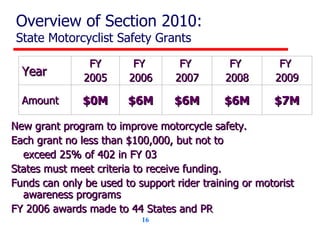
New grant program to improve motorcycle safety. Each grant no less than $100,000, but not to  exceed 25% of 402 in FY 03 States must meet criteria to receive funding. Funds can only be used to support rider training or motorist awareness programs FY 2006 awards made to 44 States and PR  Overview of Section 2010: State Motorcyclist Safety Grants $7M $6M $6M $6M $0M Amount FY  2009 FY  2008 FY  2007 FY  2006 FY 2005 Year
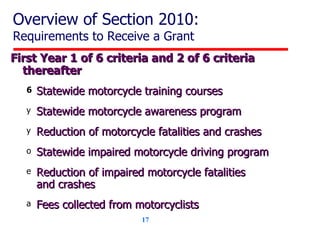
First Year 1 of 6 criteria and 2 of 6 criteria thereafter Statewide motorcycle training courses Statewide motorcycle awareness program Reduction of motorcycle fatalities and crashes Statewide impaired motorcycle driving program Reduction of impaired motorcycle fatalities  and crashes Fees collected from motorcyclists Overview of Section 2010:  Requirements to Receive a Grant
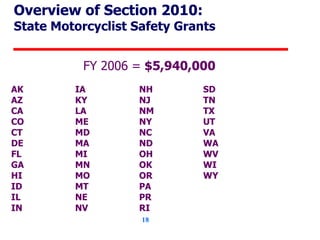
Overview of Section 2010: State Motorcyclist Safety Grants FY 2006 =  $5,940,000 AK   IA  NH SD AZ KY NJ TN CA LA  NM TX CO ME NY UT CT MD NC VA DE  MA ND WA FL  MI OH WV GA MN OK WI HI MO OR WY ID MT PA IL NE PR IN NV RI
Develop and provide model Share the Road language to States Status-  Model   language sent to State Highway Safety Offices, Motor  Vehicle Administrators, and State Motorcycle  Safety Administrators in August 2006 Overview of Section 2010:  Model Share the Road Language
Overview of Section 2003: Impaired Motorcycle Riding Study Conduct study on educational, public information and other activities targeted at reducing impaired motorcycle crashes and resulting fatalities and injuries where the mc operator is impaired Report the results to Congress including Data collected and statistics compiled Recommendations to reduce the number of crashes, fatalities and injuries due to impaired riding Report results to Congress in August 2007
Overview of Section 1914: FHWA Motorcycle Advisory Council Establishes 10 member motorcycle advisory council to the Secretary of Transportation, through the FHWA Administrator Council to advise on infrastructure issues of concern to motorcyclists, including Barrier design Road design, construction, and maintenance practices Architecture and implementation of intelligent transportation system technologies Second meeting held last week
Overview of Section 1914: FHWA Motorcycle Advisory Council Council Members Ed Moreland, American Motorcyclist Association Jeff Hennie, Motorcycle Riders Foundation Ken Kiphart, State Motorcycle Safety Administrators Darrel Killion, ABATE of South Dakota Steven Zimmer, ABATE of Ohio Gerald Salontai, Kleinfelder, Inc. Robert McClune, North America Potters Industries Kathy Van Kleeck, Motorcycle Industry Council Mark Bloschock, Texas Dept. of Transportation Donald Vaughn, Alabama Dept. of Transportation
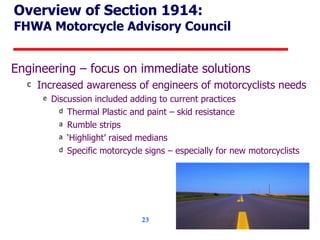
Overview of Section 1914: FHWA Motorcycle Advisory Council Engineering – focus on immediate solutions  Increased awareness of engineers of motorcyclists needs Discussion included adding to current practices Thermal Plastic and paint – skid resistance Rumble strips ‘ Highlight’ raised medians Specific motorcycle signs – especially for new motorcyclists
Overview of Section 1914: FHWA Motorcycle Advisory Council Best Practices and Special Interest Call in program for motorcycle-specific hazards in state Additional study –  Barriers that provide increased hazard to motorcyclists ITS – Include motorcycles as part of the planning process, not as an after thought.
Overview of Section 5511: Motorcycle Crash Causation Study Directs the Secretary to provide grant funds to the OK State University Transportation Center to conduct a comprehensive, in-depth motorcycle crash causation study that employs the OECD methodology Project managed by FHWA NHTSA conducting a pilot study for a crash causation study to develop protocol based on OECD methodology
What can AAMVA do to Support Motorcycle Safety? Include Motorcycle Safety Signage and Helmet Information in DMV Offices Encourage Programs to Track Motorcycle Endorsements with Motorcycle Registrations (MD, NY) Work with SHSO to Promote Motorcycle Safety Programs Support Law Enforcement Issuing Citations for Riding Without a Motorcycle Endorsement Support Rider Training
 

Nhtsa Motorcycle Safety Program

  • 1.
    NHTSA MotorcycleSafety Program Presentation to the American Association of Motor Vehicle Administrators Rapid City, SD, August 19-22, 2007 Bill Watada, Regional Administrator National Highway Traffic Safety Administration Region 8
  • 2.
  • 3.
    Motorcycle Safety Problem Areas Alcohol In fatal crashes in 2005, a higher percentage of motorcycle operators (41%) had a BAC of .08 or higher than operators of any other type of motor vehicle. Sixty-one percent of motorcycle operators who died in single-vehicle crashes on weekend nights in 2005 had BAC levels of .08 or higher. Speed In 2005, 34% of all motorcyclists involved in fatal crashes were speeding, approximately twice the rate for drivers of passenger cars or light trucks. Licensing Nearly one out of four motorcycle operators involved in fatal crashes were operating the vehicle with an invalid license. Helmet Use Helmets are estimated to be 37% effective in preventing fatal injuries to motorcyclists. 728 more lives might have been saved in 2005 if all motorcyclists had worn helmets. According to NOPUS, helmet use declined by 13% over 4 years, from 71% in 2000 to 58% in 2004: a striking 45% increase in nonuse.
  • 4.
    Motorcycle Safety NHTSA Research Programs SAFETEA-LU
  • 5.
    Motorcycle Safety Research Study to Determine Motorcyclist Impairment at Different BAC Levels Pilot Study: Motorcycle Crash Causes and Outcomes Evaluation of the Reinstatement of the Helmet Law in Louisiana Cooperative Agreement between NHTSA & MSF on Crash Avoidance Skills Evaluation of Strategies to Increase Motorcyclist Licensing
  • 6.
    Motorcycle Safety Research Motorcycle Braking Motorcycle Conspicuity Novelty Helmet Testing
  • 7.
    Motorcycle Safety Programs:National Agenda for Motorcycle Safety NHTSA partnered with the Motorcycle Safety Foundation and worked with motorcyclists across the nation to develop the NAMS. Examines components of motorcycle safety program at the Federal, State and local levels Provides recommendations and specific actions needed to reduce motorcycle crashes.
  • 8.
    Motorcycle Safety Programs:Implementation Guide for the National Agenda for Motorcycle Safety Implementation Guide for the NAMS Provides ideas and resources for implementation of recommendations to States and communities Alcohol and other drugs Personal protective equipment Motorcycle operator training and education Licensing Motorist education Highway and environment Management
  • 9.
    Motorcycle Safety Programs:NAMS Forum www.implementNAMS.org Developed by MSF and NHTSA to provide one internet location to discuss motorcycle safety learn about the NAMS share ideas talk about activities that show promise
  • 10.
    Motorcycle Safety Program:Activities Rider Education and Training Promising Practices in Motorcycle Rider Education and Licensing Demonstration Grants Section 2010 Grant Program National Standard for Rider Education
  • 11.
    Motorcycle Safety Program:Activities Rider Licensing Updating guidelines for Motor Vehicle Administrators Efforts to reduce number of improperly licensed motorcyclists
  • 12.
    Motorcycle Safety Program:Activities Impaired Riding Focus Group Research Ride Straight Campaign Demonstration Project Integrating impaired riding into Crackdowns Riders Helping Riders
  • 13.
    Motorcycle Safety Program:Activities Helmets and Protective Gear Helmet promotion PSAs Website Video Clip on how to select the right helmet and identify a non-compliant helmet Motorist Awareness Model Share the Road Language Motorcycle Safety Planner Motorists Awareness Campaign Materials
  • 14.
    Motorcycle Safety Program:Activities Bystander Care Network Meetings (Quarterly) Older Riders NHTSA Regional Meetings State Motorcycle Program Assessments
  • 15.
    SAFETEA-LU Section 2010: State Motorcycle Safety Grants Section 2010 : Motorcycle Share the Road Language Section 2003 : Impaired Motorcycle Riding Study Section 1914 : FHWA Motorcycle Advisory Council Section 5511 : Motorcycle Crash Causation Study
  • 16.
    New grant programto improve motorcycle safety. Each grant no less than $100,000, but not to exceed 25% of 402 in FY 03 States must meet criteria to receive funding. Funds can only be used to support rider training or motorist awareness programs FY 2006 awards made to 44 States and PR Overview of Section 2010: State Motorcyclist Safety Grants $7M $6M $6M $6M $0M Amount FY 2009 FY 2008 FY 2007 FY 2006 FY 2005 Year
  • 17.
    First Year 1of 6 criteria and 2 of 6 criteria thereafter Statewide motorcycle training courses Statewide motorcycle awareness program Reduction of motorcycle fatalities and crashes Statewide impaired motorcycle driving program Reduction of impaired motorcycle fatalities and crashes Fees collected from motorcyclists Overview of Section 2010: Requirements to Receive a Grant
  • 18.
    Overview of Section2010: State Motorcyclist Safety Grants FY 2006 = $5,940,000 AK IA NH SD AZ KY NJ TN CA LA NM TX CO ME NY UT CT MD NC VA DE MA ND WA FL MI OH WV GA MN OK WI HI MO OR WY ID MT PA IL NE PR IN NV RI
  • 19.
    Develop and providemodel Share the Road language to States Status- Model language sent to State Highway Safety Offices, Motor Vehicle Administrators, and State Motorcycle Safety Administrators in August 2006 Overview of Section 2010: Model Share the Road Language
  • 20.
    Overview of Section2003: Impaired Motorcycle Riding Study Conduct study on educational, public information and other activities targeted at reducing impaired motorcycle crashes and resulting fatalities and injuries where the mc operator is impaired Report the results to Congress including Data collected and statistics compiled Recommendations to reduce the number of crashes, fatalities and injuries due to impaired riding Report results to Congress in August 2007
  • 21.
    Overview of Section1914: FHWA Motorcycle Advisory Council Establishes 10 member motorcycle advisory council to the Secretary of Transportation, through the FHWA Administrator Council to advise on infrastructure issues of concern to motorcyclists, including Barrier design Road design, construction, and maintenance practices Architecture and implementation of intelligent transportation system technologies Second meeting held last week
  • 22.
    Overview of Section1914: FHWA Motorcycle Advisory Council Council Members Ed Moreland, American Motorcyclist Association Jeff Hennie, Motorcycle Riders Foundation Ken Kiphart, State Motorcycle Safety Administrators Darrel Killion, ABATE of South Dakota Steven Zimmer, ABATE of Ohio Gerald Salontai, Kleinfelder, Inc. Robert McClune, North America Potters Industries Kathy Van Kleeck, Motorcycle Industry Council Mark Bloschock, Texas Dept. of Transportation Donald Vaughn, Alabama Dept. of Transportation
  • 23.
    Overview of Section1914: FHWA Motorcycle Advisory Council Engineering – focus on immediate solutions Increased awareness of engineers of motorcyclists needs Discussion included adding to current practices Thermal Plastic and paint – skid resistance Rumble strips ‘ Highlight’ raised medians Specific motorcycle signs – especially for new motorcyclists
  • 24.
    Overview of Section1914: FHWA Motorcycle Advisory Council Best Practices and Special Interest Call in program for motorcycle-specific hazards in state Additional study – Barriers that provide increased hazard to motorcyclists ITS – Include motorcycles as part of the planning process, not as an after thought.
  • 25.
    Overview of Section5511: Motorcycle Crash Causation Study Directs the Secretary to provide grant funds to the OK State University Transportation Center to conduct a comprehensive, in-depth motorcycle crash causation study that employs the OECD methodology Project managed by FHWA NHTSA conducting a pilot study for a crash causation study to develop protocol based on OECD methodology
  • 26.
    What can AAMVAdo to Support Motorcycle Safety? Include Motorcycle Safety Signage and Helmet Information in DMV Offices Encourage Programs to Track Motorcycle Endorsements with Motorcycle Registrations (MD, NY) Work with SHSO to Promote Motorcycle Safety Programs Support Law Enforcement Issuing Citations for Riding Without a Motorcycle Endorsement Support Rider Training
  • 27.