Ghent 23/10/13

CYBERSPACE TIME CRISIS
Methods of Dreaming
Lucid explorations versus Urgencies
Urgencies: Overload
 “The acceleration of information exchange has

produced and is producing an effect of a
pathological type on the individual human mind
and even more on the collective mind. Individuals
are not in a position to process the immense and
always growing mass of information that enters
their computers, their cell phones, their television
screens, their electronic diaries and their heads.
However, it seems indispensable to follow,
recognise, evaluate, process all this information if
you want to be efficient, competitive, victorious.
… The necessary time for paying attention to the
fluxes of information is lacking.” – Franco Berardi,
Precarious Rhapsody
Urgencies: compulsion
Jodi Dean has convincingly argued that digital
communicative compulsion constitutes a capturing by
(Freudian/Lacanian) drive: individuals are locked into
repeating loops, aware that their activity is pointless,
but nevertheless unable to desist. The ceaseless
circulation of digital communication lies beyond the
pleasure principle: the insatiable urge to check
messages, email or Facebook is a compulsion, akin to
scratching an itch which gets worse the more one
scratches. Like all compulsions, this behaviour feeds on
dissatisfaction. If there are no messages, you feel
disappointed and check again very quickly. But if there
are messages you also feel disappointed: no amount
of messages is ever enough. Sherry Turkle has talked to
people who are unable to resist the urge to send and
receive texts on their mobile telephone, even when
they are driving a car.
Urgencies: work as religion
 “In the current age of machines … humans finally

have the possibility of devolving most productive
processes to technological apparatus, while
retaining all outcomes for themselves. In other
words, the (first) world currently hosts all the
necessary pre-conditions for the realization of the
old autonomist slogan „zero work / full income/ all
production / to automation‟. Despite all this, 21st
century Western societies are still torn by the dusty,
capitalist dichotomy which opposes a tragically
overworked section of population against an
equally tragically unemployed one.” – “Raidcal
Atheism” Federico Campagna
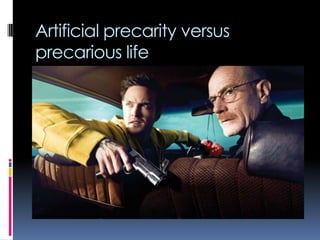
Artificial precarity versus
precarious life
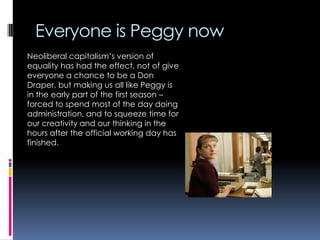
Everyone is Peggy now
Neoliberal capitalism‟s version of
equality has had the effect, not of give
everyone a chance to be a Don
Draper, but making us all like Peggy is
in the early part of the first season –
forced to spend most of the day doing
administration, and to squeeze time for
our creativity and our thinking in the
hours after the official working day has
finished.
Urgencies: permanent insecurity
 the post-Fordist worker “lives in a world
marked … by short-term flexibility and flux
… Corporations break up or join

together, jobs appear and disappear, as
events lacking connection ... what‟s
peculiar about uncertainty today is that it
exists without any looming historical
disaster; instead it is woven into the
everyday practices of a vigorous
capitalism.” – Richard Sennett, The
Corrosion of Character: The Personal
Consequences of Work in the New
Capitalism
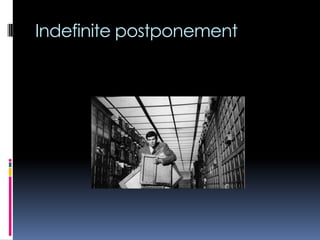
Indefinite postponement
From insecurity to where?
How do we escape and what do we
want to escape to?
A new politics of security and adventure
A new politics of time

Powerpoint Mark Fisher

  • 1.
  • 2.
    Methods of Dreaming Lucidexplorations versus Urgencies
  • 6.
    Urgencies: Overload  “Theacceleration of information exchange has produced and is producing an effect of a pathological type on the individual human mind and even more on the collective mind. Individuals are not in a position to process the immense and always growing mass of information that enters their computers, their cell phones, their television screens, their electronic diaries and their heads. However, it seems indispensable to follow, recognise, evaluate, process all this information if you want to be efficient, competitive, victorious. … The necessary time for paying attention to the fluxes of information is lacking.” – Franco Berardi, Precarious Rhapsody
  • 8.
    Urgencies: compulsion Jodi Deanhas convincingly argued that digital communicative compulsion constitutes a capturing by (Freudian/Lacanian) drive: individuals are locked into repeating loops, aware that their activity is pointless, but nevertheless unable to desist. The ceaseless circulation of digital communication lies beyond the pleasure principle: the insatiable urge to check messages, email or Facebook is a compulsion, akin to scratching an itch which gets worse the more one scratches. Like all compulsions, this behaviour feeds on dissatisfaction. If there are no messages, you feel disappointed and check again very quickly. But if there are messages you also feel disappointed: no amount of messages is ever enough. Sherry Turkle has talked to people who are unable to resist the urge to send and receive texts on their mobile telephone, even when they are driving a car.
  • 9.
    Urgencies: work asreligion  “In the current age of machines … humans finally have the possibility of devolving most productive processes to technological apparatus, while retaining all outcomes for themselves. In other words, the (first) world currently hosts all the necessary pre-conditions for the realization of the old autonomist slogan „zero work / full income/ all production / to automation‟. Despite all this, 21st century Western societies are still torn by the dusty, capitalist dichotomy which opposes a tragically overworked section of population against an equally tragically unemployed one.” – “Raidcal Atheism” Federico Campagna
  • 10.
  • 11.
    Everyone is Peggynow Neoliberal capitalism‟s version of equality has had the effect, not of give everyone a chance to be a Don Draper, but making us all like Peggy is in the early part of the first season – forced to spend most of the day doing administration, and to squeeze time for our creativity and our thinking in the hours after the official working day has finished.
  • 12.
    Urgencies: permanent insecurity the post-Fordist worker “lives in a world marked … by short-term flexibility and flux … Corporations break up or join together, jobs appear and disappear, as events lacking connection ... what‟s peculiar about uncertainty today is that it exists without any looming historical disaster; instead it is woven into the everyday practices of a vigorous capitalism.” – Richard Sennett, The Corrosion of Character: The Personal Consequences of Work in the New Capitalism
  • 13.
  • 14.
    From insecurity towhere? How do we escape and what do we want to escape to? A new politics of security and adventure A new politics of time