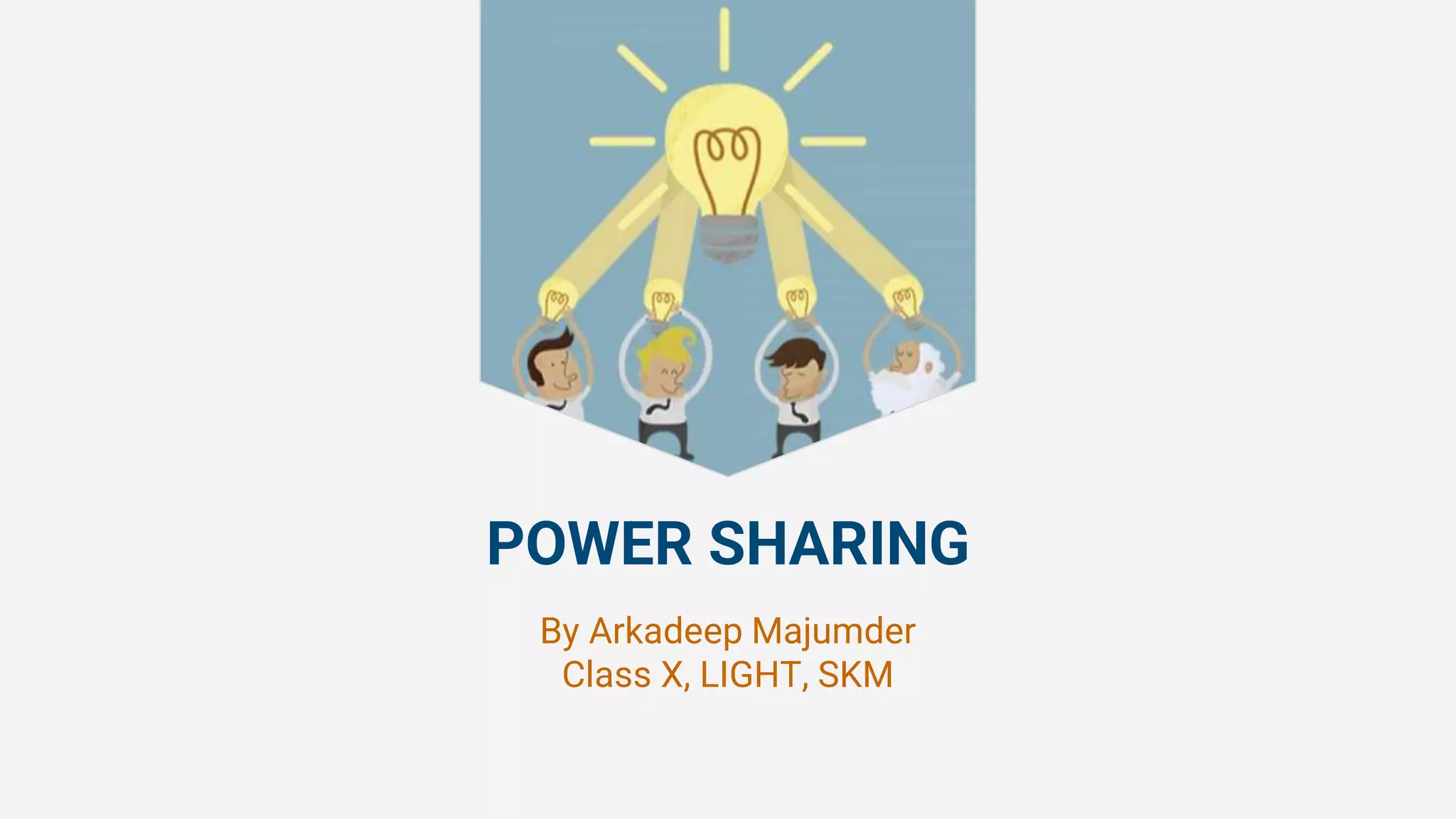
POWER SHARING
By Arkadeep Majumder
Class X, LIGHT, SKM
MEANING OF
POWER SHARING
The process of distribution of the power of a
country or a region amongst the different
parts or organs of any particular government
such as the judiciary, executive, and
legislature can be defined as power sharing.
With the help of this process, several
countries have achieved stability in the best
way on their order of maintaining a political
calm. Apart from that, power sharing also
involves sharing of power along with the
different district levels such as local, state,
and union.
Why is power sharing desirable?
Prudential reasons:
(a) It helps to reduce the possibility of conflict between social groups.
(b) It is a good way to ensure the stability of political order.
(c) Imposing the will of majority, community over others may look like an attractive
option in the short run, but in the long run it undermines the unity of the nation.
Moral reasons:
(a) Power sharing is the very spirit of democracy.
(b) People have a right to be consulted on how they are to be governed.
(c) A legitimate government is one where citizens through participation, acquire a stake
in the system.
Forms of
power
sharing
Horizontal distribution of power
● Power is shared among different organs of government,
such as the legislature, executive and judiciary.
Vertical distribution of power
● Power can be shared among governments at different levels.
Community government
● Power can also be shared among different socially active
groups such as the religious and linguistic groups.
Power-sharing between political parties, pressure groups and
movements
● This kind of power-sharing competition ensures that power
does not remain in one single hand.
The example of
Belgium
About Belgium:
Belgium is a small country in Europe. It
has borders with France, the
Netherlands, Germany and Luxembourg.
It has a population of a little over one
crore. The ethnic groups of the country
are Dutch speaking, French speaking
and the German speaking people. The
capital city is Brussels, which was
chosen as the headquarters for the
European Union.
Ethnic composition of Belgium
● 59% lives in the Flemish region and are Dutch-speaking.
● Another 40% people live in the Wallonia region and speak French.
● Remaining 1% are the German-speakers.
● In the capital city of Brussels, 80% people speak French and 20% are Dutch-
speaking.
Accommodation in Belgium
● Dutch and French speaking ministers shall be equal in the central govt.
● Many Powers of the central government have been given to state govt. The
state govt are not subordinate to the central govt.
● Brussels has a separate govt in which both the communities have equal
representation.
● There is a third kind of govt called community govt elected by the people
belonging to Dutch, French and German no matter where they live.
The example
of Sri Lanka
About Sri Lanka:
Sri Lanka is an island nation, just a few kilometers
off the southern coast of Tamil Nadu. It has about
two crore people. Like other nations in South Asian
region, Sri Lanka has a diverse population. It
emerged as an independent country in 1948.
Ethnic composition
of Sri Lanka
● 74% of the total population are the Sinhala-speakers.
● 18% are the Tamil-speakers, among them there are two sub groups-
1) ‘Sri Lankan Tamils’, the Tamil natives of the country (13%).
2) ‘Indian Tamils’, whose forefathers came from India as plantation workers.
Majoritarianism in Sri Lanka
● Sri lanka became independent in 1948.
● In 1956, an Act was passed to recognise Sinhala as the only official language, thus
disregarding Tamil.
● Sinhala applicants were favoured for university and government jobs.
● The constitution gives special protection to Buddhism.
● The result of these policies make the Srilankan Tamils feel that -
1) Leaders were insensitive to their language and culture.
2) Government policies deprived them of equal political rights.
● They were discriminated against in getting jobs & other opportunities.
CIVIL WAR
OF SRI
LANKA
By 1980 several political organisations were formed
demanding an independent Tamil Eelam in northern
and eastern parts of the country. The distrust
between the Sinhala and Tamil communities turned
into widespread conflicts, which soon led to a civil
war. As a result of which thousand people of both
the communities were killed, many families were
forced to leave the country, many lost their
livelihoods. The civil war also caused a terrible
setback to the social, cultural and economic life of
the country. It ended in 2009.
THANK YOU!

POWER SHARING CLASS 10 DEMO POL

  • 1.
    POWER SHARING By ArkadeepMajumder Class X, LIGHT, SKM
  • 2.
    MEANING OF POWER SHARING Theprocess of distribution of the power of a country or a region amongst the different parts or organs of any particular government such as the judiciary, executive, and legislature can be defined as power sharing. With the help of this process, several countries have achieved stability in the best way on their order of maintaining a political calm. Apart from that, power sharing also involves sharing of power along with the different district levels such as local, state, and union.
  • 3.
    Why is powersharing desirable? Prudential reasons: (a) It helps to reduce the possibility of conflict between social groups. (b) It is a good way to ensure the stability of political order. (c) Imposing the will of majority, community over others may look like an attractive option in the short run, but in the long run it undermines the unity of the nation. Moral reasons: (a) Power sharing is the very spirit of democracy. (b) People have a right to be consulted on how they are to be governed. (c) A legitimate government is one where citizens through participation, acquire a stake in the system.
  • 4.
    Forms of power sharing Horizontal distributionof power ● Power is shared among different organs of government, such as the legislature, executive and judiciary. Vertical distribution of power ● Power can be shared among governments at different levels. Community government ● Power can also be shared among different socially active groups such as the religious and linguistic groups. Power-sharing between political parties, pressure groups and movements ● This kind of power-sharing competition ensures that power does not remain in one single hand.
  • 5.
    The example of Belgium AboutBelgium: Belgium is a small country in Europe. It has borders with France, the Netherlands, Germany and Luxembourg. It has a population of a little over one crore. The ethnic groups of the country are Dutch speaking, French speaking and the German speaking people. The capital city is Brussels, which was chosen as the headquarters for the European Union.
  • 6.
    Ethnic composition ofBelgium ● 59% lives in the Flemish region and are Dutch-speaking. ● Another 40% people live in the Wallonia region and speak French. ● Remaining 1% are the German-speakers. ● In the capital city of Brussels, 80% people speak French and 20% are Dutch- speaking.
  • 7.
    Accommodation in Belgium ●Dutch and French speaking ministers shall be equal in the central govt. ● Many Powers of the central government have been given to state govt. The state govt are not subordinate to the central govt. ● Brussels has a separate govt in which both the communities have equal representation. ● There is a third kind of govt called community govt elected by the people belonging to Dutch, French and German no matter where they live.
  • 8.
    The example of SriLanka About Sri Lanka: Sri Lanka is an island nation, just a few kilometers off the southern coast of Tamil Nadu. It has about two crore people. Like other nations in South Asian region, Sri Lanka has a diverse population. It emerged as an independent country in 1948.
  • 9.
    Ethnic composition of SriLanka ● 74% of the total population are the Sinhala-speakers. ● 18% are the Tamil-speakers, among them there are two sub groups- 1) ‘Sri Lankan Tamils’, the Tamil natives of the country (13%). 2) ‘Indian Tamils’, whose forefathers came from India as plantation workers.
  • 10.
    Majoritarianism in SriLanka ● Sri lanka became independent in 1948. ● In 1956, an Act was passed to recognise Sinhala as the only official language, thus disregarding Tamil. ● Sinhala applicants were favoured for university and government jobs. ● The constitution gives special protection to Buddhism. ● The result of these policies make the Srilankan Tamils feel that - 1) Leaders were insensitive to their language and culture. 2) Government policies deprived them of equal political rights. ● They were discriminated against in getting jobs & other opportunities.
  • 11.
    CIVIL WAR OF SRI LANKA By1980 several political organisations were formed demanding an independent Tamil Eelam in northern and eastern parts of the country. The distrust between the Sinhala and Tamil communities turned into widespread conflicts, which soon led to a civil war. As a result of which thousand people of both the communities were killed, many families were forced to leave the country, many lost their livelihoods. The civil war also caused a terrible setback to the social, cultural and economic life of the country. It ended in 2009.
  • 12.