OILY
INTRODUCTION
several million tons of oil soils the world's
seas every year
The metabolism of microorganisms is
capable of breaking down hydrocarbons in
crude oil.
Microbes are tiny living things—so tiny that
you need a microscope to see them. Yet
unseen microbes have a collective mass
greater than all the animals on the planet.
They're everywhere!
OUTLOOK
Alcanivorax, Marinobacter, Pseudomonas,
and Acinetobacter are some of the bacteria
found to degrade oil .
As oil contains organic pollutants which can
be used to produce electricity, hydrogen and
high-value chemicals, such as caustic soda
 This can be achieved if the organic matter is
broken down by electrically-active bacteria in
an electrochemical cell, which, at the same
time, helps clean up the wastewater.
Cow dung has considerable potential for
biodegradation and biotransformation of petroleum
product.
The predominate species identified were Bacillus,
Psuedomonas, Proteus spp.
The maximum degradation of petroleum was at
incubation temperature 37oC, pH 7 and xylene as
substrate. Among the isolated bacteria Psuedomonas
spp. was found to give maximum activity.
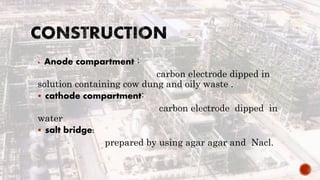
 Anode compartment :
carbon electrode dipped in
solution containing cow dung and oily waste .
 cathode compartment:
carbon electrode dipped in
water
 salt bridge:
prepared by using agar agar and Nacl.
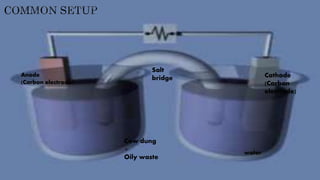
Anode
(Carbon electrode)
Cathode
(Carbon
electrode)
Cow dung
+
Oily waste
Salt
bridge
water
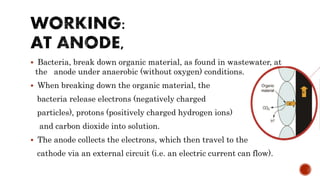
 Bacteria, break down organic material, as found in wastewater, at
the anode under anaerobic (without oxygen) conditions.
 When breaking down the organic material, the
bacteria release electrons (negatively charged
particles), protons (positively charged hydrogen ions)
and carbon dioxide into solution.
 The anode collects the electrons, which then travel to the
cathode via an external circuit (i.e. an electric current can flow).
electricity is produced by extracting it from the
electron-carrying external circuit. The electrons
arriving at the cathode under aerobic conditions,
i.e. in the presence of oxygen, combine with the
protons and oxygen, typically from the air, to form
wate
The H+ ion react with react with negatively
charged electron to form hydrogen .
one of the big challenges is to improve the performance of
the bacteria and the electrodes so that ‘electron transfer’
can be enhanced. This would lead to greater production of
electricity, hydrogen or other chemicals.
1) Direct electron transfer between the bacteria and the
electrode can occur in two ways:
2) Indirect transfer of electrons from the bacteria to an
electrode occurs via long-range electron shuttle compounds
It is a One time investment process.
Decompose of waste to form usefull materials
Pollution free.
Production of hydrogen .
Large amount of energy is not required.
.
Production of bio gas
Production of caustic soda
Increase of surface area of electrodes
santosh. M
Deepak raj .B
Project guide : Dr . Chitradevi ,kEC
queries????
Power production from oily waste

Power production from oily waste

  • 1.
  • 2.
    INTRODUCTION several million tonsof oil soils the world's seas every year The metabolism of microorganisms is capable of breaking down hydrocarbons in crude oil. Microbes are tiny living things—so tiny that you need a microscope to see them. Yet unseen microbes have a collective mass greater than all the animals on the planet. They're everywhere!
  • 3.
    OUTLOOK Alcanivorax, Marinobacter, Pseudomonas, andAcinetobacter are some of the bacteria found to degrade oil . As oil contains organic pollutants which can be used to produce electricity, hydrogen and high-value chemicals, such as caustic soda  This can be achieved if the organic matter is broken down by electrically-active bacteria in an electrochemical cell, which, at the same time, helps clean up the wastewater.
  • 4.
    Cow dung hasconsiderable potential for biodegradation and biotransformation of petroleum product. The predominate species identified were Bacillus, Psuedomonas, Proteus spp. The maximum degradation of petroleum was at incubation temperature 37oC, pH 7 and xylene as substrate. Among the isolated bacteria Psuedomonas spp. was found to give maximum activity.
  • 5.
     Anode compartment: carbon electrode dipped in solution containing cow dung and oily waste .  cathode compartment: carbon electrode dipped in water  salt bridge: prepared by using agar agar and Nacl.
  • 6.
  • 7.
     Bacteria, breakdown organic material, as found in wastewater, at the anode under anaerobic (without oxygen) conditions.  When breaking down the organic material, the bacteria release electrons (negatively charged particles), protons (positively charged hydrogen ions) and carbon dioxide into solution.  The anode collects the electrons, which then travel to the cathode via an external circuit (i.e. an electric current can flow).
  • 8.
    electricity is producedby extracting it from the electron-carrying external circuit. The electrons arriving at the cathode under aerobic conditions, i.e. in the presence of oxygen, combine with the protons and oxygen, typically from the air, to form wate The H+ ion react with react with negatively charged electron to form hydrogen .
  • 9.
    one of thebig challenges is to improve the performance of the bacteria and the electrodes so that ‘electron transfer’ can be enhanced. This would lead to greater production of electricity, hydrogen or other chemicals. 1) Direct electron transfer between the bacteria and the electrode can occur in two ways: 2) Indirect transfer of electrons from the bacteria to an electrode occurs via long-range electron shuttle compounds
  • 10.
    It is aOne time investment process. Decompose of waste to form usefull materials Pollution free. Production of hydrogen . Large amount of energy is not required. .
  • 11.
    Production of biogas Production of caustic soda Increase of surface area of electrodes
  • 12.
    santosh. M Deepak raj.B Project guide : Dr . Chitradevi ,kEC
  • 13.