Investing and Financing Decisions and the Balance SheetChapter 2McGraw-Hill/Irwin© 2009 The McGraw-Hill Companies, Inc.
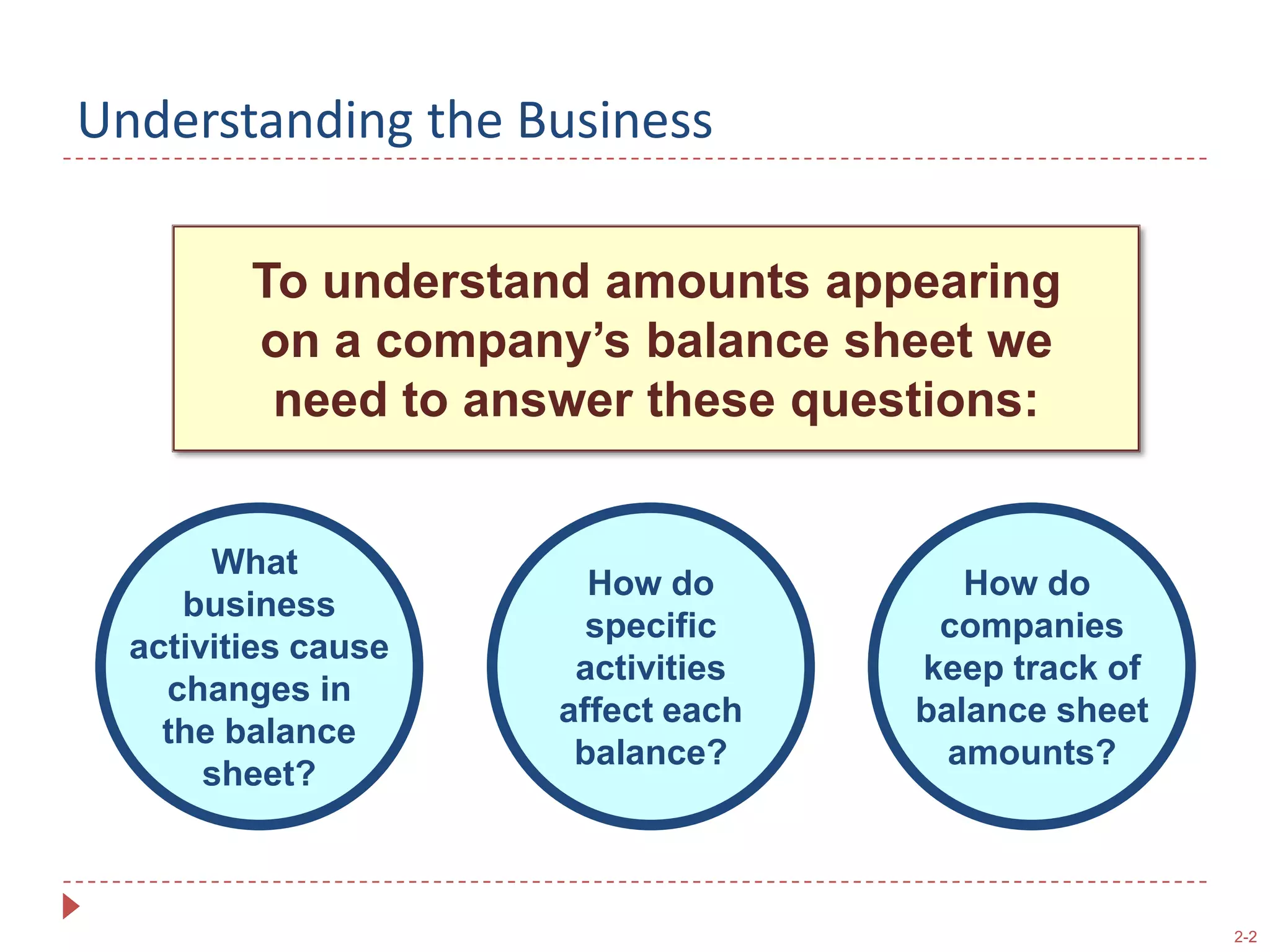
Understanding the BusinessTo understand amounts appearingon a company’s balance sheet weneed to answer these questions:What businessactivities causechanges inthe balancesheet?How dospecificactivitiesaffect eachbalance?How do companieskeep track ofbalance sheetamounts?
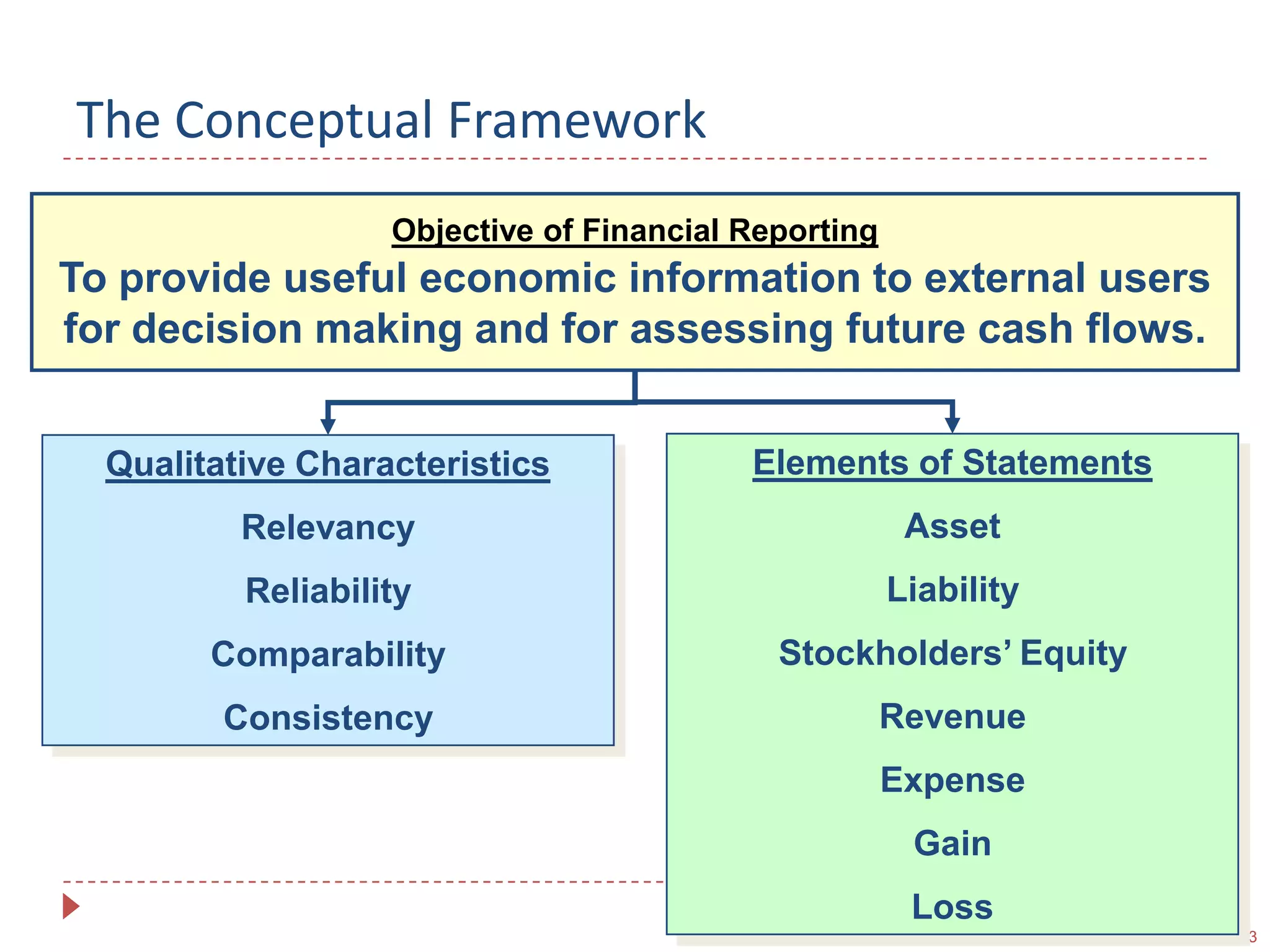
The Conceptual FrameworkElements of StatementsAssetLiabilityStockholders’ EquityRevenueExpenseGainLossQualitative CharacteristicsRelevancyReliabilityComparabilityConsistencyObjective of Financial ReportingTo provide useful economic information to external users for decision making and for assessing future cash flows.
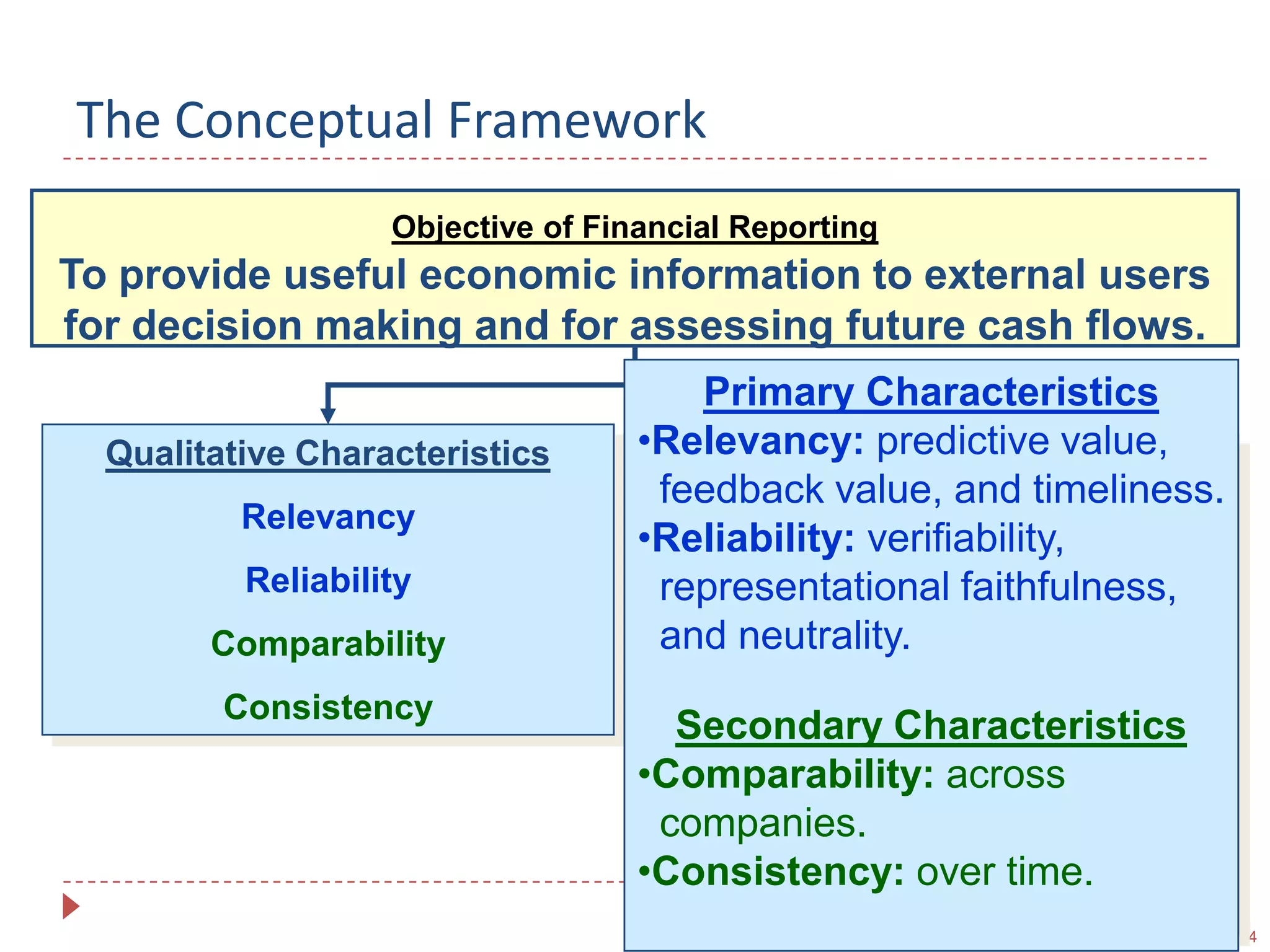
The Conceptual FrameworkObjective of Financial ReportingTo provide useful economic information to external users for decision making and for assessing future cash flows.Primary CharacteristicsRelevancy: predictive value,  feedback value, and timeliness.Reliability: verifiability,  representational faithfulness,   and neutrality. Secondary CharacteristicsComparability: across   companies.Consistency: over time.Qualitative CharacteristicsRelevancyReliabilityComparabilityConsistencyElements of StatementsAssetLiabilityStockholders’ EquityRevenueExpenseGainLoss
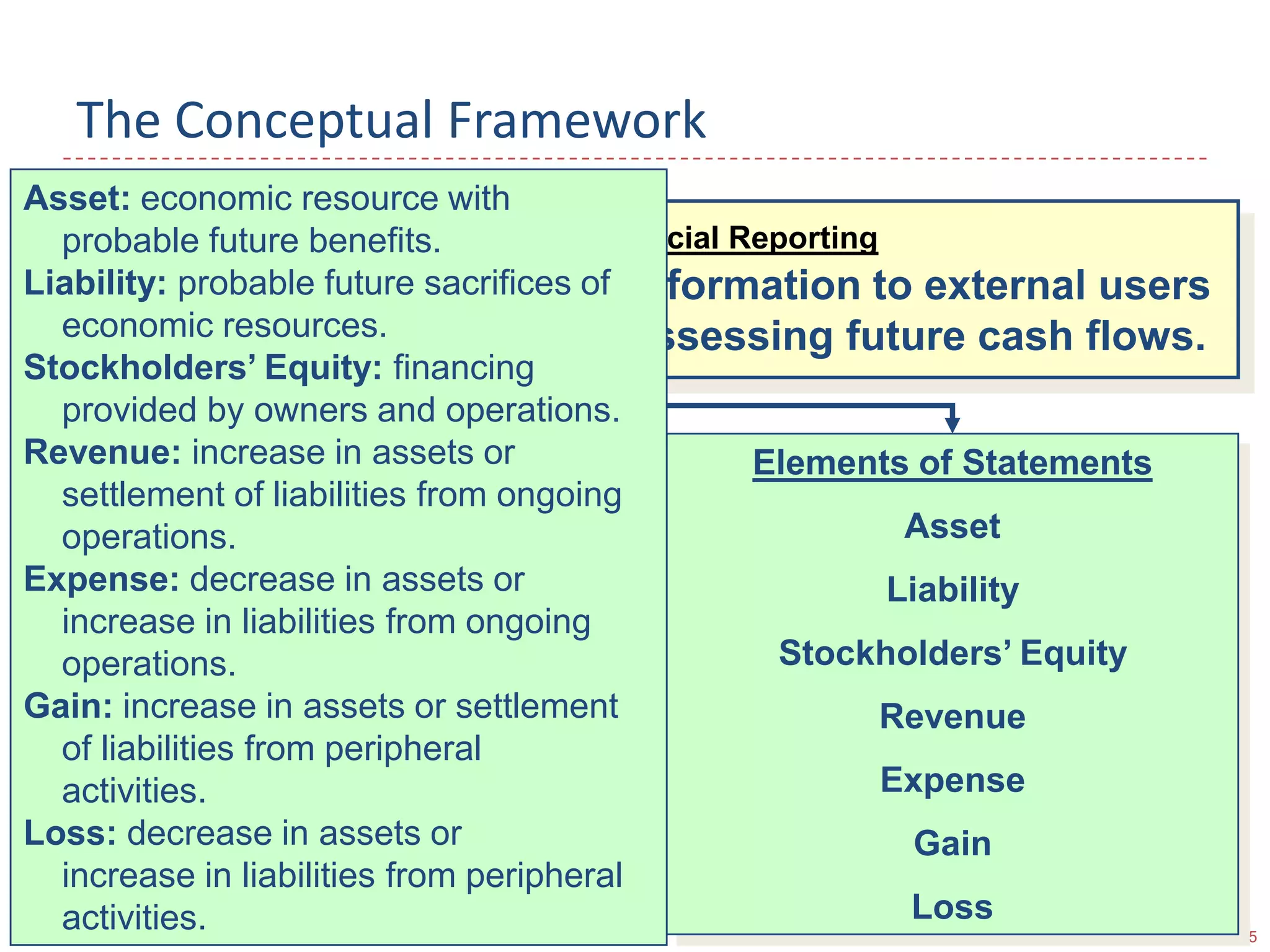
The Conceptual FrameworkAsset: economic resource with     probable future benefits.Liability: probable future sacrifices of     economic resources.Stockholders’ Equity: financing    provided by owners and operations.Revenue: increase in assets or    settlement of liabilities from ongoing     operations.Expense: decrease in assets or    increase in liabilities from ongoing     operations.Gain: increase in assets or settlement     of liabilities from peripheral    activities.Loss: decrease in assets or      increase in liabilities from peripheral     activities.Objective of Financial ReportingTo provide useful economic information to external users for decision making and for assessing future cash flows.Elements of StatementsAssetLiabilityStockholders’ EquityRevenueExpenseGainLossQualitative CharacteristicsRelevancyReliabilityComparableConsistent
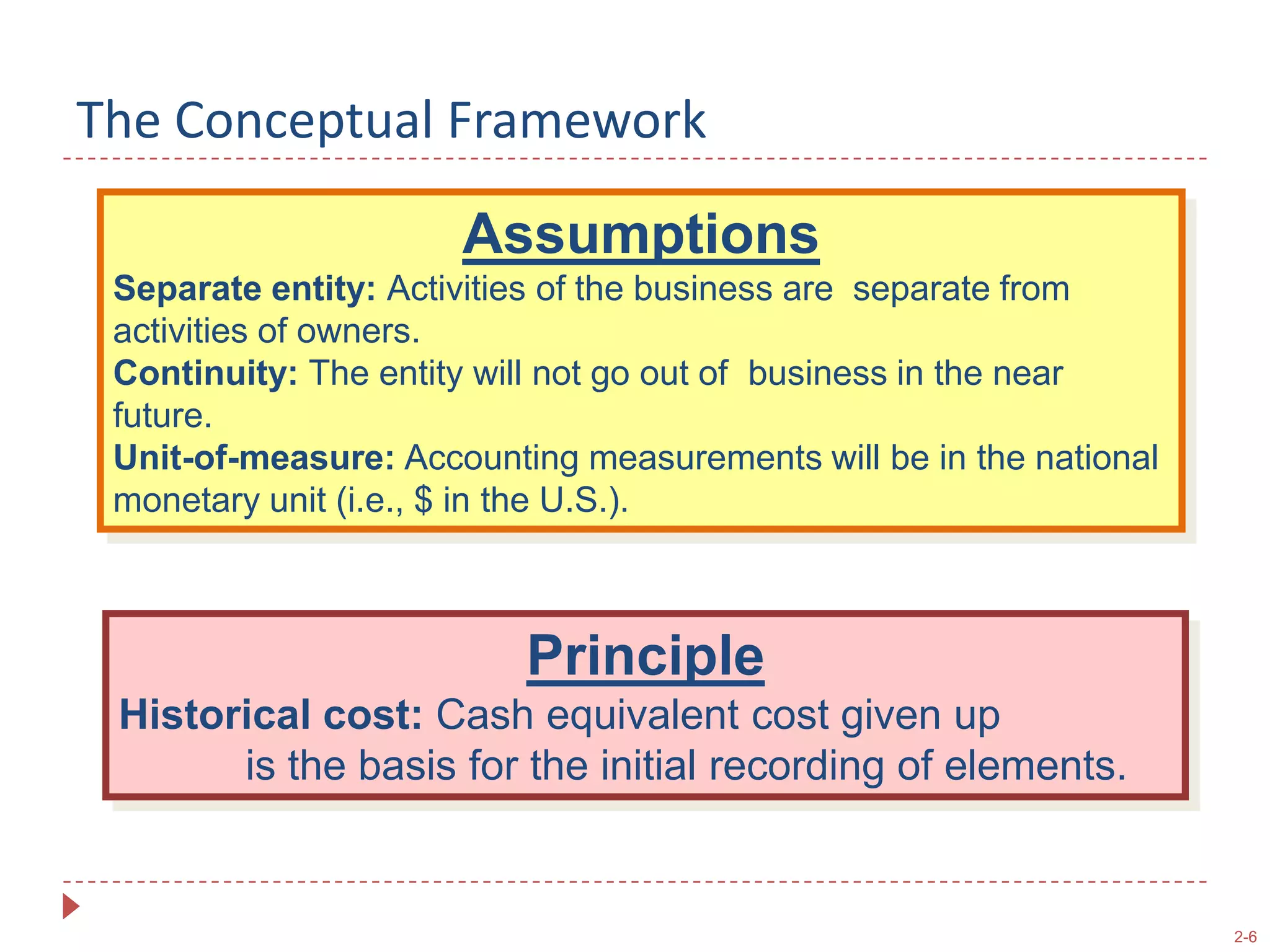
The Conceptual FrameworkAssumptionsSeparate entity: Activities of the business are  separate from activities of owners.Continuity: The entity will not go out of 	business in the near future.Unit-of-measure: Accounting measurements will be in the national monetary unit (i.e., $ in the U.S.).PrincipleHistorical cost: Cash equivalent cost given up 	is the basis for the initial recording of elements.
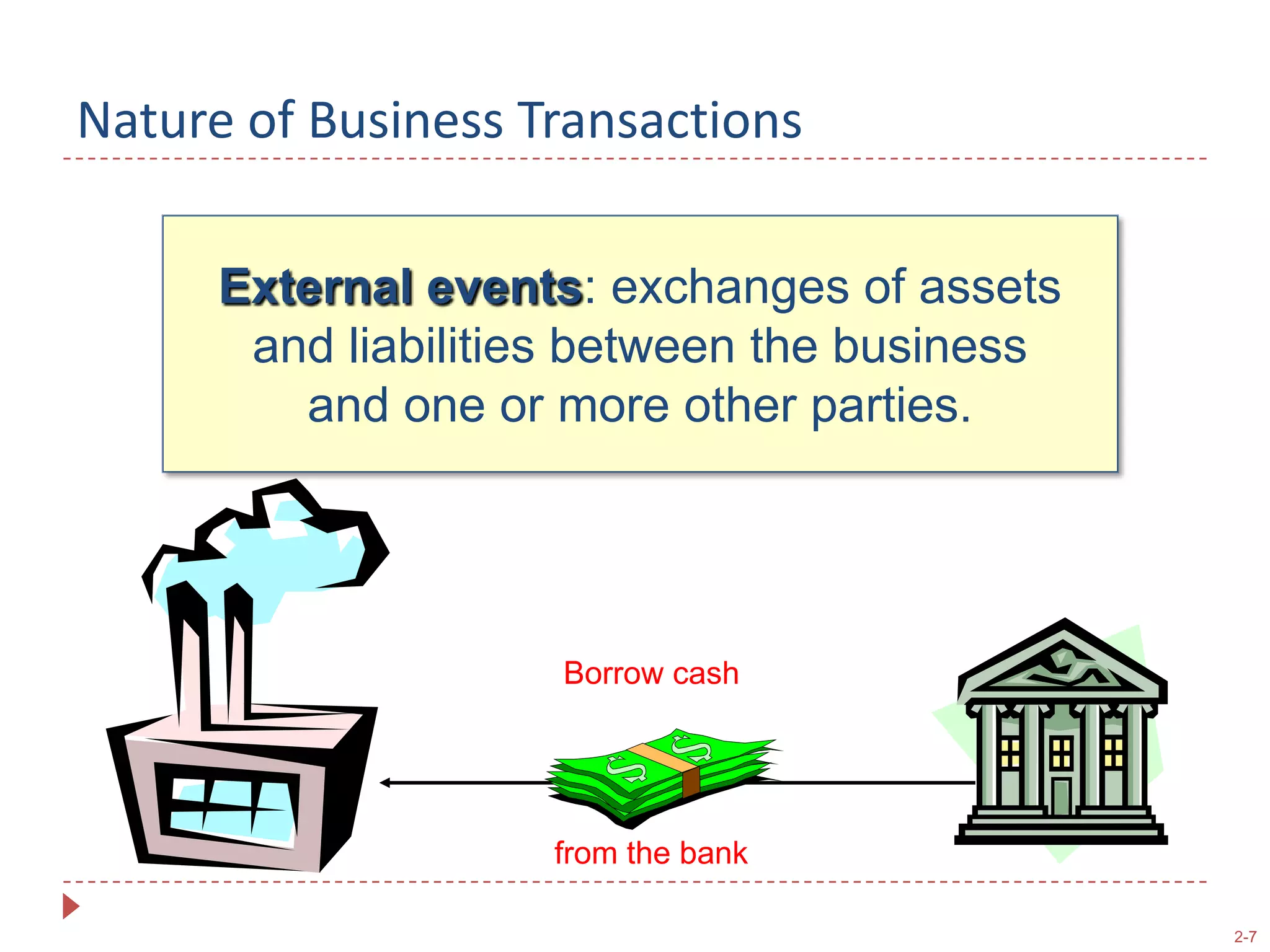
Nature of Business TransactionsExternal events: exchanges of assetsand liabilities between the businessand one or more other parties.Borrow cashfrom the bank
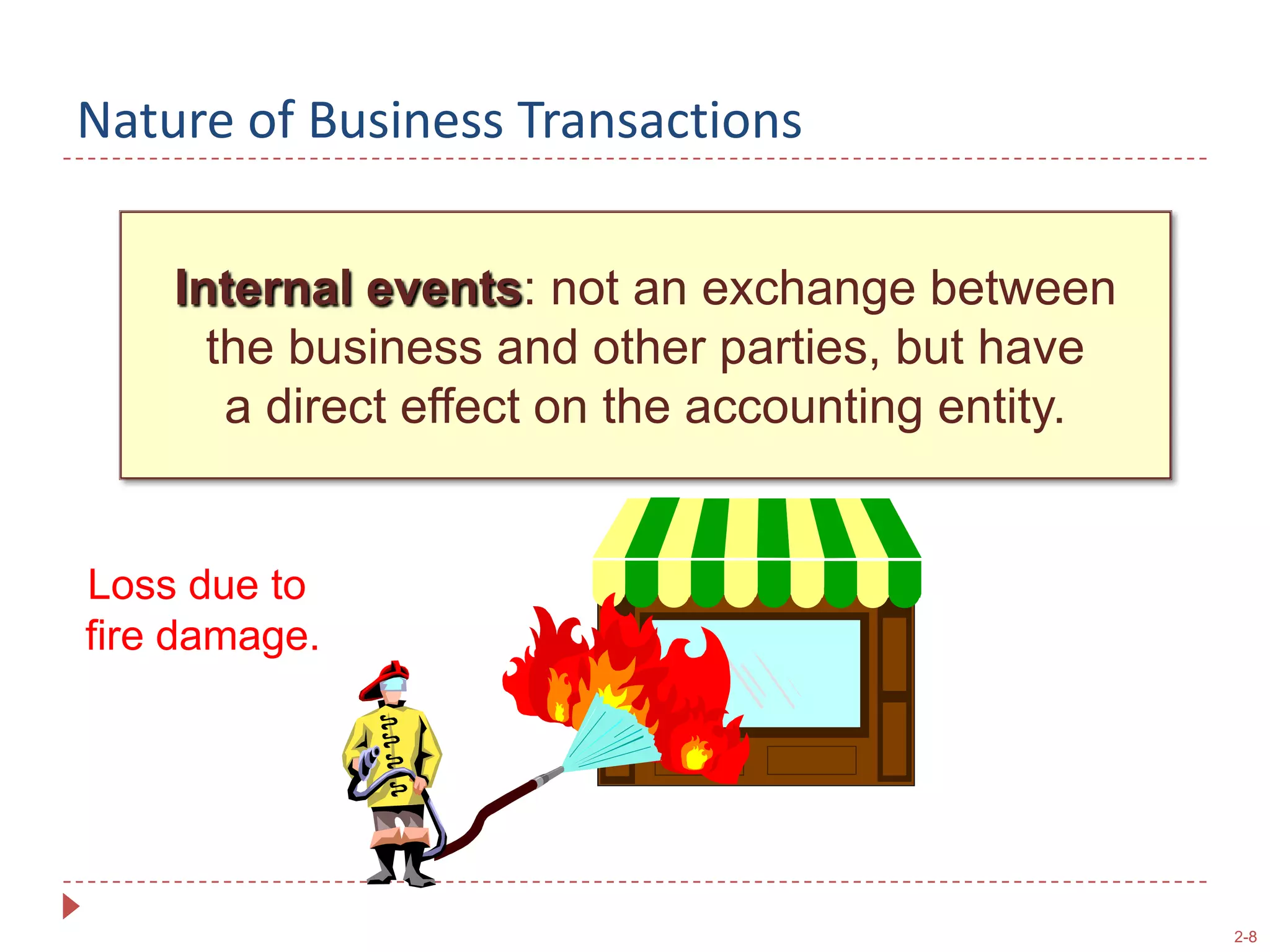
Nature of Business TransactionsInternal events: not an exchange betweenthe business and other parties, but havea direct effect on the accounting entity.Loss due to fire damage.
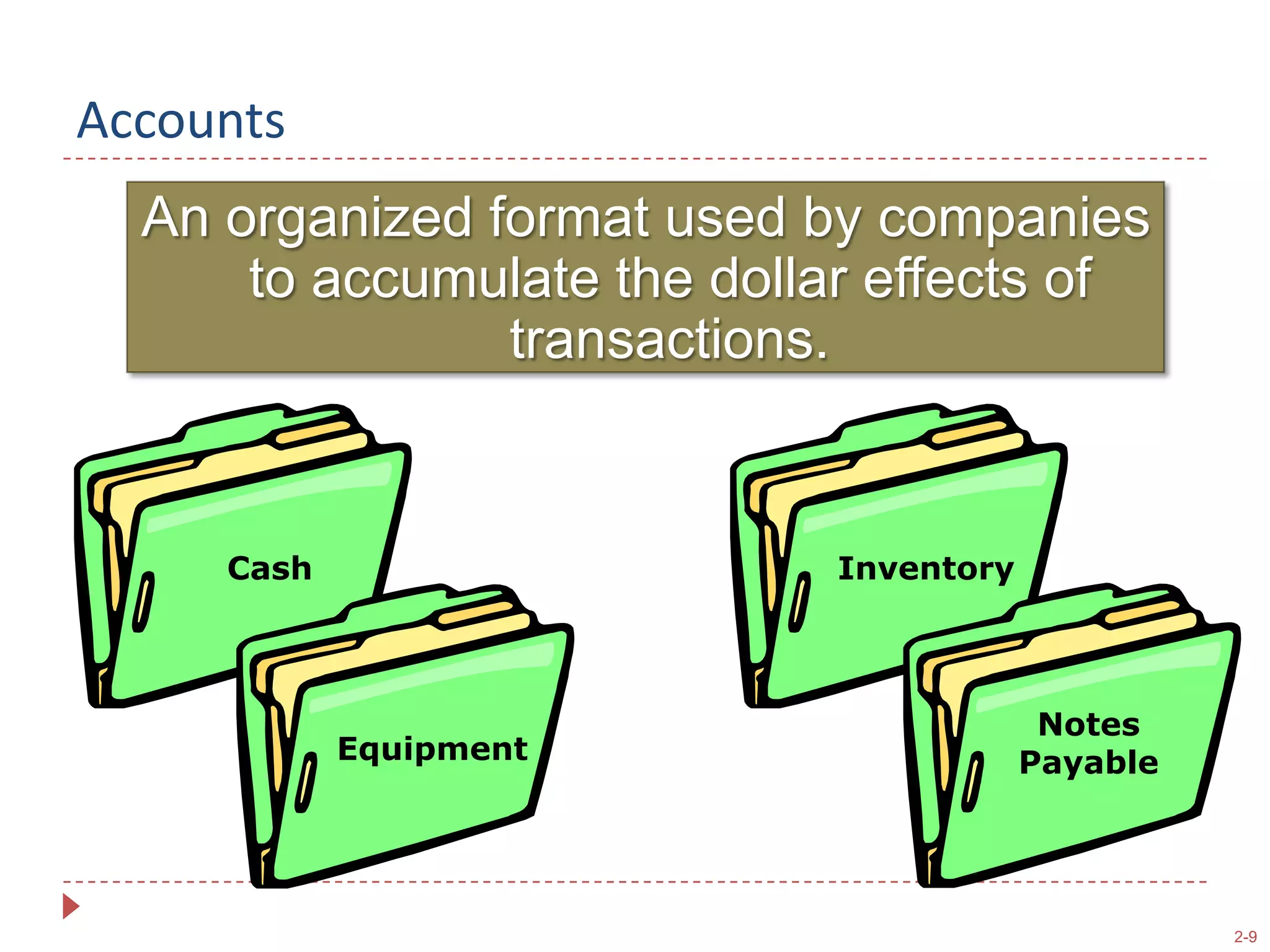
AccountsCashInventoryNotes PayableEquipmentAn organized format used by companies to accumulate the dollar effects of transactions.
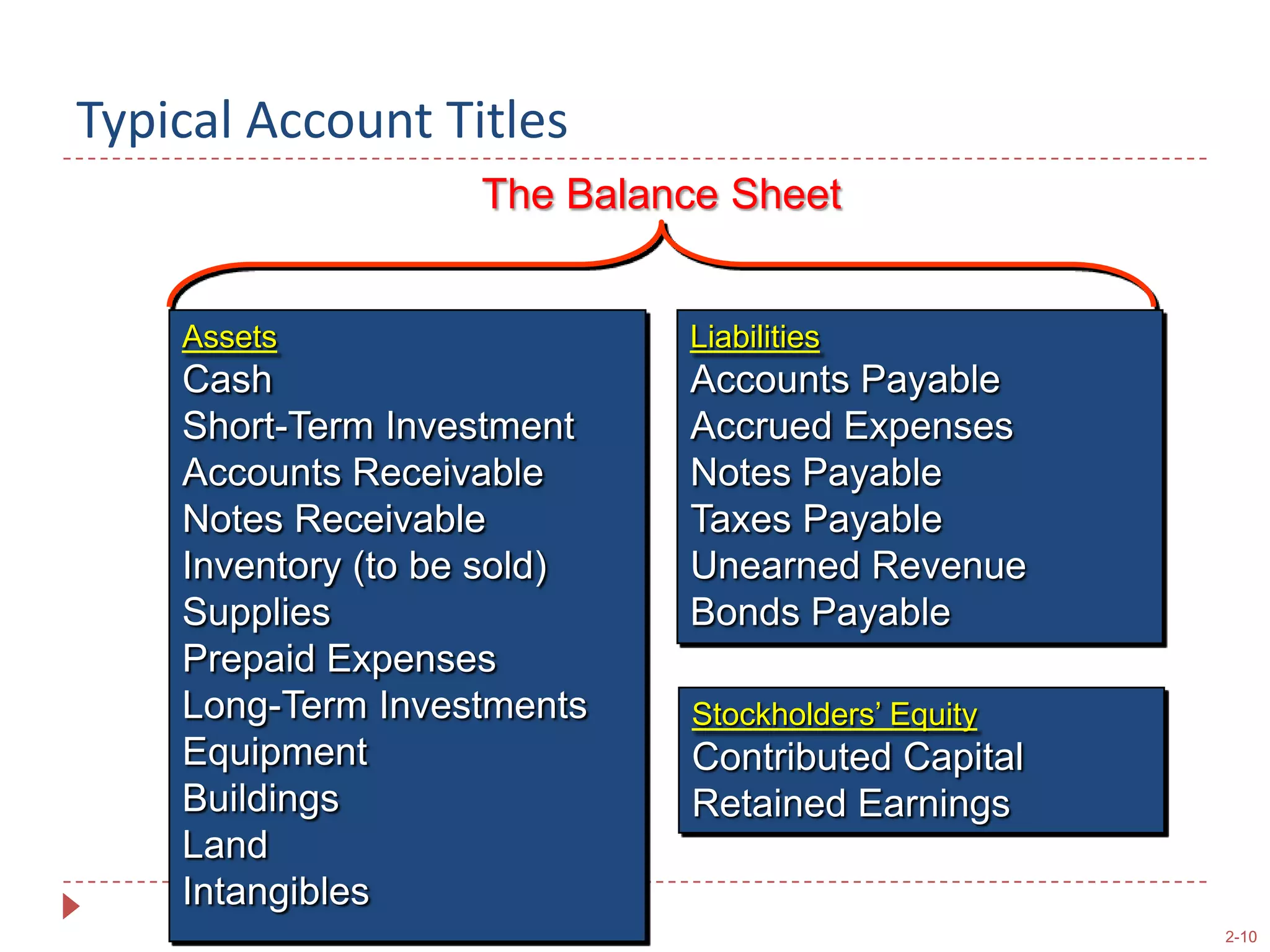
Typical Account TitlesThe Balance SheetAssetsCashShort-Term InvestmentAccounts ReceivableNotes ReceivableInventory (to be sold)SuppliesPrepaid ExpensesLong-Term InvestmentsEquipmentBuildingsLandIntangiblesLiabilitiesAccounts PayableAccrued ExpensesNotes PayableTaxes PayableUnearned Revenue Bonds PayableStockholders’ EquityContributed CapitalRetained Earnings
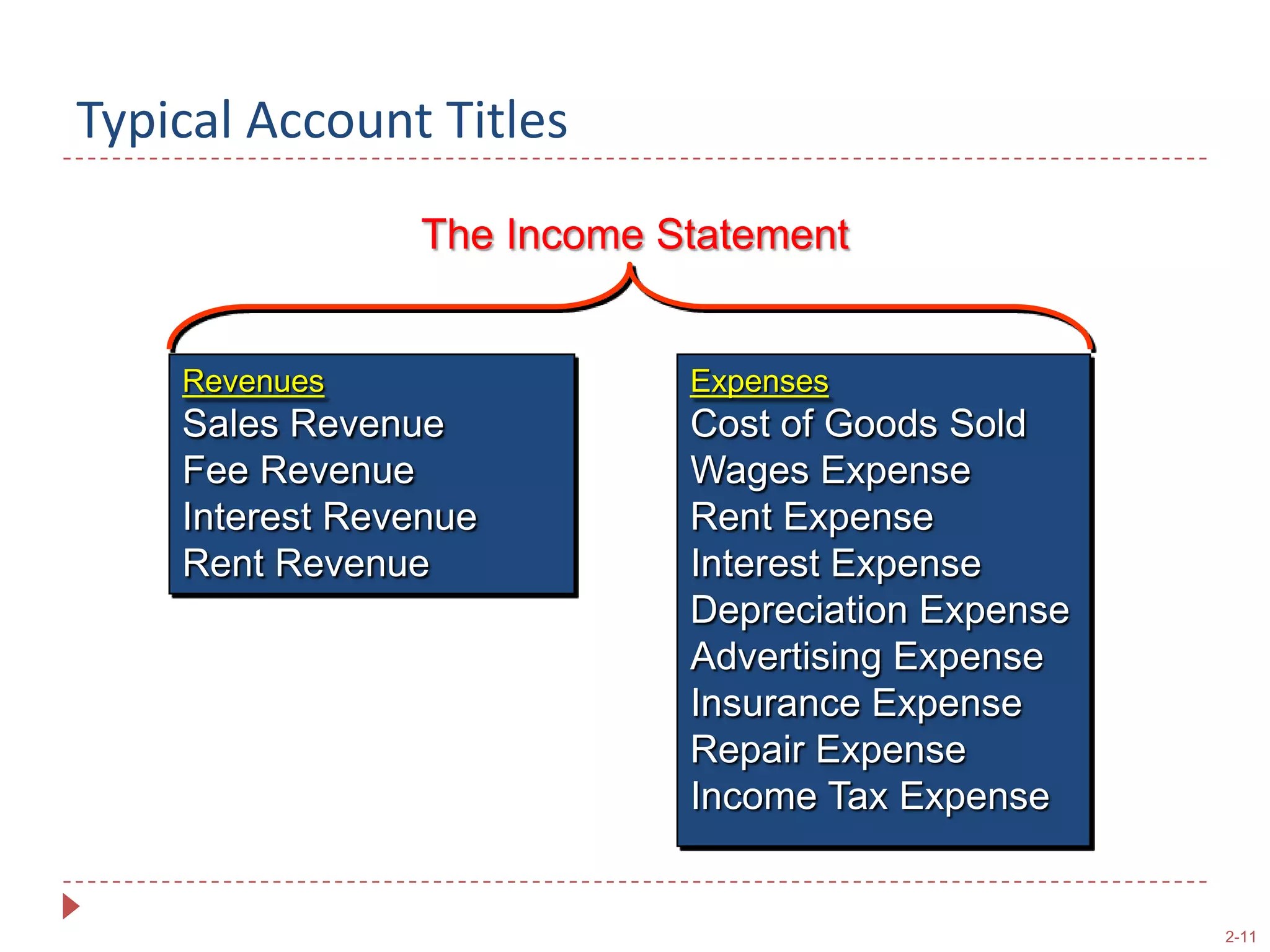
Typical Account TitlesThe Income StatementRevenuesSales RevenueFee RevenueInterest RevenueRent RevenueExpensesCost of Goods SoldWages ExpenseRent ExpenseInterest ExpenseDepreciation ExpenseAdvertising ExpenseInsurance ExpenseRepair ExpenseIncome Tax Expense
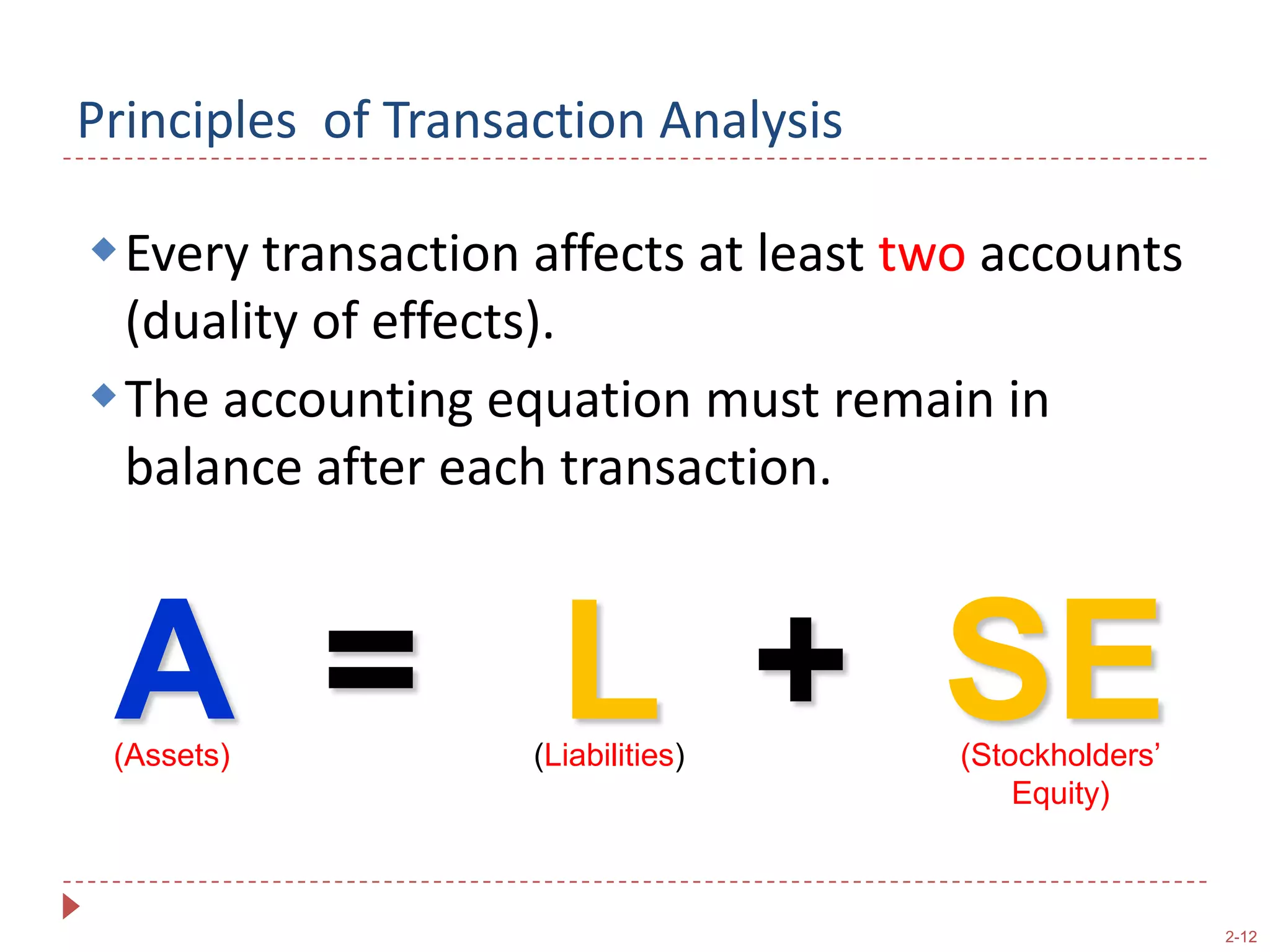
Principles  of Transaction AnalysisEvery transaction affects at least twoaccounts (duality of effects).
The accounting equation must remain in balance after each transaction.A  =   L  +  SE(Assets)(Liabilities)(Stockholders’Equity)
Duality of Effects    Most transactions with external parties involve an exchange where the business entity gives up something but receivessomething in return.
Balancing the Accounting EquationStep 1: Accounts and effectsIdentify the accounts affected and classify them by type of account (A, L, SE).
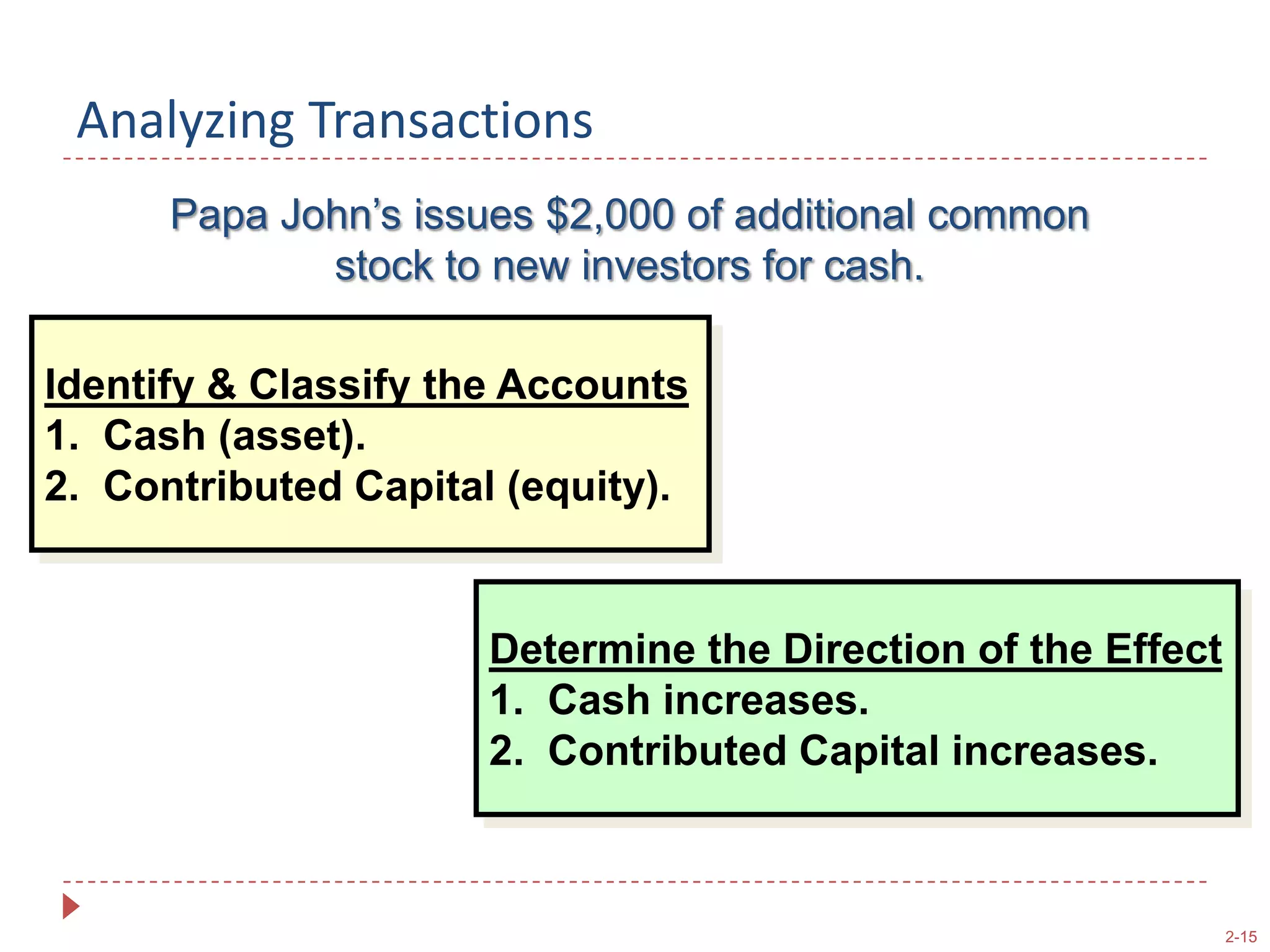
Determine the direction of the effect (increase or decrease) on each account.Step 2: BalancingVerify that the accounting equation (A = L + SE) remains in balance.  Identify & Classify the Accounts1.  Cash (asset).2.  Contributed Capital (equity).Determine the Direction of the Effect1.  Cash increases.2.  Contributed Capital increases.Papa John’s issues $2,000 of additional common stock to new investors for cash.Analyzing Transactions
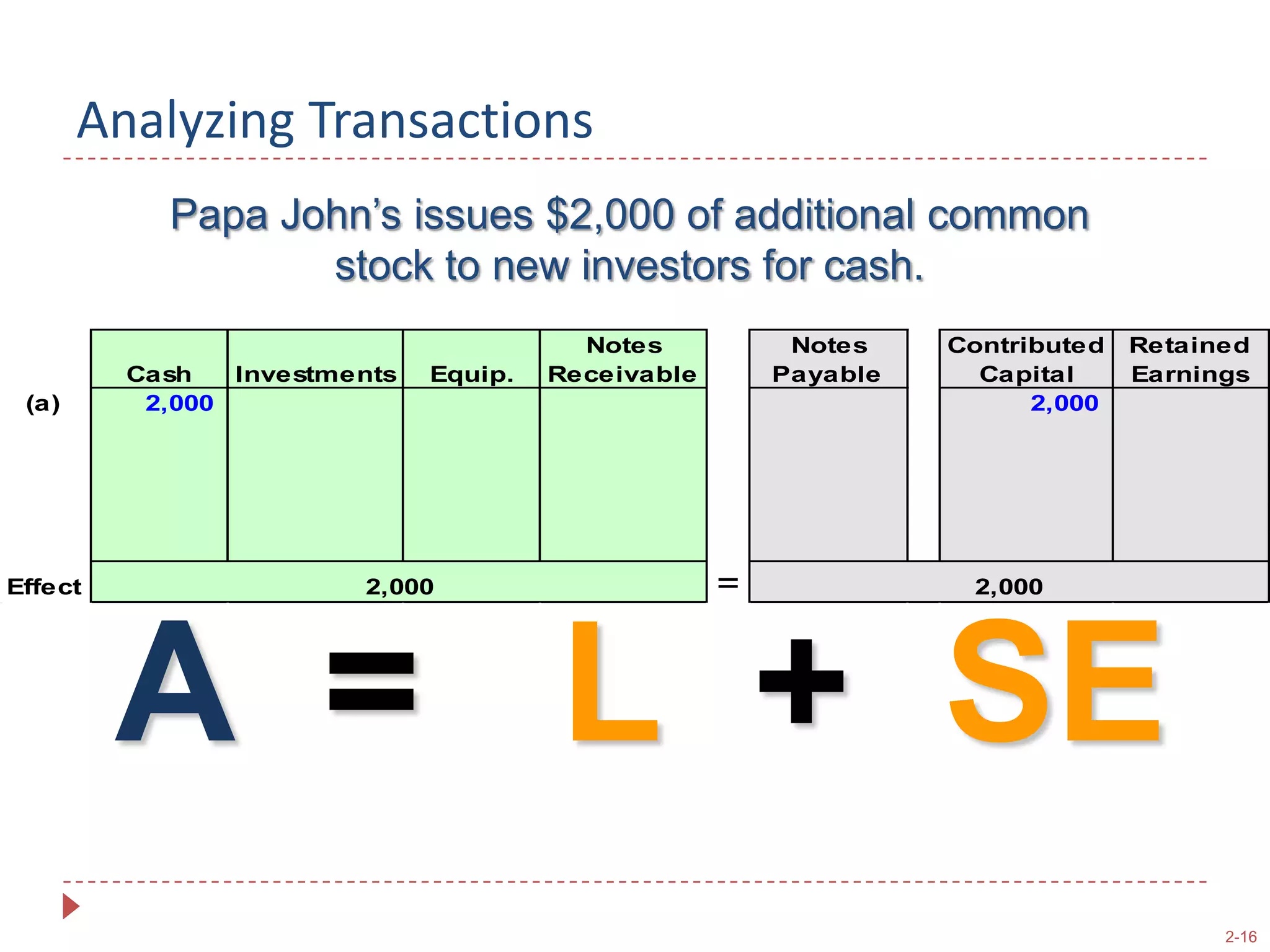
A=   L  +  SEAnalyzing TransactionsPapa John’s issues $2,000 of additional common stock to new investors for cash.
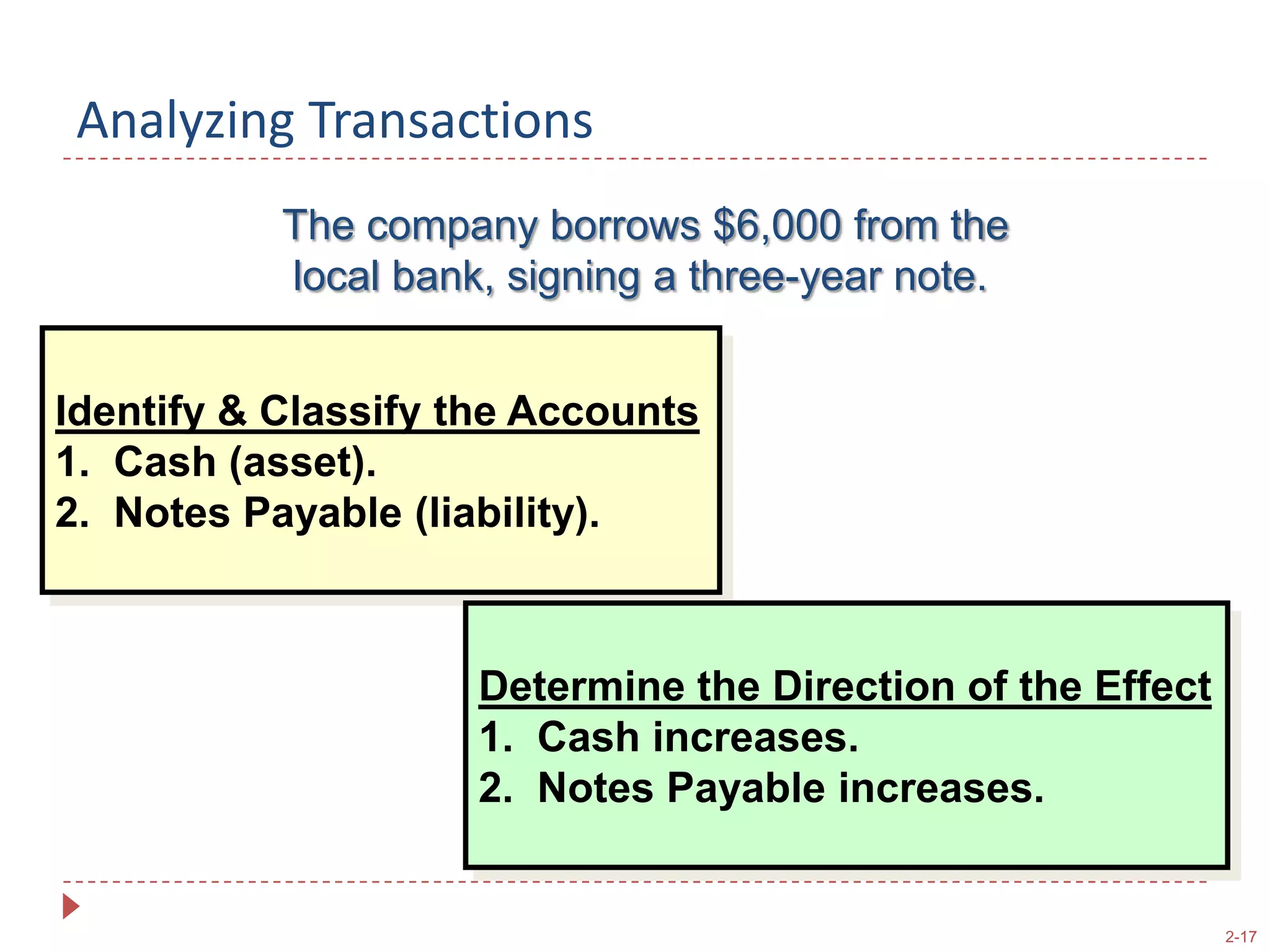
Identify & Classify the Accounts1.  Cash (asset).2.  Notes Payable (liability).Determine the Direction of the Effect1.  Cash increases.2.  Notes Payable increases. The company borrows $6,000 from the local bank, signing a three-year note.Analyzing Transactions
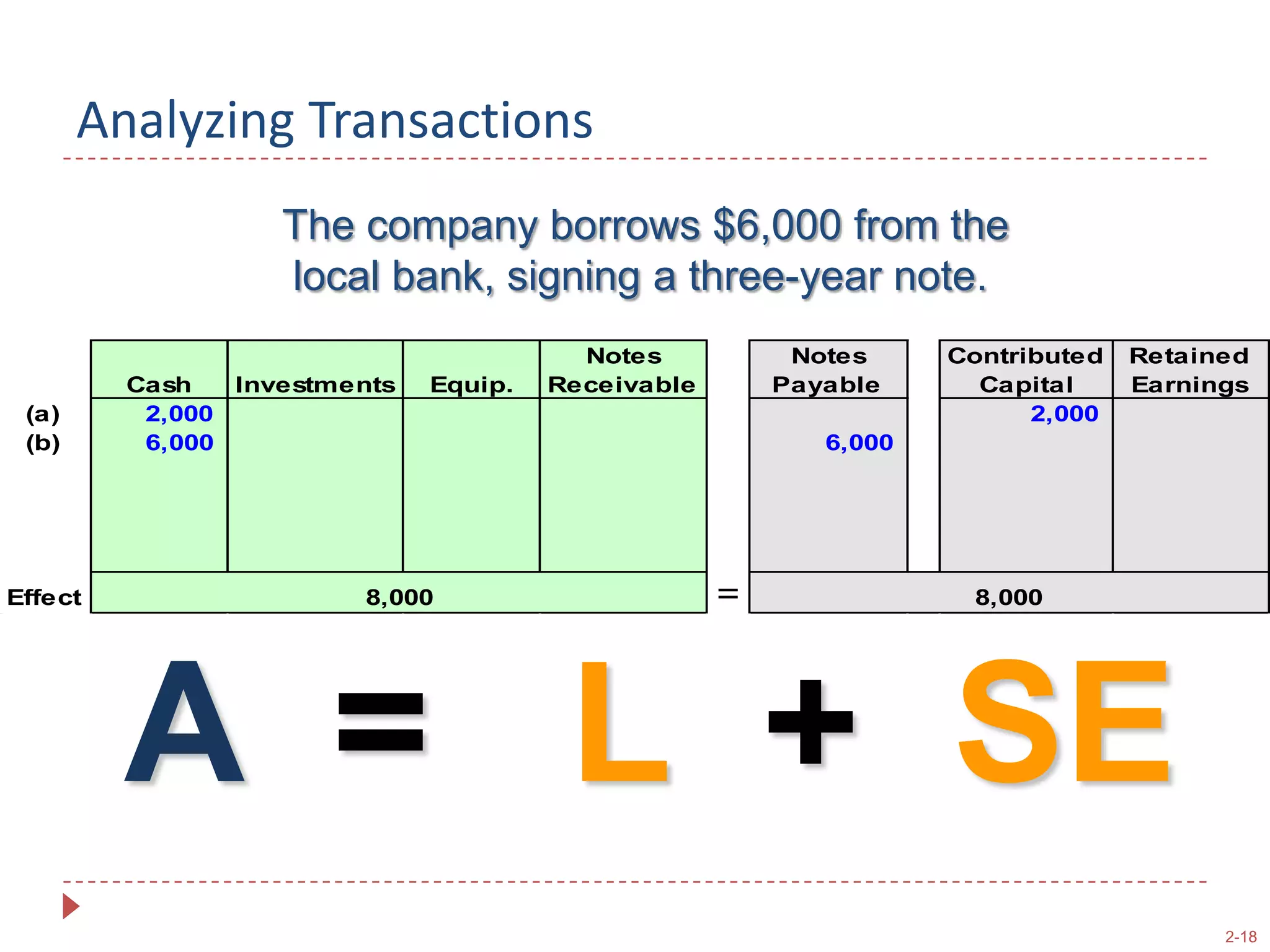
A=   L  +  SEAnalyzing Transactions The company borrows $6,000 from the local bank, signing a three-year note.
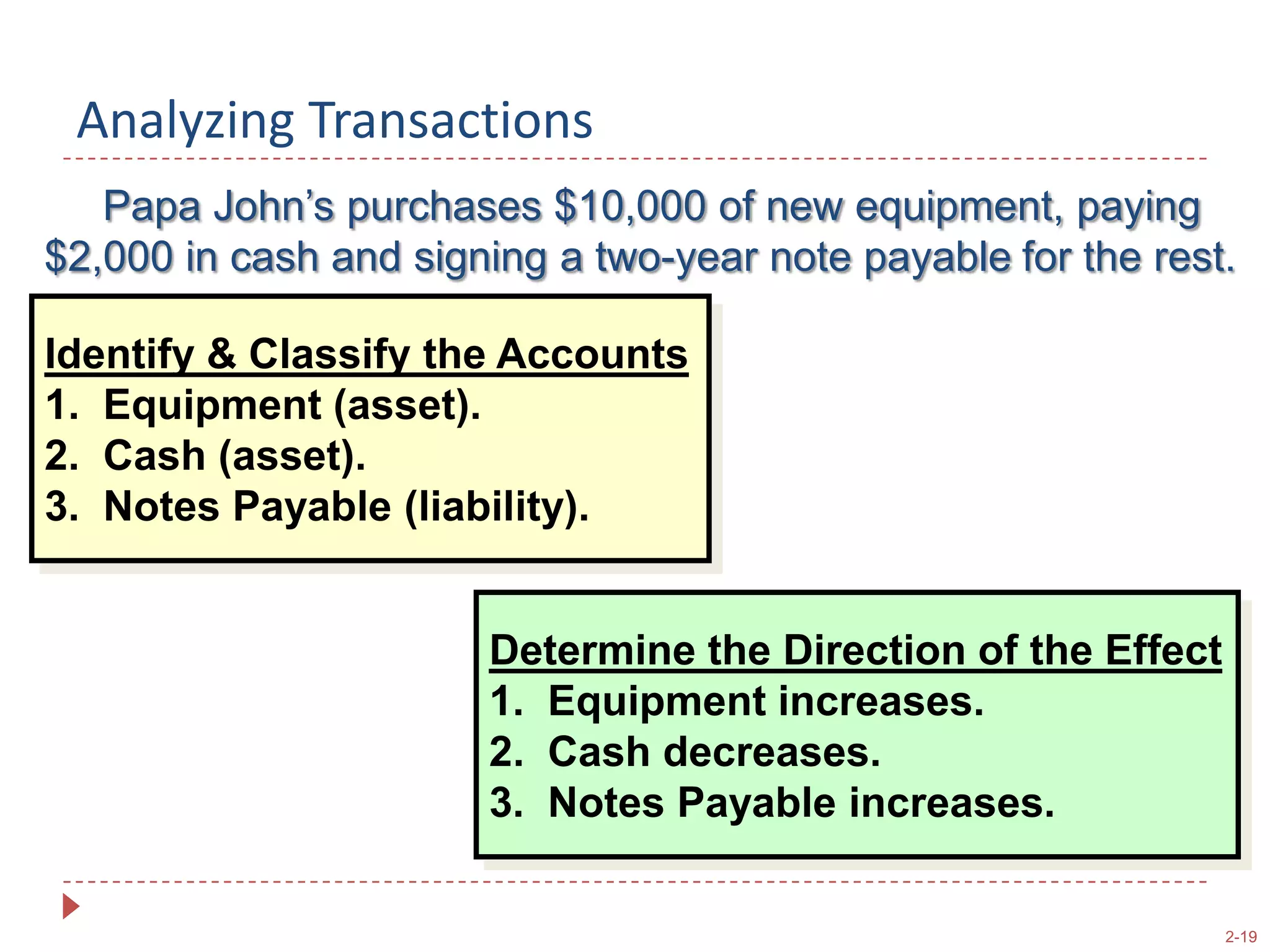
Identify & Classify the Accounts1.  Equipment (asset).2.  Cash (asset).3.  Notes Payable (liability).Determine the Direction of the Effect1.  Equipment increases.2.  Cash decreases.3.  Notes Payable increases.  Papa John’s purchases $10,000 of new equipment, paying $2,000 in cash and signing a two-year note payablefor the rest.Analyzing Transactions
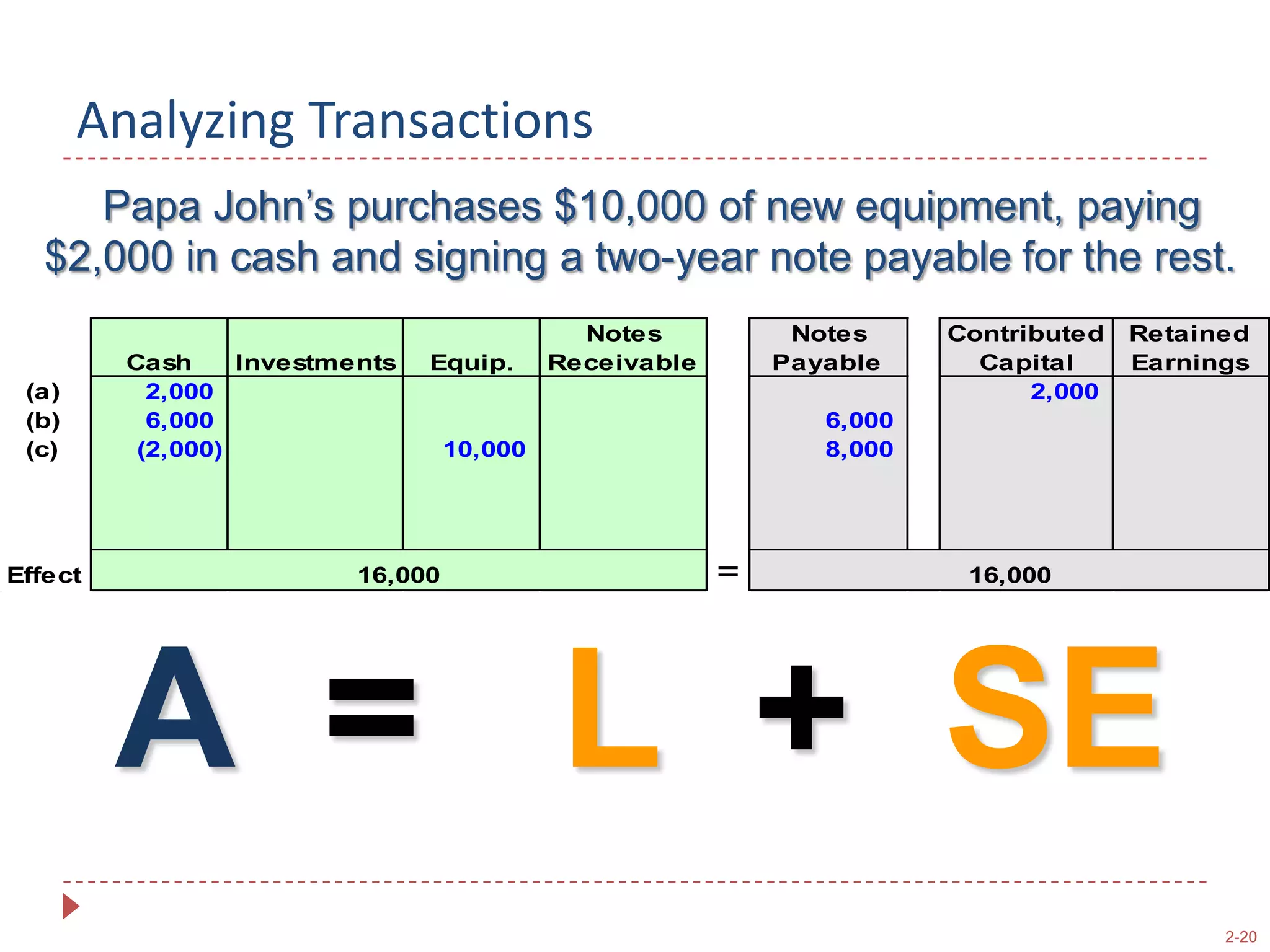
A =   L  +  SEAnalyzing Transactions  Papa John’s purchases $10,000 of new equipment, paying $2,000 in cash and signing a two-year note payablefor the rest.
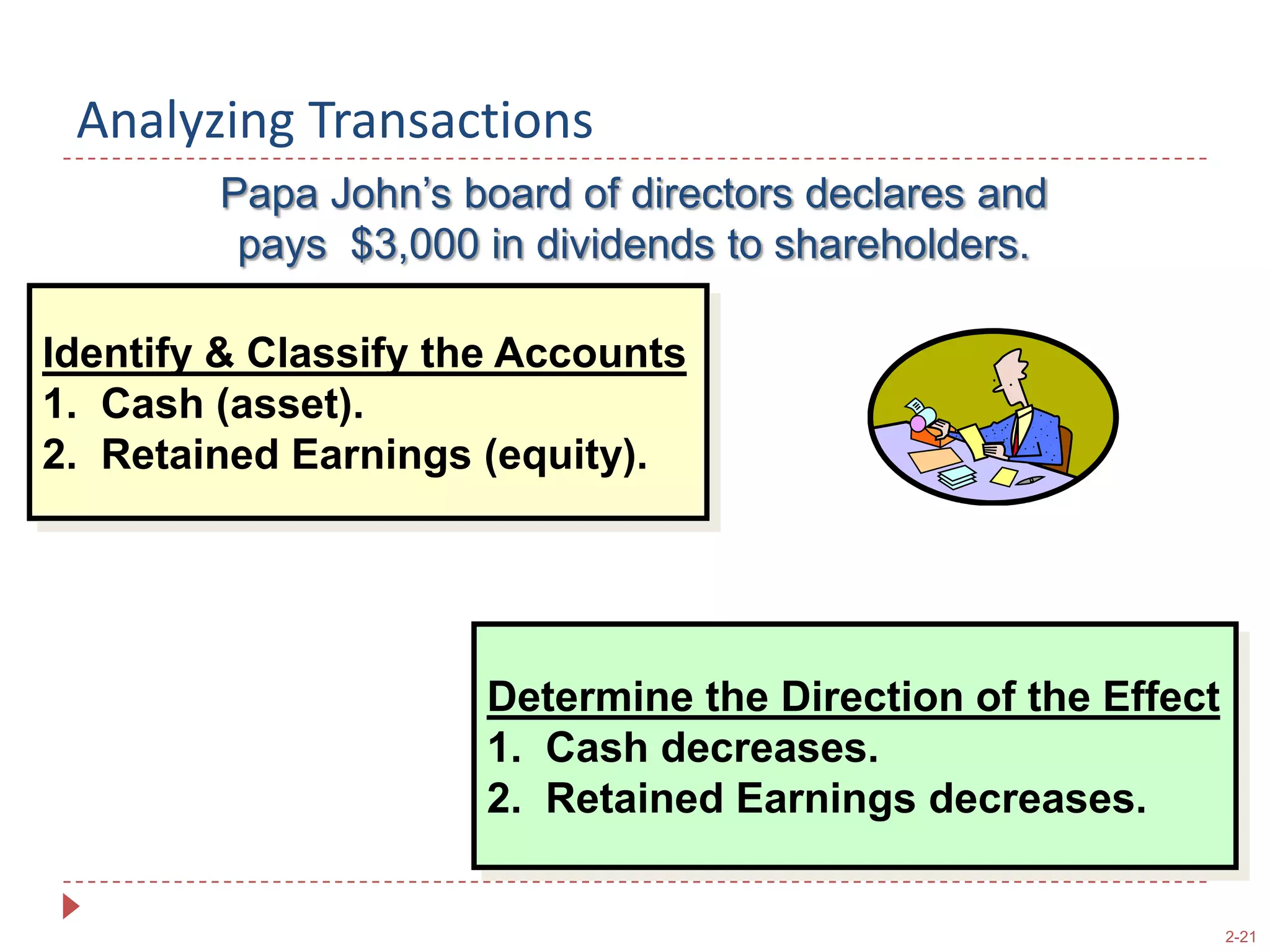
Analyzing TransactionsPapa John’s board of directors declares andpays  $3,000 in dividends to shareholders.Identify & Classify the AccountsIdentify & Classify the Accounts1.  Cash (asset).2.  Retained Earnings (equity).Determine the Direction of the EffectDetermine the Direction of the Effect1.  Cash decreases.2.  Retained Earnings decreases.
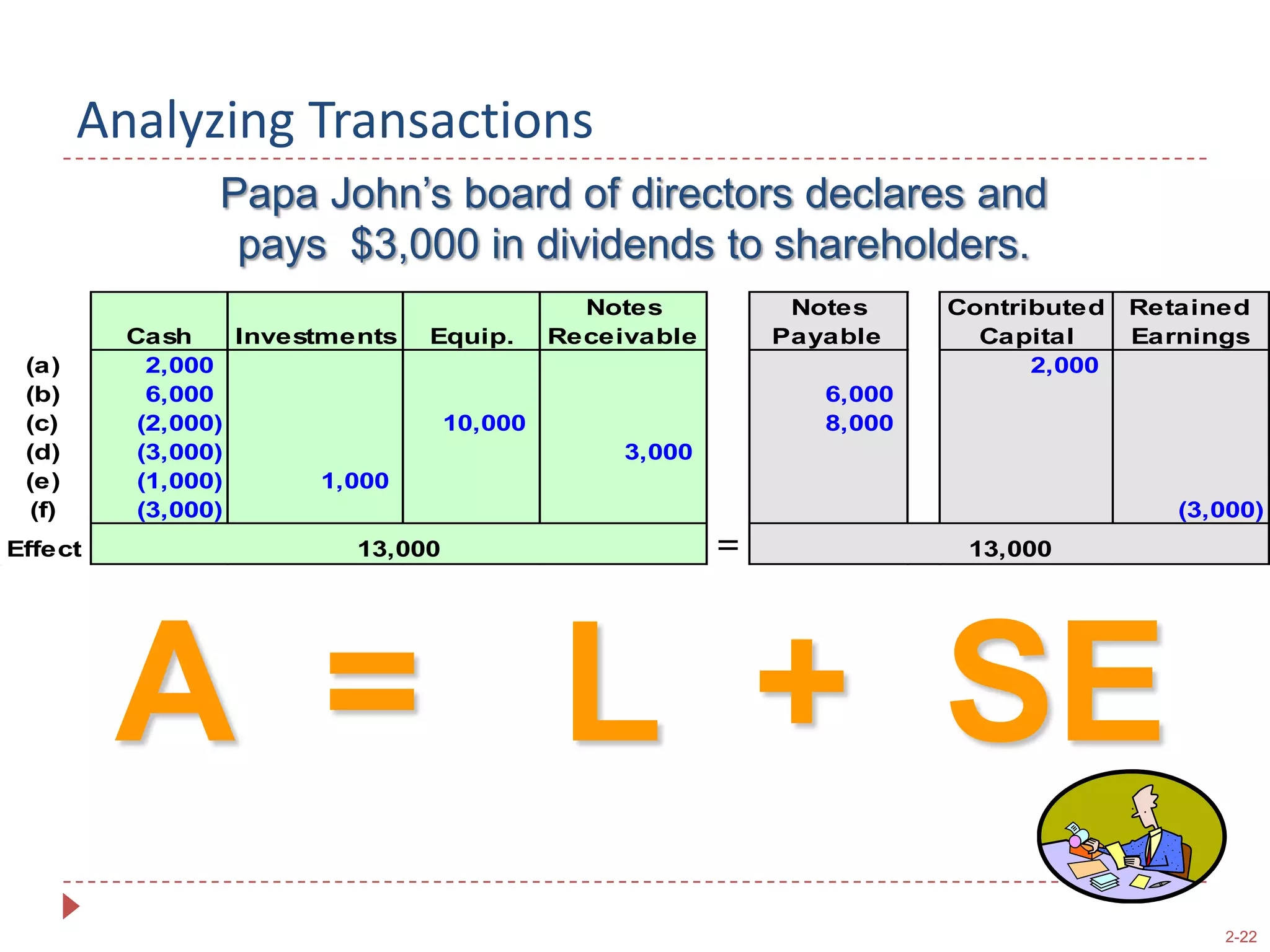
Papa John’s board of directors declares andpays  $3,000 in dividends to shareholders.A  =   L  +  SEAnalyzing Transactions
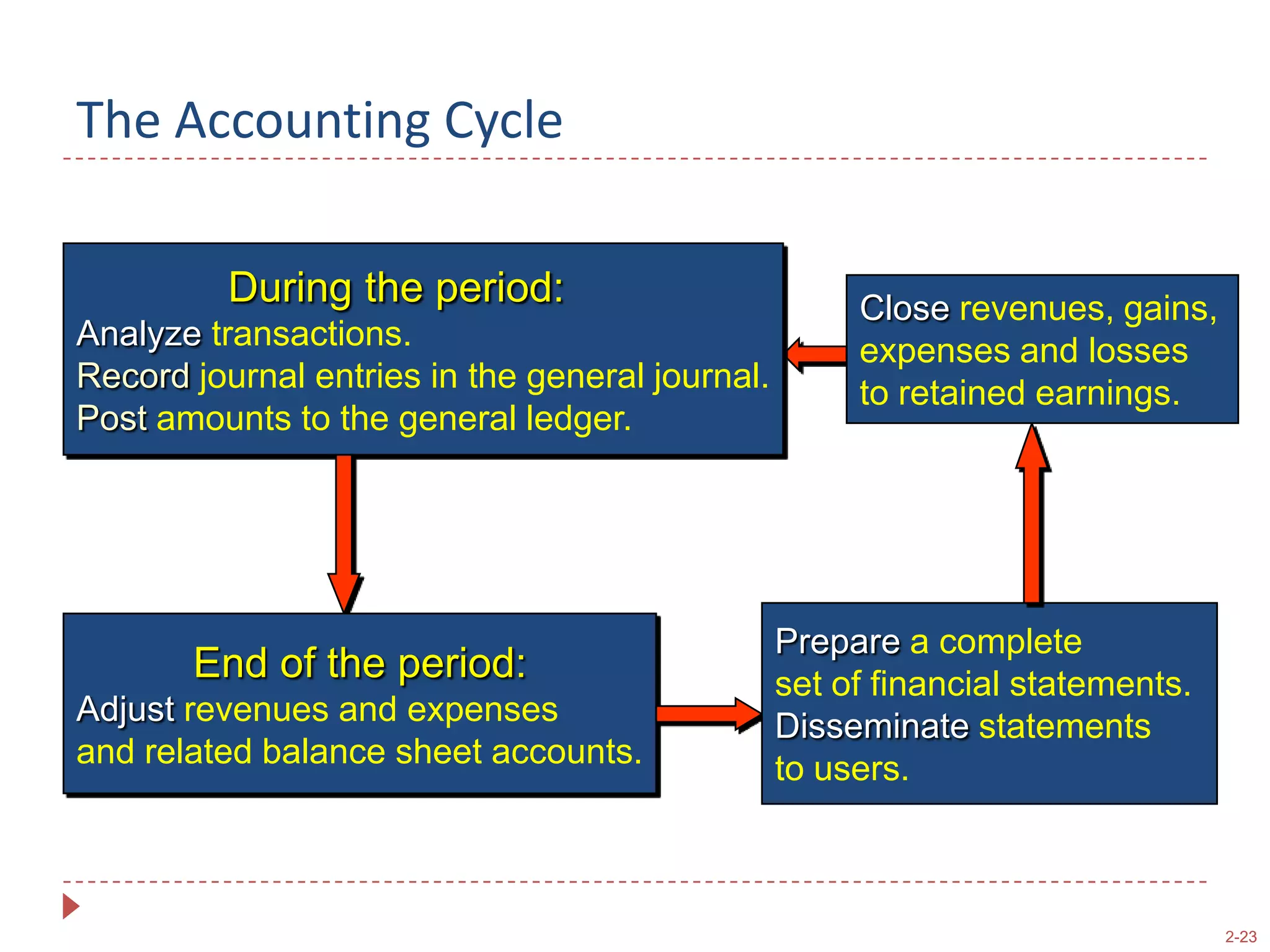
The Accounting CycleCloserevenues, gains,expenses and lossesto retained earnings.Preparea completeset of financial statements.Disseminatestatementsto users.End of the period:Adjustrevenues and expensesand related balance sheet accounts.During the period:Analyzetransactions.Record journal entries in the general journal.Post amounts to the general ledger.
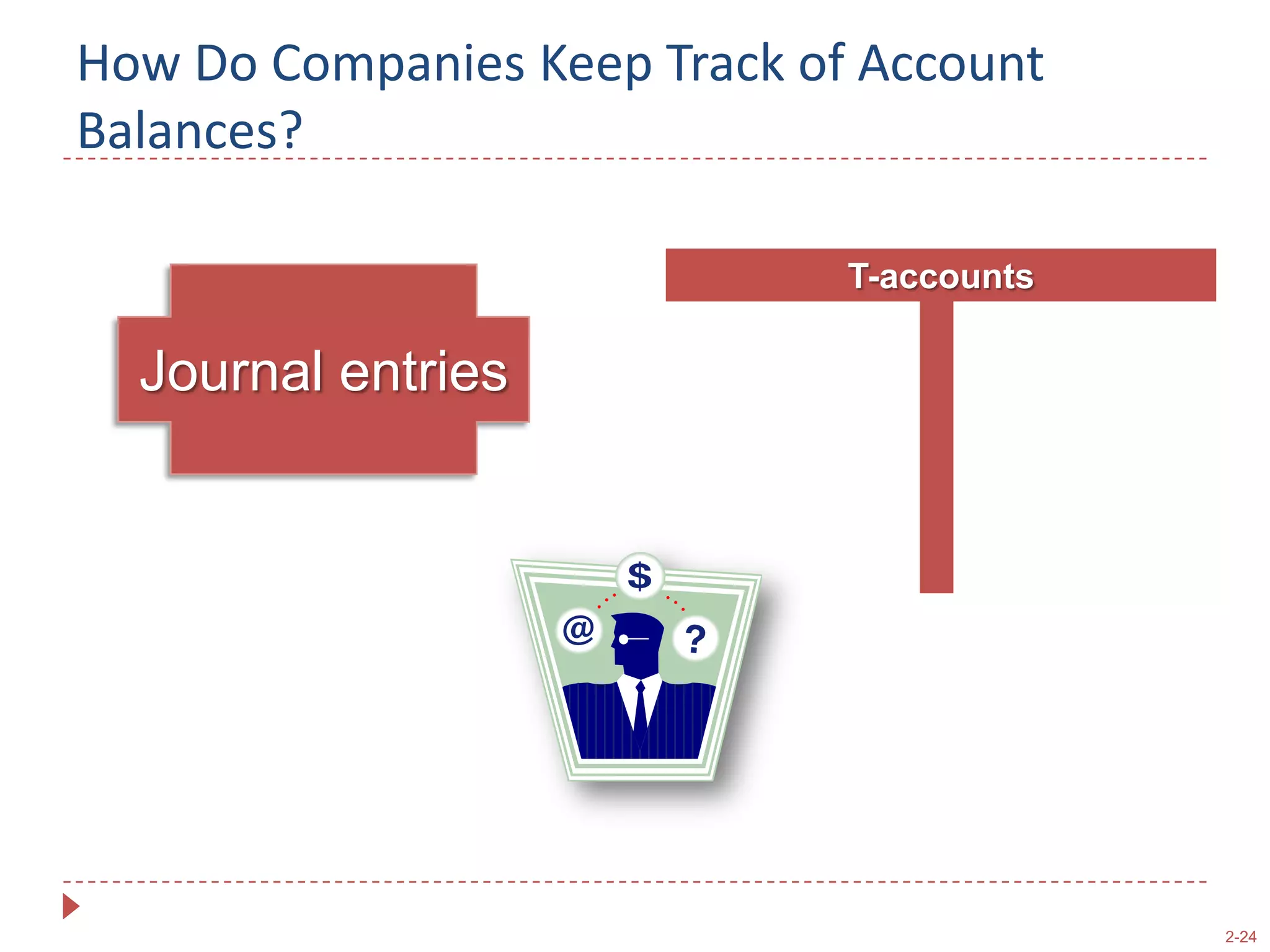
How Do Companies Keep Track of Account Balances?T-accountsJournal entries
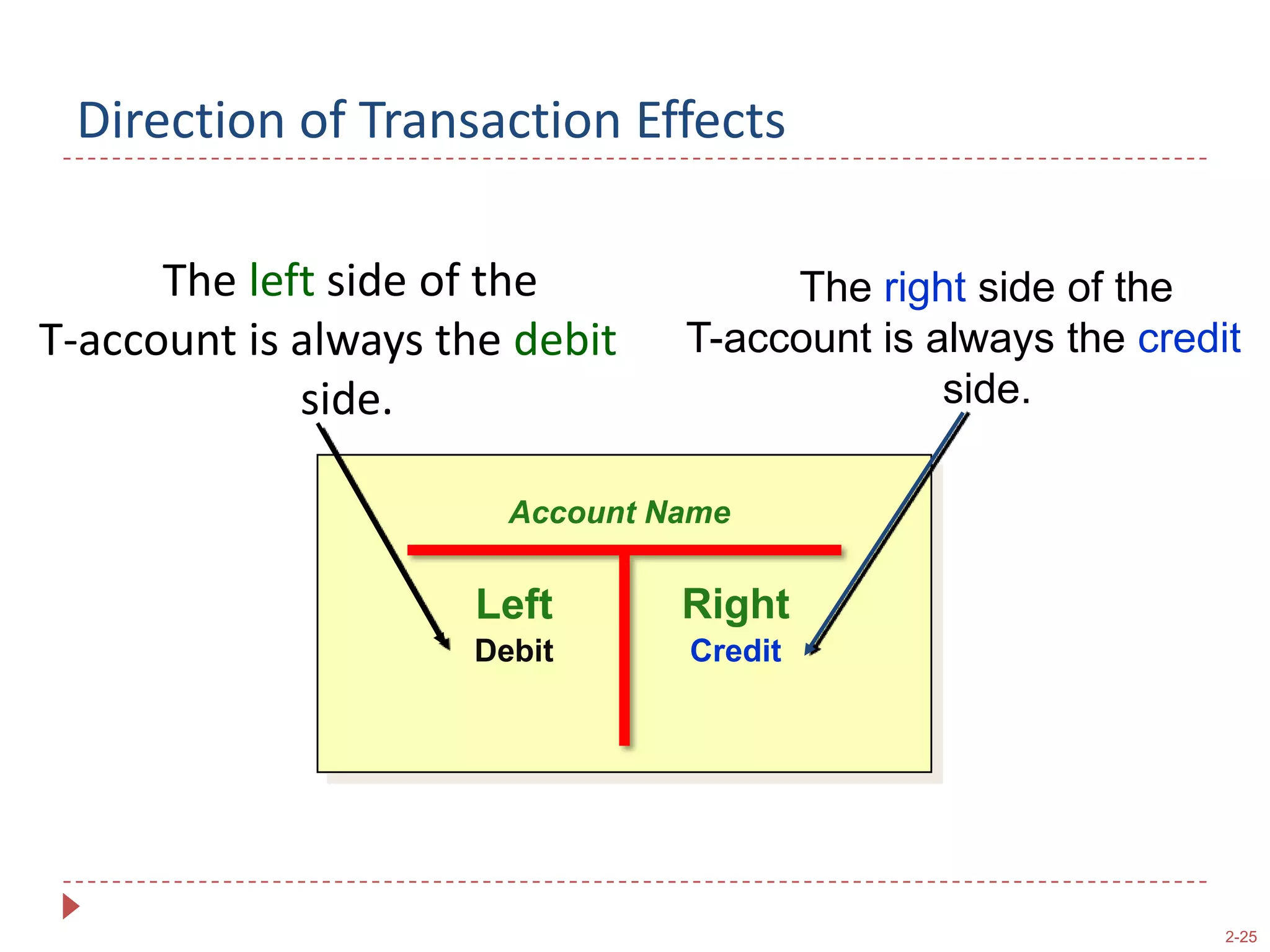
Direction of Transaction Effects    The left side of the T-account is always the debit side.    The rightside of the T-account is always the credit side.Account NameRightLeftDebitCredit
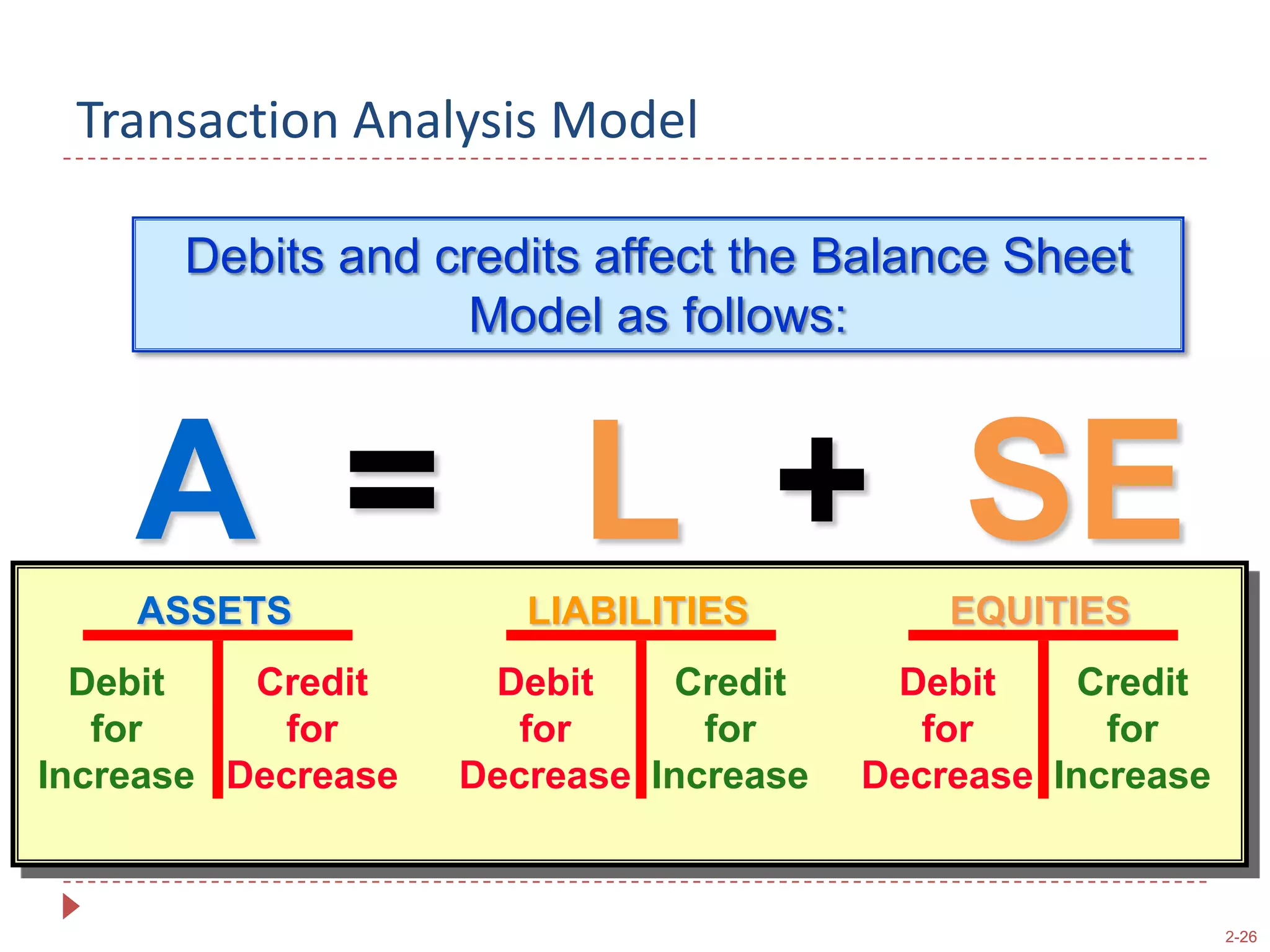
Transaction Analysis ModelASSETSEQUITIESLIABILITIESDebit  for IncreaseCredit  for DecreaseDebit      for DecreaseCredit for IncreaseDebit      for DecreaseCredit for IncreaseDebits and credits affect the Balance Sheet Model as follows:A  =  L  +  SE
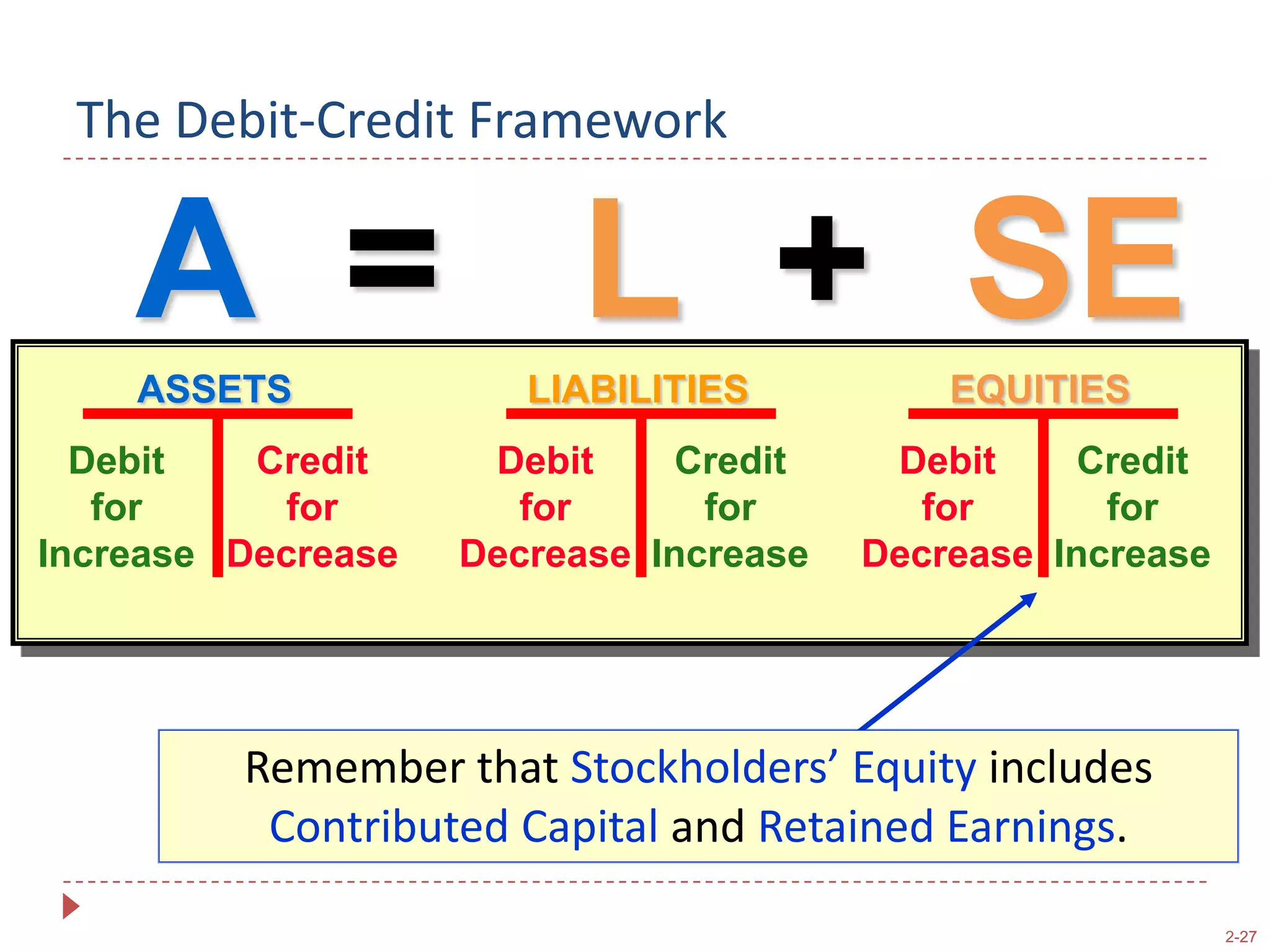
ASSETSEQUITIESLIABILITIESDebit  for IncreaseCredit  for DecreaseDebit      for DecreaseCredit for IncreaseDebit      for DecreaseCredit for IncreaseRemember that Stockholders’ Equity includes Contributed Capital and Retained Earnings.A  =  L  +  SEThe Debit-Credit Framework
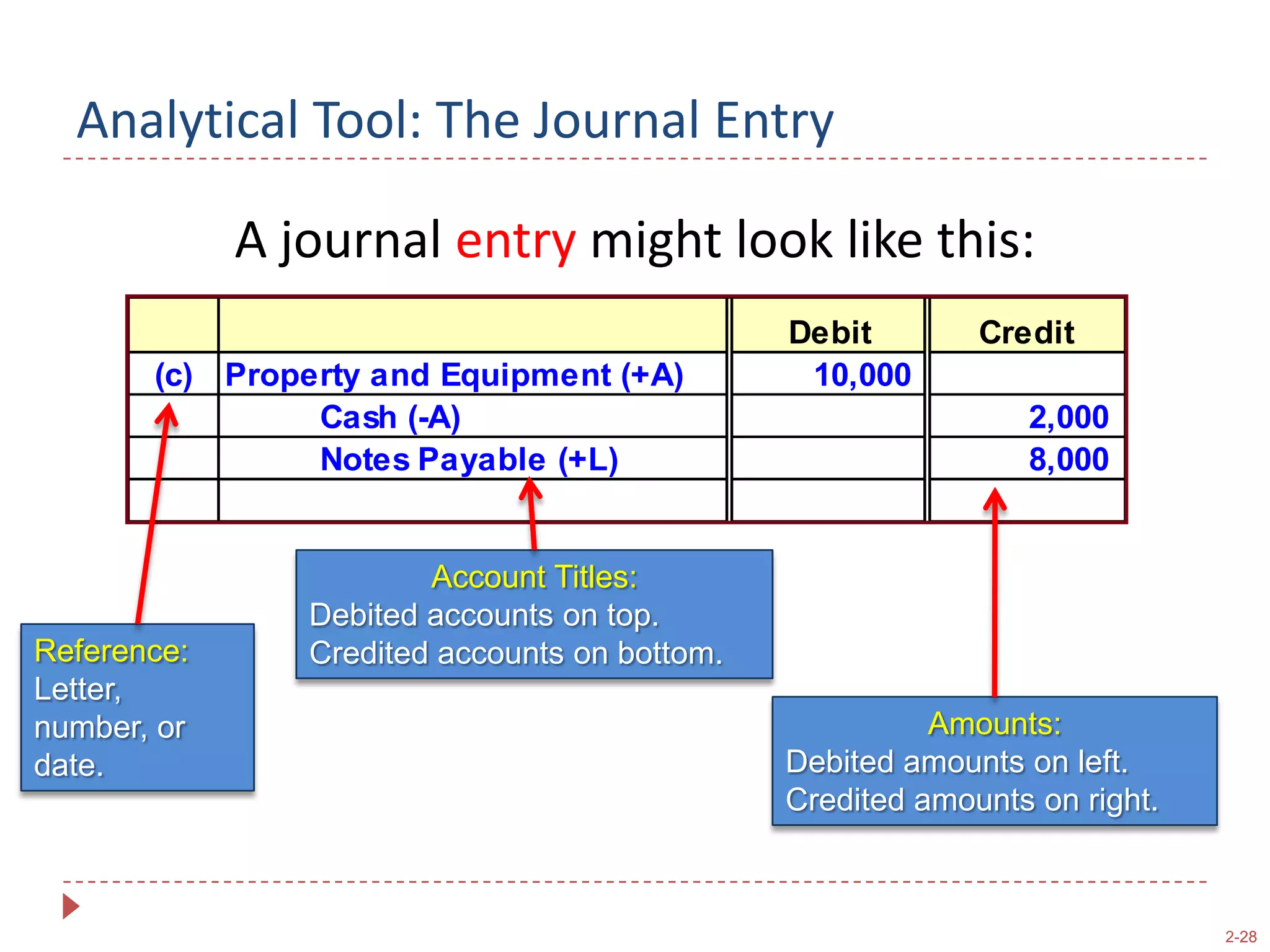
Analytical Tool: The Journal EntryA journal entry might look like this:Account Titles:Debited accounts on top.Credited accounts on bottom.Reference:Letter, number, or date.Amounts:Debited amounts on left.Credited amounts on right.
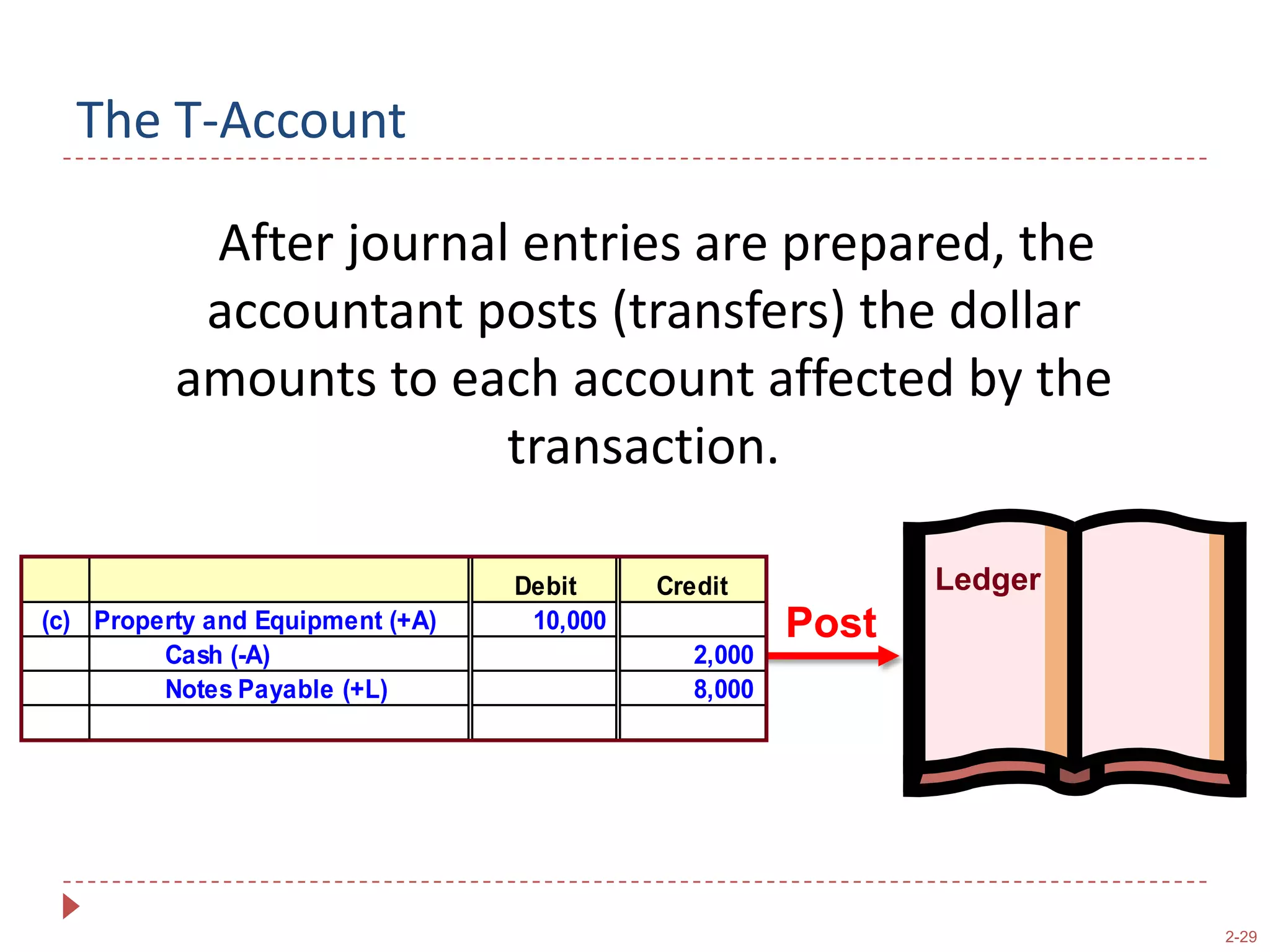
     After journal entries are prepared, the accountant posts (transfers) the dollar amounts to each account affected by the transaction.LedgerPostThe T-Account
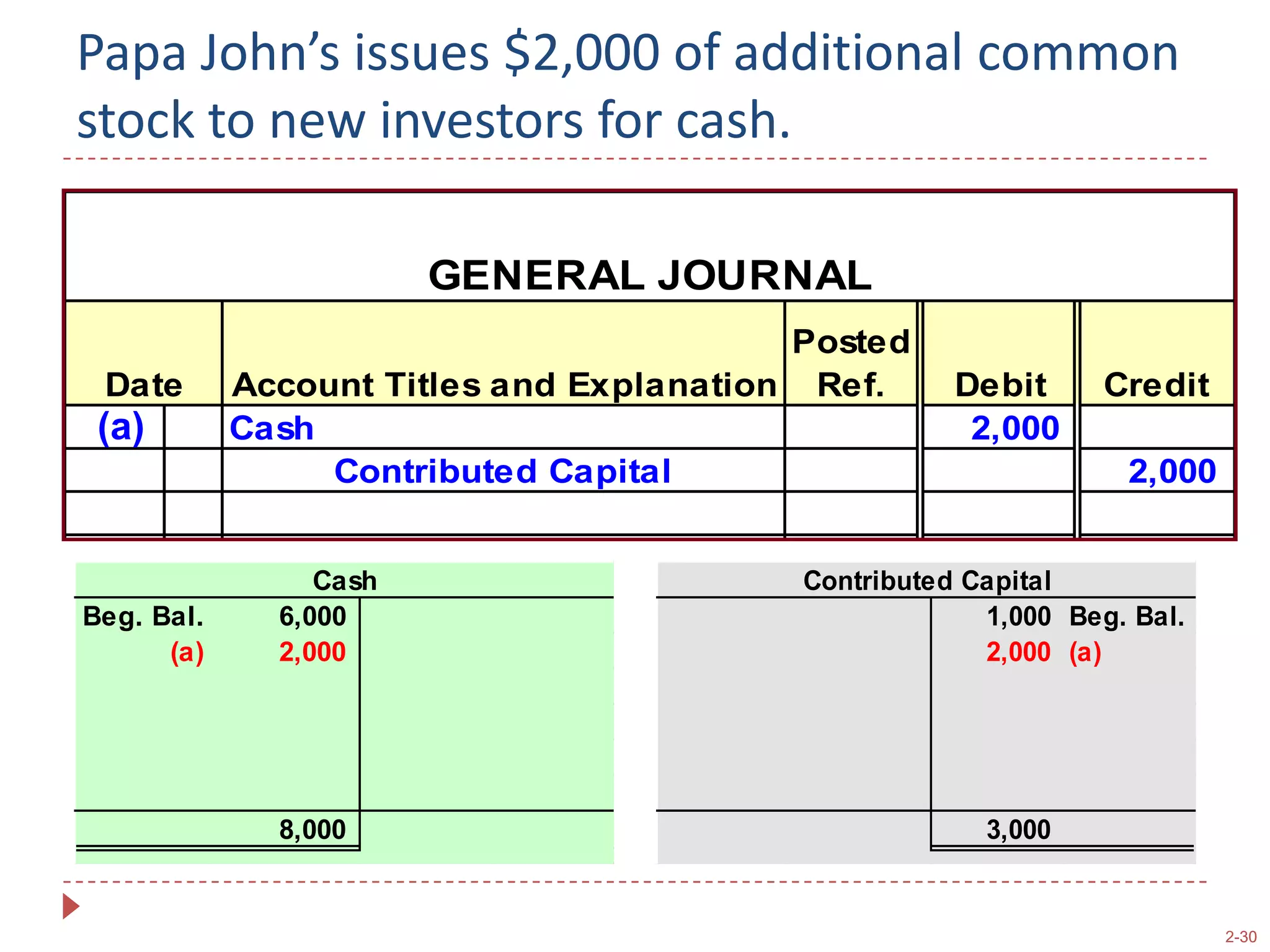
(a)Papa John’s issues $2,000 of additional common stock to new investors for cash.
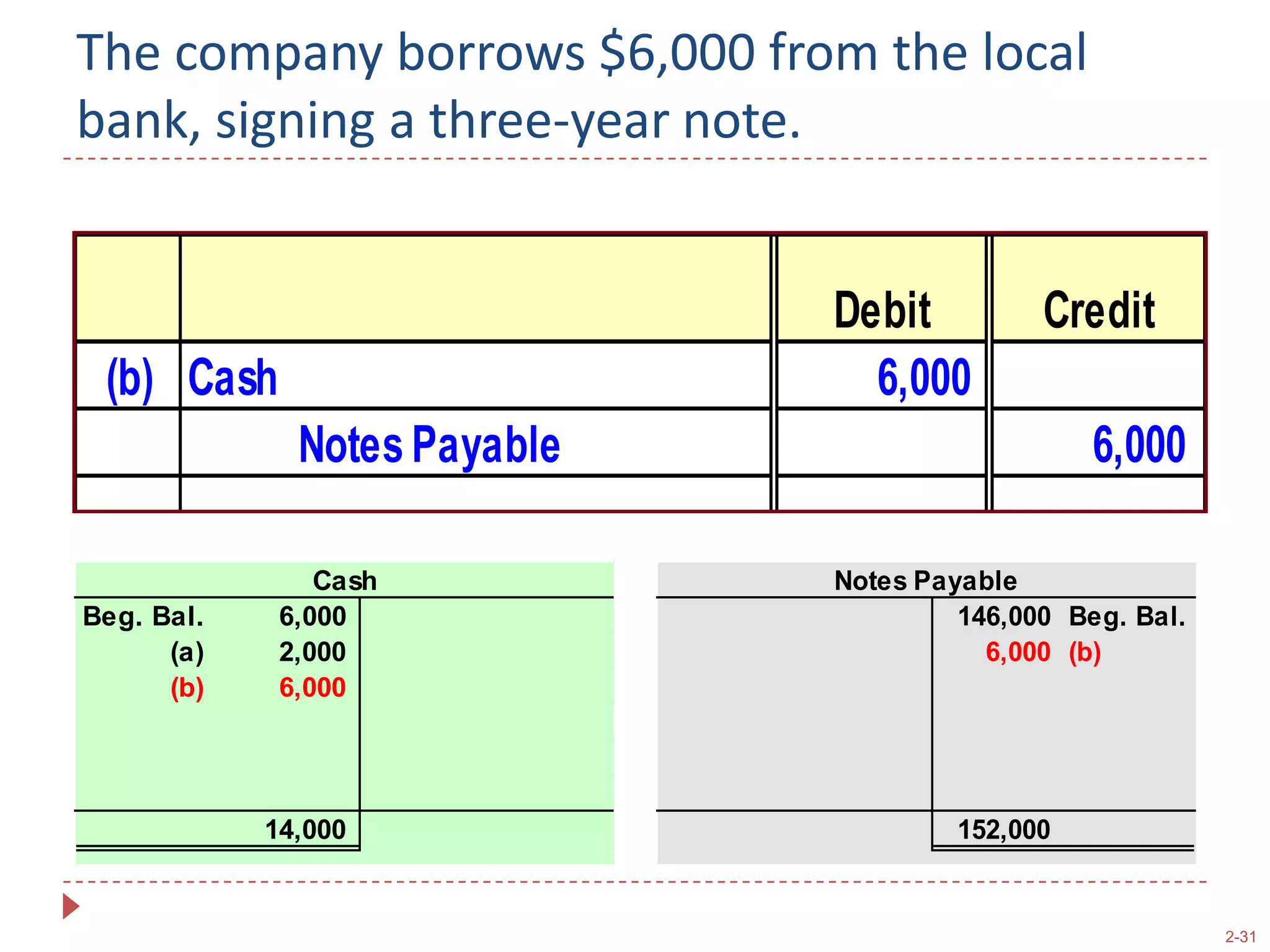
The company borrows $6,000 from the local bank, signing a three-year note.
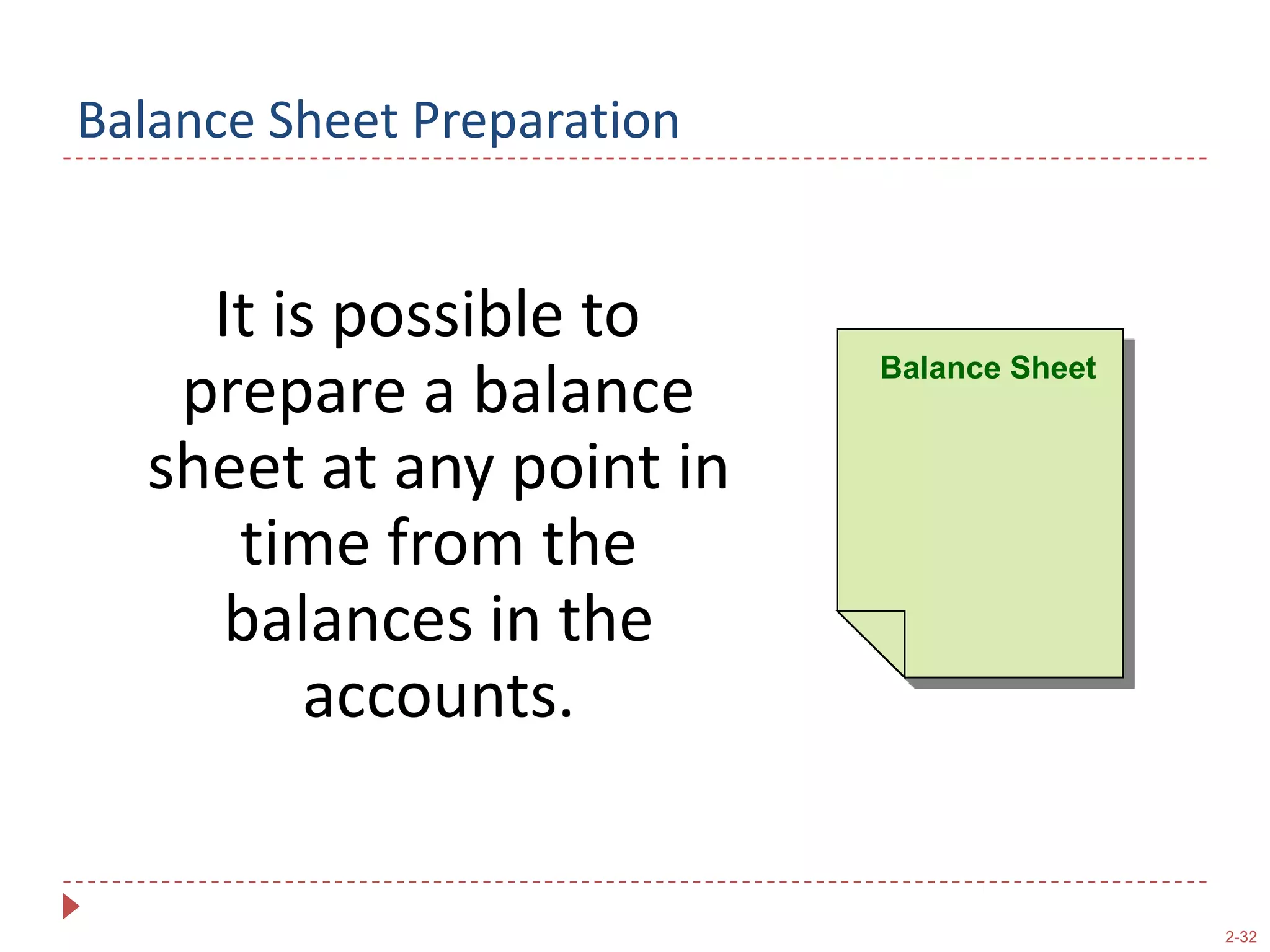
Balance Sheet Preparation It is possible to prepare a balance sheet at any point in time from the balances in the accounts.Balance Sheet
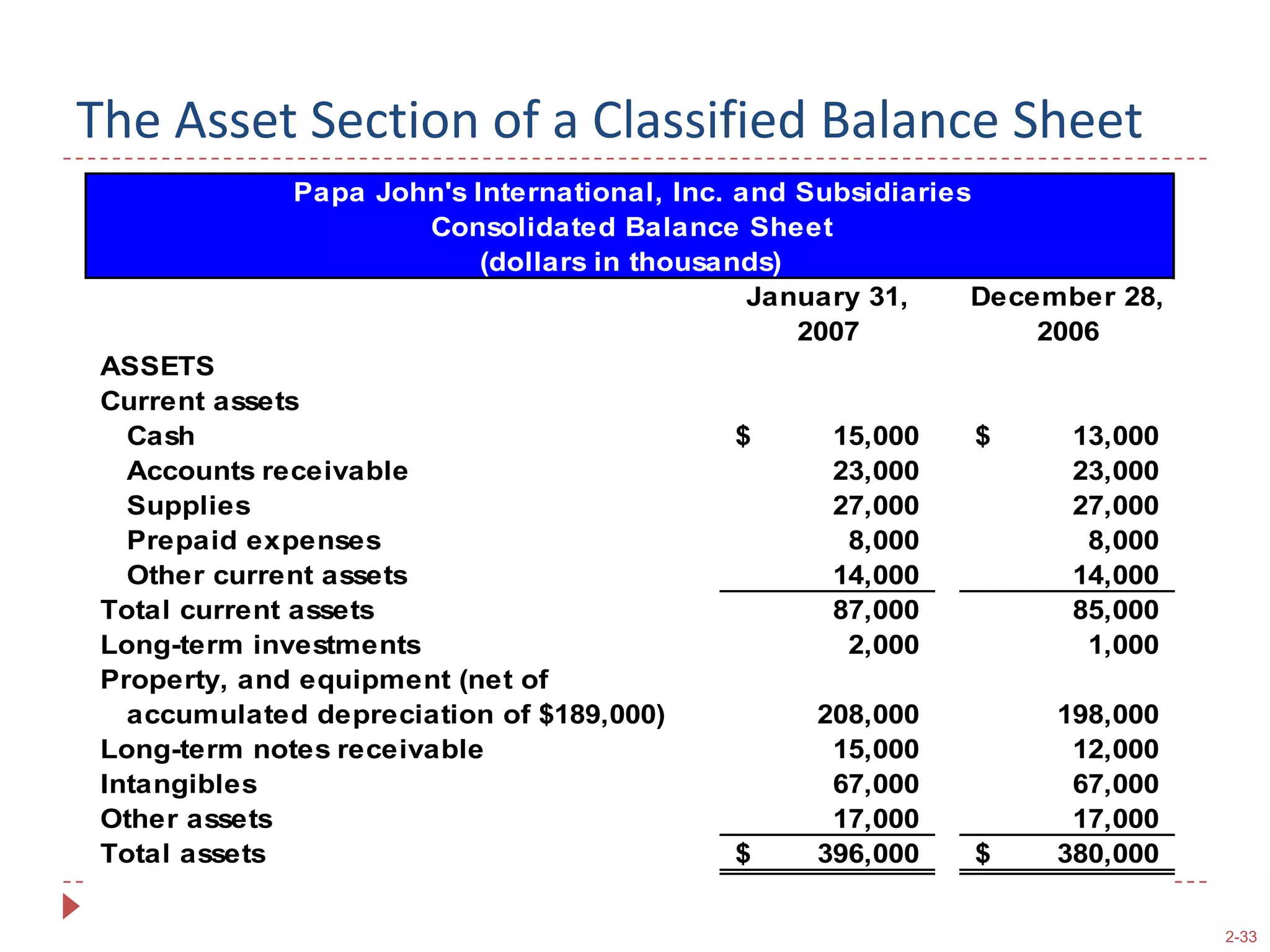
The Asset Section of a Classified Balance Sheet
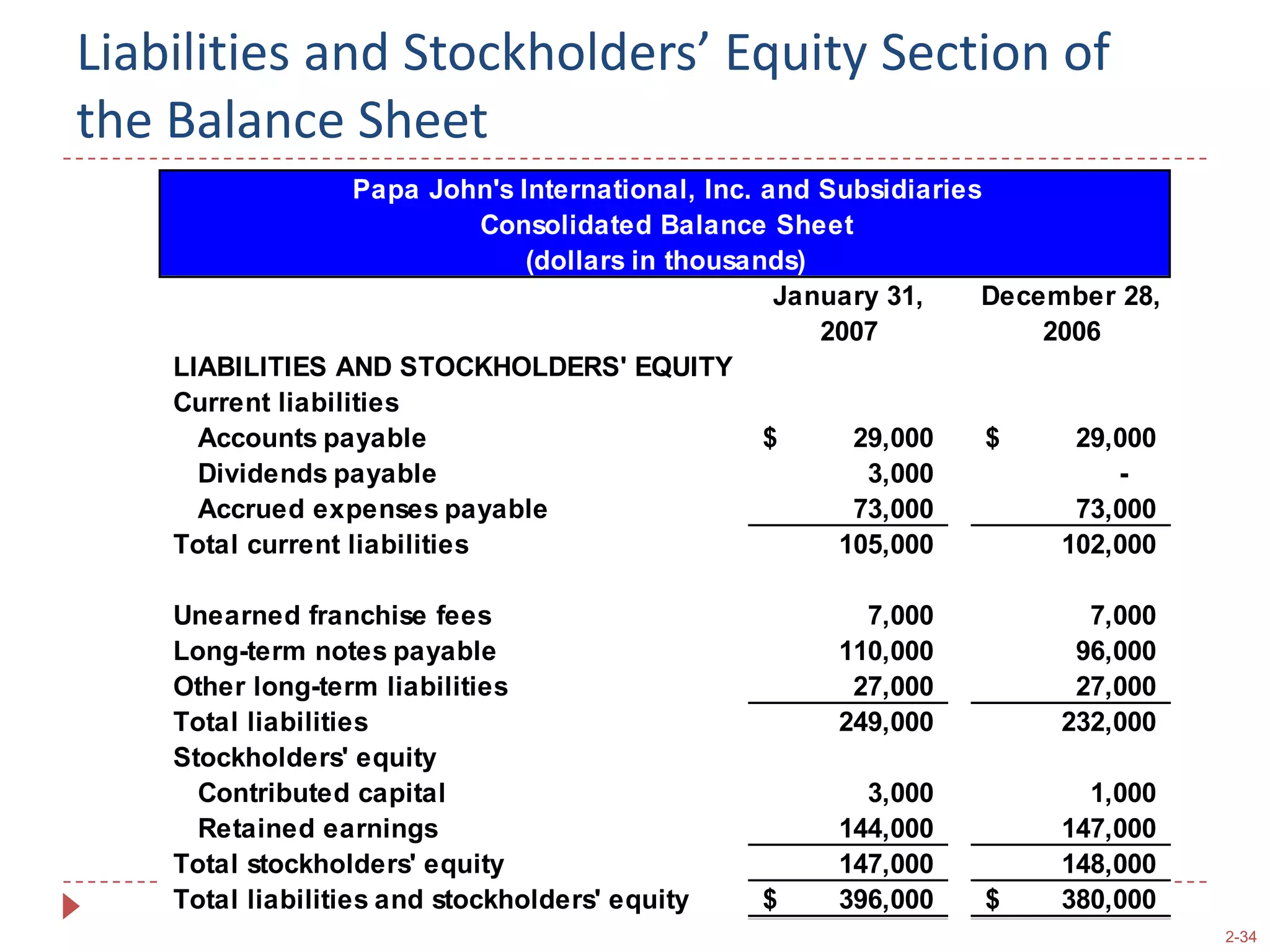
Liabilities and Stockholders’ Equity Section of the Balance Sheet
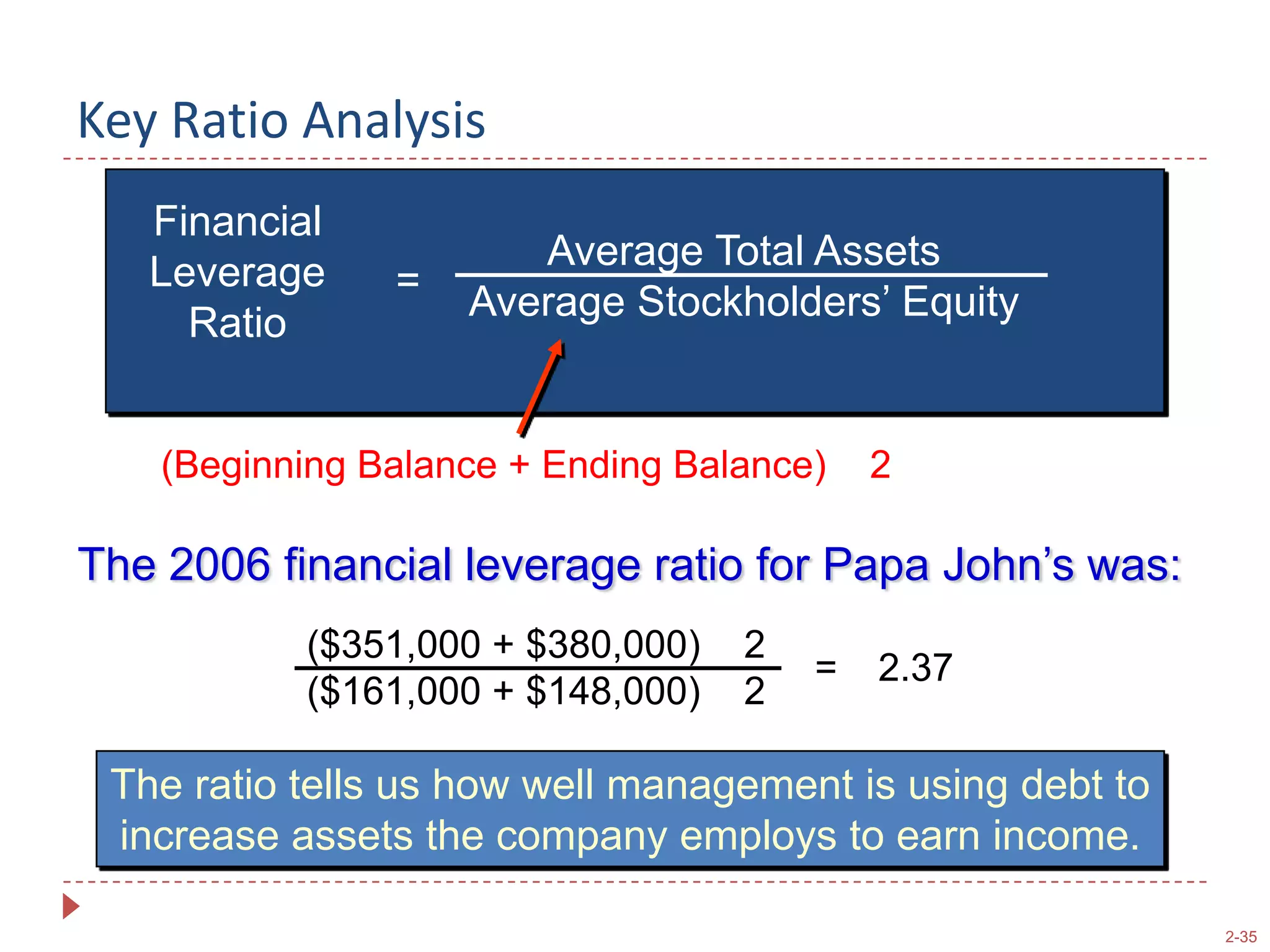
Key Ratio AnalysisFinancialLeverageRatioAverage Total AssetsAverage Stockholders’ Equity=The 2006 financial leverage ratio for Papa John’s was:($351,000 + $380,000) ÷ 2($161,000 + $148,000) ÷ 2=2.37The ratio tells us how well management is using debt toincrease assets the company employs to earn income.(Beginning Balance + Ending Balance) ÷ 2
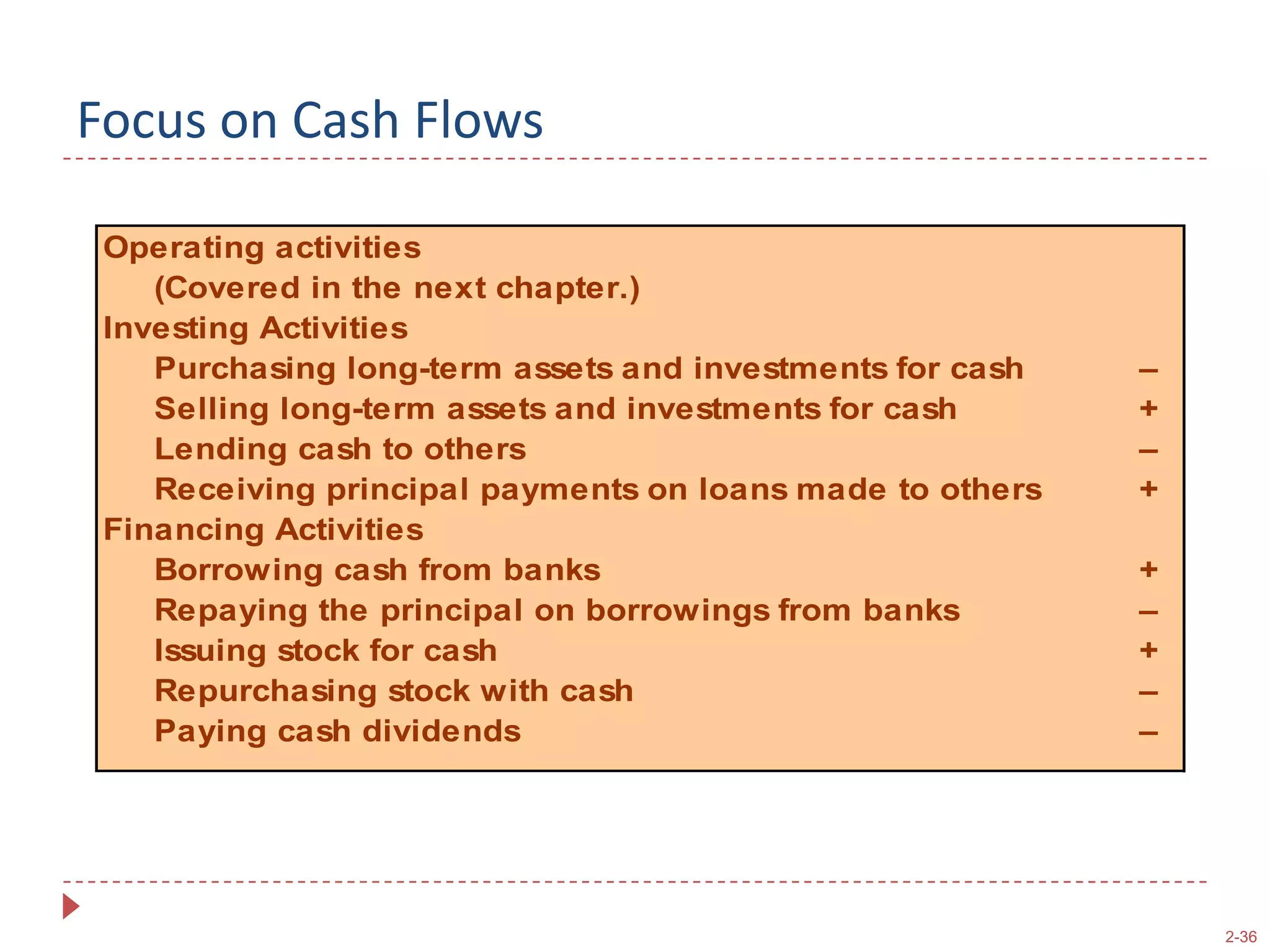
Focus on Cash Flows
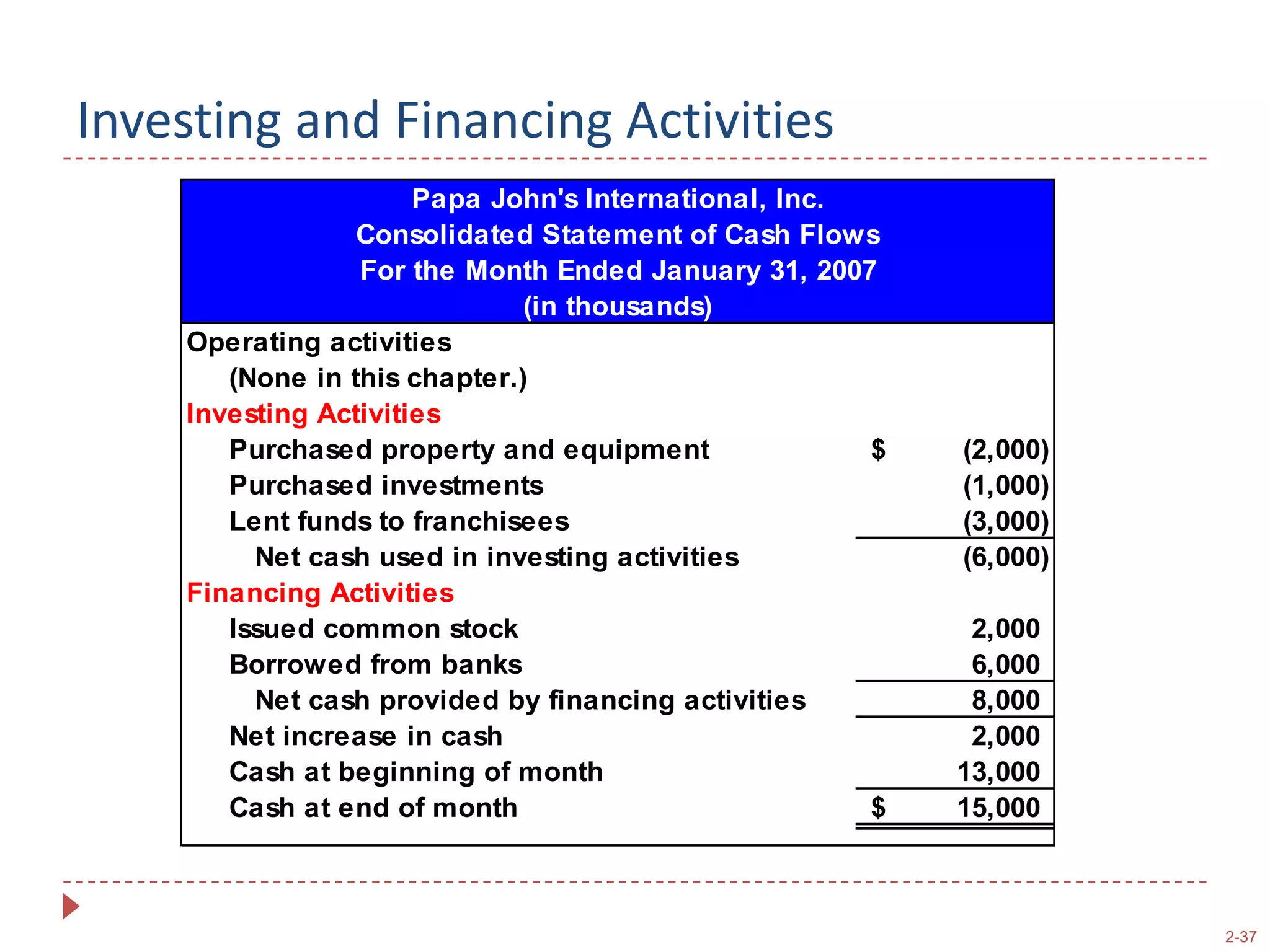
Investing and Financing Activities

Power pointchapter2

  • 1.
    Investing and FinancingDecisions and the Balance SheetChapter 2McGraw-Hill/Irwin© 2009 The McGraw-Hill Companies, Inc.
  • 2.
    Understanding the BusinessTounderstand amounts appearingon a company’s balance sheet weneed to answer these questions:What businessactivities causechanges inthe balancesheet?How dospecificactivitiesaffect eachbalance?How do companieskeep track ofbalance sheetamounts?
  • 3.
    The Conceptual FrameworkElementsof StatementsAssetLiabilityStockholders’ EquityRevenueExpenseGainLossQualitative CharacteristicsRelevancyReliabilityComparabilityConsistencyObjective of Financial ReportingTo provide useful economic information to external users for decision making and for assessing future cash flows.
  • 4.
    The Conceptual FrameworkObjectiveof Financial ReportingTo provide useful economic information to external users for decision making and for assessing future cash flows.Primary CharacteristicsRelevancy: predictive value, feedback value, and timeliness.Reliability: verifiability, representational faithfulness, and neutrality. Secondary CharacteristicsComparability: across companies.Consistency: over time.Qualitative CharacteristicsRelevancyReliabilityComparabilityConsistencyElements of StatementsAssetLiabilityStockholders’ EquityRevenueExpenseGainLoss
  • 5.
    The Conceptual FrameworkAsset:economic resource with probable future benefits.Liability: probable future sacrifices of economic resources.Stockholders’ Equity: financing provided by owners and operations.Revenue: increase in assets or settlement of liabilities from ongoing operations.Expense: decrease in assets or increase in liabilities from ongoing operations.Gain: increase in assets or settlement of liabilities from peripheral activities.Loss: decrease in assets or increase in liabilities from peripheral activities.Objective of Financial ReportingTo provide useful economic information to external users for decision making and for assessing future cash flows.Elements of StatementsAssetLiabilityStockholders’ EquityRevenueExpenseGainLossQualitative CharacteristicsRelevancyReliabilityComparableConsistent
  • 6.
    The Conceptual FrameworkAssumptionsSeparateentity: Activities of the business are separate from activities of owners.Continuity: The entity will not go out of business in the near future.Unit-of-measure: Accounting measurements will be in the national monetary unit (i.e., $ in the U.S.).PrincipleHistorical cost: Cash equivalent cost given up is the basis for the initial recording of elements.
  • 7.
    Nature of BusinessTransactionsExternal events: exchanges of assetsand liabilities between the businessand one or more other parties.Borrow cashfrom the bank
  • 8.
    Nature of BusinessTransactionsInternal events: not an exchange betweenthe business and other parties, but havea direct effect on the accounting entity.Loss due to fire damage.
  • 9.
    AccountsCashInventoryNotes PayableEquipmentAn organizedformat used by companies to accumulate the dollar effects of transactions.

  • 10.
    Typical Account TitlesTheBalance SheetAssetsCashShort-Term InvestmentAccounts ReceivableNotes ReceivableInventory (to be sold)SuppliesPrepaid ExpensesLong-Term InvestmentsEquipmentBuildingsLandIntangiblesLiabilitiesAccounts PayableAccrued ExpensesNotes PayableTaxes PayableUnearned Revenue Bonds PayableStockholders’ EquityContributed CapitalRetained Earnings
  • 11.
    Typical Account TitlesTheIncome StatementRevenuesSales RevenueFee RevenueInterest RevenueRent RevenueExpensesCost of Goods SoldWages ExpenseRent ExpenseInterest ExpenseDepreciation ExpenseAdvertising ExpenseInsurance ExpenseRepair ExpenseIncome Tax Expense
  • 12.
    Principles ofTransaction AnalysisEvery transaction affects at least twoaccounts (duality of effects).
  • 13.
    The accounting equationmust remain in balance after each transaction.A = L + SE(Assets)(Liabilities)(Stockholders’Equity)
  • 14.
    Duality of Effects Most transactions with external parties involve an exchange where the business entity gives up something but receivessomething in return.
  • 15.
    Balancing the AccountingEquationStep 1: Accounts and effectsIdentify the accounts affected and classify them by type of account (A, L, SE).
  • 16.
    Determine the directionof the effect (increase or decrease) on each account.Step 2: BalancingVerify that the accounting equation (A = L + SE) remains in balance. Identify & Classify the Accounts1. Cash (asset).2. Contributed Capital (equity).Determine the Direction of the Effect1. Cash increases.2. Contributed Capital increases.Papa John’s issues $2,000 of additional common stock to new investors for cash.Analyzing Transactions
  • 17.
    A= L + SEAnalyzing TransactionsPapa John’s issues $2,000 of additional common stock to new investors for cash.
  • 18.
    Identify & Classifythe Accounts1. Cash (asset).2. Notes Payable (liability).Determine the Direction of the Effect1. Cash increases.2. Notes Payable increases. The company borrows $6,000 from the local bank, signing a three-year note.Analyzing Transactions
  • 19.
    A= L + SEAnalyzing Transactions The company borrows $6,000 from the local bank, signing a three-year note.
  • 20.
    Identify & Classifythe Accounts1. Equipment (asset).2. Cash (asset).3. Notes Payable (liability).Determine the Direction of the Effect1. Equipment increases.2. Cash decreases.3. Notes Payable increases. Papa John’s purchases $10,000 of new equipment, paying $2,000 in cash and signing a two-year note payablefor the rest.Analyzing Transactions
  • 21.
    A = L + SEAnalyzing Transactions Papa John’s purchases $10,000 of new equipment, paying $2,000 in cash and signing a two-year note payablefor the rest.
  • 22.
    Analyzing TransactionsPapa John’sboard of directors declares andpays $3,000 in dividends to shareholders.Identify & Classify the AccountsIdentify & Classify the Accounts1. Cash (asset).2. Retained Earnings (equity).Determine the Direction of the EffectDetermine the Direction of the Effect1. Cash decreases.2. Retained Earnings decreases.
  • 23.
    Papa John’s boardof directors declares andpays $3,000 in dividends to shareholders.A = L + SEAnalyzing Transactions
  • 24.
    The Accounting CycleCloserevenues,gains,expenses and lossesto retained earnings.Preparea completeset of financial statements.Disseminatestatementsto users.End of the period:Adjustrevenues and expensesand related balance sheet accounts.During the period:Analyzetransactions.Record journal entries in the general journal.Post amounts to the general ledger.
  • 25.
    How Do CompaniesKeep Track of Account Balances?T-accountsJournal entries
  • 26.
    Direction of TransactionEffects The left side of the T-account is always the debit side. The rightside of the T-account is always the credit side.Account NameRightLeftDebitCredit
  • 27.
    Transaction Analysis ModelASSETSEQUITIESLIABILITIESDebit for IncreaseCredit for DecreaseDebit for DecreaseCredit for IncreaseDebit for DecreaseCredit for IncreaseDebits and credits affect the Balance Sheet Model as follows:A = L + SE
  • 28.
    ASSETSEQUITIESLIABILITIESDebit forIncreaseCredit for DecreaseDebit for DecreaseCredit for IncreaseDebit for DecreaseCredit for IncreaseRemember that Stockholders’ Equity includes Contributed Capital and Retained Earnings.A = L + SEThe Debit-Credit Framework
  • 29.
    Analytical Tool: TheJournal EntryA journal entry might look like this:Account Titles:Debited accounts on top.Credited accounts on bottom.Reference:Letter, number, or date.Amounts:Debited amounts on left.Credited amounts on right.
  • 30.
    After journal entries are prepared, the accountant posts (transfers) the dollar amounts to each account affected by the transaction.LedgerPostThe T-Account
  • 31.
    (a)Papa John’s issues$2,000 of additional common stock to new investors for cash.
  • 32.
    The company borrows$6,000 from the local bank, signing a three-year note.
  • 33.
    Balance Sheet PreparationIt is possible to prepare a balance sheet at any point in time from the balances in the accounts.Balance Sheet
  • 34.
    The Asset Sectionof a Classified Balance Sheet
  • 35.
    Liabilities and Stockholders’Equity Section of the Balance Sheet
  • 36.
    Key Ratio AnalysisFinancialLeverageRatioAverageTotal AssetsAverage Stockholders’ Equity=The 2006 financial leverage ratio for Papa John’s was:($351,000 + $380,000) ÷ 2($161,000 + $148,000) ÷ 2=2.37The ratio tells us how well management is using debt toincrease assets the company employs to earn income.(Beginning Balance + Ending Balance) ÷ 2
  • 37.
  • 38.
  • 39.

Editor's Notes

  • #2 Chapter 2: Investing and Financing Decisions and the Balance Sheet.
  • #39 End of chapter 2.