BIDMAS 
How to read equations
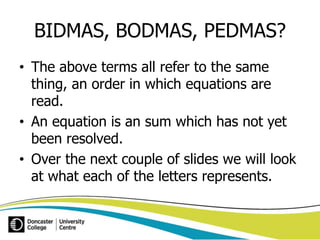
BIDMAS, BODMAS, PEDMAS? 
• The above terms all refer to the same 
thing, an order in which equations are 
read. 
• An equation is an sum which has not yet 
been resolved. 
• Over the next couple of slides we will look 
at what each of the letters represents.
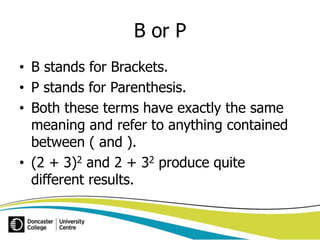
B or P 
• B stands for Brackets. 
• P stands for Parenthesis. 
• Both these terms have exactly the same 
meaning and refer to anything contained 
between ( and ). 
• (2 + 3)2 and 2 + 32 produce quite 
different results.
Powers (I, O or E) 
• I stands for Indices. 
• O stands for Orders. 
• E stands for Exponents. 
• Given the title you could use P as well but 
again, these all refer to the same type of 
calculation. 
• 2 x 62 using this method would equal 72
D and M 
• Quite simply this refers to Division and 
Multiplication. 
• Division doesn’t take precedence over 
Multiplication and the order of the letters 
is for pronunciation of the acronym. 
• To avoid confusion division can be thought 
of as simply being the multiplication of a 
fraction.
A and S 
• Here we have the initials of Addition and 
Subtraction. 
• Addition does not take precedence over 
Subtraction, both are of equal precedent and 
as with multiplication and division should be 
calculated from left to right. 
• To try and avoid confusion subtraction could 
be thought of as the addition of negative 
numbers.
So… ? 
• Choose the term that feels right for you to 
help you remember the appropriate order 
of operators. 
• Some people choose the term that they 
can remember the most easily, some 
prefer to remember a term that relates to 
the operator names they prefer. 
• All the Acronyms are equally valid.
Acronyms 
• BODMAS – Generally used in the UK and derived 
from the original acronym used before powers 
were introduced. 
• BIDMAS – Another acronym used commonly in the 
UK and US. 
• PEDMAS – This is the preferred Canadian 
acronym. 
• PEMA – The New Zealand acronym where division 
is thought of as a type of multiplication and 
subtraction as a type of addition.
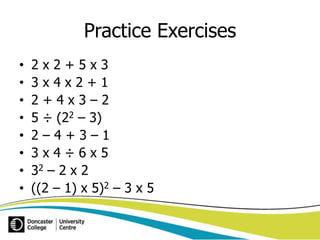
Practice Exercises 
• 2 x 2 + 5 x 3 
• 3 x 4 x 2 + 1 
• 2 + 4 x 3 – 2 
• 5 ÷ (22 – 3) 
• 2 – 4 + 3 – 1 
• 3 x 4 ÷ 6 x 5 
• 32 – 2 x 2 
• ((2 – 1) x 5)2 – 3 x 5
Practice Exercises 
• 2 x 2 + 5 x 3 
• 3 x 4 x 2 + 1 
• 2 + 4 x 3 – 2 
• 5 ÷ (22 – 3) 
• 2 – 4 + 3 – 1 
• 3 x 4 ÷ 6 x 5 
• 32 – 2 x 2 
• ((2 – 1) x 5)2 – 3 x 5 
• 19 
• 25 
• 12 
• 5 
• 0 
• 10 
• 5 
• 10
Practice Exercises 
• Insert the brackets to correct the equation: 
• 2 + 3 x 4 = 20 
• 12 ÷ 7 – 1 = 2 
• 2 + 12 = 9 
• 12 – 3 x 22 = 36 
• 25 ÷ 5 – 4 – 3 = 4 
• 17 – 2 ÷ 5 = 3
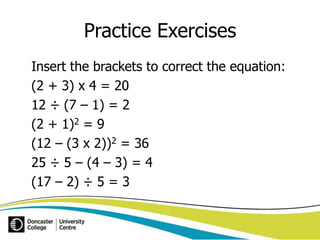
Practice Exercises 
Insert the brackets to correct the equation: 
(2 + 3) x 4 = 20 
12 ÷ (7 – 1) = 2 
(2 + 1)2 = 9 
(12 – (3 x 2))2 = 36 
25 ÷ 5 – (4 – 3) = 4 
(17 – 2) ÷ 5 = 3
So what is the order? 
• B or P? 
• Brackets or Parenthesis 
• O, I, E or P? 
• Orders, Indices, Exponents or Powers 
• D and M or M? 
• Division and Multiplication or Multiplication 
• A and S or A? 
• Addition and Subtraction or Addition

Bidmas

  • 1.
    BIDMAS How toread equations
  • 2.
    BIDMAS, BODMAS, PEDMAS? • The above terms all refer to the same thing, an order in which equations are read. • An equation is an sum which has not yet been resolved. • Over the next couple of slides we will look at what each of the letters represents.
  • 3.
    B or P • B stands for Brackets. • P stands for Parenthesis. • Both these terms have exactly the same meaning and refer to anything contained between ( and ). • (2 + 3)2 and 2 + 32 produce quite different results.
  • 4.
    Powers (I, Oor E) • I stands for Indices. • O stands for Orders. • E stands for Exponents. • Given the title you could use P as well but again, these all refer to the same type of calculation. • 2 x 62 using this method would equal 72
  • 5.
    D and M • Quite simply this refers to Division and Multiplication. • Division doesn’t take precedence over Multiplication and the order of the letters is for pronunciation of the acronym. • To avoid confusion division can be thought of as simply being the multiplication of a fraction.
  • 6.
    A and S • Here we have the initials of Addition and Subtraction. • Addition does not take precedence over Subtraction, both are of equal precedent and as with multiplication and division should be calculated from left to right. • To try and avoid confusion subtraction could be thought of as the addition of negative numbers.
  • 7.
    So… ? •Choose the term that feels right for you to help you remember the appropriate order of operators. • Some people choose the term that they can remember the most easily, some prefer to remember a term that relates to the operator names they prefer. • All the Acronyms are equally valid.
  • 8.
    Acronyms • BODMAS– Generally used in the UK and derived from the original acronym used before powers were introduced. • BIDMAS – Another acronym used commonly in the UK and US. • PEDMAS – This is the preferred Canadian acronym. • PEMA – The New Zealand acronym where division is thought of as a type of multiplication and subtraction as a type of addition.
  • 9.
    Practice Exercises •2 x 2 + 5 x 3 • 3 x 4 x 2 + 1 • 2 + 4 x 3 – 2 • 5 ÷ (22 – 3) • 2 – 4 + 3 – 1 • 3 x 4 ÷ 6 x 5 • 32 – 2 x 2 • ((2 – 1) x 5)2 – 3 x 5
  • 10.
    Practice Exercises •2 x 2 + 5 x 3 • 3 x 4 x 2 + 1 • 2 + 4 x 3 – 2 • 5 ÷ (22 – 3) • 2 – 4 + 3 – 1 • 3 x 4 ÷ 6 x 5 • 32 – 2 x 2 • ((2 – 1) x 5)2 – 3 x 5 • 19 • 25 • 12 • 5 • 0 • 10 • 5 • 10
  • 11.
    Practice Exercises •Insert the brackets to correct the equation: • 2 + 3 x 4 = 20 • 12 ÷ 7 – 1 = 2 • 2 + 12 = 9 • 12 – 3 x 22 = 36 • 25 ÷ 5 – 4 – 3 = 4 • 17 – 2 ÷ 5 = 3
  • 12.
    Practice Exercises Insertthe brackets to correct the equation: (2 + 3) x 4 = 20 12 ÷ (7 – 1) = 2 (2 + 1)2 = 9 (12 – (3 x 2))2 = 36 25 ÷ 5 – (4 – 3) = 4 (17 – 2) ÷ 5 = 3
  • 13.
    So what isthe order? • B or P? • Brackets or Parenthesis • O, I, E or P? • Orders, Indices, Exponents or Powers • D and M or M? • Division and Multiplication or Multiplication • A and S or A? • Addition and Subtraction or Addition