On a chip
 board
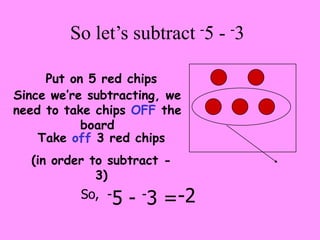
So let’s subtract        -5   -   -3


     Put on 5 red chips
Since we’re subtracting, we
need to take chips OFF the
           board
    Take off 3 red chips
  (in order to subtract -
             3)
          So, -5   -   -3   =-2
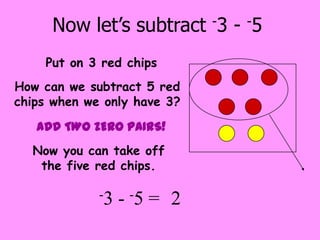
Now let’s subtract -3 - -5
    Put on 3 red chips
How can we subtract 5 red
chips when we only have 3?

   ADD TWO ZERO PAIRS!
  Now you can take off
   the five red chips.

             -3   -   -5   = 2
Remember, one positive
and one negative make a
     ZERO PAIR
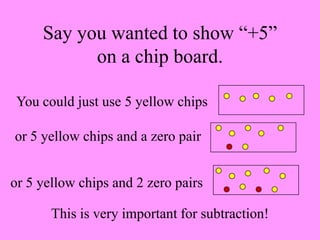
Say you wanted to show “+5”
           on a chip board.

 You could just use 5 yellow chips

or 5 yellow chips and a zero pair


or 5 yellow chips and 2 zero pairs

       This is very important for subtraction!
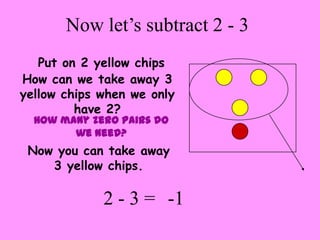
Now let’s subtract 2 - 3
   Put on 2 yellow chips
How can we take away 3
yellow chips when we only
         have 2?
  How many zero pairs do
        we need?
 Now you can take away
    3 yellow chips.

             2 - 3 = -1
Try subtracting -4 - -6
  What should we do
       first?
Do we have enough to
    subtract -6?
  No, so how many zero
pairs do we need to add?
Now, what do we take
       away?

           -4   -   -6   = 2
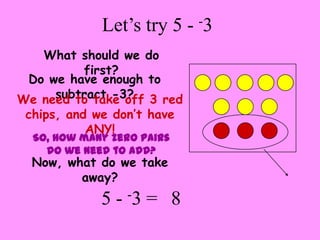
Let’s try 5 - -3
   What should we do
         first?
 Do we have enough to
     subtract -3?
We need to take off 3 red
 chips, and we don’t have
           ANY!
  So, how many zero pairs
    do we need to add?
  Now, what do we take
         away?
            5-  -3 = 8
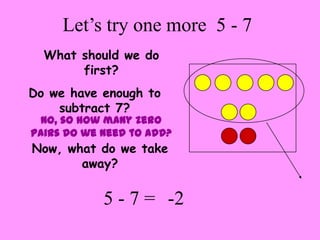
Let’s try one more 5 - 7
  What should we do
       first?
Do we have enough to
    subtract 7?
  No, so how many zero
pairs do we need to add?
Now, what do we take
       away?

            5 - 7 = -2
1. Solve 5 – 3
Explain in words:


2. Solve -5 – (-3)
Explain in words:
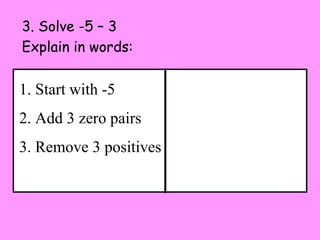
3. Solve -5 – 3
Explain in words:


1. Start with -5
2. Add 3 zero pairs
3. Remove 3 positives
4. Solve 5 – (-3)
Explain in words:


5. Solve -4 – (-7)
Explain in words:
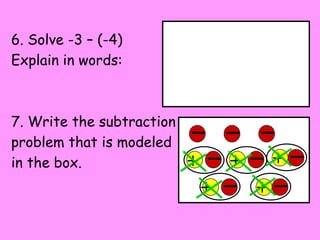
6. Solve -3 – (-4)
Explain in words:


7. Write the subtraction
problem that is modeled
in the box.                +       +       +
                               +       +
1. What does it mean to add a “zero pair”?


2. Does adding a “zero pair” change the
   difference?
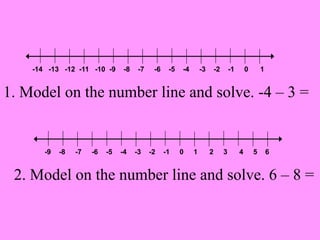
-14 -13 -12 -11 -10 -9       -8    -7    -6    -5   -4       -3       -2       -1       0       1


1. Model on the number line and solve. -4 – 3 =


       -9   -8   -7   -6   -5   -4    -3    -2    -1    0    1        2        3        4       5       6


 2. Model on the number line and solve. 6 – 8 =
Rules for adding integers:
• Same signs – ADD and keep the sign.

• Different signs – SUBTRACT and
  take the sign from the number that
  “has more” (or is bigger in absolute
  value.
Rules for subtracting integers:

SUBTRACTION IS ICKY! So:
1. Keep the first number the same.
2. Change the subtraction sign to addition.
3. Make the second number its opposite.
4. Use the addition rules.
     Keep it! Change it! Opposite it!

Subtracting Integers

  • 1.
  • 2.
    So let’s subtract -5 - -3 Put on 5 red chips Since we’re subtracting, we need to take chips OFF the board Take off 3 red chips (in order to subtract - 3) So, -5 - -3 =-2
  • 3.
    Now let’s subtract-3 - -5 Put on 3 red chips How can we subtract 5 red chips when we only have 3? ADD TWO ZERO PAIRS! Now you can take off the five red chips. -3 - -5 = 2
  • 4.
    Remember, one positive andone negative make a ZERO PAIR
  • 5.
    Say you wantedto show “+5” on a chip board. You could just use 5 yellow chips or 5 yellow chips and a zero pair or 5 yellow chips and 2 zero pairs This is very important for subtraction!
  • 6.
    Now let’s subtract2 - 3 Put on 2 yellow chips How can we take away 3 yellow chips when we only have 2? How many zero pairs do we need? Now you can take away 3 yellow chips. 2 - 3 = -1
  • 7.
    Try subtracting -4- -6 What should we do first? Do we have enough to subtract -6? No, so how many zero pairs do we need to add? Now, what do we take away? -4 - -6 = 2
  • 8.
    Let’s try 5- -3 What should we do first? Do we have enough to subtract -3? We need to take off 3 red chips, and we don’t have ANY! So, how many zero pairs do we need to add? Now, what do we take away? 5- -3 = 8
  • 9.
    Let’s try onemore 5 - 7 What should we do first? Do we have enough to subtract 7? No, so how many zero pairs do we need to add? Now, what do we take away? 5 - 7 = -2
  • 10.
    1. Solve 5– 3 Explain in words: 2. Solve -5 – (-3) Explain in words:
  • 11.
    3. Solve -5– 3 Explain in words: 1. Start with -5 2. Add 3 zero pairs 3. Remove 3 positives
  • 12.
    4. Solve 5– (-3) Explain in words: 5. Solve -4 – (-7) Explain in words:
  • 13.
    6. Solve -3– (-4) Explain in words: 7. Write the subtraction problem that is modeled in the box. + + + + +
  • 14.
    1. What doesit mean to add a “zero pair”? 2. Does adding a “zero pair” change the difference?
  • 15.
    -14 -13 -12-11 -10 -9 -8 -7 -6 -5 -4 -3 -2 -1 0 1 1. Model on the number line and solve. -4 – 3 = -9 -8 -7 -6 -5 -4 -3 -2 -1 0 1 2 3 4 5 6 2. Model on the number line and solve. 6 – 8 =
  • 16.
    Rules for addingintegers: • Same signs – ADD and keep the sign. • Different signs – SUBTRACT and take the sign from the number that “has more” (or is bigger in absolute value.
  • 17.
    Rules for subtractingintegers: SUBTRACTION IS ICKY! So: 1. Keep the first number the same. 2. Change the subtraction sign to addition. 3. Make the second number its opposite. 4. Use the addition rules. Keep it! Change it! Opposite it!