 Overall plan of rotation of all students
in a particular educational institution,
showing the placement of the students
total programme includes both theory
and practice denoting the study block,
partial block, placement of students in
clinical blocks, team nursing,
examinations, vacation, co- curricular
activities, etc.
It is prepared well in advance for the
whole year so that it gives a complete
and clear picture about students
placement either in theory or field
during an academic session.
For each year, it can be prepared
separately and for total programme
one can be prepared so that every
faculty will be aware of students
placements.
Teacher should follow the Indian
Nursing Council syllabus as a guideline
for preparing a rotation.
DEFINITION:
The master rotation plan is an overall
plan of rotation of all the students in a
particular educational institution
showing the placement of the students
belonging to various groups/ classes in
clinical nursing as well as community
nursing fields denoting the duration of
such placement together with
placement of theoretical teaching
blocks/ periods.
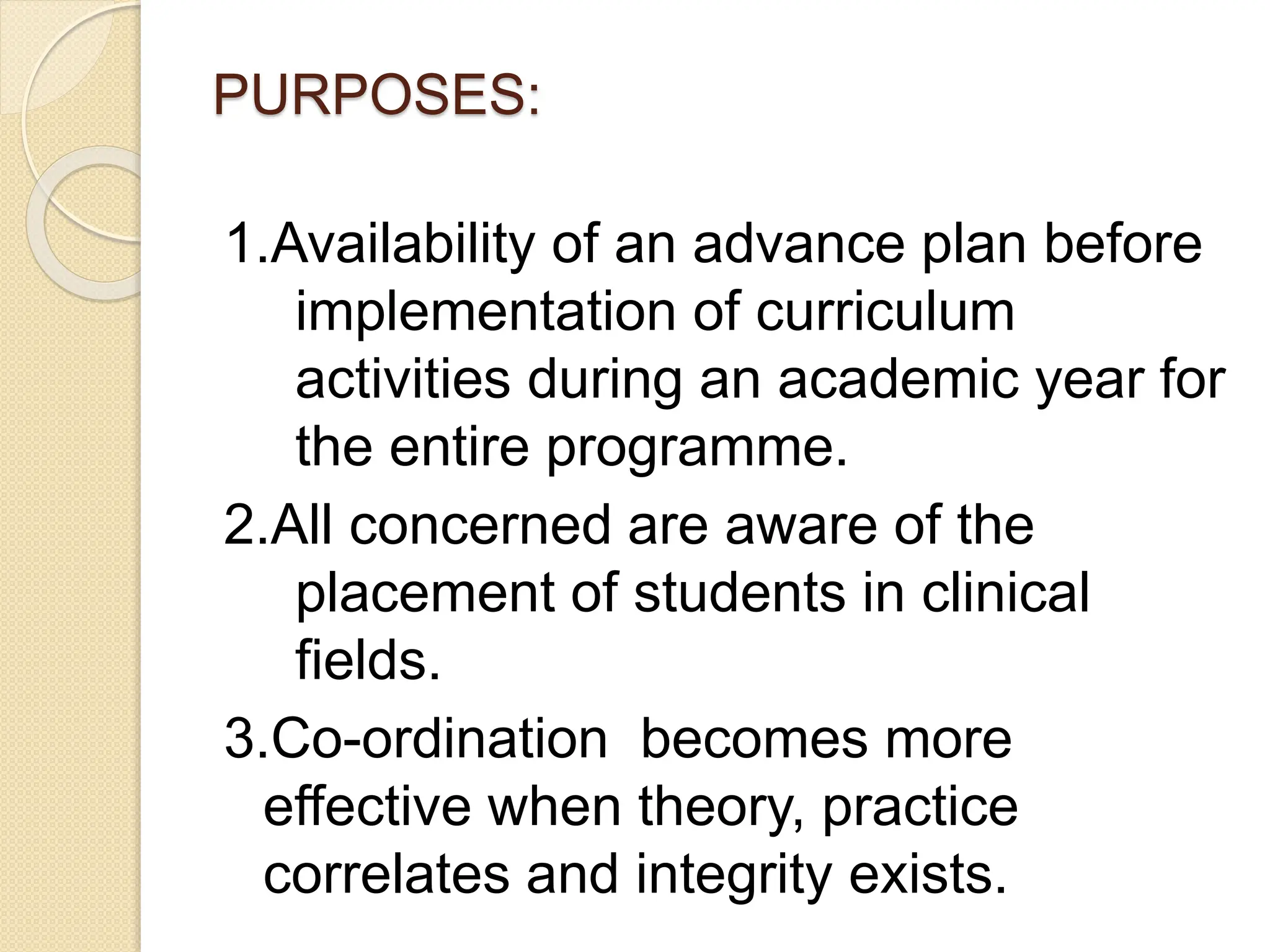
PURPOSES:
1.Availability of an advance plan before
implementation of curriculum
activities during an academic year for
the entire programme.
2.All concerned are aware of the
placement of students in clinical
fields.
3.Co-ordination becomes more
effective when theory, practice
correlates and integrity exists.
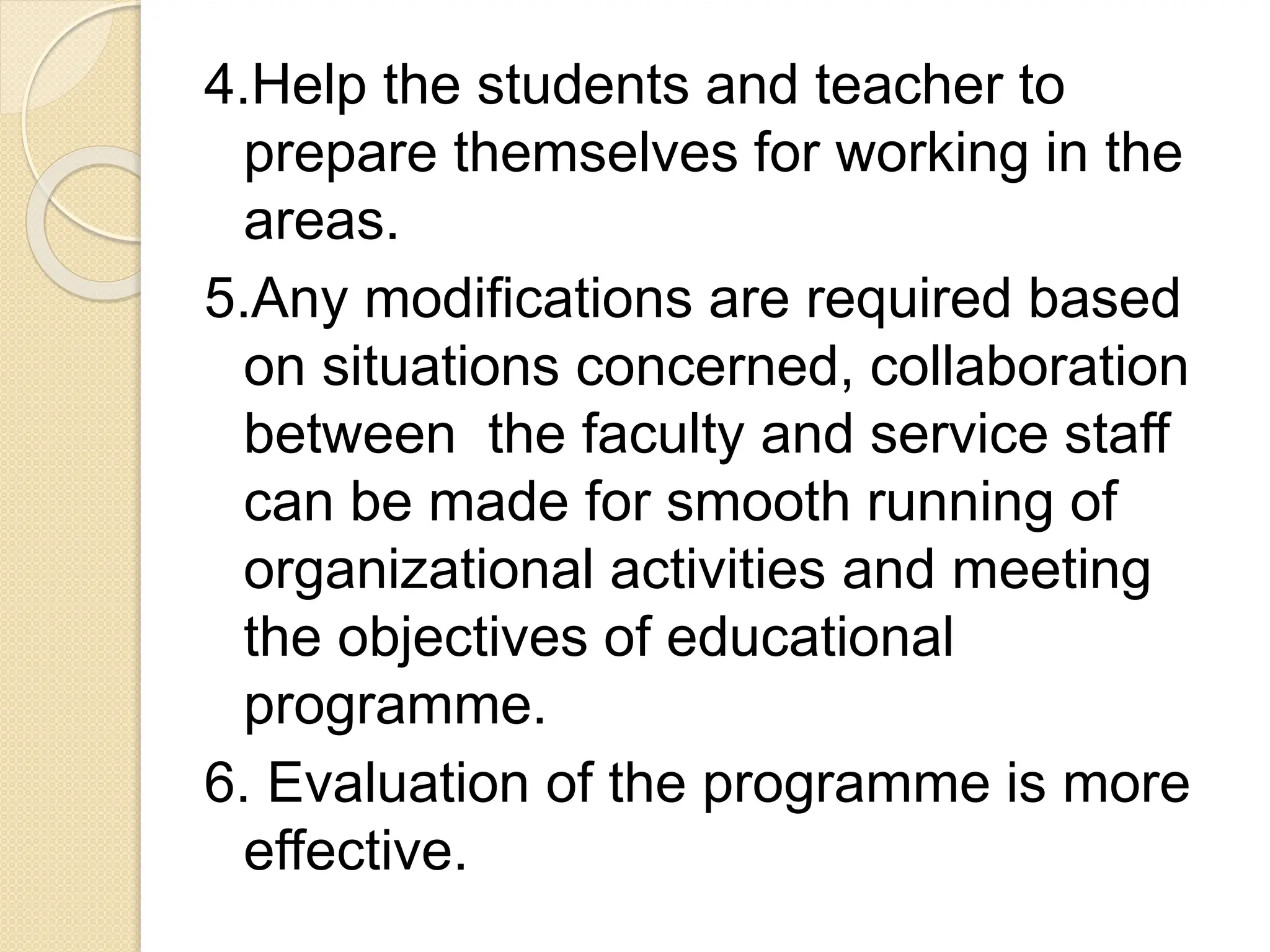
4.Help the students and teacher to
prepare themselves for working in the
areas.
5.Any modifications are required based
on situations concerned, collaboration
between the faculty and service staff
can be made for smooth running of
organizational activities and meeting
the objectives of educational
programme.
6. Evaluation of the programme is more
effective.
7. The faculty members and nursing
service are in a position to make
tentative advance plans for their leave
or vacation without jeoparding the
teaching- learning activities.
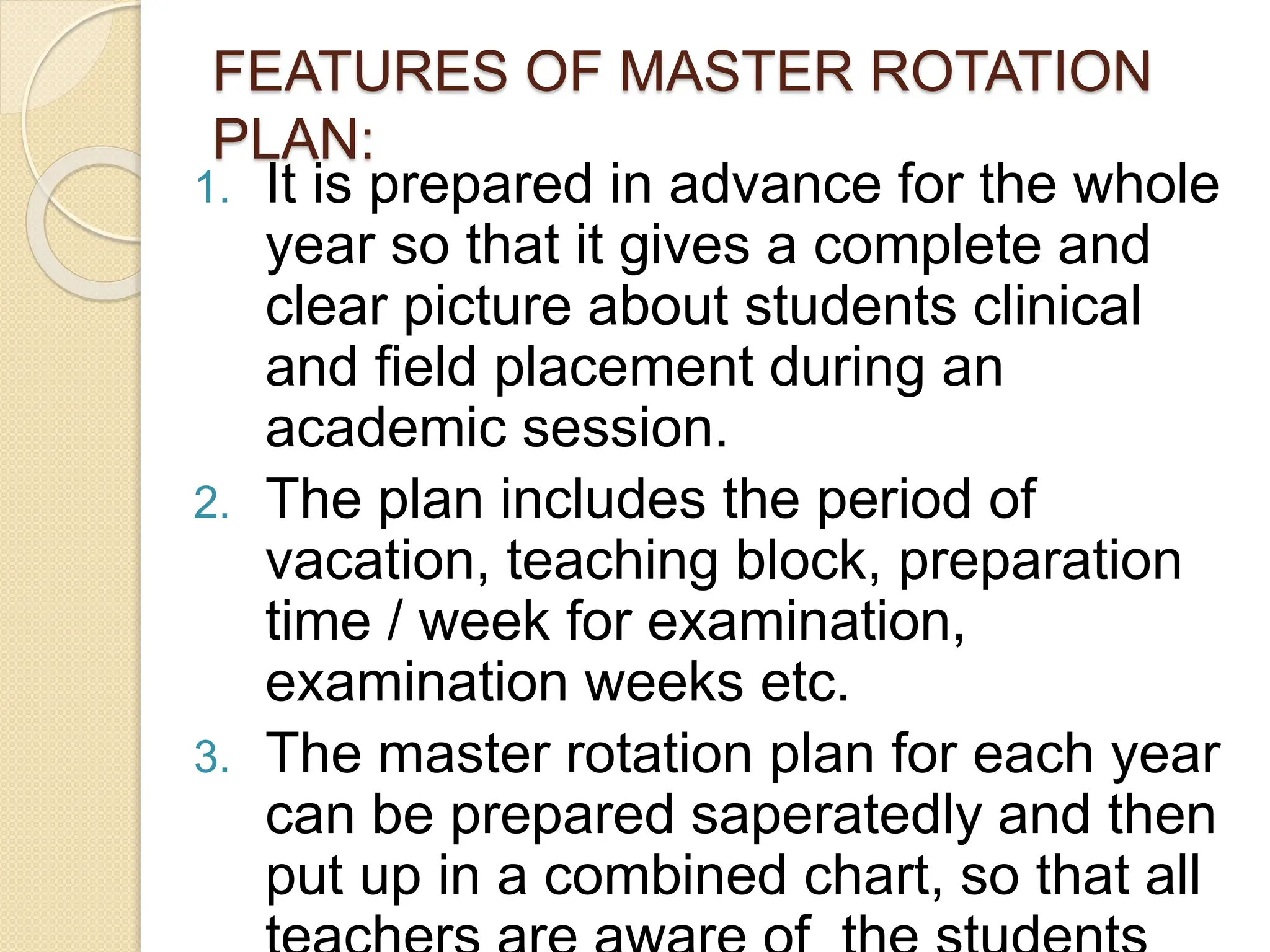
FEATURES OF MASTER ROTATION
PLAN:
1. It is prepared in advance for the whole
year so that it gives a complete and
clear picture about students clinical
and field placement during an
academic session.
2. The plan includes the period of
vacation, teaching block, preparation
time / week for examination,
examination weeks etc.
3. The master rotation plan for each year
can be prepared saperatedly and then
put up in a combined chart, so that all
4. Overlapping in a particular area can be
noted and appropriate action can be
taken through viewing the rotation plan
in a glance of each year.
5. INC syllabus should be taken, a
guideline in preparing a rotation.
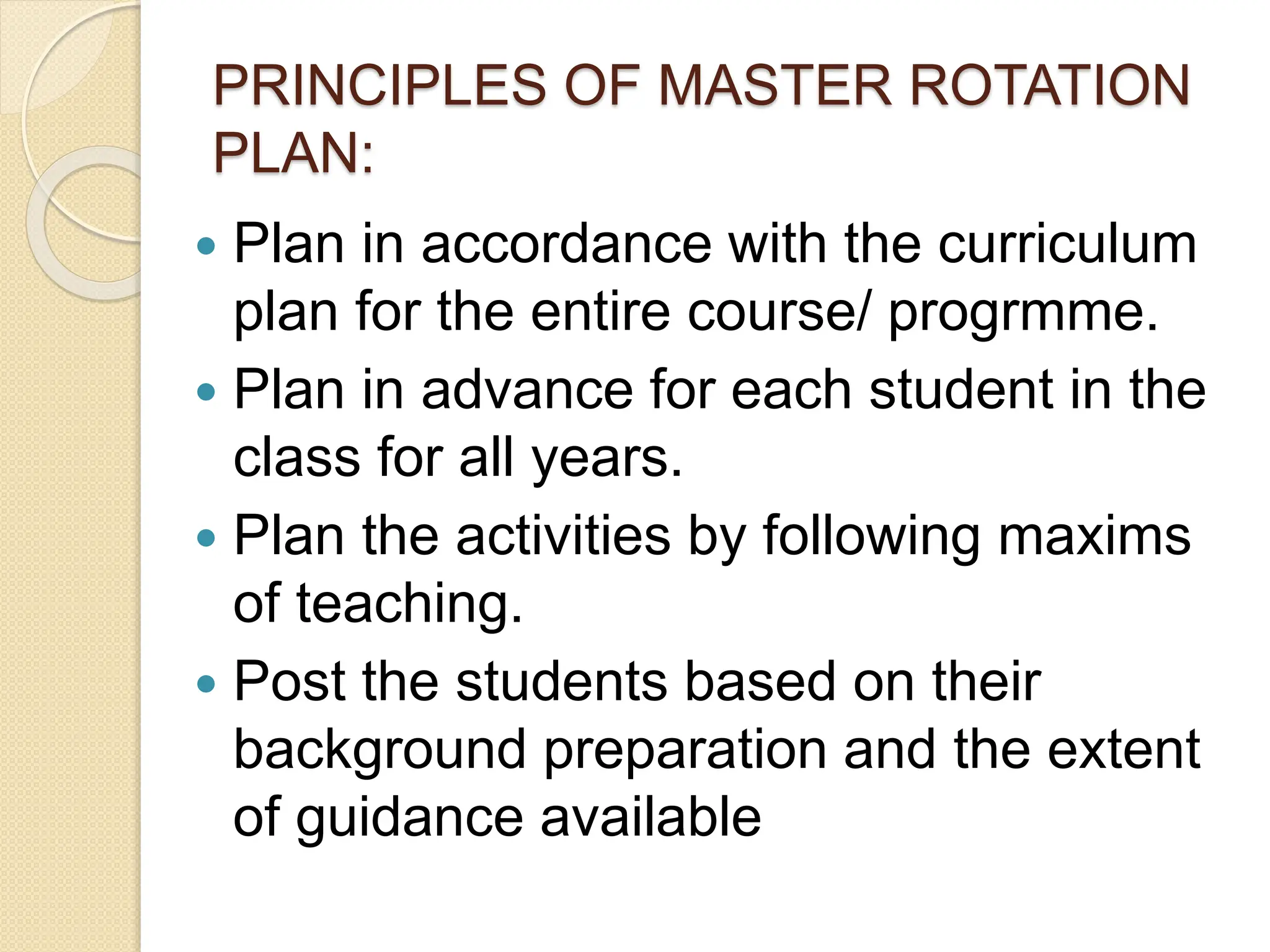
PRINCIPLES OF MASTER ROTATION
PLAN:
 Plan in accordance with the curriculum
plan for the entire course/ progrmme.
 Plan in advance for each student in the
class for all years.
 Plan the activities by following maxims
of teaching.
 Post the students based on their
background preparation and the extent
of guidance available
 Select areas that can provide expected
learning experience.
 Plan to build on previous experiences.
 Acquaint the clinical staff/clinical
supervision with clinical objectives and
rotation plan.
 Provide each clinical experience of
same duration to all the students.
 Rotate each student through each
learning experience or block.
 Plan for all students to enter and leave
at the same time schedule.
Month 1st
AUGUST 2009
Weeks 1 2 3 4 5 6 7 8 9 10 11 12 13 14 15 16 17 18 19 20 21 22 23 24 25 26 27 28 29 30 31 32 33 34 35 36 37 38
1
2
3
4
5
6
7
INDICATORS:
1. Orientation
2. Study Block
3. Specialty Clinical Posting
4. Nursing Research & Statistics Practical
5. Advanced Concept Of Nursing Clinical Posting
6. Mid-Term Exam
7. Nursing Education Practical
8. Pre-Final Exams
9. Study Leave
10. University Exam
SL.
No.
SUBJECT
ALLOTTED HOURS PLANN
Theory Practical Theory
01
Nursing
Education
150 150 160
02
Advance Nursing
Practice
150 200 160
03
Nursing Research
And Statistics
150 100 155
04 Clinical Specialty 150 650 160
Total hours 600 1100 635
CLINICAL ROTATION PLAN
 Clinical rotation plan is developed so
that each student is given the uniform
type of clinical experience.
CONCEPT AND TYPE:
The plan for clinical experience in
general plan of the curriculum shows
that a class in each year is divided into
a number of groups depending upon
the size of the class and accordingly
each group experiences through the
number of clinical areas at regular
succession.
 There can be two to four groups of
students and as many number of clinical
areas to be rotated through.
 Such a plan for clinical experience refers
to clinical rotation plan.
 The clinical rotation plans are of three
types:
a) Master clinical rotation plan:
 The master clinical rotation plan is the
plan which is prepared for all the classes/
groups for all the clinical areas including
community health nursing field for the
Master clinical rotation plan can be
defined as an overall plan of rotation of all
the students in a particular educational
institution showing the placement of the
students belonging to various classes in
groups (10-15 students in a group) in
clinical nursing as well as community
nursing field denoting the duration of such
placement.
 The master clinical plan is prepared in
advance for the whole year so that it gives
a complete and clear picture about
students’ clinical and field placement
during an academic session.
This plan may either be prepared as
separate plan along with theory
teaching blocks/ periods, the period of
vacation, preparation time, examination
period etc.
b) Year/ class wise Rotation plan :
 The rotation plan for each year/class
can be prepared separately .
 All these can be put up in a combined
chart, so that all teachers would be
aware of the students’ placement.
 Overlapping in a particular area, if any,
may be noted and action can be taken
apropriately.
 As mentioned earlier teachers need to
take (INC) syllabus as the guideline for
preparing rotation plan.
3.Internal rotation plan :
 In each clinical area, the various
specific experiences are identified and
students in each block of respective
clinical area get divided into subgroups
accordingly and rotate through each
identified experience. This rotation plan
refers to internal rotation plan.
K.L.E UNIVERSITY’S INSTITUTE OF NURSING SCIENCES, BELGAUM
COMMUNITY HEALTH NURSING
CLINICAL ROTATION PLAN FOR I -MSc (N) 2009-10.
KEY
GROUP I-ROLL NO-1
GROUP II-ROLL NO-2
SURVEY- SUB-CENTER
PHC DISTRICT FAMILY WELFARE
CHC BUREAU
URBAN CENTERS FIELD VISITS
GROUP 05 Oct to
19 Oct
20 Oct to
18 Nov
19 Nov to
18 Dec
05 Jan to
05 Feb
06 Feb to
06 Mar
07 Mar to
07 Apr
08 Apr to
08 May
I
II
Factors to be considered in preparing a
clinical rotation plan :
a) The objective of the course :
The objectives of the course needs to be
clearly stated so that these can be used
as a guideline for planning clinical rotation
for all the classes and for specific block of
clinical experience.
b) Number of students in each class:
Since the students will be posted in different
clinical areas at different time of the year
and the course of study, the placement of
optimal number of students in each of
these area is important.
 The number of students in each class will
determine the number and size of groups
for clinical experiences.
 There are some areas particularly
intensive care unit, coronary care unit
where more than 2 or 3 students cannot
be posted at a given point of time.
c) The number of
departments/agencies/areas where
students should be given opportunity for
giving clinical experience:
1. The size of the department/agency/area
of experience in each area/ hospital used
 e.g, if the labor room selected for
student placement has only four labor
beds then more than 2-3 students
cannot be posted at a time in the said
labor room.
d) The duration of experience in each
area:
 This may vary from 2 weeks to twenty
weeks in a year.
 For example, posting in eye ,E.N.T
ward is generally for two weeks but that
for community health experience is for
twenty weeks or more.
e) Number of persons available for
supervision:
This is particularly important because the
students need to be given supervised and
guided experience to enable them to learn
the right way of performing a nursing
procedure or make the appropriate
nursing interventions for the patients
assigned to their care.
f) Indian Nursing Council requirements:
It has been mentioned earlier that in India
the Indian Nursing Council, a statutory
body constitute in 1949 empowered to
prescribe the curriculum for various
nursing programmes.
CONCLUSION:
 It is essential to evaluate a curriculum
for it helps in knowing whether the set
of objectives have been obtained or
not. It also help in knowing if the
planned curriculum was ideal enough
to prepare a students activities
throughout the year which is displayed
in a graph.
THANK YOU

POWER POINT PRESENTATION ON ROTATION PLAN

  • 1.
     Overall planof rotation of all students in a particular educational institution, showing the placement of the students total programme includes both theory and practice denoting the study block, partial block, placement of students in clinical blocks, team nursing, examinations, vacation, co- curricular activities, etc.
  • 2.
    It is preparedwell in advance for the whole year so that it gives a complete and clear picture about students placement either in theory or field during an academic session. For each year, it can be prepared separately and for total programme one can be prepared so that every faculty will be aware of students placements. Teacher should follow the Indian Nursing Council syllabus as a guideline for preparing a rotation.
  • 3.
    DEFINITION: The master rotationplan is an overall plan of rotation of all the students in a particular educational institution showing the placement of the students belonging to various groups/ classes in clinical nursing as well as community nursing fields denoting the duration of such placement together with placement of theoretical teaching blocks/ periods.
  • 4.
    PURPOSES: 1.Availability of anadvance plan before implementation of curriculum activities during an academic year for the entire programme. 2.All concerned are aware of the placement of students in clinical fields. 3.Co-ordination becomes more effective when theory, practice correlates and integrity exists.
  • 5.
    4.Help the studentsand teacher to prepare themselves for working in the areas. 5.Any modifications are required based on situations concerned, collaboration between the faculty and service staff can be made for smooth running of organizational activities and meeting the objectives of educational programme. 6. Evaluation of the programme is more effective.
  • 6.
    7. The facultymembers and nursing service are in a position to make tentative advance plans for their leave or vacation without jeoparding the teaching- learning activities.
  • 7.
    FEATURES OF MASTERROTATION PLAN: 1. It is prepared in advance for the whole year so that it gives a complete and clear picture about students clinical and field placement during an academic session. 2. The plan includes the period of vacation, teaching block, preparation time / week for examination, examination weeks etc. 3. The master rotation plan for each year can be prepared saperatedly and then put up in a combined chart, so that all
  • 8.
    4. Overlapping ina particular area can be noted and appropriate action can be taken through viewing the rotation plan in a glance of each year. 5. INC syllabus should be taken, a guideline in preparing a rotation.
  • 9.
    PRINCIPLES OF MASTERROTATION PLAN:  Plan in accordance with the curriculum plan for the entire course/ progrmme.  Plan in advance for each student in the class for all years.  Plan the activities by following maxims of teaching.  Post the students based on their background preparation and the extent of guidance available
  • 10.
     Select areasthat can provide expected learning experience.  Plan to build on previous experiences.  Acquaint the clinical staff/clinical supervision with clinical objectives and rotation plan.  Provide each clinical experience of same duration to all the students.  Rotate each student through each learning experience or block.  Plan for all students to enter and leave at the same time schedule.
  • 11.
    Month 1st AUGUST 2009 Weeks1 2 3 4 5 6 7 8 9 10 11 12 13 14 15 16 17 18 19 20 21 22 23 24 25 26 27 28 29 30 31 32 33 34 35 36 37 38 1 2 3 4 5 6 7 INDICATORS: 1. Orientation 2. Study Block 3. Specialty Clinical Posting 4. Nursing Research & Statistics Practical 5. Advanced Concept Of Nursing Clinical Posting 6. Mid-Term Exam 7. Nursing Education Practical 8. Pre-Final Exams 9. Study Leave 10. University Exam SL. No. SUBJECT ALLOTTED HOURS PLANN Theory Practical Theory 01 Nursing Education 150 150 160 02 Advance Nursing Practice 150 200 160 03 Nursing Research And Statistics 150 100 155 04 Clinical Specialty 150 650 160 Total hours 600 1100 635
  • 12.
    CLINICAL ROTATION PLAN Clinical rotation plan is developed so that each student is given the uniform type of clinical experience. CONCEPT AND TYPE: The plan for clinical experience in general plan of the curriculum shows that a class in each year is divided into a number of groups depending upon the size of the class and accordingly each group experiences through the number of clinical areas at regular succession.
  • 13.
     There canbe two to four groups of students and as many number of clinical areas to be rotated through.  Such a plan for clinical experience refers to clinical rotation plan.  The clinical rotation plans are of three types: a) Master clinical rotation plan:  The master clinical rotation plan is the plan which is prepared for all the classes/ groups for all the clinical areas including community health nursing field for the
  • 14.
    Master clinical rotationplan can be defined as an overall plan of rotation of all the students in a particular educational institution showing the placement of the students belonging to various classes in groups (10-15 students in a group) in clinical nursing as well as community nursing field denoting the duration of such placement.  The master clinical plan is prepared in advance for the whole year so that it gives a complete and clear picture about students’ clinical and field placement during an academic session.
  • 15.
    This plan mayeither be prepared as separate plan along with theory teaching blocks/ periods, the period of vacation, preparation time, examination period etc. b) Year/ class wise Rotation plan :  The rotation plan for each year/class can be prepared separately .  All these can be put up in a combined chart, so that all teachers would be aware of the students’ placement.  Overlapping in a particular area, if any, may be noted and action can be taken apropriately.
  • 16.
     As mentionedearlier teachers need to take (INC) syllabus as the guideline for preparing rotation plan. 3.Internal rotation plan :  In each clinical area, the various specific experiences are identified and students in each block of respective clinical area get divided into subgroups accordingly and rotate through each identified experience. This rotation plan refers to internal rotation plan.
  • 17.
    K.L.E UNIVERSITY’S INSTITUTEOF NURSING SCIENCES, BELGAUM COMMUNITY HEALTH NURSING CLINICAL ROTATION PLAN FOR I -MSc (N) 2009-10. KEY GROUP I-ROLL NO-1 GROUP II-ROLL NO-2 SURVEY- SUB-CENTER PHC DISTRICT FAMILY WELFARE CHC BUREAU URBAN CENTERS FIELD VISITS GROUP 05 Oct to 19 Oct 20 Oct to 18 Nov 19 Nov to 18 Dec 05 Jan to 05 Feb 06 Feb to 06 Mar 07 Mar to 07 Apr 08 Apr to 08 May I II
  • 18.
    Factors to beconsidered in preparing a clinical rotation plan : a) The objective of the course : The objectives of the course needs to be clearly stated so that these can be used as a guideline for planning clinical rotation for all the classes and for specific block of clinical experience. b) Number of students in each class: Since the students will be posted in different clinical areas at different time of the year and the course of study, the placement of optimal number of students in each of these area is important.
  • 19.
     The numberof students in each class will determine the number and size of groups for clinical experiences.  There are some areas particularly intensive care unit, coronary care unit where more than 2 or 3 students cannot be posted at a given point of time. c) The number of departments/agencies/areas where students should be given opportunity for giving clinical experience: 1. The size of the department/agency/area of experience in each area/ hospital used
  • 20.
     e.g, ifthe labor room selected for student placement has only four labor beds then more than 2-3 students cannot be posted at a time in the said labor room. d) The duration of experience in each area:  This may vary from 2 weeks to twenty weeks in a year.  For example, posting in eye ,E.N.T ward is generally for two weeks but that for community health experience is for twenty weeks or more.
  • 21.
    e) Number ofpersons available for supervision: This is particularly important because the students need to be given supervised and guided experience to enable them to learn the right way of performing a nursing procedure or make the appropriate nursing interventions for the patients assigned to their care. f) Indian Nursing Council requirements: It has been mentioned earlier that in India the Indian Nursing Council, a statutory body constitute in 1949 empowered to prescribe the curriculum for various nursing programmes.
  • 22.
    CONCLUSION:  It isessential to evaluate a curriculum for it helps in knowing whether the set of objectives have been obtained or not. It also help in knowing if the planned curriculum was ideal enough to prepare a students activities throughout the year which is displayed in a graph.
  • 23.