Earthquake
Earthquake
Tsunamis
Seismic
waves
Earthquake
the shaking and
trembling of Earth that
results from the
sudden movement of
part of Earths crust.
most common cause is
faulting.
Earthquake
Tsunamis
Seismic
waves
Earthquake
during faulting, energy is
released as the rocks
break and move . As they
move, they cause nearby
rocks to move also.
most of it occur along
the edge of the oceanic
and continental plate.
Earthquake
Tsunamis
Seismic
waves
Earthquake
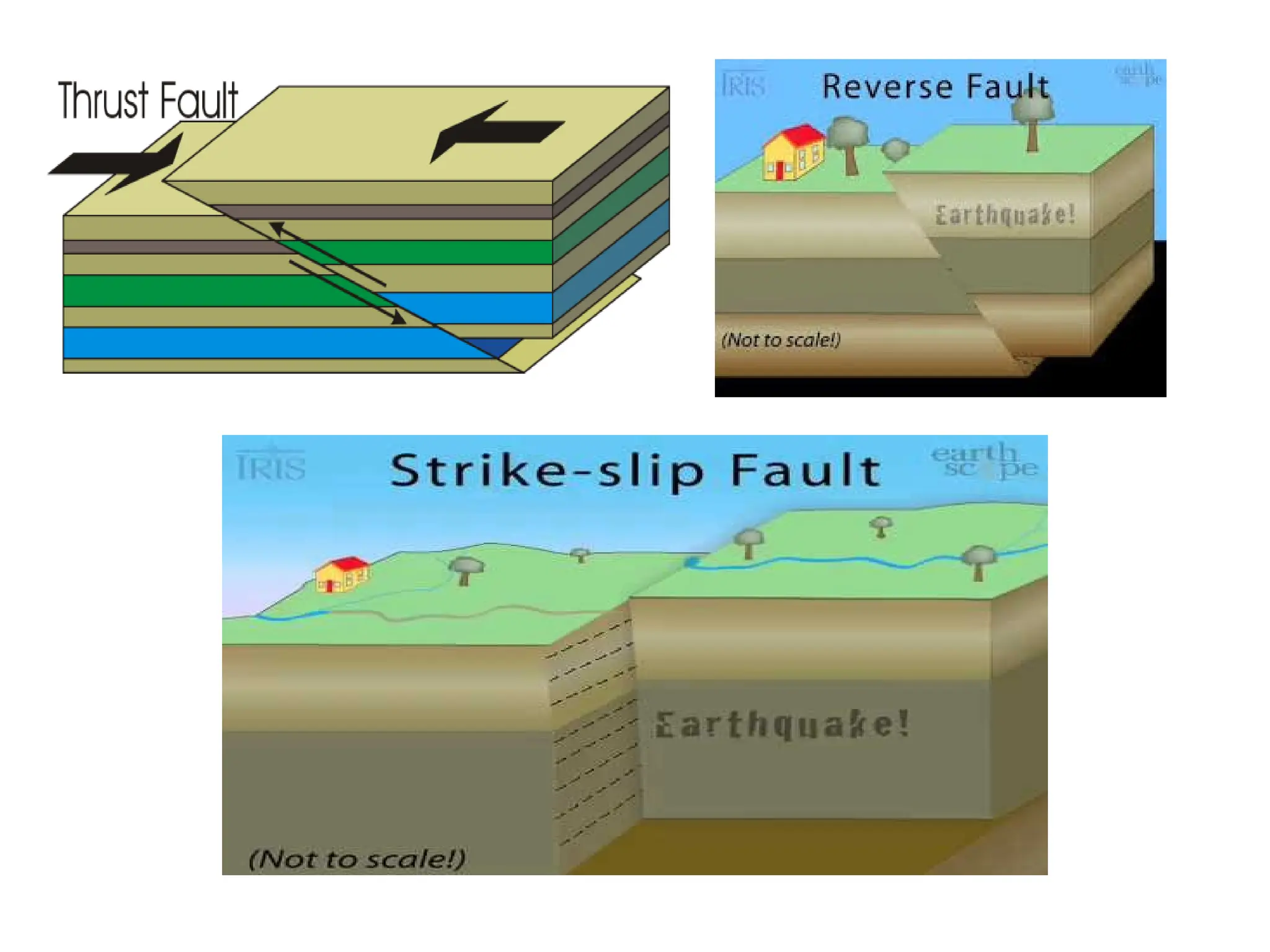
Along faults: normal,
reverse, thrust, strike-
slip.
can occur on the ocean
floor.
Earthquake
Tsunamis
Seismic
waves
Tsunami
giant ocean waves.
can travel at speeds of
700 to 800 km/h.
can be as high as 10 to 20
meters as they approach
the coast.
one of the world’s worst
natural disasters that
can hit a country.
EARTHQUAKE
Tsunamis
Seismic
waves
Earthquake
• FOCUS OR HYPOCENTER
- the point or region
where an earthquake
ruptures and the rock break.
- underground point of
origin of an earthquake.
• EPICENTER
- the point on Earth’s
surface directly above the
focus.
Earthquake
Tsunamis
Seismic
waves
focus
epicenter
Seismic waves
earthquake waves
waves of energy caused
by the sudden breaking
of rock within Earth or
an explosion.
energy that travels
through Earth and is
recorded in
seismographs.
Earthquake
Tsunamis
Seismic
waves
Seismic waves
can be distinguish
through the properties
speed, direction and
where they do not
propagate.
3 main types:
- Primary waves
- Secondary waves
- Surface waves
Earthquake
Tsunamis
Seismic
waves
Primary waves
Fastest and the first to
arrive at a seismic
station.
can move through solid
rock and fluids .
compressional or push-
pull waves.
propagate parallel to the
direction in which the
wave is moving.
Earthquake
Tsunamis
Seismic
waves
Secondary
wave
second to arrive.
slower than P-wave.
can only move through
solid rock
they are not always
recorded at all locations
during an earthquake
Earthquake
Tsunamis
Seismic
waves
Secondary
wave
moves rock particles up
and down, or side-to-side
perpendicular to the
direction the wave.
Earthquake
Tsunamis
Seismic
waves
Surface waves
interaction of the P and S
waves with Earth’s
surface and shallow
structure.
Slowest
travel from the focus
directly upward to the
epicenter.
Earthquake
Tsunamis
Seismic
waves
Surface waves
Complex motion: up and
down, side-to-side
bend and twist Earth’s
surface (most
destructive)
Earthquake
Tsunamis
Seismic
waves
Seismograph
an instrument that
detects and measures
seismic waves.
Seismograph
Magnitude
Intensity
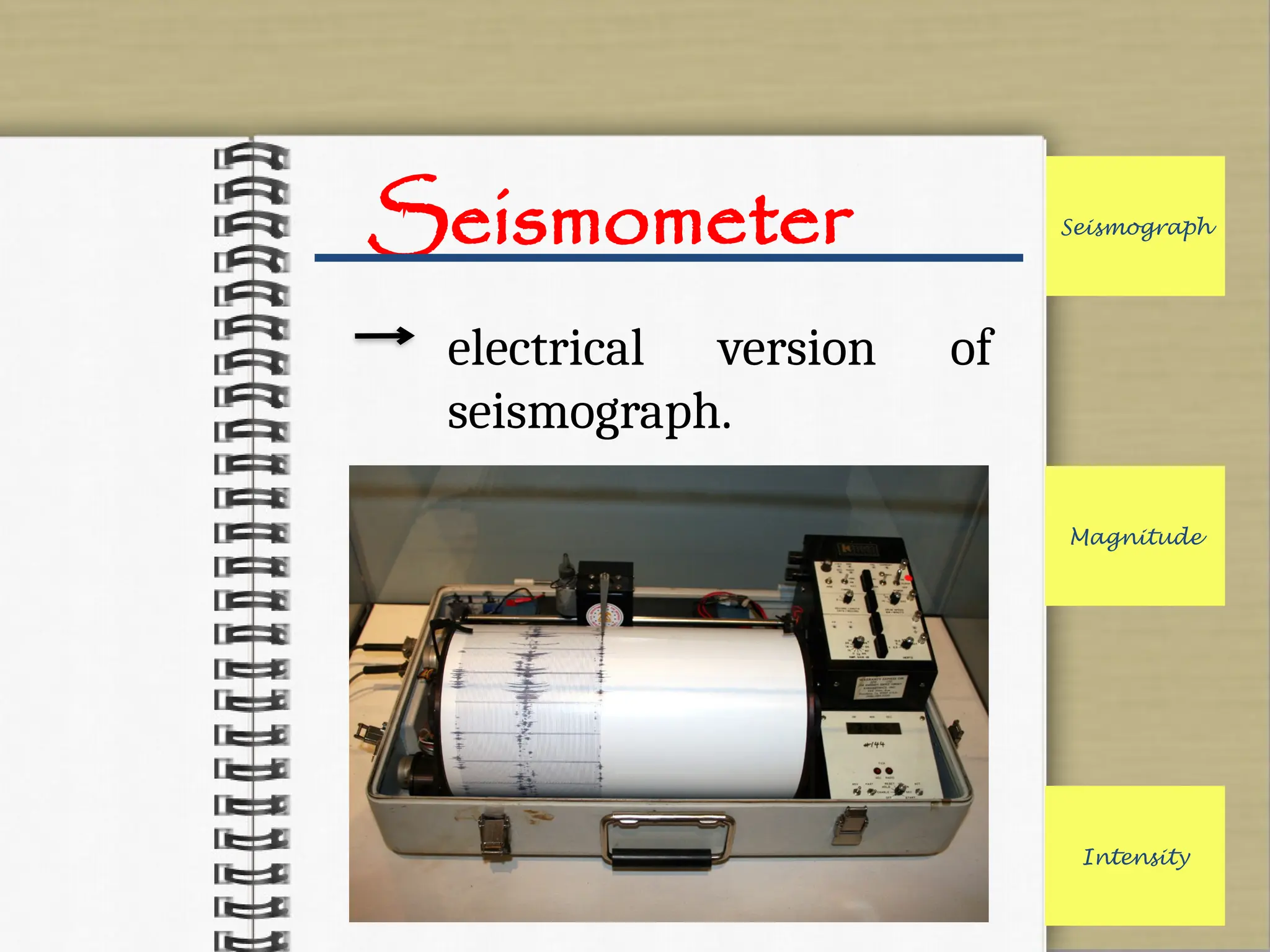
Seismometer
electrical version of
seismograph.
Seismograph
Magnitude
Intensity
Seismogram
seismograph’s record of
the waves (paper or
digital)
the higher the wavy
lines, the stronger the
earthquake.
Seismograph
Magnitude
Intensity
Seismogram Seismograph
Magnitude
Intensity
Magnitude
how much energy is
released during an
earthquake.
determined from
seismic records.
Richter scale
Seismograph
Magnitude
Intensity
Richter scale Seismograph
Magnitude
Intensity
developed in 1935 by
Charles Richter.
determined by measuring
the largest amplitude
(wave height) recorded on
the seismogram.
measures how much
energy an earthquake
releases by assigning the
earthquake a number from
1 to 10.
Richter scale Seismograph
Magnitude
Intensity
each number represents
an earthquake ten times
stronger than an
earthquake represented by
the preceding number.
any number above 6
indicates a very
destructive earthquake.
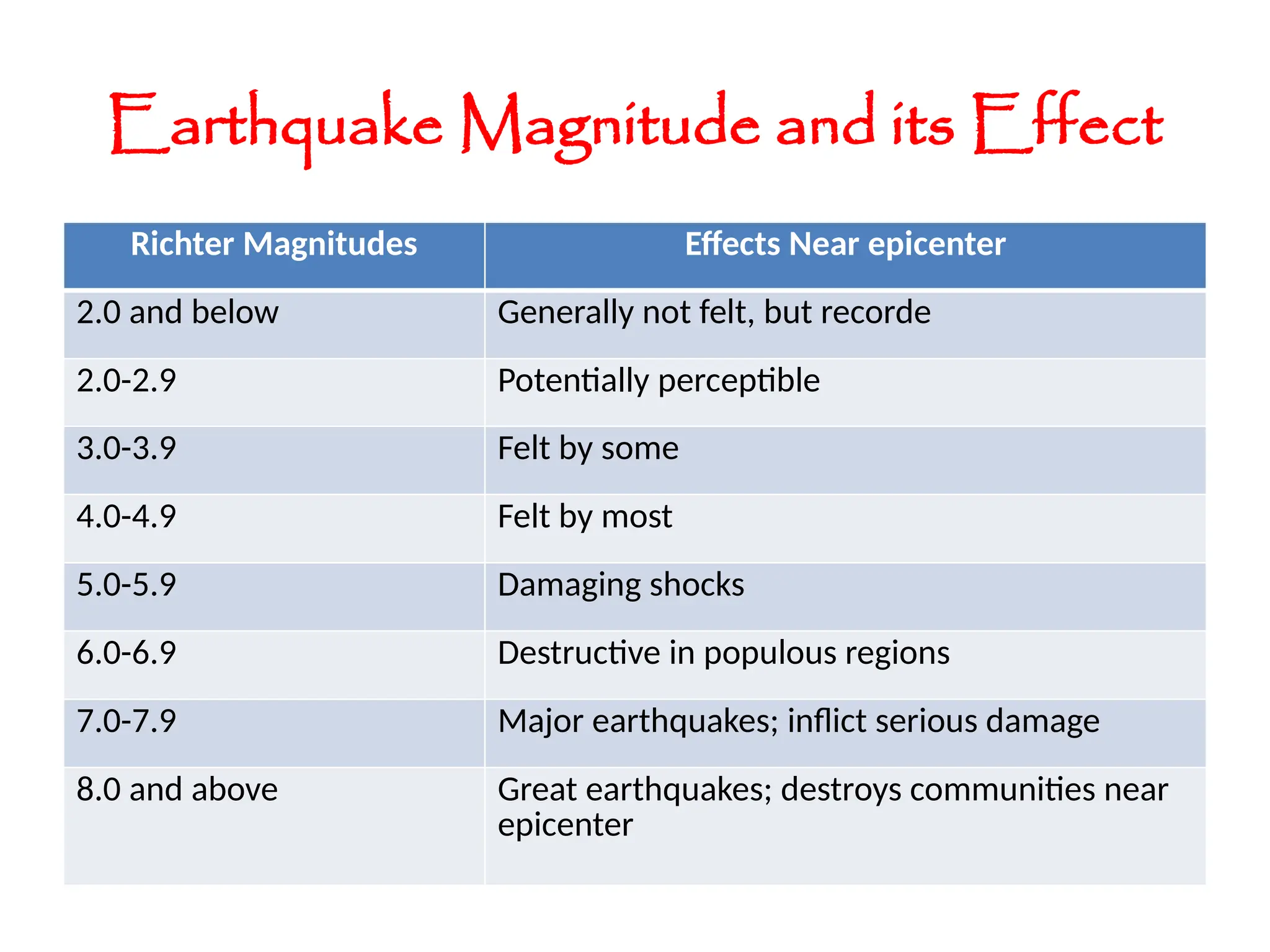
Earthquake Magnitude and its Effect
Richter Magnitudes Effects Near epicenter
2.0 and below Generally not felt, but recorde
2.0-2.9 Potentially perceptible
3.0-3.9 Felt by some
4.0-4.9 Felt by most
5.0-5.9 Damaging shocks
6.0-6.9 Destructive in populous regions
7.0-7.9 Major earthquakes; inflict serious damage
8.0 and above Great earthquakes; destroys communities near
epicenter
Richter magnitude Seismograph
Magnitude
Intensity
can be expressed in two
ways:
1) wave amplitude
increases ten fold (10X).
2) energy released
increases thirty fold (30X).
Intensity
based on effects of
earthquakes (structures
and people)
depends on: distance to
quake, population
density, nature of surface
materials, type of
building, observer
Modified Mercalli
Intensity Scale
Seismograph
Magnitude
Intensity
Modified Mercalli Intensity Scale
invented by Giuseppe
Mercalli in 1902
measures the
earthquake’s effects on a
scale of I-Xll (in Roman
Numerals).
determined by scientists
surveying the damage
and then rating it on the
scale
Seismograph
Magnitude
Intensity
Modified Mercalli (MM) Intensity Scale
Intensity Description
MM I Not felt
MM II Felt by people at rest on upper floors of buildings
MM III Felt indoors, like a small truck passing; hanging
objects swing slightly
MM IV Felt indoors by many; like a heavy truck passing;
hanging objects swing; windows rattle
MM V Felt outdoors; sleepers awakened; small objects and
pictures move
MM VI Felt by all; crockery breaks; furniture moves; weak
plaster cracks
Intensity Description
MM VII Everybody jruns outdoors; difficult to stand; notice by
car drivers; furniture breaks; weak chimneys break at
roof line; plaster, loose bricks, and tiles fall
MM VIII Damage is slight but may be great in poorly built
structures. Driving is difficult; ordinary structure is
damaged; chimneys and towers fall
MM IX General panic; poor structures destroyed; ordinary
masonry and foundations damaged; landslides;
ground badly cracked
MM X Most masonry structures destroyed; some well-built
wooden structures and bridges destroyed; dams and
embankments damaged; large landslides; ground
badly cracked
MM XI Few buildings left standing
MM XII Damage nearly total; objects thrown upward into air
Isoseismals from the 1906 San Francisco
Earthquake
Power point in Earthquake Grade 8 Science.pptx

Power point in Earthquake Grade 8 Science.pptx

  • 2.
  • 3.
    Earthquake the shaking and tremblingof Earth that results from the sudden movement of part of Earths crust. most common cause is faulting. Earthquake Tsunamis Seismic waves
  • 4.
    Earthquake during faulting, energyis released as the rocks break and move . As they move, they cause nearby rocks to move also. most of it occur along the edge of the oceanic and continental plate. Earthquake Tsunamis Seismic waves
  • 6.
    Earthquake Along faults: normal, reverse,thrust, strike- slip. can occur on the ocean floor. Earthquake Tsunamis Seismic waves
  • 8.
    Tsunami giant ocean waves. cantravel at speeds of 700 to 800 km/h. can be as high as 10 to 20 meters as they approach the coast. one of the world’s worst natural disasters that can hit a country. EARTHQUAKE Tsunamis Seismic waves
  • 9.
    Earthquake • FOCUS ORHYPOCENTER - the point or region where an earthquake ruptures and the rock break. - underground point of origin of an earthquake. • EPICENTER - the point on Earth’s surface directly above the focus. Earthquake Tsunamis Seismic waves
  • 10.
  • 11.
    Seismic waves earthquake waves wavesof energy caused by the sudden breaking of rock within Earth or an explosion. energy that travels through Earth and is recorded in seismographs. Earthquake Tsunamis Seismic waves
  • 12.
    Seismic waves can bedistinguish through the properties speed, direction and where they do not propagate. 3 main types: - Primary waves - Secondary waves - Surface waves Earthquake Tsunamis Seismic waves
  • 13.
    Primary waves Fastest andthe first to arrive at a seismic station. can move through solid rock and fluids . compressional or push- pull waves. propagate parallel to the direction in which the wave is moving. Earthquake Tsunamis Seismic waves
  • 15.
    Secondary wave second to arrive. slowerthan P-wave. can only move through solid rock they are not always recorded at all locations during an earthquake Earthquake Tsunamis Seismic waves
  • 16.
    Secondary wave moves rock particlesup and down, or side-to-side perpendicular to the direction the wave. Earthquake Tsunamis Seismic waves
  • 18.
    Surface waves interaction ofthe P and S waves with Earth’s surface and shallow structure. Slowest travel from the focus directly upward to the epicenter. Earthquake Tsunamis Seismic waves
  • 19.
    Surface waves Complex motion:up and down, side-to-side bend and twist Earth’s surface (most destructive) Earthquake Tsunamis Seismic waves
  • 23.
    Seismograph an instrument that detectsand measures seismic waves. Seismograph Magnitude Intensity
  • 24.
  • 25.
    Seismogram seismograph’s record of thewaves (paper or digital) the higher the wavy lines, the stronger the earthquake. Seismograph Magnitude Intensity
  • 26.
  • 27.
    Magnitude how much energyis released during an earthquake. determined from seismic records. Richter scale Seismograph Magnitude Intensity
  • 28.
    Richter scale Seismograph Magnitude Intensity developedin 1935 by Charles Richter. determined by measuring the largest amplitude (wave height) recorded on the seismogram. measures how much energy an earthquake releases by assigning the earthquake a number from 1 to 10.
  • 29.
    Richter scale Seismograph Magnitude Intensity eachnumber represents an earthquake ten times stronger than an earthquake represented by the preceding number. any number above 6 indicates a very destructive earthquake.
  • 30.
    Earthquake Magnitude andits Effect Richter Magnitudes Effects Near epicenter 2.0 and below Generally not felt, but recorde 2.0-2.9 Potentially perceptible 3.0-3.9 Felt by some 4.0-4.9 Felt by most 5.0-5.9 Damaging shocks 6.0-6.9 Destructive in populous regions 7.0-7.9 Major earthquakes; inflict serious damage 8.0 and above Great earthquakes; destroys communities near epicenter
  • 31.
    Richter magnitude Seismograph Magnitude Intensity canbe expressed in two ways: 1) wave amplitude increases ten fold (10X). 2) energy released increases thirty fold (30X).
  • 33.
    Intensity based on effectsof earthquakes (structures and people) depends on: distance to quake, population density, nature of surface materials, type of building, observer Modified Mercalli Intensity Scale Seismograph Magnitude Intensity
  • 52.
    Modified Mercalli IntensityScale invented by Giuseppe Mercalli in 1902 measures the earthquake’s effects on a scale of I-Xll (in Roman Numerals). determined by scientists surveying the damage and then rating it on the scale Seismograph Magnitude Intensity
  • 53.
    Modified Mercalli (MM)Intensity Scale Intensity Description MM I Not felt MM II Felt by people at rest on upper floors of buildings MM III Felt indoors, like a small truck passing; hanging objects swing slightly MM IV Felt indoors by many; like a heavy truck passing; hanging objects swing; windows rattle MM V Felt outdoors; sleepers awakened; small objects and pictures move MM VI Felt by all; crockery breaks; furniture moves; weak plaster cracks
  • 54.
    Intensity Description MM VIIEverybody jruns outdoors; difficult to stand; notice by car drivers; furniture breaks; weak chimneys break at roof line; plaster, loose bricks, and tiles fall MM VIII Damage is slight but may be great in poorly built structures. Driving is difficult; ordinary structure is damaged; chimneys and towers fall MM IX General panic; poor structures destroyed; ordinary masonry and foundations damaged; landslides; ground badly cracked MM X Most masonry structures destroyed; some well-built wooden structures and bridges destroyed; dams and embankments damaged; large landslides; ground badly cracked MM XI Few buildings left standing MM XII Damage nearly total; objects thrown upward into air
  • 56.
    Isoseismals from the1906 San Francisco Earthquake

Editor's Notes

  • #2 What will happen if you will throw a pebble in a pond? Waves will move outward in all direction. In a similar manner, when rock’s in Earth’s crust break, earthquake occur and earthquake waves travel through Earth in all directions.
  • #6 When an earthquake occurs only a part of a fault is involved in the rupture. Some faults are deep inside Earth. Others are close to or at Earth’s surface. Earthquakes don’t kill people, buildings kill people
  • #10 Earthquake waves reach the epicenter first. This is where the most violent shaking of the ground occurs.
  • #12 Speed the waves travel, the directions that the waves move particles as they pass by. They all move in different ways
  • #13 P-wave Push and pull the rock as it moves Just like sound waves push and pull the air Thunder- the windows rattle because the sound waves were pushing and pulling on the window glass Sometimes animals can hear the P-waves of an earthquake and commonly begin barking histerically
  • #15 It is the property of S-waves that led seismologists to conclude that Earth’s outer core is a liquid. What happens then to s-waves when they reach the liquid part of the earth? Here the s-waves stop.
  • #16 It is the property of S-waves that led seismologists to conclude that Earth’s outer core is a liquid. What happens then to s-waves when they reach the liquid part of the earth? Here the s-waves stop.
  • #18 L waves
  • #19 Earth’s surface moves up and down with each L wave that passes
  • #21 If we know the velocity of the wave, we can infer the type of rock it traveled through- that’s how we map the interior of the Earth!!!
  • #23 Earth’s surface moves up and down with each L wave that passes A seismograph records the vibrations from earthquakes. Mechanical versions work by way of a large mass, freely suspended. A seismometer is an electrical version of the instrument. In the example on the left, a rotating drum records a red line on a sheet of paper. If the earth moves (in this case from left to right) the whole machine will vibrate too. However, the large mass tends to stay still, so the drum shakes beneath the pen, recording a squiggle!
  • #24 Earth’s surface moves up and down with each L wave that passes A seismograph records the vibrations from earthquakes. Mechanical versions work by way of a large mass, freely suspended. A seismometer is an electrical version of the instrument. In the example on the left, a rotating drum records a red line on a sheet of paper. If the earth moves (in this case from left to right) the whole machine will vibrate too. However, the large mass tends to stay still, so the drum shakes beneath the pen, recording a squiggle!
  • #25 The scientist study the height of the wavy lines recorded on the paper. the higher the wavy lines on the seismogram are, the stronger the earthquake is.
  • #26 How is the strength of an earthquake measured?
  • #28 - The number indicates how strong the earthquake is.
  • #29 - The number indicates how strong the earthquake is.
  • #30 Each step in the scale represents a tenfold increase in the size of the quake!
  • #31 - The number indicates how strong the earthquake is.
  • #33 varies from place to place
  • #52 Used before instruments were invented to detect seismic waves. This scale is VERY subjective!
  • #54 The Mercalli scale does not give a true indication of the actual strength of an earthquake because the amount of damage done to different places will largely depend on, the type of materials used and the degree of construction of buildings and structures.