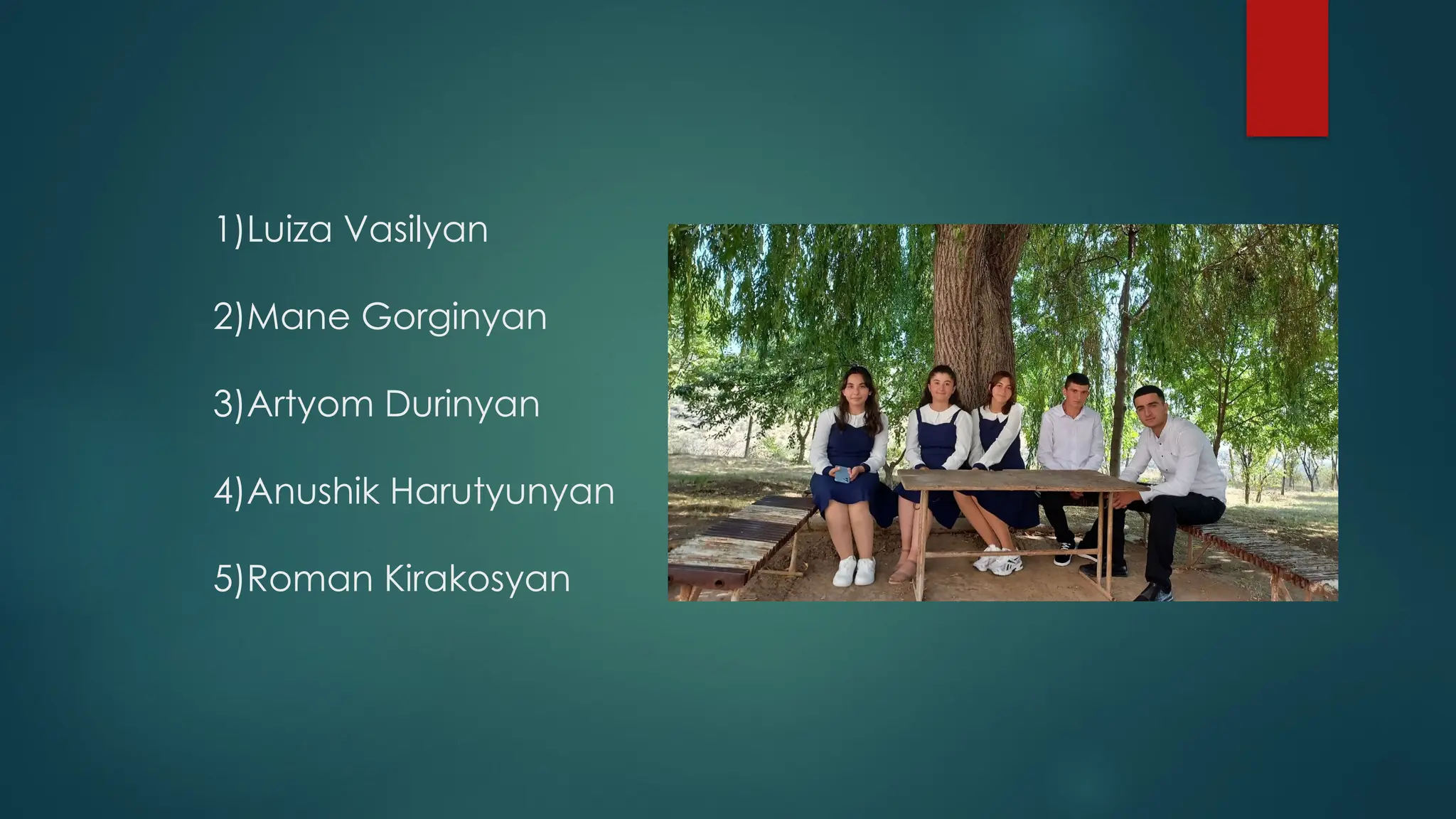
1)Luiza Vasilyan
2)Mane Gorginyan
3)Artyom Durinyan
4)Anushik Harutyunyan
5)Roman Kirakosyan
PROJECT WORK
ENGLISH 12
PARTS OF SPEECH
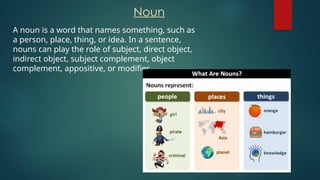
A noun is a word that names something, such as
a person, place, thing, or idea. In a sentence,
nouns can play the role of subject, direct object,
indirect object, subject complement, object
complement, appositive, or modifier.
Noun
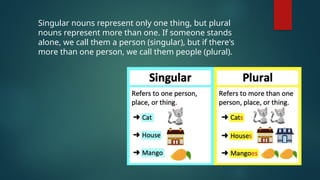
Singular nouns represent only one thing, but plural
nouns represent more than one. If someone stands
alone, we call them a person (singular), but if there's
more than one person, we call them people (plural).
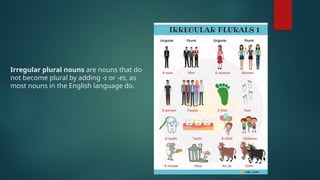
Irregular plural nouns are nouns that do
not become plural by adding -s or -es, as
most nouns in the English language do.
Verb
A WORD USED TO DESCRIBE AN ACTION, STATE, OR
OCCURRENCE, AND FORMING THE MAIN PART OF
THE PREDICATE OF A SENTENCE, SUCH
AS HEAR, BECOME, HAPPEN.
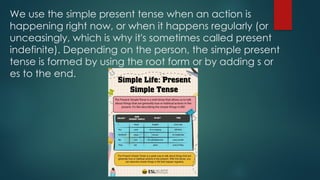
We use the simple present tense when an action is
happening right now, or when it happens regularly (or
unceasingly, which is why it's sometimes called present
indefinite). Depending on the person, the simple present
tense is formed by using the root form or by adding s or
es to the end.
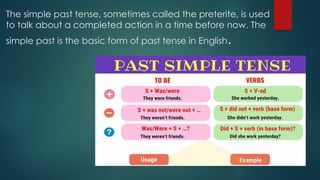
The simple past tense, sometimes called the preterite, is used
to talk about a completed action in a time before now. The
simple past is the basic form of past tense in English.
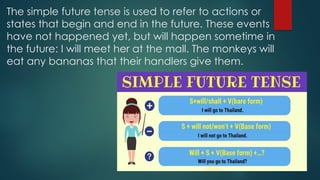
The simple future tense is used to refer to actions or
states that begin and end in the future. These events
have not happened yet, but will happen sometime in
the future: I will meet her at the mall. The monkeys will
eat any bananas that their handlers give them.
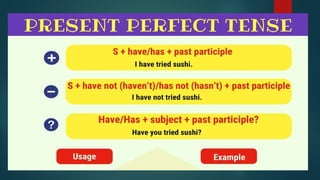
The present perfect is formed from the present tense of the
verb have and the past participle of a verb.
We use the present perfect:
•for something that started in the past and continues in the present:
They've been married for nearly fifty years.
She has lived in Liverpool all her life.
•when we are talking about our experience up to the present:
I've seen that film before.
I've played the guitar ever since I was a teenager.
He has written three books and he is working on another one.
We often use the adverb ever to talk about experience up to the
present:
My last birthday was the worst day I have ever had.
and we use never for the negative form:
Have you ever met George?
Yes, but I've never met his wife.
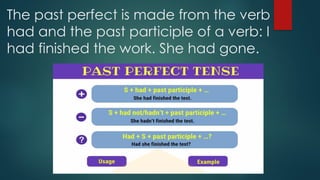
The past perfect is made from the verb
had and the past participle of a verb: I
had finished the work. She had gone.
The present continuous verb tense
indicates that an action or condition is happening now, frequently,
and may continue into the future.
The Present Continuous Formula: to be [am, is, are] + verb [present participle]
Aunt Christine is warming up the car while Scott is looking for his new leather
coat. They are eating at Scott’s favorite restaurant today, Polly’s Pancake Diner.
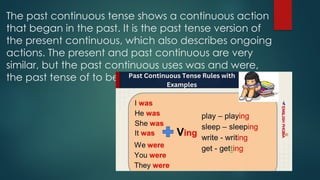
The past continuous tense shows a continuous action
that began in the past. It is the past tense version of
the present continuous, which also describes ongoing
actions. The present and past continuous are very
similar, but the past continuous uses was and were,
the past tense of to be.
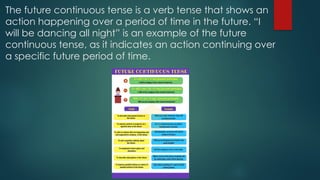
The future continuous tense is a verb tense that shows an
action happening over a period of time in the future. “I
will be dancing all night” is an example of the future
continuous tense, as it indicates an action continuing over
a specific future period of time.
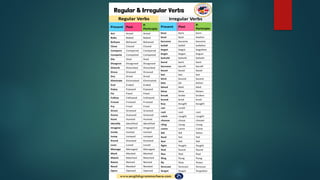
Regular and Irregular verbs
There are two kinds of verbs:regular and irregular.
Regular verbs are verbs whose simple past and past participle are formed by
adding the suffix “-ed” (e.g., “walked”).
Irregular verbs are verbs that form their simple past and past participles in some way
other than by adding the suffix “-ed” (e.g., “sat”).
An irregular verb is defined as “a verb that does not
follow the usual rules of grammar. For example, 'eat' is
an irregular verb because its past tense is 'ate' and its
past participle is 'eaten', not 'eated',” according to the
Macmillan Dictionary.
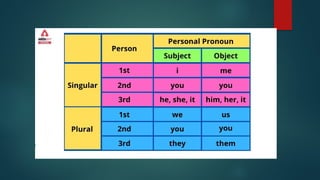
Each of the English personal pronouns shows us the
grammatical person, gender, number, and case of the noun
it replaces. I, you, he, she, it, we, they, me, him, her, us, and
them are all personal pronouns.
Pronoun
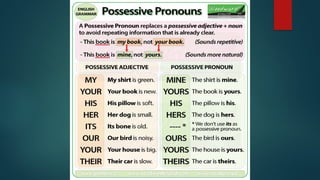
What is a possessive pronoun? A possessive
pronoun is a pronoun used to indicate indicate
ownership (e.g., “This hat is mine”).
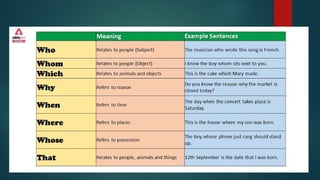
A relative pronoun is a pronoun that's used to introduce
a relative clause. The main English relative pronouns
are which, that, who, and whom. These words can also
function as other parts of speech—they aren't exclusively
used as relative pronouns.
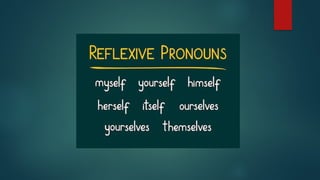
Reflexive pronouns are words like myself, yourself,
himself, herself, itself, ourselves, yourselves and
themselves. They refer back to a person or thing. We
often use reflexive pronouns when the subject and the
object of a verb are the same. I cut myself when I was
making dinner last night.
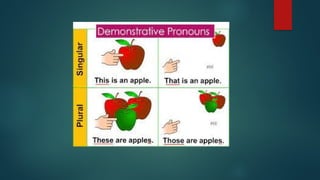
A demonstrative pronoun is a word used to
stand in for a noun. They are used to point to
something or someone specific (e.g., “this is my
sister”). The English demonstrative pronouns
are this, that, these, and those.
Adjective
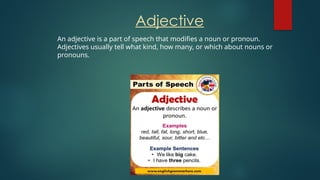
An adjective is a part of speech that modifies a noun or pronoun.
Adjectives usually tell what kind, how many, or which about nouns or
pronouns.
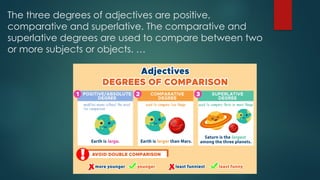
The three degrees of adjectives are positive,
comparative and superlative. The comparative and
superlative degrees are used to compare between two
or more subjects or objects. …
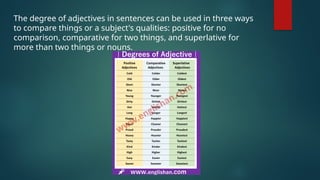
The degree of adjectives in sentences can be used in three ways
to compare things or a subject's qualities: positive for no
comparison, comparative for two things, and superlative for
more than two things or nouns.
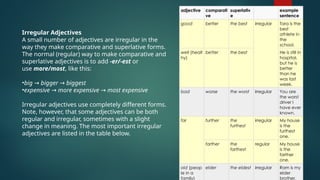
Irregular Adjectives
A small number of adjectives are irregular in the
way they make comparative and superlative forms.
The normal (regular) way to make comparative and
superlative adjectives is to add -er/-est or
use more/most, like this:
•big bigger biggest
→ →
•expensive more expensive most expensive
→ →
Irregular adjectives use completely different forms.
Note, however, that some adjectives can be both
regular and irregular, sometimes with a slight
change in meaning. The most important irregular
adjectives are listed in the table below.
adjective comparati
ve
superlativ
e
example
sentence
good better the best irregular Tara is the
best
athlete in
the
school.
well (healt
hy)
better the best He is still in
hospital,
but he is
better
than he
was last
week.
bad worse the worst irregular You are
the worst
driver I
have ever
known.
far further the
furthest
irregular My house
is the
furthest
one.
farther the
farthest
regular My house
is the
farther
one.
old (peop
le in a
family)
elder the eldest irregular Ram is my
elder
brother.
Conjunction
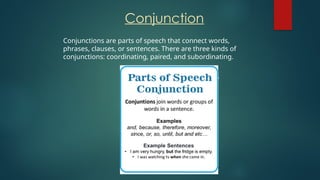
Conjunctions are parts of speech that connect words,
phrases, clauses, or sentences. There are three kinds of
conjunctions: coordinating, paired, and subordinating.
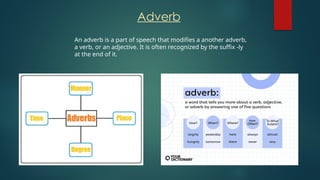
Adverb
An adverb is a part of speech that modifies a another adverb,
a verb, or an adjective. It is often recognized by the suffix -ly
at the end of it.
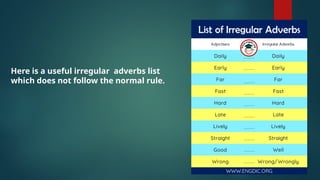
Here is a useful irregular adverbs list
which does not follow the normal rule.
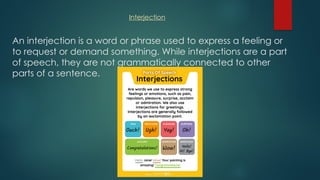
An interjection is a word or phrase used to express a feeling or
to request or demand something. While interjections are a part
of speech, they are not grammatically connected to other
parts of a sentence.
Interjection
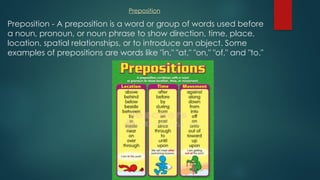
Preposition - A preposition is a word or group of words used before
a noun, pronoun, or noun phrase to show direction, time, place,
location, spatial relationships, or to introduce an object. Some
examples of prepositions are words like "in," "at," "on," "of," and "to."
Preposition
END

presentation for 1st year ESL student.pptx

  • 1.
    1)Luiza Vasilyan 2)Mane Gorginyan 3)ArtyomDurinyan 4)Anushik Harutyunyan 5)Roman Kirakosyan
  • 2.
  • 3.
    A noun isa word that names something, such as a person, place, thing, or idea. In a sentence, nouns can play the role of subject, direct object, indirect object, subject complement, object complement, appositive, or modifier. Noun
  • 4.
    Singular nouns representonly one thing, but plural nouns represent more than one. If someone stands alone, we call them a person (singular), but if there's more than one person, we call them people (plural).
  • 5.
    Irregular plural nounsare nouns that do not become plural by adding -s or -es, as most nouns in the English language do.
  • 6.
    Verb A WORD USEDTO DESCRIBE AN ACTION, STATE, OR OCCURRENCE, AND FORMING THE MAIN PART OF THE PREDICATE OF A SENTENCE, SUCH AS HEAR, BECOME, HAPPEN.
  • 7.
    We use thesimple present tense when an action is happening right now, or when it happens regularly (or unceasingly, which is why it's sometimes called present indefinite). Depending on the person, the simple present tense is formed by using the root form or by adding s or es to the end.
  • 8.
    The simple pasttense, sometimes called the preterite, is used to talk about a completed action in a time before now. The simple past is the basic form of past tense in English.
  • 9.
    The simple futuretense is used to refer to actions or states that begin and end in the future. These events have not happened yet, but will happen sometime in the future: I will meet her at the mall. The monkeys will eat any bananas that their handlers give them.
  • 10.
    The present perfectis formed from the present tense of the verb have and the past participle of a verb. We use the present perfect: •for something that started in the past and continues in the present: They've been married for nearly fifty years. She has lived in Liverpool all her life. •when we are talking about our experience up to the present: I've seen that film before. I've played the guitar ever since I was a teenager. He has written three books and he is working on another one. We often use the adverb ever to talk about experience up to the present: My last birthday was the worst day I have ever had. and we use never for the negative form: Have you ever met George? Yes, but I've never met his wife.
  • 12.
    The past perfectis made from the verb had and the past participle of a verb: I had finished the work. She had gone.
  • 13.
    The present continuousverb tense indicates that an action or condition is happening now, frequently, and may continue into the future. The Present Continuous Formula: to be [am, is, are] + verb [present participle] Aunt Christine is warming up the car while Scott is looking for his new leather coat. They are eating at Scott’s favorite restaurant today, Polly’s Pancake Diner.
  • 14.
    The past continuoustense shows a continuous action that began in the past. It is the past tense version of the present continuous, which also describes ongoing actions. The present and past continuous are very similar, but the past continuous uses was and were, the past tense of to be.
  • 15.
    The future continuoustense is a verb tense that shows an action happening over a period of time in the future. “I will be dancing all night” is an example of the future continuous tense, as it indicates an action continuing over a specific future period of time.
  • 16.
    Regular and Irregularverbs There are two kinds of verbs:regular and irregular. Regular verbs are verbs whose simple past and past participle are formed by adding the suffix “-ed” (e.g., “walked”). Irregular verbs are verbs that form their simple past and past participles in some way other than by adding the suffix “-ed” (e.g., “sat”).
  • 17.
    An irregular verbis defined as “a verb that does not follow the usual rules of grammar. For example, 'eat' is an irregular verb because its past tense is 'ate' and its past participle is 'eaten', not 'eated',” according to the Macmillan Dictionary.
  • 19.
    Each of theEnglish personal pronouns shows us the grammatical person, gender, number, and case of the noun it replaces. I, you, he, she, it, we, they, me, him, her, us, and them are all personal pronouns. Pronoun
  • 21.
    What is apossessive pronoun? A possessive pronoun is a pronoun used to indicate indicate ownership (e.g., “This hat is mine”).
  • 23.
    A relative pronounis a pronoun that's used to introduce a relative clause. The main English relative pronouns are which, that, who, and whom. These words can also function as other parts of speech—they aren't exclusively used as relative pronouns.
  • 25.
    Reflexive pronouns arewords like myself, yourself, himself, herself, itself, ourselves, yourselves and themselves. They refer back to a person or thing. We often use reflexive pronouns when the subject and the object of a verb are the same. I cut myself when I was making dinner last night.
  • 27.
    A demonstrative pronounis a word used to stand in for a noun. They are used to point to something or someone specific (e.g., “this is my sister”). The English demonstrative pronouns are this, that, these, and those.
  • 29.
    Adjective An adjective isa part of speech that modifies a noun or pronoun. Adjectives usually tell what kind, how many, or which about nouns or pronouns.
  • 30.
    The three degreesof adjectives are positive, comparative and superlative. The comparative and superlative degrees are used to compare between two or more subjects or objects. …
  • 31.
    The degree ofadjectives in sentences can be used in three ways to compare things or a subject's qualities: positive for no comparison, comparative for two things, and superlative for more than two things or nouns.
  • 32.
    Irregular Adjectives A smallnumber of adjectives are irregular in the way they make comparative and superlative forms. The normal (regular) way to make comparative and superlative adjectives is to add -er/-est or use more/most, like this: •big bigger biggest → → •expensive more expensive most expensive → → Irregular adjectives use completely different forms. Note, however, that some adjectives can be both regular and irregular, sometimes with a slight change in meaning. The most important irregular adjectives are listed in the table below. adjective comparati ve superlativ e example sentence good better the best irregular Tara is the best athlete in the school. well (healt hy) better the best He is still in hospital, but he is better than he was last week. bad worse the worst irregular You are the worst driver I have ever known. far further the furthest irregular My house is the furthest one. farther the farthest regular My house is the farther one. old (peop le in a family) elder the eldest irregular Ram is my elder brother.
  • 33.
    Conjunction Conjunctions are partsof speech that connect words, phrases, clauses, or sentences. There are three kinds of conjunctions: coordinating, paired, and subordinating.
  • 34.
    Adverb An adverb isa part of speech that modifies a another adverb, a verb, or an adjective. It is often recognized by the suffix -ly at the end of it.
  • 35.
    Here is auseful irregular adverbs list which does not follow the normal rule.
  • 36.
    An interjection isa word or phrase used to express a feeling or to request or demand something. While interjections are a part of speech, they are not grammatically connected to other parts of a sentence. Interjection
  • 37.
    Preposition - Apreposition is a word or group of words used before a noun, pronoun, or noun phrase to show direction, time, place, location, spatial relationships, or to introduce an object. Some examples of prepositions are words like "in," "at," "on," "of," and "to." Preposition
  • 39.