Today in Science Today you will need : Pencil,  Colored Pencils, Highlighters Power Notes  –Physical vs. Chemical Changes  (Bookshelf - 2 pgs - 4 sides –  Please Staple ) Volume Lab Worksheets  Due Today Morning Tutorials On TUESDAY ! –  I have a leadership meeting so no tutorials tomorrow
Test #2 and Binder Check #2 Update Log #2 – New work Target Concepts for Test #2 on Learning Point –  Oct. 20 th &  21 st  ½ page of notes, front side, done by hand Binder Check #2 –  Table of Contents  on- Learning Point for this week – Due Oct. 20 th  at the beginning of class.
Identifying Volume There are  THREE  way to find volume in the chemistry classroom. You will need to know them in order to help you eventually determine the density of various objects . REMEMBER : Volume is the  Amount of Space  something takes up.
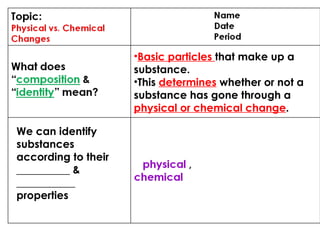
Basic particles  that make up a substance. This  determines  whether or not a substance has gone through a  physical or chemical change . We can identify substances according to their __________ & ___________ properties
H 2 O Ice water + Heat = H 2 O Liquid water Why do we have to use  more than just physical propertie s to determine what a substance is? Different substances can look the same  such as PYRITE – “Fools Gold”. It LOOKS like gold but required additional information and more property observations to identify. Physical Properties Characteristics of materials that can be  observed w/out  carrying out a  chemical reaction Usually  easy to reverse NO NEW substance  created Examples of Physical Properties Color, size, texture, density, freezing pt. electrical & thermal conductivity, luster, malleability, ductility, hardness, mass, solubility
2 H 2 O + = O 2 H 2 H 2 2 molecules of water electricity 1 molecules of diatomic oxygen 2 molecules of diatomic Hydrogen Different Substances Chemical Properties Characteristics  that  cannot be easily seen Must create a chemical reaction to observe NEW substance  created Difficult to reverse Happens quickly  ( explosion )  or slowly  ( rusting ). Examples of Chemical Change Flammability, reacting with acid Oxidation (rusting-reacting w/oxygen), digesting, decomposition
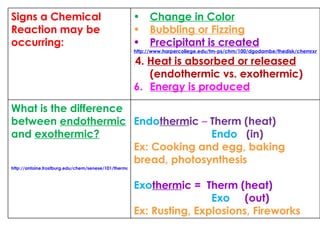
Signs a Chemical Reaction may be occurring: Change in Color Bubbling or Fizzing Precipitant is created http://www.harpercollege.edu/tm-ps/chm/100/dgodambe/thedisk/chemrxn/signs.htm 4.  Heat is absorbed or released  (endothermic vs. exothermic) Energy is produced What is the difference between  endothermic  and  exothermic? http://antoine.frostburg.edu/chem/senese/101/thermo/faq/exothermic-endothermic-examples.shtml   Endo therm ic  –  Therm (heat) Endo   (in) Ex: Cooking and egg, baking bread, photosynthesis Exo therm ic =  Therm (heat) Exo   (out) Ex: Rusting, Explosions, Fireworks
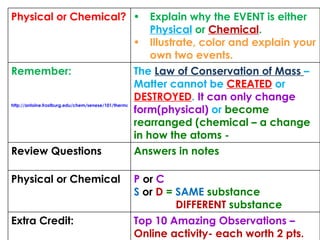
Physical or Chemical? Explain why the EVENT is either  Physical  or  Chemical . Illustrate, color and explain your own two events. Remember: http://antoine.frostburg.edu/chem/senese/101/thermo/faq/exothermic-endothermic-examples.shtml   The  Law of Conservation of Mass  – Matter cannot be  CREATED  or  DESTROYED .  It can only change form(physical)  or  become rearranged (chemical – a change in how the atoms - Review Questions Answers in notes Physical or Chemical P  or  C  S  or   D   =  SAME  substance DIFFERENT  substance Extra Credit: Top 10 Amazing Observations –  Online activity- each worth 2 pts.
Remember 1.  Due by Wednesday

Power Notes: Physical vs. Chemical

  • 1.
    Today in ScienceToday you will need : Pencil, Colored Pencils, Highlighters Power Notes –Physical vs. Chemical Changes (Bookshelf - 2 pgs - 4 sides – Please Staple ) Volume Lab Worksheets Due Today Morning Tutorials On TUESDAY ! – I have a leadership meeting so no tutorials tomorrow
  • 2.
    Test #2 andBinder Check #2 Update Log #2 – New work Target Concepts for Test #2 on Learning Point – Oct. 20 th & 21 st ½ page of notes, front side, done by hand Binder Check #2 – Table of Contents on- Learning Point for this week – Due Oct. 20 th at the beginning of class.
  • 3.
    Identifying Volume Thereare THREE way to find volume in the chemistry classroom. You will need to know them in order to help you eventually determine the density of various objects . REMEMBER : Volume is the Amount of Space something takes up.
  • 4.
    Basic particles that make up a substance. This determines whether or not a substance has gone through a physical or chemical change . We can identify substances according to their __________ & ___________ properties
  • 5.
    H 2 OIce water + Heat = H 2 O Liquid water Why do we have to use more than just physical propertie s to determine what a substance is? Different substances can look the same such as PYRITE – “Fools Gold”. It LOOKS like gold but required additional information and more property observations to identify. Physical Properties Characteristics of materials that can be observed w/out carrying out a chemical reaction Usually easy to reverse NO NEW substance created Examples of Physical Properties Color, size, texture, density, freezing pt. electrical & thermal conductivity, luster, malleability, ductility, hardness, mass, solubility
  • 6.
    2 H 2O + = O 2 H 2 H 2 2 molecules of water electricity 1 molecules of diatomic oxygen 2 molecules of diatomic Hydrogen Different Substances Chemical Properties Characteristics that cannot be easily seen Must create a chemical reaction to observe NEW substance created Difficult to reverse Happens quickly ( explosion ) or slowly ( rusting ). Examples of Chemical Change Flammability, reacting with acid Oxidation (rusting-reacting w/oxygen), digesting, decomposition
  • 7.
    Signs a ChemicalReaction may be occurring: Change in Color Bubbling or Fizzing Precipitant is created http://www.harpercollege.edu/tm-ps/chm/100/dgodambe/thedisk/chemrxn/signs.htm 4. Heat is absorbed or released (endothermic vs. exothermic) Energy is produced What is the difference between endothermic and exothermic? http://antoine.frostburg.edu/chem/senese/101/thermo/faq/exothermic-endothermic-examples.shtml Endo therm ic – Therm (heat) Endo (in) Ex: Cooking and egg, baking bread, photosynthesis Exo therm ic = Therm (heat) Exo (out) Ex: Rusting, Explosions, Fireworks
  • 8.
    Physical or Chemical?Explain why the EVENT is either Physical or Chemical . Illustrate, color and explain your own two events. Remember: http://antoine.frostburg.edu/chem/senese/101/thermo/faq/exothermic-endothermic-examples.shtml The Law of Conservation of Mass – Matter cannot be CREATED or DESTROYED . It can only change form(physical) or become rearranged (chemical – a change in how the atoms - Review Questions Answers in notes Physical or Chemical P or C S or D = SAME substance DIFFERENT substance Extra Credit: Top 10 Amazing Observations – Online activity- each worth 2 pts.
  • 9.
    Remember 1. Due by Wednesday